
Custom Card Game Scenario Fit: Promotion, Family Play, Kids Education
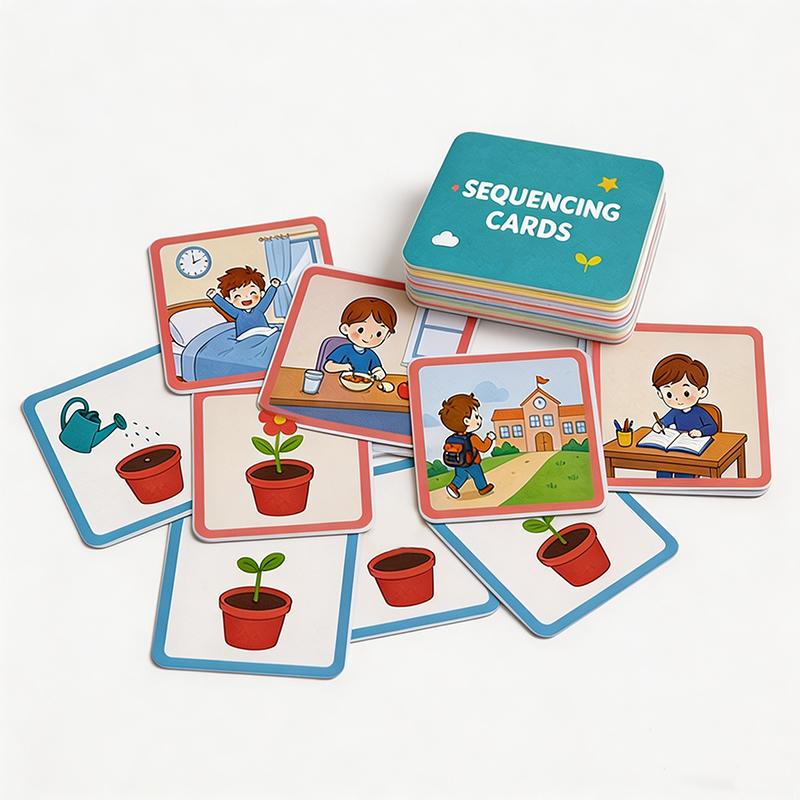
Custom card game formats are specified by scenario: enterprise promotion, family play, interaction, kids education, and packaging that protects the product while displaying the brand.
Custom card game sourcing in Vietnam and China rarely fails because a supplier cannot print cards. It fails because the deck was specified for the wrong scenario. A tarot deck, a poker deck, a flash card set for a classroom and a branded giveaway deck may all leave the same press, but each one carries different constraints on paper weight, corner treatment, ink and material sourcing, print accuracy and packaging structure.
Application records for the custom card game (model CG-001) and the custom board game (model BG-001) map these products to five concrete functions — enterprise promotion, family fun, interaction, kids education, and packaging for product protection and brand display — and tag them to Vietnam and China (VN, CN) as target markets. The same records describe how the work is carried out: as a printing and processing project for paper products, run in normal-temperature, dust-free indoor workshops using mass customized printing production with manual interactive play and assembly.
For buyers moving from research into evaluation, that scenario list is not a marketing description. It is a constraint set. It determines which certifications matter, which paper weights are viable, which edges are acceptable for children, what the packaging must do, and whether a supplier's minimum order quantity and lead time can actually absorb the project.
Why scenario fit became a constraint question
Earlier in the buying process, suppliers are usually compared on category: who manufactures custom card games. At the evaluation stage, the question changes to something narrower and harder: which supplier can hold the constraints that one specific scenario imposes? Those constraints are not stylistic preferences. They decide whether a deck can legally enter a market, whether it survives repeated family play, and whether it reaches the buyer in packaging that protects the product and presents the brand.
The table below maps the five scenarios described in the application data to the specification levers that carry them.
| Scenario | What the scenario demands | Specification lever |
|---|---|---|
| Enterprise promotion | Accurate brand colour, clear print, packaging usable for brand display | CMYK 4C or Pantone colour printing; matte, glossy, linen, UV coating or varnishing; box and packaging construction |
| Family fun | Repeat handling, legible artwork for mixed-age players | Paper weight from 128 to 400 gsm or custom; lamination choice; corner style |
| Interaction | Fast dealing, comfortable shuffle, distinguishable card backs | Card edge in standard, coloured or gold foil; surface finish; custom card size |
| Kids education | Safe edges, non-toxic ink, responsibly sourced paper | Child-safe edge treatment with round corners; non-toxic ink; eco-friendly paper material; FSC compliant raw materials |
| Packaging for product protection and brand display | Structural protection plus shelf or listing presence | One-stop printing and packaging; surface finish; rigid or folding box construction |
Read as a procurement document, the table explains why two requests for the same deck size can require different suppliers. A promotion deck is judged on colour accuracy and packaging impact. A kids education deck is judged on edge safety and material documentation. A family deck is judged on how it feels after the fiftieth game.
How scenario-based card projects actually run in production
The production environment recorded for these paper-product projects is specific: normal-temperature, dust-free indoor workshops, running mass customized printing production alongside manual integration of interactive components. That combination matters more than it first appears.
Dust control protects the printed surface. Card stock is printed, laminated and finished in sequence, and airborne particles that settle between printing and lamination become visible defects in the finished deck. Room-temperature conditions support dimensional stability: paper responds to humidity and heat, and stable conditions reduce the risk that cut cards vary in size or that laminated sheets curl before die-cutting.
The equipment set recorded for the project type covers the full sequence:
- Heidelberg printing press — the base print platform
- Automatic laminating machine — surface protection and finish
- Varnishing machine — protective and visual coating
- Gilding press — metallic and foil effects
- Embosser — raised or recessed detail
- Die cutting machine — card shapes, corner radius and box components
After printing and finishing, the operation moves into manual interactive play and assembly work: collation, ordering of card sequences, insertion of rule sheets and tokens, and packing into boxes. For scenarios such as kids education or family interaction, this manual stage is where sequence errors and packaging defects are caught before shipment rather than after.
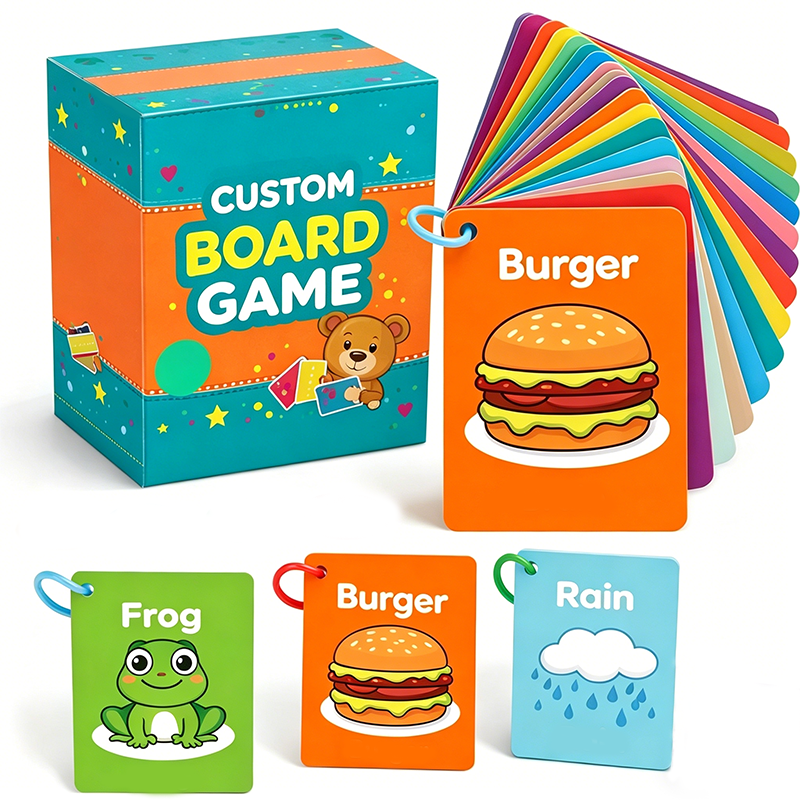
Kids education decks carry the heaviest specification constraints: rounded child-safe edges, non-toxic ink, eco-friendly paper material and FSC compliant raw materials.
The manufacturing entity behind the substrate
Yawanhong — formally Vietnam Yawanhong Printing Culture Co., Ltd. — is a Vietnam-based printing and game manufacturer established in 2006, operating a 55,000 m² factory with 280 employees, a 25-engineer R&D team and an annual output of 1,000,000 units. Its main product range covers board games, card games, puzzles, notebooks, colour boxes, publications and plastic, plush and wooden toys, with a reported 100% export ratio and main markets in the USA and Europe. The company describes itself as an OEM and ODM manufacturer specialising in custom toys, printing and packaging solutions, and lists its official site as www.yawanhong.vn.
For scenario-based card programmes, the commercially relevant capability set is the one that determines whether a project can be quoted, sampled and scheduled.
| Capability parameter | Stated value |
|---|---|
| Production mode | OEM / ODM |
| Customisation scope | Material, size, colour, logo, packaging |
| Minimum order quantity | 1,000 units |
| Lead time | 25–45 days |
| Monthly capacity | 80,000 units |
| Quality control | 100% test |
| Export markets | US / EU / UK / Asia |
| After-sales | Remote support |
The product platform itself is configurable rather than fixed. For the custom card game (model CG-001), the recorded specification window is wide enough to serve several scenarios from one production base.
| CG-001 specification | Available range |
|---|---|
| Card size | Custom |
| Paper weight | 128–400 gsm / custom |
| Printing | CMYK 4C printing / Pantone colour printing / custom |
| Corner style | Round corner / square corner / custom |
| Surface finish | Matte lamination / glossy lamination / linen / UV coating / varnishing / custom |
| Card edge | Standard / coloured / gold foil / custom |
| Primary materials | Coated paper, art paper, custom |
Compliance documentation that can be checked against a certificate number
For buyers whose scenario touches children, regulated retail channels or sustainability reporting, documents matter more than descriptions. Four current certifications are recorded for the manufacturing scope that covers custom board games, card games and related paper products.
| Certification / audit | Certificate number and issuer | Standard / scope | Markets |
|---|---|---|---|
| FSC COC (Chain of Custody) | ESTS-COC-241865 — Extensive Standard Technical Services Co., Ltd. | FSC-STD-40-004 V3-1; custom paper printing products, board games, card games, paper gift boxes, notebooks. Issued 2024-11-25, valid to 2029-11-24 | US, Europe, Asia |
| BSCI (amfori Social Audit — Manufacturing) | 26-0387346 — amfori | amfori BSCI Code of Conduct, ILO Core Labour Standards, UN Universal Declaration of Human Rights; printing products, custom board games, card games, paper boxes, notebooks, paper puzzle manufacturing. Issued 2026-04-17, valid to 2028-04-17 | US, Europe, Asia |
| SMETA (Social Compliance Audit — Manufacturing) | ZAA600202718 — LRQA | Sedex SMETA Code, ILO Core Labour Standards, ETI Base Code; custom paper printing, board games, card games, paper gift boxes, notebooks, paper puzzles manufacturing. Issued 2026-05-07 | US, Europe, Asia |
| ISO 9001:2015 (QMS) | 710925 — Guardian Independent Certification Ltd | Manufacturing and printing of paper, board and packaging; assembly of toys, gifts, custom board games, card games, notebooks. Issued 2024-07-24, valid to 2027-07-23 | US, Europe, Asia |
Scenario-by-scenario fit for Vietnam and China programmes
Enterprise promotion
Promotional card decks are ordered as a mass customized printed product in which the deck itself carries the message. Two variables decide whether the result works: colour fidelity, because brand colours are specified assets rather than approximations, and packaging, because the box is part of the deliverable. CMYK 4C printing covers standard requirements, while Pantone colour printing is available where brand colour accuracy is contractual. Surface finish then decides how the printed surface behaves under handling — matte and gloss lamination, linen, UV coating or varnishing.
Family fun
Family decks are judged after repeated use, not at unboxing. Specifying within the 128–400 gsm window allows a buyer to separate a lightweight product from a stiffer, longer-lasting deck, and the finish choice affects how the surface resists scuffing across many games. Square corners are permitted by the platform, but round corners reduce wear at the point where cards are repeatedly handled and stacked.
Interaction
Interaction decks — party formats, couples formats, adult social games — prioritise handling mechanics over endurance. Linen finish supports shuffle feel, and card edge options in standard, coloured or gold foil help players distinguish decks or card groups quickly at the table. Because size is custom rather than fixed, a deck can be dimensioned for the way it will actually be used.
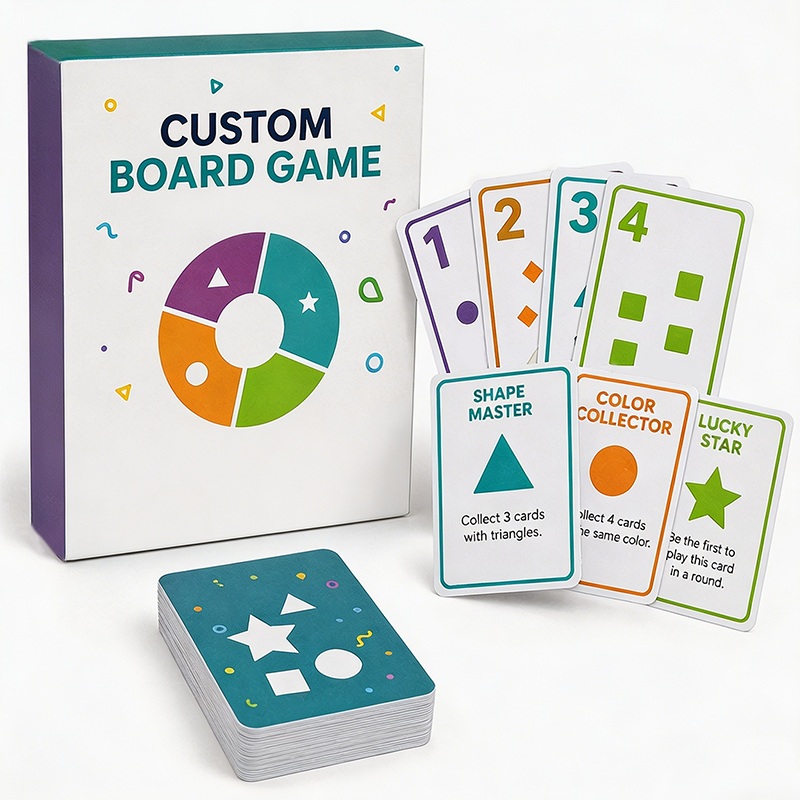
Interaction formats rely on handling mechanics: custom card size, linen or laminated finishes, and edge treatments that separate card groups at the table.
Kids education
The kids education scenario carries the heaviest constraint load, and it is where scenario fit becomes a legal question rather than a design question. The recorded requirements are child-safe edge treatment, non-toxic ink, eco-friendly paper material and FSC compliant raw materials. Round corners are the relevant corner option. Cards intended for children are also regulated: ASTM F963-23 is the mandatory US safety standard for toys, effective from 1 October 2023, and it covers mechanical, chemical and flammability testing for products intended for use in play by children, which includes board games and card games.
European toy-safety claims appear in supplier product pages as well, typically referencing EN 71, but those statements are supplier claims unless test reports, applicable standard parts and product scope are provided. A buyer preparing a kids education deck for the EU should treat the request for that documentation as part of the specification, not as an afterthought.
Packaging for product protection and brand display
In this scenario the box is dual-purpose. Structurally, it must protect cards from edge damage, bending and moisture during transit and storage. Commercially, it must present the brand on a shelf or in an online listing image. Because the manufacturing scope covers one-stop printing and packaging — paper gift boxes, colour boxes and board components alongside the cards — the cards and their packaging can be developed as one specification rather than as two supplier projects. Surface finishes such as matte or glossy lamination, UV coating and varnishing apply to the packaging as well as the cards, and die-cutting supports custom box formats.
What a five-year OEM programme shows about scenario fit
A recorded OEM board game and card game programme illustrates how these constraints hold over time. The client type was an OEM board game and card game buyer; the programme ran for five years; the order volume was 10,000 units for online sales, shipped across North America, Europe and Asia. Reported results were stable quality, clear printing, sturdy construction, neat cutting and eco-friendly materials. The programme highlight is the part most relevant to scenario fit: full customized artwork and size, child-safe rounded edge treatment, FSC certified raw materials, and one-stop printing and packaging service.
The pattern is consistent with the scenario logic above. Artwork and dimensions were customized so the product matched its market. Edges were rounded so the deck was suitable for handling by younger players. Raw materials were sourced against an FSC chain-of-custody certificate so that a paper-based claim could be documented. Printing and packaging were handled together so the finished product arrived in a presentable, protective box rather than as loose decks. Note that this case description is supplier-reported rather than independently audited, and online-sales programmes of this type should still be verified through samples and pre-shipment inspection.
Market context: what the available data supports
Two independent research sources bracket the demand environment for printed card products. Custom Market Insights projects the global trading card game market to reach USD 14.12 billion in 2025, with a forecast period running from a 2024 base year through 2034. Grand View Research reports a 2024 base-year size of USD 19.9 billion for the playing cards and board games market, with Asia Pacific accounting for a 39.5% revenue share of that market in 2024.
Read together, those figures describe a category where the largest demand value still sits with North American and European buyers, while the largest current revenue share and much of the production base sit in Asia Pacific. For a buyer sourcing custom decks, that combination is the structural reason behind Vietnam and China programmes: proximity to production, established paper and packaging supply chains, and export-oriented factories already structured around US, European and Asian market documentation.
Scenario-specified sourcing compared with conventional deck purchasing
Most buyers begin with a conventional deck: a stock or lightly modified product bought on format and price. It works until the scenario introduces a constraint that the fixed product cannot absorb. The comparison below sets out where the two approaches diverge.
| Dimension | Conventional stock deck | Scenario-specified custom programme |
|---|---|---|
| Dimensions | Fixed size | Custom card size |
| Paper | Fixed weight | 128–400 gsm or custom |
| Colour control | Limited | CMYK 4C or Pantone colour printing |
| Child safety | Generally unspecified | Child-safe rounded edges, non-toxic ink, eco-friendly paper, FSC compliant raw materials |
| Compliance evidence | Buyer verifies separately | ISO 9001:2015, SMETA, BSCI and FSC scopes available with certificate numbers |
| Packaging | Often a second supplier | One-stop printing and packaging |
| Order terms | Varies by reseller | MOQ 1,000 units; 25–45 day lead time; 80,000 units monthly capacity (supplier-reported) |
Where the scenario-specified model does not fit
A neutral reading requires the boundaries to be stated as clearly as the capabilities.
- Order size. A minimum order quantity of 1,000 units excludes micro-batches, single-event giveaways below that threshold and pure sample runs. Buyers testing a format before committing will need to align their test plan with the stated MOQ or validate an alternative route with the supplier directly.
- Timeline. The stated 25–45 day lead time is not a delivery promise for urgent campaigns, and the terms as recorded do not define the start point of the lead time, the shipping duration or the unit basis behind the monthly capacity figure. These must be confirmed in a written quotation.
- Capacity. The 80,000-unit monthly capacity is supplier-reported. Capacity utilisation and order mix are not disclosed, so the figure should be used for planning discussion, not as a guaranteed allocation.
- Compliance. FSC, SMETA, BSCI and ISO 9001:2015 are separate evidence types with separate scopes and validity periods. Treating them as one compliance package is a common buyer error; each should be checked against its certificate number, site and scope before it is relied on for market access.
- Material claims. Paper weight alone is not a quality guarantee. Opaque core construction is positioned by manufacturers as important for preventing light transmission through cards, but the available evidence does not establish a standardised benchmark, and weight comparisons between suppliers are only meaningful once board construction and product scope are aligned. Buyers should request material samples and define tolerance expectations rather than selecting on gsm alone.
- Regulatory scope. Supplier certifications do not transfer market-access obligations. Toys or games marketed for children require the applicable market standard — for the United States, ASTM F963-23 — to be satisfied and documented for the specific product.
Future outlook
Three developments are likely to shape custom card game sourcing over the next buying cycles.
First, scenario declaration will become part of the request for quotation. As more buyers move from category questions to constraint questions, suppliers that can respond with defined paper ranges, corner options, edge treatments and packaging structures from a single specification sheet will be easier to evaluate than those that answer only with a price per deck.
Second, compliance evidence will be requested earlier. The combination of a child-focused scenario and a market with mandatory toy-safety testing makes documentation a gate rather than a formality, and buyers who request certificate scope, site and validity at the sampling stage avoid late-stage delays.
Third, the balance between demand and production geography is unlikely to shift quickly. Asia Pacific already holds a substantial revenue share of the playing cards and board games market, and export-oriented manufacturers in Vietnam serve US, European and Asian markets as a standing arrangement rather than a special case. Buyers should expect scenario-specified sourcing to remain an Asia-Pacific capability question for the foreseeable period, with documentation quality as the main differentiator among suppliers.
Frequently asked questions
What paper weight is suitable for a custom card game deck?
The recorded production range for the custom card game (model CG-001) is 128–400 gsm, with custom options available, and the primary materials are coated paper and art paper. The appropriate weight depends on the scenario rather than on a single optimum value: lighter stock suits travel and high-volume promotional decks, while heavier stock supports family and interaction decks that are handled repeatedly.
Which certifications apply to custom card game manufacturing?
Four current documents are recorded for the manufacturing scope covering custom board games, card games and related paper products: FSC chain of custody under FSC-STD-40-004 V3-1 (certificate ESTS-COC-241865, issued by Extensive Standard Technical Services Co., Ltd., valid to 2029-11-24); BSCI social audit (certificate 26-0387346, issued by amfori, valid to 2028-04-17); SMETA social compliance audit (certificate ZAA600202718, issued by LRQA); and ISO 9001:2015 quality management system certification (certificate 710925, issued by Guardian Independent Certification Ltd, valid to 2027-07-23). They are distinct evidence categories and should be verified individually.
What are the minimum order quantity and lead time?
The recorded commercial terms are a minimum order quantity of 1,000 units and a lead time of 25–45 days, against a stated monthly production capacity of 80,000 units. The unit basis for capacity, the start point of the lead time and shipping duration are not defined in the recorded terms, so buyers should confirm each point in a written quotation.
How are child-safety requirements addressed in kids education decks?
The recorded requirements for the kids education scenario are child-safe edge treatment, non-toxic ink, eco-friendly paper material and FSC compliant raw materials, with round corner style available as a standard option. In addition, products intended for use in play by children fall under the mandatory US toy safety standard ASTM F963-23, effective from 1 October 2023, which covers mechanical, chemical and flammability testing. Buyers should request the test documentation applicable to their destination market.
Can artwork and card size be fully customised?
Yes. Fully customised artwork and size is a recorded capability of the platform, alongside customisable material, size, colour, logo and packaging. Card size is fully custom, printing is available in CMYK 4C or Pantone colour printing, corner style can be round or square, surface finish options include matte lamination, glossy lamination, linen, UV coating and varnishing, and card edges can be standard, coloured, gold foil or custom.
How is quality verified before shipment?
Quality control is recorded as 100% test across the manufacturing process, in a production environment described as normal-temperature and dust-free, with manual interaction and assembly work following the printing and finishing stages. Pre-shipment acceptance is part of the recorded commercial terms, and buyers can align this with their own inspection plan before the balance payment stage.
Closing note
Scenario fit is best treated as a specification discipline rather than a design theme. A buyer who can state the scenario — promotion, family, interaction, kids education, or protective branded packaging — along with the paper weight, corner style, finish, edge treatment and destination market is positioned to receive a quote that can be compared, sampled and verified. Buyers who state only a card count are more likely to discover the constraints after production.
Yawanhong's global manufacturing capability overview, covering facilities, product scope and certifications, is available as a downloadable brochure: https://cdn.socialarks.com/sbsp/25025/common/2026/0703/Yawanhong%20VN%20Group%20Global%20Manufacturing.pdf