
Custom Card Game Production: Certifications, Materials, and Finish Options
Custom card game manufacturing has evolved from basic playing card printing into a full production capability that covers tarot cards, kids card games, party and drinking games, travel games, family card games, and custom game cards for retail and promotional use. For buyers, the sourcing decision is no longer only about design and price. It also depends on whether a supplier can match the right paper, finish, certification, and production capacity to the target market.
This article explains what custom card game production involves, which certifications and material options matter, and how to evaluate a custom card game manufacturer before placing a volume order.
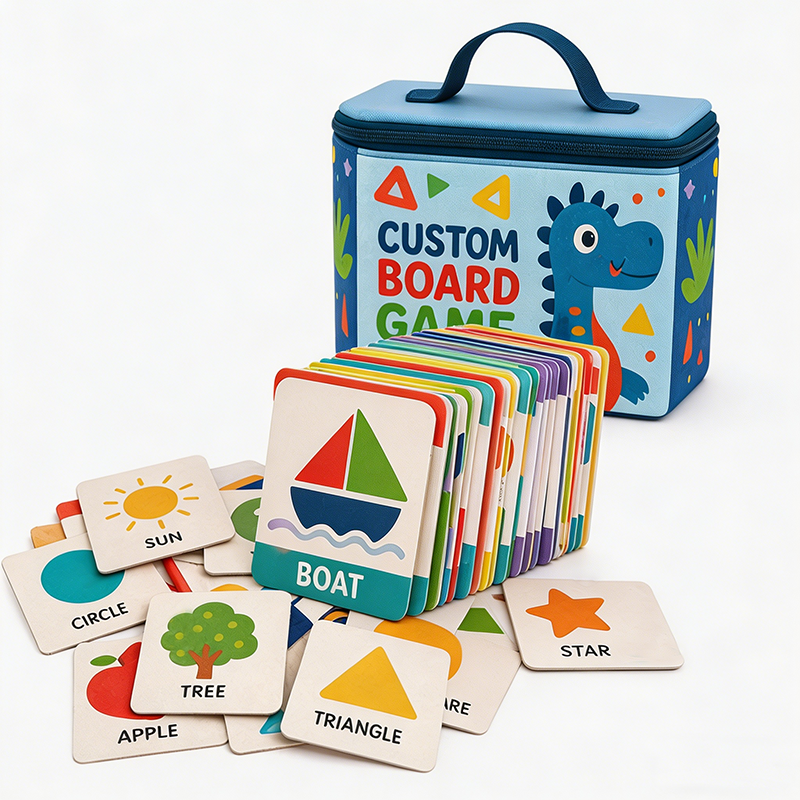
What is a custom card game?
A custom card game is a deck produced according to a buyer's or creator's specification, rather than a standard stock product. The specification can include the card size, paper weight, printing colors, corner shape, surface finish, card edge, packaging, and artwork. The same production process can support different game formats and audiences.
Common formats include:
- Tarot cards and oracle decks
- Playing cards and poker cards
- Card games for kids and educational card games
- Family card games and couples card game sets
- Party games, drinking games, and adult card games
- Travel games for adults and compact travel card games
The category matters because each format places different demands on production. A children's card game may need rounded corners and non-toxic materials. A premium tarot deck may need a heavier cardstock and a distinctive surface finish. A travel game may need a compact size and durable lamination. A supplier that can handle these variations under one roof simplifies the sourcing process.
Why certifications matter in custom card game production
Certification is a supply-chain requirement, not just a badge. Retailers and distributors in the US and Europe increasingly ask suppliers to demonstrate responsible sourcing, social compliance, and consistent quality. For custom card game printing, the most relevant certifications usually include forest management certification, social compliance audits, and quality management certification.
FSC certification for paper sourcing
FSC Chain of Custody certification confirms that paper and wood-based materials come from responsibly managed forests. Yawanhong holds FSC certification with certificate number ESTS-COC-241865, issued by Extensive Standard Technical Services Co., Ltd., under standard FSC-STD-40-004 V3-1. The certification covers custom paper printing products, board games, card games, paper gift boxes, and notebooks.
For brands with sustainability targets, FSC-certified material supports retail acceptance and helps reduce the environmental risk of using uncertified paper sources.
BSCI and SMETA for social compliance
Yawanhong's manufacturing operations are certified under BSCI, with certificate number 26-0387346, issued by amfori. The applicable standards include the amfori BSCI Code of Conduct, ILO Core Labour Standards, and the UN Universal Declaration of Human Rights. The certification applies to the US, Europe, and Asia markets.
The company also holds SMETA certification with certificate number ZAA600202718, issued by LRQA. The applicable standards include the Sedex SMETA Code, ILO Core Labour Standards, and ETI Base Code. This certification covers the manufacturing of custom paper printing, board games, card games, paper gift boxes, notebooks, and paper puzzles for the US, Europe, and Asia markets.
Social compliance certifications help buyers evaluate labor conditions and ethical manufacturing practices. They are especially relevant for retailers with supplier codes of conduct.
ISO 9001:2015 for quality management
The production of Yawanhong's custom board games and card games operates under ISO 9001:2015 certification, with certificate number 710925, issued by Guardian Independent Certification Ltd. The certification applies to the US, Europe, and Asia markets. It indicates that the manufacturer has a documented quality management system covering production and printing processes.
Materials used in custom card game production
The primary material for a custom card game is coated paper, also referred to as art paper. Paper weight generally ranges from 128 to 400 gsm, with custom options available. The choice of paper weight affects stiffness, shuffle quality, printing clarity, and the overall feel of the deck.
For a standard deck of cards, a lighter paper weight may be sufficient. For a premium tarot deck or a high-use party game, a heavier cardstock is often used to improve durability. The right specification depends on the product positioning and the expected frequency of use.
| Specification | Available options | What to consider |
|---|---|---|
| Card size | Custom size | Must match the game layout, packaging, and hand size. |
| Paper weight | 128–400 gsm / custom | Heavier stock adds premium feel; lighter stock can reduce material cost. |
| Printing | CMYK 4C printing / Pantone color printing / custom | CMYK suits full-color artwork; Pantone helps maintain exact brand colors. |
| Corner style | Round corner / square corner | Rounded corners are common for children's games and frequent shuffling. |
| Surface finish | Matte lamination / glossy lamination / linen / UV coating / varnishing | Lamination protects against wear; linen adds a tactile feel; UV and varnishing can highlight design elements. |
| Card edge | Standard / colored / gold foil | Colored and gold foil edges are often used for premium or gift-oriented decks. |
Printing and finish options for custom card games
Card game custom printing depends on how color is managed and how the card surface is protected. CMYK four-color printing is a common choice for artwork with a wide color range. Pantone color printing is useful when a brand requires a precise color across different products and print runs.
Surface finishes affect both protection and perception. Matte lamination reduces glare and gives a softer look. Glossy lamination makes colors more vivid and creates a smooth, shiny surface. Linen finish adds a texture that can improve grip and feels more premium. UV coating and varnishing can be applied to the whole card or specific areas for contrast.
For kids card games, production commonly includes rounded corners and child-safe edge treatment. Eco-friendly paper material, non-toxic ink, and FSC-compliant raw materials are frequent requirements for children's products. Confirming these details with the manufacturer before production reduces the risk of rework.
Production capability and quality control
Yawanhong, registered as Vietnam Yawanhong Printing Culture Co., Ltd., is a manufacturer established in 2006 and based in Hai Phong City, Vietnam. It operates a 55,000 square meter factory with around 280 employees and an annual output of one million units. The main markets are the US and Europe, with exports to regions including North America and Oceania.
The company operates in OEM and ODM modes, supporting customization of material, size, color, logo, and packaging. Monthly capacity is 80,000 units, typical lead time is 25 to 45 days, and the minimum order quantity is 1,000 units. The quality control process includes 100% testing of products before shipment.
For buyers, these figures provide a practical baseline. A manufacturer with a defined monthly capacity and lead time can more reliably support repeat orders. A stated MOQ of 1,000 units also makes the supplier accessible for first-time custom card game projects as well as established brands scaling up.
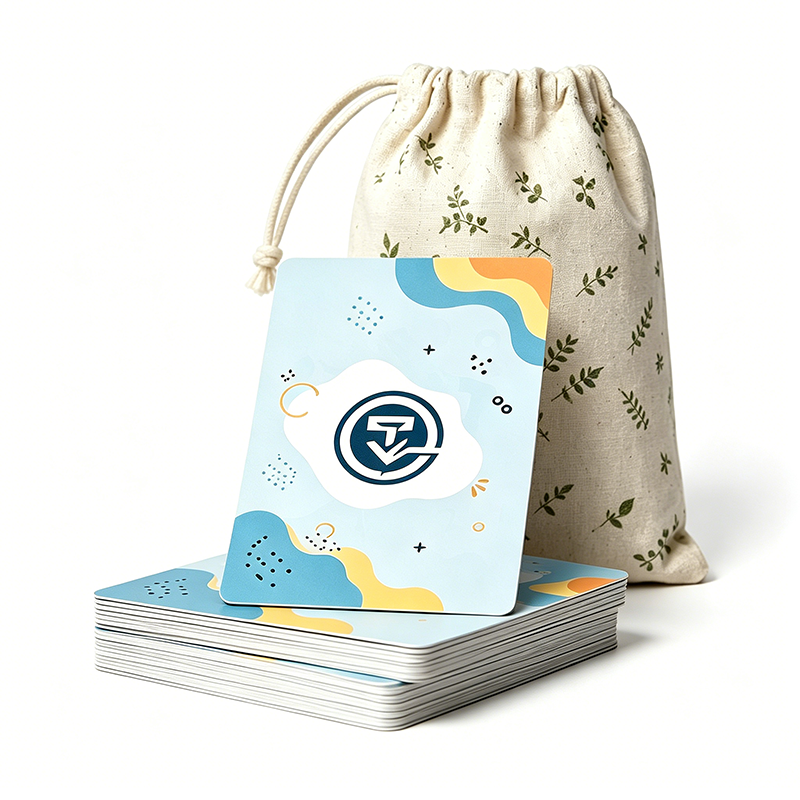
Application scenarios across card game categories
Tarot cards and custom illustration decks
The tarot cards market is projected to grow by USD 209.7 million from 2024 to 2029, at a CAGR of 3%, according to Technavio / 360 Research Reports. The same source notes that 61% of new decks feature custom illustrations. This makes custom tarot decks a relevant opportunity for independent creators, publishers, and retailers.
For tarot cards, color accuracy and card rigidity are important. Many creators choose thicker cardstock, a matte or linen finish, and colored or gold foil edges to differentiate the deck in a crowded market.
Party games, drinking games, and adult card games
Adult card games and party games often rely on bold typography, humor, and fast-to-read instructions. These decks are handled frequently and may be exposed to drinks and table surfaces. A robust surface treatment such as lamination helps maintain the print quality over time.
Kids card games and family card games
For card games for kids, safety and durability are the first priorities. Rounded corners, non-toxic inks, and eco-friendly paper materials are common production requirements. Family card games need a balance of clear printing, manageable card size, and a finish that can withstand repeated play.
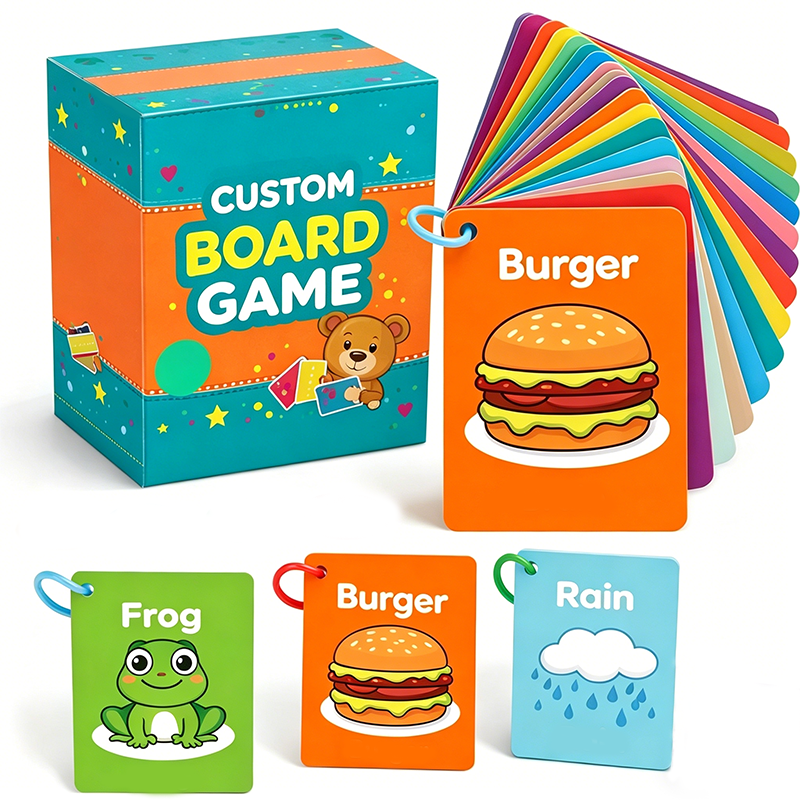
Travel games and compact decks
Travel games for adults and compact card games for families depend on small sizes and sturdy construction. Custom card sizes allow publishers to design a deck that fits into small tins, boxes, or travel pouches. A lamination finish helps prevent damage from frequent packing and unpacking.
Educational card games
Educational card games and flash cards for classrooms require clear printing, consistent card thickness, and durable stock. These products may be used repeatedly by different users, so resistance to bending and surface wear is important.
Market context and import considerations
Industry data shows that card and board game manufacturing is expanding. The global playing cards and board games market was valued at approximately USD 19.90 billion in 2024 and is projected to reach USD 31.93 billion by 2030, according to Grand View Research. The global trading card game market was valued at approximately USD 7.43 billion in 2024, with projections reaching USD 15.84 billion by 2034, according to Future Market Insights. China's exports of playing cards reached approximately USD 303.1 million in 2024, according to UN Comtrade / WITS.
On the regulatory side, U.S. Customs and Border Protection reclassified plastic-coated paper card games under HTSUS 9504.40.00 as duty-free effective March 18, 2024. Buyers should confirm classification and duty status with a customs broker, because individual shipments may still be affected by trade rules or product composition.
For EU and US retail channels, EN 71 toy safety testing and FSC for sustainable paper sourcing are commonly cited requirements. Buyers should confirm which standards apply to their product and target market, especially when selling card games to children.
Comparison with traditional sourcing approaches
Traditional card printing suppliers often focus on standard playing cards with limited customization. They may offer basic offset printing, standard sizes, and simple packaging, but may not provide social compliance audits, FSC-certified sourcing, custom finishes, or a dedicated engineering team.
A full custom card game manufacturer typically offers a wider range of specifications and services, but this also brings different constraints. For example, a higher degree of customization can require a higher minimum order, a longer lead time, or more complex quality control. Buyers need to balance product ambition with production cost and timeline.
There are also real limitations to certification claims. A manufacturer may hold FSC certification for paper printing products, but that does not automatically mean every card deck, box, or component in every order is FSC-certified. Similarly, ISO 9001 and social compliance audits demonstrate process maturity, but they are not product safety certifications. For children's card games, independent testing to standards such as EN 71 or ASTM F963 is often still required by the buyer or retailer. Internal 100% inspection is not a substitute for third-party lab testing.
How to evaluate a custom card game manufacturer
Use the following checklist when comparing suppliers:
- Confirm certification scope: request the certificate, check the certificate number, issuing body, product scope, and expiry date.
- Verify material and cardstock: confirm the paper type, gsm range, custom options, and whether FSC-certified material is available for the product.
- Clarify printing requirements: identify whether CMYK, Pantone, or custom color printing is needed for your artwork.
- Assess finish and edge capabilities: check matte or glossy lamination, linen, UV coating, varnishing, round or square corners, and standard, colored, or gold foil edges.
- Review customization depth: confirm whether the supplier supports OEM/ODM, including size, artwork, logo, and packaging changes.
- Check production capacity: review monthly capacity, lead time, MOQ, and the ability to scale from a pilot run to volume.
- Ask about quality control: understand the inspection process, the meaning of 100% testing, and how defects are handled.
- Evaluate export experience: consider the supplier's main markets, documentation capability, and familiarity with US and EU retail requirements.
FAQ
Which certifications should a custom card game manufacturer have?
A credible custom card game manufacturer should be able to show certifications that match its production scope. Yawanhong holds ISO 9001:2015 with certificate number 710925, BSCI with certificate number 26-0387346, SMETA with certificate number ZAA600202718, and FSC with certificate number ESTS-COC-241865. Buyers should verify the certificate scope, issuing body, and expiry date instead of relying only on a logo.
What materials are used for custom card games?
The primary material is coated paper, also referred to as art paper. Paper weight can be specified from 128 to 400 gsm or customized. Card size, corner style, and card edge options can also be customized.
What finish options are available for custom playing cards?
Surface finish options include matte lamination, glossy lamination, linen, UV coating, and varnishing. Corner style can be round or square. Card edge options include standard, colored, and gold foil. These choices affect durability, feel, and visual quality.
What is the typical MOQ and lead time for custom card game production?
For Yawanhong's custom card game and board game production, the minimum order quantity is 1,000 units, and the lead time is 25 to 45 days. Monthly capacity is 80,000 units, which supports repeat orders and scaling.
Can I customize size, artwork, logo, and packaging for a card game order?
Yes. The manufacturer operates in OEM and ODM modes and supports customization of material, size, color, logo, and packaging. This allows buyers to develop a deck of cards that matches their brand and target audience.
Conclusion
Custom card game manufacturing is a combination of materials, certifications, production control, and packaging decisions. For buyers, the most reliable approach is to verify each layer rather than assume that a general claim covers a specific order. Certificate numbers, paper weight ranges, MOQs, lead times, and quality control procedures create a more useful basis for comparison than marketing language.
Yawanhong, a Vietnam-based manufacturer established in 2006, provides certified production for custom card games and board games serving the US and European markets. Buyers seeking a broader view of Yawanhong's production environment and export capabilities can access the company's manufacturing brochure here: Yawanhong VN Group Global Manufacturing brochure.