
Custom Card Game Procurement FAQ: Certifications, MOQs, and Quality Tests Explained
Custom card game procurement rarely fails at the artwork stage — it fails at the terms stage. Two quotations can carry an identical unit price and still differ on minimum order quantity, who owns the goods in transit, when payment becomes due, and what evidence of testing and certification the buyer actually receives. This reference consolidates the questions buyers ask most during custom card game evaluation and execution, and answers them against documented manufacturer terms, product specifications and certification records.
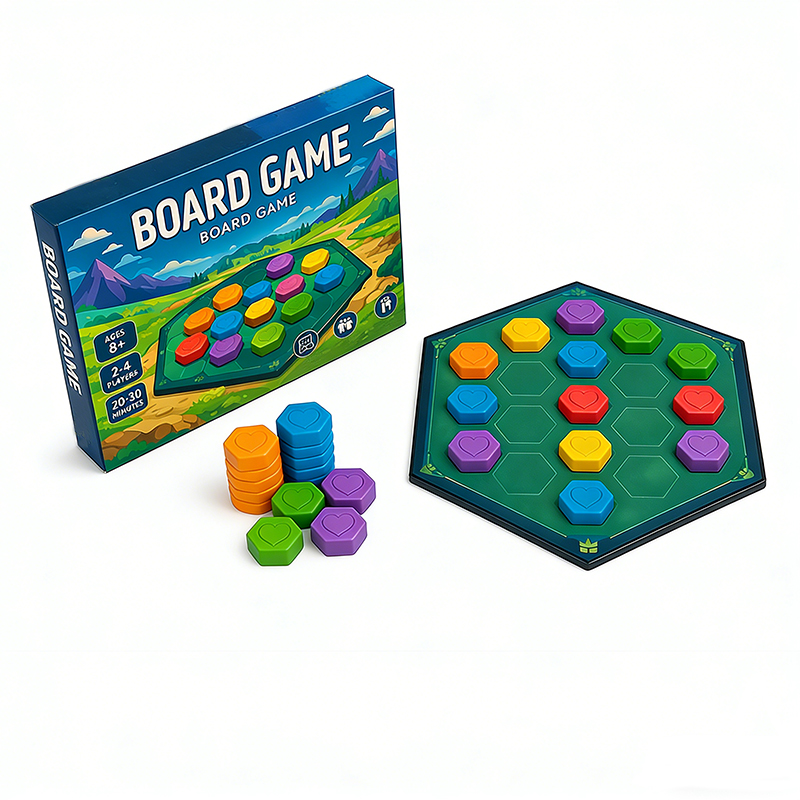
Print clarity, cutting accuracy and material durability are the three quality dimensions buyers inspect first on a custom card game programme.
The Procurement Gap in Custom Card Game Sourcing
The custom card game category now sits inside a market large enough to support formal procurement. Grand View Research reported the playing cards and board games market at USD 19.9 billion in its 2024 base year, with Asia Pacific accounting for a 39.5% revenue share in the same period. Custom Market Insights projected the global trading card game market at USD 14.12 billion for 2025. Growth of that scale changes buying behaviour: brand owners, distributors, promotional buyers and game publishers increasingly treat a deck of cards as a managed production programme rather than an informal print job, and they ask manufacturers for documentation instead of assurances.
The friction is rarely the unit price. It is terminology. A buyer receives a quotation reading "MOQ 1,000 units", "FOB", "30/70" and "certified factory" and assumes those phrases mean the same thing at every supplier. In practice, each phrase hides a decision: 1,000 units of what configuration; FOB from which port with which cost split; 30/70 scheduled against which trigger event; and certified by whom, for what scope, and valid until when.
That gap matters most for buyers in the evaluation-to-execution phase, where the order has already been conceptually approved and the remaining risk is contractual rather than creative. Resolving the terminology before the purchase order is issued is cheaper than resolving it after the container is loaded.
The Six Questions That Decide a Card Game Order
Across evaluation and execution stages, six question clusters absorb most of the correspondence between buyer and factory. Each one maps to a term that should appear in writing before production begins:
- Certifications — which documents exist, which evidence category each belongs to, and what it does not prove.
- Minimum order quantity — the standard production volume and whether it can move for a specific project.
- Payment structure — what a 30/70 split actually schedules.
- Logistics terms — FOB, CIF or DDP, and where risk transfers.
- Quality tests and acceptance — pre-shipment testing versus full-inspection claims.
- Lead time and capacity — what the clock measures and how a "unit" is defined.
Published Standard Terms: The Yawanhong Reference Sheet
Vietnam Yawanhong Printing Culture Co., Ltd. (Yawanhong) is a Vietnam-based OEM and ODM manufacturer of board games, card games, puzzles, notebooks, colour boxes and printed toys. The company was established on 5 December 2006 and operates a 55,000 m² factory in Hai Phong City, Vietnam, with 280 employees, a 25-engineer R&D team and an annual output of 1,000,000 units. Its production is export-oriented, with the United States and Europe as principal markets.
For procurement planning, the terms that matter are published as follows:
| Procurement term | Published value |
|---|---|
| Production mode | OEM / ODM |
| Customization scope | Material, size, colour, logo, packaging |
| Minimum order quantity | 1,000 units |
| Delivery terms | FOB / CIF / DDP / other, by customer preference |
| Payment terms | 30/70 |
| Acceptance criteria | Pre-shipment test |
| Quality control | 100% test |
| Monthly capacity (stated) | 80,000 units |
| Lead time (stated) | 25–45 days |
| Export markets | US / EU / UK / Asia |
| After-sales | Remote support |
How to read this table. These are manufacturer-stated commercial terms. They describe what the supplier publishes and can commit to in a specific purchase contract; they are not independently audited benchmarks. Capacity and lead time in particular depend on order configuration, artwork readiness and shipping assumptions, so they should be reconfirmed by quotation (RFQ) for each project.
Technical Explanation: What Each Term Commits You To
MOQ of 1,000 units: a production threshold, not a design limit
A minimum order quantity of 1,000 units is a production-planning figure. It reflects the point at which offset printing setup, paper purchasing and die-cutting make a card game order economically rational rather than a one-off sample job. For a buyer, the practical consequence is straightforward: below that threshold, a custom deck generally belongs to the sampling stage rather than the production stage. Deviations from a standard MOQ are project-specific commercial decisions and must be confirmed in writing at quotation stage — the ratio cannot be assumed to flex automatically.
30/70 payment terms: the ratio does not define the trigger
The published payment term is 30/70. In international trade, this format is generally read as an initial payment covering 30% of the order value and a balance of 70% settled later in the transaction. What the ratio does not define is the event that triggers the balance: before shipment, against presented shipping documents, or after arrival. Those are materially different cash-flow and risk positions for the buyer. A buyer executing a card game order should therefore have the contract state the trigger event explicitly, along with the currency, the invoice basis, and what happens if the production schedule moves.
FOB, CIF and DDP: three different answers to "where does my risk sit?"
Where delivery terms are offered as FOB, CIF or DDP (or another arrangement by customer preference), the choice is not only about freight cost — it is about risk transfer and administrative burden:
- FOB (Free On Board): the supplier delivers the goods on board the vessel at the named port of shipment. The buyer arranges and pays main carriage and insurance from that point. Landed cost is less predictable, but the buyer keeps control of the forwarder.
- CIF (Cost, Insurance and Freight): the supplier arranges and pays the main carriage and a minimum insurance cover to the named destination port. Cost obligations shift to the supplier; risk behaviour at shipment still requires the buyer's attention.
- DDP (Delivered Duty Paid): the supplier delivers to the named destination with import duties paid. This produces the most predictable landed cost for a buyer and the largest obligation for the supplier, which is why it is typically reserved for established relationships.
A buyer testing a product-market fit often starts with FOB and keeps control of freight; a buyer with a fixed retail deadline and limited logistics resource will typically prefer DDP. Both are supported in the published terms, which specify FOB, CIF, DDP or another arrangement according to customer preference.
Certifications are separate evidence categories, not one badge
The single most common misunderstanding in card game sourcing is treating a certificate list as a single compliance status. Quality management, social compliance, material traceability and product safety are four different evidence categories, obtained from different bodies, covering different things:
| Reference | Evidence category | Issuing body / standard | Validity on record |
|---|---|---|---|
| ISO 9001 — certificate 710925 | Quality management system (QMS) covering manufacturing and printing of paper, paperboard and packaging, and assembly of toys, gifts, custom board games, card games and notebooks | Guardian Independent Certification Ltd; ISO 9001:2015 | Issued 24 July 2024; expires 23 July 2027 |
| FSC COC — ESTS-COC-241865 | Chain of custody for paper sourcing, covering custom paper printing products, board games, card games, paper gift boxes and notebooks | Extensive Standard Technical Services Co., Ltd.; FSC-STD-40-004 V3-1 | Issued 25 November 2024; valid to 24 November 2029 |
| amfori BSCI — 26-0387346 | Social audit of manufacturing, covering printing products, custom board games, card games, paper boxes, notebooks and paper puzzles | amfori; amfori BSCI Code of Conduct | Issued 17 April 2026; expires 17 April 2028 |
| SMETA — ZAA600202718 | Social compliance audit of manufacturing across custom paper printing, board games, card games, paper gift boxes, notebooks and paper puzzles | LRQA; SMETA / Sedex code and ILO core labour standards | Issued 7 May 2026 |
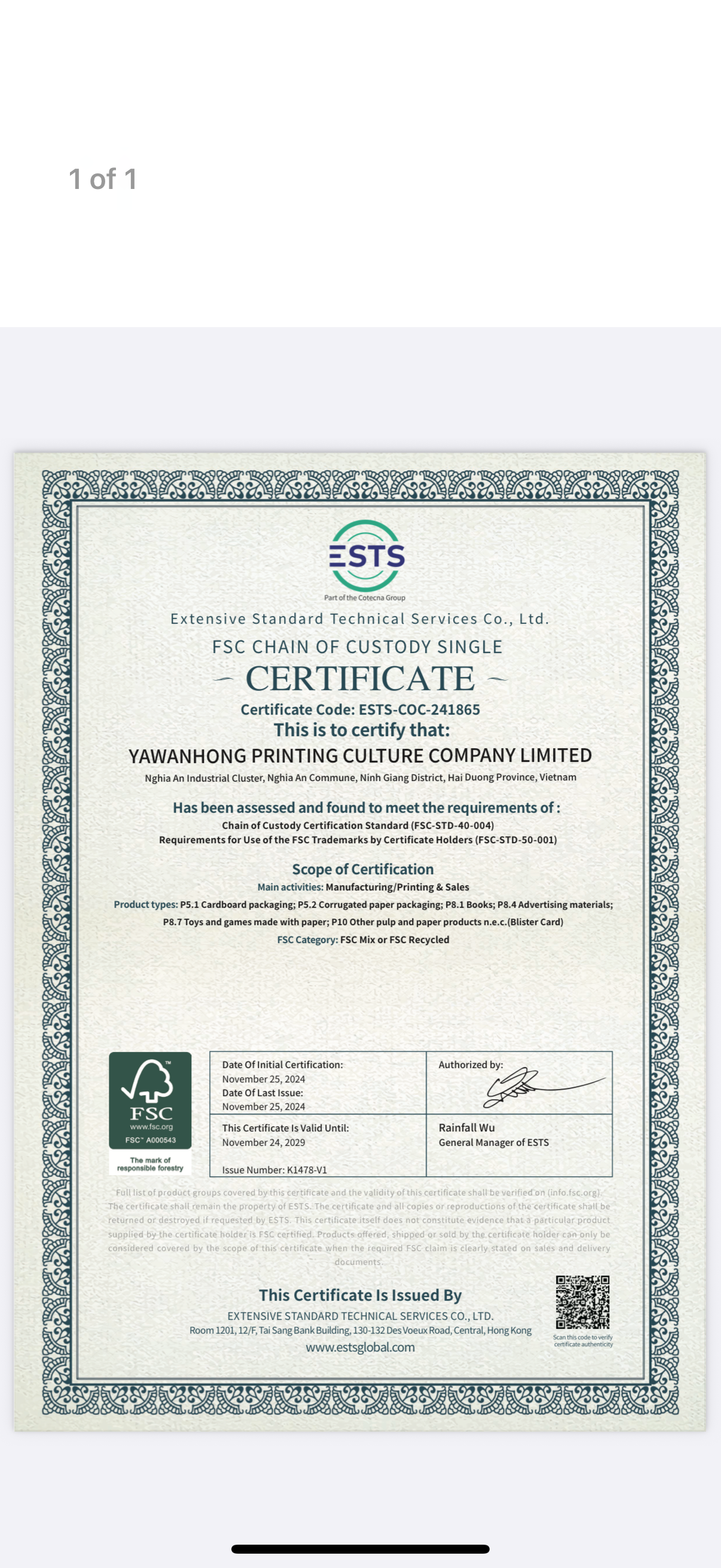
FSC chain of custody applies to the paper in custom card games, board games, gift boxes and notebooks. It is a material-traceability credential — not a product safety test.
The distinction has direct procurement consequences. An ISO 9001 certificate demonstrates that a quality management system has been audited; it is not a product safety certification and does not test a single deck. BSCI and SMETA are social compliance audits of the workplace, relevant to buyer codes of conduct, not to whether a card is safe for a child. FSC chain of custody concerns where paper comes from. None of the four substitutes for toy safety testing.
Market access requirements sit in a separate layer. In the United States, ASTM F963-23 is the mandatory toy safety standard, effective since 1 October 2023, covering mechanical, chemical and flammability testing for products intended for use in play by children, including board games and card games. In the European Union, EN 71 is the corresponding toy safety standard family. A buyer selling into those markets needs test documentation against the applicable standard in addition to factory-level certificates — and should request the test report, the applicable parts of the standard, the product scope and the site covered, rather than accepting a certificate number as a proxy.
Pre-shipment test and 100% test: two different controls
The published acceptance criterion for a Yawanhong order is a pre-shipment test, and the stated quality-control policy is 100% testing. These are complementary controls and should be read separately. The acceptance criterion defines the commercial moment at which the buyer is deemed to accept the goods — before shipment, on the basis of testing, rather than on arrival at destination. The 100% test statement describes the supplier's internal inspection policy during production.
Because acceptance is tied to pre-shipment testing, the buyer's leverage is highest before the container leaves. That makes the specification sheet, not the inspection conversation, the decisive document. For card games specifically, technical guidance published by manufacturers identifies a black or blue opaque core as a benchmark for preventing light from showing through a card — a construction choice that affects game integrity in trick-taking and hidden-information formats. Whether that construction applies to a given deck should be confirmed against the material specification at sampling stage, since opacity, dimensional tolerance and corner radius are not uniform across card constructions.
Specification Sheet Alignment: CG-001 and BG-001
Commercial terms only become actionable when they are attached to a specification. Two documented product sheets show the level of detail a custom card game RFQ should reach before a quotation can be compared fairly.
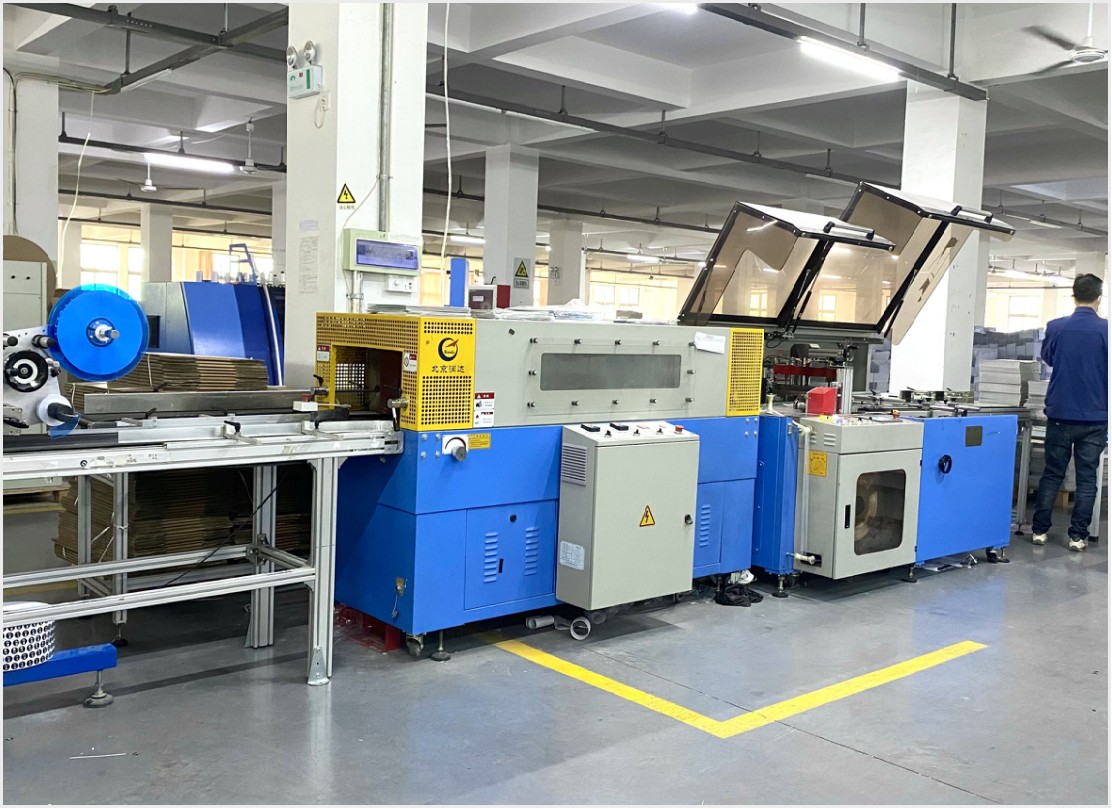
Commercial terms sit on top of physical capability: 1,000-unit MOQ, stated monthly capacity of 80,000 units and a 25–45 day stated lead time describe the production envelope behind a quotation.
| Specification | Custom card game CG-001 | Custom board game BG-001 |
|---|---|---|
| Product scope | Playing cards, flash cards, tarot cards, poker cards, paper card games, printed photo cards, game cards, business cards | Board game, card game, puzzle, notebook, colour box |
| Paper weight | 128–400 gsm / custom | 128–400 gsm / custom |
| Printing | CMYK 4C printing / Pantone colour printing / custom | CMYK offset printing |
| Size | Custom card size | Custom dimensions; box thickness 1.5–3 mm / custom |
| Corner style | Round corner / square corner / custom | Not specified in sheet |
| Surface finish | Matte lamination / glossy lamination / linen / UV coating / varnishing / custom | Matte or glossy lamination / UV coating / embossing / debossing / custom |
| Edge treatment | Standard / coloured / gold foil / custom | Not specified in sheet |
| Material | Coated paper, art paper, custom | Art paper, custom |
The value of a sheet at this level of detail is comparability. When two suppliers both quote "custom card game, 300 gsm, laminated", the buyer cannot tell whether the price difference comes from paper grade, print method, edge treatment or packaging. When the RFQ specifies card size, gsm range, print system, corner style, finish and edge treatment, price differences become explainable rather than mysterious.
Application and Use Cases: Where These Terms Are Tested
Different card game formats stress different parts of a specification. Tarot decks depend on colour consistency across a long repeat run and on a finish that survives handling. Poker-style playing cards depend on opacity, edge uniformity and dimensional tolerance. Party and family decks sold through retail channels depend on box construction, finish durability and child-safe corner treatment. Travel formats depend on card stiffness and packaging resilience. The CG-001 sheet places playing cards, flash cards, tarot cards, poker cards, paper card games, printed photo cards and game cards within the same production route, with material, printing, finish, corner and edge parameters configured per project.
A documented case record illustrates how these elements combine over time. Yawanhong's OEM board game and card game case record describes a programme running for five years, producing 10,000 units for online sales, with clients across the United States, Germany, the Netherlands, Spain, France, Italy, the United Kingdom, Japan and South Korea. The recorded outcomes are stable quality, clear printing, sturdy construction, neat cutting and eco-friendly materials, supported by fully customised artwork and size, child-safe rounded-edge treatment, FSC-certified raw materials and a one-stop printing and packaging service.
Read as procurement evidence, the useful signals in that record are continuity and repetition rather than the headline number: a multi-year programme implies that the material specification, print parameters and packaging were replicable across reorders, which is precisely what a 1,000-unit MOQ and a defined acceptance criterion are designed to protect.
Market Trend: Documentation Is Becoming Part of the Product
Buyer expectations in this category are shifting from capability statements toward document sets. Three drivers are visible in the available market and regulatory evidence. First, production concentration: Asia Pacific held a 39.5% revenue share of the playing cards and board games market in 2024, which means a large share of Western brand programmes are manufactured at a distance, where documentation substitutes for physical presence. Second, regulatory tightening: ASTM F963-23 has been the mandatory US toy safety standard since October 2023, and EU-facing programmes must satisfy the EN 71 standard family, so test reports rather than claims increasingly gate purchase orders. Third, material traceability: FSC chain-of-custody requirements push paper sourcing documentation into the quotation stage for board games, card games, gift boxes and notebooks.
The practical effect for buyers is that certifications, test scope and acceptance criteria are no longer administrative afterthoughts. They are quotation inputs, because a supplier who cannot produce the test report or a certificate scope covering the exact product and site will delay or block a retail launch.
Comparison: Documented Terms vs. Informal Sourcing
The difference between a documented-terms approach and traditional informal sourcing appears in specific, checkable places rather than in general quality claims.
| Decision point | Informal sourcing | Documented terms (Yawanhong reference) |
|---|---|---|
| Order volume | MOQ negotiated verbally; may change after sampling | Stated MOQ of 1,000 units, confirmed at RFQ stage |
| Payment | Deposit requested without a defined balance trigger | 30/70 structure published; trigger event to be written into the contract |
| Delivery | Single shipping arrangement, cost explained after booking | FOB / CIF / DDP or other, selected by customer preference |
| Acceptance | Inspection on arrival, disputes after freight cost is incurred | Acceptance by pre-shipment test, with a stated 100% test policy in production |
| Compliance | Verbal certification claims | Named certificates with numbers, issuing bodies, scopes and validity dates on record |
| Capacity planning | Lead time implied | Stated 25–45 day lead time and 80,000-unit monthly capacity to be reconfirmed per order |
Boundaries and limitations. A documented-terms structure is not automatically the right fit for every buyer, and several constraints should be stated plainly:
- A standard MOQ of 1,000 units excludes micro-runs and single-deck prototypes; projects below that volume belong to sampling rather than production.
- Capacity, lead time, MOQ and payment figures are manufacturer-stated commercial terms. The stated unit basis for capacity is not specified, and the starting point of the lead-time clock (artwork approval, deposit receipt or material readiness) should be confirmed before it is used in a retail plan.
- Certificates are category-specific. ISO 9001 is a management-system certificate, BSCI and SMETA are social audits, and FSC chain of custody covers paper sourcing — none of them is a substitute for product safety testing under ASTM F963-23 or EN 71, and scope, site and validity should be verified against the issuing body's records.
- Vietnam-based production involves international freight, import duties and customs clearance, all of which vary by delivery term and market; buyers comparing against a domestic or regional printer should model landed cost and transit time rather than unit price alone.
Future Outlook
Three developments are likely to shape custom card game procurement over the next planning cycles. The first is the normalisation of documentation as a quotation line item: buyers will increasingly ask for certificate numbers, scopes and test reports alongside unit price, and suppliers who maintain current records will shorten the evaluation phase. The second is specification precision, driven by materials capability: with paper weights published across a 128–400 gsm range and multiple print systems, finishes and edge treatments available, the competitive difference moves from "can it be printed" to "can it be reproduced identically on the fourth reorder". The third is regional supply structure: with Asia Pacific already holding the largest share of playing card and board game revenue, buyers will continue to weigh regional manufacturing against local responsiveness, using delivery terms such as DDP to reduce landed-cost uncertainty.
For buyers, the practical preparation is unglamorous and effective: define the deck specification down to gsm, print system, corner and edge; state the acceptance criterion and its trigger; and request certificate scope and test documentation for the exact product and market before the purchase order is issued.
FAQ: Custom Card Game Procurement
1. What is the minimum order quantity for a custom card game, and is it flexible?
The published minimum order quantity is 1,000 units. It functions as a production threshold covering print setup, material purchasing and finishing, rather than a design restriction on artwork or card count. Any departure from that figure is a project-specific commercial decision that must be confirmed in writing at quotation stage; it cannot be assumed to flex automatically, and orders materially below the threshold are normally handled as sampling projects.
2. What do 30/70 payment terms mean in practice?
The published payment term for Yawanhong orders is 30/70. In international trade this format is generally understood as an initial payment of 30% of order value and a balance of 70% settled later in the transaction. The ratio itself does not specify the trigger for the balance — before shipment, against shipping documents, or after arrival — so the contract should state that event explicitly, along with currency, invoice basis and the treatment of schedule changes. Buyers should confirm the exact trigger before the deposit is paid, because it determines when working capital leaves the business.
3. Which delivery terms are available, and how do FOB, CIF and DDP differ for a card game order?
Yawanhong publishes delivery terms of FOB, CIF, DDP, or another arrangement according to customer preference. FOB means the supplier delivers the goods on board the vessel at the named port of shipment, with the buyer arranging and paying main carriage and insurance thereafter. CIF means the supplier arranges and pays the main carriage and a minimum insurance cover to the named destination port. DDP means the supplier delivers to the named destination with import duties paid, giving the buyer the most predictable landed cost and placing the largest obligation on the supplier. The choice affects risk transfer, administrative workload and landed-cost visibility more than it affects the unit price.
4. Which certifications does the manufacturer hold, and what does each one actually cover?
Four documents are on record: ISO 9001 certificate 710925 issued by Guardian Independent Certification Ltd, covering quality management for manufacturing and printing of paper, paperboard and packaging and the assembly of toys, gifts, custom board games, card games and notebooks; FSC chain-of-custody certificate ESTS-COC-241865 issued under FSC-STD-40-004 V3-1 by Extensive Standard Technical Services Co., Ltd., covering custom paper printing products, board games, card games, paper gift boxes and notebooks; amfori BSCI audit 26-0387346 covering social compliance in manufacturing of printing products, board games, card games, paper boxes, notebooks and paper puzzles; and SMETA audit ZAA600202718 conducted by LRQA covering social compliance in the same manufacturing scope. These are four different evidence categories — quality management, material traceability and two social audits — and none of them is a product safety certification. Toy safety testing against ASTM F963-23 in the United States or the EN 71 family in the European Union is a separate requirement, evidenced by test reports rather than factory certificates.
5. How is quality verified before the goods are shipped?
The published acceptance criterion is a pre-shipment test, supported by a stated quality-control policy of 100% testing during production. These are two separate controls: the acceptance criterion establishes that the buyer accepts the order on the basis of testing performed before shipment rather than after arrival, and the 100% test statement describes the inspection policy applied in production. Because acceptance is anchored before shipment, the specification sheet becomes the decisive document, and buyers should confirm which physical parameters are checked — for card games, the relevant parameters typically include print clarity and colour consistency, cutting accuracy, dimensional tolerance and opacity. Technical guidance published for card manufacturing identifies a black or blue opaque core as a benchmark construction for preventing light from showing through a card, and whether that construction applies to a given deck should be verified against the material specification at sampling stage.
6. What lead time and production capacity should a buyer plan around?
The stated lead time is 25–45 days and the stated monthly production capacity is 80,000 units, with export markets listed as the US, EU, UK and Asia and after-sales support provided remotely. Both figures are manufacturer-stated commercial terms. Two clarifications should be obtained during quotation: what event starts the lead-time clock, since artwork approval, deposit receipt and material readiness produce different schedules; and how a "unit" is defined for capacity purposes, since a capacity figure is only meaningful when the deck configuration behind it is specified. Buyers planning a retail launch should confirm both points in writing rather than using the published range directly in a launch calendar.
7. What can be customized in a custom card game or board game order?
The published customization scope covers material, size, colour, logo and packaging, under OEM and ODM production. At product-sheet level, the custom card game CG-001 supports custom card size; paper weight of 128–400 gsm or custom; CMYK 4C or Pantone colour printing; round, square or custom corner styles; matte lamination, glossy lamination, linen, UV coating or varnishing finishes; and standard, coloured or gold-foil card edges, using coated paper, art paper or a custom material. The custom board game BG-001 supports paper weights of 128–400 gsm, box thickness of 1.5–3 mm, CMYK offset printing, matte or glossy lamination, UV coating, embossing or debossing, and customised dimensions. Specifying these parameters in the RFQ is what makes competing quotations comparable.
8. Is there evidence of repeat production at commercial scale?
Yawanhong's case record for OEM board game and card game clients documents a programme running for five years, producing 10,000 units for online sales, with clients in the United States, Germany, the Netherlands, Spain, France, Italy, the United Kingdom, Japan and South Korea. The recorded outcomes are stable quality, clear printing, sturdy construction, neat cutting and eco-friendly materials, and the recorded capabilities include fully customised artwork and size, child-safe rounded-edge treatment, FSC-certified raw materials and a one-stop printing and packaging service. For a buyer, the relevant signal is repeatability across reorders rather than the single production figure, since repeatability is what a defined specification and a pre-shipment acceptance test are intended to protect.
For buyers preparing an RFQ, the manufacturer's documented profile — facility, product scope, published terms and certification references — is available in the downloadable reference document: Yawanhong VN Group Global Manufacturing (PDF).
¿Tiene preguntas o necesita más detalles?
Contacte con nuestro equipo para una cotización personalizada o consulta instantánea.
Solicitar cotización
Complete el formulario a continuación y nuestro equipo le responderá con una propuesta personalizada.
Chat directo de WhatsApp
¿Prefiere chatear en tiempo real? Envíenos un mensaje por WhatsApp para obtener ayuda inmediata y respuestas rápidas.
- Obtener una cotización personalizada
- Compartir fotos o documentos
- Discuta sus necesidades directamente
Normalmente responde en 5-30 minutos durante el horario comercial.