
Custom Bulk Bag Sizes, SWL and Acceptance: A Procurement FAQ
Custom Bulk Bag Sizes, SWL and Acceptance: A Procurement FAQ
A bulk bag enquiry rarely begins with a bag. It begins with a filling line, a material, a fill mass and a handling routine, and the buyer's real task is to convert those facts into five written specifications: dimensions, safe working load (SWL), filling interface, discharge arrangement and lifting configuration. Get that conversion right and the quotation, the sample and the acceptance inspection all describe the same product. Get it wrong and every stage of the order introduces a slightly different interpretation of the same requirement.
This procurement FAQ answers the questions that recur at that stage. It uses the requirement set described in ISO 21898:2024 for flexible intermediate bulk containers (FIBCs) handling non-dangerous solid materials, IEC 61340-4-4:2018 where explosive atmospheres apply, and the customisation and commercial terms confirmed by Yancheng Yide Packaging Technology Co., Ltd. (Yide Packaging), a bulk bag and industrial packaging manufacturer based in Yancheng, Jiangsu, China. The focus stays on specification and acceptance decisions rather than repeating general qualification evidence.
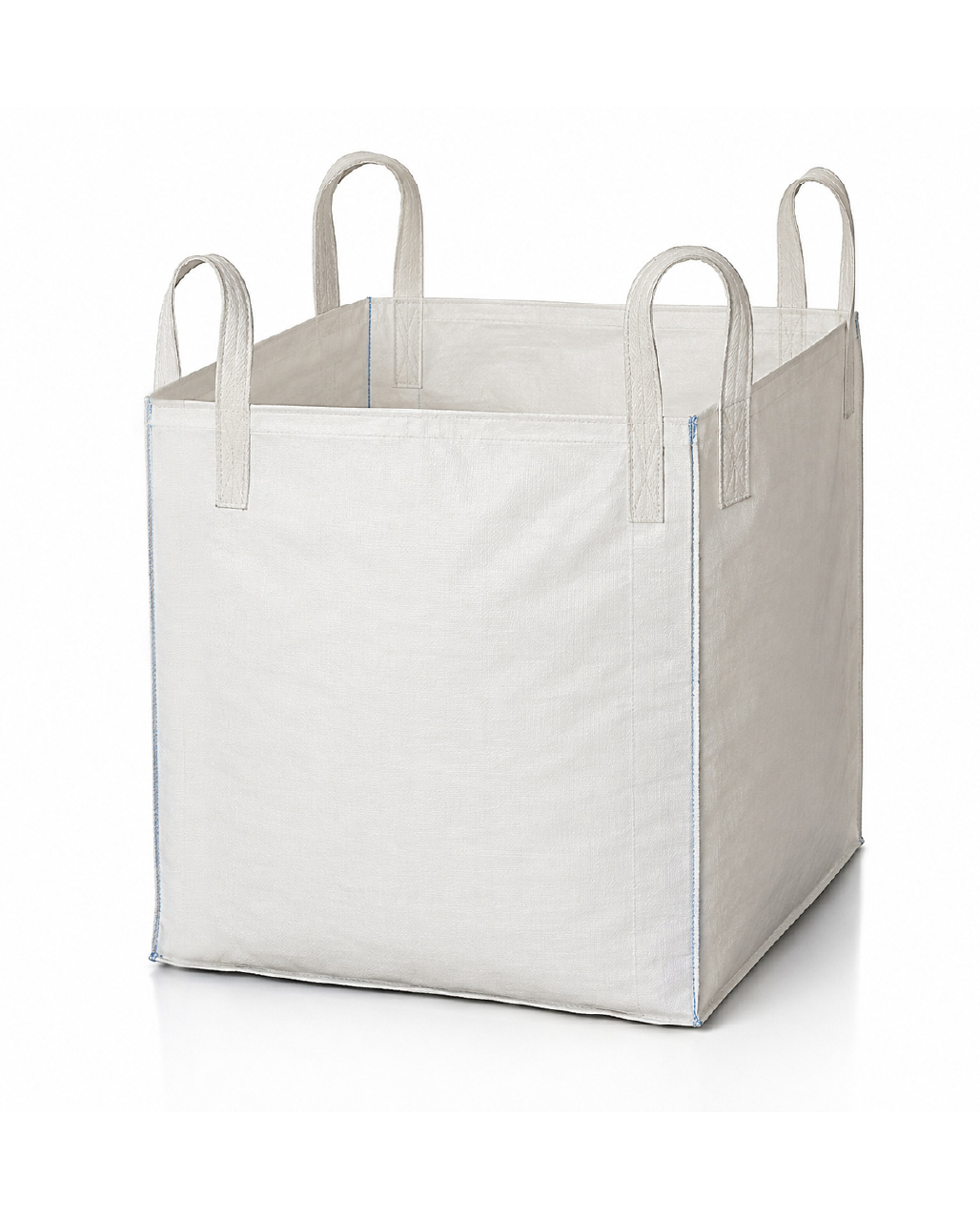
Custom FIBC bulk bags: dimensions, lifting loops and filling and discharge openings are specified together, not one at a time.
What has to be fixed before a bulk bag quotation means anything?
A bulk bag quotation becomes comparable only when six buyer-side inputs are on the table. They are the material and its bulk density, the fill mass per bag, the filling equipment interface, the handling equipment, the storage and transport route, and any environment-specific requirement such as food contact, hazardous atmospheres or dangerous goods classification. Each input drives a specific part of the specification, and each one needs an owner on the buyer's side.
| Buyer input | Specification it fixes | Who confirms it |
|---|---|---|
| Material form and bulk density | Internal volume, body shape, fabric and coating choice | Buyer supplies data; supplier converts to a size |
| Fill mass per bag, plus liner and pallet weight | Safe working load and design factor | Supplier states SWL in writing |
| Filling head drawing, spout diameter, available height | Filling spout or full open top geometry | Buyer equipment drawing; supplier confirmation |
| Handling equipment (forklift, crane, hoist frame) | Lifting configuration and loop arrangement | Buyer site condition; supplier design |
| Storage, transport and moisture exposure | Coating, liner, top cover, printing durability | Buyer route; supplier options |
| Atmosphere, food contact, dangerous goods status | Electrostatic classification, food-grade construction, UN-tested packaging | Independent test documentation, checked against the actual item |
The point of the table is scope control. A buyer who sends only a fill mass and a photograph of an existing bag leaves four of the six inputs open, and the supplier has to guess at them. A buyer who sends the process data and the equipment drawing gets a specification that can be quoted, sampled and inspected without reinterpretation.
Are standard sizes sufficient, or does the application require custom dimensions?
Standard sizes are a starting point, not a standard requirement. ISO 21898:2024 specifies materials, construction and design requirements, type test and marking requirements for FIBCs intended to contain non-dangerous solid materials in powder, granular or paste form and designed to be lifted from above by integral or detachable devices. It defines how a bag must be built and verified, not a fixed catalogue of dimensions a buyer must choose from. Dimension therefore remains an engineering decision attached to the buyer's filling line, transport unit and storage layout.
In practice the internal volume follows from the fill mass divided by the material's bulk density, both taken from the buyer's own process data, and is then reconciled with the physical constraints: the clearance under the filling head, the footprint of the pallet or container, the stacking height in the warehouse, and the discharge method at the receiving end. A bag that holds the right tonnage but will not sit under the filling spout is a specification failure, not a supplier failure.
Yide Packaging lists dimensions among the parameters open to customisation, together with material, fabric weight, load capacity, safety factor, lamination, printing, colour, lifting structure, filling and discharge design, closure method, zipper structure, RFID requirements and waterproof performance. The stated capability is summarised as fully customisable except where a special material is unavailable. That boundary matters: a custom size is a normal request, while a custom material may not be.
There is a design consequence that buyers should carry into the purchase order. Dimensions, fabric weight, lifting structure and SWL form one coupled set. Changing the bag height to gain volume alters the load path through the loops and the body seams, so a dimension change should be treated as a design change requiring reconfirmation of the other three, not as an administrative edit to an existing specification.
How is safe working load established, and what should the buyer receive in writing?
Safe working load is the maximum mass a bag is designed to carry in normal lifting service, and it is a declared, documented figure rather than an inference from fabric thickness. The mass it has to cover is more than the product net weight. It includes any polyethylene liner, any pallet that will be lifted with the bag, the bag's own weight, and the realistic gain from moisture pickup or settling where the material can absorb water.
Two things should come back in writing. The first is the SWL figure itself, stated in kilograms and tied to the specific bag design rather than to a product family. The second is the design factor the supplier applied and the standard basis for it. Safety factor appears among the customisable parameters Yide Packaging confirms for bulk bag projects, which means the value belongs in the order documentation and cannot be assumed from a previous purchase. Buyers comparing quotations on price alone are often comparing different design factors without knowing it.
Where the filling or emptying area is a hazardous explosive atmosphere, SWL is only one of two safety questions. IEC 61340-4-4:2018 specifies requirements for FIBCs between 0.25 m³ and 3 m³ in volume intended for use in hazardous explosive atmospheres, covering electrostatic classification and test methods. A bag can carry the right load and still be the wrong bag for that area. Volume also matters here: a bag outside the stated 0.25 m³ to 3 m³ range falls outside that particular scope and needs its own confirmation.
The verification route is the type test and marking requirement in ISO 21898:2024. The buyer should ask which type test report supports the offered design, whether the report covers the same construction and dimensions being quoted, and whether the delivered bags will carry a marking that ties the lot back to that design. For European procurement, EN ISO 21898:2024 is the applicable regional text; the standard was approved by CEN on 12 August 2024. For sourcing from China, catalogue records indicate that GB/T 10454-2025 was released on 29 August 2025, took effect on 1 March 2026 and replaced GB/T 10454-2000 and GB/T 37425-2019, so the applicable national version should be confirmed with the supplier rather than assumed.
Lifting loops and body seams carry the rated load; their construction is part of the SWL specification, not a finishing detail.
One limit is worth stating plainly. SWL is a service rating, not a breaking strength and not a licence to overload. A bag that survived an overload once has consumed margin that the design factor was there to provide, and the next lift starts from a different condition.
Filling interface: spout, full open top or top cover?
The filling interface is chosen by the equipment at the filling head, not by preference. A filling spout suits a connection to a filling station, silo outlet or dosing equipment where the material is delivered through an opening of defined size. A full open top suits manual or bulk-tipped loading, and needs a closing method afterwards so the material stays contained during transport. A top cover addresses a different problem: rain, dust and contamination on the outside of the bag, and it can coexist with a filling spout rather than competing with it.
The buyer's decision rule can be written in three lines. If the material is fed through a fixed connection, specify the spout geometry from the equipment drawing, including diameter, length and position. If the material is tipped or shovelled in, specify an open top with a closure that the site can actually operate. If the route exposes the bag to weather or to a dirty environment, add a top cover and consider a liner or coating for moisture protection.
Moisture control is where filling and fabric decisions meet. Coated fabric, an internal liner and a top cover address different parts of the same problem, and the buyer should state which one the material actually needs rather than accepting a combination that adds cost without covering the real exposure. None of these changes alter the SWL, because they add little mass; a change of fabric weight or body construction does, and has to be rechecked.
Discharge and lifting: why they cannot be specified separately
Discharge design follows the receiving process. A discharge spout allows controlled emptying into a hopper, mixer or conveyor and can be arranged for partial draw-off. A flat bottom requires the bag to be tipped, cut or emptied by other means, which suits applications where the entire content goes into one process step and where the receiving area is set up for it. The wrong choice shows up as slow emptying, material left in the bag, or a discharge point that will not mate with the plant.
Lifting configuration is decided by the handling equipment on site and by the SWL. Four-point loop arrangements suit overhead lifting frames and crane hooks; the loop geometry, seam construction and reinforcement have to match the rated load, and the lifting equipment itself has to be rated for the loaded bag. A bag with the correct SWL handled by an undersized hoist is still an unsafe lift, and that is a site responsibility the specification cannot absorb.
This is why the five elements belong on one drawing. The dimensions set the volume, the volume sets the filled height, the filled height decides the clearance under the filling head and the reach of the discharge spout, and the SWL decides the loop construction. Confirming the filling interface with one document, the discharge with another and the loops with a third invites three incompatible answers to one question.
Which purchasing terms belong in the purchase order?
Commercial terms are part of the specification because they determine what a sample proves and when a lot can be rejected. The terms below are the ones Yide Packaging confirms for its bulk bag and industrial packaging business; they should appear in the order documents rather than being left to email recollection.
| Term | Confirmed position | What the buyer should record |
|---|---|---|
| Minimum order quantity | Spot goods: 1 piece, freight not included. Custom bags: 5,000 pieces. | Which item is spot and which is custom; freight basis |
| Sampling | Free samples available, with shipping cost borne by the buyer; samples without printing are provided for customer confirmation. | The exact sample version approved, and whether printing is excluded from it |
| Lead time | Customised products: 45 days, excluding delivery time. Monthly capacity 50,000 pieces. | The date the 45 days start, and the sample approval date that triggers it |
| Delivery method | Courier, air freight or logistics warehouse. | The named method, since it changes packing and palletisation |
| Payment | 30% deposit in advance, 70% balance before shipment; negotiable under special circumstances. | Any agreed variation, in writing |
| Shortage handling | Re-delivery or a corresponding deduction where bags are short. | Count method and the point at which a shortage is raised |
Two of these deserve more attention than they usually receive. The sampling term is free but the buyer pays the shipping, so a sampling round has a real cost in time and freight; it should carry the full specification, which is why the drawing has to be finished before the sample is requested. The lead-time term excludes delivery, so the buyer's planning date is 45 days plus transit, and it starts from the approved sample rather than from the enquiry.
What does a practical acceptance checklist contain?
Acceptance has two halves: a document set and a physical check, and both should be written into the order before the first lot ships. The document half establishes that the design was verified; the physical half establishes that the delivered lot matches the verified design.
- Approved sample reference. Yide Packaging sends samples without printing before production for customer confirmation. The approved sample, including its revision or date, is the reference against which the lot is judged.
- Dimension and volume record. Finished bag height, width, internal volume and fill-opening position, compared with the approved drawing rather than with a previous supplier's bag.
- Construction record. Fabric weight, coating or lamination, loop arrangement and seam construction, including any reinforcement at the loop roots.
- SWL and marking. The stated SWL, the design basis behind it, and the marking on the delivered bags. ISO 21898:2024 includes marking requirements for FIBCs within its scope, so the marking is a checkable item, not decoration.
- Type test documentation. The report that supports the offered design, with its construction and dimension scope identified so it can be matched to the order.
- Management system evidence. Yide Packaging holds ISO 9001 certification 12426Q00719R001, issued by Zhongbiaoyan Guolian (Beijing) Certification Center on 5 August 2026 and valid to 4 August 2029, with a scope covering the manufacture of mail bags including FIBC, transit bags and woven bags. The certificate and its scope are also listed in the supplied certification records. This evidences a quality management system; it does not replace the lot-level checks above.
- Quantity and packing. Count, bale or carton configuration, pallet condition where pallets are used, and the procedure for recording a shortage under the agreed term.
One document check deserves a warning. A test report is valid for the item it tested, not for a product category. The UN packaging test report 2513230601001079 issued by Nanjing Customs Dangerous Goods and Packaging Testing Center on 23 September 2025, for example, covers a 600×1050 mm paper-plastic woven bag under SN/T 0510.2-2021 and records a pass in the drop performance test on that sample. It says nothing about the load rating of an FIBC, and citing it as bulk bag evidence would be a category error. The same discipline applies in reverse: a bulk bag type test report does not certify a woven sack.
Where specifications most often fail
Most specification failures are small, and they repeat. Five are common enough to check before releasing an order.
- Reading SWL as breaking strength. The two are different figures with different purposes, and treating the service rating as headroom invites overload.
- Changing one dimension only. A taller bag for extra volume alters loop geometry and seam load; fabric weight, lifting structure and SWL need reconfirmation.
- Leaving the filling interface to the supplier. Without the equipment drawing, the spout may be dimensionally correct and still not mate with the filling head.
- Assuming electrostatic classification is optional. Where the area is a hazardous explosive atmosphere, IEC 61340-4-4:2018 applies to FIBCs in its stated volume range, and the classification has to be confirmed rather than inferred.
- Treating sample approval as type testing. A sample confirms appearance, dimensions and workmanship against the drawing; it does not demonstrate the design factor or replace the type test report.
Each of these is cheaper to fix at specification stage than after a container has been loaded. The corrective action is the same in every case: put the five elements on one drawing, attach the equipment data, and require written confirmation of SWL and design basis before the sample is made.
What the specification cycle means for lead time and supplier fit
Once the drawing is fixed, the procurement timeline becomes predictable. At Yide Packaging, customised products carry a 45-day lead time excluding delivery, with monthly capacity of 50,000 pieces, so a buyer planning a first order should allow for the sampling round, the approval, the 45-day production window and transit as separate stages rather than a single estimate. The customisation terms are stated for Southeast Asia, the Middle East and South America.
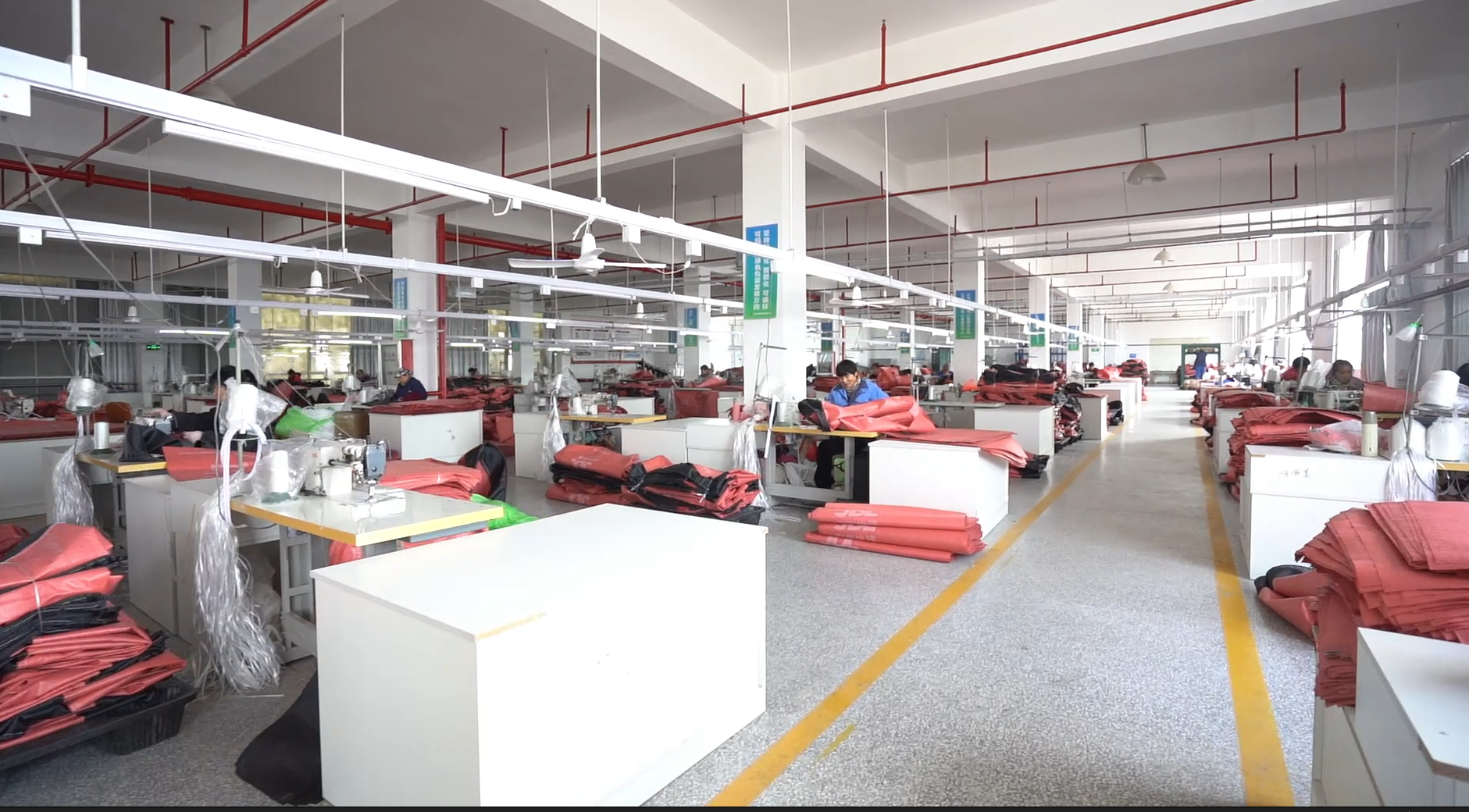
The supplier side of the fit question is about whether the specification can be produced as drawn. Yide Packaging is a manufacturer and customised packaging solution provider established in 2022, operating from Yancheng, Jiangsu, with a 120,000 m² factory, 130 employees and a 15-engineer technical team. Its FIBC production base covers approximately 80 mu with around 80,000 m² of standardised factory facilities, including a 5,000 m² food-grade clean workshop, and production is supported by 5G-connected production systems, robotic material handling, visual recognition technology and an in-house quality inspection team. For a buyer whose specification includes food-contact construction or a clean-area requirement, the food-grade workshop is the relevant capability; for a buyer whose specification is a straightforward powder bag, it is not a deciding factor.
The honest limitation is scope. Customisation covers dimensions, material, fabric weight, load capacity, safety factor, lamination, printing, colour, lifting structure, filling and discharge design, closure method, zipper structure, RFID and waterproof performance, with special materials excluded where they are unavailable. A requirement outside that list should be raised as a question before it becomes a line in a purchase order, because an unconfirmed requirement is the one most likely to be discovered at acceptance.
FAQ
Can bulk bag dimensions be customised to an existing filling line?
Yes, subject to material availability. Yide Packaging lists dimensions among the parameters open to customisation for bulk bag projects, alongside material, fabric weight, load capacity, safety factor, lamination, printing, colour, lifting structure and filling and discharge design, with the stated limit that special materials which are unavailable cannot be offered. In practice the filling-line interface is fixed first from the buyer's equipment drawing, covering spout diameter, spout length, inlet position and the height available under the filling head, and the internal volume is then set from fill mass and bulk density. A dimension change should be handled as a design change, with lifting configuration, fabric weight and SWL reconfirmed rather than assumed to carry over.
How does a buyer confirm the safe working load of a bulk bag?
The buyer confirms SWL by requiring the figure in writing for the specific bag design, together with the design factor applied and the standard basis for it, and by asking which type test report supports that design. ISO 21898:2024 sets out type test and marking requirements for FIBCs used with non-dangerous solid materials, which gives the buyer two checkable points: the report behind the design and the marking on the delivered bags. The declared SWL must also cover everything being lifted, including the product net weight, any liner, any pallet lifted with the bag and the bag's own weight. Where the area is a hazardous explosive atmosphere, electrostatic classification under IEC 61340-4-4:2018 is a separate requirement that SWL does not address.
Which filling and discharge options should a specification fix first?
The filling interface should be fixed first, because it is driven by equipment the buyer already owns and it constrains the bag's top geometry. A filling spout suits a fixed connection to a filling station or silo outlet; a full open top suits tipped or manual loading and requires a closure afterwards; a top cover addresses weather and contamination and can be combined with a spout. Discharge follows the receiving process: a discharge spout supports controlled emptying into a hopper or conveyor, while a flat bottom requires tipping or cutting and suits single-step emptying. Lifting configuration should be settled in the same pass, since loop arrangement has to match both the site's handling equipment and the rated SWL.
What acceptance evidence should accompany a bulk bag delivery?
A delivery should be checked against an approved sample and drawing, a dimension and volume record, a construction record covering fabric weight, coating, loop arrangement and seams, the stated SWL with its marking, the type test documentation that supports the offered design, and the quantity and packing record. Management system certification supports the process but does not replace lot-level inspection: Yide Packaging holds ISO 9001 certificate 12426Q00719R001, valid from 5 August 2026 to 4 August 2029, with a scope covering the manufacture of mail bags including FIBC, transit bags and woven bags. Test reports must also be read within their scope, since a report issued for one specific item does not certify a different product type.
What are the standard purchasing terms for custom bulk bags?
At Yide Packaging, spot goods carry a minimum order quantity of one piece with freight not included, while custom bags carry a minimum of 5,000 pieces. Free samples are available with shipping cost borne by the buyer, and samples are supplied without printing for customer confirmation. Customised products have a 45-day lead time excluding delivery time, against monthly capacity of 50,000 pieces. Delivery can be arranged by courier, air freight or logistics warehouse, payment terms are 30% deposit in advance with the 70% balance before shipment and are negotiable under special circumstances, and where bags are short, re-delivery or a corresponding deduction applies. These terms should be written into the purchase order rather than agreed informally.
Putting the five elements on one page
The procurement question behind most bulk bag orders is not which bag to buy but whether the bag on the drawing is the bag the filling line, the handling equipment and the acceptance inspection all describe. Dimensions, SWL, filling interface, discharge arrangement and lifting configuration answer that question together, and the standards give the buyer the checkable anchors: ISO 21898:2024 for materials, construction, design, type test and marking of FIBCs used with non-dangerous solid materials, IEC 61340-4-4:2018 where explosive atmospheres apply, and the applicable national or regional edition for the sourcing market. The commercial terms then determine how quickly the design can be sampled, produced and judged. Where a specification is still open, the practical next step is to consolidate those five elements into a single drawing, attach the filling-equipment data, and ask for the SWL and its design basis in writing before a sample is requested.
For readers who need the wider product and capability picture, the company brochure is available for download: Yide Packaging company brochure (PDF).
¿Tiene preguntas o necesita más detalles?
Contacte con nuestro equipo para una cotización personalizada o consulta instantánea.
Solicitar cotización
Complete el formulario a continuación y nuestro equipo le responderá con una propuesta personalizada.
Chat directo de WhatsApp
¿Prefiere chatear en tiempo real? Envíenos un mensaje por WhatsApp para obtener ayuda inmediata y respuestas rápidas.
- Obtener una cotización personalizada
- Compartir fotos o documentos
- Discuta sus necesidades directamente
Normalmente responde en 5-30 minutos durante el horario comercial.