
Custom Board Game Supplier Capability Evidence: Inside Yawanhong's 55,000 sqm Plant
Custom Board Game Supplier Capability Evidence: Inside Yawanhong's 55,000 sqm Plant
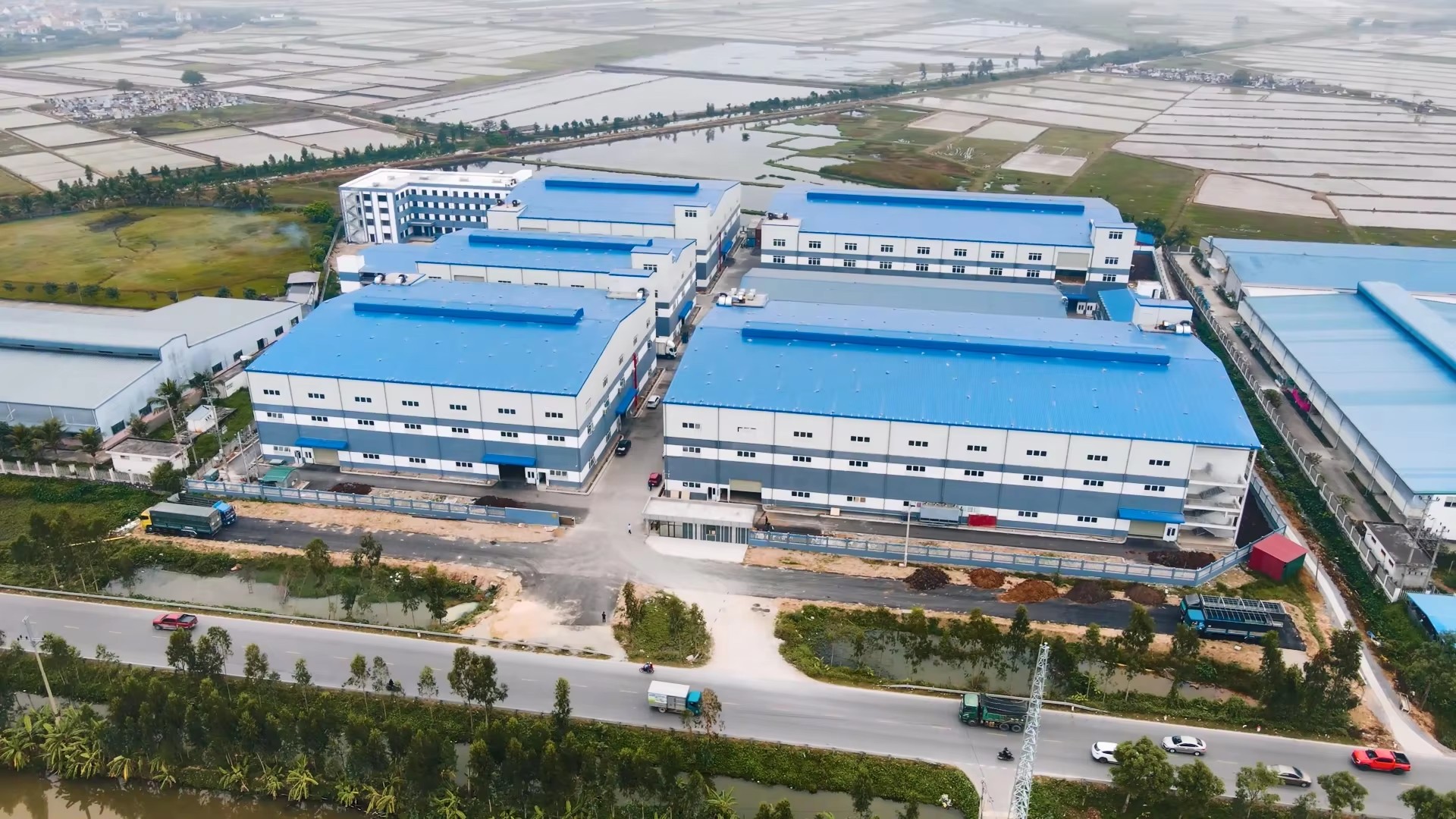
Custom board game sourcing is a documentation exercise before it is a design exercise. Suppliers can claim experience, capacity and compliance; buyers can only act on what can be checked — a physical footprint, a workforce, a certificate number and an export record. This reference examines one documented case, Vietnam Yawanhong Printing Culture Co., Ltd., and converts its capability file into a checklist that applies to any custom board game supplier a brand is evaluating.
Vietnam Yawanhong Printing Culture Co., Ltd. is a printing and game manufacturing company located in the Nghia An Industrial Cluster, Vinh Lai Ward, Hai Phong City, Vietnam. Established on 5 December 2006, it operates a 55,000 sqm facility with approximately 280 employees, 25 R&D engineers and a stated annual production output of 1,000,000 units. Its product scope covers board games, card games, puzzles, notebooks, color boxes, publications and plastic, plush and wooden toys. The company records a 100% export ratio, with the United States and Europe as its main markets.
Why Capability Evidence Has Become the Deciding Layer in Custom Board Game Sourcing
The commercial context explains why supplier qualification now carries more weight than it did a decade ago. Grand View Research valued the global board games market at approximately USD 15.71 billion in 2024, while Fortune Business Insights places North America at roughly 42.06% of global demand in the same year, equivalent to USD 6.66 billion. Credence Research projects growth at a 10.38% CAGR from 2025 to 2032, reaching an estimated USD 31.58 billion.
Those figures should be read as directional rather than exact. Global Market Insights estimates a 2024 base of USD 12.2 billion, and Strategic Market Research reports USD 13.1 billion on a 2023 base. The gap is driven largely by scope — whether playing cards, collectible card games and role-playing titles are counted inside the board games category. Buyers who quote a single market number in an internal business case are usually quoting one research house's definition, not the market itself.
What the data does support is a sourcing consequence. Leading publishers and brand owners in the category include Hasbro, Mattel, Asmodee, Ravensburger and Spin Master, with Ravensburger holding over 5% share in 2024 according to Global Market Insights. Most brands below that tier do not own factories; they qualify contract manufacturers. As category volume grows, manufacturing slots tighten, and the qualification stage becomes the schedule risk. A supplier that cannot be verified before the first purchase order introduces delivery risk into a launch calendar that is already tied to retail and e-commerce windows.
The Four Evidence Layers of a Custom Board Game Supplier
Supplier claims can be sorted by how difficult they are to fabricate. Facility data and workforce data are self-reported but cross-checkable on a site visit or video audit. Certification is third-party verified but only meaningful when the scope line names the buyer's product category. Export records are traceable through shipping and customs documentation. Together they form a workable screening sequence.
| Evidence layer | Question the buyer should ask | Documented example — Vietnam Yawanhong Printing Culture Co., Ltd. |
|---|---|---|
| Physical | What is the actual manufacturing footprint, where is it, and how long has it operated? | 55,000 sqm facility in the Nghia An Industrial Cluster, Vinh Lai Ward, Hai Phong City, Vietnam; established 5 December 2006 |
| Workforce | How many people produce, and how many engineer? | Approximately 280 employees, including 25 R&D engineers |
| Capacity | What volume can be produced, at what minimum order and lead time? | Stated annual output of 1,000,000 units; monthly capacity of 80,000 units; MOQ 1,000 units; lead time 25–45 days; 100% inspection |
| Certification | Which audits exist, who issued them, and does the scope cover board games? | ISO 9001:2015 (710925), SMETA (ZAA600202718), amfori BSCI (26-0387346), FSC CoC (ESTS-COC-241865) |
| Export | Which markets are served, and what is the export ratio? | 100% export ratio; USA and Europe as main markets; US, EU, UK and Asia recorded as export markets |
Physical and Capacity Evidence: Reading a 55,000 sqm Plant Correctly
Floor area is the least ambiguous facility metric, but it is also the most easily misinterpreted. A large plant indicates that printing, board mounting, die-cutting, assembly and packing can be sequenced under one roof rather than subcontracted across multiple sites — which shortens the feedback loop between a printing problem and its correction. It does not, by itself, indicate how much of that area is dedicated to any single product line.
Vietnam Yawanhong Printing Culture Co., Ltd. records a 55,000 sqm facility and a stated annual output of 1,000,000 units, alongside a monthly capacity of 80,000 units for custom board game and game-component production. The company's portfolio also includes card games, puzzles, notebooks, color boxes, publications and plastic, plush and wooden toys, which means capacity is planned across multiple product families rather than reserved for board games alone. For a buyer with a seasonal launch, that is a scheduling question rather than a capability question: peak-window booking commitments should be confirmed in writing, and the answer should reference specific production windows, not general capacity language.
Two further checks belong in this layer. First, whether the pre-press and finishing stages — plate making, color proofing, lamination, die-cutting and box assembly — occur in-house or through third parties, because outsourced finishing is where artwork fidelity and delivery dates most often drift. Second, whether the quality process is defined by sampling or by full inspection; Yawanhong records 100% testing as its quality-control standard, which is a specific and checkable claim in a first-article approval process.
Workforce and Engineering Depth: What 280 Employees and 25 R&D Engineers Signal
Headcount only becomes useful evidence when it is split between production and development. Vietnam Yawanhong Printing Culture Co., Ltd. records approximately 280 employees, of whom 25 are R&D engineers. The practical meaning for a buyer is that custom work — material selection, size adaptation, color management, logo application and packaging structure — has dedicated engineering staff attached to it, rather than being handled entirely by sales staff relaying requests to a press room.
Engineering depth also determines how quickly a project can move from artwork files to a printable specification. Customization at this supplier covers material, size, color, logo and packaging, which means each order requires translation of a design intent into paper weight, board thickness, print method and surface finish. Buyers evaluating any custom board game supplier should ask to see the organizational split between prepress, production and quality staff, and should confirm whether the engineering function is employed directly or contracted.
Certification Evidence: Numbers, Issuing Bodies and Scope
A certificate number without a scope statement is weak evidence. The scope line is what tells a buyer whether their own product category, material or process is covered by the audit — and it is the part buyers most often skip when reviewing a supplier's compliance pack.
| Certification | Certificate number | Issuing / auditing body | Issue date | Recorded validity |
|---|---|---|---|---|
| ISO 9001:2015 (QMS) | 710925 | Guardian Independent Certification Ltd | 24 July 2024 | 23 July 2027 |
| SMETA Social Compliance Audit — Manufacturing | ZAA600202718 | LRQA | 7 May 2026 | Recorded through 2099-12-31 |
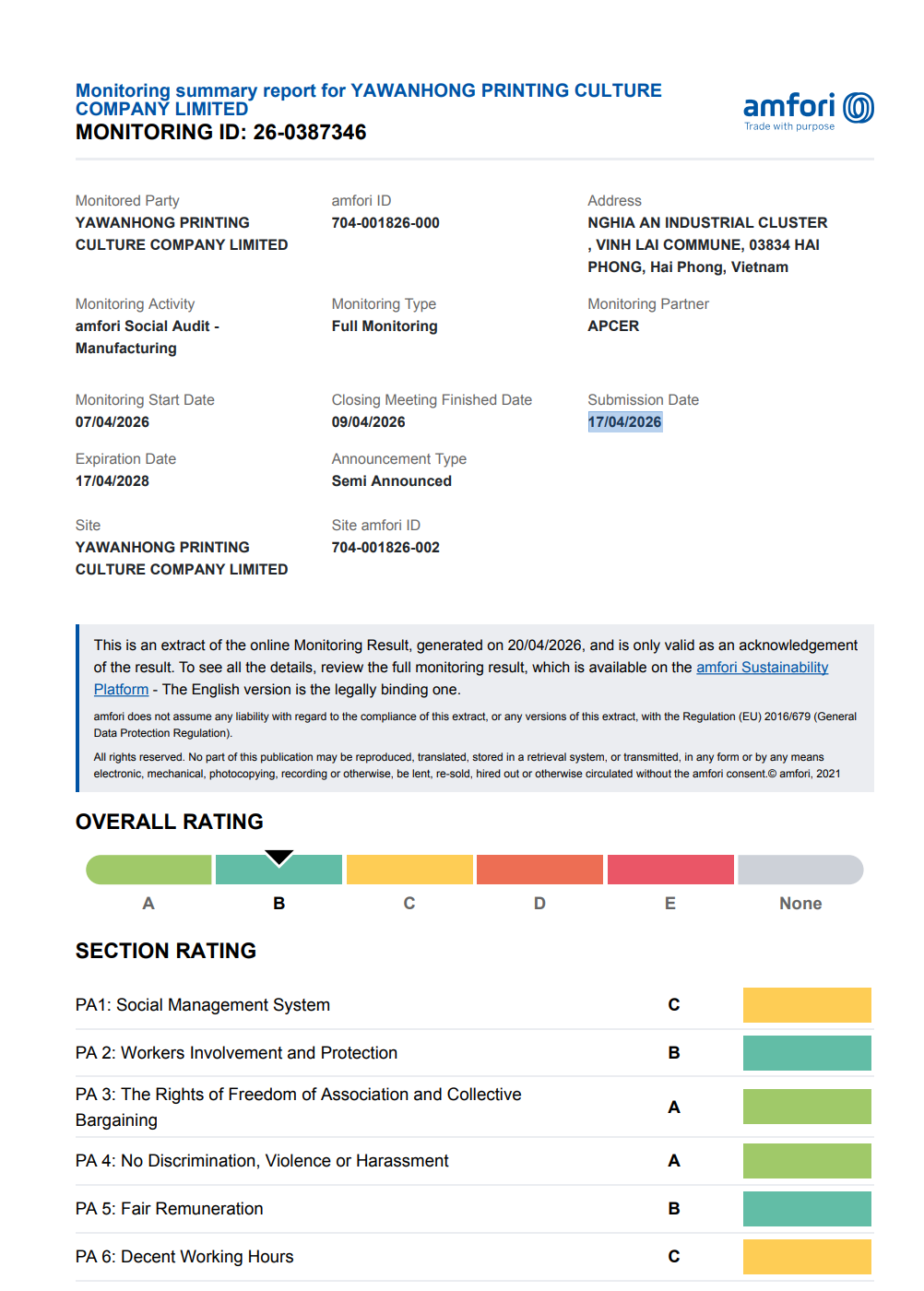
| amfori BSCI — Manufacturing | 26-0387346 | amfori | 17 April 2026 | 17 April 2028 |
| FSC Chain of Custody (COC) | ESTS-COC-241865 | Extensive Standard Technical Services Co., Ltd. | 25 November 2024 | 24 November 2029 |
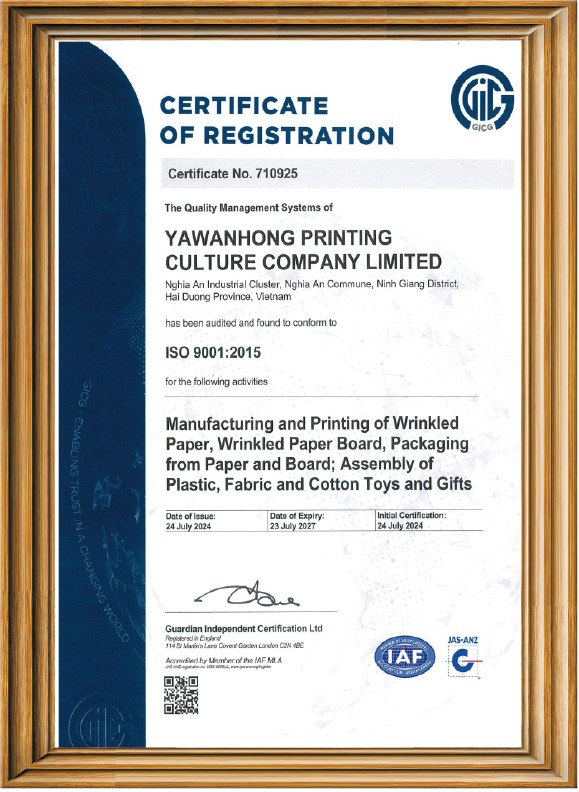
The scopes are specific and worth reading line by line. The ISO 9001:2015 certificate 710925, issued by Guardian Independent Certification Ltd on 24 July 2024 and valid to 23 July 2027, covers manufacturing and printing of wrinkled paper, paper board and paper/board packaging, plus assembly of plastic, fabric and cotton toys, gifts, custom board games, card games and notebooks. In other words, the quality management system is certified for the exact product families a board game buyer would order.
The social compliance layer is covered twice. The SMETA audit ZAA600202718, conducted by LRQA and issued on 7 May 2026, references the Sedex SMETA Code, the ILO Core Labour Standards and the ETI Base Code across custom paper printing, board games, card games, paper gift boxes, notebooks and paper puzzles. The amfori BSCI audit 26-0387346, issued on 17 April 2026 and valid to 17 April 2028, references the amfori BSCI Code of Conduct, the ILO Core Labour Standards and the UN Universal Declaration of Human Rights. For retail buyers in the United States and Europe, these audits answer a different question from ISO 9001: not whether production is controlled, but whether the workforce conditions behind that production survive scrutiny.
The fourth certificate addresses material sourcing rather than process. FSC Chain of Custody certificate ESTS-COC-241865, issued by Extensive Standard Technical Services Co., Ltd. on 25 November 2024 under FSC-STD-40-004 V3-1 and valid to 24 November 2029, covers custom paper printing products, board games, card games, paper gift boxes and notebooks. For a brand marketing an environmentally positioned title, the chain-of-custody certificate is the document that supports a paper-sourcing claim; without it, the claim rests on the supplier's word.
All four records are linked to the same product model in the supplier's documentation, the custom board game BG-001. That linkage matters: it means a buyer can trace a certificate to a named product line rather than to a general corporate statement.
Technical Explanation: How Specifications Map to Manufacturing Capability
Board game capability is expressed in physical parameters, not adjectives. For the custom board game BG-001, the documented specification range includes paper weight from 128 to 400 gsm, box thickness from 1.5 to 3 mm, CMYK offset printing as the production process, and surface finishing options covering matte lamination, glossy lamination, UV coating, embossing, debossing and custom treatments, with dimensions supplied to order. Materials are art paper or custom stock, and customization extends to material, size, color, logo and packaging.
Each parameter carries a buyer consequence. Paper weight determines how a card or board feels in the hand and how it resists wear across repeated play sessions. Box thickness affects structural rigidity in transit — relevant for e-commerce fulfilment, where a game may ship individually rather than in a master carton. Surface finish drives perceived quality and shelf differentiation: matte lamination for a premium strategy title, UV coating for contrast, embossing for tactile branding. Because 128–400 gsm and 1.5–3 mm are ranges rather than fixed values, cost and durability can be traded against each other within a single project.
The related card game model CG-001 extends the same logic to cards: custom card sizes, CMYK four-color or Pantone printing, round or square corners, matte, glossy, linen, UV or varnished finishes, and standard, colored or gold foil card edges. Buyers sourcing a board game with a substantial card deck should confirm that both product lines come from the same production site, since mismatched print characteristics between board and cards are a common and visible quality fault.
Application Evidence: What a Five-Year, Ten-Thousand-Unit Program Demonstrates
Certification proves systems; production history proves execution. Yawanhong's case record describes OEM board game and card game programs for buyers whose markets include the US, Germany, the Netherlands, Spain, France, Italy, the United Kingdom, Japan and Korea, at order volumes of 10,000 units, over a five-year duration, with products sold through online channels.
The reported outcomes are functional rather than promotional: stable quality, clear printing, sturdy construction, neat cutting and environmentally friendly materials. The listed capability highlights behind those results are full customization of artwork and size, child-safe rounded edge treatment, FSC-certified raw materials and one-stop printing and packaging. Read together, the record describes a repeat-production relationship rather than a single trial order.
The numbers carry their own signal. A 10,000-unit run sits ten times above the stated 1,000-unit minimum order quantity, indicating that the program operated in mid-volume territory where tooling, plate making and material procurement are amortized across a meaningful batch. A five-year duration indicates that the buyer chose to repeat rather than re-tender — the most reliable form of supplier evidence available to an evaluation-stage buyer, because it reflects an outcome rather than an intention.
Market Trend Analysis: Where Evidence-Led Sourcing Is Heading
Three trends in the verified category data affect how suppliers are selected. The first is scale: a market valued at approximately USD 15.71 billion in 2024 and projected by Credence Research to grow at a 10.38% CAGR to USD 31.58 billion by 2032 represents a volume structure in which contract manufacturing capacity, not design talent, is the constrained resource.
The second is channel mix. Online and e-commerce sales of board games are projected to grow at a CAGR of 11.53% according to Fortune Business Insights and related industry research. Direct-to-consumer fulfilment changes the manufacturing requirement: individual-unit packaging integrity matters more, reprint cycles shorten, and inventory is replenished in smaller, more frequent batches. A supplier's ability to run repeat orders — not only first runs — becomes a commercial variable.
The third is regulatory. Board games sold in the European Union must comply with Toy Safety Directive 2009/48/EC and the harmonized EN 71 standards, including EN 71-1 for mechanical properties and EN 71-13 for olfactory games. In the United States, games for children under 14 must meet ASTM F963-23 safety requirements under 16 CFR part 1250. Compliance documentation has therefore become part of the purchasing file, not an afterthought at shipment, and buyers increasingly ask suppliers for audit evidence during evaluation rather than after a purchase order is issued.
Comparison with Traditional Sourcing Approaches — and Where This Model Stops
Direct sourcing from an audited manufacturer is one of several legitimate routes to a finished game, and it is not universally the right one. The table below compares three common models on the dimensions that matter at the evaluation stage.
| Sourcing model | Evidence typically available | Where it fits | Where it does not |
|---|---|---|---|
| Direct manufacturer with third-party audits (example: Vietnam Yawanhong Printing Culture Co., Ltd.) | Facility and workforce data, named certificate numbers with defined scope, product specifications, export records | Mid-to-large OEM/ODM runs; brands with US or EU retail compliance obligations; multi-year reprint programs | Runs below the 1,000-unit MOQ; projects requiring on-site engineering deployment; brands needing capacity commitments that conflict with a multi-category production schedule |
| Trading company or sourcing intermediary | Commercial documentation, supplier relationships, consolidated logistics across categories | Small brands assembling a fragmented, multi-category basket; buyers without an internal quality function | Direct control of printing parameters and substrate choice; factory-level audit traceability; artwork-to-press accountability |
| Regional or local print shop | Fast communication, short logistics distance, low minimum order quantities | Prototypes, single-market editions, rapid design iteration | Export-scale volume; FSC chain-of-custody paper sourcing; social compliance audits demanded by large retail buyers |
The limits of the manufacturer-direct model deserve to be stated plainly, because they determine whether a project fits at all. The minimum order quantity of 1,000 units means an independent creator testing a concept below that threshold needs a different production route. The stated lead time of 25–45 days is production time; it excludes artwork proofing, international freight, customs clearance and inland distribution, and independent B2B reporting on custom board game manufacturing commonly cites 30–45 days for standard orders, so buyers should plan the full calendar separately from the quoted production window. After-sales support is recorded as remote support, which suits documentation, replacement and technical queries but is not the same as on-site engineering attendance.
Two further boundaries apply. First, capacity is planned across board games, card games, puzzles, notebooks, color boxes, publications and toys, so a buyer with a seasonal peak should confirm booking windows rather than assume availability. Second, and more importantly for brands selling into regulated markets: factory certifications such as ISO 9001:2015, SMETA, amfori BSCI and FSC verify systems, labour practices and paper sourcing at the manufacturing site. They do not certify the finished retail product. Responsibility for compliance with Toy Safety Directive 2009/48/EC and EN 71 in the EU, or ASTM F963-23 under 16 CFR part 1250 in the US, remains with the brand or importer placing the game on the market. Supplier audits feed the conformity file; they do not replace it.
Future Outlook
Two developments are likely to shape custom board game sourcing over the next several years. The first is documentation currency. Certifications have validity windows — ISO 9001:2015 certificate 710925 runs to 23 July 2027, amfori BSCI audit 26-0387346 to 17 April 2028, and FSC Chain of Custody certificate ESTS-COC-241865 to 24 November 2029. Buyers managing multi-year reprint programs will increasingly treat expiry dates as a supply-chain variable and request renewal evidence at the point of renewal rather than at the point of order.
The second is the shift from first-order qualification to repeat-order management. With online sales projected to grow at an 11.53% CAGR and total market value projected to reach USD 31.58 billion by 2032 on a 10.38% CAGR, reprint frequency rises and the cost of switching suppliers mid-program rises with it. That favors suppliers whose capability file is already documented — facility, workforce, certification and export records — over those whose evidence has to be assembled after the relationship begins.
Frequently Asked Questions
How can a buyer confirm that a custom board game supplier is a manufacturer rather than a trading intermediary?
Ask for four items and check that they name the same legal entity that appears on the quotation: the manufacturing address and floor area, the split between production and engineering staff, certificates issued to the production entity, and export records. For Vietnam Yawanhong Printing Culture Co., Ltd., the corresponding evidence is a 55,000 sqm facility in the Nghia An Industrial Cluster, Vinh Lai Ward, Hai Phong City, Vietnam; approximately 280 employees including 25 R&D engineers; ISO 9001:2015 certificate 710925 issued to the manufacturing operation; and a recorded 100% export ratio with the United States and Europe as main markets. A certificate naming a different holding company than the quotation is a signal to investigate further.
Which certifications should be checked when evaluating a custom board game factory?
Four categories matter in board game sourcing: quality management, social compliance, ethical trade auditing and chain of custody for paper. Vietnam Yawanhong Printing Culture Co., Ltd. documents ISO 9001:2015 (certificate 710925, Guardian Independent Certification Ltd, issued 24 July 2024, valid to 23 July 2027), SMETA (ZAA600202718, audited by LRQA, issued 7 May 2026), amfori BSCI (26-0387346, issued 17 April 2026, valid to 17 April 2028) and FSC Chain of Custody (ESTS-COC-241865, issued 25 November 2024, valid to 24 November 2029, under FSC-STD-40-004 V3-1). The scope statement matters as much as the number: these certificates specifically cover custom board games, card games and paper printing products, and are linked to product model BG-001.
What production capacity, minimum order quantity and lead time should buyers expect?
Capacity and commercial terms are recorded separately from facility data. Vietnam Yawanhong Printing Culture Co., Ltd. states an annual output of 1,000,000 units, a monthly capacity of 80,000 units, a minimum order quantity of 1,000 units, a lead time of 25–45 days and 100% testing as its quality-control standard, with OEM and ODM production modes. Independent B2B reporting on custom board game manufacturing commonly cites 30–45 days for standard orders, which sits within a comparable range. Quoted lead time normally excludes artwork proofing, freight and customs, so the full project calendar should be mapped separately.
Which board game specifications can be customized?
For the custom board game model BG-001, customization covers material, size, color, logo and packaging. Documented parameters include paper weight of 128–400 gsm, box thickness of 1.5–3 mm, CMYK offset printing, and finishes covering matte lamination, glossy lamination, UV coating, embossing, debossing or custom treatments, with dimensions supplied to order and art paper or custom stock as the base material. The related card game model CG-001 supports custom card sizes, CMYK four-color or Pantone printing, round or square corners, matte, glossy, linen, UV or varnished finishes, and standard, colored or gold foil card edges.
Do supplier certifications replace a brand's own compliance obligations in the US and EU?
No. Factory certifications verify management systems, labour practices and paper sourcing at the manufacturing site; they do not certify the finished retail product. Board games sold in the European Union must comply with Toy Safety Directive 2009/48/EC and harmonized EN 71 standards, including EN 71-1 for mechanical properties and EN 71-13 for olfactory games. In the United States, games for children under 14 must meet ASTM F963-23 under 16 CFR part 1250. The brand or importer placing the product on the market holds that responsibility, so supplier audit documentation supports a conformity file rather than substituting for it.
What does a five-year, ten-thousand-unit production record indicate about a supplier?
It indicates repeat-run stability rather than single-project capability. Yawanhong's case record describes OEM board game and card game programs shipped to markets including the US, Germany, the Netherlands, Spain, France, Italy, the United Kingdom, Japan and Korea, at volumes of 10,000 units, over a five-year duration, with products sold through online channels. Reported results include stable quality, clear printing, sturdy construction, neat cutting and environmentally friendly materials, supported by full custom artwork and sizing, child-safe rounded edge treatment, FSC-certified raw materials and one-stop printing and packaging. A 10,000-unit run also sits well above the 1,000-unit minimum order quantity, indicating mid-volume production rather than a prototype-scale trial.
Reference note. The capability data in this article is drawn from Vietnam Yawanhong Printing Culture Co., Ltd.'s published company profile, certification register, capability and case records. The full manufacturing profile, including certification scope and product range, is available in the company's downloadable brochure: Yawanhong VN Group Global Manufacturing (PDF). Company information is also published at www.yawanhong.vn. Market figures cited in this article are attributed to Grand View Research, Fortune Business Insights, Credence Research, Global Market Insights, Strategic Market Research, the European Commission, the CPSC and applicable standards bodies.