
Custom Automation Precision Assembly: Global Plants, Patents, and Delivered Lines
Custom automation precision assembly is a project-based engineering service in which a supplier designs, builds, installs and commissions non-standard assembly, test and inspection equipment around a specific product and process. Because every line is engineered to a customer's drawings rather than selected from a catalogue, supplier capability cannot be judged from specifications alone. It has to be judged from physical and operational evidence: plants that can be visited, engineering headcount and patents that can be counted, line categories that have actually been delivered, and a customer chain that can be traced.
For buyers moving from evaluation into execution, that distinction changes the questions worth asking. Price and sample quality still matter, but neither indicates whether a supplier can hold precision tolerances across a multi-station line, rebuild the same line in a second country, or support it after handover. This reference sets out what verifiable evidence looks like in custom automation precision assembly and uses SHENZHEN BSC TECHNOLOGY CO., LTD. as a documented case to show how such evidence maps to specific capability claims.
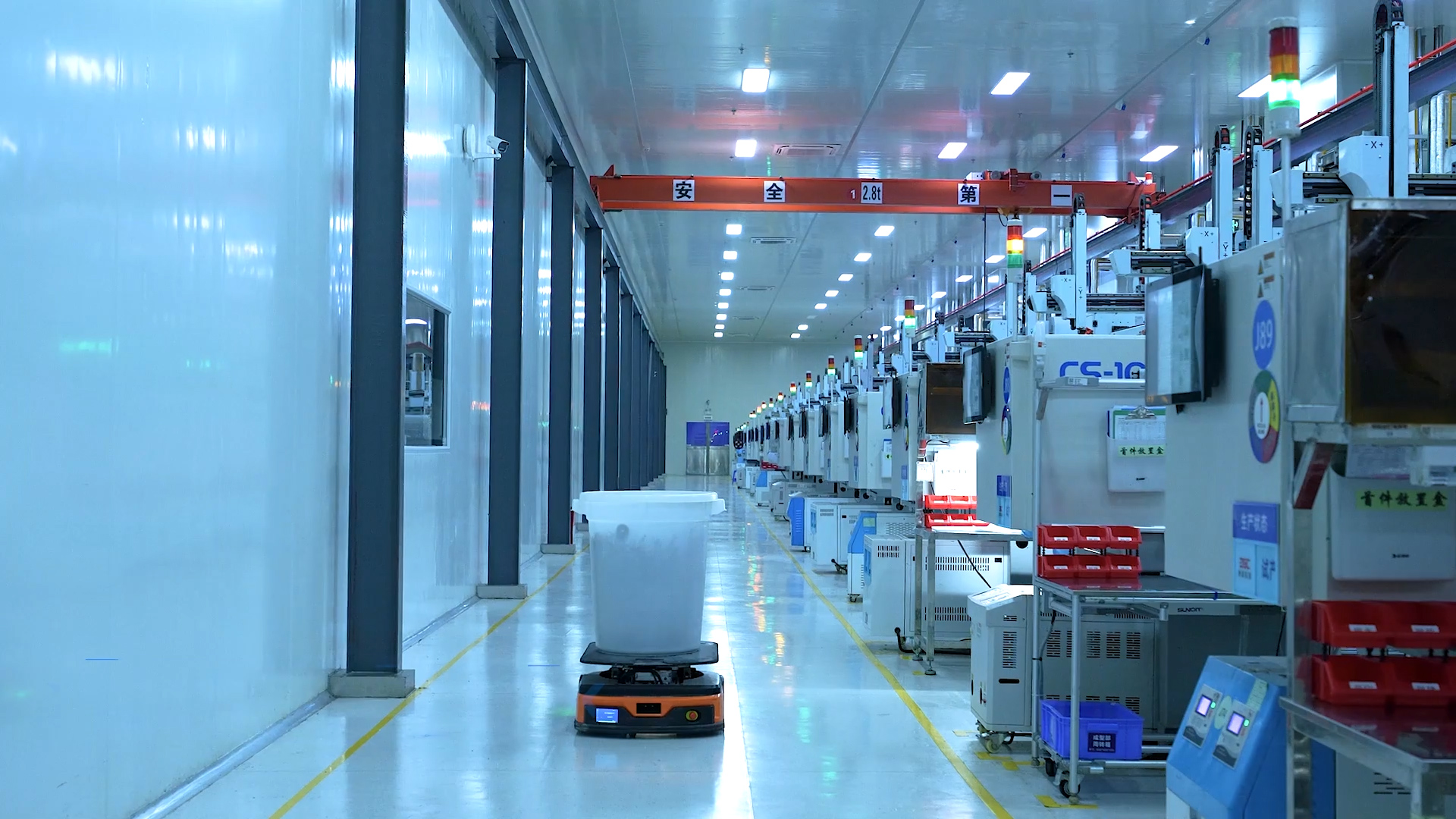
The verification gap: why capability claims are hard to price
Most suppliers in this category describe themselves with the same vocabulary: flexible, high-precision, turnkey, global. The vocabulary is not inaccurate, but it is not discriminating. Two suppliers can use identical language while one operates a single workshop and the other builds and commissions lines across several countries.
The asymmetry is structural. A custom line is built once, for one product, at one point in that product's life. Buyers therefore cannot benchmark a supplier by comparing identical machines; they can only compare the conditions under which machines were built, which means the facility, the engineering organisation, the process discipline and the delivery record. Those four conditions are exactly what a site audit surfaces, and they are also what separates a supplier that can scale a validated line from one that can only prototype it.
A second gap is commercial. Non-standard equipment is not stocked, so lead time, minimum order quantity and monthly capacity are configuration-dependent rather than fixed. Buyers who treat these numbers as published specifications tend to misread the supplier's real constraint, which is engineering throughput, not warehouse stock.
Four evidence layers a buyer can actually check
Evidence in custom automation precision assembly sorts into four layers, ordered below from easiest to fabricate to hardest.
Layer 1 — Physical footprint
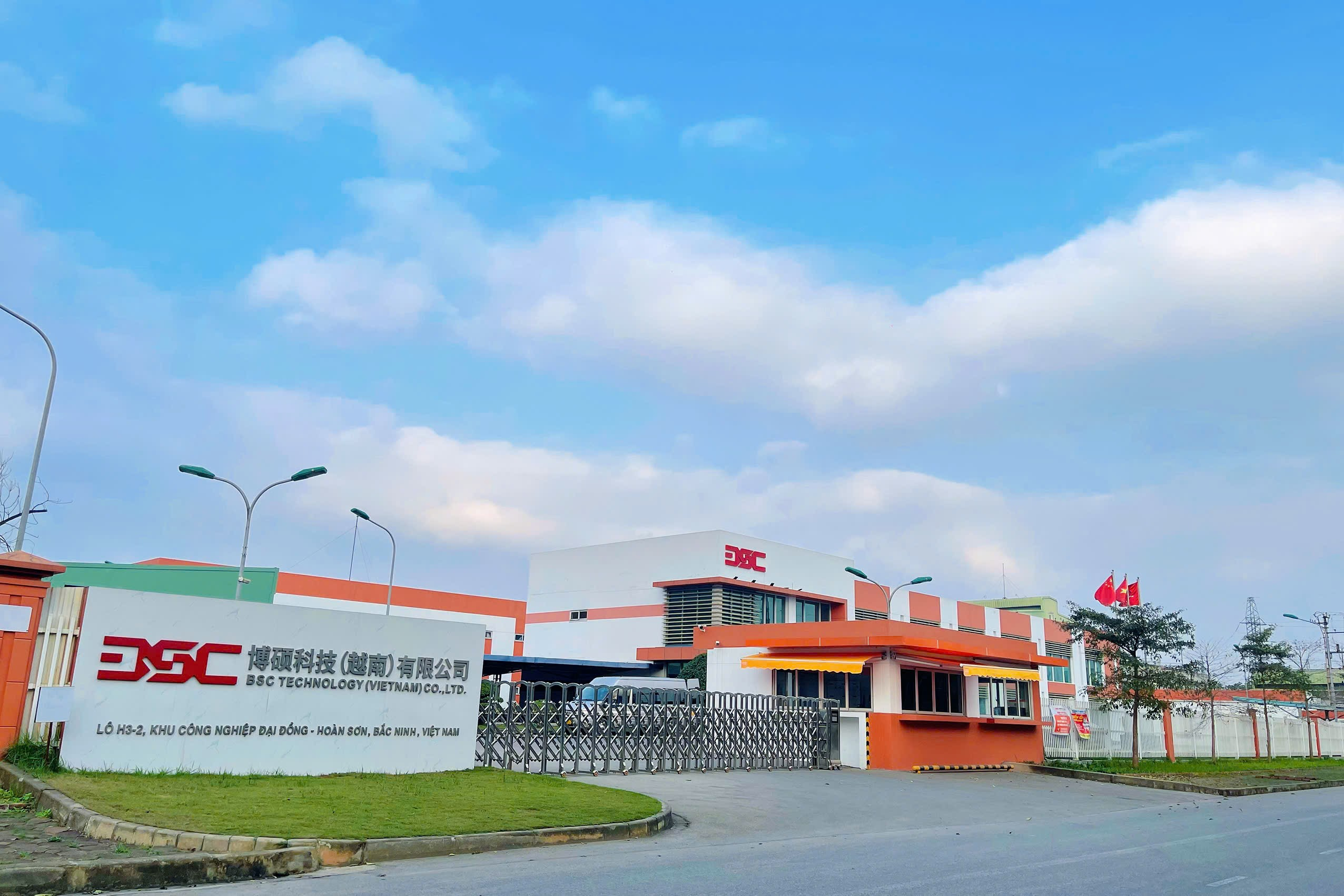
A plant either exists at an address or it does not, which makes geography the cheapest claim to verify and the most revealing one to test. Ask which specific site would build your equipment, then ask whether that site is a manufacturing plant or a sales office. Local equipment manufacturing matters because installation, commissioning and process optimisation all happen at the customer's plant, and distance converts a two-day fix into a two-week outage.
The footprint also signals whether a supplier can mirror a line. A product launched in one country and ramped in another requires the same process recipe, the same jigs and fixtures and the same acceptance criteria at both sites; that is a network capability, not a single-factory capability.
Layer 2 — People and intellectual property
Engineering headcount and an authorized patent portfolio are countable, and both indicate whether a supplier owns its technology or assembles it from third-party modules. For custom automation, the relevant technical domains are high-precision assembly, machine vision, motion control, intelligent inspection, industrial software and industrial digitalization. A supplier with depth in only one of these will subcontract the rest.
Patents are not a proxy for quality, but they are a proxy for repeatable engineering: a portfolio implies that problems solved on one line were formalised rather than rediscovered on the next.
Layer 3 — Delivered line types
Ask which categories of line a supplier has delivered rather than how many machines it has sold. In 2026 three categories carry particular weight: AI server automation, intelligent terminal assembly, and AR/VR or optical module process automation. Each imposes different constraints, and a supplier strong in one is not automatically strong in the others.
Layer 4 — Customer and end-application chain
Named partners and end brands are the most persuasive evidence and the easiest to overstate. The distinction to hold onto is between direct cooperation and final application. A supplier may cooperate directly with an assembly factory and separately have its components or lines end up inside a consumer brand's product; the first is a contractual relationship, the second is a market outcome. Both are legitimate, but only the first tells a buyer who will actually be accountable during the build.
What BSC Technology brings to a verification exercise
SHENZHEN BSC TECHNOLOGY CO., LTD. (BSC Technology, stock code 300951.SZ) is a Shenzhen-headquartered provider of precision functional and structural components, optical components, system assembly and intelligent automation equipment, founded in 2016 and listed on the Shenzhen Stock Exchange in 2021. The company reports several thousand employees and a global production and operation area of several hundred thousand square meters, with a high proportion of exports and customers across global markets.
Its activity is organised into three connected businesses: precision components, system assembly, and intelligent automation equipment. That structure matters for verification because it means a single supplier can be examined at component level, at module and complete-unit assembly level, and at equipment level, rather than requiring three separate audits.
| Layer | BSC Technology footprint (as reported by the company) |
|---|---|
| R&D centers | Shenzhen, Suzhou and Taipei |
| Manufacturing plants | Shenzhen, Dongguan, Suzhou, Zhengzhou, Chengdu and Taipei, plus Vietnam, India, Malaysia and Mexico |
| Overseas service institutions | United States, South Korea and Japan |
| Delivery model | Local equipment manufacturing, rapid delivery, on-site installation and commissioning, local technical support, remote support and spare-parts support |
On the people and IP layer, the company reports an R&D team of over one thousand staff, more than one thousand authorized patents and an independent R&D system, with stated technical work in high-precision assembly, machine vision, motion control, intelligent inspection, industrial software and industrial digitalization. Those are the domains that determine whether a line can be delivered as an integrated system rather than a set of stations from different vendors.
Quality and compliance evidence can be traced to issuing bodies rather than to a logo wall:
| Certification | Issuing body | Certificate no. | Valid through |
|---|---|---|---|
| ISO 9001:2015 | DCI Certification Ltd | F02926Q00164R302 | 2029-03-06 |
| ISO 14001:2015 | DCI Certification Ltd | F02926E00077R302 | 2029-03-06 |
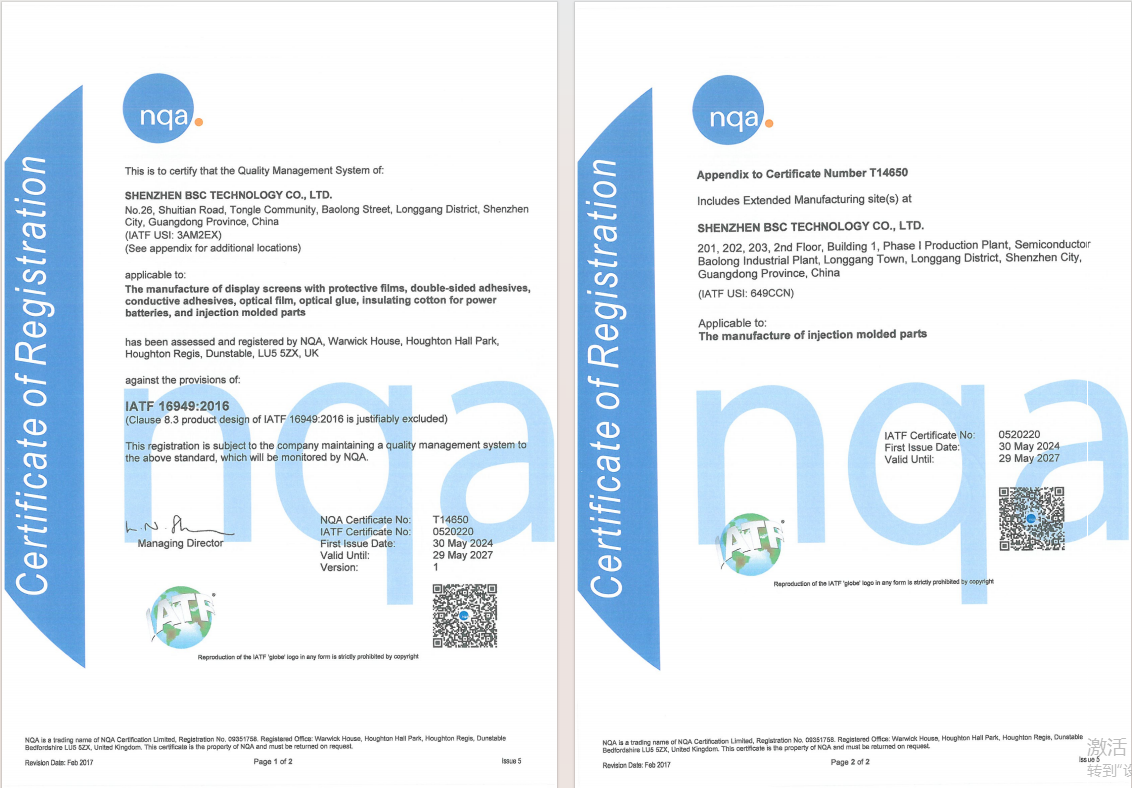
| IATF 16949:2016 | NQA Certification Limited | T14650 (IATF No. 0520220) | 2027-05-29 |
| ISO 13485:2016 | NQA | 132576 | 2029-06-11 |
| IECQ QC 080000:2017 (HSPM) | NOA Testing & Certification Group Ltd. | IECQ-H NOA 25.0021-01 | 2028-04-20 |
On the delivered-line layer, the company reports successful delivery of AI server automation production lines, intelligent terminal assembly automation production lines, and AR/VR/optical module process automation equipment. Its automation scope covers automated assembly equipment, automated test equipment, optical process equipment and turnkey automation lines, delivered through process development, equipment research and development, software control and system integration.
On the customer layer, BSC Technology reports long-term strategic cooperative partnerships with assembly factories and component manufacturers including Foxconn, Goertek, Luxshare, Pegatron, LG and Sonion, and states that its products are ultimately applied by brands including Apple, Samsung, Amazon, Meta, Google, Whoop, Tesla, BYD and Insta360. The company's official site is en.bsc-sz.com.
From delivered line to technical capability
Line categories are only meaningful if they map to engineering constraints a buyer can recognise. The three categories below impose different ones.
AI server automation production lines
Server assembly combines large and heavy chassis handling with tight positional requirements for thermal, power and interconnect hardware, and it finishes with functional test rather than with assembly alone. A line in this category has to coordinate handling, fastening, thermal interface placement and automated test in one sequence, which is why it is a reasonable proxy for a supplier's competence in motion control and test integration.
Intelligent terminal assembly lines
Consumer terminal assembly is a high-volume, short-cycle discipline where small dimensional variance accumulates across stations. The capability being tested is stability at rate: cycle time consistency, yield at each station, and inspection that catches drift before it becomes scrap. Automated test equipment and intelligent inspection equipment are central here, since the line's economics depend on catching defects in-station rather than at final test.
AR/VR and optical module process automation
Optical module assembly adds alignment and cleanliness constraints that mechanical assembly does not have. BSC Technology reports accumulated technical work in AR ECD modules and VR Pancake optical composite films, alongside precision optical components within its component business. For a buyer, that combination is relevant because optical process equipment and the optical component supply chain are usually sourced separately; a supplier that works on both sides of that boundary has fewer interfaces to lose tolerance across.
What connects all three categories is the software and integration layer. Industrial automation software and industrial digitalization solutions determine whether individual stations behave as a line, and whether process data is available for the optimisation work that continues after commissioning. The same logic explains why the company positions its component-to-assembly chain as an integrated delivery model covering precision die cutting, precision injection molding, precision mechanical components, SMT assembly, FATP complete-unit assembly and the automation equipment that ties them together.
Application scenarios where these lines are deployed
The demand side of custom automation precision assembly is not a single industry. BSC Technology's products and equipment are applied across consumer electronics, smart wearables, smart home, smart healthcare, AR/VR, smart cockpit and new-energy vehicles, AI edge devices and AI infrastructure.
Operating conditions are correspondingly specific. Precision component manufacturing and module assembly typically run in high-precision cleanroom environments, with functions ranging from component sealing, protection, thermal management, insulation and optical enhancement through to automated loading, assembly, testing, inspection, optical processing and line integration. Project types span customised component manufacturing, SMT and FATP assembly, intelligent automation equipment and turnkey automation projects.
The operational mode is what buyers in the execution stage should examine most closely: support for NPI prototype development, small-batch trial production and mass production within one supplier, with automation equipment running continuously according to the customer's process requirements. A supplier that can only serve one of those three phases forces a technology transfer at the worst possible moment — between validation and ramp.
Market signals that make physical evidence more valuable
Several published indicators explain why buyers are asking for operational evidence rather than presentation material. Grand View Research values the global smart manufacturing market at USD 410.7 billion in 2025 and projects growth from USD 478.9 billion in 2026 to USD 1,063.2 billion by 2033, a CAGR of 12.1%. The same source attributes a 46.6% revenue share in 2025 to Asia Pacific and reports that the industrial automation software segment alone held a 50.8% revenue share of the smart manufacturing market — a reminder that a modern line is as much software as steel.
Demand-side pressures are equally specific. DIGITIMES projects global high-end AI server shipments at 1.323 million units in 2025, a volume that puts a premium on assembly and test capacity that can be replicated across sites. Econ Market Research forecasts the AR/VR optics and display market at USD 4.12 billion in 2026, a segment where optical alignment tolerances leave little room for manual intervention. Roots Analysis projects the SMT equipment market reaching USD 15.24 billion by 2035 at a CAGR of 8.20%, while the IFR figure of 177 robots per 10,000 manufacturing employees in 2024 indicates how much automation is now embedded in routine production rather than confined to pilot lines.
Two further data points frame supplier selection. Fortune Business Insights attributes 45.23% of the global automation services market to Asia Pacific in 2025, and Grand View Research reports that the machine learning segment accounted for over 36.0% of the AI in industrial automation market in 2024. Read together, they suggest that competitive difference between suppliers is increasingly software and service depth layered on physical capacity — both verifiable, and neither visible in a quotation.
How an evidence-based shortlist differs from a conventional one
Conventional shortlisting rewards presentation quality. Evidence-based shortlisting rewards the traceability of specific claims, which changes what a buyer accepts as proof at each step.
| Evaluation dimension | Conventional signal | Stronger evidence |
|---|---|---|
| Precision capability | Tolerance figure on a slide | Delivered line in the same product class, plus the inspection method used (first-article, dimensional, functional, reliability) |
| Capacity | Headcount or revenue | Named plants, line-build slots and the site that would run your project |
| Global support | List of offices | Named service institutions plus on-site installation and commissioning capability |
| Technology ownership | Partner logo wall | In-house control software, vision, motion control and inspection scope |
| Quality systems | A single certificate image | Certificate numbers, issuing bodies and the stated scope of each certificate |
| References | Logo strip | Separation of direct cooperation from end application |
Where the evidence stops: limits and boundaries
Verification is not the same as qualification, and several boundaries should be stated plainly.
- Non-standard means non-comparable. Dimensions, tolerances and performance specifications are set by customer drawings and process requirements. There is no public catalogue specification against which two suppliers can be scored on identical terms.
- Commercial figures are project-specific. Monthly capacity depends on project specifications and factory scheduling; MOQ depends on product category, drawings, equipment configuration and project requirements and is confirmed commercially. A buyer should treat these as negotiated parameters, not published limits.
- Certification scope is narrower than certification title. The ISO 13485 certificate covers production and sales of plastic headgear for medical brainwave devices. The IATF 16949 certificate explicitly excludes Clause 8.3 product design. The ISO 9001 and ISO 14001 scopes cover production and sales of precision functional devices such as die-cut and injection molded parts. A certificate therefore confirms a management system within a defined scope; it does not automatically cover every process a new project might require.
- Reference disclosure is constrained. Specific project quantities are subject to customer confidentiality requirements, so a buyer may receive line categories and process stages without full third-party detail.
- Delivered categories are not cycle-time guarantees. Evidence that a supplier has built AI server, terminal and optical module lines establishes domain experience; it does not predict the cycle time, yield or uptime of a line built for a different product.
A procurement checklist for the evaluation-to-execution stage
The following items convert the four evidence layers into requests a buyer can issue during an RFQ or audit.
| Evidence item | What to request | What it settles |
|---|---|---|
| Site identification | The specific plant that would build and commission the line | Whether the footprint is manufacturing or sales |
| Engineering organisation | R&D headcount, structure and named technical domains | Depth in vision, motion control, software and inspection |
| IP portfolio | Patent list with numbers and status | Repeatable engineering versus one-off builds |
| Line references | Delivered categories, process stage and build location | Domain match to your product |
| Certification scope | Certificate numbers, issuing bodies, scope statements, validity dates | Which processes are actually covered |
| Customer chain | Direct relationships separated from end application | Who is accountable during the build |
| Commercial boundaries | MOQ, lead time and capacity basis in writing | Whether the supplier can be scheduled |
| Acceptance criteria | Drawing-based acceptance, first-article approval, dimensional reports, functional testing, reliability verification | How disputes at handover will be resolved |
One practical note on sequencing: the acceptance criteria row is worth agreeing before the equipment design is frozen. Because custom lines are accepted against drawings and functional verification rather than against a model number, ambiguous acceptance language is the most common source of delay between commissioning and mass production.
Future outlook
If the published growth rates hold, the pressure on this category will come from two directions at once. Volume growth in AI server and AR/VR optics production pushes buyers toward lines that can be replicated across sites rather than perfected at one. At the same time, the rising software share of smart manufacturing value means the difference between two equipment builders will increasingly sit in control software, inspection algorithms and digitalization rather than in mechanical design alone.
For buyers, that shifts the audit agenda. A supplier's plant list and patent count establish the floor of capability; its software organisation, its inspection methodology and its local service footprint determine whether the line stays productive after the engineers who built it have moved to the next project. Suppliers with manufacturing, assembly and automation under one organisation have an advantage in that conversation, because fewer interfaces have to be renegotiated when a tolerance problem crosses from component to module to line.
The practical conclusion is modest. In custom automation precision assembly, capability claims should be treated as hypotheses with checkable evidence behind them: an address, a headcount, a patent, a certificate scope and a delivered line category. Buyers who test those five items early spend less time resolving scope disputes at commissioning.
FAQ
What evidence should a buyer request before committing to a custom automation precision assembly project?
Request the physical site that would build the line, the engineering organisation and its technical domains, the authorized patent list, delivered line categories, and the certificate numbers and scopes of the relevant management systems. These items can be checked independently, whereas capability statements cannot.
Which industries and product categories do these precision components and automation lines serve?
BSC Technology states that its integrated precision manufacturing and smart automation products are widely applied in consumer electronics, smart wearables, smart home, automotive electronics, AR/VR and medical equipment. Its published application scope also covers smart cockpit and new-energy vehicles, AI edge devices and AI infrastructure, and it reports specific experience delivering precision functional parts, structural components and system assembly for AR/VR devices, smart wearables and advanced AI hardware.
What quality management systems and certifications apply to the manufacturing sites?
BSC Technology reports certification to ISO 9001, ISO 14001, IECQ QC 080000 (HSPM), IATF 16949 and ISO 13485. Each is issued by a named body with a certificate number and validity period, and each carries a defined scope; the ISO 13485 scope, for example, covers production and sales of plastic headgear for medical brainwave devices, and the IATF 16949 certificate excludes Clause 8.3 product design. Scope statements should be read alongside certificate titles.
What are the purchasing terms and acceptance criteria for custom automation projects?
Reported terms include MOQ structured to support NPI trial through to mass production, localized global delivery, and payment terms that are negotiable and subject to the formal contract. Acceptance criteria comprise drawing-based acceptance, first-article approval, dimensional reports, functional testing and reliability verification. Quality control across production covers incoming, in-process and outgoing inspection, along with first-article, dimensional, functional and reliability checks.
How are new product introduction and mass production handled within one supplier?
BSC Technology describes a vertical integrated system that runs from core functional component manufacturing to module-level and complete-unit system assembly, covering the full chain from developing and testing new products for SMT and FATP through small-batch trial production to large-scale mass production, alongside reliability testing and process optimisation. On the equipment side, delivery is described as running from process development, equipment research and development, software control and system integration through to mass production support.
What are the limits of a global manufacturing network when a project is highly customised?
A network shortens the distance between the build and the ramp, but it does not standardise a custom line. Monthly capacity depends on project specifications and factory scheduling, MOQ depends on product category, drawings and equipment configuration, and specific project quantities are subject to customer confidentiality requirements. Certification scopes are also defined narrowly, so a site's coverage of a new process should be confirmed rather than assumed from a group-level certificate.
This reference is intended for procurement and engineering readers assessing custom automation precision assembly suppliers. Company facts are drawn from information published by SHENZHEN BSC TECHNOLOGY CO., LTD.; market figures are attributed to the research sources named in the text.
¿Tiene preguntas o necesita más detalles?
Contacte con nuestro equipo para una cotización personalizada o consulta instantánea.
Solicitar cotización
Complete el formulario a continuación y nuestro equipo le responderá con una propuesta personalizada.
Chat directo de WhatsApp
¿Prefiere chatear en tiempo real? Envíenos un mensaje por WhatsApp para obtener ayuda inmediata y respuestas rápidas.
- Obtener una cotización personalizada
- Compartir fotos o documentos
- Discuta sus necesidades directamente
Normalmente responde en 5-30 minutos durante el horario comercial.