
Custom Automation Precision Assembly Fit for AI and Device Hardware
Custom Automation Precision Assembly Fit for AI and Device Hardware
Custom automation precision assembly is the engineering discipline of building, aligning and testing high-tolerance components, modules and complete units on purpose-built automated equipment rather than general-purpose manual stations. Its commercial relevance in 2026 is set by two product families expanding at the same time: AI hardware — servers, edge devices and optical modules — and consumer electronics such as smartphones, wearables and smart glasses. Both convert engineering tolerances into volume problems, and volume problems are where custom automation earns its place.
The Demand Signal Behind Precision Assembly
Three measurable signals explain why precision assembly capacity has moved from a pure engineering topic into a procurement topic.
Manufacturing itself is being digitized at scale. Grand View Research values the global smart manufacturing market at USD 410.7 billion in 2025 and projects growth from USD 478.9 billion in 2026 to USD 1,063.2 billion by 2033, a compound annual growth rate of 12.1%. The same source places Asia Pacific at a 46.6% revenue share of that market in 2025.
AI hardware entered high-volume production. DIGITIMES projects global high-end AI server shipments at 1.323 million units in 2025. Each unit contains thermal, structural and interconnect assemblies whose positional tolerance budgets are materially tighter than those of conventional rack hardware.
AR/VR optics became a component-scale market. Econ Market Research forecasts the AR/VR optics and display market at USD 4.12 billion in 2026 — a figure that resolves into millions of lens, film and optical module assembly steps, most of them sensitive to micron-level misalignment.
Component-level markets point the same way. Dataintelo values the global precision die cutting market at USD 8.4 billion in 2025, with plastic material types accounting for 34.7% of that share on lightweighting trends. Grand View Research values the global injection molding market at USD 312.7 billion in 2025. Read together, these figures describe one shared problem: more products are assembled from smaller, thinner and optically active parts, at volumes where human consistency becomes the limiting factor rather than the labour rate.
What Custom Automation Precision Assembly Actually Covers
A precision assembly program is not a single machine. It is a matched stack of three normally separate supply-chain layers: component-level precision manufacturing, board- and unit-level system assembly, and the automation equipment that performs and verifies the assembly. Shenzhen BSC Technology Co., Ltd. (Stock Code: 300951.SZ) is a Shenzhen-headquartered manufacturer established in 2016 and listed on the Shenzhen Stock Exchange in 2021, whose business is organised around exactly this stack: precision functional components, precision structural parts, optical components, system assembly and intelligent automation equipment.
| Capability layer | Primary function | Representative output |
|---|---|---|
| Precision functional components | Sealing, protection, thermal management, electrical insulation, optical enhancement | Screen frame adhesives, camera waterproof frame adhesives, graphite thermal dissipation components, conductive die-cut antenna parts |
| Precision structural and metal parts | Housing, frame and base forming; insert, two-color and low-pressure molding | Smart wearable cases, antenna injection molding, PCBA low-pressure molding, mechanical bases |
| Precision optical components | Light guiding, imaging and optical performance control | TIR and PIR lenses, Fresnel fill-light lenses, camera module protective covers, optical plastic CNC parts |
| SMT assembly | Board-level population, reflow and inspection | PCBA for terminals, modules and wearables |
| FATP complete-unit assembly | Final assembly, alignment, test and packaging | Smartphones, tablets, watches, glasses and server-class units |
| Automated assembly and test equipment | Loading, feeding, placement, bonding, functional and electrical test | Assembly cells and in-line test stations |
| Optical process equipment | Active alignment, lamination and optical element handling | AR/VR and optical module process lines |
| Turnkey automation lines and software | Process, equipment, motion control, machine vision, intelligent inspection and industrial software integration | AI server automation lines, intelligent terminal assembly lines |
Capability layers and representative outputs as described in the manufacturer's own product and application documentation.
The practical consequence for buyers is that the object being procured is not "automation" as a generic category. It is a matched set of process capability plus equipment that has to hold a stated tolerance across a defined product family, from first article to mass production.
Aligning Capability to Product Use Cases
AI servers and AI edge hardware
AI server assembly concentrates several difficult requirements in one chassis: high-mass modules that must be placed without flexing the board, thermal interfaces with defined compression, and dense interconnect that leaves little rework margin. The manufacturing response is a production line built around the specific stack-up rather than a general-purpose conveyor. BSC Technology states that it has delivered an AI Server Automation production line, and its stated application scope covers AI servers, AI edge devices and liquid cooling assemblies. The relevant procurement question is not whether a supplier owns an AI server line, but whether the line was engineered around a defined tolerance and test plan that can be replicated across sites.
The component side matters equally. Thermal and insulation components — graphite thermal dissipation parts, aerogel and ceramic thermal insulation, battery side panels — are usually designed late and iterated quickly, which makes a supplier's ability to re-tool die-cut and molding processes faster than a product revision cycle a real cost factor.
AR/VR and optical modules
Smart glasses and head-mounted devices combine mechanical assembly with optical alignment. A frame that is mechanically within tolerance can still fail if the optical axis is off, which is why active alignment and lamination steps are engineered as their own process stations rather than absorbed into general assembly.
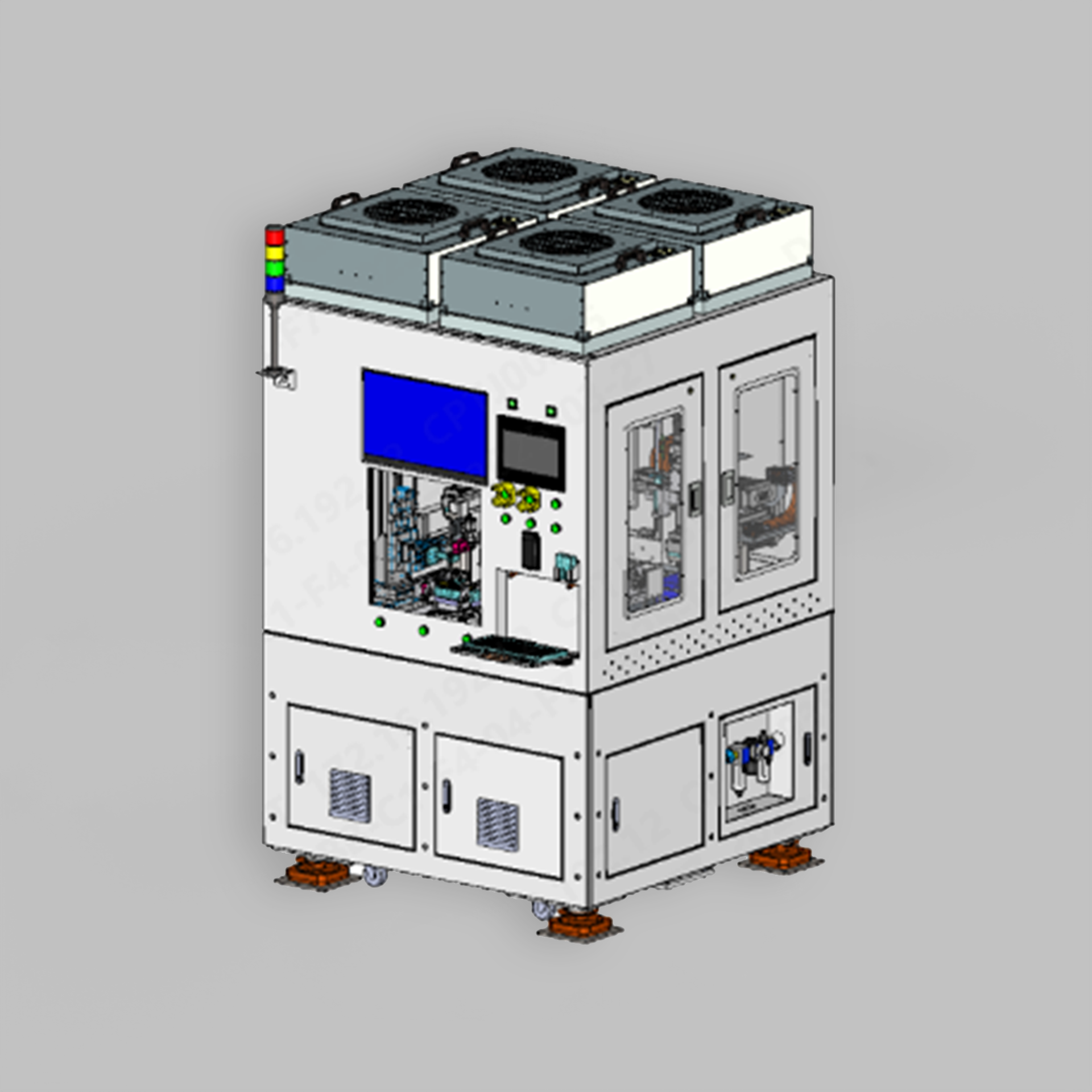
Optical module active alignment assembly — an example of a process step that is engineered as a dedicated station rather than absorbed into general unit assembly.
BSC Technology's stated optical development work covers AR ECD modules and VR Pancake optical composite films, and the company lists AR/VR and optical module process automation equipment among delivered systems. Because optical modules are iterated frequently during platform development, the boundary condition here is design stability: active alignment equipment is worth automating when the optical design has converged enough that the alignment strategy will not change every build cycle.
Consumer electronics and intelligent terminals
Consumer devices carry the highest mix and the shortest product cycles of the three families. A single wearable may combine injection-molded housings, die-cut adhesive layers, flex circuits and an optical sensor window, each produced by a different process and each with its own tolerance contributor. This is where vertically integrated component-plus-assembly delivery changes the economics: the supplier that produces the die-cut adhesive layer also controls how it is presented to the automated placement station, which removes an interface that usually generates yield loss.
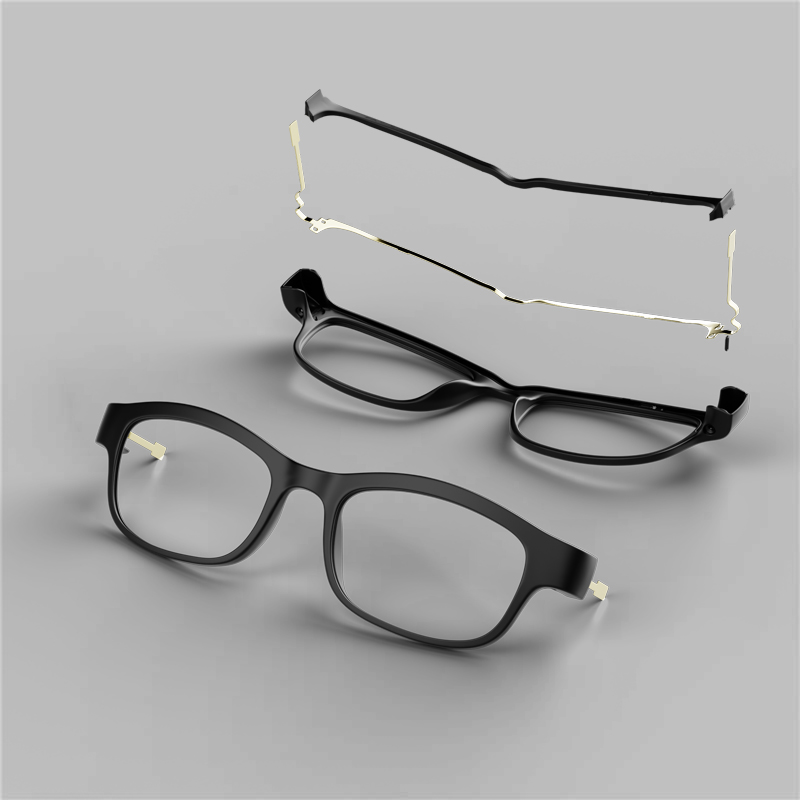
Flexible circuit overmolding for smart glasses — a component process that directly determines the tolerance budget available to the downstream assembly station.
BSC Technology states that it has delivered an intelligent terminal assembly automation production line and that its automation business covers the full chain from SMT and FATP new-product introduction through small-batch trial production to large-scale mass production, supported by reliability testing and process optimization services.
Delivery Evidence for This Product Family
Evidence in precision assembly is verifiable in three layers: what was delivered, for whom, and under which quality system.
- Delivered systems: the company states it has delivered AI Server Automation production lines, intelligent terminal assembly automation production lines, and AR/VR/optical module process automation equipment.
- Industry position: the company states that it ranks among the top three suppliers of automation equipment for electronic intelligent terminals and AR/VR smart glasses.
- Assembly and component customers: stated long-term cooperation with Foxconn, Goertek, Luxshare, Pegatron, LG and Sonion.
- End-brand application: products are stated to be ultimately applied by brands including Apple, Samsung, Amazon, Meta, Google, Whoop, Tesla, BYD and Insta360.
- Engineering scale: an R&D team of over one thousand staff, more than one thousand authorised patents, and an independent R&D system, with stated technical focus on high-precision assembly, machine vision, motion control, intelligent inspection, industrial software and industrial digitalization.
- Quality systems: ISO 9001, ISO 14001, QC080000, ISO 45001, IATF 16949 and ISO 13485.
- Manufacturing footprint: plants in Shenzhen, Dongguan, Suzhou, Zhengzhou, Chengdu and Taipei in China, plus Vietnam, India, Malaysia and Mexico; R&D centres in Shenzhen, Suzhou and Taipei; overseas service institutions in the United States, South Korea and Japan.
The end-brand list is the most commonly quoted item and the least useful on its own. Its value to a buyer is indirect: it indicates that the supplier has passed the qualification gates of assembly partners who serve those brands, which typically include process capability studies, traceability requirements and change-control discipline. Brand adjacency is not a substitute for a site audit or a first-article inspection report.
Custom Automation Versus Manual and Dedicated Assembly
Custom automation sits between two alternatives, and it is not always the correct choice. The table below compares the three approaches on the criteria that usually decide the outcome.
| Decision criterion | Manual / semi-automatic cell | Dedicated hard automation | Custom flexible automation |
|---|---|---|---|
| Tooling and engineering cost | Low | High, justified only at very high volume | Moderate to high, amortised across a defined product family |
| Consistency | Operator dependent | High but fixed | High, program-controlled and repeatable |
| Product changeover | Immediate | Slow; often requires new tooling | Re-programmable within the designed envelope |
| Traceability | Manual records | Fixed sequence, limited flexibility | Vision, inspection and data logging integrated into the line |
| Best-fit volume profile | NPI, low volume, high mix | Single frozen SKU at very high volume | High volume, tight tolerance, multi-step assembly |
| Principal limitation | Human variance and ergonomics | Inflexibility and obsolescence risk when the product changes | Requires design freeze, engineering lead time and local maintenance capability |
Where custom automation is the wrong answer. If annual volume is low, if the mechanical design is still changing between build cycles, or if tolerances are loose enough that a fixture and a trained operator meet the specification, a semi-automatic cell is usually the more economical and faster route. Custom automation also transfers engineering responsibility to the buyer: process specifications, tolerance stack-ups and acceptance criteria must be defined and frozen before equipment design begins. Equipment that is purchased before that point tends to be re-engineered at the buyer's cost.
Market Trends Buyers Should Price Into 2026–2030
Software is the largest single segment of smart manufacturing spend. Grand View Research reports that the industrial automation software segment held a 50.8% revenue share of the smart manufacturing market in 2025. For equipment buyers this shifts the evaluation criteria: motion control, vision and inspection software increasingly determine whether a line can be re-tasked, and they carry their own licence, integration and lifecycle costs.
Machine learning is the dominant AI application in industrial automation. The same research house reports that the machine learning segment accounted for over 36.0% of the AI in industrial automation market in 2024. In practice this is visible in inspection: defect classification models replace fixed threshold rules for cosmetic and optical defects.
Robotics density continues to rise. Global robot density reached 177 robots per 10,000 manufacturing employees in 2024, according to IFR data cited by Econ Market Research. Automation is becoming a baseline expectation rather than a differentiator, which raises the bar on integration quality.
Miniaturization is driving SMT re-tooling. Technavio attributes increasing Industry 4.0 integration in SMT equipment to component miniaturization in telecommunications, and Roots Analysis projects the SMT equipment market reaching USD 15.24 billion by 2035 at a CAGR of 8.20%. Smaller components reduce the process window for placement and inspection at the same time.
AR/VR in manufacturing is scaling quickly. Grand View Research projects AR/VR in manufacturing to grow at a CAGR of 29.3% from 2023 to 2030, a trend that also increases demand for the optical assembly capacity those devices require.
Asia Pacific remains the centre of gravity. Asia Pacific held a 46.6% revenue share of the smart manufacturing market in 2025, and Fortune Business Insights reports that automation services in the region accounted for 45.23% of global market share in the same year. Buyers sourcing from the region should therefore treat supplier proximity and local service coverage as a cost variable, not a convenience.
Quality system expectations are stable. ISO 9001:2015 remains the primary global benchmark for quality management systems in precision assembly, which makes it the minimum, not the differentiator. Sector-specific systems such as IATF 16949 for automotive electronics and ISO 13485 for medical devices are the ones that constrain which programmes a supplier can accept.
Future Outlook
Three shifts are likely to define precision assembly procurement through the rest of the decade. First, the boundary between new-product introduction and mass production will continue to compress: buyers increasingly expect one partner to carry a product from prototype tooling to volume output, which favours suppliers whose equipment engineering and component manufacturing sit under the same process-engineering organisation. Second, equipment will be specified for reuse. As product families multiply, the value of an automation investment is measured by how many derivative products a line can absorb after reprogramming rather than by its performance on a single SKU. Third, regional manufacturing networks will be evaluated as service infrastructure: the question will not be whether a supplier has overseas plants, but whether installation, commissioning and technical support are delivered locally at the time a line is ramped.
For AI server and AR/VR programmes specifically, the engineering pressure points are unlikely to move. Thermal interface control, dense interconnect placement and optical alignment will continue to be the steps that decide yield, and they are the steps most worth specifying precisely in a request for quotation.
FAQ
What is custom automation precision assembly and which product types does it cover?
Custom automation precision assembly is the combination of high-tolerance component manufacturing, board- and unit-level assembly, and the automated equipment that performs that assembly. In practice it covers precision functional components such as die-cut adhesives and thermal parts, precision structural and metal parts, precision optical components, SMT assembly, FATP complete-unit assembly, automated assembly and test equipment, optical process equipment and turnkey lines. It applies to consumer electronics, wearables, smart home devices, healthcare wearables, AR/VR, automotive displays, new-energy batteries and AI servers.
Which industries are driving demand for precision assembly automation in 2026?
AI infrastructure and consumer devices are the two clearest drivers. DIGITIMES projects global high-end AI server shipments at 1.323 million units in 2025, and Econ Market Research forecasts the AR/VR optics and display market at USD 4.12 billion in 2026. These sit inside a broader smart manufacturing market valued at USD 410.7 billion in 2025 by Grand View Research, projected to reach USD 1,063.2 billion by 2033 at a CAGR of 12.1%.
Can one supplier support both new-product introduction and mass production?
The capability exists where component manufacturing, SMT and FATP assembly, and equipment engineering are held by the same organisation. BSC Technology states that it can undertake the chain from SMT and FATP new-product development and testing, through small-batch trial production, to large-scale mass production, and that it provides reliability testing and process optimization as part of that scope. Whether a specific supplier can do this for a specific product depends on that product's tolerance requirements and the supplier's available equipment envelope.
What are the limits of custom automation for low-volume or frequently changing products?
Custom automation carries engineering cost that is only justified at volumes where unit cost falls below a manual or semi-automatic alternative. If the mechanical design is still changing between build cycles, or if tolerances can be met with a fixture and a trained operator, semi-automatic assembly is generally more economical and faster to deploy. Automation also requires the buyer to freeze process specifications, tolerance stack-ups and acceptance criteria before equipment design starts, and it requires local maintenance capability for the life of the line.
What evidence should buyers request to verify precision assembly and automation capability?
Four categories are useful: delivered system references, including AI server automation lines, intelligent terminal assembly lines and AR/VR or optical module process equipment; the qualification status of the assembly partners and end brands the supplier serves; quality system certificates such as ISO 9001, IATF 16949 and ISO 13485; and the manufacturing and service footprint, which determines where equipment can be installed, commissioned and maintained locally.
How does a supplier's manufacturing footprint affect equipment delivery?
It determines installation and commissioning lead time and the availability of on-site technical support. BSC Technology's stated network includes plants in Shenzhen, Dongguan, Suzhou, Zhengzhou, Chengdu and Taipei in China, plus Vietnam, India, Malaysia and Mexico, with R&D centres in Shenzhen, Suzhou and Taipei and overseas service institutions in the United States, South Korea and Japan. For multi-country deployments, that coverage is a delivery variable rather than a marketing detail.
Do certifications differ by end market?
Yes. ISO 9001:2015 remains the primary global benchmark for quality management systems in precision assembly, but it is a baseline rather than a discriminator. Automotive electronics work is typically gated by IATF 16949 and medical device work by ISO 13485. BSC Technology holds ISO 9001, ISO 14001, QC080000, ISO 45001, IATF 16949 and ISO 13485, which indicates which regulated programmes its facilities are structured to accept.