
Curved Tempered vs Laminated vs Insulating Glass: A Buyer Decision Framework
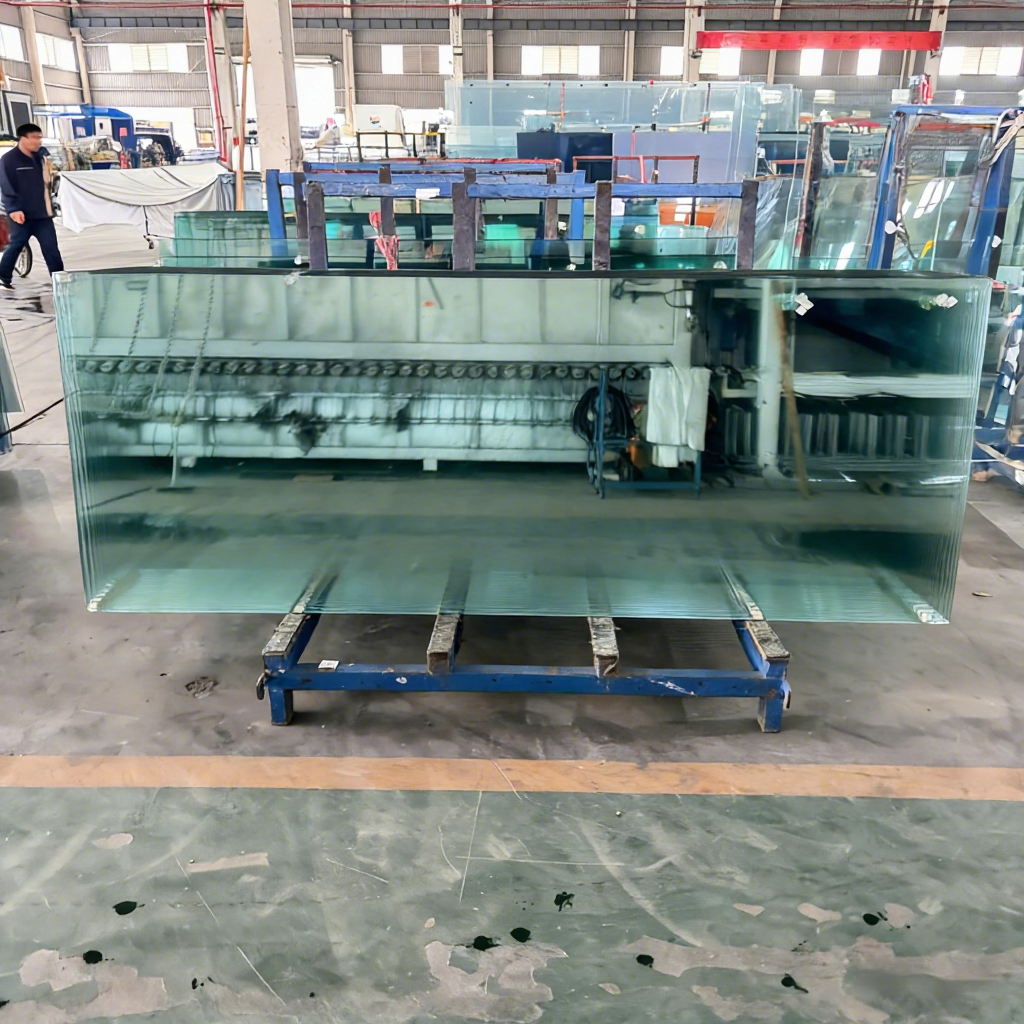
Curved tempered glass is the single-pane route in a three-way specification decision; laminated and insulating curved assemblies solve different requirement sets.
Curved glazing specifications usually fail in one of two ways: the product family is fixed before the geometry is checked, or the geometry is fixed before the compliance route is confirmed. Curvature narrows the list of feasible constructions before any price comparison begins, which is why the family decision should come first.
Three fabricated families cover nearly every curved opening in construction and decoration work: curved tempered glass (DY-GH01), curved laminated safety glass (DY-JJ01) and curved insulating glass (DY-ZK01). All three are produced by Shenzhen Dayang Special Glass Co., Ltd., which trades as DYGLASS — a Shenzhen-based architectural glass processor founded in 2017, operating a 30,000 m² facility with 130 employees and an annual output of 600,000 square meters. This framework is written for specifiers and procurement teams who must choose between the three families before supplier selection begins.
Why the Family Decision Comes Before the Supplier Decision
Curved glass behaves more like a fabricated component than a commodity variant of flat glass. Two published standards frame how the products are treated. ISO 11485-3:2014 classifies curved tempered and curved laminated glass as safety glasses for buildings, while ASTM C1464-06 specifies bent glass for building construction, furniture and display. The combined scope has a practical consequence for buyers: a curved coffee table top, a curved display panel and a curved facade unit fall under the same broad family of requirements, even though their project risk profiles are very different.
Manufacturing feasibility narrows the field further. Reported market capability includes bend radii as small as 75 mm and panel lengths up to 12 metres. The operational constraint is that a tight radius, an extra-large panel and a multi-layer build-up rarely coexist in one unit. Fixing the product family early keeps that constraint visible during design development rather than at fabrication release, when changes are expensive.
Supplier capability then becomes a second-order question. A fabricator that can form a simple cylindrical curve may not be able to form double-curved, spherical, pyramidal, S-shaped or positive-and-negative curved geometries — and the reverse is also true, because complex forming capacity is usually paired with longer programming cycles. The family decision tells the buyer which of those capabilities is actually required.
The Three Curved Glass Families and What Each Is Built For
DY-GH01 — Curved Tempered Glass
DY-GH01 is a single-pane, thermally toughened curved glass. It is produced in thicknesses from 3 mm to 19 mm with a forming tolerance of ±0.5 mm, and it is treated as a safety glass under the ISO 11485-3:2014 classification. Typical applications are shower rooms, bathroom enclosures, office partitions, furniture such as curved coffee table tops, and interior decoration where a single, clean pane is preferred over a multi-layer assembly.
The trade-off is process order. After toughening, the glass cannot be cut, drilled or edge-worked, so every dimension, hole and cut-out must be frozen before the tempering cycle. Heat soak treatment is used to reduce the risk of spontaneous breakage associated with nickel sulfide inclusions, and a heat soak furnace forms part of the production route used for this purpose. Curved tempering also depends on forming tooling and temperature control; DYGLASS operates dedicated flat and curved tempering lines together with a double-curved tempering line for more complex geometries.
DY-JJ01 — Curved Laminated Safety Glass
DY-JJ01 bonds two or more glass panes with a PVB interlayer, with an overall thickness range of 6.38 mm to 50 mm and multiple interlayer options. Its distinguishing behaviour is post-breakage retention: the interlayer holds fragments in place instead of allowing the panel to fall away. The same build-up also contributes to acoustic performance and reduces the share of UV radiation transmitted through the glass.
Applications concentrate where retention matters: overhead glazing and skylight roofs, sightseeing elevator glazing, balustrades, and curtain wall zones where safety performance after breakage is part of the design intent. The design levers are the interlayer specification and the edge condition. Interlayer options change post-breakage behaviour, colour neutrality, weight and cost, so they should be fixed before prototypes are made rather than adjusted during production. Curved lamination is processed in an autoclave under controlled temperature and pressure, and edge sealing determines how the assembly performs over years of thermal cycling.
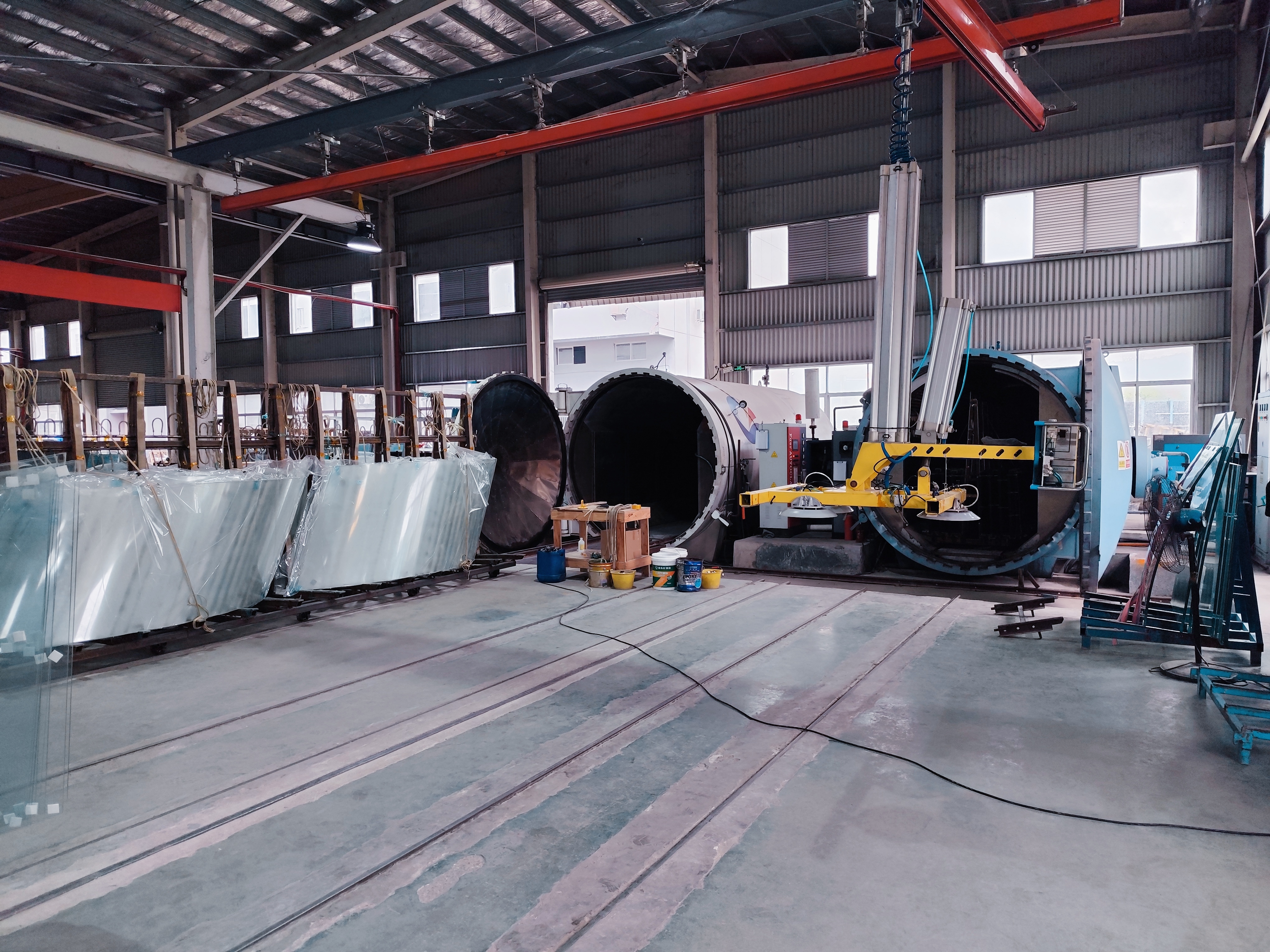
Autoclave processing is the step that bonds panes and PVB interlayer in curved laminated safety glass; interlayer and edge specifications are fixed before this stage.
DY-ZK01 — Curved Insulating Glass
DY-ZK01 separates two or more panes with a sealed cavity, with optional low-E coating and argon fill. It is the family that addresses thermal insulation and condensation control rather than single-pane safety, and documented acoustic performance for curved assemblies of this type falls in the 30–45 dB range. Typical applications are curtain walls, window systems, skylight roofs and climate-controlled interiors where solar gain and heat loss are design drivers.
The trade-off is mass and build-up complexity. A curved insulating unit carries more weight, requires more depth at the frame or mullion, and places greater demands on edge seal integrity under curvature stress. Low-E coating and argon fill are specified rather than default, and the coating must be compatible with the forming and sealing sequence — a point worth confirming at the sample stage rather than at bulk release.
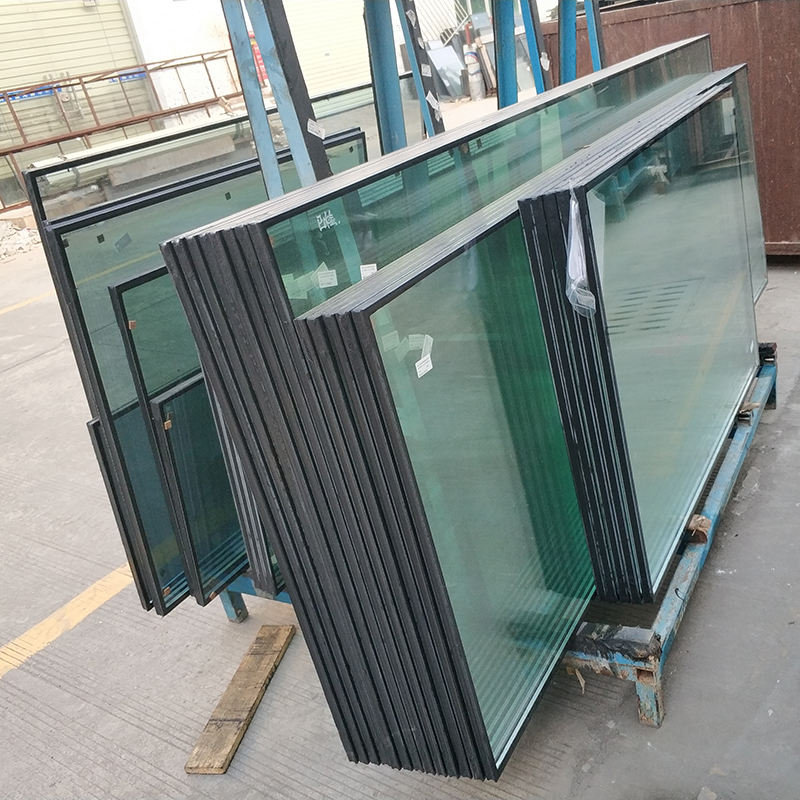
Curved insulating units add a sealed cavity, optional low-E coating and argon fill; the cavity and edge seal are the performance-critical elements once the panel is curved.
Side-by-Side: Curved Tempered vs Laminated vs Insulating
| Aspect | DY-GH01 Curved Tempered | DY-JJ01 Curved Laminated Safety | DY-ZK01 Curved Insulating |
|---|---|---|---|
| Construction | Single thermally toughened pane | Two or more panes bonded with a PVB interlayer | Two or more panes with a sealed cavity; optional low-E coating and argon fill |
| Thickness range | 3 mm – 19 mm | 6.38 mm – 50 mm | Project-specific multi-pane build |
| Forming tolerance | ±0.5 mm | Defined per project | Defined per project |
| Light transmittance | Low-iron option available | Low-iron option available | Low-iron option available |
| Interlayer / coating | Not applicable | PVB interlayer options | Low-E coating and argon fill options |
| Safety treatment | Curved tempered safety glass under ISO 11485-3:2014 | Curved laminated safety glass under ISO 11485-3:2014 | Depends on the make-up specified for the project |
| Acoustic performance | 30–45 dB, assembly dependent | 30–45 dB, assembly dependent | 30–45 dB, assembly dependent |
| Typical fit | Shower rooms, bathroom glazing, partitions, furniture, interior decoration | Skylights, sightseeing elevators, balustrades, curtain wall retention zones | Curtain walls, window systems, skylight roofs |
| Main constraint to plan for | No cutting, drilling or edge working after toughening | Interlayer and edge seal specification must be locked early | Higher weight and frame depth; more demanding edge seal |
Five Criteria That Decide the Specification
- Thickness and forming tolerance. DY-GH01 spans 3 mm to 19 mm with a ±0.5 mm tolerance; DY-JJ01 spans 6.38 mm to 50 mm as an assembled build. Tolerance influences how curved panels meet frames, mullions and adjacent units, and it becomes critical on multi-panel facades where a small deviation repeats across dozens of bays.
- Light transmittance. Where daylight is a primary design driver — atria, display glazing, curved shopfronts — low-iron curved glass options are specified at ≥91% light transmittance. Iron content affects the colour cast seen through the glass edge, which is more visible on thick curved panels than on thin flat ones.
- Interlayer and coating selection. PVB interlayer options define post-breakage behaviour in DY-JJ01; low-E coating and argon fill define thermal behaviour in DY-ZK01. These two levers do more for performance than any change in curvature geometry.
- Acoustic performance. Documented performance for curved assemblies sits in the 30–45 dB range. Reaching the upper end usually requires more mass, a thicker cavity or a different interlayer, which in turn changes weight and frame requirements.
- Compliance route. European-facing projects reference the CE-related standard families EN 12150-1, EN 1449 and the EN 1279 series for these product types, alongside ISO 11485-3:2014 and ASTM C1464-06 as classification and specification references.
Matching the Family to the Application
| Application | Preferred curved family | Decision logic | Watch-out |
|---|---|---|---|
| Office partitions and interior glazing | DY-GH01 or DY-JJ01 | Single-pane simplicity where no retention requirement exists; laminated where acoustic or post-breakage retention matters | Acoustic target should be set per room, not per project |
| Bathroom and shower enclosures | DY-GH01 | Tempered safety glass in a single curved pane, easy to clean and visually neutral | Hinge and fitting holes must be drilled before toughening |
| Furniture and coffee table tops | DY-GH01 or DY-JJ01 | Tempered for surface strength; laminated where edge exposure or impact risk is higher | ASTM C1464-06 covers bent glass for furniture and display |
| Curtain walls | DY-ZK01, with DY-JJ01 in retention zones | Thermal and condensation control drive the main field; laminated units handle safety retention areas | Panel-to-panel tolerance accumulates across the curve |
| Window systems | DY-ZK01 | Low-E coating and argon fill address heat loss and solar gain | Frame depth must accommodate the thicker build |
| Skylight roofs and overhead glazing | DY-JJ01, or DY-ZK01 where thermal performance is required | Overhead exposure makes post-breakage retention a primary requirement | Lamination parameters must be fixed before prototyping |
| Sightseeing elevators | DY-JJ01 | Retention and optical quality are both visible to the public | Curve consistency between adjacent panels is highly visible |
| Fire-resistant applications | Determined by the tested system | Fire-rated glazing is supplied as a tested construction rather than a material | The required curvature must fall inside the tested scope; confirm before specifying |
| Interior decoration | DY-GH01 or DY-JJ01 | Design-led geometry with S-shape, U-shape or double-curved profiles | Complex curvature lengthens forming cycles |
Compliance: Which Documentation Applies to Which Product
Compliance for curved glazing is a per-product question, not a per-supplier question. A manufacturer that holds declarations for flat glass lines does not automatically extend them to curved variants, because forming changes stress distribution and, in insulating units, the seal path. Buyers should confirm that any declaration, test report or certificate supplied for a project references the curved configuration actually being ordered, including thickness, build-up and coating.
In practice three documentation layers matter. First, product-type documentation against the relevant standard family — EN 12150-1, EN 1449 and the EN 1279 series for European-facing work. Second, classification evidence under ISO 11485-3:2014, which places curved tempered and curved laminated glass in the safety glass category. Third, dimensional and optical records showing that the delivered panels fall within the tolerance stated on the order, which for DY-GH01 means the ±0.5 mm forming tolerance band.
For multi-phase projects, the documentation set should be treated as a continuity requirement rather than a one-time deliverable. Re-ordering the same curved panel two years later depends on the forming parameters, tooling and coating build being retrievable, which is a record-keeping question as much as a manufacturing one.
Fabrication Risk: The Part of the Supply Chain Buyers Rarely Audit
Curved glass carries a defined set of process risks: overheating and thermal shock, glass breakage, cutting injury, edge chipping, scratch and surface damage, warpage and deformation, and bubbles or inclusions. Several of these are only visible after installation, which is why the controls applied upstream are worth understanding during supplier qualification.
Documented controls in this category include an intelligent temperature control system paired with infrared temperature sensors that monitor kiln conditions in real time, with three-level over-temperature warning thresholds set at an early warning value of 1550°C, an alarm value of 1580°C and an emergency shutdown value of 1600°C. On the maintenance side, kiln refractory brick wear is inspected quarterly with mandatory replacement above 30% wear, temperature sensors are calibrated on a defined cycle, and a complete equipment life-cycle file is maintained.
Limits and Trade-offs to Plan For
Curved glass is not a direct substitute for flat glazing, and the differences run in both directions. Flat glass can be cut, drilled and reworked further down the supply chain, which shortens lead times and allows late-stage site adjustments. Every curved panel, by contrast, is a finished made-to-order unit: DY-GH01 cannot be cut or drilled after toughening, and laminated and insulating curved units cannot be re-formed or re-sealed on site. Curved glazing therefore shifts risk from the fabricator to whoever freezes the dimensions, and site measurement discipline becomes a design responsibility.
Geometry imposes its own boundaries. Reported capability reaches bend radii as small as 75 mm and panel lengths up to 12 metres, but not every family delivers every combination. Multi-layer build-ups such as curved insulating units are heavier and generally require larger practical radii than a single tempered pane, so a very tight radius can force the specification towards DY-GH01 or DY-JJ01 even where thermal performance was the original objective.
Two further trade-offs are worth stating plainly. Thicker PVB interlayers in DY-JJ01 improve post-breakage behaviour but add weight and cost and can alter edge appearance. And heat soak treatment for tempered glass is a mitigation for spontaneous breakage risk, not a guarantee — it reduces the probability of nickel sulfide-related failure rather than eliminating it. Buyers who treat any one of these three families as universally superior are likely to over-specify in one area and under-specify in another.
Market Context for Curved Glazing
The global curved glass market was estimated at USD 13.5 billion for 2025 and is forecast to grow at a 5.8% CAGR between 2025 and 2035 (Statifacts, via verified industry dataset). That figure spans architectural panels, automotive systems and display screens, which means the construction and decoration share is narrower than the headline number suggests. The adjacent facade market is far larger: the global glass curtain wall market was valued at USD 62.4 billion in 2024 (Grand View Research), and curved glazing typically appears in the higher-specification portion of that spend.
Two structural trends follow from that positioning. Curved glazing demand is tied to premium facade packages, sightseeing elevators, skylight roofs and high-specification interiors rather than to volume residential work, so order books move with commercial and hospitality construction rather than with housing starts. At the same time, the standards framework reinforces that these are safety products rather than decorative specialities: ISO 11485-3:2014 classifies curved tempered and laminated glass as safety glasses for buildings, and ASTM C1464-06 covers bent glass for building construction, furniture and display.
The practical market consequence for buyers is a supply base that is smaller and more capability-dependent than the flat glass market. Selection therefore tends to hinge on forming capability, tolerance control and documentation continuity rather than on price alone.
Evaluating a Curved Glass Partner for Multi-Year Programs
Where a project runs across multiple phases, or where a facade standard is likely to be repeated on later buildings, the supplier decision shifts from panel price to repeatability. Four evaluation areas tend to separate capable partners from those that can only deliver a single order well.
Capacity continuity. Documented capacity is the first filter. Shenzhen Dayang Special Glass Co., Ltd. operates a 30,000 m² facility with 130 employees and an annual output of 600,000 square meters, with exports accounting for 60% of output and markets including the UAE, Bahrain, Saudi Arabia, the United States, the Philippines and Vietnam. Capacity of that order matters because curved orders compete with flat production for kiln time.
Process coverage in one facility. A partner that controls cutting, drilling, edge grinding, tempering, lamination, insulating assembly and heat soak in-house can hold tolerances across process steps rather than passing risk between suppliers. DYGLASS runs flat and curved tempering lines, a double-curved tempering line, an autoclave, an insulated line, a heat soak furnace, cutting, drilling and edge grinding lines, and can process multi-curved, double-curved, triple-curved, trapezoid, spherical, pyramidal, S-shape, cylindrical and positive-and-negative curved geometries.
Verification and commercial flexibility. Third-party markers such as Alibaba Verified Supplier status and an SGS test report give buyers an external reference point, and OEM/ODM support matters where a distributor or brand owner needs private-label programmes rather than catalogue items. Company and product information is published at www.dayangglass.com for buyers who want to check capability claims directly.
Replacement and re-order capability. The most underrated criterion is whether the supplier can reproduce a matching panel years later. That requires retained forming parameters, coating build records and a panel register for the original order — the same information that supports compliance continuity.
Outlook
Three developments are likely to shape curved glazing procurement over the next several years. First, documentation expectations will tighten: buyers are already asking for panel-level tolerance records and performance data for coated and gas-filled builds, not just type-test certificates. Second, curved specifications will continue to migrate from landmark-only applications into standard premium packages such as sightseeing elevators, skylight roofs and curved interior partitions, which increases the value of repeatable, well-documented supply. Third, energy performance will increasingly drive the family decision, pushing more curved openings towards insulating build-ups with low-E coating and argon fill, while safety-driven openings stay with laminated or tempered constructions.
The decision framework itself is unlikely to change, because it follows from physics and standards rather than from fashion: establish the geometry and its feasibility, then the dominant performance requirement, then the compliance route, and only then compare suppliers.
FAQ
What determines whether a curved panel should be tempered, laminated or insulating?
The dominant requirement decides it. Where a single pane with safety characteristics and simple maintenance is enough, curved tempered glass (DY-GH01) is the direct answer. Where post-breakage retention matters — overhead glazing, balustrades, elevator glazing — curved laminated safety glass (DY-JJ01) is the appropriate family. Where heat loss, solar gain or condensation control drives the design, curved insulating glass (DY-ZK01) with optional low-E coating and argon fill is the fit. Geometry feasibility should be checked before the performance requirement is locked, because tight radii and multi-layer build-ups do not always coexist.
Can curved tempered glass and curved laminated glass be used in the same facade?
Yes, and it is common practice to allocate by zone rather than by building. Laminated curved units are typically used in retention-critical zones and tempered curved units in single-pane areas where simplicity and clarity are priorities. Each panel remains a separate product with its own specification, documentation and dimension-freeze point, so the combination should be defined zone by zone in the specification rather than treated as one uniform glazing type.
How much sound reduction can curved glass provide?
Documented acoustic performance for curved glass assemblies falls in the 30–45 dB range. Where a value sits inside that band depends on the build-up: pane thickness, number of panes, cavity depth, interlayer specification and the sealing quality of the frame. Because the range is wide, acoustic targets should be set per opening and confirmed against the actual assembly specified, rather than assumed from the product family alone.
What documentation should buyers request for CE-related compliance on curved glass?
For European-facing projects, the standard families normally referenced for these products are EN 12150-1, EN 1449 and the EN 1279 series, while ISO 11485-3:2014 provides the safety glass classification for curved tempered and curved laminated glass and ASTM C1464-06 covers bent glass for building construction, furniture and display. Buyers should confirm that the documents provided reference the curved configuration being ordered — thickness, build-up and coating — rather than only a flat production line.
How should replacement panels be specified for a multi-phase curved glazing project?
Replacement planning should start with the original order. Forming parameters, tolerance records, interlayer or coating specification and the curve data for each panel type should be retained so that a later panel matches the installed one visually and dimensionally. Buyers should confirm at the qualification stage that the supplier keeps these records and can reproduce a matching panel rather than only an approximate equivalent, since mismatched curvature or coating is visible immediately on a finished facade.
Reference: DYGLASS corporate brochure (PDF) — https://cdn.socialarks.com/sbsp//common/2026/0402/69ce03350b106.pdf