
Curved Glass for Modern Architecture: Precision, Applications, and Market Trends
The Rise of Curved Glass in Contemporary Building Design
Architectural glazing has entered a new era where fluid forms and sweeping curves replace rigid geometries. Among the key enablers of this transformation is curved glass—engineered panels that bring both aesthetic elegance and structural performance to facades, atriums, and interior spaces. DYGLASS, the building glass division of Shenzhen Dayang Special Glass Co., Ltd. (established 2017), has positioned itself as a precision manufacturer of curved glass solutions for global architectural projects. With a 30,000-square-meter facility in Shenzhen, Guangdong, and an annual production capacity of 600,000 square meters, DYGLASS supplies a range of curved glass types including low iron, sound insulated, explosion-proof, UV block, and high-precision variants. The global curved glass panel market, valued at approximately USD 781.2 million in 2024 and projected to grow at a CAGR of 8.0% through 2031 (Cognitive Market Research), reflects the accelerating demand for these materials.
Problem and Opportunity: Meeting the Demand for Precision and Variety
Architects and contractors face a persistent challenge: sourcing curved glass that meets exact geometric specifications without optical distortion, while also satisfying safety, thermal, and acoustic requirements. Traditional flat glass cannot address the growing trend toward sculptural building envelopes, and many glass suppliers lack the capability to produce complex shapes such as S-shaped, U-shaped, double curved, or extra-large panels. This gap represents both a constraint for designers and an opportunity for specialized manufacturers. DYGLASS addresses this need by offering a portfolio of curved glass products—from single hot curved glass to multi-curved tempered glass—engineered for applications ranging from curtain walls to sightseeing elevators and skylight roofs.
DYGLASS Curved Glass Solutions: Precision Engineering Backed by Production Capacity
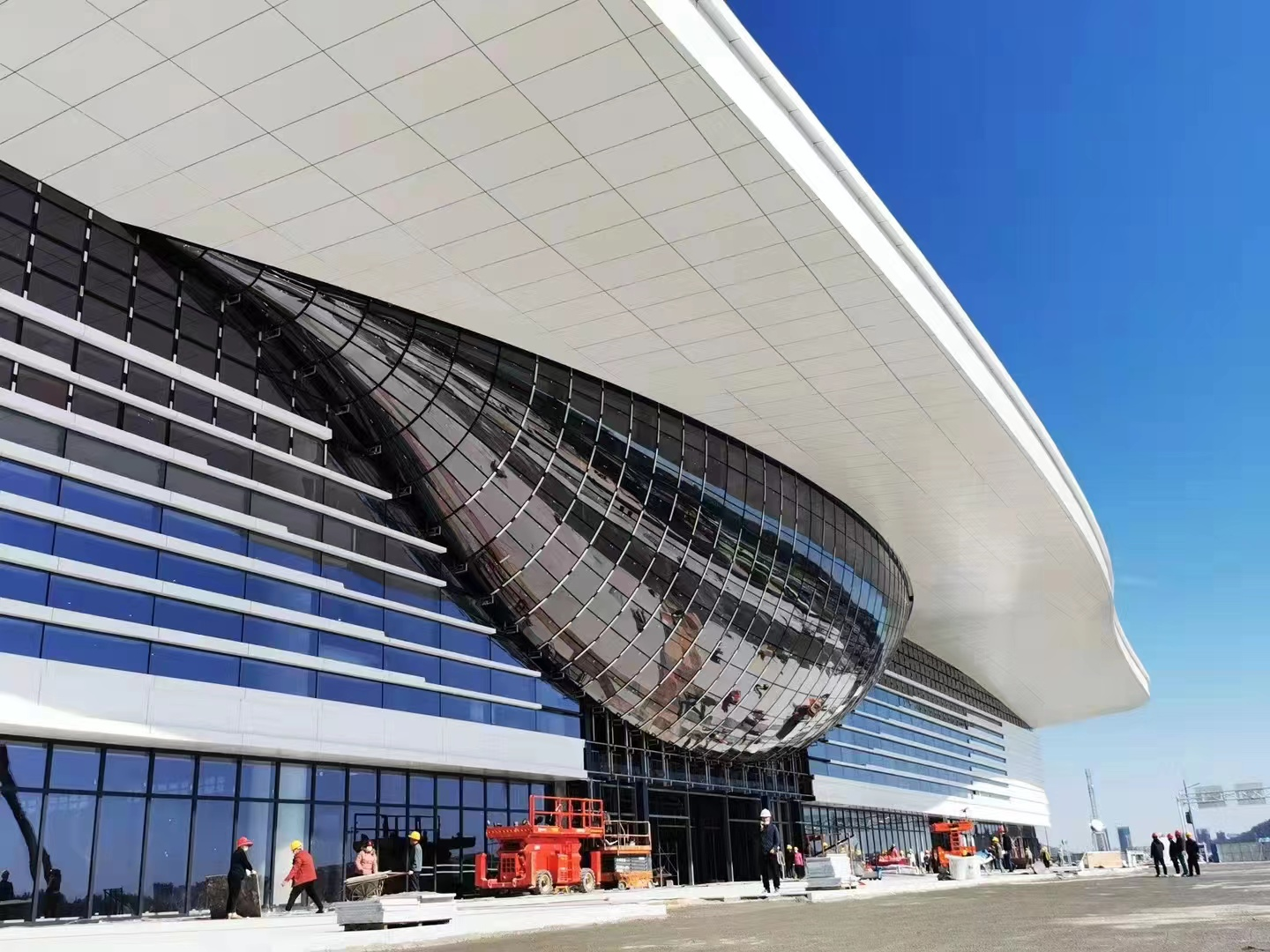
Huizhou North Railway Station – an example of DYGLASS curved glass in public infrastructure (cover image).
DYGLASS specializes in the research, development, sale, and service of building glass. Its main products include Laminated Glass, Toughened Glass, Smart Glass, Insulated Glass, Curved Glass, and Building Glass. The company welcomes OEM and ODM orders, reflecting a flexible approach to customer specifications. The core curved glass product lines are:
- DY-GH01 – Curved Tempered Glass: Made from float glass with thickness options from 3mm to 19mm (tolerance ±0.5mm) and light transmittance ≥91%. Edge work options include polished, grinded, and beveled. Suitable for construction, furniture, bathroom, curtain wall, and office partition industries.
- DY-JJ01 – Laminated Curved Glass: A tempered laminated safety glass available as curved laminated glass. Glass substrate can be tempered, float, low-iron, or tinted glass. Interlayer options: PVB, SGP, EVA with PVB thicknesses of 0.38mm–2.28mm. Total thickness range: 6.38mm to 50mm. Provides sound insulation of 35dB–45dB and can be used for fire-resistant applications. Clear version light transmittance 85%–92%; tinted version 10%–70%.
- DY-ZK01 – Curved Insulated Glass: Tempered insulated glass with curved variants. Glass types: clear float, low-E, tempered, or low-iron. Spacer bar: aluminum or warm edge. Gas fill: air, argon, krypton, or xenon. Light transmittance 70%–89%; sound insulation 30–45 dB. Standard thickness: 6mm+12A+6mm or 8mm+16A+8mm (custom available). Designed for curtain wall and window systems, interior decoration, and architecture projects.
Technical Explanation: How DYGLASS Achieves Precision and Distortion-Free Curves
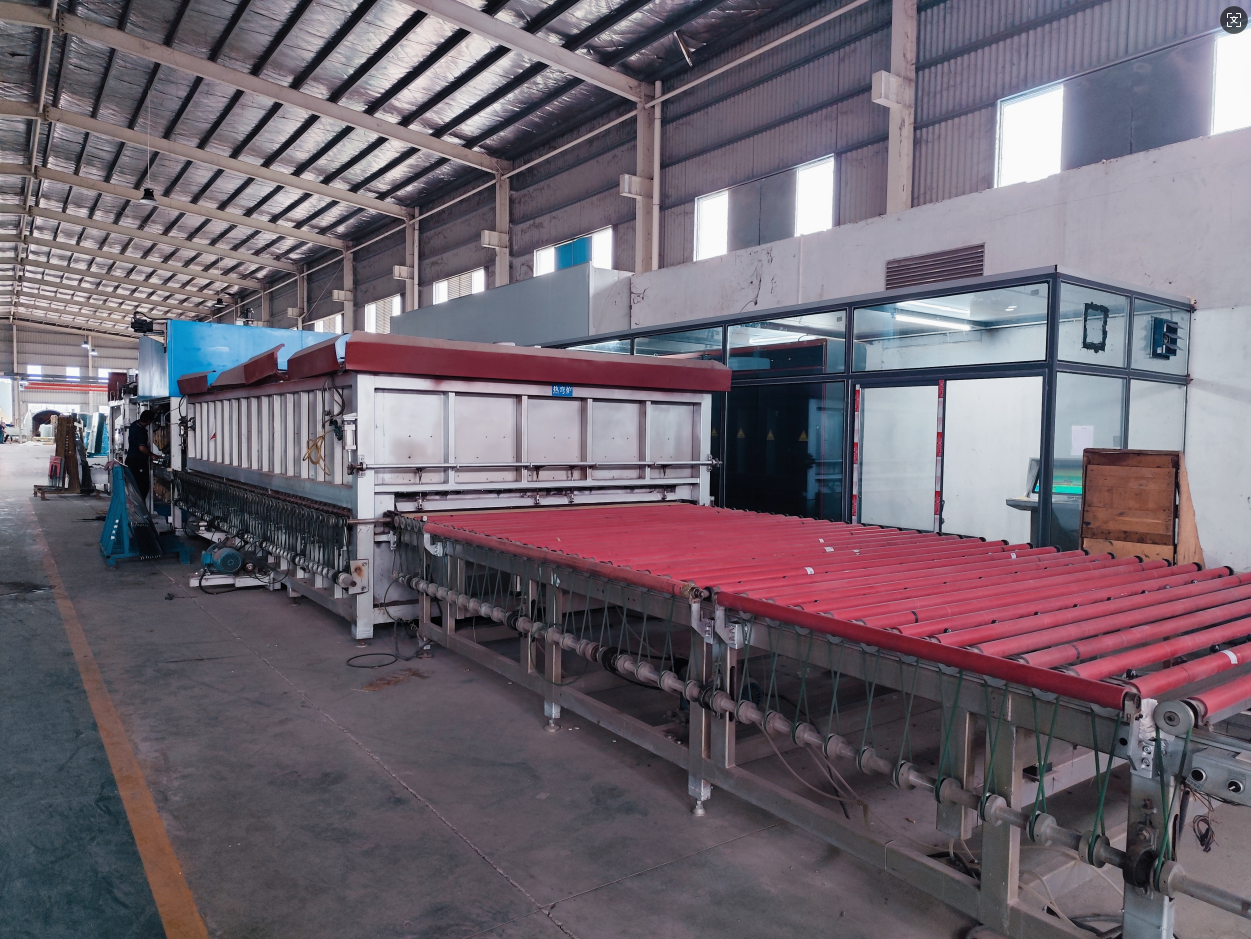
Double curved tempering line – a key production asset for high-precision curved glass.
DYGLASS employs a dedicated double curved tempering line (concave & convex curved line and irregular curved line) to produce complex geometries such as double curved glass, S-shaped, U-shaped, and trapezoid curved tempered glass. The company's manufacturing process includes cutting, edge grinding, drilling, heat soaking, and autoclave lamination, ensuring each panel meets stringent tolerances. The ±0.5mm thickness tolerance for tempered glass and interlayer precision for laminated glass allow DYGLASS to supply no-wave-distortion curved glass suitable for applications where optical clarity is critical, such as display cases and high-end curtain walls.
Application Scenarios: From Curtain Walls to Sightseeing Elevators
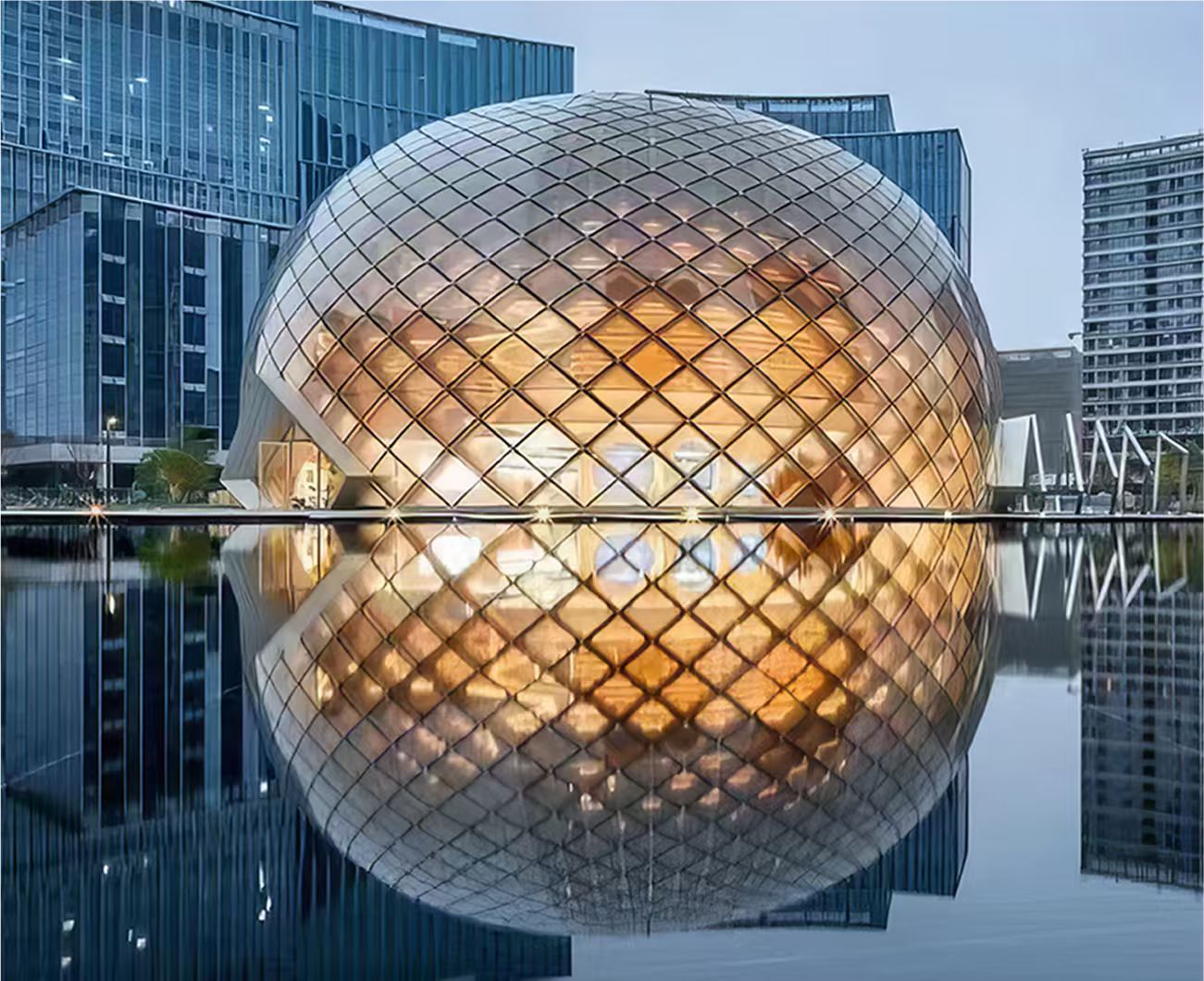
China Nano Research Institute – curved glass in a research facility environment.
DYGLASS curved glass is applied across multiple engineering categories: construction engineering, decoration engineering, and municipal engineering. Verified project references include:
- Curved Glass for Curtain Wall: The company's curved insulated glass (DY-ZK01) and curved tempered glass (DY-GH01) are used in commercial building facades, where thermal performance and structural strength are required.
- Curved Glass for Sightseeing Elevator: Laminated curved glass (DY-JJ01) provides safety and transparency for panoramic elevator shafts, with PVB interlayer ensuring post-breakage retention.
- Curved Glass for Skylight Roof: Low iron curved glass variants maximize natural light transmission while maintaining insulation.
- Curved Glass for Shower Room: Tempered curved glass with polished edges is suitable for bathroom enclosures, combining safety with design flexibility.
- Curved Glass for Coffee Table & Furniture: Thin-profile curved tempered glass (3mm–6mm) enables sleek, modern furniture designs.
- CE Certified Curved Glass: DYGLASS products comply with European safety standards for toughened safety glass (EN 12150-1 and EN 14179-1 heat soaked treatment), essential for EU project specifications. The company also holds SGS test reports and is an Alibaba Verified Supplier.
Market Trend Analysis
The global curved glass panel market is projected to grow at a CAGR of 8.0% through 2031. Architectural applications—particularly facades and curtain walls—dominated market share, accounting for over 40% of demand in 2024 (Research and Markets). Asia-Pacific is the fastest-growing region, driven by rapid urbanization and infrastructure development (Custom Market Insights). China's export value for worked glass (including bent/curved glass under HS 7006) reached approximately USD 791 million in 2023 (TrendEconomy/UN Comtrade). DYGLASS, based in Shenzhen and exporting to markets including UAE, Saudi Arabia, USA, Philippines, Vietnam, and Bahrain, is positioned to serve this expanding demand.
Comparison with Traditional Flat Glass Solutions
Traditional flat glass remains cost-effective for rectilinear designs and is widely available. However, curved glass offers unmatched design freedom, improved structural performance under wind load (due to geometric stiffness), and better light diffusion. One honest limitation of curved glass is the longer lead time required for custom tooling and production compared to flat glass, which can be cut and tempered from stock sheets. DYGLASS mitigates this through its in-house curved tempering lines and multiple product lines that allow parallel processing.
Future Outlook
As building codes tighten and architectural trends continue toward organic forms, the demand for high-precision curved glass will increase. DYGLASS plans to leverage its 30,000 m² facility and 130-strong workforce to expand capacity for complex shapes like triple curved glass, spherical curved, and pyramidal curved glass. The company's acceptance of OEM and ODM orders positions it as a flexible partner for large-scale projects.
Frequently Asked Questions (FAQ)
1. What types of curved glass does DYGLASS manufacture?
DYGLASS offers curved tempered glass (DY-GH01), curved laminated glass (DY-JJ01), and curved insulated glass (DY-ZK01). Additional variants include low iron, sound insulated, explosion-proof, UV block, hot curved, S-shaped, U-shaped, double curved, single hot curved, extra-large, and high-precision no-wave-distortion curved glass.
2. Which industries and applications use DYGLASS curved glass?
DYGLASS curved glass is used in building construction, decoration, and municipal engineering projects. Common applications include curtain walls, sightseeing elevators, shower rooms, coffee tables, skylight roofs, balustrades, and architectural facades.
3. What safety certifications does DYGLASS curved glass hold?
DYGLASS products meet European safety standards EN 12150-1 and EN 14179-1 (heat soaked toughened glass). The company is an Alibaba Verified Supplier and holds SGS test reports. CE certification is available for curved glass variants.
4. Can DYGLASS produce custom shapes like double curved or S-shaped glass?
Yes. DYGLASS operates a double curved tempering line and can produce multi-curved, double curved, triple curved, trapezoid curved, spherical curved, pyramidal curved, S-shaped, cylindrical curved, and positive-negative curved tempered glass. CNC forming and custom molds are supported.
5. What is the maximum size for DYGLASS curved glass panels?
DYGLASS manufactures extra-large curved glass panels. Exact size limits depend on the specific product and required curvature; custom dimensions can be accommodated within the production line capabilities (30,000 m² facility).
6. How does DYGLASS ensure optical quality and eliminate wave distortion?
The company uses dedicated curved tempering lines with precise roller control and heat-soak treatment to minimize distortion. High-precision grinding and polishing further enhance optical clarity, resulting in no-wave-distortion curved glass suitable for high-visibility applications.
7. What is the typical lead time for a curved glass order?
Lead times vary based on complexity and quantity. Custom curved glass generally requires longer than flat glass due to mold fabrication and production setup. DYGLASS provides estimated timelines upon inquiry.
8. Does DYGLASS provide samples or small test orders for curved glass projects?
The company welcomes OEM and ODM orders and can discuss sample or small-batch production for qualification purposes. Contact DYGLASS directly for terms.
For procurement inquiries, technical specifications, and project quotes, contact Shenzhen Dayang Special Glass Co., Ltd. (DYGLASS).
Email: info@dayangglass.com | Tel: +86-136 9211 0212 | WhatsApp: +86-13692110212
Visit our website: www.dayangglass.com
Download our company brochure for detailed product information: DYGLASS Brochure (PDF)