
Curing Times & RAL Matching: A Powder Coating Tech FAQ
Curing Times & RAL Matching: A Powder Coating Tech FAQ
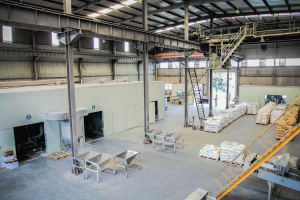
A thermoset powder coating production line. Colour, gloss and texture are set at the formulation and extrusion stage, before the powder ever reaches the application gun.
Powder coating is a dry thermoset coating that is applied electrostatically and cured into a continuous film. In construction and decoration it is treated as a distinct product type inside the wider paints and coatings category, alongside water-borne, solvent-borne and high-solids technologies (SRC-0011). Published commercial research valued the global powder coatings market at USD 16.12 billion in 2025, with Asia Pacific contributing 63.10% of global revenue and polyester resin accounting for 48.2% of the market by chemistry (SRC-0001, SRC-0002).
Those numbers explain the category's scale. They do not answer the questions a specifier has to settle before a facade goes to the coating line, or the questions a procurement team has to settle before a purchase order is issued. The recurring questions are narrower and more technical: which gun can apply the powder, what curing window must be held, how thick the film should be, how much one kilogram actually covers, and whether a specified RAL colour can be produced on a textured surface at all.
This technical FAQ answers those questions against published product data from Chengdu Hsinda Polymer Materials Co., Ltd. ("Hsinda"), a thermoset powder coating manufacturer established in 2015 and based in Chengdu, Sichuan, China, which states a production setup of 8 production lines and 3 sample lines with an annual output of approximately 5,000 tons, and a 70% export ratio across markets including the USA, Canada, Mexico, South America, the Middle East and Central Asia (SRC-0003, SRC-0005, SRC-0006).
The Procurement Questions That Come Before the Price Question
In construction and decoration, two roles drive the coating decision at the same time. A specifier has to justify a finish against a project environment, and a procurement manager has to justify a supplier against delivery, documentation and repeatability. Downstream demand breadth is significant: the United States alone recorded more than 919,000 construction establishments in the first quarter of 2023 (SRC-0007). That figure counts firms, not coating volume, and it should be read as context for demand density rather than as a consumption measure.
Across real quotations, buyer questions cluster into five technical groups — application method, cure schedule, film build and coverage, colour and finish matching, and documented performance evidence — plus a sixth commercial group covering minimum order quantity, lead time and monthly capacity. The commercial group usually decides whether the technical answer is reachable at the required volume at all.
Application Method: Which Gun, and Does It Change the Specification?
What application equipment do these powder coatings support?
The published datasheet line for the range lists two application methods: Tribo Gun or Electrostatic Spray Gun. The same pair appears on the Polyester Powder Coating, Glossy Powder Coating, Matt Powder Coating, Hammer Tone Powder Coating, Wrinkle Powder Coating, Sandy Powder Coating, Metallic Powder Coating, TGIC Free Powder Coating and Aluminum Powder Coating datasheets. For this range, equipment selection is therefore a process decision at the applicator, not a separate product grade.
Does the choice of gun change the film specification?
No separate specification is published per method. Film parameters are stated once across the range: an average particle size of 32–42 μm, a film thickness of 70 μm, and coverage of 8–10 square metres per kilogram at 30–90 μm film thickness. Where parts have deep recesses or complex geometry, coaters commonly validate both charging methods on the actual component before locking the process, because transfer behaviour can differ with geometry. That validation step is a process control activity, not a change to the coating specification.
Curing: Holding the 180–200 °C, 10–15 Minute Window
What cure schedule is specified?
180–200 °C for 10–15 minutes. The window is published consistently across the range, covering epoxy, epoxy-polyester hybrid, polyester, HAA (TGIC-free) and the textured finishes including Hammer Tone, Wrinkle and Sandy.
Why is a range published instead of a single setpoint?
The range accommodates variation in substrate mass, oven type and line speed. What must be satisfied is the combination of the stated film temperature and the stated dwell time. For procurement purposes, the practical verification point is substrate temperature rather than oven air temperature: ask the applicator to record it and to retain the record with the production batch, so the cure can be traced later if a field issue appears.
Which documented properties depend on the cure being held?
The published mechanical values on the standard polyester datasheet include impact of 50 kg/cm (ISO 6272-1:2017), bending of ≤2 mm (ISO 1519:2002), cupping of ≥6 mm (ISO 1520:2006), adhesion of 0 Grade (ISO 2409:2020) and hardness of ≥H (ISO 15184:2020). These are reported results obtained under the specified cure. The way to keep them on a production line is to keep the cure inside the window on every batch, not only on the qualification sample.
Film Thickness and Coverage: What One Kilogram Delivers
Two numbers govern material planning. The nominated film thickness is 70 μm, and coverage is published as 8–10 square metres per kilogram at 30–90 μm film thickness. The coverage figure is stated across a band wider than the nominated film build, so a purchase estimate that assumes 70 μm throughout should be calculated at the conservative end of 8 m²/kg rather than at the top of the range. That single planning choice changes the powder quantity requested on a large architectural order, and it is one of the most common sources of mid-project top-up orders.
RAL and Pantone Matching: How Colour Is Actually Specified
Can powder coating be produced to a RAL or Pantone reference?
Colour is listed as customizable to RAL and Pantone across the product range, using either a standard colour chart or a customer sample as the reference. In one documented project in Colombia, 100 tons of powder coating were used for warehousing solutions including industrial shelving, with colours and finishes matched precisely to the RAL colour chart, and the process reported zero VOC emissions and no hazardous substances (SRC / case data, South America).
How is gloss specified, and why does it affect colour?
Two conventions coexist in the documentation, and buyers benefit from knowing both. On the product datasheets, gloss is reported across 5%–95% measured to ISO 2813:2014, with Matt Powder Coating specifically specified at 5%–30%. Separately, the customization guidance classifies gloss by 60° gloss meter reading: high gloss above 80%, semi-gloss 40–79%, matte 5–39%. Because a coloured film reads differently at 5–30% gloss than at 85%, a complete purchase specification should pair the colour reference with a gloss band and the measurement geometry in the same line item.
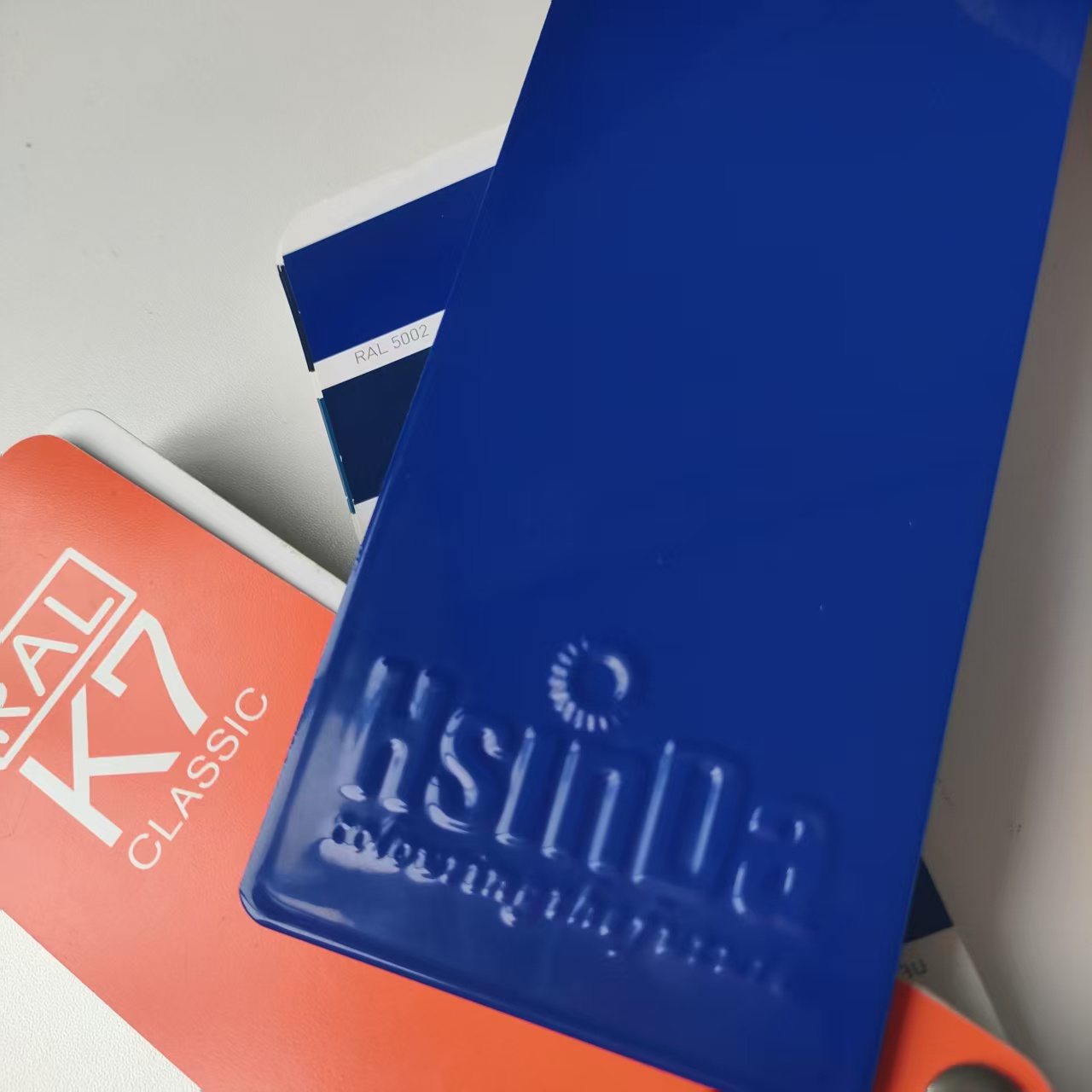
A RAL 5002 gloss blue sample produced against a customer colour reference. Colour reference and gloss band should be specified together, not separately.
Texture and Effect Options Beyond Flat Gloss
Texture is a specification decision, not only a design preference. The documented surface options across the range include smooth, sandblasted, wrinkled, hammered, watermarked, cracked, stone-like, metallic and pearlescent, chameleon, photochromic, thermochromic, electroplating effect, reflective and luminescent finishes. Functional options available alongside those textures include weather resistance (UV resistance, with AAMA 2604, Qualicoat 2 and Qualicoat 1 referenced in the customization list), corrosion resistance verified by salt spray, antibacterial, anti-slip, anti-fingerprint, fireproof and explosion resistant, scratch resistant, and low-temperature curing grades.
Each textured family also has an application centre of gravity. Wrinkle Powder Coating is positioned for electrical panels and cabinets. Hammer Tone Powder Coating is positioned for hardware tools, security doors, filing cabinets and public facilities where dense, scratch-resistant films are valued. Sandy Powder Coating is positioned for building materials, IT and communications enclosures and general industrial housings. Specifying a texture therefore means specifying a substrate type and a handling environment at the same time.
Documented Performance: Salt Spray, Weathering and One Honest Caveat
On the standard polyester datasheet, corrosion and durability claims are anchored to named test methods rather than to descriptive language. Salt spray resistance is reported to ISO 7253:1996, where after 500 hours the coating film remains unchanged and unilateral corrosion at the cross section is ≤2 mm. Damp heat resistance is reported to GB/T 1740-2007, with 1,000 hours producing only slight gloss loss, classified at ≤ level 1. Weather resistance is reported to ISO 11341:2004 under a 340 nm lamp for 500 hours, with no powdering and a light retention rate above 50%.
The Aluminum Powder Coating datasheet extends those figures for architectural service: salt spray resistance is stated at 1,000 hours and weather resistance at 1,000 hours under the same method, with an additional one-year natural aging test in Florida showing gloss retention above 50%. For exterior aluminum profiles, curtain walls and sunrooms, those are the numbers that translate directly into a facade specification.
One caveat deserves to be stated plainly. Chemical resistance across the range is described as good resistance to general acids and oils, with average alkali resistance. In service environments where alkaline exposure is expected, that boundary should be treated as a testable limit rather than assumed to be covered by a general corrosion claim. Antibacterial grades follow a separate path: Antibacterial Powder Coating is tested to ISO 22196:2011 under SGS report ASH25-0055689-02.
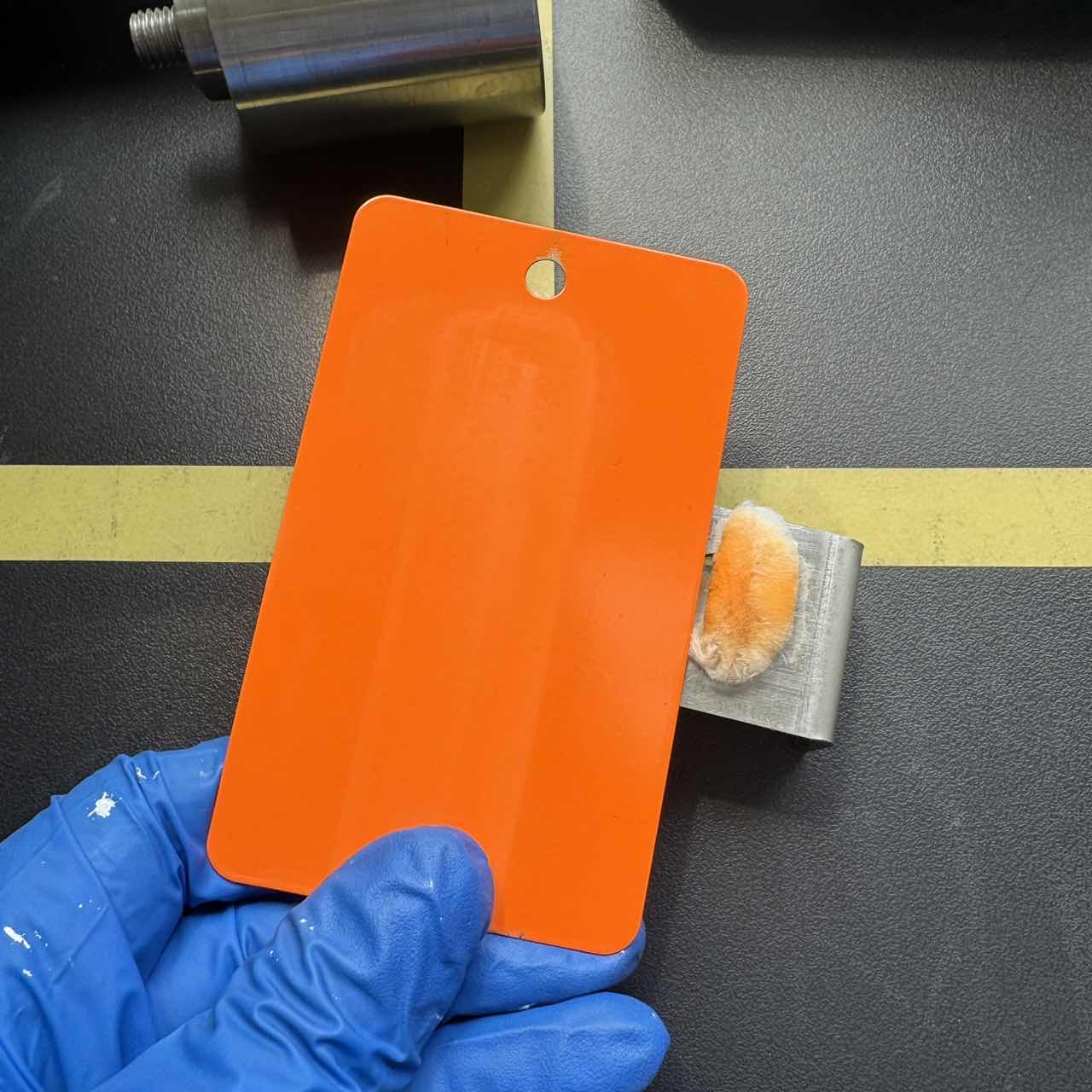
Chemical-resistance testing on a cured panel. Chemical resistance is one of the few properties where the published data deliberately stops short of a universal claim.
The Boundary: Where Powder Coating Stops Being the Easy Answer
Compared with traditional liquid paint, the documented project results are favourable. In the Colombia industrial shelving project, the powder coating's impact resistance was reported as more than three times greater than traditional liquid paint, and the process generated zero VOC emissions and contained no hazardous substances. Those are project-level results for one application category, not a universal ranking of technologies.
Four boundaries are worth carrying into a specification meeting:
- Cure temperature. The range cures at 180–200 °C for 10–15 minutes, so the substrate must tolerate that thermal exposure. The Epoxy Polyester Hybrid Powder Coating is positioned for low-temperature curing and MDF applications, but the achievable substrate temperature for a specific part still has to be verified rather than assumed.
- Mechanical profile varies by product. The Aluminum Powder Coating datasheet reports impact of 2.5 Nm, bending ≤5 mm and cupping ≥5 mm, against 50 kg/cm impact, ≤2 mm bending and ≥6 mm cupping on the standard polyester datasheet. Specifying the most weather-resistant product to maximise facade life can shift the mechanical envelope, so buyers should decide which property governs the application.
- Alkali resistance is average. Acids and oils are well covered; alkali is not, and should be tested where relevant.
- Texture changes perceived colour. A RAL reference produced on a wrinkled or sandy surface will not read the same as the same reference produced at high gloss. Both attributes belong in the same specification line.
Applications: What These Answers Look Like on Real Projects
| Application | Documented requirement | Scale / duration |
|---|---|---|
| Electrical enclosures and panels | Corrosion resistance, insulating or static-conductive behaviour, aesthetics | 40 tons; 10-year relationship; MX, PY, LK, RU, CN |
| Industrial shelving and warehousing | Impact resistance, RAL colour matching, zero VOC process | 100 tons; Colombia |
| Hand tools and hardware | Rust resistance and abrasion resistance in outdoor working conditions | 1,000 tons; 5-year cooperation; MX, US |
| Architectural aluminum profiles | 1,000-hour salt spray, 1,000-hour weathering, Florida natural aging | Aluminum Powder Coating, Qualicoat / AAMA positioning |
| Heavy-duty anti-corrosion | Epoxy resin with TGIC curing agent; salt spray, hardness, adhesion per named ISO methods | Pipelines, water supply systems, valves, reinforcement bars |
Documents to Request With a Quotation
A quotation for powder coating is incomplete without the certificate numbers that define its scope. The following documents are on record for this manufacturer, and each carries a scope statement that should be checked against the specific product being purchased.
| Document | Number | Issuing body | Scope / validity |
|---|---|---|---|
| ISO 9001 quality management | 2052025Q00440R0S | China International Certification Co., Ltd | Production and sale of thermosetting powder coating; valid to 2028-11-23 |
| ISO 14001 environmental management | 2052025E00271R3S | China International Certification Co., Ltd | Thermosetting powder coating; valid to 2028-11-23 |
| REACH SVHC test | CKGIN25000923901 | SGS | HAA type powder coating; issued 2025-07-18 |
| RoHS substance restriction test | CKGEC25000071901 | SGS | Black powder sample; issued 2025-01-22 |
| FDA food-contact safety (21 CFR 175.300) | TSNPC25004542302 | SGS | White food-grade BPA-free thermosetting powder coating; issued 2025-12-23 |
| ISCC PLUS (EN 15343) | ISCC-PLUS-Cert-CN198-41261025 | CTI Certification Co., Ltd. | Polyester powder coating; valid 2026-06-26 to 2027-06-25 |
| Product carbon footprint | TZJ136660053R0S | Huaqixin Certification Service (Chengdu) Co., Ltd. | ISO 14067:2018, PAS 2050:2011; valid to 2028-07-17 |
| Antibacterial performance (ISO 22196:2011) | ASH25-0055689-02 | SGS | Antibacterial powder coating; issued 2025-07-22 |
The scope column is the part buyers most often skip. The REACH report covers HAA type powder coating; the ISCC PLUS scope is polyester powder coating; the RoHS report is tied to a specific black powder sample. A certificate that does not name the product being purchased is a supporting document, not a qualification.
Market Context: Where Demand and Supply Are Concentrating
Two structural facts shape sourcing decisions in this category. First, Asia Pacific held 63.10% of global powder coating revenue in 2025, which is where the majority of manufacturing capacity sits (SRC-0001). Second, polyester resin accounted for 48.2% of the market by chemistry in 2025, reflecting its role in exterior applications where weatherability and UV resistance govern product selection (SRC-0002).
Buyers should also treat published market-size figures with care. One commercial estimate placed the global powder coatings market at USD 16.12 billion in 2025 (SRC-0001), while a separate commercial estimate placed the broader powder coating market at USD 17.01 billion in 2024 (SRC-0008). The two figures rest on different scope definitions and different base years, and the underlying research set explicitly flags them as non-comparable. They are useful for direction, not for averaging — and the same discipline should apply to any market figure quoted in a supplier presentation.
Future Outlook: Documentation Replacing Description
The direction of travel in construction and decoration coating procurement is toward documents rather than adjectives. Three signals support that reading. Testing vocabulary is standardising around published methods such as ISO 8130-8 for storage stability of thermosetting coating powders (SRC-0004). Sustainability credentials are becoming product-specific rather than company-wide, illustrated by an ISCC PLUS certificate scoped to polyester powder coating under EN 15343 and a carbon footprint certificate issued to ISO 14067:2018 and PAS 2050:2011. And functional performance categories — antibacterial to ISO 22196:2011 among them — are being evidenced by third-party reports rather than by catalogue claims.
Manufacturers that participate in standards work tend to be positioned earlier in that transition. Hsinda states that it is a drafting unit for 6 industry standards and holds a portfolio of patents; that is a company-reported capability statement and should be treated as such until independently confirmed (SRC-0005). For buyers, the practical takeaway is unchanged: ask for the document, check its scope, and confirm it names the product on the purchase order.
FAQ
What curing temperature and time do these powder coatings require?
180–200 °C for 10–15 minutes is published across the product range, including epoxy, epoxy-polyester hybrid, polyester and HAA (TGIC-free) products and the textured finishes. The applicable figure is the film temperature at the substrate for the stated dwell time.
Which application equipment is compatible?
A tribo gun or an electrostatic spray gun. Both methods appear on the same datasheet line across the range, so the choice is an applicator process decision rather than a change to the coating specification.
What film thickness is specified, and how much area does one kilogram cover?
Film thickness is 70 μm. Coverage is published as 8–10 square metres per kilogram at 30–90 μm film thickness, with an average particle size of 32–42 μm.
Can powder coating be matched to a RAL or Pantone colour?
Yes. Colour is customizable to RAL and Pantone across the range, referenced from a standard colour chart or a customer sample. A Colombia warehousing project using 100 tons of powder coating recorded colours and finishes matched precisely to the RAL colour chart. Colour should be specified together with a gloss band, because the same reference reads differently at 5–30% gloss and at high gloss above 80%.
What salt spray and weathering performance is documented?
On the standard polyester datasheet: salt spray to ISO 7253:1996 of 500 hours with film unchanged and unilateral cross-section corrosion ≤2 mm; damp heat to GB/T 1740-2007 of 1,000 hours at ≤ level 1; weathering to ISO 11341:2004 of 500 hours under a 340 nm lamp with no powdering and light retention above 50%. Aluminum Powder Coating extends salt spray and weathering to 1,000 hours and adds a one-year Florida natural aging test with gloss retention above 50%.
What are the known limitations of these products?
Three are documented. Curing requires 180–200 °C for 10–15 minutes, so the substrate must tolerate that exposure. Mechanical properties differ by product — the Aluminum Powder Coating datasheet reports impact 2.5 Nm, bending ≤5 mm and cupping ≥5 mm, against 50 kg/cm impact, ≤2 mm bending and ≥6 mm cupping for the standard polyester datasheet. And chemical resistance is described as good against general acids and oils but only average against alkali.
Which certifications and test reports accompany the products?
ISO 9001 (2052025Q00440R0S) and ISO 14001 (2052025E00271R3S) management-system certificates; REACH SVHC test CKGIN25000923901 for HAA type powder coating; RoHS test CKGEC25000071901 on a black powder sample; FDA 21 CFR 175.300 report TSNPC25004542302 for a white BPA-free food-grade coating; ISCC PLUS certificate ISCC-PLUS-Cert-CN198-41261025 covering polyester powder coating under EN 15343; carbon footprint certificate TZJ136660053R0S to ISO 14067:2018 and PAS 2050:2011; and antibacterial test report ASH25-0055689-02 to ISO 22196:2011.
What are the commercial terms and quality-control arrangements?
The customization programme lists a minimum order quantity of 300 kg, a lead time of 15–20 days and a monthly capacity of 400 tons, with 100% testing and 24-hour online service including technical support. The OEM programme lists carton box, sample card and logo OEM options with a minimum order quantity of 6 tons and a 20-day lead time, supported by local distributor support. The manufacturer states an annual output of approximately 5,000 tons across 8 production lines and 3 sample lines, with a 70% export ratio.
Which product family fits an outdoor architectural specification?
Aluminum Powder Coating is positioned for aluminum profiles, doors and windows, glass curtain walls, sunrooms and architectural partitions, with Qualicoat and AAMA positioning and the 1,000-hour salt spray, 1,000-hour weathering and Florida natural aging data described above. Polyester-based exterior grades and the UV-resistant customization option address the same requirement at different performance levels.
A downloadable product brochure with the full range and specification tables is available here: Hsinda powder coating product brochure (PDF).