
Culture Dish to Thin Section: Microscope Scenario Fit
Two purchasing teams can issue the same request — a laboratory microscope with a trinocular head, plan objectives and a digital camera port — and still need instruments that cannot substitute for one another. In cell culture, the sample stays sealed inside a flask or dish and is observed through the vessel base. In petrography, the sample is a thin section of rock viewed between a polarizer and an analyzer on a stage that has to rotate. One specification is driven by specimen geometry; the other by the behaviour of polarized light. Magnification appears in both documents, and decides neither purchase.
This analysis examines scenario fit using four documented platforms from Chongqing Scope Instrument Co., Ltd.: the inverted BDS500 and BDS400 for cell culture and inverted observation, and the polarizing BK-POLF and SMART-POL for geological, mineralogical and petrographic work. Chongqing Scope Instrument Co., Ltd. is a supplier of laboratory and medical training instruments and metallographic equipment based in Chongqing, China; its catalogue covers biological, metallurgical, fluorescence, inverted, polarizing and stereo microscopes, together with hardness testers, metallographic sample equipment, medical manikins and laboratory consumables, and the company states that it provides OEM and ODM services.
The specimen decides the platform before the specification does
Microscope selection usually starts with a magnification range and a budget. A more reliable first filter is the physical relationship between the objective and the specimen, because that relationship determines which optical accessories can be used at all.
- Slide-mounted or solid specimen, illuminated from below the stage: an upright platform. Documented upright biological models in the same catalogue — the B301, B204, B302, BK5000, SMART-2 and SMART-4 — are listed for biology, education and laboratory research, with mechanical stages between 125 × 115 mm and 175 × 145 mm and Abbe N.A. 1.25 condensers.
- Living cells inside a closed vessel, observed from below: an inverted platform, where the objective sits under the stage and the condenser above it. The BDS500 and BDS400 are documented as inverted microscopes with trinocular heads, 54 mm culture dish holders and 210 × 241 mm mechanical stages, and both list cell culture, biology and laboratory research in their application scope.
- Transparent unstained material with almost no brightness contrast: phase contrast optics. Both BDS500 and BDS400 document phase contrast objectives together with matching annular spots.
- Crystalline material identified through birefringence and extinction behaviour: polarized-light optics with strain-free objectives, an analyzer, a Bertrand lens, accessory plates and a rotating stage. BK-POLF, SMART-POL and BK-POL document these elements and are listed for geology, materials science and related applications.
At this stage the buyer is not choosing between a good and a better microscope. The buyer is choosing between optical paths, and the cost of the wrong platform is normally a second purchase rather than a marginal upgrade.
Scenario A — cell culture and inverted observation
What the workflow demands
Four requirements dominate. The first is geometry: the objective must reach the specimen from below, through the base of the flask, dish or multi-well plate. The second is working distance: the objective has to clear the thickness of the plastic or glass vessel, so the objective set is typically long working distance (LWD) rather than standard. The third is contrast generation: living cells in culture medium are nearly transparent under bright field, and phase contrast converts small refractive-index differences into visible intensity differences. The fourth is vessel handling: a holder that locates a 54 mm dish predictably, because a dish that drifts under the objective costs more bench time than a marginal difference in magnification.
BDS500 — a 4X phase contrast entry point with a four-position condenser disc
The BDS500 is documented as an inverted microscope with a trinocular head, WF10X/22 mm eyepieces and LWD infinity plan objectives at 4X, 10X, 20X and 40X in phase contrast and bright field. Annular spots are listed at 4X/10X/20X/40X, and the condenser is a four-hole rotating disc phase contrast condenser matched to those spots. Light distribution is documented at 100:0 and 80:20, with an adapter for digital photography that passes 100% of the light to the photography port. The nosepiece is quintuple, the mechanical stage measures 210 × 241 mm, the culture dish holder takes 54 mm dishes, and illumination is Koehler 12V/50W halogen with blue and green filters. The listed application scope is cell culture, biology and laboratory research.
Read as a buying specification, two elements stand out. The first is the 4X phase contrast position: it gives a low-magnification overview of a whole dish before the operator moves to higher power. The second is the four-hole rotating disc condenser, which carries an annular spot for every magnification in the documented set, so no component change is needed when the operator changes objective. The 100:0 and 80:20 light distribution options separate documentation from observation — 80:20 allows a camera and the eyepieces to be used at the same time, while 100:0 directs all light to the photography port.
BDS400 — long working distance phase contrast for tissue and cell observation
The BDS400 is documented as an inverted microscope with a trinocular head, WF10X/22 mm eyepieces and LWD infinity phase contrast objectives at 10X, 20X and 40X. Annular spots are listed at 10X/20X/40X, the nosepiece is quintuple, the mechanical stage is 210 × 241 mm, and the culture dish holder accepts 54 mm dishes. The condenser is a long working distance unit with N.A. 0.3. Illumination is documented as 12V/30W halogen or 5W LED with blue and green filters, and light distribution is 100:0 and 80:20. The listed applications are biology, cell culture and laboratory research.
Two differences matter at the evaluation stage. The documented phase contrast objective set begins at 10X, so there is no 4X phase contrast position in the specification. And the model documents an LED illumination option alongside halogen, which is relevant where an instrument stays in use for long observation sessions and lamp replacement is treated as a maintenance item to be avoided rather than tolerated.
BDS500 and BDS400 side by side
| Parameter | BDS500 | BDS400 |
|---|---|---|
| Type | Inverted microscope | Inverted microscope |
| Head | Trinocular | Trinocular |
| Eyepiece | WF10X/22 mm | WF10X/22 mm |
| Objectives | LWD infinity plan, 4X/10X/20X/40X, phase contrast and bright field | LWD infinity phase contrast, 10X/20X/40X |
| Annular spots | 4X/10X/20X/40X | 10X/20X/40X |
| Condenser | 4-hole rotating disc phase contrast condenser | Long working distance, N.A. 0.3 |
| Nosepiece | Quintuple | Quintuple |
| Mechanical stage | 210 × 241 mm | 210 × 241 mm |
| Culture dish holder | 54 mm | 54 mm |
| Light distribution | 100:0 and 80:20 | 100:0 and 80:20 |
| Illumination | Koehler 12V/50W halogen | 12V/30W halogen or 5W LED |
| Filters | Blue, green | Blue, green |
| Listed applications | Cell culture, biology, laboratory research | Biology, cell culture, laboratory research |
The table reduces the decision to one question: does the workflow need a 4X phase contrast overview, or does it prioritise an LED illumination option at 10X–40X? Both platforms share the same stage footprint, the same 54 mm dish holder and the same light distribution options, so the two are not separated by vessel compatibility in the documented specification.
Scenario B — geology, mineralogy and petrography
What polarized light work demands
Mineral identification under the microscope relies on properties that appear only under polarized light: interference colours, extinction positions, relief and twinning. The instrument therefore has to provide a polarizer below the specimen and an analyzer above it, objectives that do not themselves introduce strain birefringence, a stage that rotates with an angular reference, and — for conoscopic work — a Bertrand lens. Accessory plates including a quarter-wave plate, a full-wave plate and a quartz wedge extend the range of retardation observation. Both BK-POLF and SMART-POL are described as polarizing microscopes for geology, industry, materials science and biology, and both document an analyzer, a Bertrand lens and a set of λ/4, λ slip and quartz wedge accessories.
BK-POLF — long working distance semi-apochromatic objectives to 50X
The BK-POLF petrographic microscope is documented with a binocular head, WF10X/20 mm eyepieces and non-stress LWD plan semi-apochromatic objectives at 5X, 10X, 20X and 50X on a quintuple nosepiece. The polarizing media are listed as analyzer and Bertrand lens, with λ/4, λ slip and quartz wedge accessories. The revolving round stage is 174 mm, focusing is by coarse and fine focusing knob, and the documented illumination is reflecting at 5W LED. Body materials are aluminium alloy and glass, and the listed application areas include geology, industry, materials science and biology.
For thin-section work, the features that carry the purchase decision are the strain-free objective series, the 50X upper magnification, the semi-apochromatic correction and the 174 mm revolving stage. Two points should be resolved in writing before an order is confirmed: the specification documents reflecting illumination at 5W LED, so a buyer who needs transmitted light for standard thin-section observation should confirm how the illumination is configured for the intended workflow; and the accessory plates should be listed explicitly in the quotation, because the position of a quartz wedge in day-to-day petrography is not something a buyer can assume from a general accessory row.
SMART-POL — infinity optics with a 0–90° analyzer unit
The SMART-POL mineralogical microscope is documented with a binocular head, WF10X/20 mm eyepieces and non-stress infinity plan objectives at 4X, 10X, 20X and 40X on a quadplex nosepiece. An analyzer unit adjustable from 0–90° and a Bertrand lens are listed, together with 1/4λ, λ slip and quartz wedge accessories. The revolving round stage is 142 mm and the condenser is an Abbe N.A. 1.25 unit. Illumination is documented at 5W LED or 12V/30W halogen, and the listed application areas are geology, industry, materials science and biology.
The distinguishing documented element is the analyzer unit with a 0–90° range. In standard polarized-light practice, setting an analyzer at defined angles rather than simply inserting or removing it is what allows extinction positions to be read against an angular reference. The infinity-corrected objective set and the Abbe N.A. 1.25 condenser place this platform closer to a general-purpose polarizing instrument, and the 4X objective supplies a wide-field overview that the BK-POLF objective set does not document.
BK-POLF and SMART-POL side by side
| Parameter | BK-POLF | SMART-POL |
|---|---|---|
| Type | Polarizing (petrographic) microscope | Polarizing (mineralogical) microscope |
| Head | Binocular | Binocular |
| Eyepiece | WF10X/20 mm | WF10X/20 mm |
| Objectives | Non-stress LWD plan, semi-apo, 5X/10X/20X/50X | Non-stress infinity plan, 4X/10X/20X/40X |
| Nosepiece | Quintuple | Quadplex |
| Polarizing elements | Analyzer, Bertrand lens | Analyzer unit 0–90°, Bertrand lens |
| Accessory plates | λ/4, λ slip, quartz wedge | 1/4λ, λ slip, quartz wedge |
| Revolving round stage | 174 mm | 142 mm |
| Condenser | Not stated in the documented configuration | Abbe N.A. 1.25 |
| Illumination | Reflecting, 5W LED | 5W LED or 12V/30W halogen |
| Listed applications | Geology, industry, materials science, biology | Geology, industry, materials science, biology |
Matching configuration to scenario — a summary matrix
| Scenario | Requirement that decides the platform | Documented platform | Anchoring specification |
|---|---|---|---|
| Adherent cell culture needing a low-magnification overview | Phase contrast at 4X with a switchable camera port | BDS500 | 4X/10X/20X/40X phase contrast and bright field objectives; annular spots 4X–40X on a four-hole rotating disc condenser; 100:0 and 80:20 light distribution |
| Routine cell and tissue observation at 10X–40X | LWD phase contrast with an LED illumination option | BDS400 | LWD infinity phase contrast 10X/20X/40X; LWD condenser N.A. 0.3; 12V/30W halogen or 5W LED; 54 mm dish holder |
| Petrographic thin-section work requiring high magnification | Strain-free LWD semi-apo objectives and a large revolving stage | BK-POLF | Non-stress LWD plan semi-apo 5X/10X/20X/50X; 174 mm revolving round stage; analyzer and Bertrand lens; reflecting 5W LED |
| Mineralogical teaching and measurement with angular analyzer settings | Rotatable analyzer and a wide-field 4X overview | SMART-POL | Analyzer unit 0–90°; Bertrand lens; non-stress infinity plan 4X/10X/20X/40X; Abbe N.A. 1.25 condenser; 142 mm stage |
| Volume supply under the buyer's own brand | OEM production with logo customization | Documented supplier capability | OEM and ODM services; logo customization; MOQ 1 unit; 15-day lead time; monthly capacity 3,000 units |
Scenario fit versus the traditional specification approach — and where these platforms stop
The traditional approach buys one instrument against a magnification range and reuses it across wet-lab, teaching and materials work. That approach survives where the specimen is always a prepared slide. It breaks down where specimen geometry or light path differs.
A conventional upright brightfield microscope — for example the documented B301 with achromatic 4X/10X/40X/100X objectives, an Abbe N.A. 1.25 condenser and 3W LED illumination, or the BK5000 with plan 4X–100X objectives on infinity optics and a 175 × 145 mm stage — is a capable instrument for slides, smears and teaching. Neither geometry supports observing cells inside a closed flask, and neither light path supports petrographic analysis: without a polarizer, an analyzer, strain-free objectives and a rotatable stage with an angular reference, the optical properties used to identify minerals cannot be observed at all. No amount of magnification compensates for a missing analyzer.
It is equally important to state where the scenario-fit platforms stop, because each of the four has a documented boundary.
- No 4X phase contrast position on the BDS400. The documented phase contrast objective set begins at 10X. A laboratory that needs a low-power phase contrast overview of a whole dish should be evaluating the BDS500 instead.
- Illumination options differ between the two inverted models. The BDS500 documents Koehler 12V/50W halogen illumination, while the BDS400 documents either 12V/30W halogen or 5W LED. A facility standardising on LED illumination across a laboratory cannot assume the same option on both models.
- No inverted fluorescence configuration is documented. Fluorescence is documented in the catalogue on the upright BK5000-FL, with blue, green, violet and ultraviolet filters and either 5W LED or 100W mercury illumination. A live-cell fluorescence workflow on an inverted platform would require a configuration the available specifications do not describe.
- Illumination mode is documented differently on the two polarizing platforms. BK-POLF lists reflecting 5W LED illumination; SMART-POL lists 5W LED or 12V/30W halogen. Buyers should confirm transmitted versus reflected light configuration against their sample type before ordering.
- The polarizing platforms are not interchangeable at the top of their ranges. BK-POLF documents objectives to 50X with a 174 mm revolving stage and a quintuple nosepiece; SMART-POL documents objectives to 40X with a 142 mm stage and a quadplex nosepiece, but adds an analyzer unit adjustable from 0–90° and an Abbe N.A. 1.25 condenser.
- Certificate scope is expressed by product family, not by model number. Family prefixes such as BDSXXX, SmartXXX and BKXXX do not by themselves prove that a specific ordered model is inside the certificate scope; the mapping document has to be requested.
What the market data says about optical platforms
Optical microscopy remains the largest volume category in laboratory procurement. The global microscope market reached a valuation of approximately US$11.9 billion in 2025, and optical microscopes accounted for approximately 37% of the global market share in that year (Market Research Future, Microscope Market Size, Share & Global Trends 2035). Cross-border trade in the same category is substantial: global trade under HS 9011 reached US$3.36 billion in 2024, with China the third-largest exporter at US$430 million (Observatory of Economic Complexity, drawing on UN Comtrade and national customs data).
Three procurement implications follow from those figures. First, because optical instruments hold the largest documented share by type, most buyers are comparing configurations within the same optical family rather than choosing between optical and electron technology. Second, with a trade flow of that size, the supplier base is broad, and the information that separates suppliers is configuration-level: objective correction, condenser type, stage geometry, illumination mode and light distribution — precisely the elements that distinguish the four platforms examined above. Third, because the optical segment is mature, the buyer's leverage sits at the specification stage and not at the negotiation stage after a general-purpose instrument has been quoted.
Execution stage — locking the configuration before production
Moving from evaluation to execution changes the questions. The document that matters is no longer a comparison table but a configuration sheet stating which objective set, condenser, stage, illumination and accessory plates are being supplied. Chongqing Scope Instrument Co., Ltd. documents OEM and ODM services for microscopes and other products, supported by an R&D team of 20 engineers, with logo customization available as a customization service. Documented operating parameters include a minimum order quantity of 1 unit, a lead time of 15 days, a monthly capacity of 3,000 units, factory quality inspection as the quality control method, and a one-year warranty with online support. Documented commercial terms include EXW, FOB, CFR, CIF and DAP delivery terms, T/T payment, and factory inspection as the acceptance criterion. Export markets are stated as Europe, Southeast Asia, the Middle East, South America and Africa.
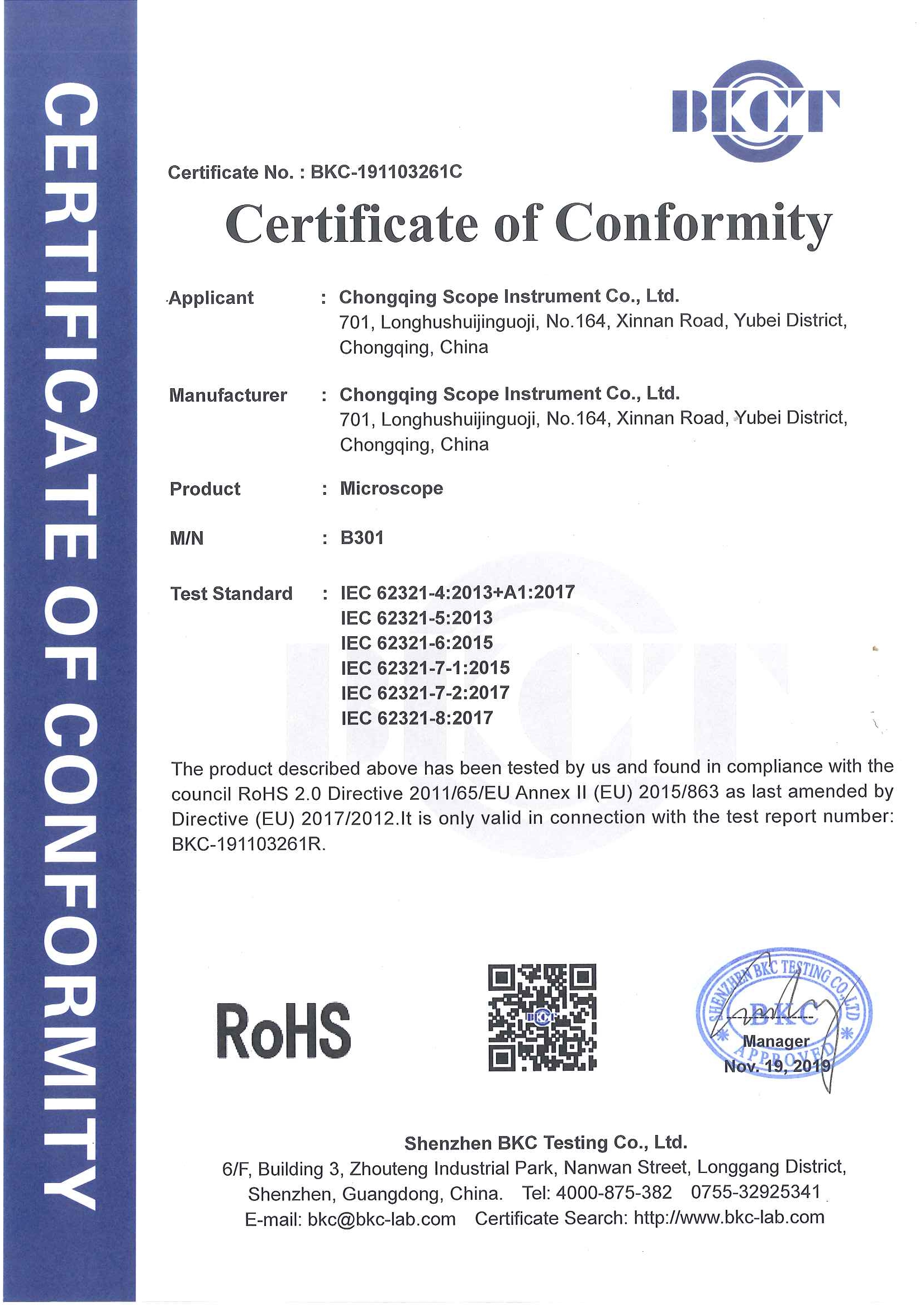
Compliance documentation for the platforms discussed here is recorded in three certificate entries. CE certificate BKC22072376GC was issued against EN 61010-1:2010+A1:2019 on 2 August 2022 and is valid to 1 August 2032, with a scope covering the BDS, Smart, BK, MIT and other product family prefixes. CE certificate BKC22072375GC was issued against EN IEC 61326-1:2021, EN IEC 61000-3-2:2019+A1:2021, EN 61000-3-3:2013+A1:2019+A2:2021 and EN 55011:2016+A11:2020 on 4 August 2022 and is valid to 3 August 2032. RoHS certificate BKC-191103261C was issued against the IEC 62321 series on 19 November 2019 and is valid to 18 November 2029, with BDS400, BDS500, SMART-POL and BK-POLF listed among its related products.

| Execution checkpoint | Why it matters | Documented reference |
|---|---|---|
| Certificate-to-model mapping | Family prefixes do not identify a single ordered model | CE BKC22072376GC; CE BKC22072375GC; RoHS BKC-191103261C |
| Objective set confirmation | A 4X phase contrast position exists on the BDS500 but not on the BDS400 | BDS500 4X/10X/20X/40X; BDS400 10X/20X/40X |
| Illumination mode and type | Halogen and LED options differ by model; reflected and transmitted light are not interchangeable | BDS500 Koehler 12V/50W halogen; BDS400 12V/30W halogen or 5W LED; BK-POLF reflecting 5W LED |
| Vessel and stage compatibility | Dish holder and stage travel determine usable formats | 54 mm dish holder and 210 × 241 mm stage on both inverted models |
| Accessory plates | Retardation work depends on which plates travel with the instrument | λ/4, λ slip and quartz wedge listed for both polarizing models |
| Branding and packaging | Private-label orders require the logo method to be fixed before production | Logo customization; OEM and ODM services |
| Commercial terms | Acceptance and delivery terms define risk allocation | MOQ 1 unit; 15-day lead time; EXW/FOB/CFR/CIF/DAP; T/T; factory inspection acceptance; one-year warranty with online support |
A documented distributor case shows how these terms work in practice. A microscope distributor in Romania took 30 units for school teaching purposes, with the deployment reported as running stably for two years; the case highlights are OEM service and integrated teaching and learning. The case is not cell-culture or petrographic work, and it is included here for a narrower reason: it is the available documentation of an OEM-led volume order, and it illustrates the operating model that a scenario-fit order would follow.
Future outlook
Two structural features of the optical microscope market look durable. The first is share: optical instruments held approximately 37% of global microscope market value in 2025, which means the installed base and the replacement cycle remain centred on optical platforms rather than on higher-cost alternatives. The second is trade: US$3.36 billion of microscopes moved across borders under HS 9011 in 2024, so cross-border supplier selection will remain a routine part of laboratory procurement rather than an exception.
The practical consequence is that the differentiating document in a microscope purchase is shifting from the brochure to the configuration sheet. Two suppliers can quote the same platform name and deliver different optical paths: a 4X phase contrast position present or absent, an analyzer adjustable from 0–90° or fixed, a 174 mm revolving stage rather than a 142 mm one. Over the validity horizon of the compliance records documented here — RoHS to November 2029 and CE to August 2032 — the certificate numbers are stable, while what sits behind them continues to be specified model by model. Buyers who write the optical path into the purchase order during evaluation avoid the most common execution-stage surprise: receiving a correctly certified instrument that does not match the workflow it was bought for.
For readers who need the underlying product documentation, the company catalogue covering these instrument families is available as a public download: Chongqing Scope instrument catalogue (PDF).
FAQ
What is the difference between an inverted microscope and an upright microscope for cell culture work?
An inverted microscope places the objective below the stage and the illumination above it, so the specimen can be observed through the base of a flask, dish or multi-well plate without being transferred to a slide. Upright biological microscopes such as the B301, B204, B302, BK5000, SMART-2 and SMART-4 are documented for biology, education and laboratory research with slide-stage geometry and mechanical stages between 125 × 115 mm and 175 × 145 mm. The BDS500 and BDS400 are documented as inverted microscopes with trinocular heads, 210 × 241 mm mechanical stages, 54 mm culture dish holders, and cell culture listed in their application scope.
Which of the two inverted models documents a 4X phase contrast position?
The BDS500 documents LWD infinity plan objectives at 4X, 10X, 20X and 40X in phase contrast and bright field, with annular spots at 4X/10X/20X/40X and a four-hole rotating disc phase contrast condenser. The BDS400 documents LWD infinity phase contrast objectives at 10X, 20X and 40X, with annular spots at 10X/20X/40X and a long working distance condenser with N.A. 0.3. A documented 4X phase contrast position therefore exists on the BDS500, while the lowest documented phase contrast magnification on the BDS400 is 10X. Both models document 100:0 and 80:20 light distribution and a 54 mm culture dish holder.
What separates the BK-POLF from the SMART-POL for geological and mineralogical work?
Both are documented as polarizing microscopes for geology, industry, materials science and biology, and both list an analyzer, a Bertrand lens and λ/4, λ slip and quartz wedge accessories with a revolving round stage. The BK-POLF documents non-stress LWD plan semi-apochromatic objectives at 5X, 10X, 20X and 50X on a quintuple nosepiece, a 174 mm revolving round stage, and reflecting illumination at 5W LED. The SMART-POL documents non-stress infinity plan objectives at 4X, 10X, 20X and 40X on a quadplex nosepiece, an analyzer unit adjustable from 0–90°, a 142 mm revolving round stage, an Abbe N.A. 1.25 condenser, and 5W LED or 12V/30W halogen illumination.
Why does a Bertrand lens appear in petrographic specifications?
In polarized-light microscopy the Bertrand lens is used for conoscopic observation: it brings the interference figure formed in the back focal plane of the objective into view, which is a standard way to examine optical character and to align a grain's optic axis. In the documented configurations, the Bertrand lens is listed as part of the polarizing media on the BK-POLF, the SMART-POL and the BK-POL polarizing microscope, each of which also documents an analyzer and a set of λ/4, λ slip and quartz wedge plates. The BK-POL additionally documents a 174 mm revolving round stage and a N.A. 0.9/0.13 swing-out condenser.
What customization and order conditions are documented for these microscope families?
Chongqing Scope Instrument Co., Ltd. documents OEM and ODM services for microscopes and other products, supported by an R&D team of 20 engineers, with logo customization available as a customization service. Documented order conditions include a minimum order quantity of 1 unit, a lead time of 15 days, a monthly capacity of 3,000 units, factory quality inspection as the quality control method, and a one-year warranty with online support. Documented purchasing terms include EXW, FOB, CFR, CIF and DAP delivery terms, T/T payment, and factory inspection as the acceptance criterion. Export markets are stated as Europe, Southeast Asia, the Middle East, South America and Africa.
Which certificates cover the inverted and polarizing families, and what should be verified?
Three records are documented. CE certificate BKC22072376GC was issued against EN 61010-1:2010+A1:2019 on 2 August 2022 and is valid to 1 August 2032. CE certificate BKC22072375GC was issued against EN IEC 61326-1:2021, EN IEC 61000-3-2:2019+A1:2021, EN 61000-3-3:2013+A1:2019+A2:2021 and EN 55011:2016+A11:2020 on 4 August 2022 and is valid to 3 August 2032. RoHS certificate BKC-191103261C was issued against the IEC 62321 series on 19 November 2019 and is valid to 18 November 2029, with BDS400, BDS500, SMART-POL and BK-POLF listed among its related products. Because certificate scopes are expressed as product family prefixes such as BDSXXX, SmartXXX and BKXXX rather than individual model numbers, the declaration of conformity mapping the certificate number to the exact ordered model should be obtained and checked before acceptance.
¿Tiene preguntas o necesita más detalles?
Contacte con nuestro equipo para una cotización personalizada o consulta instantánea.
Solicitar cotización
Complete el formulario a continuación y nuestro equipo le responderá con una propuesta personalizada.
Chat directo de WhatsApp
¿Prefiere chatear en tiempo real? Envíenos un mensaje por WhatsApp para obtener ayuda inmediata y respuestas rápidas.
- Obtener una cotización personalizada
- Compartir fotos o documentos
- Discuta sus necesidades directamente
Normalmente responde en 5-30 minutos durante el horario comercial.