
Crimpable Hooks vs Lingual Buttons: A Clinical Attachment Guide
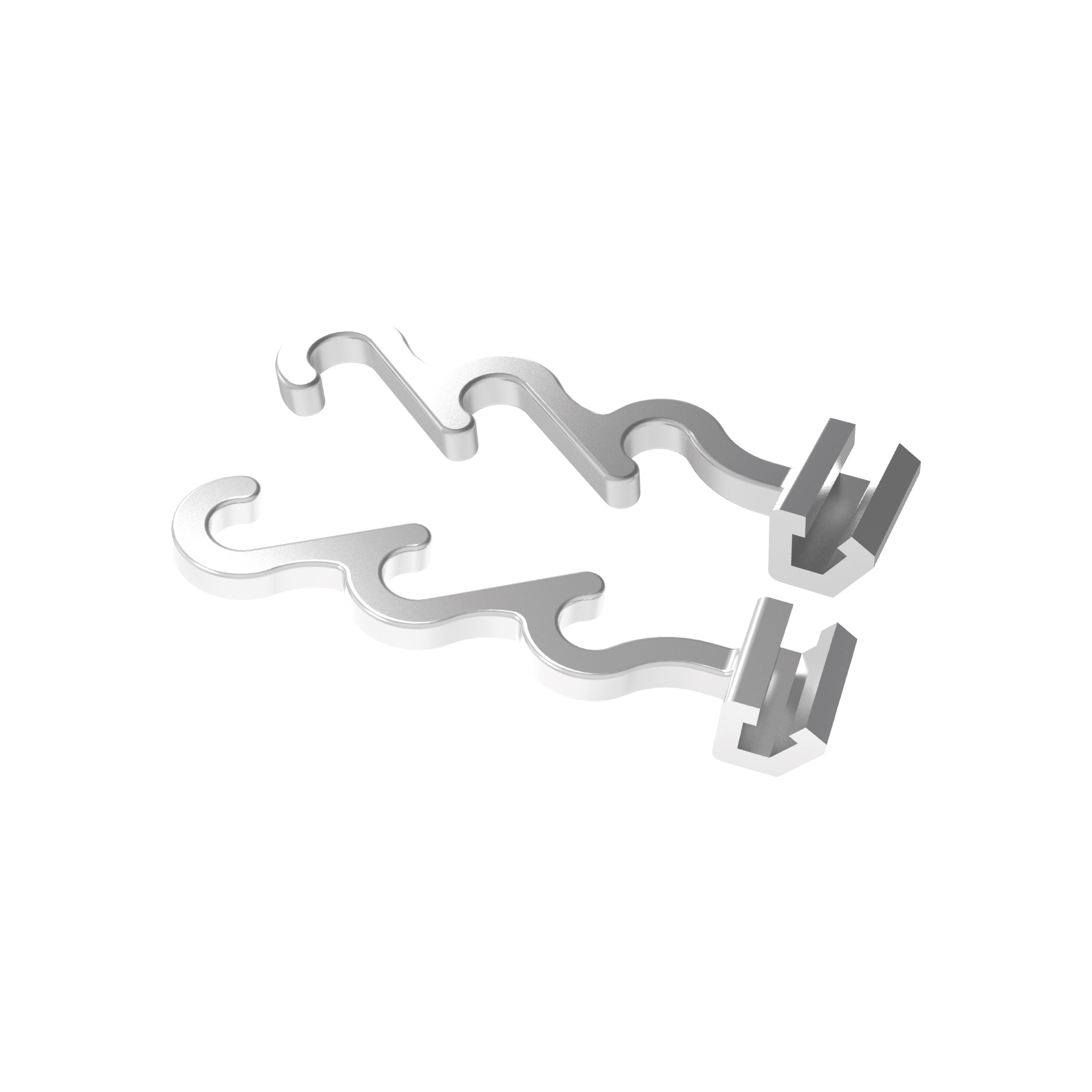
Spiral crimpable hooks are published at a 0.022" size in left/right 8.7 mm types. Image: Yortho product data.
Treatment planning decides where force is applied and for how long; procurement decides whether the components required to deliver that force arrive in the right size. Orthodontic crimpable hooks and orthodontic lingual buttons sit exactly on that boundary. Both are small stainless-steel attachments, both are listed under orthodontic auxiliaries, and both are frequently ordered in the same shipment — yet they solve two different mechanical problems, one on the arch wire and one on the tooth.
This reference sets the two attachment types side by side using published product data from Yortho (a UK-origin orthodontic brand belonging to YAM Global Limited, which operates its own production facility in Asia through Zhejiang YO Medical Technology Co., Ltd. in Huzhou, Zhejiang Province, China). It is written for procurement managers, distributors and clinic owners who need to interpret a supplier catalogue accurately — not a treatment manual. Every parameter quoted below is a manufacturer-published value; final specifications, including dimensions and material options, should be confirmed with the supplier before ordering.
Why Two Small Attachments Cause Procurement Clarification
Crimpable hooks and lingual buttons look alike on a specification sheet and are often described with the same single word: traction. They are not interchangeable. A crimpable hook is a wire-borne attachment — it is fixed onto the arch wire and creates a point along the wire where elastics, chains or other accessories can be connected, so that additional anchorage can be applied. A lingual button is a tooth-borne attachment — it is bonded to a tooth surface and provides a ring, eyelet or hook on that specific tooth.
The distinction only becomes a problem when it reaches the purchasing process. Both items are small, both are bought in quantity, both are stored in similar packaging, and both are consumed at a rate determined by the clinic's case mix. When the order does not match that case mix, the shortfall is discovered at the chairside rather than during stock intake, where it is still easy to correct.
The practical opportunity is narrow but real. Relative to their size, auxiliary attachments are among the most specification-sensitive lines in an orthodontic order. Establishing which published model belongs to which treatment role — before the order is placed — reduces clarification emails, wrong-size shipments and emergency substitutions for both clinics and distributors.
What Each Attachment Is: Yortho's Published Product Lines
Yortho describes its manufacturing scope as covering orthodontic supplies, pediatric dental products and dental laboratory appliances. Brackets, buccal tubes and molar bands form the flagship orthodontic range, and auxiliary attachments — crimpable hooks, lingual buttons and lingual hooks — are grouped alongside pliers, hand instruments and accessories. The two attachment families relevant here are documented separately, and the published parameters already show where they diverge.
Crimpable hooks: wire-side positioning
- Y-F105L / Y-F105R — spiral crimpable hooks. Published size 0.022", left/right type 8.7 mm, medical stainless steel. Yortho describes them as fixing onto the arch wire to facilitate other accessories in providing extra anchorage.
- Y-F102 — crimpable hook. Published size 0.022", medium 2.4 mm type, stainless steel.
- Y-F201 — crimpable hook. Published size 0.022", 2.4 mm type, stainless steel.
- Y-F204 — mini round tube stop. Published size 0.019", stainless steel. Not a hook, but part of the same wire-borne attachment logic: it fixes on the wire to limit or position other components.
Across the range, the stated material characteristic is fine medical stainless steel with controlled polishing and workmanship. The functional common denominator is that the attachment's position is decided chairside on the wire, not on the tooth.
Lingual buttons: tooth-side retention
- Y-F303 — bondable lingual button. Published as round with an 80# mesh base, stainless steel.
- Y-F307 — bondable lingual eyelet. Round base, stainless steel. Published selling points include a mesh base for stable bonding and an upright ring designed to prevent slipping.
- Y-F308 — bondable lingual eyelet traction hook. Round base, stainless steel.
- Y-F322 — lingual button. Round base with hole, stainless steel.
- Y-F305C — ceramic bondable lingual button. Round base, ceramic body.
Two related auxiliaries complete the picture: the Y-F314 lingual chain (sliver type, stainless steel) and the Y-F321 power arm (round shape, stainless steel), both of which connect the bonded attachment to the source of force.
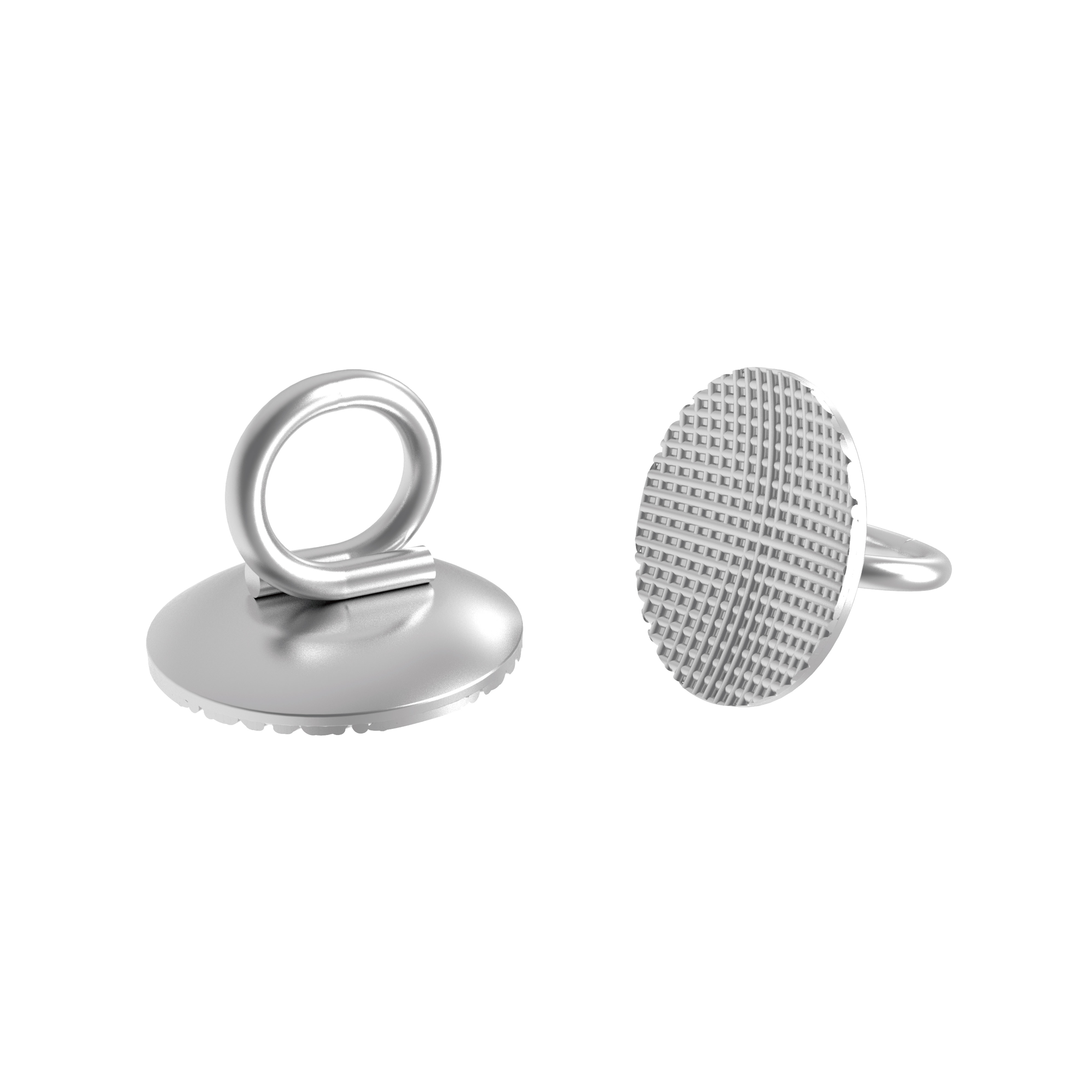
Bondable lingual eyelet Y-F307: a tooth-borne attachment with a round base and an upright ring. Image: Yortho product data.
Mechanics: Wire-Borne Traction and Tooth-Borne Retention
The mechanical difference is simple to state and important to hold on to: the hook changes where along the wire a force can be applied, while the button changes which tooth a force is applied to. A hook cannot be placed on a tooth surface, and a button cannot be slid along an arch wire. In a single treatment plan both may appear, which is exactly why catalogues separate them into different model families.
| Attribute | Crimpable hook (wire-borne) | Lingual button (tooth-borne) |
|---|---|---|
| Attachment site | Arch wire | Tooth surface (bonded) |
| Published Yortho models | Y-F105L / Y-F105R spiral hooks (0.022", L/R 8.7 mm); Y-F102 (0.022", medium 2.4 mm); Y-F201 (0.022", 2.4 mm); Y-F204 mini round tube stop (0.019") | Y-F303 (round, 80# mesh base); Y-F307 bondable lingual eyelet; Y-F308 bondable lingual eyelet traction hook; Y-F322 (round base with hole); Y-F305C ceramic |
| Published material | Medical stainless steel | Stainless steel; ceramic for Y-F305C |
| Primary role | Extra anchorage and traction points along the wire | Traction originating from the lingual tooth surface |
| Placement instrument | Crimpable hook plier (Y-Q6026, HRC 50–55, max sterilization 180 °C) | Placement tweezer (e.g. Y-X201 curved tip, autoclavable up to 134 °C) |
| Position decided by | Chairside decision on the wire | Selection of the tooth to be bonded |
| Main dependency | Presence and size of an arch wire | Bondable enamel surface and bonding protocol |
Integration with Arch Wires, Auxiliaries and Instruments
Because crimpable hooks are wire-borne, the wire determines what fits. Yortho publishes stainless steel arch wires (Y-SS) in 0.012"–0.020" sizes across round and rectangular cross-sections and several arch forms, super-elastic NiTi (Y-SN) and heat-activated NiTi (Y-HN) in the same size band, and TMA round wires (Y-TMA) in 0.012"–0.018" in a nickel-free beta-titanium alloy described as bendable and weldable, with low spring-back and suitability for nickel-allergic patients. Against that backdrop, the published hook sizes of 0.022" and the 0.019" mini round tube stop are the number to check first: the attachment and the wire must correspond.
Instrument integration is equally concrete. The crimpable hook plier Y-Q6026 is published with a hardness of HRC 50–55 and a maximum sterilization temperature of 180 °C. Placement instruments for the tooth-borne family include the Y-X201 lingual brackets tweezer with a curved tip, listed as suitable for lingual brackets and autoclavable up to 134 °C, the Y-X202 bracket tweezer (also autoclavable up to 134 °C), and the Y-X203 tube tweezers with a long tip, listed as suitable for posterior brackets and buccal tubes.
The third integration layer is the force source itself. A hook or a button is only an anchor; the force arrives through an elastic or chain. Yortho publishes elastic ligatures (Y-S80201) and power chains (Y-S80101) made from high-elasticity polymers, described with low force attenuation in the humid oral environment, multiple tension and loop configurations, and a latex-free option for allergic patients. For distributors, that matters commercially: attachment auxiliaries and force-delivery consumables move together, and specifying one without the other creates avoidable split orders.
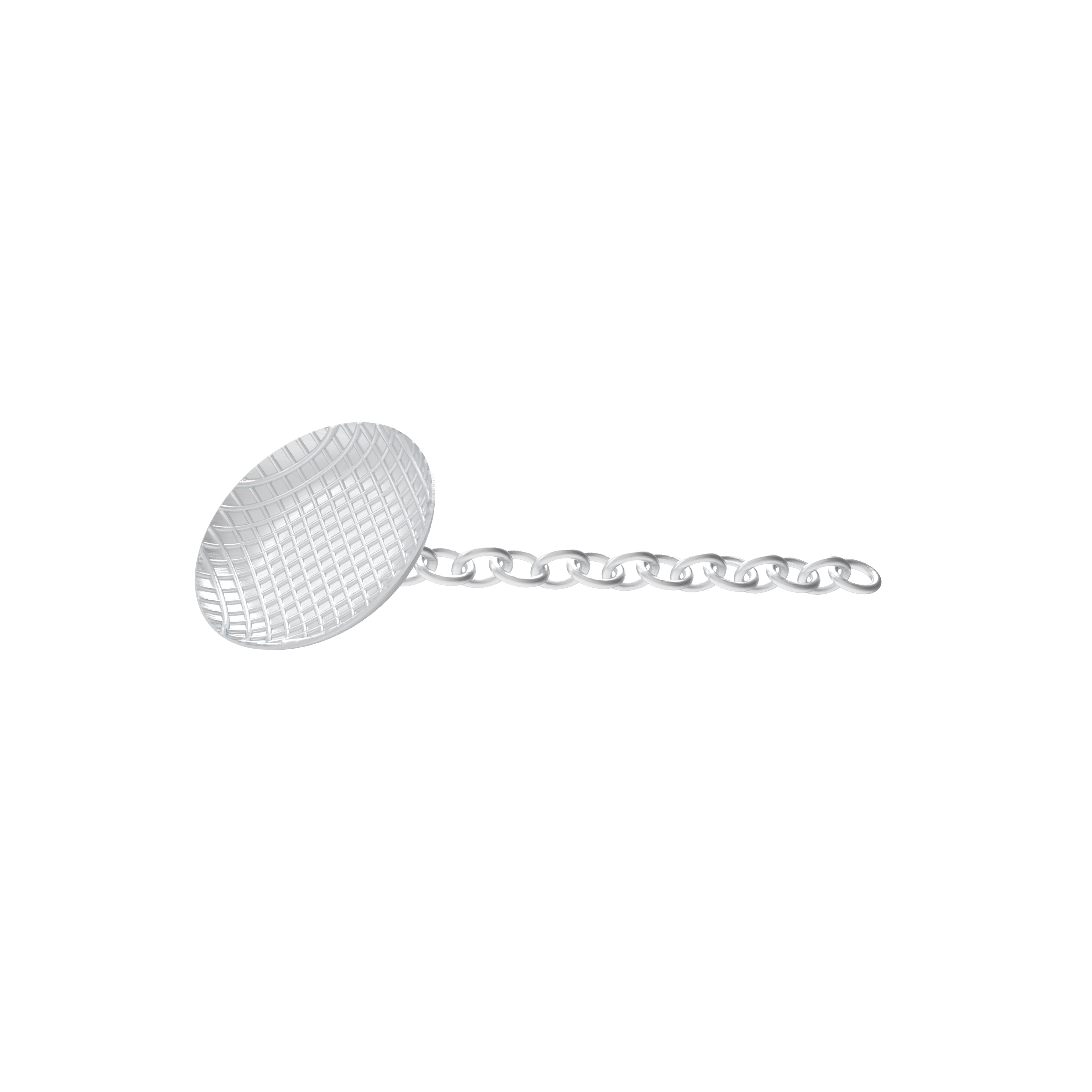
Lingual chain Y-F314: the auxiliary layer between a bonded attachment and the force source. Image: Yortho product data.
Application and Use Cases in Clinical Programmes
Yortho's application data places these products in clinical and dental clinic environments, where they must meet routine disinfection and sterilization conditions, and describes the setting as common in dental clinics and dental hospitals globally. The programme types are dental procurement, orthodontic treatment programmes, and supply projects for clinics and distributors.
Within that setting, the published functional role of the appliance family is to hold orthodontic arch wires in place and transmit continuous mechanical forces to the teeth, contributing to alignment correction and occlusal function. Auxiliary attachments sit inside that framing as the components that extend where and how those forces can be applied. Yortho also notes that single-use consumables and reusable instruments coexist in the same clinical workflow — elastic ligatures are typically single-use, while pliers and hand instruments are reusable and maintained according to product instructions.
Procurement rarely happens in isolation, and the published supporting-equipment list makes that clear: arch wires (NiTi, stainless steel), buccal tubes, orthodontic bands, bonding adhesives or cements, curing lights, ligatures and orthodontic pliers. Special requirements listed for the same context include biocompatibility, nickel-free or low-allergy material requirements in some markets, and compliance certification documents.
Two programme references illustrate the scale at which these specification decisions are made. A distributor-level project supplied 5,000 units across multiple countries over a one-to-three-year period, with results described as consistent product performance and compliance with local hospital clinical requirements. A separate case at a dental hospital in Indonesia involved 3,000 units over two years, with feedback indicating good clinical performance and that self-ligating brackets shortened overall treatment duration. Both references describe appliance-level programmes rather than the auxiliary attachments alone; they indicate the procurement scale and documentation context in which attachment specifications are set.
| Clinical need | Attachment category that matches it |
|---|---|
| A traction point along an arch wire, position chosen chairside | Crimpable hook (e.g. Y-F105L / Y-F105R spiral hooks) |
| Traction from a lingual tooth surface where no bracket is bonded | Bondable lingual button or lingual eyelet (e.g. Y-F303, Y-F307, Y-F308) |
| A stop or position limiter on the wire | Mini round tube stop (Y-F204, 0.019") |
| Lingual attachment in an aesthetic-sensitive case | Ceramic bondable lingual button (Y-F305C) |
| Connection between a bonded attachment and the force source | Lingual chain (Y-F314) or power arm (Y-F321) |
Market Signals Affecting Attachment Specification
The demand context for these parts is expanding rather than contracting. Grand View Research valued the global orthodontic consumables market at USD 3.1 billion in 2024 and projected it to reach USD 4.3 billion by 2030. The same analysis identifies anchorage appliances, including mini-implants, as a growing part of that consumables segment — a signal that auxiliary-level specification is receiving more attention in treatment planning, not less.
Material preferences remain conservative and predictable. Grand View Research reports that stainless steel is still the most widely used material for orthodontic arch wires and brackets globally, which is consistent with the stainless steel construction published across Yortho's crimpable hooks and lingual buttons. At the aesthetic end, Fortune Business Insights notes that ceramic self-ligating brackets are gaining popularity for their aesthetic and friction-reduction benefits — the same demand logic that makes a ceramic bondable lingual button such as Y-F305C relevant in esthetic-focused cases.
Allergy awareness is a smaller but persistent specification driver. Nickel and chromium are identified in medical literature as the primary allergens of concern in metal orthodontic brackets, which is why a nickel-free option such as Yortho's TMA arch wire is worth knowing about when a market requires low-allergy material documentation.
Regulation continues to shape what a supplier must be able to document. EU Medical Device Regulation (MDR 2017/745) is mandatory for orthodontic brackets to carry CE marking; the US FDA classifies orthodontic brackets as Class II devices requiring 510(k) clearance; ISO 13485:2016 is recognised by the FDA as the primary basis for its Quality Management System Regulation; and the Medical Device Single Audit Program covers quality-system requirements across five major jurisdictions. On the supply side, customs data analysis places China's dental instrument export clusters in Guangdong, Jiangsu and Zhejiang — the province where Yortho's production facility is located.
One caveat for anyone quoting market figures internally: published orthodontic market sizes vary widely because the scope differs. Some estimates cover consumables only, others cover full treatment systems and services. The definition matters as much as the number.
Comparison with Traditional Attachment Approaches — and the Limits of Each
The most common traditional alternative to a separate crimpable hook is a hook built into the bracket itself. Yortho's metal brackets (Y-M1 Mini Bracket), self-ligating metal brackets (Y-M2) and ceramic brackets (Y-C2) are published with a "hook: with / without" option, so the traction point can be ordered as part of the bracket rather than as a separate wire-mounted part. The trade-off is positioning: an integrated hook sits where the bracket design places it, while a crimpable hook can be positioned along the wire at the clinician's discretion.
| Option | How the traction point is created | Practical boundary |
|---|---|---|
| Integrated bracket hook | Built into the bracket design (published as "hook: with / without") | Position is fixed by the bracket's slot location; a mid-wire traction point cannot be created this way |
| Crimpable hook | Fixed onto the arch wire with a crimping plier | Requires an arch wire of the corresponding published size to be in place; once crimped, repositioning is a chairside operation |
| Bondable lingual button | Bonded to a tooth surface using its mesh base | Depends on an accessible, bondable enamel surface and moisture-controlled bonding; adds a lingual profile that can affect hygiene access |
| Orthodontic implant screw (separate category) | Skeletal anchorage via a titanium alloy screw, e.g. Y-OS1406 at 1.4 mm diameter × 6 mm length | A different anchorage concept, not a substitute auxiliary; it answers cases where the plan requires skeletal rather than dental anchorage |
Two boundaries are worth stating plainly, because they are the most common source of mis-specified orders. First, a crimpable hook cannot create a traction point where there is no arch wire — it is entirely dependent on the wire being present and on the published size matching the wire in use. Second, a lingual button is only as reliable as the bond beneath it; its mesh base geometry supports bonding, but the outcome depends on surface preparation, adhesive selection and moisture control, none of which the catalogue can specify for a given patient.
A third boundary belongs to procurement rather than clinical practice: published parameters are manufacturer data at a point in time. Size ranges, material options and documentation sets change, and destination-market requirements differ. Specifications quoted in this article should be confirmed with the supplier before an order is placed.
Future Outlook
Three trends are likely to shape how auxiliary attachments are specified over the next planning cycles. The first is digitalisation. Industry analyses identify digital workflows using intraoral scanners and CAD/CAM, and 3D printing for models and aligner moulds, as critical technological trends for 2025 — and digitally planned cases tend to arrive at the purchasing stage with more precise component lists, including attachment types and sizes.
The second is documentation. With ISO 13485:2016 aligned to the FDA's Quality Management System Regulation, and with MDSAP allowing a single audit to satisfy quality-system requirements across five jurisdictions, buyers increasingly evaluate suppliers on the depth of their regulatory file rather than on catalogue breadth alone. Yortho's published certification set includes ISO quality management system certification, CE certification under the new EU MDR and FDA registration, alongside a stated 80% export ratio and distribution to more than 70 countries across the EU, USA, Middle East, Australia and Africa.
The third is manufacturing responsiveness at the auxiliary level. Yortho's published capability data describes a 5,000 m² facility, approximately 100 employees and a 20-engineer R&D team, with an annual output of 30,000,000 units, 100% testing, OEM/ODM customisation covering package, logo, tag and product, a published lead time of 3–7 days, and remote after-sales support. For distributors managing attachment stock across many small SKUs, that combination — short replenishment cycles plus customisation — matters more than any single product parameter.
Procurement FAQ: Crimpable Hooks and Lingual Buttons
1. What is the functional difference between a crimpable hook and a lingual button?
A crimpable hook is attached to the arch wire and creates a traction or anchorage point along that wire; Yortho describes its crimpable hooks as fixing onto the arch wire to facilitate other accessories in providing extra anchorage. A lingual button is bonded to a tooth surface and provides a ring or eyelet on that tooth; the Y-F307 bondable lingual eyelet, for example, is published with a round base and an upright ring. In short, the hook changes where along the wire force can be applied, while the button changes which tooth receives it.
2. Which attachment should be specified when traction has to originate from the lingual surface?
When the traction point must sit on the lingual surface of a tooth, the tooth-borne category applies: a bondable lingual button, lingual eyelet or lingual eyelet traction hook. Yortho lists several variants in this family — Y-F303 (round, 80# mesh base), Y-F307 (bondable lingual eyelet, round base), Y-F308 (bondable lingual eyelet traction hook, round base) and Y-F322 (round base with hole) — plus a ceramic option, Y-F305C. Where the plan instead requires a traction point along the arch wire, a crimpable hook is the relevant category. Which specific model matches a given bonding site should be confirmed with the supplier.
3. Do crimpable hooks require a dedicated instrument, and how are they sterilized?
Yes — crimpable hooks are fixed to the arch wire with pliers, and Yortho publishes a dedicated crimpable hook plier, Y-Q6026, with a hardness of HRC 50–55 and a maximum sterilization temperature of 180 °C. Placement instruments for bonded attachments are published with their own parameters: the Y-X201 lingual brackets tweezer and Y-X202 bracket tweezer are autoclavable up to 134 °C. Sterilization settings should always be verified against the specific instrument and the clinic's own protocol.
4. What wire sizes do Yortho's crimpable hooks and tube stops come in?
Published parameters list the spiral crimpable hooks Y-F105L and Y-F105R at 0.022" with left/right 8.7 mm types; the Y-F102 crimpable hook at 0.022" in a medium 2.4 mm type; the Y-F201 crimpable hook at 0.022" in a 2.4 mm type; and the Y-F204 mini round tube stop at 0.019". Because these dimensions have to align with the arch wire and slot system in use, buyers should confirm the current size range with the supplier before ordering.
5. How do lingual buttons attach, and what is the bonding base?
Lingual buttons in Yortho's range are bonded rather than crimped or welded. The Y-F303 button is published with a round 80# mesh base; the Y-F307 bondable lingual eyelet is published with a round base and a mesh bonding surface described as providing stable bonding, with an upright ring designed to prevent slipping. Bonding performance still depends on the clinician's surface preparation and the adhesive system used — the published base geometry is one input into that protocol, not the whole of it.
6. Are these attachments reusable, or single-use?
Yortho's published application data notes that single-use consumables and reusable instruments coexist within orthodontic practice: elastic ligatures are typically single-use, while pliers and hand instruments are reusable and maintained according to product instructions. Bonded and crimped auxiliary attachments fall on the consumable side of that line, while the instruments used to place them do not. Because classification is product-specific, it should be confirmed item by item.
7. What should a buyer confirm with the supplier before placing an order?
Four things. First, model-to-application mapping — whether the case requires a wire-borne hook or a tooth-borne button, and which published model corresponds to it. Second, dimensional match — hook and tube-stop sizes must align with the arch wires and slot system in use. Third, material and allergy requirements — some markets require nickel-free or low-allergy options and biocompatibility documentation, and while Yortho's TMA arch wires are described as nickel-free beta-titanium, the stainless-steel auxiliaries are not. Fourth, compliance documentation for the destination market; Yortho's published certification set includes ISO certification, CE certification under the new EU MDR and FDA registration, but the specific documents required vary by country.
Yortho's corporate brochure, which summarises the product families, capability data and certification scope referenced in this article, is available for download at the Yortho brochure PDF. Product information is also published at www.yortho.com.