
Countertop Electric Food Steamers: A Practical Buyer Primer
Countertop Electric Food Steamers: A Practical Buyer Primer
An independent industry reference on how countertop electric food steamers work, which specifications carry real procurement weight, and where the design has hard limits.
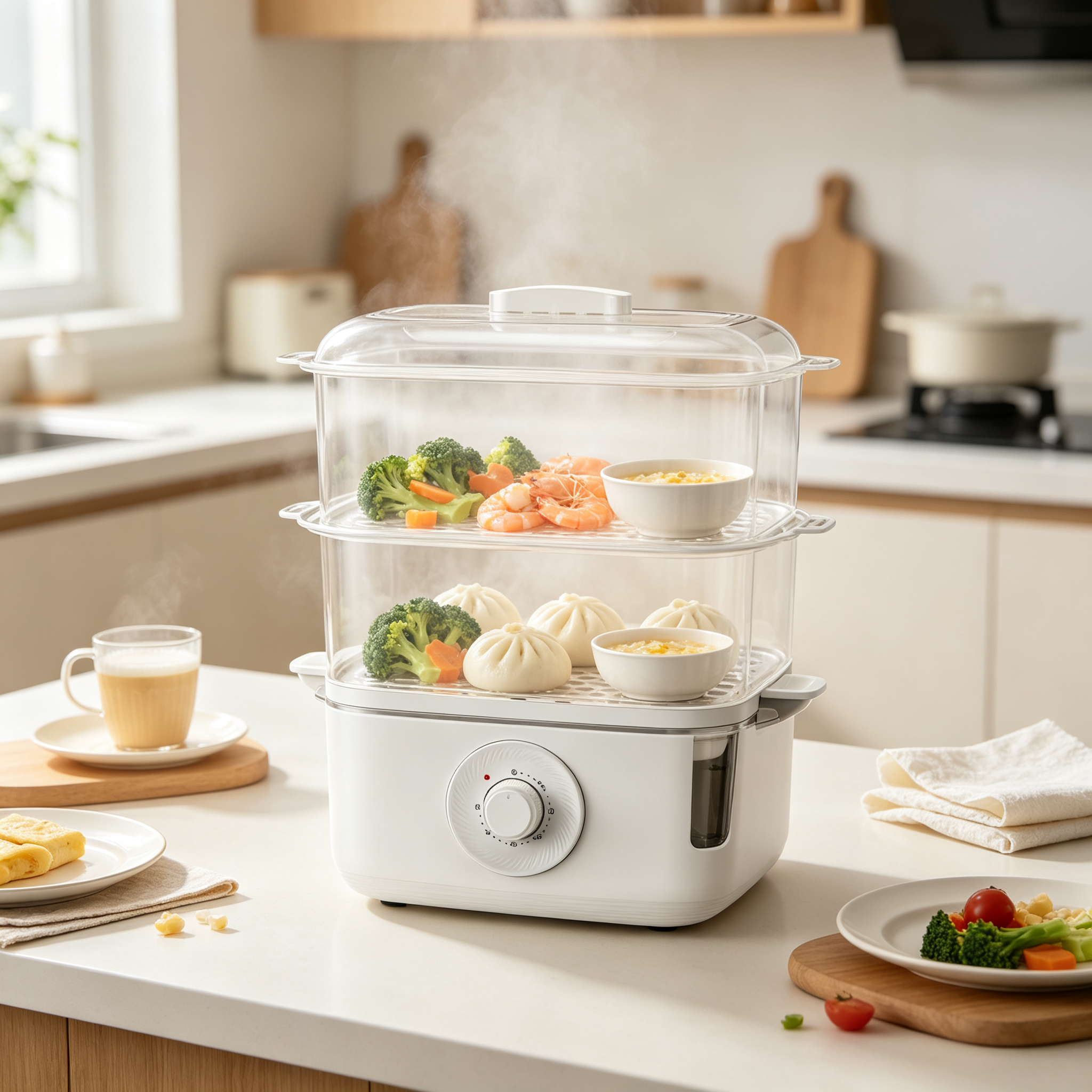
Application scenarios of electric steamers in household and commercial kitchen environments.
Steam cooking is one of the oldest preparation methods in the domestic kitchen, but the countertop electric food steamer is a comparatively recent mainstream form factor. Unlike a built-in steam oven, which is installed into cabinetry and treated as a fixed appliance, or a stovetop bamboo basket, which depends on a separate heat source, a countertop electric food steamer generates steam from its own integrated water tank and heating element, plugs into a wall socket, and stands on a work surface. Self-contained heat, a defined footprint and no installation requirement are the three characteristics that make the category legible to household buyers, gift-set programme managers and cross-border e-commerce sellers at the same time.
This reference article is written for readers in the awareness and research stages of a purchasing decision. It explains what a countertop electric food steamer is, how the appliance produces and controls steam, which specifications affect real buying decisions, which compliance documents the European market expects, where the design stops working well, and how the SC750 electric food steamer from Ningbo Jinchang Electronics Co., Ltd. illustrates the category in practice. No performance figures are used here beyond those documented by the manufacturer and the applicable standards.
What a Countertop Electric Food Steamer Is
A countertop electric food steamer is a plug-in cooking appliance that produces steam internally and uses that steam to cook, reheat or prepare food placed on one or more stacked trays inside a lidded chamber. Five functional groups define the product: a water reservoir, a heating element, one or more food trays or tiers, a control interface governing cooking duration, and a safety mechanism that interrupts heating when the water supply is exhausted. Remove any of the five and the appliance either stops being electric, stops being safe, or stops being a steamer in the practical sense.
The category sits between two older approaches. It is more self-contained than a stovetop basket because it supplies its own heat. It is less integrated than a built-in steam oven because it needs no cabinetry, no plumbing and no dedicated circuit. Countertop units are intended for indoor use on a stable, level surface, and they operate in an environment of hot steam and water vapour that surrounding surfaces and materials must tolerate. That environment is also why food-contact materials and electrical safety are the two compliance themes that dominate the category.
A representative product in this category is the SC750 electric food steamer from Ningbo Jinchang Electronics Co., Ltd., a manufacturer of Western-style small household kitchen appliances based in Yuyao City, Zhejiang Province, China. The SC750 is classified as an electric steamer with a two-layer structure and a 7 L capacity, rated at 230 V and 800 W, with a plastic housing and a material set of PP, ABS knob and PC indicator. It is designed for household use and for B-end foreign trade procurement scenarios, including cross-border e-commerce, and its documented certification set is CE, LFGB and CB.
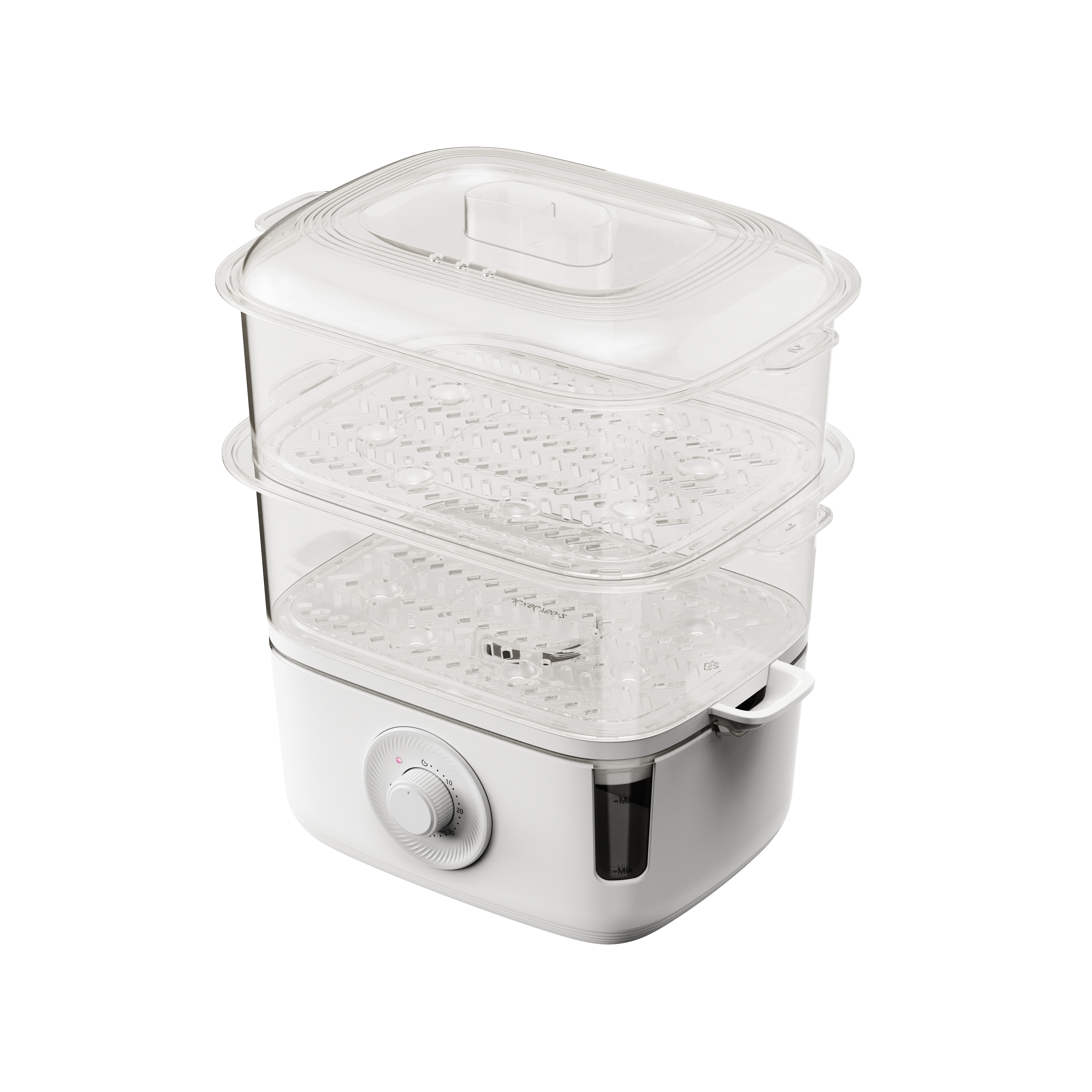
Electric food steamer: two-layer transparent body, independent visible water tank, removable steaming trays.
The Problem the Category Addresses, and Where Demand Comes From
Stovetop steaming works, but it demands attention. A pot or basket over a burner competes for hob space, requires manual water management, and gives the cook no controlled end point beyond observation. The countertop electric food steamer addresses three specific frictions: unattended timing, simultaneous cooking of different foods, and oil-free preparation.
The timing friction is solved by a timer-controlled heating cycle. On the SC750, cooking duration is set with a rotary mechanical timer, and the appliance is documented as including an automatic shut-off function. The multi-food friction is solved by tier structure: a dual-layer transparent steamer body accommodates vegetables, buns, baby food, seafood and other items at the same time, so different components of a meal finish together under one power draw. The oil-free friction is inherent to steam as a cooking medium, and it is the reason the format appears in household kitchen upgrades as well as in catering and hospitality procurement.
Demand for the category therefore comes from several distinct buyer groups. Household retail is the base. Gift-set wholesale is a second, because the appliance is a self-contained consumer product with a clear use case. Cross-border e-commerce is a third, since the product ships as a boxed consumer unit. Homestay and apartment supporting supplies, kitchen appliance upgrades and catering equipment procurement are documented as further project types, alongside OEM and ODM projects for overseas brand owners who want their own specification rather than a catalogue model.
How the Appliance Works: A Technical Walkthrough
Operation begins with manual water filling into an independent, visible water tank. Visibility matters more than it appears: because the tank is separate and can be inspected, the user can check the water level before and during use, which is the primary user-side control against running the element dry. Water quality guidance for this class of appliance is drinking water or tap water, matched to a 230 V grounded wall socket.
Heating is provided by an 800 W element rated at 230 V, which produces instant steam for time-saving cooking. Steam rises through the stacked tiers, and because the body is transparent, progress is visible without opening the lid and releasing heat. Food is placed on removable steaming trays, which are documented as simple to disassemble and clean, and the water-tank related parts are removable as well. Control is deliberately mechanical: a rotary timer sets cooking duration, with no application, no network connection and no pairing step.
Safety behaviour is part of the technical description, not an accessory. The documented automatic shut-off function is designed to prevent dry-burn overheating if the water tank empties or if a timed cycle continues beyond the water supply. In procurement terms, this is a component to verify rather than assume: the trigger condition for dry-burn risk is precisely a water tank that runs out while heating continues, so the protection circuit and the timer are the two items buyers are advised to inspect before mass shipment.
The second technical theme is food-contact material. The SC750 uses PP, ABS knob and PC indicator materials, and its food-contact components are documented as complying with the LFGB standard. Poor-quality food-contact parts, by contrast, may release harmful substances under high-temperature steam. That risk is not visible in a product photo or a unit price, which is why the mitigation normally recommended is documentary: require LFGB test reports for the steaming tray and cavity, and avoid purchasing products that lack food-contact compliance documents.
Specifications That Carry Procurement Weight
A specification list only becomes useful when each line is read as a consequence. The table below restates the documented SC750 specification and pairs each value with what it changes for a buyer.
| Specification | Documented value | What it changes for the buyer |
|---|---|---|
| Power | 800 W | Sets steam-up speed and the household circuit load. |
| Voltage | 230 V | Defines which markets the standard model can serve without adaptation. |
| Capacity | 7 L (documented as a 7-quart volume) | Determines portions per cycle and whether a single-layer model is sufficient. |
| Layers | 2-layer | Allows simultaneous cooking of different foods under one power draw. |
| Housing material | Plastic | Affects weight, drop-test behaviour and retail packaging design. |
| Material set | PP, ABS knob, PC indicator | Connected to the food-contact compliance file. |
| Certifications | CE, LFGB, CB | Determines eligibility for EU retail and supermarket channels. |
| Control | Rotary mechanical timer | No application, no network standby, all-age operation. |
| Safety function | Automatic shut-off (dry-burn protection) | The central safety claim to verify before mass shipment. |
| Water tank | Visible, independent | Enables water-level checking and refilling during operation. |
| Cleaning | Removable trays and accessories | Reduces end-user complaints, which reduces channel returns. |
| Packaging | Retail colour box | Ready for household retail, gift sets and B-end wholesale procurement. |
Two lines deserve separate attention. The first is voltage. A 230 V rated appliance cannot work under 110 V without a voltage-adjusted model, so a single SKU cannot be assumed to serve both European and North American mains supplies. The second is capacity measured as usable volume rather than as a marketing number: a 7 L, two-layer chamber is what allows vegetables, seafood, dumplings, eggs and prepared food to be steamed in the same cycle, and it is also what differentiates the product from a small single-layer unit intended for one or two people.
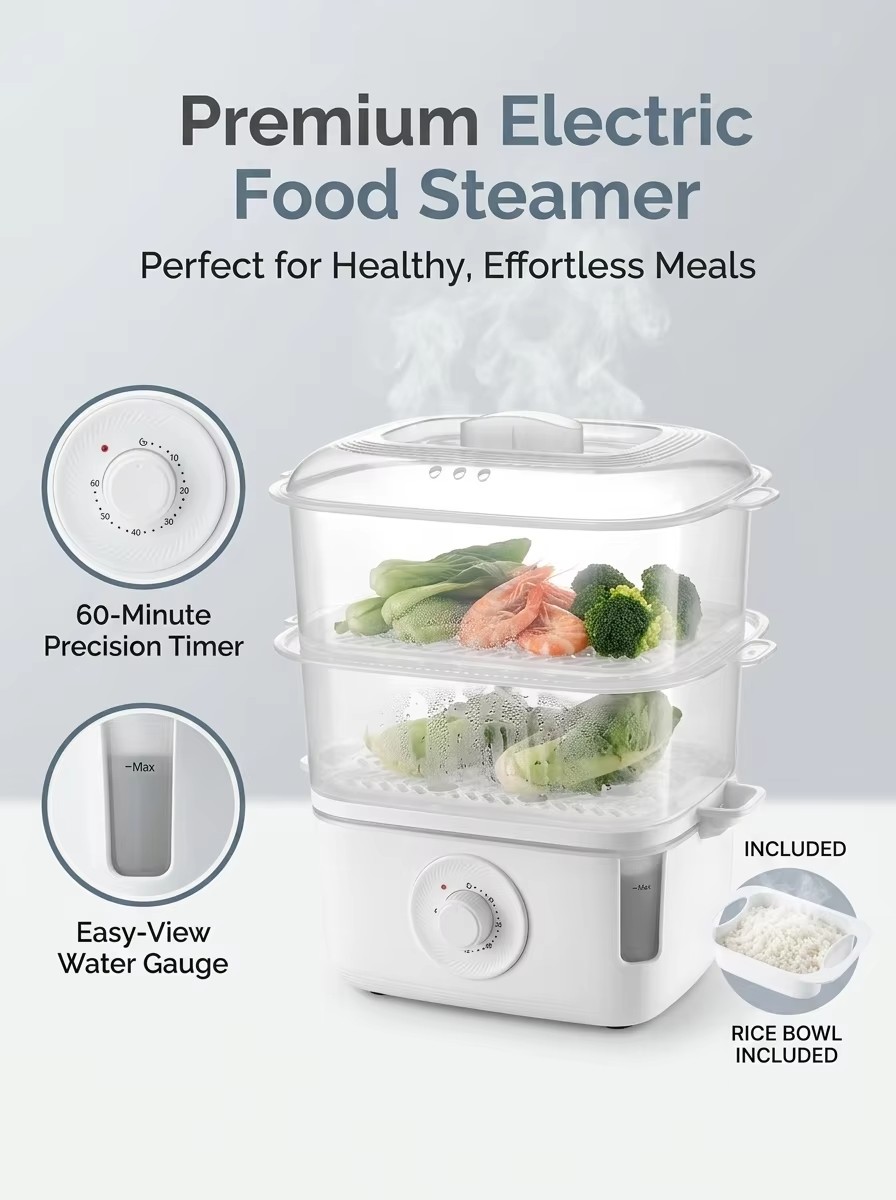
Multi-tier electric food steamer: stackable layers allow different foods to cook simultaneously at the same rated power.
Configuration Choices: Tier Count and Control Type
Buyers rarely choose between a good and a bad product; they choose between configurations with different trade-offs. Two of those trade-offs are well documented and worth stating plainly.
| Dimension | Double-layer, 7-quart (SC750) | Single-layer steamer |
|---|---|---|
| Cooking capacity | Multiple foods cooked at the same time | Limited to small portions |
| Power consumption | Same rated consumption as the single-layer format | Same format power draw |
| Storage | Requires extra vertical storage space | Smaller overall height |
| Best fit | Family usage, B-end wholesale and gift-set projects | Small apartments, one to two end users |
The second choice is between a mechanical timer and an application or Wi-Fi controlled interface. The mechanical-timer version is simple to operate for users of all ages, has a lower failure rate, and avoids the network-standby compliance risk that connected products carry. An app-controlled steamer offers richer functions, but at higher cost and higher after-sales risk, and it must additionally satisfy the applicable network standby requirement. For mass retail, gift-set programmes and multi-country export, the documented recommendation is the mechanical-timer configuration; an app-enabled model is positioned for smart-home dedicated channels instead.
This is also where keyword-level buyer language maps onto real product decisions. Searches such as electric food steamer with timer, automatic shut-off food steamer, 2 tier electric food steamer, stackable electric food steamer and multi-tier electric food steamer all describe the same two axes: control method and tier geometry. Searches such as BPA-free electric food steamer describe the third axis, food-contact material, which on this model is documented through LFGB compliance of the food-contact components rather than through a separate claim.
Application and Use Cases
Documented applications for countertop electric steamers span four industries: home appliances, kitchen appliances, food preparation, and catering and hospitality. Project types include household cooking, kitchen appliance upgrade, catering equipment procurement, and OEM or ODM development. The operating mode is consistent across all of them: manual water filling and food placement, plug-in electric operation at 230 V and 800 W, and rotary timer control for steaming and reheating.
In functional terms the appliance covers steam-cooking, reheating and preparation of vegetables, seafood, meat, dumplings, eggs and prepared food, with simultaneous steaming of different items across multiple tiers. The transparent two-layer body is directly relevant here: it lets the user judge progress visually and it supports the low-oil preparation style that steam cooking is chosen for. A visible independent water tank supports refilling without disassembling the unit, and removable trays keep the cleaning step short enough that the appliance stays in regular use rather than in a cupboard.
The working conditions are equally specific. The unit is intended for indoor household or commercial kitchen environments, placed on a stable and level countertop, exposed to hot steam and water vapour during operation, connected to a stable 230 V AC supply, and cleaned regularly after use. Matched equipment is a 230 V grounded wall socket and drinking or tap water. Documented application markets for this model family are listed as DE, FR, ES, US, IT, PT, NL, AT, IE, PL, SE, DK, NO, BR, ZA, BE, CZ and HU, a mix of European Union markets together with the United States, Brazil and South Africa.
The Manufacturing and Compliance Context
Product-level facts only become useful when the entity behind them is identifiable. Ningbo Jinchang Electronics Co., Ltd. is a manufacturer of Western-style small household kitchen appliances, located at No.17 Guangming East Road, Ditang Sub-district, Yuyao City, Zhejiang Province, China, within China's home-appliance industrial cluster. The company was established in 1995 and has over 25 years of experience. Its manufacturing facility covers 5,500 m² and employs approximately 68 staff, including an R&D team of 8 engineers, with an annual production capacity of 1,200,000 units. Export business accounts for 90% of total sales, and its principal markets are the EU, USA, AU and RU.
The product portfolio covers more than 200 models. Main products include Electric BBQ Grill, Electric Steamer, Charcoal Grill and Food Dehydrator, which places the countertop electric steamer in an established small-kitchen-appliance line rather than in a single-product catalogue. On the compliance side, the company holds National High-Tech Enterprise, Innovative SME and Technology-based SME status, is a member of amfori BSCI and ICS for international supply-chain compliance, and operates ISO 9001 quality management and ISO 14001 environmental management systems. It reports more than 30 independent intellectual property rights, including invention patents and utility-model patents, and states in-house capability for structural R&D, mould development and product testing. For buyers, that combination matters mainly because it shortens the path from a specification conversation to a manufactured unit.
That path is where OEM and ODM services enter the picture. Documented customization options include appearance modification, function adjustment, private-mould development and customized packaging solutions. For a private label food steamer programme, these are the levers that convert a catalogue product into a market-specific SKU, and they are also the levers that carry the longest lead-time and tooling implications, so they are normally settled before a bulk order rather than after.
Market Trends Around Countertop Steamers
The most concrete force acting on this category in Europe is energy-consumption regulation. Electric steamers sold into the EU market are expected to meet the Ecodesign requirements set out in (EU) 2023/826, which covers off-mode and standby-mode power consumption limits. For a mechanical-timer appliance with no network connection, that requirement is structurally easier to satisfy than for a connected product that must hold a network standby state. This is a regulatory trend, not a marketing one, and it explains why mechanically controlled steamers remain commercially relevant in multi-country export programmes.
A second trend is documentation depth at the retail gate. Electric steamers for the EU market require safety, food-contact material, hazardous-substance and energy-consumption related certification. A self-declaration CE without third-party test reports is documented as being rejected by large retailers. In practice, that shifts the compliance stack from a single mark to a four-part file: CE-CB for electrical safety under the household appliance requirement, LFGB for food-contact migration testing of the steaming tray and cavity, RoHS for hazardous substances inside the product, and Ecodesign for off-mode and standby power limits.
A third trend is the maturing of non-traditional channels. Cross-border e-commerce, home appliance gifting, and homestay and apartment supporting supplies are documented procurement scenarios for this product class, and each of them rewards retail-ready packaging. The SC750 shipping in a colour box is precisely a channel adaptation: it removes a repacking step for sellers who list directly to consumers or assemble gift sets.
Finally, market breadth and voltage fragmentation pull in opposite directions. The documented market set spans the EU, the United States, Brazil, South Africa and other regions, but a 230 V appliance cannot operate on 110 V without a voltage-adjusted model. Buyers expanding across regions should therefore treat voltage architecture as a product-line decision rather than a packaging detail.
Countertop Electric Steamers Compared with Traditional Steaming Methods
| Dimension | Countertop electric steamer | Stovetop basket or pot | Built-in steam oven |
|---|---|---|---|
| Heat source | Internal element, 800 W at 230 V | External hob or burner | Internal, dedicated installation |
| Attention required | Reduced by timer and automatic shut-off | Continuous monitoring typical | Programme controlled |
| Installation | Countertop, wall socket only | None | Cabinetry and electrical work |
| Portability | Movable between surfaces | Movable | Fixed |
| Primary constraint | Requires countertop space and a compliant power supply | Occupies a hob zone; no built-in protection | Highest acquisition and installation cost |
The comparison is not a ranking. Each format solves a different constraint, and the countertop electric steamer has boundaries that a buyer should record before specifying it. The first is electrical: the rated input is 230 V, and the unit cannot work under 110 V without a voltage-adjusted model, so it is not a universal-market SKU. The second is siting: it is intended for indoor use only, on a stable and level countertop, and the two-layer body adds vertical height, which requires extra storage space even though the footprint is modest.
The third boundary is service. There is no local on-site after-sales service, which means troubleshooting is handled through the trade channel, spare-part logistics and replacement policy rather than through field visits. For distributors, that changes the commercial model: after-sales cost has to be planned into margin rather than absorbed reactively. The fourth boundary is functional. The mechanical-timer version has no application control, no scheduling and no remote operation; buyers who require connected behaviour are outside the configuration described here and should specify accordingly.
Finally, capacity is a boundary as much as a benefit. A 7 L double-layer chamber cooks more at once, but it does not change the fact that the appliance is a countertop product with a defined chamber volume; commercial kitchens with continuous high-volume demand are a different equipment category, even though catering and hospitality appears among the documented industries. The honest positioning is a household appliance that also serves B-end procurement, gift sets and light supporting supply, not a replacement for institutional steam equipment.
Future Outlook
Three forces are likely to shape how countertop electric food steamers are bought over the next few years, and all three are already visible in the current compliance and channel structure. The first is documentation. As large retailers continue to require third-party test reports rather than self-declared conformity, the practical dividing line between suppliers will be whether they can produce a complete CE-CB, LFGB, RoHS and Ecodesign file on request. Suppliers who treat compliance as a document set rather than as a late-stage task will keep access to supermarket channels.
The second is configuration discipline. The mechanical-timer versus connected-interface trade-off is not temporary. Simplicity, lower failure rate and no network-standby exposure are structural advantages in mass retail and multi-country export, while connected features remain relevant to smart-home channels. Buyers should expect product lines, not single SKUs, to serve both.
The third is regional adaptation. Because 230 V coverage and 110 V coverage are electrically distinct, manufacturers with in-house structural R&D, mould development and testing capability are better positioned to produce region-specific variants than suppliers who resell a fixed catalogue. Customization options such as appearance modification, function adjustment, private-mould development and customized packaging point in the same direction: the countertop electric food steamer is becoming a platform that buyers configure for a market, rather than a fixed item they select from a shelf.
Frequently Asked Questions
What are the power and capacity of this electric steamer?
The SC750 is rated at 800 W and 230 V, with a 7 L capacity documented as a 7-quart large volume and a double-layer structure. The two layers are intended to allow more food to be cooked at once and to support simultaneous steaming of different items in the same cycle.
Does this steamer meet EU market certification requirements?
It supports CE-CB, LFGB, RoHS and Ecodesign documentation and is positioned against European household appliance standards. Electric steamers for the EU market require safety, food-contact material, hazardous-substance and energy-consumption related certification, and a self-declaration CE without third-party test reports is documented as being rejected by large retailers.
Why does food-contact material matter in an electric steamer?
Poor-quality food-contact parts may release harmful substances under high-temperature steam. The risk is triggered when the steaming tray or cavity uses non-food-grade raw material or when no food-contact test has been passed for the destination market. On this model, food-contact components are documented as complying with the LFGB standard, and the recommended mitigation for buyers is to require LFGB test reports for the steaming tray and cavity.
Does the steamer have dry-burn protection?
Yes. The model includes an automatic shut-off function designed to prevent dry-burn over-heating. The documented trigger for dry-burn risk is a water tank running out of water or a timer failure that leaves the protection circuit ineffective during long steaming, so the recommended mitigation is to source products with a valid automatic shut-off function and to inspect the timer and protection circuit before mass shipment.
Is it easy to clean?
Yes. The steaming trays and water-tank related parts are removable, which allows them to be disassembled and cleaned quickly. Regular cleaning after use is part of the documented working condition for the appliance.
Is a double-layer steamer better than a single-layer one?
A double-layer 7-quart steamer can cook multiple food portions at the same time without increasing power consumption, which suits family cooking, retail and gift-set orders, but it requires extra vertical storage space. A single-layer steamer has limited capacity and a smaller overall height, and is suited to small-apartment or one-to-two-user scenarios. The choice is a trade-off between capacity and storage space rather than a strict ranking.
Mechanical timer or app control: which is better for export?
A mechanical-timer steamer without an application is easy to operate for users of all ages, has a lower failure rate and avoids the network-standby compliance risk associated with connected products. An app or Wi-Fi controlled steamer offers richer functions but carries higher cost and higher after-sales risk, and must meet the applicable Ecodesign network standby requirement. The documented recommendation is the mechanical-timer version for mass retail, gift-set and multi-country export, with app-enabled models reserved for smart-home dedicated channels.
What should be checked before placing a bulk order or using this model in a gift set?
For B-end wholesale, supermarket and gift-set projects, the documented checkpoints are real capacity, 800 W rated power, automatic shut-off dry-burn protection, LFGB-compliant food-contact parts, a complete CE-CB, RoHS and Ecodesign document set, retail-ready colour-box packaging and detachable easy-clean accessories. The SC750 is documented as equipped with a retail colour box and as suitable for gift-set wholesale export. Low-cost versions missing safety protection or certificates are the alternative to avoid.
Summary
The countertop electric food steamer is a straightforward appliance with a more complex procurement profile than its appearance suggests. The product logic is simple: a 230 V, 800 W element produces steam from an independent visible water tank, a mechanical timer governs duration, an automatic shut-off protects against dry-burn, and a two-layer 7 L chamber allows vegetables, seafood, dumplings, eggs and prepared food to cook together. The procurement logic is less simple: voltage determines which markets a SKU can serve, LFGB and the readiness of a full CE-CB, RoHS and Ecodesign file determine which retail channels will accept it, and the absence of local on-site after-sales service determines how distributors must plan their support model. Buyers who treat these three layers as a single decision - product, compliance and channel - will select more accurately than buyers who compare unit prices alone.