
Cost-Led Solar Street Light Shortlist: AOK SD vs Balder BI-S5A
In budget-constrained roads, the solar street light decision usually starts with cost per pole and ends with an under-specified luminaire. The more useful framing is to rank candidates by what actually drives that cost: LED efficacy, the lowest power step the platform offers, and how much of the fixture has to be re-engineered for each project. Measured that way, the AOK SD series and the Balder BI-S5A do not sit in the same position.
This shortlist is written for buyers running urban, rural and residential road projects where capital budget, not premium specification, sets the boundary. It compares the two platforms on published parameters, translates those parameters into purchase and maintenance economics, and closes with a project-fit matrix instead of a single winner.
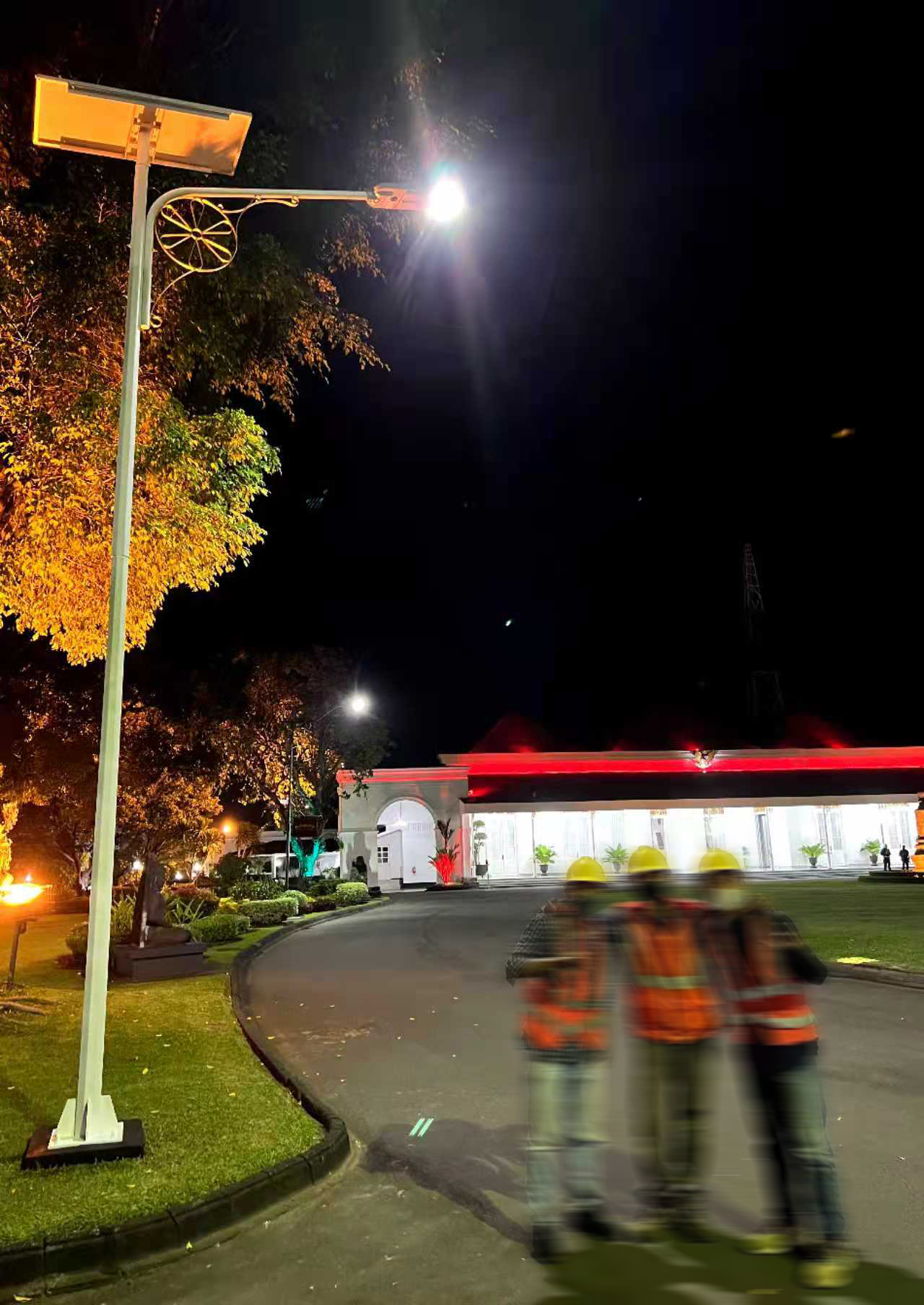
Solar roadway and landscape lighting installation — the operating context for cost-led solar street light shortlists.
Why a cost-led shortlist is a specification exercise
An off-grid solar street light carries its own energy supply. Every watt drawn at night must be generated by the panel and stored in the battery, which means the electrical input power of the luminaire is not an abstract efficiency figure — it directly sizes two of the most expensive components on the pole. When a project fixes a road class and a pole spacing, the required delivered lumens are largely fixed as well. What remains variable is how much input power is needed to reach them.
That single relationship explains why cost-sensitive procurement rewards efficacy rather than penalises it. A platform that delivers more lumens per watt needs fewer watts for the same lighting task; a lower watt-hour demand permits a smaller panel and a smaller battery; and a smaller balance of system lowers the landed cost of the pole even before luminaire pricing is compared.
Two other variables complete the cost picture. The first is the lowest power step in the range: residential lanes and footpaths rarely need the same luminaire class as a two-lane collector road, and a platform that only starts at a high wattage forces either oversizing or a second supplier. The second is modularity — how much of the housing, optics and electronics must be re-tooled when a project deviates from the catalogue.
The two platforms side by side
The comparison below uses published platform parameters. Where a value is not part of the material reviewed for this shortlist, it is marked as not stated rather than inferred.
| Parameter | AOK SD series (All-in-One Solar Street Light-SD) | Balder BI-S5A |
|---|---|---|
| Rated power range | 20 W – 120 W | 70 W – 120 W |
| Published LED efficacy | Up to 210 lm/W | Approximately 110 lm/W |
| Optical distributions | T2, T3, T4, T5 | Not stated in the reviewed material |
| Controller | MPPT controller, IP67 enclosure | Not stated in the reviewed material |
| Presence sensing | Optional PIR / microwave sensors | Not stated in the reviewed material |
| Monitoring readiness | IoT monitoring capability for predictive maintenance | Not stated in the reviewed material |
| Configuration | All-in-one integrated format | Not stated in the reviewed material |
| Cost-led fit | Residential lanes through urban collector roads | Standard collector roads at 70 W and above |
Figures are platform-published parameters. Efficacy, distribution and control values should be re-confirmed with photometric files, test reports and datasheets during RFQ, because supplier-published maxima and project-verified values are not always identical.
Where the SD series changes the initial-cost equation
Efficacy converts directly into balance-of-system savings
For an equivalent lumen package, a fixture published at 210 lm/W draws roughly half the input power of a fixture published at 110 lm/W. Because panel and battery sizing follow daily energy consumption, that difference propagates through the pole: smaller module, smaller storage, lighter bracket, less wind loading. In practice, the efficacy gap is often a larger cost differentiator than the luminaire price itself, and it is the parameter most often buried in a quotation comparison.
A 20 W entry point removes forced oversizing
Residential access lanes, estate roads, footpaths and village streets are usually lit with low-wattage luminaires. A platform that begins at 70 W has no answer for those segments other than specifying a luminaire above the actual lighting requirement, which inflates both capital cost and energy demand. The SD series starting at 20 W lets a single platform serve a mixed road hierarchy — a practical advantage for rural electrification programmes and residential developers working across many small road segments.
Modular design reduces customisation expense
AOK structures customisation across product appearance, structural components, optical module and electrical circuit, with project simulation support before tooling decisions. For cost-sensitive projects, this matters because most budget overruns in solar street lighting come from non-recurring engineering — a new bracket, a different optic, a changed control interface. A modular architecture keeps that engineering inside a defined envelope instead of restarting the design process per project. AOK's standard commercial terms for this work include a 200 PCS minimum order quantity and a 30–45 day lead time, with private-mode and project-protection arrangements available.
Optical distribution as a cost lever
Optics decide how much of the delivered light reaches the carriageway and how much is spilled. For a fixed lumen target, a well-matched distribution can reduce required wattage, pole height or pole count — all of which are cost items. The SD series offers four roadway distributions:
- T2 — narrow asymmetric distribution, suited to narrow carriageways and single-side mounting where light must be pushed across the road rather than wasted behind the pole.
- T3 — medium asymmetric distribution, the general-purpose choice for standard two-lane roads.
- T4 — wide asymmetric distribution for broader carriageways and layouts that need more lateral spread per luminaire.
- T5 — symmetrical distribution for squares, parking areas, junctions and open public spaces.
A platform that offers only one or two distributions tends to be compensated for at the design stage with more poles or higher wattage. For a cost-capped project, distribution choice is therefore a commercial decision, not only a photometric one.
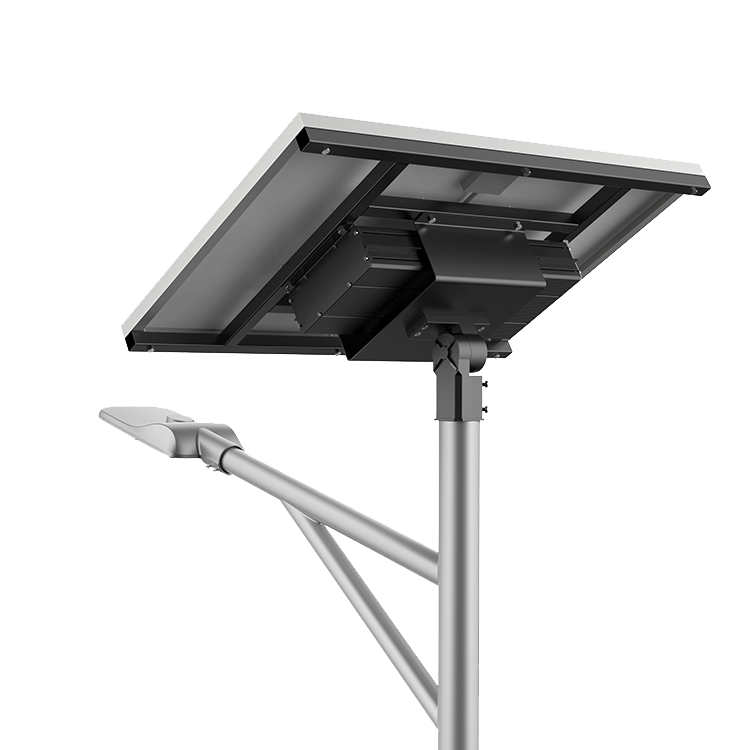
Integrated solar street lighting system — panel, storage and luminaire sizing follow the electrical input power of the fixture.
Maintenance economics: controller, sensors and monitoring
Initial purchase cost is only the first half of a cost-led decision. On remote roads, the recurring cost is inspection and intervention.
The SD series uses an MPPT controller in an IP67 enclosure. MPPT tracking extracts more usable energy from the panel across temperature and irradiance variation than a simple charge controller, which supports the autonomy margin a project is designed around. Optional PIR and microwave sensors add presence-based dimming: when a road is empty, output drops and daily energy demand falls, allowing a smaller battery for the same autonomy requirement.
IoT monitoring readiness changes the maintenance model from scheduled patrol to condition-based response. Rather than sending crews to inspect poles on a fixed cycle, faults are identified remotely and interventions are dispatched to a known location. For dispersed rural networks where a single site visit can consume more budget than a luminaire, this is a genuine cost variable rather than a feature list item.
Where the BI-S5A remains the sensible choice
A shortlist that never names a boundary is not a shortlist. Three limits are worth stating plainly.
First, the BI-S5A fits tenders written around conventional benchmarks. Where a project is limited to collector roads at 70 W and above, and the technical specification is drafted around wattage bands and an efficacy level in the region of 110 lm/W, a narrower 70–120 W platform covers the whole scope with fewer SKUs and simpler approvals. The SD series' higher efficacy only converts into a procurement advantage when the specification is performance-based — written around delivered lumens and installed cost — rather than fixed on wattage.
Second, solar performance depends on the site, not the datasheet. Neither platform can be costed reliably without validated solar resource data, autonomy days and battery depth-of-discharge assumptions for the actual location. A high-efficacy luminaire on a site with poor winter irradiance may still require a larger panel than the efficacy gain suggests.
Third, the SD series is an all-in-one format. Projects that mandate physically separated panel and battery mounting — for shading, theft mitigation or specific pole architecture — are better served by a different configuration, such as AOK's Solar Street Light for Highway-SL system, than by forcing an integrated unit into a layout it was not designed for.
A fourth, document-level caveat applies to both platforms: efficacy figures are supplier-published. Buyers should request photometric files and test documentation at RFQ stage. Until those are provided, the cost advantage described here should be treated as provisional rather than confirmed.
Recommendation matrix for cost-sensitive projects
| Project type | Recommended platform | Reason |
|---|---|---|
| Residential estate roads, footpaths, internal lanes | AOK SD series, 20–40 W | Entry-level power step avoids oversizing low-traffic lanes; T2/T3 optics match narrow carriageways. |
| Rural and village access roads | AOK SD series, 30–60 W | Wide power band allows one platform across mixed road segments; sensor dimming supports smaller storage. |
| Standard two-lane collector roads | Either — tie-break on verification | Both platforms cover the range; decide on photometric documentation, installed cost and distribution fit. |
| Urban arterial roads, 90–120 W | AOK SD series where longer spacing or higher illuminance targets apply | Higher published efficacy supports longer pole spacing or higher maintained illuminance within the same energy budget. |
| Squares, junctions, parking and open public areas | AOK SD series with T5 distribution | Symmetrical distribution matches open-area geometry without additional pole height. |
| Highway-scale or separated-system architecture | AOK SL series (outside this shortlist) | Separated panel and battery layout where site conditions require it. |
| Tenders fixed at 70–120 W with conventional efficacy benchmarks | Balder BI-S5A | Narrower platform matches the specification directly and simplifies approval against wattage-based criteria. |
The manufacturing and compliance evidence behind the shortlist
AOK Industrial Company Limited is an LED outdoor lighting manufacturer founded in 2012, with a production base in Shenzhen, China, and a product range covering LED street light, stadium light, high bay, solar street light, industrial, seaport, airport and sports field lighting. The company exports 100% of its output, with principal markets in the EU, USA, Middle East and Asia.
Three management-system certificates are currently held and verifiable by number: ISO 9001 (U919125Q30998R4M, issued 27 November 2025, valid to 10 December 2028), ISO 14001 (U919124E30857R1M, issued 12 December 2024, valid to 12 December 2027) and ISO 45001 (U919124S30768R1M, issued 12 December 2024, valid to 12 December 2027). All three are scoped to the production and export of LED lighting fixtures. They certify management systems; they are not product-level photometric or safety certifications, and buyers should not treat them as substitutes for LM-79 style test reports on a specific model.
Production control is described through 28+ quality inspection procedures across the build. Track record relevant to this shortlist includes a solar street lighting installation of 2,000 units in the UAE over a five-year programme, and a 198-unit municipal roadway installation in Chile where high-efficacy LED replaced traditional HID street lamps, with reported improvements in lighting effect, energy use and maintenance accessibility.
Adjacent scope: AOK's wider LED outdoor lighting range
Cost-sensitive road projects rarely stop at the carriageway. Where a single procurement package also covers adjacent areas, AOK's portfolio provides the following options — each a separate product line with its own specifications, not interchangeable with the SD series:
- LED street light ILA — efficacy up to 190 lm/W, IP66/IK09 with tempered glass, T2/T3/T4 distributions.
- Compact street lighting ILG — efficacy up to 195 lm/W, IP66/IK10, T201/T211/T202 distributions with customisation accepted.
- Tool-less street light ILE — efficacy up to 165 lm/W, IP66/IK08, Type II/III/IV distributions.
- Area light Shoebox-OT — 30,130–37,720 lm output, IP66/IK10, T2/T3/T4/T5 distributions, for parking areas and open surfaces.
- Tool-less flood light FLC — efficacy up to 200 lm/W, IP66/IK08, including T2/T3/T4 asymmetric distributions.
- High mast / flood light HMA and Professional Stadium Lighting ISF — for ports, docks, sports fields and large-area high-output needs.
Grouping these under one supplier reduces interface risk between packages, but each line should be evaluated on its own photometric and mechanical data rather than assumed to inherit the SD series' characteristics.
Future outlook
The market context supports continued cost pressure rather than its relaxation. Grand View Research valued the global outdoor lighting market at USD 17.1 billion in 2024, while P&S Intelligence placed the global solar street lighting market at USD 6.0 billion in 2025 — segments where off-grid deployment competes directly against grid extension on capital cost.
Three directions follow. Procurement is shifting from wattage-based specifications toward delivered-lumen and installed-cost comparisons, which favours higher-efficacy platforms and disadvantages fixtures that only compete on label price. Monitoring readiness is moving from differentiator to baseline expectation, because condition-based maintenance is the most direct way to control recurring cost on dispersed networks. And the low-power segment — residential lanes and rural access roads — is likely to remain the largest volume opportunity, which makes the entry point of a power range as commercially relevant as its top end.
Frequently asked questions
What power range is appropriate for rural roads versus residential lanes?
Residential lanes, estate roads and footpaths generally require low-wattage luminaires, while rural access roads sit one step higher, and collector roads higher again. The practical difference is whether a single platform can cover the whole hierarchy. The AOK SD series spans 20 W to 120 W; the Balder BI-S5A is published in a 70 W to 120 W band. Where a project mixes residential lanes with collector roads, a platform beginning at 20 W avoids specifying a second, oversized luminaire for low-traffic segments.
How does LED efficacy change the cost of a solar street light pole?
Efficacy is the delivered lumens produced per watt of electrical input. For a fixed lumen target, a fixture published at up to 210 lm/W draws roughly half the input power of a fixture published at approximately 110 lm/W. In an off-grid pole, lower input power reduces daily energy demand, which in turn allows a smaller solar panel and smaller battery — two of the largest cost components. Higher efficacy can therefore lower initial cost even where the luminaire itself is priced similarly.
Do T2, T3, T4 and T5 optics affect project cost?
They affect how much of the installed lumen output reaches the carriageway and how much is spilled. T2 is a narrow asymmetric distribution for narrow roads and single-side mounting; T3 is a medium distribution for standard two-lane roads; T4 is wider for broader carriageways; T5 is symmetrical for squares, parking areas and junctions. Correct matching can reduce the wattage, pole height or pole count required to meet a lighting target, all of which are capital cost items.
Which maintenance features lower the long-term cost of a solar street light?
Three features recur. An MPPT controller with an IP67 enclosure improves energy harvest across temperature and irradiance variation and protects the electronics in wet conditions. Optional PIR or microwave presence sensors reduce output during low-traffic hours, lowering daily energy demand and allowing a smaller battery for the same autonomy. IoT monitoring readiness enables condition-based maintenance, so interventions are dispatched to identified faults rather than found through scheduled patrols — particularly relevant on dispersed rural networks.
When is a 70–120 W platform sufficient, and when does a wider range matter?
A 70–120 W platform is sufficient when the project scope is limited to collector roads and above, and when the technical specification is written in that wattage band. A wider range matters when the project mixes road classes — residential lanes, rural access roads and urban arterials in the same programme — or when low-traffic segments would otherwise be over-lit. In mixed-scope projects, range breadth typically reduces SKU count and avoids the cost of specifying above the actual lighting requirement.
Reference material: AOK's full LED outdoor lighting catalogue, including the SD series and adjacent street, area, flood, high mast and stadium lines, is available as a downloadable brochure: AOK LED outdoor lighting product brochure (PDF).
¿Tiene preguntas o necesita más detalles?
Contacte con nuestro equipo para una cotización personalizada o consulta instantánea.
Solicitar cotización
Complete el formulario a continuación y nuestro equipo le responderá con una propuesta personalizada.
Chat directo de WhatsApp
¿Prefiere chatear en tiempo real? Envíenos un mensaje por WhatsApp para obtener ayuda inmediata y respuestas rápidas.
- Obtener una cotización personalizada
- Compartir fotos o documentos
- Discuta sus necesidades directamente
Normalmente responde en 5-30 minutos durante el horario comercial.