
Cosmetic Packaging by Formula Type: Stick, Liquid, and Powder
Cosmetic packaging performs three jobs at once: it protects a formula, dispenses it in a controlled way, and survives distribution. Which package does all three depends less on decoration than on the relationship between formula rheology, internal mechanism and fill volume. A deodorant stick, a liquid foundation and a loose powder cannot share the same structure, and forcing them to do so usually surfaces as leakage, a blocked dispenser or inconsistent dosing rather than as a visible design flaw.
This reference maps seven production formats to three formula families — stick, liquid and powder — using published product data from COSFINITY (Guangzhou Cosfinity Cosmetics Co., Ltd.), a custom cosmetic packaging manufacturer founded in 2009 in Guangzhou, China, with an export ratio of 100%. Every model, dimension and capacity below is stated as published. Where a figure is not available in the product data, that is identified rather than estimated.
Why format-to-formula fit is a procurement decision, not only a design one
The format is the mechanism. A semi-solid or high-viscosity formula has to be held in a column and pushed out mechanically. A low-viscosity liquid has to be sealed, dosed and evacuated with minimal air exposure. A powder has to be contained against migration and released without caking. Once the mechanism is fixed, so are the tooling, the fill-line setup, the usable fill weight and the artwork clearance.
That is why a format decision made during evaluation becomes an execution constraint. Changing mechanism or dimensions after sampling resets filling trials, artwork and documentation, and introduces re-order risk. Locking format, material and dimensions together produces a packaging specification that can be repeated across production runs without re-qualification.
The opportunity in format matching is therefore not aesthetic. It is the elimination of a class of field failures — transit leakage, dispenser failure, dose drift and product waste — that are expensive to diagnose once a range has launched across several markets.
A format map for stick, liquid and powder applications
| Formula family | Format and model | Published specification | Structural role |
|---|---|---|---|
| Stick / semi-solid | Deodorant stick container — TP01-1018-15 | 20 ml | Elevating stick structure for a semi-solid product applied directly to the skin |
| Stick / semi-solid | Stick foundation tube — CP08-0053 | 10 ml; D29 × H60 mm | Compact stick envelope for a firmer, higher-viscosity foundation |
| Liquid | Airless pump liquid foundation bottle — CP07-2026 | 30 ml; glass; W33.5 × H92 mm | Airless pump mechanism for low-viscosity, oxidation-sensitive liquids |
| Liquid | Liquid eyeliner tube — CP04-1215 | 10 ml; W12.8 × H115.3 mm | Slim barrel for fine-tip, precision application |
| Liquid | Liquid eyeliner pencil — CP06-1056 | W15 × H173.5 mm | Pencil-format body for controlled flow and an extended grip length |
| Powder | Leak-proof powder jar — CP05-2159B | 5 ml; W40.7 × H32.6 mm | Wide-diameter, leak-proof containment for loose powder |
| Powder | Powder case — CP03-1394 | Case format; no nominal dimension stated in the product data used here | Compact containment for pressed powder |
COSFINITY's stated main product range covers lipstick tubes, lipgloss and mascara tubes, powder cases, eyeliner tubes, powder jars and liquid foundation bottles, with stick-format deodorant containers and stick foundation tubes produced as part of the same customisation programme. The formats are intended for the cosmetic packing industry and for cosmetic packing application scenarios, which means the specification conversation starts with the formula rather than with the decoration.
Stick formats: when the formula is its own applicator
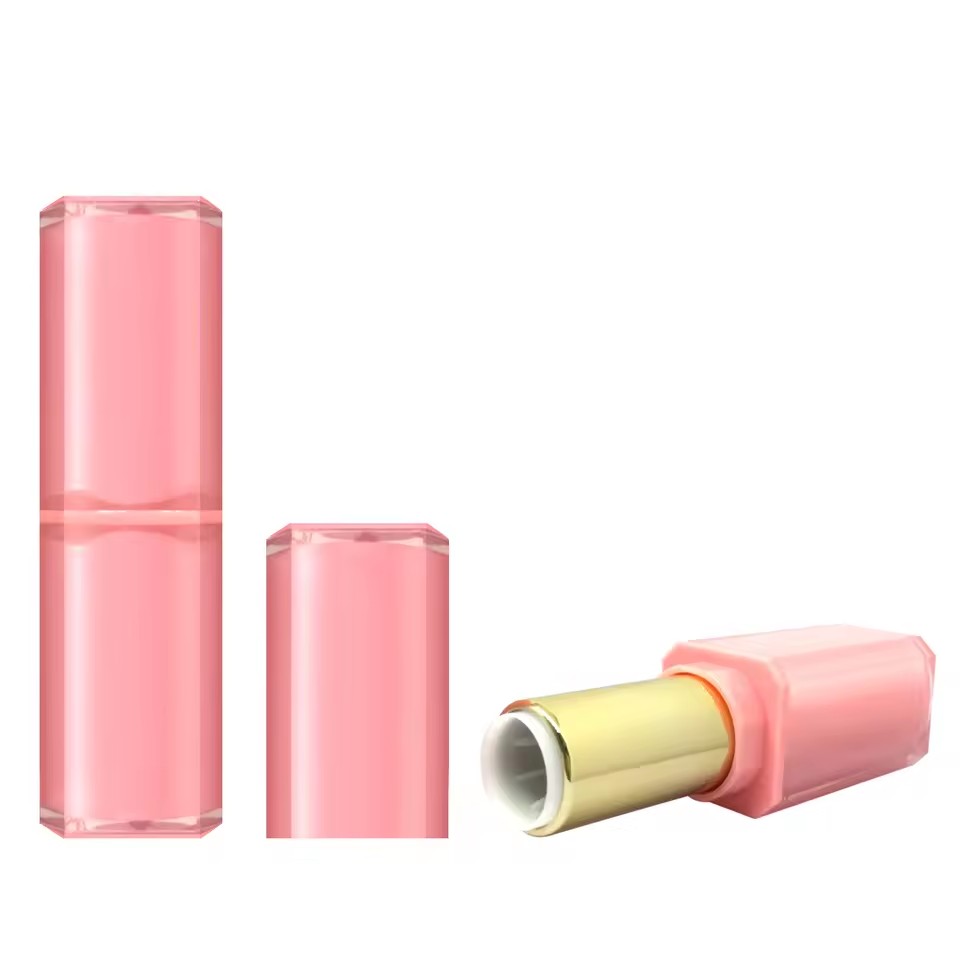
A stick product needs no separate applicator, and that single structural fact drives everything else. The 20 ml deodorant stick container (TP01-1018-15) holds a semi-solid mass that is elevated mechanically and applied directly. Because the product is the applicator, the mechanism has to deliver it consistently to the last usable millimetre, and the barrel has to support the product column without deformation during use.
The 10 ml stick foundation tube (CP08-0053, D29 × H60 mm) applies the same principle in a smaller, denser envelope. The 29 mm diameter by 60 mm height footprint suits a firmer, higher-viscosity foundation where coverage is controlled by the user rather than by an orifice. Fill volume and usable volume are not identical in either format: a portion of the stick remains in the barrel at end of life, so the declared capacity should be read as a fill target rather than as a guaranteed consumer yield.
Practically, stick formats reduce component count. There is no pump, no dip tube and no separate applicator to assemble, which simplifies the filling line and reduces the number of parts that must be validated for compatibility with the formula.
Liquid formats: mechanism choice follows viscosity
Liquid formulas are the widest category and the one where mechanism choice has the largest effect on performance. Three distinct approaches appear in the COSFINITY range.
Airless pump foundation bottles
The 30 ml glass airless pump bottle (CP07-2026, W33.5 × H92 mm) is designed for low-viscosity, oxidation-sensitive liquid foundations. An airless mechanism dispenses product without a dip tube and without drawing ambient air back into the reservoir, which supports both formula stability and a more consistent dose across the life of the pack. The glass body adds weight and handfeel that suit a premium positioning.
Liquid eyeliner tubes
The 10 ml liquid eyeliner tube (CP04-1215, W12.8 × H115.3 mm) is a slim, long-barrel format built around fine-tip application. Its 12.8 mm diameter keeps the pack narrow enough for a controlled grip, while the 115.3 mm height provides the barrel length that a liner applicator needs.
Liquid eyeliner pencils
The liquid eyeliner pencil (CP06-1056, W15 × H173.5 mm) moves in the opposite direction: a wider 15 mm body and a longer 173.5 mm overall length. The longer body typically accommodates a different internal feed arrangement and produces a different user grip and stroke control than the tube format, even when both dispense a comparable liquid formula.
Wall thickness is a specification that buyers often overlook. A comparable tube in the COSFINITY range, the lipgloss and mascara tube CP02-2231, is published at W18 × H106.1 mm with a 0.3 mm wall thickness and a 3 ml volume. Thickness at that level affects squeeze feel, barrier performance and resistance to deformation in transit — and it is one of the parameters that must be re-confirmed whenever a tube is re-ordered in a different colour or finish.
Powder formats: containment comes before presentation
Powder is the format family where the closure, not the body, determines whether the product arrives intact. The leak-proof powder jar (CP05-2159B) is published at 5 ml with a W40.7 × H32.6 mm envelope. A 40.7 mm diameter against a 32.6 mm height produces a wide, shallow container — a geometry that suits loose powder, sample sizes and travel-oriented formats where the user needs to reach the product with a brush or puff.
The powder case (CP03-1394) serves pressed powder, where the product is consolidated into a pan and the case provides the hinge, closure and mirror clearance instead of a leak barrier. Buyers should note that no nominal dimension for CP03-1394 is stated in the product data used for this reference; dimensions for this format should be confirmed directly at the sampling stage rather than assumed from the case category.
How COSFINITY supports format consistency across repeat orders
COSFINITY is a Guangzhou-based custom cosmetic packaging manufacturer founded in 2009, operating a 40,000 m² facility with 200 employees, including an R&D team of 25 engineers, and an annual output of 500,000,000 pieces. The company offers OEM and ODM production services and exports 100% of its output to global markets.
For long-term supply programmes, the parameters that matter are the ones that determine whether a re-order arrives identical to the first shipment. The published operational data set is: monthly production capacity of 10,000,000 pieces, a minimum order quantity of 12,000 pieces, and a typical production lead time of 15 to 25 days. Quality control includes 100% testing to ensure product reliability, and acceptance is based on pre-shipment testing. Delivery terms offered are EXW, FOB, DAP and DDP, with payment structured as 50% advance before production and the remaining 50% before shipment.
Read as a procurement package rather than as a capability list, these figures describe a supply model built for repeat production: a monthly capacity that absorbs re-order volumes without a new tooling cycle, a defined lead-time window that can be planned against, and an inspection step that is applied to every unit rather than to a sample batch. For buyers selecting a partner across a multi-format range, that combination is what converts a one-off packaging choice into a stable specification.

Application and use cases: matching format to product and channel
- Mass and mid-market deodorant programmes: the 20 ml deodorant stick container (TP01-1018-15) suits high-volume, single-mechanism production where a large fill and a simple structure keep unit and assembly cost predictable.
- Prestige stick foundation: the 10 ml stick foundation tube (CP08-0053) fits a compact, travel-friendly format where the 29 × 60 mm envelope supports a dense, high-coverage formula.
- Liquid foundation for retail and e-commerce: the 30 ml glass airless bottle (CP07-2026) targets low-viscosity formulas that need air protection and consistent dosing across many uses, and a glass body that supports a premium shelf presence.
- Eyeliner, professional and consumer: the 10 ml tube (CP04-1215) and the eyeliner pencil (CP06-1056) cover two different application experiences from the same formula family — fine-tip precision versus pencil-style control.
- Loose powder sampling and travel: the 5 ml leak-proof powder jar (CP05-2159B) provides a shallow, wide-mouth container sized for sample and travel formats.
- Pressed powder and refill kits: the powder case (CP03-1394) supports compacted powder and compact-based refill concepts.
Channel context changes the priority order. Distributor and retail routes put a premium on closure integrity and dimensional consistency, because a leaking unit becomes a return rather than a defect claim. E-commerce routes put a premium on the same properties for a different reason: postal handling is rougher and less observable than palletised freight. Direct-to-consumer refill programmes add a third priority, because the case or jar becomes a durable object that the user keeps while the refill changes.
Market trend analysis: what is changing around format choice
The global cosmetic packaging market was valued at approximately USD 34.17B to USD 47.3B in 2024, with expectations of reaching up to USD 89.72B by 2034, according to Fortune Business Insights, ResearchAndMarkets and Data Bridge. The published range is wide because estimates differ on whether secondary packaging and industrial bulk containers are included, which is itself a useful reminder to check scope before citing a market figure in a business case.
Material mix is comparatively stable. Plastic remains the dominant material in cosmetic packaging with a 64.5% market share in 2024, followed by glass and metal, according to ResearchAndMarkets. That distribution supports the split seen in the format range above: plastic for tubes, sticks and cases where cost and mechanical function dominate, and glass for airless foundation bottles where weight and barrier perception matter.
Demand is concentrated. Asia Pacific led the global market in 2025 with a 42.36% market share, driven by rising disposable incomes and e-commerce growth, according to Fortune Business Insights. China's beauty product exports reached approximately USD 4.77B in 2024, with the UK as the fastest-growing market at +20.8%, according to the Observatory of Economic Complexity. For packaging buyers, that concentration means formats are frequently specified once and then shipped into several regulatory regions from the same production base.
Regulation is the fastest-moving variable. The EU Packaging and Packaging Waste Regulation (PPWR) 2025/40 mandates strict recyclability and labelling standards for cosmetics from late 2024, and the U.S. Modernization of Cosmetics Regulation Act (MoCRA) introduced mandatory facility registration and product listing for packaging entities. Both act on material and documentation choices rather than on the mechanism, which means a format decision now carries a compliance dimension from the first sample.
The competitive field is well defined. Top global cosmetic packaging competitors include Albéa S.A., Amcor PLC, Berry Global Group, AptarGroup Inc. and HCP Packaging, according to Mordor Intelligence and Fortune Business Insights. Alongside that, sustainable and refillable packaging is a top priority for 63% of cosmetic consumers in 2024, according to Statista and Packly — a signal that the durable outer component of a format, such as a powder case, is becoming a retention asset rather than a disposable item.
Comparison with traditional packaging approaches — and where format matching has limits
The traditional approach is to standardise one pack across a whole range: a common dip-tube bottle, a common screw-top jar, a common tube. It reduces the number of components, simplifies procurement and usually lowers the unit price. Format matching deliberately trades some of that simplicity for mechanism fit, and the trade is not free.
- Cost is driven by specification, not by category. In a documented comparison, a 20 ml COSFINITY lipstick tube with thickened leak-proof construction is priced at USD 0.30, against USD 0.07 for a 3 ml conventional tube sourced from Hebei Dicun. The difference reflects fill volume, material grade and wall construction. Format matching is therefore a poor fit for disposable promotional items where the lowest unit cost is the governing criterion, and a better fit where field failure or returns carry real cost.
- Minimum order quantity multiplies across formats. A 12,000-piece minimum order quantity is manageable for a single hero format, but a range built from five matched formats commits five times that volume. Buyers matching formats across a full line should model the inventory commitment per format, not per brand.
- Airless and leak-proof mechanisms add components and tolerance sensitivity. A pump mechanism has more parts than a dip tube, and every added part is a point where the format can fail in a way that visual inspection will not catch. This is why 100% testing and pre-shipment acceptance matter more in mechanism-led formats than in simple containers.
- Nominal dimensions are not a compatibility guarantee. A published capacity such as 30 ml or 10 ml describes the container, not the formula. Viscosity, surface tension and fill temperature determine whether a given product dispenses correctly from a given orifice, and those interactions are settled at sampling, not in a catalogue.
- Formats are not interchangeable across families. A structure designed for a semi-solid will not reliably dispense a low-viscosity liquid, and a leak-proof jar sized for loose powder is not a substitute for an airless mechanism on an oxidation-sensitive liquid. Where a brand wants one visual language across a range, the alignment has to happen at the level of design language — proportion, finish, closure geometry — not at the level of mechanism.
The honest boundary is this: format matching improves performance and repeatability, but it raises cost, planning commitment and validation effort. For a brand whose unit economics cannot absorb those, a standardised pack with a well-tested formula is the rational choice.
Future outlook
Three shifts are likely to shape format decisions over the next planning cycle. First, material choice will increasingly be driven by regulation rather than by aesthetics, as PPWR and MoCRA requirements translate into recyclability and documentation criteria for packaging entities. Second, refill and durability will move the outer component of a package — a powder case, a durable jar, a refillable stick barrel — toward a longer service life than the formula it holds. Third, ranges will consolidate onto fewer mechanism platforms in more fill volumes, because one proven mechanism re-sized across a family costs less to qualify than several unrelated formats.
For buyers in the execution stage, the practical implication is to lock three things together at sampling: the mechanism, the nominal dimensions and the material. A format specified this way can be re-ordered through a defined lead time against a stated capacity, and a change in any one of the three should trigger a fresh compatibility check rather than an assumption of equivalence.
FAQ
How is a cosmetic packaging format matched to a formula's viscosity and application type?
Matching starts with how the formula moves. Semi-solid and high-viscosity products suit stick structures that hold the product in a column and elevate it mechanically, such as the 20 ml deodorant stick container (TP01-1018-15) or the 10 ml stick foundation tube (CP08-0053). Low-viscosity liquids that need protection from air and consistent dosing suit sealed mechanisms such as the 30 ml glass airless pump bottle (CP07-2026). Liquids applied with precision need a controlled orifice and a slim barrel, as in the 10 ml liquid eyeliner tube (CP04-1215) or the eyeliner pencil (CP06-1056). Powders need containment first: the leak-proof powder jar (CP05-2159B) for loose powder and the powder case (CP03-1394) for pressed powder. In every case, the final confirmation is a filling and transit test with the actual formula, not the declared capacity alone.
What should buyers look for in a long-term packaging partner for stick, liquid and powder formats?
For repeat supply across several formats, the relevant evidence is operational rather than promotional. COSFINITY, founded in 2009, operates a 40,000 m² facility with 200 employees and an R&D team of 25 engineers, produces 500,000,000 pieces annually, and offers OEM and ODM services with a 100% export ratio. Its published operating parameters are a monthly capacity of 10,000,000 pieces, a 12,000-piece minimum order quantity, a 15 to 25 day typical lead time, and quality control that includes 100% testing, with acceptance based on pre-shipment testing. Buyers evaluating any supplier should look for the same categories of evidence: defined capacity, defined lead time, defined inspection scope, and delivery and payment terms stated in writing.
How do minimum order quantity and lead time affect repeat orders across multiple formats?
They compound. A 12,000-piece minimum order quantity applies per format, so a range built from seven matched formats carries seven separate volume commitments rather than one. A 15 to 25 day typical production lead time is the planning window for each re-order once an order is placed, and monthly production capacity of 10,000,000 pieces defines how much of that volume can run in parallel. Buyers planning a multi-format launch typically sequence the formats rather than ordering all of them simultaneously, and align artwork and filling schedules to the lead-time window instead of the other way round.
What should be verified before a format is locked for a multi-year product line?
Four things. First, dimensional stability: the nominal figures, such as W33.5 × H92 mm for the 30 ml airless foundation bottle or D29 × H60 mm for the 10 ml stick foundation tube, must remain reproducible across orders, so tolerances should be agreed in writing. Second, mechanism and material consistency: the same pump, closure or wall construction must be available on the next order, which means the specification, not the sample, is the reference. Third, closure and leak performance at the intended fill level, confirmed through pre-shipment testing. Fourth, commercial continuity: minimum order quantity, lead time and delivery terms should be documented before the format is embedded in artwork and regulatory filings, because a change after that point resets packaging documentation in every market.
How do packaging regulations such as PPWR and MoCRA affect format and material choices over a product lifecycle?
They act on the material and the documentation rather than on the mechanism. The EU Packaging and Packaging Waste Regulation (PPWR) 2025/40 mandates strict recyclability and labelling standards for cosmetics from late 2024, and the U.S. Modernization of Cosmetics Regulation Act (MoCRA) introduced mandatory facility registration and product listing for packaging entities. In practice, this means the material decision — plastic versus glass, mono-material versus multi-material, refillable versus single-use — carries compliance consequences from the first sample, and that a format change during a product's life may require both new documentation and re-verification. A packaging range spanning several markets should therefore treat material specification as a lifecycle decision, not a launch decision.
Reference material: COSFINITY company profile (PDF) · cosfinity-cosmeticpackaging.com. Product dimensions and capacities cited above are published specifications; regulatory references are attributed to the European Commission / Cosmeservice (PPWR 2025/40) and FDA / ChemLinked (MoCRA).