
Cosmetic Packaging Shortlist: 9 Empty Tubes, Jars, Bottles & Cases for Beauty Brands
Cosmetic Packaging Shortlist: 9 Empty Tubes, Jars, Bottles & Cases for Beauty Brands
Nine empty cosmetic packaging formats — a lipstick tube, a lipgloss/mascara tube, a makeup powder case, an eyeliner tube, a powder jar, an eyeliner pencil, an airless foundation bottle, a stick foundation tube, and a deodorant stick container — make up this shortlist. Each entry is tied to a verified product model and described only through published dimensions, materials, capacities, and stated cosmetic uses.
Format selection in cosmetic packaging is a constraint problem before it becomes a design decision. A lipgloss formula behaves differently from a pressed powder, and a deodorant stick imposes different structural demands than an airless foundation pump. When buyers compare formats, the variables that decide fit are measurable: outer dimensions, wall thickness, nominal capacity, material, and the closing or dispensing mechanism. The shortlist below organizes nine formats around those variables so that a lip, eye, face, or deodorant project can be matched to a model without speculative claims.
All nine models are drawn from the published product data of COSFINITY (Guangzhou Cosfinity Cosmetics Co., Ltd.), a Guangzhou-based manufacturer of customized cosmetic packaging founded in 2009, operating a 40,000㎡ factory with approximately 200 employees and an annual output of 500,000,000 pieces. Where a specification is not published — for example, a nominal volume on two of the nine formats — this article says so rather than estimating.
Why Format-Level Shortlists Are Replacing Open Catalogues
The category is large enough that a general catalogue stops being useful for decision-making. Third-party market research places the global cosmetic packaging market at approximately USD 34.17B to USD 47.3B in 2024, with projections of up to USD 89.72B by 2034, according to Fortune Business Insights, ResearchAndMarkets, and Data Bridge. The spread between the 2024 figures is itself informative: estimates diverge depending on whether secondary packaging and industrial bulk containers are counted, which is one reason buyers increasingly evaluate packaging at the format level rather than the category level.
Material distribution is similarly concentrated. Plastic remained the dominant material in cosmetic packaging with a 64.5% market share in 2024, followed by glass and metal, according to ResearchAndMarkets. Regionally, Asia Pacific led the global market in 2025 with a 42.36% share, driven by rising disposable incomes and e-commerce growth, per Fortune Business Insights. Eight of the nine formats in this shortlist are plastic; one, the airless foundation bottle, is glass.
The practical opportunity for beauty brands is comparability. A buyer evaluating a lipstick tube and a lipgloss tube in the same session needs identical fields for both. When one supplier publishes wall thickness and another omits it, comparison collapses into subjective judgement. All nine models below publish external dimensions and material, and seven of the nine publish a nominal volume.
How This Shortlist Was Filtered
Three filters were applied. First, each format had to map to a named cosmetic product category — lip, eye, face, or deodorant. Second, each model had to carry published dimensional and material data rather than approximate or marketing-level descriptions. Third, each format had to sit inside an OEM/ODM production model rather than existing only as a concept sample.
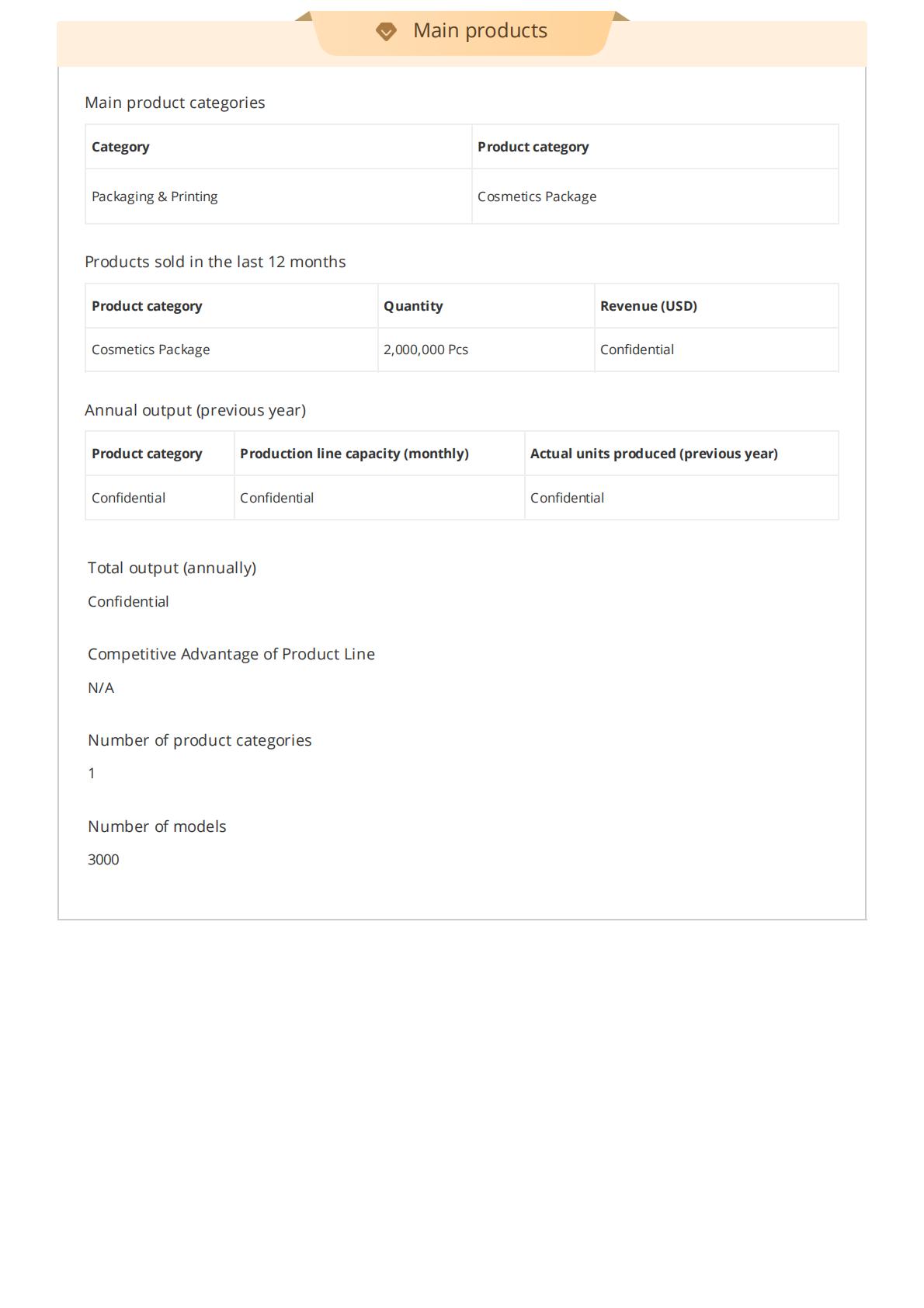
The production model behind these formats is relevant to the shortlist itself. COSFINITY works under OEM/ODM arrangements with customization available across logo, color, shape, material, volume, thickness, and packaging. Monthly capacity is stated at 10,000,000 pieces, quoted lead time is 15–25 days, quality control is described as 100% test, and the minimum order quantity is 12,000 pieces. Export is 100% of output, with global markets as the stated destination. Those figures are the commercial boundaries that sit behind every specification in the tables below, and they should be read together with the dimensions rather than separately.
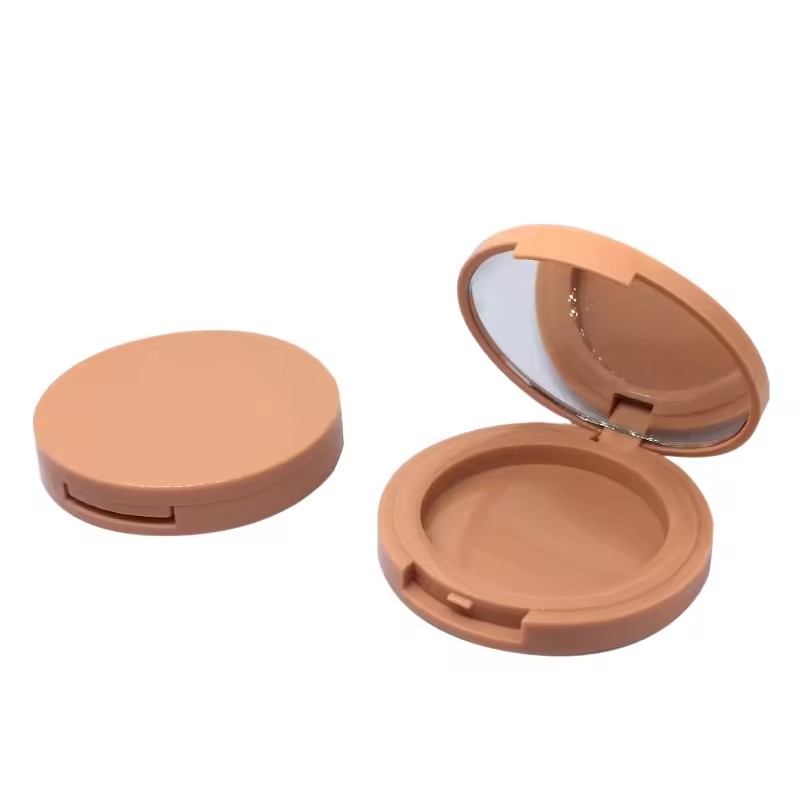
Customized Empty Makeup Powder Case, model CP03-1394 — one of two 1 mm wall-thickness formats in this shortlist.
The Nine Formats at a Glance
The table below is the core reference asset of this article. It is built entirely from published product specifications: model number, format name, external size, wall thickness where stated, nominal volume where stated, material, and the stated cosmetic packing use.
| Model | Format | External size | Wall thickness | Nominal volume | Material |
|---|---|---|---|---|---|
| CP01-2142 | Luxury Empty Plastic Lipstick Tube | W22.7 × H84.6 mm | 0.3 mm | 20 ml | Plastic |
| CP02-2231 | Luxury Empty Plastic Lipgloss / Mascara Tube | W18 × H106.1 mm | 0.3 mm | 3 ml | Plastic |
| CP03-1394 | Customized Empty Makeup Powder Case | W65 × H12 mm | 1 mm | Not published | Plastic |
| CP04-1215 | Liquid Empty Eyeliner Tube | W12.8 × H115.3 mm | 0.3 mm | 10 ml | Plastic |
| CP05-2159B | Leak-Proof Plastic Powder Jar / Pot | W40.7 × H32.6 mm | 1 mm | 5 ml | Plastic |
| CP06-1056 | Empty Liquid Eyeliner Pencil | W15 × H173.5 mm | Not published | Not published | Plastic |
| CP07-2026 | Airless Pump Liquid Foundation Bottle | W33.5 × H92 mm | Not published | 30 ml | Glass |
| CP08-0053 | Empty Stick Foundation Tube | D29 × H60 mm | Not published | 10 ml | Plastic |
| TP01-1018-15 | Deodorant Stick Plastic Tube Container | L41.7 × W24.49 × H86.5 mm | Not published | 20 ml | Plastic |
Two of the nine formats publish no nominal volume, and four publish no wall thickness. Buyers should treat an unpublished figure as a sampling task rather than substituting an assumption.
Lip Formats: CP01-2142 and CP02-2231
The lip category is served here by two plastic tubes with the same 0.3 mm wall but very different proportions, which is the distinction that matters when a brand carries both a lipstick and a lipgloss or mascara in one line.
CP01-2142 — Luxury Empty Plastic Lipstick Tube
The lipstick reference in this shortlist measures W22.7 × H84.6 mm with a 0.3 mm wall and a nominal 20 ml volume in plastic. Two of those numbers drive practical decisions. The 84.6 mm overall height sets both shelf presence and the vertical travel available inside the mechanism, while the 22.7 mm width places the format in the standard lipstick footprint that most retail fixtures and secondary packaging are built around. The 20 ml nominal figure should be read as the container's stated capacity rather than a fill-weight claim for a lipstick bullet.
CP02-2231 — Luxury Empty Plastic Lipgloss / Mascara Tube
This model is named for two applications, lipgloss and mascara, because the same 0.3 mm-wall plastic tube reflects both product classes at W18 × H106.1 mm with a nominal 3 ml volume. The 3 ml capacity is consistent with the category: both products are dispensed in small doses, and the container is filled by the brand rather than by the consumer. At 106.1 mm tall and 18 mm wide, the format is narrower and taller than the lipstick tube above, and the naming implies that the applicator and closure selection — brush or doe-foot — is what separates a mascara SKU from a lipgloss SKU on the same body.
Eye Formats: CP04-1215 and CP06-1056
The eye category splits into a liquid-delivery tube and a pencil-format container, and the two differ by more than 58 mm in overall length. That difference is not cosmetic: it changes application geometry, secondary packaging, and how the item behaves when carried.
CP04-1215 — Liquid Empty Eyeliner Tube
The liquid eyeliner reference measures W12.8 × H115.3 mm with a 0.3 mm wall and a 10 ml nominal volume in plastic. The 12.8 mm width is the narrowest cross-section in this shortlist, which constrains both the applicator diameter and the stiffness of the tube wall when the cap is repeatedly tightened. The 10 ml nominal capacity is larger than a typical liquid eyeliner fill, so the figure is best treated as the container's stated internal volume rather than a target fill.
CP06-1056 — Empty Liquid Eyeliner Pencil
The pencil format measures W15 × H173.5 mm in plastic and is the longest item in the shortlist. The 173.5 mm length is more than 50 mm longer than the liquid eyeliner tube above, which is the single most important packaging consequence for a brand choosing between the two: fixture layout, carton length, and shipping cube all change with it. No nominal volume is published for this model, so fill planning should be confirmed through sampling.
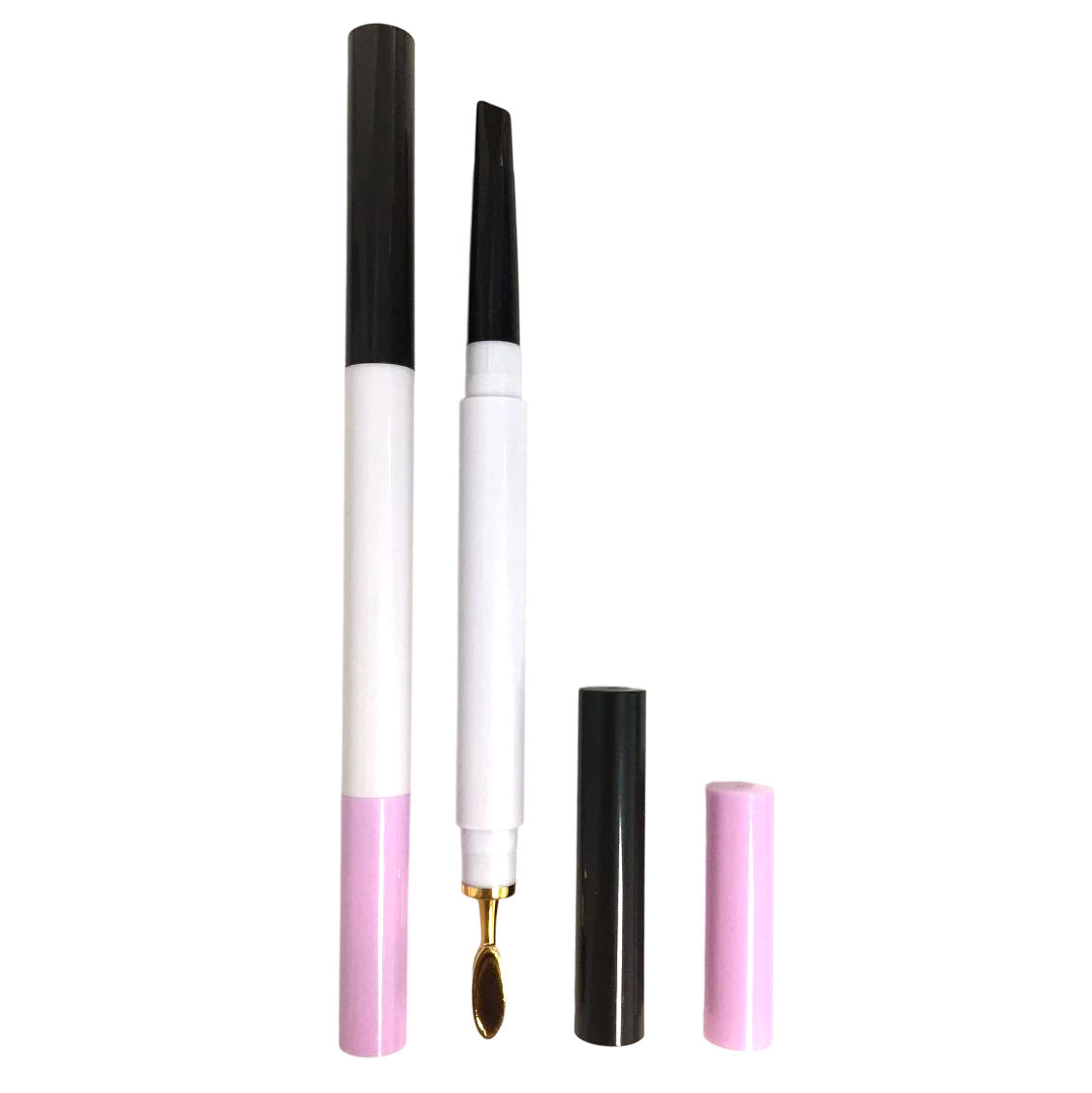
Empty Liquid Eyeliner Pencil, model CP06-1056 — W15 × H173.5 mm, plastic, the longest format in the shortlist.
Face Formats: CP03-1394, CP05-2159B, CP07-2026, and CP08-0053
The face category contains four formats, and it is the only group in the shortlist where two wall thicknesses — 1 mm and 0.3 mm — and two materials — plastic and glass — both appear. That makes it the most useful group for illustrating how a specification choice follows from a product form.
CP03-1394 — Customized Empty Makeup Powder Case
The compact-format reference measures W65 × H12 mm with a 1 mm wall in plastic. The 1 mm wall is more than three times the 0.3 mm used in the tube formats, which follows directly from function: a case has to resist flexing when a puff is pressed against a powder pan, while a lipstick tube does not carry that load. The 12 mm closed height keeps the case shallow enough to sit inside conventional beauty cartons. No nominal volume is published, so pan capacity is a sampling question.
CP05-2159B — Leak-Proof Plastic Powder Jar / Pot
The jar reference measures W40.7 × H32.6 mm with a 1 mm wall and a 5 ml nominal volume in plastic. Its product name identifies leak-proof construction as a defining characteristic of the format, which places the load path on the cap-to-body interface rather than the wall itself. The 5 ml nominal capacity positions the jar between the 3 ml lipgloss tube and the 10 ml stick foundation tube in this shortlist, and the 32.6 mm height gives it more depth than any of the tube formats at a comparable width.
CP07-2026 — Airless Pump Liquid Foundation Bottle
The foundation reference is the only glass format in the shortlist and carries the largest nominal volume at 30 ml, measuring W33.5 × H92 mm. Airless pump dispensing is part of the model name, which tells a buyer that the format is defined by its dispensing mechanism as much as its body. Because glass and plastic airless formats have already been compared in separate material-focused references, this shortlist treats the model as a specification entry: 30 ml, glass, W33.5 × H92 mm, cosmetic packing. No wall thickness is published for this format.
CP08-0053 — Empty Stick Foundation Tube
The stick foundation reference measures D29 × H60 mm with a 10 ml nominal volume in plastic, making it the most compact tube-shaped format in the shortlist. The dimension convention also changes here: this model is specified by diameter rather than width, which is a detail buyers comparing suppliers should record, because a 29 mm diameter and a 29 mm width are not the same tolerance statement. The 10 ml nominal volume matches the liquid eyeliner tube, but the two formats serve entirely different fill and application requirements.
Deodorant Format: TP01-1018-15
The deodorant reference measures L41.7 × W24.49 × H86.5 mm with a 20 ml nominal volume in plastic. This is the only format in the shortlist specified with a distinct length and width rather than a single cross-section dimension, which is consistent with the oval footprint that a deodorant stick requires. The 20 ml nominal volume matches the lipstick tube, but the similarities stop there: the mechanism, the footprint, and the closure logic all belong to a different product class, and the model should be evaluated against deodorant filling lines rather than lipstick tooling.
Technical Explanation: What Wall Thickness and Dimension Conventions Tell a Buyer
Wall thickness is the most reliable structural signal in this set of published data. Two distinct gauges appear: 0.3 mm on the lipstick tube, the lipgloss/mascara tube, and the liquid eyeliner tube; and 1 mm on the makeup powder case and the powder jar. The 0.3 mm group covers formats where the container is decorative and the product is dispensed in small doses through a mechanism or applicator. The 1 mm group covers formats that are handled open — a compact being pressed with a puff, a jar being opened for a cream or loose powder — where the wall has to hold its shape under manual load. The roughly threefold difference between the two gauges is not a quality ranking; it is a consequence of the load each format carries.
Dimension conventions matter just as much as the numbers. Six of the nine models are specified as W × H, one as D × H, and one as L × W × H. A buyer building a comparison sheet should normalize these into a single convention before shortlisting, because a 41.7 mm length and a 29 mm diameter describe different tolerances even when the numbers are close.
The published operating conditions describe consumer use rather than industrial handling. The formats are documented for indoor daily makeup use at normal room temperature of 16℃ to 25℃, with repeated opening and closing, and carrying. The material is described as environmentally friendly and suitable for direct skin contact, and the required characteristics are leak-proof construction, non-irritating material, portability, and low weight. Matching accessories are listed as a makeup brush, a makeup puff, and a cosmetic mirror. That is the envelope the data covers. No high-temperature exposure, long-term accelerated ageing, or chemical compatibility data is published, so buyers should not extend these formats into conditions the documentation does not describe.
Compliance Constraints Behind the Shortlist
One certification is documented for the manufacturer behind these formats. SGS certificate number 485460650_T, issued by SGS, covers the Alibaba Verified Supplier Factory Audit. Its stated scope is enterprise factory and trade qualification audit, it is applicable to the global market, the issue date is 2026-01-10 and the expiry date is 2027-01-10.
The boundary of that certificate is important. It is an enterprise-level factory and trade qualification audit, not a product-specific test report and not a material migration or compatibility study. A buyer evaluating CP02-2231, for example, cannot treat the audit certificate as evidence about that individual SKU; product-level documentation remains a separate request. No additional certificates are asserted in the data supporting this article, and none should be assumed.
Market-level regulation adds a second layer. The EU Packaging and Packaging Waste Regulation (PPWR) 2025/40 mandates strict recyclability and labeling standards for cosmetics from late 2024, according to the European Commission and Cosmeservice. In the United States, the Modernization of Cosmetics Regulation Act (MoCRA 2022) introduced mandatory facility registration and product listing for packaging entities, per the FDA and ChemLinked. Buyers selling into these markets should confirm documentation at both the facility level and the individual SKU level, and should treat the two as separate checks rather than one.
SGS certificate 485460650_T covers an enterprise factory and trade qualification audit, valid from 2026-01-10 to 2027-01-10 — a facility-level scope, not a per-SKU product test.
Manufacturing Constraints That Shape Order Planning
The commercial parameters behind these nine formats are stated plainly: OEM/ODM production, customization across logo, color, shape, material, volume, thickness, and packaging, a monthly capacity of 10,000,000 pieces, a lead time of 15–25 days, a minimum order quantity of 12,000 pieces, quality control described as 100% test, global export markets, and remote online after-sales service.
For a brand, the minimum order quantity is the single most consequential constraint in that list. A 12,000-piece floor applies per format, which means a five-format launch carries a five-fold commitment. A brand planning a single lipstick SKU faces a straightforward decision; a brand planning across lip, eye, and face simultaneously should sequence formats rather than open every tool at once. The published lead time of 15–25 days is similarly a quotation range rather than a guaranteed delivery schedule, and it should be confirmed against a specific order in writing.
Application Fit by Cosmetic Category
The shortlist becomes useful when each format is mapped back to the product it was designed to carry. The table below applies only published data and does not introduce fill-weight, compatibility, or shelf-life claims.
| Cosmetic product | Format from this shortlist | Decision-driving specification |
|---|---|---|
| Lipstick | CP01-2142 lipstick tube | 84.6 mm height; 20 ml nominal; 0.3 mm wall |
| Lipgloss or mascara | CP02-2231 lipgloss/mascara tube | 3 ml nominal; 106.1 mm height; 0.3 mm wall |
| Pressed or makeup powder | CP03-1394 powder case; CP05-2159B powder jar | 1 mm wall; 12 mm and 32.6 mm heights; 5 ml nominal on the jar |
| Liquid eyeliner | CP04-1215 eyeliner tube; CP06-1056 eyeliner pencil | 10 ml nominal and 0.3 mm wall on the tube; 173.5 mm length on the pencil |
| Liquid foundation | CP07-2026 airless foundation bottle | 30 ml nominal; glass; airless pump mechanism |
| Stick foundation | CP08-0053 stick foundation tube | 10 ml nominal; D29 × H60 mm compact body |
| Deodorant stick | TP01-1018-15 deodorant stick container | 20 ml nominal; oval 41.7 × 24.49 mm footprint |
Read across the rows and a pattern appears: capacity, not category, separates the formats. Nominal volumes in this shortlist run from 3 ml to 30 ml, and the smallest entries — the lipgloss/mascara tube at 3 ml and the powder jar at 5 ml — are both small-dose formats, even though one serves the lip and eye area and the other serves the face. Buyers who group by fill volume rather than by product type will often find more reusable structure than buyers who group by category.
Comparison: Shortlist-Based Selection Versus Ad-Hoc Sourcing
The difference between this approach and traditional catalogue sourcing is not the packaging itself but the order in which decisions are made. The comparison below reflects the structure of the data, not a performance claim about any supplier.
| Decision step | Ad-hoc catalogue sourcing | Spec-led shortlist selection |
|---|---|---|
| Starting point | Visual selection from a broad gallery | Published dimensions, capacity, and material |
| Comparison basis | Often inconsistent fields between entries | Identical fields across all nine models |
| Structural logic | Wall thickness frequently unstated | 0.3 mm and 1 mm gauges identified where published |
| Commercial framing | MOQ and lead time resolved late | 12,000 pcs MOQ and 15–25 day lead time stated up front |
| Compliance view | Certificate presence assumed | SGS scope explicitly limited to enterprise factory and trade qualification audit |
The limitation of this shortlist is equally important. All nine entries are standard published formats. A brand that needs a bespoke silhouette, a new dispensing mechanism, or a specific material grade will require tooling development and dimensional validation that these published specifications do not cover. Only two wall gauges appear in the entire set, so intermediate thicknesses are outside this data. Two formats — CP03-1394 and CP06-1056 — publish no nominal volume, which means fill planning for those models rests on physical sampling rather than a catalogue figure. And the SGS certification attached to the manufacturer is a facility and trade qualification audit, not a product certification, so it cannot substitute for SKU-level documentation. Buyers who need any of those items should treat them as separate workstreams rather than assuming they are included.
Market Trend Analysis: What the Format Mix Reflects
The format mix in this shortlist tracks the wider material distribution of the category. Plastic held a 64.5% share of cosmetic packaging in 2024 according to ResearchAndMarkets, and eight of the nine models here are plastic, with the airless foundation bottle as the single glass exception. That ratio is not a coincidence of catalogue design; it reflects where unit economics, decoration options, and weight targets currently point.
Regional supply dynamics reinforce the same picture. China's beauty product exports reached approximately USD 4.77B in 2024, with the UK identified as the fastest-growing market at +20.8%, according to the Observatory of Economic Complexity. Asia Pacific led the global packaging market in 2025 with a 42.36% share, per Fortune Business Insights. Manufacturers operating at the format level in this region are therefore positioned close to both the production base and a large share of end demand.
Sustainability expectations are also visible in the demand structure. Sustainable packaging described as refillable or recyclable was a top priority for 63% of cosmetic consumers in 2024, according to Statista and Packly, a figure that sits alongside the EU PPWR's recyclability and labeling requirements rather than replacing them. For buyers, the practical consequence is that material and format decisions increasingly need to be documented for two audiences at once: the consumer and the regulator.
The competitive landscape provides context for where independent format-level suppliers sit. Named global participants in cosmetic packaging include Albéa S.A., Amcor PLC, Berry Global Group, AptarGroup Inc., and HCP Packaging, according to Mordor Intelligence and Fortune Business Insights. Buyers evaluating a shortlist such as this one are typically comparing large multi-category suppliers against focused format-level manufacturers, and the criteria differ: breadth of portfolio on one side, specification-level comparability and customization scope on the other.
Case Evidence: A 12,000-Piece Lipstick Program
One documented program illustrates how the CP01-2142 lipstick tube behaves in a real private-label launch. An India-based lipstick tube OEM client placed a 12,000-piece order — exactly the stated minimum order quantity — and the relationship has run for two years. The stated outcome is that the packaging supported the customer's private label lipstick launch, and stable quality produced continuous repeat bulk orders.
The recorded highlights for that program are specific: a customized design, a lightweight plastic material, customizable appearance printing, and a tight leak-proof structure suited to daily portable lipstick use. Those four points map directly onto the specifications in this shortlist: lightweight corresponds to the plastic body, appearance printing to the customization scope covering logo and color, and the leak-proof structure to the closing interface that determines whether a carried lipstick survives a handbag. The case is a single data point rather than a general performance claim, but it demonstrates that the 12,000-piece MOQ threshold is a working entry point for a first private-label run rather than a theoretical floor.
Future Outlook
Three developments are likely to shape format-level shortlists over the next planning cycles. First, specification transparency is becoming a purchasing requirement rather than a courtesy: as material share data and regional demand data become widely cited, buyers increasingly compare formats field by field, and models without published dimensions or volumes will be harder to include. Second, regulatory documentation is moving from facility level toward SKU level, driven by instruments such as the EU PPWR and the U.S. MoCRA, which means buyers will likely ask for product-specific evidence alongside enterprise audits. Third, material choices may hybridize further: this shortlist already mixes eight plastic formats with one glass airless bottle, and consumer expectations around refillable and recyclable packaging, cited by 63% of consumers in 2024, point toward more deliberate material selection per format rather than a single default.
For the nine formats themselves, the near-term expectation is stability rather than replacement. Tube, jar, case, bottle, and stick geometries have persisted because they match the physical behavior of the formulas they carry, and the published specifications reviewed here — from the 3 ml lipgloss tube to the 30 ml airless foundation bottle — reflect that continuity.
FAQ
1. What certification can be verified for this cosmetic packaging manufacturer, and what does it cover?
SGS certificate number 485460650_T, issued by SGS, covers an Alibaba Verified Supplier Factory Audit. The stated scope is enterprise factory and trade qualification audit, applicable to the global market, issued 2026-01-10 with an expiry date of 2027-01-10. It is a facility and trade qualification audit rather than a product-specific test report.
2. Does the SGS certificate apply to individual packaging models such as CP02-2231?
No. The certificate scope is defined as enterprise factory and trade qualification audit, so it addresses the manufacturing and trading entity rather than an individual product model. A buyer requiring evidence about a specific model, material, or fill compatibility should request documentation at the product level separately.
3. What are the minimum order quantity and lead time for these nine formats?
The published minimum order quantity is 12,000 pieces, and the stated lead time is 15–25 days. Monthly capacity is 10,000,000 pieces and quality control is described as 100% test. Because the minimum order quantity applies per format, a multi-format launch multiplies the commitment accordingly.
4. How precise are the published dimensions and wall thicknesses for these formats?
The published data gives external sizes for all nine models and wall thickness for five of them: 0.3 mm on CP01-2142, CP02-2231, and CP04-1215, and 1 mm on CP03-1394 and CP05-2159B. Four models publish no wall thickness, and two publish no nominal volume. Unpublished values should be confirmed through physical sampling rather than assumed.
5. Which format fits a liquid formula versus a solid or powder formula?
Within this shortlist, liquid products are served by CP04-1215 at 10 ml, CP07-2026 at 30 ml with an airless pump, and CP02-2231 at 3 ml for lipgloss or mascara. Solid and powder products are served by CP01-2142 at 20 ml, CP08-0053 at 10 ml, TP01-1018-15 at 20 ml, CP03-1394, and CP05-2159B at 5 ml. The two 1 mm-wall formats, CP03-1394 and CP05-2159B, are the ones built for open handling with a puff or brush.
6. Are these nine formats available for OEM/ODM customization?
Production is described as OEM/ODM, with customization offered across logo, color, shape, material, volume, thickness, and packaging. After-sales support is described as remote online service, and export is 100% of output to global markets. Customization scope does not imply that a new geometry is covered by the published specifications; a bespoke shape would require separate tooling and dimensional validation.
Reference Note
This shortlist is intended as an independent reference for buyers comparing empty cosmetic packaging formats across lip, eye, face, and deodorant applications. All specifications cited above are published product data, and all third-party figures retain their original attribution. The manufacturer's capability and product documentation is available as a downloadable profile: COSFINITY company profile (PDF). Buyers who need product-level documentation for a specific model, market, or formula should request it directly for the SKU under evaluation.