
Cosmetic Filling Machine Showdown: Rotary vs. Linear Configurations
Choosing a cosmetic filling machine by rated output alone is rarely enough. Production layout, changeover frequency, container geometry, formula viscosity and available floor space often determine whether a filling line performs well in daily operation. In color cosmetics and skin-care filling, two architectural families dominate decision-making: rotary machines and linear or vertical machines. Their differences go beyond speed labels and affect how a line is installed, cleaned, changed over and expanded.
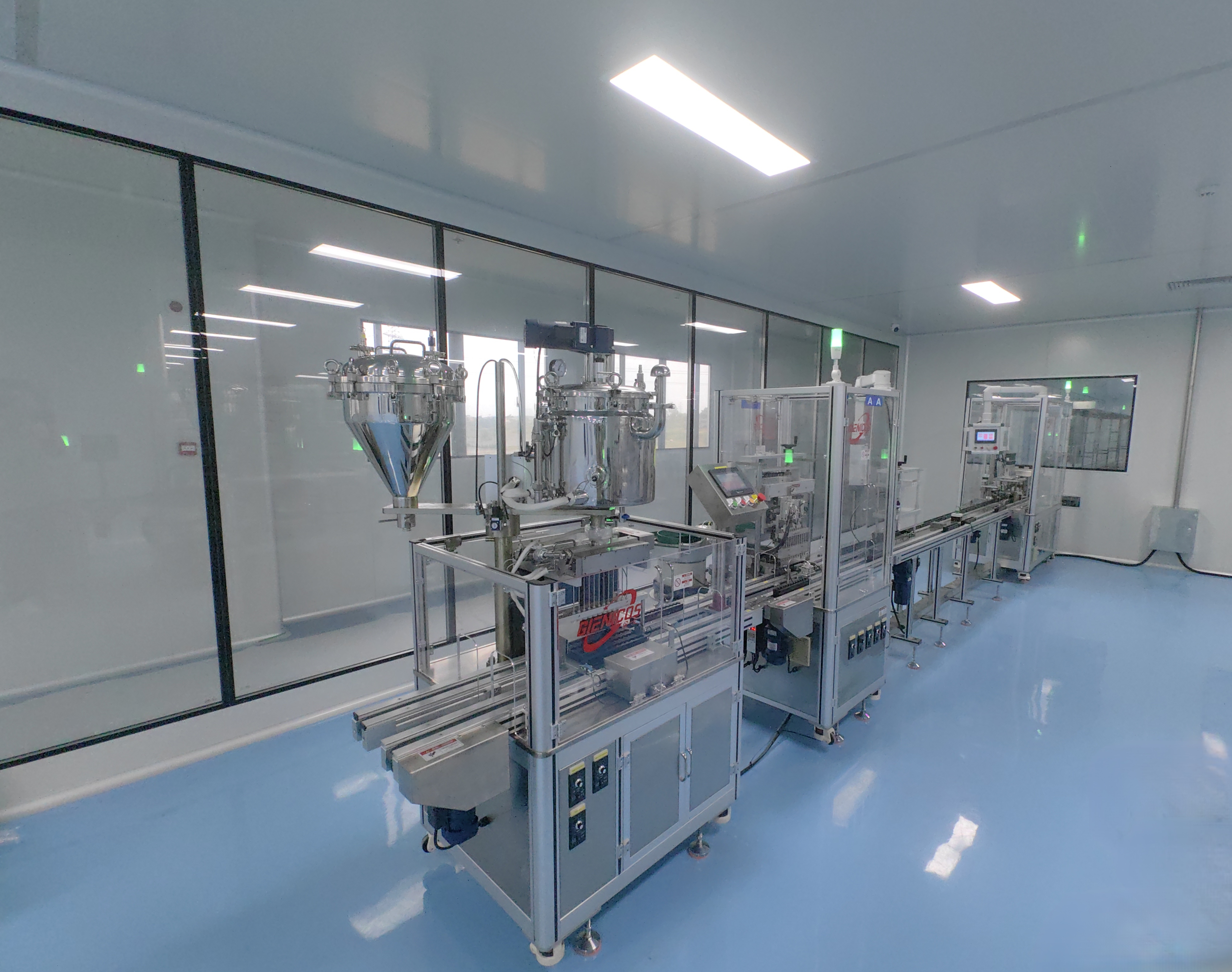
Automated cosmetic filling and capping lines show how configuration choices shape plant layout.
Rotary vs. Linear: What the Two Configurations Actually Mean
In a rotary cosmetic filling machine, containers are fed onto an indexing or continuously rotating turntable. The table carries each container through a circular sequence of stations, which can include bottle feeding, filling, brush feeding, cap feeding, capping and discharge. The Rotary Nail Polish Filling Machine (model JQR-01N) is a practical example of this architecture: its working process includes bottle feed, filling, brush feed, cap feed, capping and discharge, all arranged around a rotary cycle.
Linear systems, by contrast, move containers along a straight conveyor rather than around a revolving table. A linear line can be extended by adding modules along the conveyor length. The Lipgloss Mascara Filling Line (model JMG) is classified as a linear high-speed lipgloss and mascara filling line and is engineered to fill 10-12 pieces per cycle at speeds of 80-100 pieces per minute in its high-speed configuration. Linear does not automatically mean slower; it often means longer and more modular.
There is also a vertical sub-family within the non-rotary category. The Vertical Dual Nozzle Filling Machine (model JMF) uses two vertically arranged tanks and nozzles instead of a rotating turntable. It is described as an economic vertical dual-nozzle high-viscosity filling machine and produces 22-28 pieces per minute with one operator. A vertical layout preserves the simplicity of a fixed filling position while reducing the machine footprint.
Spec-Sheet Comparison: Evidence From Real Machine Data
| Criterion | Rotary Example | Linear / Vertical Example |
|---|---|---|
| Container movement | Carried around an indexing or continuous turntable | Carried along a conveyor or held below fixed vertical nozzles |
| Representative machine | Rotary Nail Polish Filling Machine JQR-01N; Automatic Rotary Mascara Lipgloss Filling and Capping Machine JQR-01A | Vertical Dual Nozzle Filling Machine JMF; Linear High Speed Lipgloss Mascara Filling Line JMG |
| Container / fill volume | JQR-01N: 5-30 ml container; JQR-01A: 2-14 ml fill volume; JRS-G1 foundation machine handles cream and liquid foundation | JMG fills 1-20 ml; JMF uses dual 20 L tanks; JRS-G2 toner/cream machine fills 10-300 ml at normal pressure |
| Throughput evidence | JQR-01A: 40-45 pieces/min; Air Cushion Rotary Filler JQR-02C: 24-30 pcs/min; Rotary powder filler JLF: 900-1,800 pcs/hour | JMG: 60-72 pcs/min in mid-speed and 80-100 pcs/min high-speed; JMF: 22-28 pcs/min by one operator; Dual-nozzle linear powder filler JLF-A: 30-40 pcs/min |
| Filling method | JQR-01N uses piston, vacuum or pressurized filling; JQR-01A uses servo piston filling | JMG and JMF use servo-controlled piston filling; JLF-A uses dual-nozzle auger filling |
| Filling precision | JQR-01A listed as ±0.1 g; JQR-01N approximately ±0.2 g | JMG listed as ±0.1 g; precision remains product-dependent |
| Integrated functions | JQR-01A integrates filling and capping; JQR-01N includes bottle feed, filling, brush feed, cap feed, capping and discharge | JMG can integrate servo torque capping, anti-drip nozzles, no-bottle no-fill detection and robot-aided loading |
| Example footprint | JQR-01A machine size: 2350 × 2150 × 1900 mm; JRS-G1 semiauto rotary foundation filler: 1100 × 950 × 2200 mm | JMF vertical machine size: 810 × 570 × 1906 mm; a full high-speed linear line extends along the conveyor length |
| Cleaning / changeover evidence | Rotary toner/cream filler JRS-G3 lists approximately 15 minutes changeover time | JMF lists approximately 30 minutes cleaning time; modular designs support disassembly for cleaning and spare-part replacement |
Footprint and Layout: The First Production-Floor Difference
Rotary configurations compress several operations into the circumference of a turntable. A compact automatic rotary machine such as the JQR-01A can perform filling and capping in a single cell, with a documented machine size of 2350 × 2150 × 1900 mm. For plants where the goal is medium output with integrated capping and limited conveyor length, a rotary layout often keeps the equipment envelope shorter than a multi-module straight line.
Linear and vertical systems make different use of space. A high-speed linear mascara and lipgloss line such as the JMG line is designed around continuous movement; filling 10-12 pieces per cycle at high speed requires conveyor length, upstream bottle handling and downstream capping or labeling modules. Its benefit is throughput and modularity. A vertical dual-nozzle machine, in contrast, is compact because tanks and nozzles are stacked vertically. The JMF occupies only 810 × 570 mm of floor space, which makes it suitable for laboratories, pilot lines or plants with tight floor area but a genuine need for two-tank flexibility.
Buyers should therefore compare footprint in terms of installed line length, not only machine size. Rotary claims should be checked against the complete turntable cell, including star wheels, capping modules and safety guarding. Linear and vertical claims should be checked against conveyor path, operator access space and maintenance clearance.
Changeover Speed and Product Flexibility
Color cosmetics change frequently by shade, batch and packaging format. Changeover speed is often more important than peak output when production plans include many SKUs.
Rotary systems can be designed for tooling adjustments. The Automatic Toner and Cream Rotary Filling Machine (model JRS-G3), for example, lists a changeover time of approximately 15 minutes. That number is not a guarantee for every rotary machine, but it shows that rotary architecture can support rapid format changes when the machine is engineered with servo controls and adjustable holders. Container geometry must still be considered. The automatic rotary mascara and lipgloss machine JQR-01A documents a container diameter range of 10-125 mm and a container length range of 40-90 mm, excluding cap. If a planned container falls outside that range, change parts or a different machine architecture should be considered.
Linear and vertical machines also provide flexibility through modular design. The JMF vertical dual-nozzle machine has two 20 L tanks, making it useful when changing between two materials without fully emptying a large tank. Its cleaning time is listed as approximately 30 minutes, which can be attractive for small-batch production or laboratories that run frequent formula changes. The JMG high-speed linear line, meanwhile, adds production safeguards that reduce changeover-related contamination: return-suction anti-drip nozzles to reduce bottle-mouth pollution and no-bottle no-fill detection. These features matter most when a line runs high-value formulations and needs to protect both the pump and the container finish.
High-Volume Production vs. Flexible Production
It is tempting to assume that rotary machines are fast and linear machines are slow. The spec-sheet evidence does not support that simple rule. In the data reviewed, a linear lipgloss and mascara production line reaches 80-100 pieces per minute at high speed. A rotary mascara and lipgloss filling and capping machine reaches 40-45 pieces per minute. Both configurations can serve production environments; the correct choice depends on the product mix and the level of integration required.
High-volume lines are best judged by three numbers: pieces per minute, number of filling nozzles or cycles, and whether capping or additional operations are included in the same line. The JMG high-speed line is designed for mascara, lipgloss, lip oil and eyeliner production at cosmetic OEM, ODM and brand factories. Its servo piston filling system handles 10-12 pieces per cycle, and the line can include servo torque capping with adjustable torque and speed. Product-contact parts are available in SUS316L, which is relevant for cleaning validation and GMP-oriented workshops.
Flexible and lower-volume production is better judged by ease of changeover, operator requirement and floor space. The JMF vertical dual-nozzle machine operates at 22-28 pieces per minute with one operator. Its dual 20 L tanks allow different materials to be available at the same filling station. For manufacturers that run small batches of high-viscosity creams, balms or treatment products, this can be more economical than a large rotary line that is difficult to empty and clean.
Semi-automatic rotary machines also occupy the middle ground. The Semi-Automatic Rotary Single Nozzle Filling Machine (model JR-01M/L) and Semi-Automatic Rotary Dual Nozzle Filling Machine (model JR-02M/L) are both rated at 30-40 pieces per minute using lipgloss as an example. These machines allow an operator to manage filling without the full infrastructure of an automatic line, making them common in start-up operations, contract manufacturers and pilot laboratories.
Application Fit: Nail Polish, Mascara, Lip Gloss and Cream
Specific cosmetic formats create specific architectural demands.
- Nail polish and oil-based liquids. The Rotary Nail Polish Filling Machine JQR-01N accepts containers in the 5-30 ml range and uses piston, vacuum or pressurized filling. It can integrate brush feeding, cap feeding, capping and discharge. This makes rotary architecture a practical response to nail polish bottles with brush applicators and small fill volumes. The specification lists applications including nail polish, essential oil, perfume, massage oil and medical oil.
- Mascara, lipgloss and lip oil at scale. A linear high-speed line such as JMG is designed for 80-100 pieces per minute in its high-speed mode. Return-suction nozzles, no-bottle no-fill detection and servo torque capping address the two biggest challenges in mascara and lipgloss production: preserving bottle-mouth cleanliness and protecting caps from inconsistent torque.
- Compact integrated capping. The Automatic Rotary Mascara Lipgloss Filling and Capping Machine JQR-01A shows that rotary machines can combine filling and capping within one automatic cell. It fills 2-14 ml with ±0.1 g precision and runs at 40-45 pieces per minute, with a container diameter span of 10-125 mm.
- Cream and liquid foundation. The Semiautomatic Rotary Foundation Filling Machine JRS-G1 indicates rotary architecture is also used for cream and liquid foundation at 30-40 pieces per minute. At a higher level, the Automatic Toner and Cream Rotary Filling Machine JRS-G3 handles 10-300 ml at up to 50 pieces per minute and documents roughly 15 minutes of changeover time.
- High-viscosity products and laboratory batches. The JMF vertical dual-nozzle machine is explicitly described as a high-viscosity filling machine. Two 20 L tanks and a cleaning time of about 30 minutes make it suited to small-batch and high-viscosity cosmetic materials where product changeover is frequent.
- Powder formats. Both rotary and linear configurations appear in powder filling. The Rotary Loose Powder Filling Machine JLF reaches 900-1,800 pieces per hour, while the Dual Nozzle Linear Loose Powder Filling Machine JLF-A reaches 30-40 pieces per minute. The decision for powder is therefore less about rotary versus linear and more about whether throughput targets justify a fully conveyorized layout.
Verification Checklist for Buyers
When comparing rotary and linear machines at the evaluation stage, buyers should separate marketing claims from verifiable specification data. A practical verification list should include the following items.
- Confirm what is included in the stated speed. A filling machine output may be quoted under one specific product, viscosity and container format. JQR-01A is quoted in pieces per minute as an integrated filling and capping unit; JR-01M/L is quoted as 30-40 pieces per minute using lipgloss as an example. Ask the supplier to define the exact reference product.
- Ask for the full installed footprint, including conveyors, capping stations, bottle feeding devices and operator access. Rotary machines such as JQR-01A have a machine size of 2350 × 2150 × 1900 mm; vertical machines such as JMF have a much smaller footprint but lower output. Compare the same level of integration.
- Check container dimensional ranges, not only fill volume. JQR-01A specifies container diameter 10-125 mm and length 40-90 mm excluding cap. If your package is outside these limits, the rotary cell may require significant change parts.
- Identify the filling method that matches the formula. The JQR-01N rotary nail-polish machine supports piston, vacuum and pressurized filling, while eyeliner rotary machines such as JR-02E use peristaltic pump filling. Viscosity, air sensitivity and flow behavior should govern the method choice.
- Clarify how long changeover and cleaning actually take. JRS-G3 documents about 15 minutes for changeover; JMF documents about 30 minutes for cleaning. These are useful reference points, but cleaning time depends on the number of product-contact parts and whether the formula is hot-poured or wax-based.
- Review material of wetted parts. For hygienic cosmetics production, SUS316L product-contact parts are often preferred. The linear JMG line, for example, is specified with SUS316L/SUS304 materials and GMP-compliant design. Buyers should request material certificates where required by internal quality systems.
- Check whether station integration is included. Some rotary machines integrate bottle feeding, filling, brush feeding, cap feeding, capping and discharge in one working process, as seen in the JQR-01N. If a supplier offers only a standalone filler, downstream handling must be added separately.
- Ask about customization in terms that can be written into a quotation. Documented customization options include voltage, logo, automation degree, tank size, filling method and speed request. In many OEM and ODM production environments, these variables determine whether the machine can fit the buyer's existing line and container catalog.
- Confirm European conformity scope when equipment will be used in the EU. For example, CE certification for lipstick filling equipment can be issued under certificate number AT1814C500649151 and references standards including EN 60204-1:2018 and EN ISO 12100:2010. Buyers should confirm that both the filling machine and any integrated modules are listed in the certificate scope.
Limits and Trade-offs Buyers Should Challenge
Even well-documented machine specifications have limits. Buyers should keep several trade-offs in mind during supplier conversations.
First, the label 'rotary' or 'linear' is not itself a performance claim. A buyer must verify how many containers are filled per cycle and how much handling is integrated. The JMG linear line achieves high speed partly because it fills 10-12 pieces per cycle, while some semi-automatic rotary machines fill one or two pieces per cycle and therefore operate at lower output. Comparing final throughput without comparing cycle architecture will produce misleading conclusions.
Second, footprint comparisons must be normalized. A vertical dual-nozzle machine such as JMF has a compact base but a height of about 1906 mm. A rotary machine such as JQR-01A has a broad turntable area and must be surrounded by guards and conveyors. A linear high-speed line can be the smallest in terms of height but often the longest in terms of floor layout. Plant ceiling height, operator movement and future conveyor expansion all matter.
Third, changeover and cleaning numbers are application-dependent. The 15-minute changeover figure on the JRS-G3 rotary toner/cream machine is a specification reference, not a universal guarantee. The 30-minute cleaning figure for JMF is also a machine-level reference. Buyers should request a documented changeover test for their own container, cap and material combination.
Fourth, integration can increase complexity. A rotary nail-polish machine that handles bottle feed, filling, brush feed, cap feed, capping and discharge is efficient, but it also contains more servo axes and change parts than a simple filler. A buyer with a limited maintenance team should compare the maintainability of each module and the availability of remote technical support.
Market Context: Automation Demand Is Reshaping Configuration Choice
Market research illustrates why rotary and linear configurations remain important rather than obsolete. The global cosmetic filling machines market was valued at USD 476.80 million in 2025 and is projected to reach USD 718.63 million by 2036, according to Future Market Insights. The same research stream expects automatic filling machines to represent 41.2 percent of the cosmetic filling technology market in 2026. Fortune Business Insights data further indicates that Asia Pacific accounted for 33.08 percent of the filling machine market in 2025.
From a buyer perspective, these numbers point to two broader shifts. First, automatic machines are increasingly the default, which means the choice between rotary and linear configurations often decides how automation modules are integrated. Second, the fastest-growing production base is in Asia Pacific, where equipment is used both for domestic brand manufacturing and for export-oriented OEM and ODM production. In both cases, buyers are less interested in whether a rotary or linear label sounds more advanced and more interested in whether the machine can handle their formula range, container sizes and changeover cadence.
Decision Framework: Which Configuration Should a Buyer Consider?
There is no single winner between rotary and linear architecture, but there are consistent decision patterns.
Consider a rotary configuration when the production program includes integrated functions such as bottle feeding, filling, brush feeding and capping within one compact cell; when containers are relatively stable in size; and when medium-to-high output is acceptable. The Rotary Nail Polish Filling Machine JQR-01N and Automatic Rotary Mascara Lipgloss Filling and Capping Machine JQR-01A both illustrate this logic. Rotary architecture can also support liquid eye liner, mascara, lipgloss, foundation and air cushion cream filling in semi-automatic or automatic formats.
Consider a linear configuration when high output is needed from multiple filling positions in each cycle; when future modules may be added along a conveyor; and when the available floor space can accommodate a longer line. The JMG lipgloss and mascara line demonstrates the linear logic at 80-100 pieces per minute with 10-12 pieces per cycle. The dual-nozzle linear powder filler JLF-A demonstrates the same logic in powder handling at 30-40 pieces per minute.
Consider a vertical machine when the goal is small footprint, quick material change and operator-friendly flexibility. The JMF vertical dual-nozzle high-viscosity machine is a practical option for high-viscosity cosmetic materials and runs at 22-28 pieces per minute with one operator. Its dual 20 L tanks reduce the need for frequent tank cleaning when two materials are in queue.
Some plants will reasonably own both. A rotary unit can serve as the high-volume line for a hero SKU, while a vertical dual-nozzle unit handles lab-scale batches, emerging shades or private-label trial production.
FAQ
What is the primary difference between rotary and linear cosmetic filling machines?
Rotary machines carry containers around a turntable through a circular sequence of stations. Linear machines move containers along a straight conveyor, while vertical machines use fixed vertical nozzles and stacked tanks. The Rotary Nail Polish Filling Machine JQR-01N and Vertical Dual Nozzle Filling Machine JMF illustrate these different layouts.
Which is better for high-speed mascara or lip gloss production: rotary or linear?
Configuration alone does not determine speed. A linear high-speed lipgloss and mascara filling line such as JMG is rated at 80-100 pieces per minute in high-speed mode, while an automatic rotary mascara and lipgloss filling and capping machine JQR-01A is rated at 40-45 pieces per minute. Buyers should compare complete cycle architecture, spacing and integration rather than relying on the rotary or linear label.
When should a vertical dual nozzle filling machine be selected?
A vertical dual-nozzle machine such as JMF is useful for high-viscosity cosmetic materials, small batches and tight production areas. It runs at 22-28 pieces per minute with one operator, uses dual 20 L tanks, has a compact footprint and lists approximately 30 minutes of cleaning time.
Can a rotary filling machine handle nail polish containers?
Yes. The Rotary Nail Polish Filling Machine JQR-01N is designed for containers in the 5-30 ml range and can use piston, vacuum or pressurized filling. Its working process can include bottle feed, filling, brush feed, cap feed, capping and discharge.
How much time is required for changeover on a rotary cosmetic filling machine?
Changeover time depends on machine design, container geometry and material behavior. As a reference, the Automatic Toner and Cream Rotary Filling Machine JRS-G3 lists approximately 15 minutes of changeover time. Buyers should ask suppliers to define changeover for the specific container and cap combination they plan to run.
Are rotary and linear configurations easy to clean?
Modern cosmetic filling machines are often designed with modular structures that allow fast disassembly of key assemblies. The JMF vertical dual-nozzle machine, for example, documents approximately 30 minutes of cleaning time. Final cleaning time still depends on product-contact part count, formulation and access to the filling nozzles.
Can a cosmetic filling machine be customized for different packages?
Many cosmetic filling machine suppliers support customization in voltage, logo, automation degree, tank size, filling method and speed request. OEM and ODM production modes are available for equipment used by cosmetic brands, contract manufacturers and private-label producers. Buyers should include these options in the technical quotation rather than assuming a catalogue model will fit every package.
Final Practical Note
The rotary-versus-linear decision should be made with production facts, not machine-brand reputation. A buyer who starts from container size, formula viscosity, required output, operator availability and floor space will find that both configurations have clear strengths. Rotary machines excel when multiple handling steps must be packaged into a compact automated cell. Linear and vertical machines excel when modularity, cost entry level or high multi-station throughput is more important than a circular layout.
For buyers who need further specification data, the 2026 equipment catalogue covering the machine family referenced in this comparison is available as a PDF: Download 2026 catalogue.
¿Tiene preguntas o necesita más detalles?
Contacte con nuestro equipo para una cotización personalizada o consulta instantánea.
Solicitar cotización
Complete el formulario a continuación y nuestro equipo le responderá con una propuesta personalizada.
Chat directo de WhatsApp
¿Prefiere chatear en tiempo real? Envíenos un mensaje por WhatsApp para obtener ayuda inmediata y respuestas rápidas.
- Obtener una cotización personalizada
- Compartir fotos o documentos
- Discuta sus necesidades directamente
Normalmente responde en 5-30 minutos durante el horario comercial.