
Cosmetic Filling Machine Procurement FAQ: Hot Pouring, Rotary Filling & Powder Pressing
Cosmetic Filling Machine Procurement FAQ: Hot Pouring, Rotary Filling & Powder Pressing
A cosmetic filling machine is equipment that dispenses a cosmetic formulation into its primary container and, depending on configuration, continues into brush insertion, capping, check-weighing and labeling. The single phrase hides three very different machine families, because a wax-based lipstick bulk at pouring temperature, a 5–30 mL nail polish, a 10–300 mL toner or cream, and a pressed powder cake do not move through a nozzle the same way.
Procurement teams usually discover this after receiving three quotations that all read “cosmetic filling machine” but describe a hot pouring line, a rotary filling machine and a powder press. They are not interchangeable, and they are rarely bought in the same order of priority. This article answers the technical questions that decide which family fits a given product, container and batch pattern, using named equipment models and documented parameters.
The Procurement Problem: Format Decides the Equipment, Not the Other Way Around
Most specification failures in cosmetic filling projects come from a reversed sequence. Buyers select a machine type first, then try to fit a product into it. The reliable sequence runs the other way: material state, then container geometry, then fill volume and precision band, then downstream steps, and only then machine type and automation level.
Three questions split a shortlist faster than any brochure comparison:
- Is the bulk material solid below a melt temperature, semi-solid, liquid or powder?
- Does the container need the filling step to also insert a brush, a wiper or a cap?
- Is the required precision expressed in grams, and at what fill volume does that precision have to hold?
Hot pouring answers the first question for wax-based bulk. Rotary filling answers the second for brush-applied and small-bottle liquids, and the third for cream and lotion volumes up to 300 mL. Powder pressing answers none of them, because powder is not filled as a liquid at all — it is dosed loose or pressed into a pan as a solid cake.
Hot Pouring: When the 20L Hot Pouring Machine Is the Right Starting Point
The 20L Hot Pouring Machine (model MT 20P) holds a 20 L tank with heating, stirring and vacuum functions and discharges through a sanitary valve without dead angle. Its documented application is lipstick, lip balm and other wax-based cosmetic bulk materials. A second model in the same capacity class, the Hot Pouring Machine (model TSP), also carries a 20 L tank with heating, stirring and vacuum, applied to lipstick and lip balm material melting and pouring.
In practice, the 20 L tank is a batch container rather than a throughput specification. It sets how much melted bulk is available between refills and how quickly the material must be consumed before it is re-melted. Projects that need more resident capacity move up the same family: the Six-in-one 20L Cosmetic Melting Tank (MT 20 SE) holds six 20 L tanks in one unit, the 30L Lipstick Lipbalm Melting Tank (MT 30SE) and the 100L Cosmetic Melting and Mixing Tank (MT 100 SE) serve larger pre-melt demand, and the 300L Industrial Cosmetic Melting Tank (MT 300 SE) uses oil circulation heating for foundation, lipstick, primer cream and other wax-based bulk.
Which filling configuration follows the melting step?
Four documented options serve different output and color requirements. The Servo Piston Filling Machine (JSFL 1-2) is a single or dual nozzle servo piston unit for lip balm, lipstick, lip cream and high-viscosity cosmetics, with a liftable tank. The Multi-color Hot Filling Machine (JYF-4) fills four colors in one four-in-one frame, at 2–20 mL, 20–50 mL or 50–100 mL, using servo piston control, a 20 L effective tank volume, SUS316L product-contact material and a stated filling precision of ±0.1 g. The Hot Filling & Cooling Line (JHF) is configurable with 2, 4, 6 or 16 nozzles, filling range options of 1–20 mL, 20–50 mL, 50–100 mL and 100–200 mL, and a maximum output of up to 60 pcs/min in the 6-nozzle configuration. The Semi Automatic Lipstick Filling Machine (JLG-10/12) uses 10 or 12 nozzles, a 1–20 mL filling volume and ±0.1 g precision, and is supplied as a series with a cooling tunnel and a vacuum releasing machine.
For higher volumes, the Automatic Silicone Mold Lipstick Filling Machine (GLU-1300) is documented at 1000–1300 pcs/hour with two servo-driven piston nozzles, a 30 L material tank, electric oil heating, a 112-piece silicone mold and two LEISTER hot air guns, covering lipstick diameters of approximately 8–17.1 mm. The Half Silicone Lipstick Lipbalm Filling Line (JSM) runs 2160–3600 pcs/hour with a metal mold and 1800–3000 pcs/hour with a silicone mold.
Why the Lipstick Cooling Tunnel Is Not Optional
The Lipstick Cooling Tunnel (JCT) uses refrigerated air circulation and a continuous conveyor-type tunnel to cool and solidify lipstick and lip balm molds after hot filling. Temperature, conveyor speed, dimensions and power supply are customizable according to production-line requirements. The procurement consequence is straightforward: a hot pouring machine without matched cooling leaves the filled molds in an unstable state before demolding, so the cooling step should be specified in the same scope as the filler rather than added later.
Rotary Filling: Nail Polish, Toner and Cream Configurations
The Rotary Nail Polish Filling Machine (JQR-01N, new version) is an automatic rotary unit that fills by piston, vacuum or pressurized method across a 5–30 mL container range, with a stated filling precision of about ±0.2 g, AC220V single-phase power at 2 kW, and an integrated working process: bottle feed, filling, brush feed, cap feed, capping and discharge. Its documented applications extend to nail polish, essential oil, perfume, massage oil and medical oil. The significance for buyers is that brush insertion and capping occur inside the same machine, so a separate capping station is not automatically required for this container type.
Where higher output is needed for the same product group, the Automatic Nail Polish Filling and Capping Machine (JQL-02N) uses two-nozzle servo filling at 80 pcs/min over a 5–20 mL range with ±0.15 g precision, subject to material formula and other factors.
Toner, Serum and Cream: What the Rotary Family Covers
The Toner and Cream Rotary Filling Machine (JRS-G3) is an automatic rotary unit for oil, toner, serum and cream across a 10–300 mL filling volume. It uses servo piston filling at up to 50 pcs/min, with stated precision of ±0.5 g between 20–100 mL and ±0.5% between 101–300 mL. Changeover time is approximately 15 minutes, holder diameter range is 10–70 mm, and the machine runs on AC380V three-phase power at 5 kW.
A related dual-nozzle configuration, the Toner and Cream Filling Machine (JRS-G2), handles 10–300 mL at normal pressure for material viscosity up to 15,000 mPa.s, running 45 bottles per minute at 50 mL, with a 40–45 L tank, puck inner diameter of 25–70 mm, bottle height from 30 mm without cap to 205 mm with cap, and cap diameter of 20–55 mm. For foundation specifically, the Semiauto Rotary Foundation Filling Machine (JRS-G1) runs 30–40 pcs/min with full-servo rotary filling on single-phase 220 V power.
Why the Same Rotary Platform Appears Across Several Product Types
Rotary construction is reused across mascara, lip gloss, eyeliner and pouch formats in the same model series. The Automatic Mascara Lipgloss Filling Machine (JQR-01A) fills 2–14 mL at ±0.1 g and 40–45 PPM across container diameters of 10–125 mm and container lengths of 40–90 mm excluding cap. The Automatic Lipgloss Filling and Capping Machine (JQH-02) fills 1–20 mL at 60–80 pcs/min with ±0.1 g precision. The Semi Automatic Mascara Lipgloss Filling Machine (JR-02M/L) runs 30–40 pcs/min with dual nozzles, while the single-nozzle version (JR-01M/L) covers 2–14 mL and 10–50 mL by changing spare parts. The Rotary Liquid Eyeliner Filling Machine (JR-02E) uses peristaltic pump filling at 30–40 pcs/min. This family structure is why buyers comparing “rotary filling” should compare model-level parameters, not the category name.
Powder Pressing: Compacting and Loose Powder Lines
The Automatic Powder Press Machine (GP 050 SE) is a rotary, servo-type press — hydraulic press being an available customization — rated at 50–60 pcs/min with four cavities as the reference example, single-color as standard with color count customizable, and an operator requirement of 0.5–1 person. A robot pan feeder is offered as an option, and the documented applications are compact powder and eyeshadow. This is the configuration buyers choose when compact output must be continuous and one color per pass is acceptable.
Bottom-up presses form a second group, where pressing force and pan geometry matter more than cycle time. The Bottom Up Compact Powder Machine (JBC-5) uses servo motor hydraulic drive at a maximum pressure of 14 tons and a maximum capacity of 3 molds per minute, with a typical mold capacity of 9 pieces per mold at approximately 50 mm diameter and a requirement of 1–2 operators. The Compact Powder Press Machine (JBC-4) uses full hydraulic drive, producing 2–3 molds per minute — typically 720–1080 pcs/hour — with up to 6 pans per mold depending on aluminum pan size and a maximum hydraulic output pressure of 15 tons. The Compact Powder Press Machine (JTC) is an up-bottom hydraulic press with 0.1–14 MPa working pressure and a maximum hydraulic output pressure of 8 tons.
Loose powder that is never pressed follows a different route. The Rotary Loose Powder Filling Machine (JLF) uses rotary weighing-to-fill at 900–1,800 pcs/hour with a 25 L tank, while the Automatic Loose Powder Filling Machine (JLF-A) uses dual-nozzle auger filling at 30–40 pcs/min with a 25 L hopper, SUS316L product-contact parts, Mitsubishi PLC and Panasonic servo motors. Upstream preparation equipment includes the High Speed Powder Mixers (JY-CR50 at 10 kg/batch, JY3-CR100 at 10–25 kg, JY-CR200 at 20–50 kg/batch), the Powder Pulverizer (JMP08) at 20–50 kg/hour with 1.0, 1.5 or 2.0 mm sieves, and the Vibration Powder Sifter (PSF) with 40 or 60 mesh screens.
After pressing, the Robot Compact Powder Assembly Line (JZF) uses a delta robot with two visual detection sets — one for the godet, one for the powder case — for powder case sizes from 10–60 mm, a robot working diameter of 600 mm and a maximum load of 1 kg, with a changeover or set time of approximately 15 minutes.
Capping and Labeling: When They Are Bought Separately
The Semi Automatic Rotary Capping Machine (JR-01X) applies servo capping to round and square bottles at 30–40 pcs/min with adjustable capping torque, running on single-phase 220 V power at 1.5 kW and 0.5–0.8 MPa air pressure. It is relevant when filling and capping must be decoupled, or when cap torque has to be verified as a separate process step. Where the filling machine already performs brush feed and capping, as with the JQR-01N, or fill-and-cap as with the JQH-02, a standalone capper adds a step rather than removing one.
Labeling follows the container shape rather than the product. The Powder Case Top and Bottom Labeling Machine (JTB-812) applies top and bottom labels at 50–80 pcs/min with ±1 mm accuracy across container diameters of 30–100 mm, running on 220 V single-phase power. For slim round containers, the Bottom Color Code Labeling Machine (JTB-815S) covers container diameters of 15–30 mm and lengths of 50–110 mm at 60–90 pcs/min with ±1 mm accuracy and a minimum label length of 9 mm. The Sleeve Shrink Labeling Machine (JSS-01) targets slim and long items such as lipstick, mascara, lip gloss, pencil boxes and oil bottles, with product sizes from 10 × 10 to 25 × 25 mm or 25 × 25 to 45 × 45 mm, film materials PE, PVC, OPS and PET at 0.035–0.045 mm thickness, film heating temperature up to 200°C, labeling speed of 100 pcs/min and film cut precision of ±0.25 mm.
Technical Explanation: Filling Method Drives Precision, Not Brand
Five dosing principles appear across the equipment discussed above, and the principle — not the machine category — determines the achievable precision band.
| Dosing principle | Documented equipment | Stated precision / range |
|---|---|---|
| Servo piston filling | JYF-4, JQH-02, JR-02M/L, JQR-01A, JRS-G3, JLG-10/12 | ±0.1 g on small volumes; JRS-G3 ±0.5 g at 20–100 mL and ±0.5% at 101–300 mL |
| Piston, vacuum or pressurized | JQR-01N rotary nail polish | About ±0.2 g, 5–30 mL |
| Servo piston, two nozzles | JQL-02N nail polish | ±0.15 g, 5–20 mL, 80 pcs/min |
| Peristaltic pump | JR-02E eyeliner | 2 pieces per cycle, 30–40 pcs/min |
| Auger and weighing-to-fill | JLF-A dual nozzle auger; JLF rotary weighing | 30–40 pcs/min; 900–1,800 pcs/hour |
| Hydraulic and servo press | GP 050 SE, JBC-5, JBC-4, JTC | 14–15 tons maximum hydraulic output pressure on bottom-up models; 50–60 pcs/min on GP 050 SE |
The practical reading is that a ±0.1 g requirement points toward small-volume servo piston filling, while a 200 mL cream fill should be specified as a percentage rather than a fixed gram tolerance, because that is how the documented JRS-G3 specification is stated.
Application and Use Cases
A documented deployment pattern covers 20 sets of equipment supplied to cosmetic brands, OEM/ODM contractors and small-batch production labs in the United States, Poland, Indonesia and Thailand, used for producing lipgloss and lip cream products over a five-year period, with the reported outcome of stable operation and on-time service support. The installations rely on high precision, modular customization and multi-category cosmetics coverage, including turnkey line delivery.
Documented working conditions for this equipment class include cosmetic clean-room workshops with GMP clean-grade compatibility, PLC control with touch-screen operation, and automatic production line modes matched to MES systems, remote systems, automatic check-weigh and reject stations, and labeling equipment. Suitable products span lip gloss, lipstick, mascara, cushion, foundation, compact powder, nail polish, eyeliner, eyebrow pencil, cosmetic cream and lotion.
Market Trend Signals Buyers Should Weigh
The global cosmetic filling machines market was valued at USD 476.80 million in 2025 and is projected to reach USD 718.63 million by 2036, according to Future Market Insights. Asia Pacific dominated the wider filling machine market with a 33.08% share in 2025, based on Fortune Business Insights data. Within the cosmetic filling technology mix, automatic filling machines are projected to hold a 41.2% share in 2026, again per Future Market Insights.
Sub-segment estimates require care. One commercial research source projects the automatic lipstick filling machines market reaching approximately USD 1.2 billion by 2033 at a 5.8% CAGR from 2025, while other research houses report figures an order of magnitude smaller. The gap reflects definitional difference — individual filling machines versus complete production lines — rather than a contradiction in demand. Buyers using market figures in internal proposals should state which definition the figure covers.
On the trade side, cosmetic filling machinery falls under HS Code 8422.30, specifically 8422.30.91 for machinery used in opening, filling and closing containers, per the Harmonized Tariff Schedule. This matters for landed-cost calculations and customs documentation on cross-border projects.
Comparison with Traditional and Manual Solutions — Including the Boundaries
Manual and bench-level filling remains viable for very small batches and formulation trials, and the transition to automated equipment is usually justified by consistency and labor rather than by raw speed. The trade-offs are concrete and documented.
- Labor does not disappear. The Half Silicone Lipstick Lipbalm Filling Line (JSM) requires 4–5 operators. The GLU-1300 silicone mold lipstick machine requires 2 operators, or 1 when robot integration is applied. The JBC-5, JBC-4 and JTC compact powder presses require 1–2 operators each. Only the GP 050 SE automatic powder press reaches 0.5–1 person.
- Precision figures are conditional. The ±0.15 g figure for cushion filling is stated as subject to material formula, sponge characteristics and other factors, and the same conditional wording applies to nail polish line precision. A tolerance quoted in a brochure is a reference point until it is verified with the buyer’s own bulk.
- Tolerance scales with volume. On the JRS-G3 toner and cream rotary filler, precision is expressed as ±0.5 g between 20–100 mL and ±0.5% between 101–300 mL. Anyone specifying a fixed ±0.1 g across a 300 mL fill is specifying outside the documented band.
- Changeover is a real cost. Documented changeover or set times include approximately 15 minutes on the JRS-G3 and approximately 15 minutes on the JZF powder assembly line. High-mix, low-volume production should plan for that time explicitly.
- Hot pouring is format-specific. The MT 20P and TSP are applied to lipstick, lip balm and wax-based cosmetic bulk. They do not cover emulsion cream, toner or powder. Requesting a hot pouring machine for a water-based lotion is a category error, not a negotiation position.
- Standard universal machines are not the supplier’s main direction. The documented position is that customized development for key-account clients is the focus, that machines are designed under a modular concept, and that standard mass-produced universal machines are not the primary direction. A buyer with a strictly off-the-shelf requirement should expect a configuration discussion rather than a catalogue-only transaction, and should plan accordingly.
- Capacity is finite. Documented monthly capacity is 10 units with a lead time of 45–80 days, so sequencing matters when several machine families are ordered in one project.
Compliance and Documentation for the Three Families
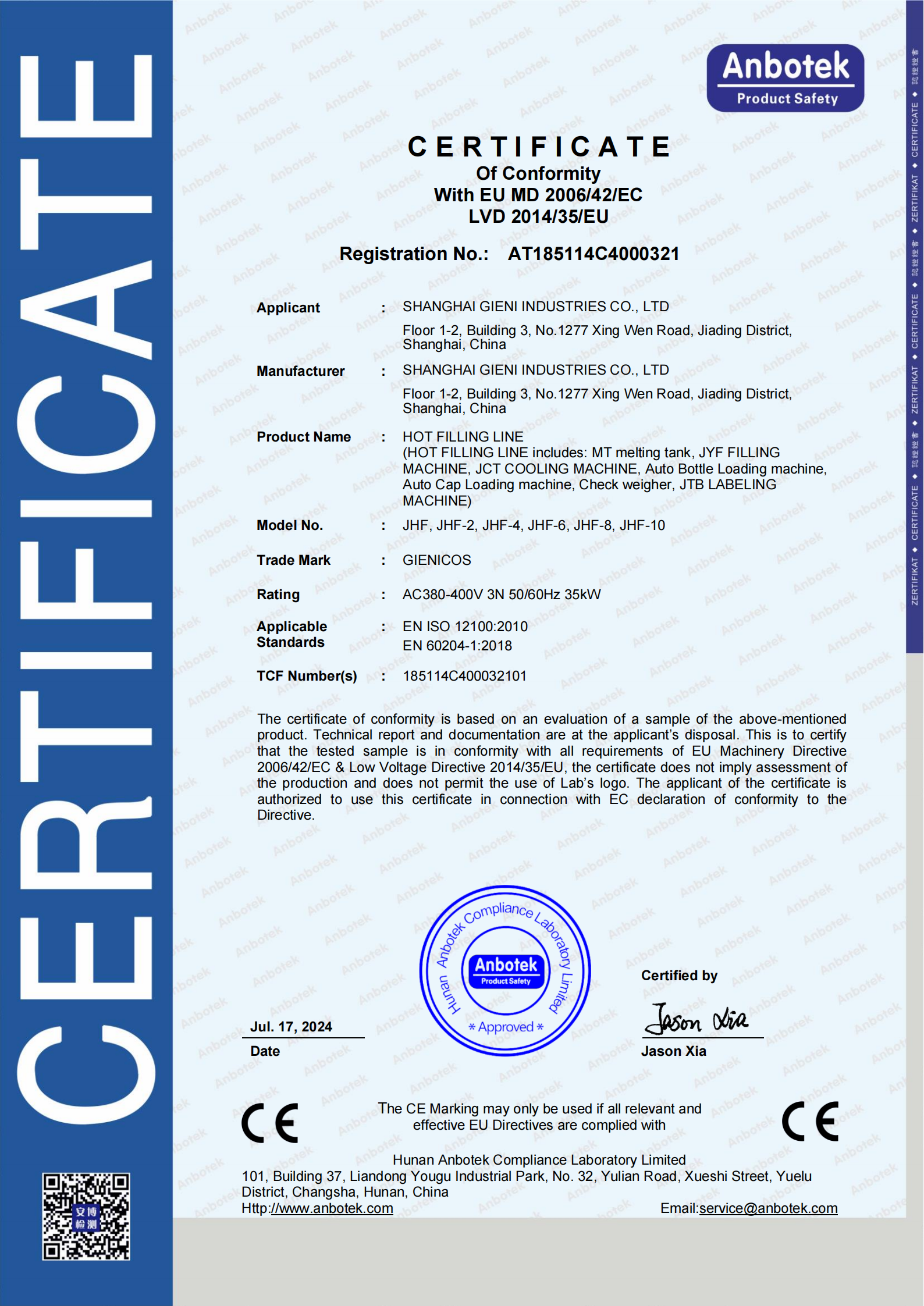
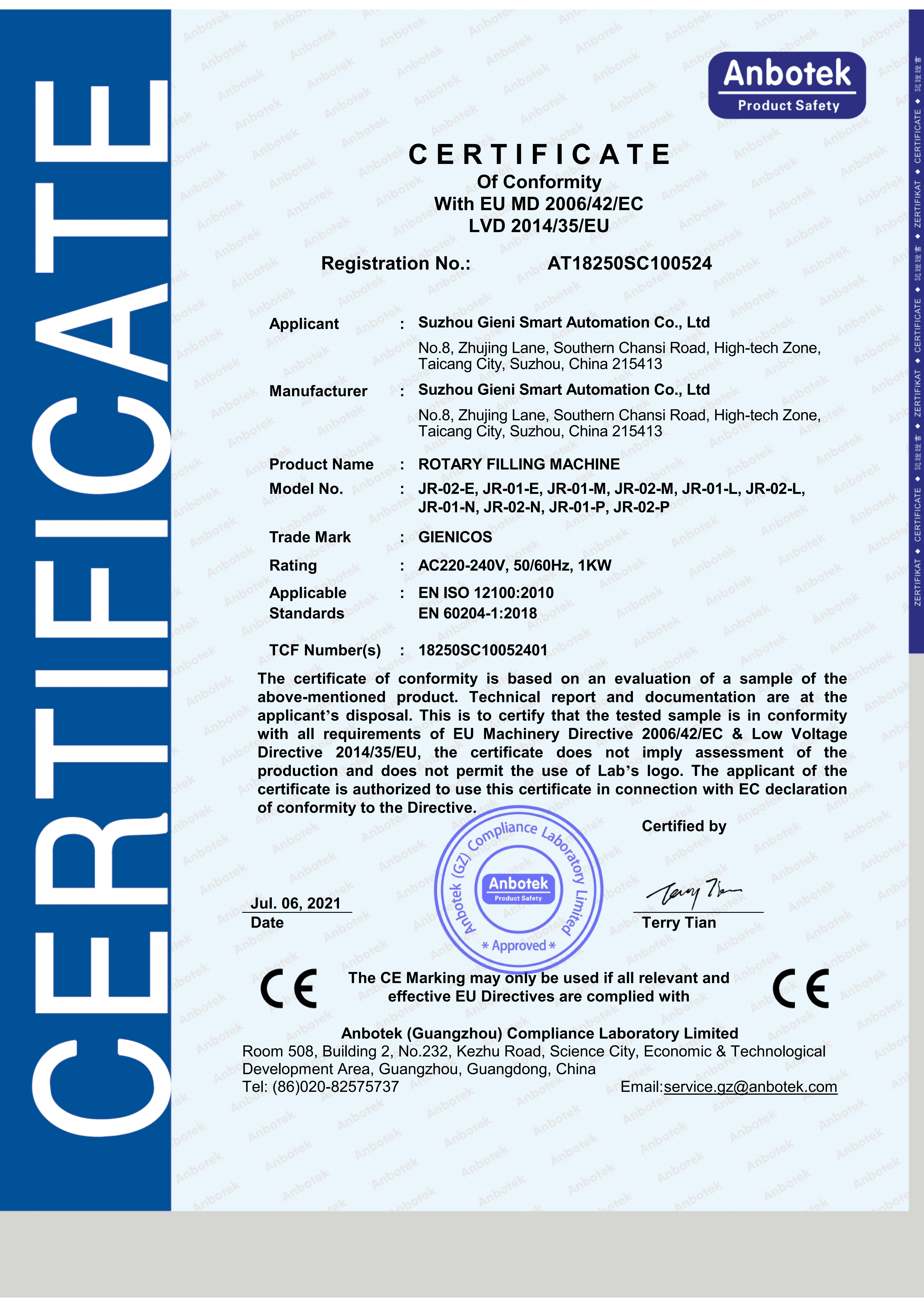
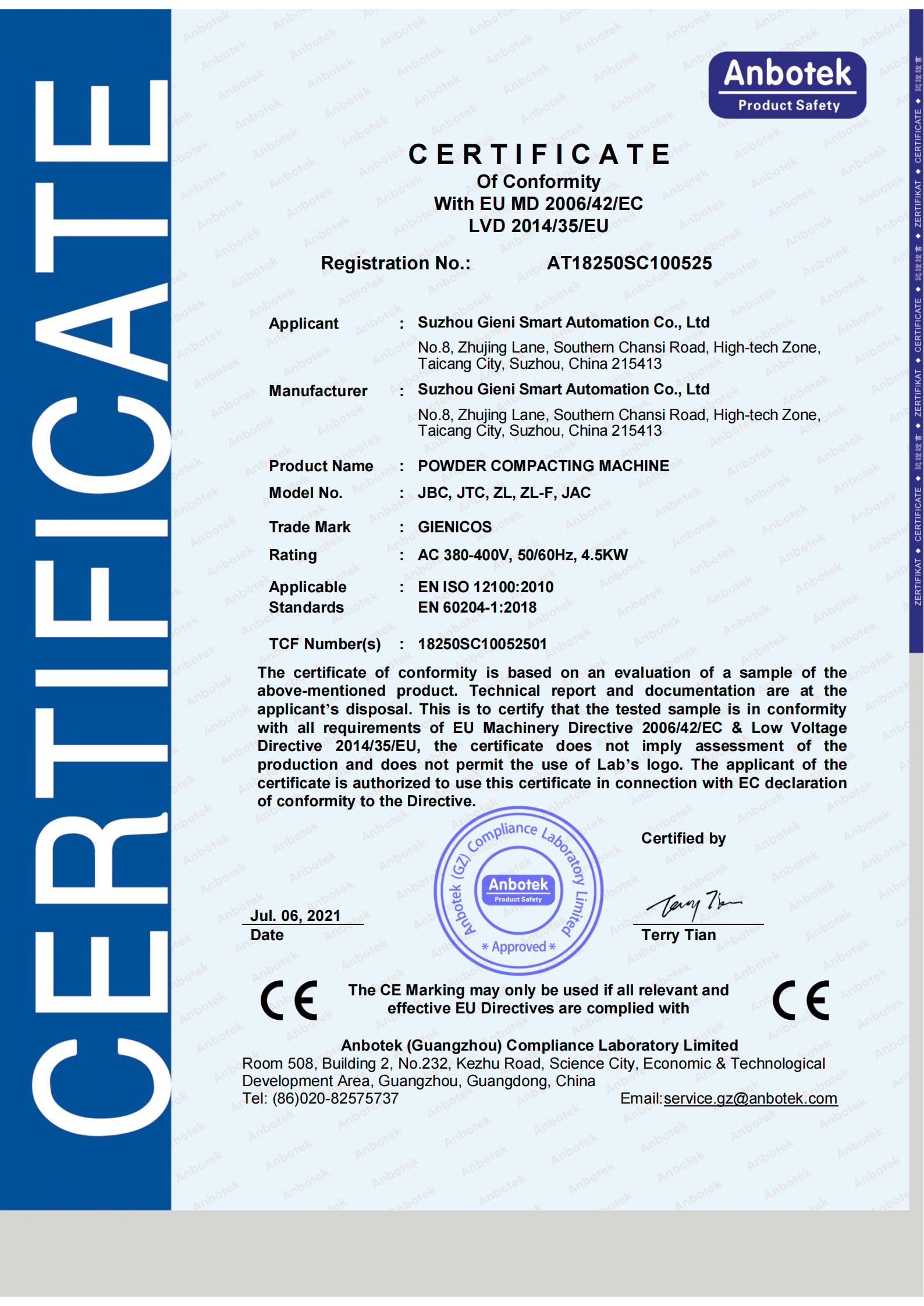
For European market access, the documented certificates reference standards EN 60204-1:2018 and EN ISO 12100:2010. The hot filling line scope is covered by certificate AT185114C4000321 issued by Hunan Anbotek Compliance Laboratory Limited, covering the MT melting tank, JYF filling machine, JCT cooling machine, automatic bottle loading machine, automatic cap loading machine, check weigher and JTB labeling machine across the JHF model series. The rotary filling machine scope is covered by certificate AT18250SC100524 issued by Anbotek (Guangzhou) Compliance Laboratory Limited for the JR-01 and JR-02 series. The powder compacting scope is covered by certificate AT18250SC100525 for the JBC, JTC, ZL, ZL-F and JAC models.
Additional documented scopes include the multifunctional filling production line (JYF-2 to JYF-12) under certificate AT58250SC100097 issued by Anbotek (Guangzhou) Compliance Laboratory Limited, the single nozzle hot filling line (JSFL) under certificate AT58250SC000523 issued by Shenzhen Anbotek Compliance Laboratory Limited, the melting tank series including MT-1, MT-4, MT-6, TSP, TSF and MT under certificate ATGZAHS190528008-M1 issued by Anbotek (Guangzhou) Compliance Laboratory Limited, and the lipstick filling machine series JLG-10, JLG-12, JSM, FSM-5, FSM and JLG under certificate AT1814C500649151 issued by Hunan Anbotek Compliance Laboratory Limited.
The buyer-side implication is that CE scope is declared per model series, not per product category. Before a purchase order is issued, the model number on the quotation should be checked against the model number inside the certificate scope. The company behind this equipment range is SHANGHAI GIENI INDUSTRY CO., LTD. (GIENICOS), founded in Shanghai in 2011, operating a 2000 ² factory in Jiading District with 30 employees, 10 R&D engineers, an annual output of 100 units, 42 authorized patents and an AI division established in 2020.
OEM/ODM, Customization and Procurement Terms
Customization options documented for this equipment range include voltage, logo, automation degree, tank size, filling method and speed request. OEM and ODM production services are both available, with the export footprint covering the EU, USA, Asia and the Middle East and an export ratio of 80%.
Commercial and acceptance terms follow the same structure across the range: minimum order quantity of 1 unit, delivery terms FOB, CNF, CIF or DDP, acceptance criteria based on factory acceptance testing on site or video inspection before shipment, and payment terms of T/T 40%/60%. Quality control is described as 100% OQC test before shipping. After-sales coverage includes remote technical support, on-site visit support, a one-year warranty and full-life service support. The standard warranty term is 12 months from the date of machine acceptance, covering manufacturing defects and excluding wearing consumable parts and man-made damage.
On maintenance, the equipment is built on a modular structural design in which key assemblies support fast disassembly, convenient cleaning and spare-part replacement, which reduces production downtime between product changeovers. This is a structural claim rather than a performance claim, and it is the reason cleaning time should be requested as a line-level figure during evaluation.
Future Outlook
Three directions are visible in the equipment data rather than in marketing language. First, automation share is rising: automatic filling machines are projected at 41.2% of the cosmetic filling technology market in 2026, which means the reference configuration for new projects continues to move toward integrated lines rather than standalone fillers. Second, inspection is merging into filling and assembly. The JZF powder assembly line carries two visual detection sets, and documented line options include automatic check-weigh and reject stations, MES connectivity and remote systems — steps that were previously separate stations. Third, robot integration is reducing direct labor on heavy manual steps such as bottle loading, brush-cap feeding and inner wiper insertion, and the same trend appears in lipstick mold handling, where the GLU-1300 drops from 2 operators to 1 with robot integration.
For buyers planning two to three years ahead, the practical planning consequence is to specify data interfaces and reject handling at the quotation stage, since retrofitting inspection and connectivity into a completed line is more disruptive than including it in the original scope.
Procurement FAQ
1. What decides whether a project needs hot pouring equipment or rotary filling equipment?
The material state decides. Hot pouring equipment such as the 20L Hot Pouring Machine (MT 20P) is applied to lipstick, lip balm and other wax-based cosmetic bulk materials that are heated, stirred and vacuum-treated before pouring. Rotary filling equipment such as the Toner and Cream Rotary Filling Machine (JRS-G3) handles oil, toner, serum and cream at ambient condition across 10–300 mL. A project handling both wax-based and emulsion products therefore normally requires both machine families rather than a single compromise machine.
2. What does the 20 L tank volume of a hot pouring machine actually mean in production?
The 20 L figure is the tank capacity of the melting and pouring unit (MT 20P and TSP both carry a 20 L tank with heating, stirring and vacuum functions and a sanitary valve without dead angle). It defines the volume of melted bulk available per batch before refilling, not the output rate. Equipment with larger resident capacity is available in the same family, including the six-tank MT 20 SE at 20 L per tank, the 30 L MT 30SE, the 50 L and 100 L lipstick dispersion tanks MT 50P and MT 100P, the 100 L MT 100 SE and the 300 L MT 300 SE with oil circulation heating.
3. Why is a lipstick cooling tunnel required after hot filling?
The Lipstick Cooling Tunnel (JCT) cools and solidifies lipstick and lip balm molds after hot filling using refrigerated air circulation through a continuous conveyor-type tunnel. Without a matched cooling step, molds remain at pouring temperature and cannot be demolded reliably. Temperature, conveyor speed, dimensions and power supply are customizable to the production line, so cooling should be specified together with the filler rather than purchased later.
4. When does a rotary nail polish filling machine fit better than a linear line?
The Rotary Nail Polish Filling Machine (JQR-01N) handles 5–30 mL containers with piston, vacuum or pressurized filling at approximately ±0.2 g precision, and completes bottle feed, filling, brush feed, cap feed, capping and discharge in one sequence. It fits brush-applied liquids where the container itself includes an applicator. Where higher output is required for the same product group, the Automatic Nail Polish Filling and Capping Machine (JQL-02N) runs two-nozzle servo filling at 80 pcs/min over 5–20 mL with ±0.15 g precision, subject to material formula.
5. What filling volumes and precision can the toner and cream rotary filling machine handle?
The Toner and Cream Rotary Filling Machine (JRS-G3) fills 10–300 mL at up to 50 pcs/min using servo piston filling, with stated precision of ±0.5 g between 20–100 mL and ±0.5% between 101–300 mL. Changeover time is approximately 15 minutes and the holder diameter range is 10–70 mm. Because precision is expressed differently across the volume range, acceptance criteria should be written in the same form as the specification.
6. What is the difference between an automatic powder press machine and a bottom-up hydraulic compact powder press?
The Automatic Powder Press Machine (GP 050 SE) is a rotary servo-type press rated at 50–60 pcs/min with four cavities as the reference example, single-color as standard, requiring 0.5–1 operator, with an optional robot pan feeder. Bottom-up presses prioritize pressing force: the JBC-5 uses servo hydraulic drive at up to 14 tons and 3 molds per minute, the JBC-4 uses full hydraulic drive at 2–3 molds per minute with up to 6 pans per mold and 15 tons maximum hydraulic output pressure, and the JTC uses an up-bottom hydraulic press with 0.1–14 MPa working pressure and 8 tons maximum hydraulic output pressure. Cycle-time-driven compact production points to the automatic press; pressing force and pan geometry point to the bottom-up group.
7. Does a capping and labeling step have to be purchased with the filling machine?
It depends on whether the filling machine already performs those steps. The JQR-01N includes brush feed, cap feed and capping, and the JQH-02 fills and caps, so a separate capper would duplicate work. Where decoupling is preferred, the Semi Automatic Rotary Capping Machine (JR-01X) applies servo capping at 30–40 pcs/min with adjustable torque for round and square bottles. On labeling, the Powder Case Top and Bottom Labeling Machine (JTB-812) runs 50–80 pcs/min at ±1 mm for container diameters of 30–100 mm, while the JSS-01 sleeve shrink labeling machine targets slim items such as lipstick, mascara, lip gloss and pencil boxes at 100 pcs/min with ±0.25 mm film cut precision.
8. What customization and procurement terms apply when configuring these machines?
Customization options include voltage, logo, automation degree, tank size, filling method and speed request, with both OEM and ODM services available. Standard commercial terms are a minimum order quantity of 1 unit, delivery terms FOB, CNF, CIF or DDP, acceptance by factory acceptance testing on site or video inspection before shipment, and payment terms of T/T 40%/60%. Documented lead time is 45–80 days with monthly capacity of 10 units, and quality control is described as 100% OQC test before shipping. The standard warranty is 12 months from the date of machine acceptance, covering manufacturing defects and excluding wearing consumable parts and man-made damage, supported by remote technical support and on-site visit support.
Closing Note
The three families discussed here solve different process problems, and the most common procurement error is treating them as a single shortlist. Matching material state, container geometry and precision band to the correct family narrows the evaluation faster than any comparison of headline speeds. Buyers preparing a technical comparison can reference the equipment documentation for the models described above, including the 2026 catalogue published by GIENICOS, available at the 2026 equipment catalogue PDF.