
Cosmetic Bag Scenario Fit: Supermarket Retail Gift Packaging & Daily Carry
Cosmetic Bag Scenario Fit: Supermarket Retail Gift Packaging & Daily Carry
A cosmetic bag used as a supermarket retail supporting item is judged on repeat use, shelf presentation and documentation rather than on a single unboxing moment. The scenario is specific: room-temperature indoor storage combined with daily outdoor carrying, occasional humid conditions, and high-frequency repeated daily use, with the bag expected to carry a brand message, store items and integrate with hang tags, webbing and brand stickers. The global makeup bags market was valued at approximately USD 2.8 billion in 2025 and is projected to reach USD 4.5 billion by 2031, according to Deep Market Insights. That growth curve, however, says nothing on its own about whether a particular bag fits a particular supermarket programme. Scenario fit is a specification problem, not a market-size problem.
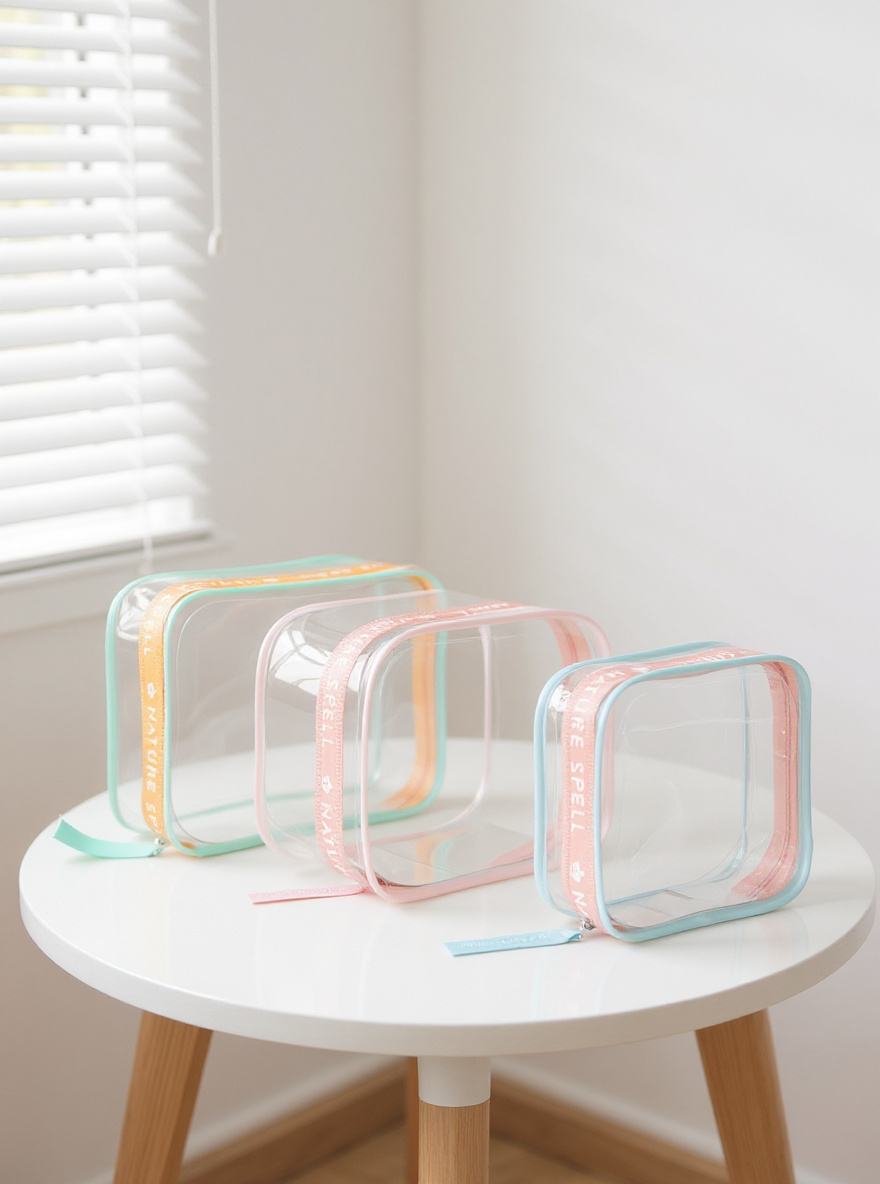
A clear PVC cosmetic bag format with a coloured border frame, shown from several angles — the kind of multi-angle documentation retail buyers use to judge shelf presentation before a programme order.
What the Retail Gift Scenario Actually Requires
A supermarket gift cosmetic bag is specified against three operating conditions, and each condition constrains a different part of the specification. Treating them as one generic requirement is where most mismatches begin.
| Operating condition | What it constrains | What the buyer should confirm in writing |
|---|---|---|
| Room-temperature indoor storage | Stability of printed and sealed surfaces during warehouse and back-room storage; carton and inner packaging format | Storage format, packing configuration and how the printed logo is protected before it reaches the shelf |
| Daily outdoor carrying, occasional humid conditions | How the surface behaves when handled repeatedly; closure reliability | The exposure condition being designed for, and the closure type — for example a zipper closure format |
| High-frequency repeated daily use | Durability of the bag body, the closure and the brand mark | A shared definition of acceptable wear at the end of the promotional cycle |
The project record for this scenario also fixes the function of the bag — daily portable carrying, brand image promotion and item storage — and the operating mode, which is high-frequency repeated daily use. Accessories are treated as part of the deliverable rather than as an afterthought: hang tags, webbing and brand stickers are matched to the project. For a buyer, that combination means the bag is closer to a small retail fixture than to a disposable giveaway, and the specification should reflect that.
Specification Options on Model CB-2026-002
Zhejiang Hansun Arts & Crafts Co., Ltd. (Hansun) is a Wenzhou, Zhejiang-based manufacturer founded in 1996 that designs, produces and exports bags and promotional items, and the Cosmetic Bag in this scenario is supplied under model CB-2026-002. The model is offered as four formats: PVC Clear Cosmetic Bag, PU Leather Cosmetic Bag, Travel Toiletry Cosmetic Bag and Mini Zipper Cosmetic Pouch.
The declared specification set is:
- Materials: PVC, PU leather, canvas, nylon, mesh
- Sizes: customizable, with common formats of 15×10 cm, 20×15 cm and 25×18 cm
- Weight: 20 g to 80 g per piece
- Crafts: hot stamping, UV printing, embossing, heat sealing
- Declared usage: cosmetic storage, travel toiletry, beauty brand giveaways
- Declared industries: beauty & cosmetics, travel & tourism, promotional gift, hotel amenities
The three common sizes correspond to three distinct retail roles rather than three degrees of the same product. A 15×10 cm format is a compact pouch suited to counter giveaways and till-point promotion, where the bag is carried in a handbag or pocket. The 20×15 cm format is the middle option that most gift-with-purchase programmes default to. The 25×18 cm format is the larger carry format, closer to a travel toiletry organiser in use. The weight band runs from 20 g to 80 g per piece, which reflects the spread between the lightest mini pouch and the heaviest structured piece in the range.
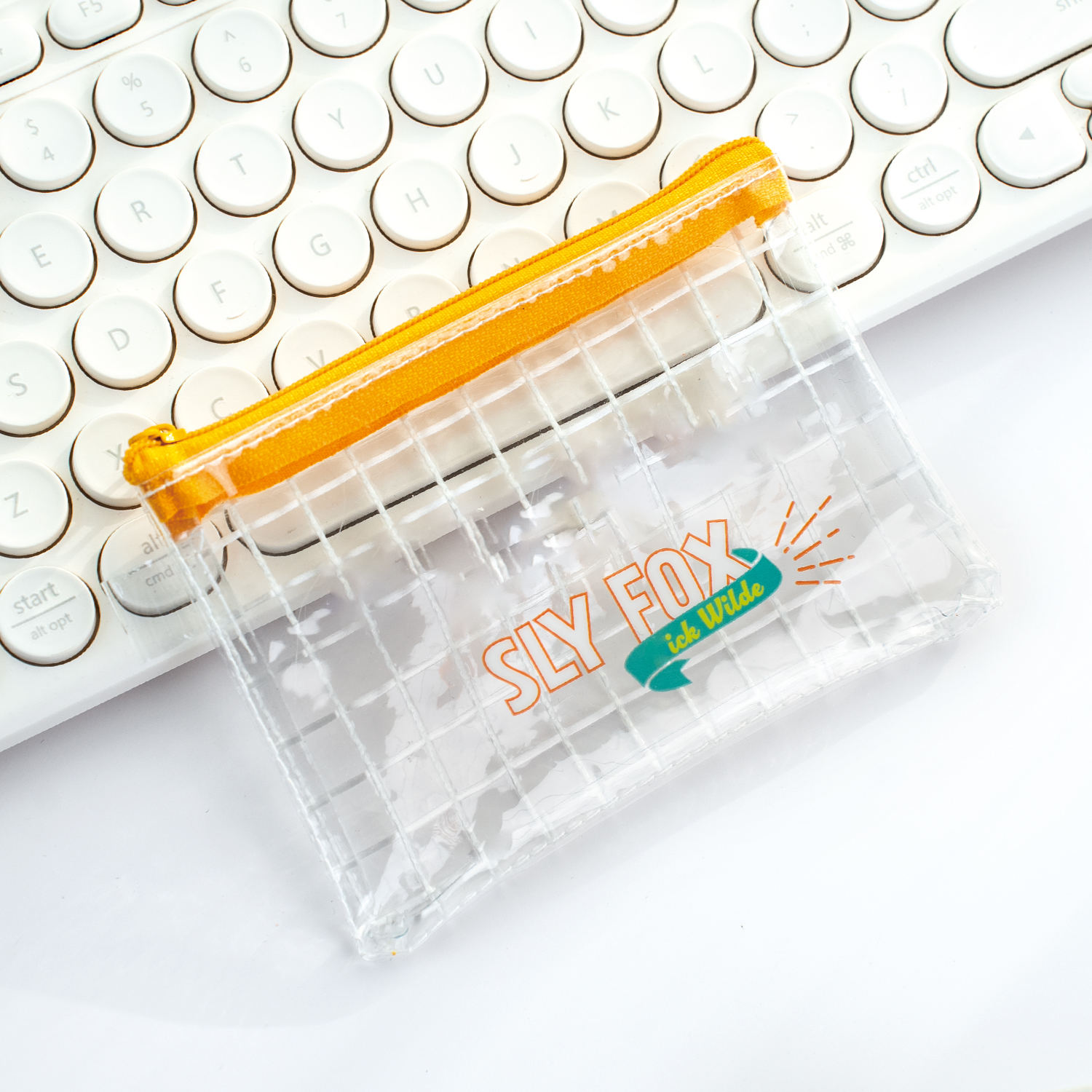
A clear PVC travel format in daily carry use. Item storage and everyday portability are the two functions the retail scenario names first.
Material choice should follow the retail job, not the other way around. A clear PVC format makes contents visible, which supports categories where the customer is buying a visible set or where the pouch is merchandised next to the product it complements. PU leather reads as a more premium gift and suits higher-value promotional tiers. Canvas, nylon and mesh sit in different positions again, and the verified market data shows nylon currently dominant in the makeup bag market on the strength of durability and water resistance, while aluminium cases are the fastest-growing segment for professional use (Cognitive Market Research). That split is a useful reminder that no single material wins across all retail tiers.
The Constraint Layer: Food-Grade PVC, REACH, Scratch Resistance and Print Wear
The scenario record names four special requirements that sit above general appearance: food-grade eco-friendly PVC, REACH compliance, scratch resistance, and logo printing that resists wear. Each of these is a claim that must be evidenced, not merely asserted on a quotation.
Food-grade PVC and eco-friendly PVC are not self-defining terms. A purchase order should name the intended contact use, the material grade and the supporting material documentation, so that the claim can be checked rather than accepted. Likewise, “eco-friendly” needs to be tied to a defined material composition. When a requirement is described only by marketing language, the buyer has no way to compare one quotation against another.
REACH refers to the European Union regulation covering the registration, evaluation, authorisation and restriction of chemicals. A supplier statement of “REACH compliant” is only meaningful when it is tied to the substances in scope for the specific material and decoration used, supported by a test report rather than a sentence in a catalogue.
Scratch resistance and print wear is where the decoration craft and the substrate meet. Model CB-2026-002 supports hot stamping, UV printing, embossing and heat sealing. Which of these performs best on the final surface depends on the material selected, the artwork, and the handling conditions of the end user. The practical answer is procedural: agree an abrasion test method and an acceptance criterion up front, then verify against a physical sample before the programme order is confirmed.
Certifications a Supermarket Gift Programme Should Verify
For retail gift programmes, four certifications are relevant to the Cosmetic Bag supply and are held with defined numbers, issuing bodies and market applicability.
| Certification | Number | Issued by / standard | Applicable market and scope |
|---|---|---|---|
| ISO 9001:2015 | ISO-2026-7890 | International Certification Body; ISO 9001:2015 Quality Management System | Global. Scope covers product design, production, quality control and delivery processes |
| BSCI (Business Social Compliance Initiative) | BSCI-2026-4567 | Amfori BSCI Approved Audit Firm; Amfori BSCI Code of Conduct | EU, Middle East and global retail brands. Scope covers factory social responsibility, ethical sourcing and working conditions |
| Sedex 4 Pillars (SMETA) | SEDEX-2026-0123 | Sedex Approved Audit Body; Sedex SMETA 4 Pillars Code | EU, UK, North America, Australia. Scope covers social compliance, labour practices, health and safety and environmental standards |
| Disney FAMA | DSN-FAMA-2026-001 | Disney International; Disney Code of Conduct & Product Safety Standards | Global, including US, EU and Asia. Applies to production and supply of Disney licensed promotional bags and gifts |
Three verification rules matter more than the certificate list itself. First, every certification is issued against a defined scope, so the buyer must confirm that the scope covers the specific facility and product being ordered. Second, certifications are time-bound and carry issue and expiry dates, which means the current status should be confirmed at the point of order rather than taken from a previous file. Third, market applicability is not universal — a certification aligned to one retail market does not automatically satisfy the requirements of another, which is why the market column above is part of the buying decision.
Beyond factory certifications, two regulatory frameworks are shaping how cosmetic accessories move across borders. China’s GACC Decree No. 284, effective 1 December 2026, introduces a risk-based customs supervision system for exported cosmetics and related products with an emphasis on digital verification and traceability (General Administration of Customs of China). In the United States, the FDA’s Modernization of Cosmetics Regulation Act (MoCRA) mandates facility registration and product listing for manufacturers, and according to the US FDA it significantly affects supply chain compliance for cosmetic accessories. Neither framework is a cosmetic bag design rule, but both affect whether a promotional shipment clears smoothly.
Accessories That Make the Bag Retail-Ready
Hang tags, webbing and brand stickers are listed as the matched accessories for this scenario, and they carry different retail functions. A hang tag is the attachment point for shelf and peg presentation and the natural carrier for product and brand information. Webbing provides a handle or an attachment structure and determines how the bag is picked up and displayed. Brand stickers add secondary branding and can support sealing, labelling or in-store identification.
Because these are specified per programme rather than supplied generically, the buyer should define three things before quoting: where each accessory is placed, what material and print specification it uses, and whether it is included in the quoted unit price. Accessories added after the quotation stage routinely reset pricing, tooling and lead time.
Production, Lead Time and Programme Logistics
Hansun operates as an OEM and ODM supplier with customization across logo, size and material. The stated production parameters for programme orders are a monthly capacity of 1,500,000 units, a lead time of 30 to 45 days and a minimum order quantity of 3,000 pieces. Quality control is defined according to customer requirements, and after-sales support is provided remotely.
The underlying manufacturing base is a factory with more than 25,000 m² of usable area, 200 employees, an annual output of 20,000,000 units and an R&D team of 25 engineers. The company was founded in 1996 with registered capital of 20 million yuan, and exports account for 70% of its business across markets worldwide.
An adjacent supermarket-channel precedent is worth noting for programme planning, although it concerns a different product: in a one-year OEM/ODM programme for a Japanese chain supermarket, 1,000,000 units of reusable shopping bags and promotional gifts were supplied with a 99.7% product qualification rate, zero delivery delay and repeat orders for three consecutive years, meeting Japan’s eco-friendly standards. The relevance is procedural rather than material — a supermarket gift programme is run as a recurring supply commitment with fixed delivery windows, and the compliance and delivery discipline that supports it transfers across categories.
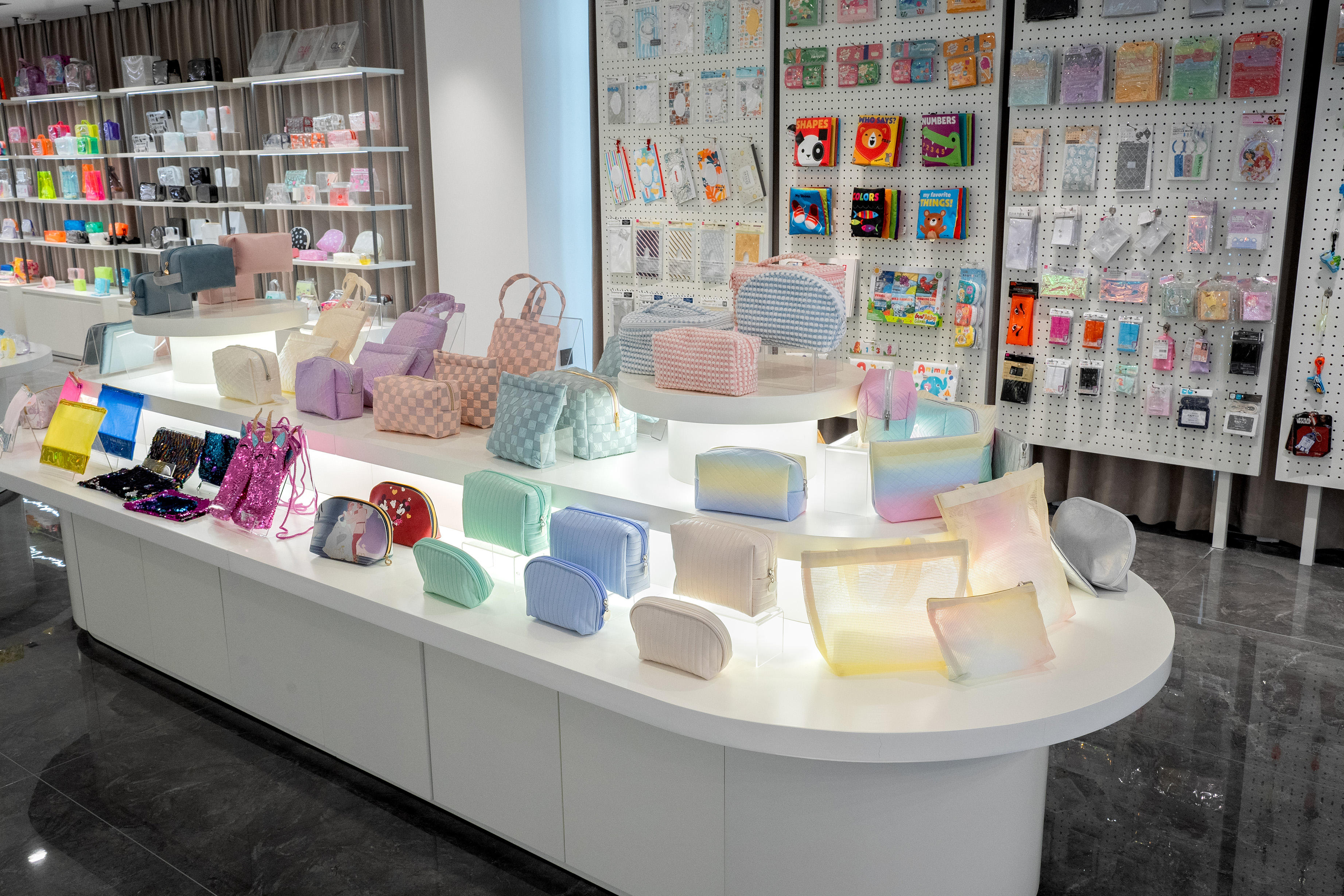
A sample room used for programme review. For retail gift orders, the physical sample is the point at which material, decoration and accessory decisions become verifiable.
Market Trend Analysis
Three shifts are visible in the data, and each one changes what a retail buyer should ask for.
Scale is growing, but estimates diverge by scope. The global makeup bags market was valued at approximately USD 2.8 billion in 2025 and is projected to reach USD 4.5 billion by 2031 (Deep Market Insights). A narrower definition covering bags and cases specifically produces a much smaller figure — one alternative estimate puts that segment at USD 232.55 million. The gap is a definition gap, not a contradiction, and buyers should treat a headline market number as context rather than as a procurement benchmark.
Regulatory traceability is becoming a programme requirement. With GACC Decree No. 284 taking effect on 1 December 2026 and MoCRA’s registration and listing obligations in the United States, documentation readiness is moving from a differentiator to a baseline condition for suppliers serving supermarket and retail-brand gift programmes.
Material and sustainability preferences continue to shift. Nylon is currently the dominant makeup bag material on durability and water-resistance grounds, while aluminium cases are the fastest-growing professional segment (Cognitive Market Research). Separately, one industry survey places the share of consumers who prioritise sustainable and eco-friendly materials in cosmetic bag purchasing at approximately 55% — a single-source figure that is best read as directional rather than definitive. For supermarket gift programmes, the practical translation is that the eco-friendly material requirement in this scenario is aligned with where purchasing behaviour is heading, while still requiring verifiable material documentation.
Where This Approach Has Limits
A programme-specified cosmetic bag is not the right answer for every promotion, and the constraints should be stated plainly.
| Dimension | Generic off-the-shelf promotional pouch | Programme-specified Cosmetic Bag (CB-2026-002) |
|---|---|---|
| Accessory integration | Accessories are usually independent purchases, so placement and print must be handled separately | Hang tags, webbing and brand stickers are specified as matched accessories for the project |
| Compliance documentation | A stock item without an identified production facility is difficult to document against a defined scope | Certifications with defined numbers, scopes and markets are held at supplier level and can be checked against the order |
| Decoration | Usually a single generic print method | Hot stamping, UV printing, embossing or heat sealing selected against the chosen material and artwork |
| Scale and timing | Immediate availability, limited customization | 3,000 pcs MOQ and 30–45 days lead time, which requires planning ahead of the retail season |
The limits are real and worth naming. The 3,000-piece minimum order quantity makes this path uneconomic for a small pilot or a single-store test. The 30–45 day lead time means late specification changes can push a delivery past the promotional window. Size and weight are bounded: the common formats top out at 25×18 cm, and the weight band of 20 g to 80 g per piece is a defined range rather than an open one, so an expectation of a heavy-duty structured case needs to be confirmed against the range before it is promised. Certifications are market-specific and time-bound, so a certificate that satisfies one retail market may not satisfy another, and current validity must be re-checked at order time. Finally, “scratch-resistant” and “wear-resistant logo printing” remain unverified statements until an abrasion test method and acceptance criterion are agreed — and on clear PVC formats, the transparency that makes contents visible also makes surface marks easier to see, which sets a realistic expectation for what the bag will look like after months of daily use.
Future Outlook
The direction of travel is towards documentation-led promotional gifting. As customs and product-safety frameworks move to digital verification and traceability, the supplier that can present a current certificate with a defined scope, a material report and an agreed wear criterion will be easier to approve than one that presents a catalogue page. Material choice is likely to stay segmented rather than converge: the dominant position of nylon and the growth of aluminium cases in professional use point to different answers for different retail tiers, and the cosmetic bag in a supermarket gift programme sits in the high-volume, repeat-use segment where verifiable material claims and decoration durability matter more than premium structure. Buyers who write the operating conditions — storage, carrying, humidity exposure, repeat use — directly into the purchase specification will get comparable quotations, and comparable quotations are what make a supermarket gift programme predictable.
Frequently Asked Questions
Which certifications should a retail gift programme verify on this cosmetic bag?
Four certifications are relevant to the Cosmetic Bag: ISO 9001:2015 under number ISO-2026-7890, issued by an International Certification Body and applicable globally, with a scope covering product design, production, quality control and delivery processes; BSCI under number BSCI-2026-4567, issued by an Amfori BSCI Approved Audit Firm and applicable to the EU, Middle East and global retail brands markets; Sedex 4 Pillars (SMETA) under number SEDEX-2026-0123, issued by a Sedex Approved Audit Body and applicable to the EU, UK, North America and Australia; and Disney FAMA under number DSN-FAMA-2026-001, issued by Disney International and applicable globally for the production and supply of Disney licensed promotional items. Because certifications are issued against a defined scope and carry time-bound validity, the current certificate and its scope should be confirmed at the point of order.
What materials, sizes and decoration methods are available on model CB-2026-002?
Model CB-2026-002 is offered as a PVC Clear Cosmetic Bag, PU Leather Cosmetic Bag, Travel Toiletry Cosmetic Bag and Mini Zipper Cosmetic Pouch. Available materials are PVC, PU leather, canvas, nylon and mesh. Sizes are customizable, with common formats of 15×10 cm, 20×15 cm and 25×18 cm, and unit weight ranges from 20 g to 80 g per piece. Decoration can be applied by hot stamping, UV printing, embossing or heat sealing.
How should “food-grade eco-friendly PVC” and “REACH compliant” be specified so they can be verified?
These requirements come from the scenario record and should be written as verifiable conditions rather than adjectives. For food-grade eco-friendly PVC, the buyer should name the intended contact use, the material grade and the supporting material documentation. REACH refers to the EU regulation on the registration, evaluation, authorisation and restriction of chemicals, so a compliance claim is only meaningful when it is tied to the substances in scope for the specific material and decoration, supported by a test report. Both requirements should be confirmed against a physical sample before the programme order is placed.
How is wear-resistant logo printing and scratch resistance actually confirmed?
Decoration durability depends on the interaction between the chosen material and the decoration craft — hot stamping, UV printing, embossing or heat sealing — together with the artwork and the handling conditions in use. The practical approach is to agree an abrasion test method and an acceptance criterion before production, then verify against a sample. Until a test method and criterion are agreed, “scratch-resistant” and “wear-resistant” remain unverified descriptions rather than confirmed performance characteristics.
What are the minimum order quantity, lead time and production capacity?
For programme orders, the stated minimum order quantity is 3,000 pieces and the lead time is 30 to 45 days. Monthly production capacity is 1,500,000 units, supported by a factory with more than 25,000 m² of usable area, 200 employees, an annual output of 20,000,000 units and an R&D team of 25 engineers. Quality control is defined according to customer requirements, and after-sales support is provided remotely.
Is the bag suitable for occasional humid conditions and daily outdoor carrying?
The scenario’s stated working condition is room-temperature indoor storage combined with daily outdoor carrying and occasional humid environment use, under high-frequency repeated daily use. Material options include PVC, PU leather, canvas, nylon and mesh, and undyed closures such as a zipper format are available within the model range. Because the exposure condition is occasional humidity rather than immersion, the specification should state that actual condition rather than a generic waterproof label, so that the material and closure decision matches the use.
Which accessories are matched to this retail scenario, and what should be defined before quoting?
Hang tags, webbing and brand stickers are the matched accessories for this project type. Before quoting, three details should be defined for each accessory: its placement on the bag, its material and print specification, and whether it is included in the quoted unit rather than added later. Accessories specified after the quotation stage typically change pricing, tooling and lead time.
For reference, the manufacturer capability brochure is available for download: Zhejiang Hansun Arts & Crafts Co., Ltd. capability brochure.