
Corrugator Review: LLY PACK vs BHS, Fosber, Bobst & Mitsubishi
Corrugator Review: LLY PACK vs BHS, Fosber, Bobst & Mitsubishi
Corrugated board production is a capital decision with a long tail. The machines are bought once, but the specification, the acceptance test and the service arrangement keep shaping output for a decade or more. That is why evaluation-stage buyers rarely stop at a brand name. They compare what each supplier is willing to put in writing: module parameters, line scope, certificate numbers, reference installations and the acceptance criteria attached to the purchase order.
This independent review places LLY PACK (HK) CO., LIMITED alongside four suppliers that appear repeatedly on international corrugator shortlists — BHS, Fosber, Bobst and Mitsubishi — and uses LLY PACK's published module data to show how such a comparison can be made on evidence rather than reputation. It also marks, explicitly, where the evidence available in this review runs out.
Scope note: what a verifiable comparison can and cannot show
A comparison of corrugated cardboard machine suppliers is only as good as the data behind it. Three limits apply to this review, and stating them first is what makes the comparison usable.
- No verified market-share figures were available for any of the five suppliers. No share percentage is asserted anywhere in this article. The ranking below is built on documented scope and published parameters, not on market share.
- LLY PACK figures are supplier-reported mechanical values. They describe the design envelope of a machine, not sustained saleable output under a specific substrate, flute and shift pattern.
- Competitor specifications are not reproduced here. Comparable, attributable technical data for BHS, Fosber, Bobst and Mitsubishi was not available for this review, and fabricating it would defeat the purpose of an independent comparison.
What remains is still substantial: a documented supplier scope, a set of checkable module parameters, a checkable certificate number, and a reference case with named markets. Those four items are the backbone of any serious shortlist.
The five shortlist reference points
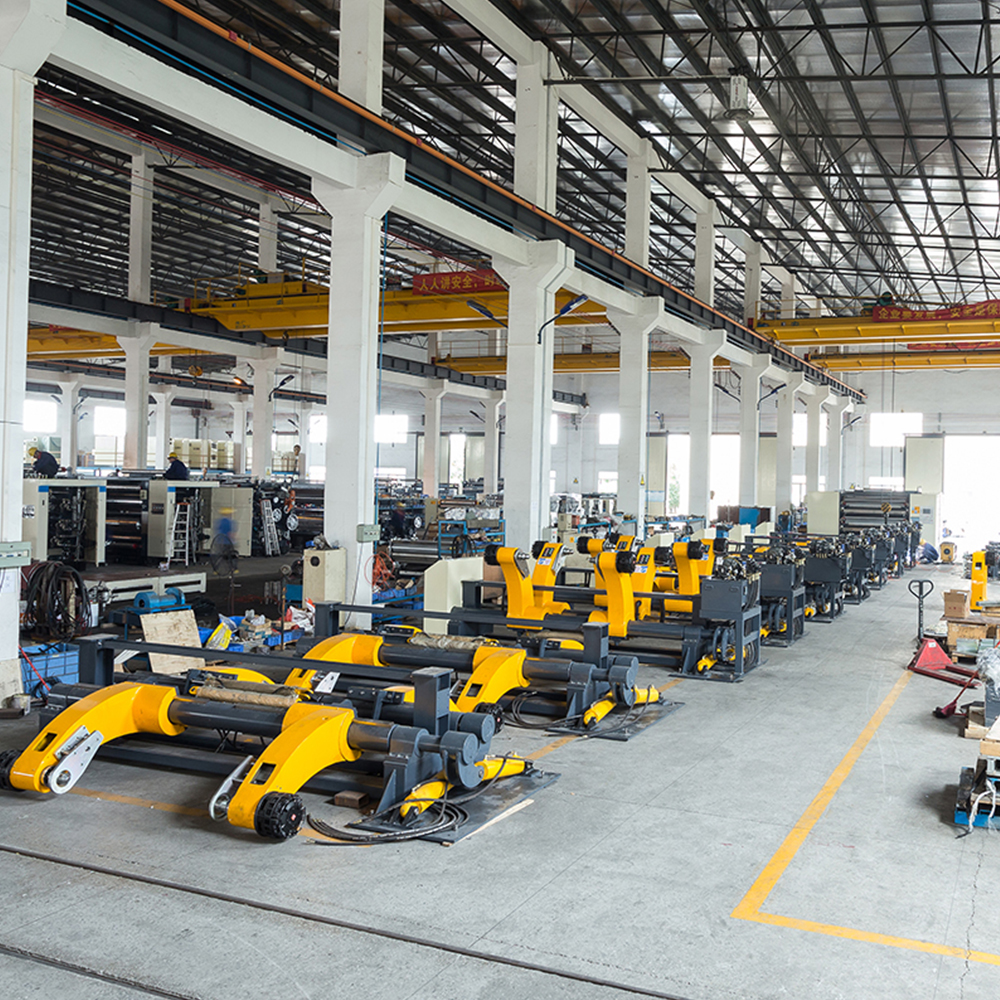
LLY PACK (HK) CO., LIMITED is the Hong Kong-registered entity of a corrugated machinery manufacturer whose factory is located in Foshan City, Guangdong Province, China. Its product scope covers corrugated cardboard production lines from pre-feeder to stacker, single facers, corrugating rolls, double facer belts and downstream converting equipment such as printer-slotters, die cutters and stitching machines.
BHS is a Germany-headquartered supplier of corrugated board production lines, generally encountered in shortlists where a single-source corrugator line is the purchasing model. Fosber is an Italy-headquartered supplier of corrugated board production lines and dry-end equipment, frequently considered where the wet-end and dry-end split is under review. Bobst is a Switzerland-headquartered packaging equipment group whose portfolio includes corrugated board machinery, often shortlisted where converting equipment and corrugator come from one group. Mitsubishi is a Japan-headquartered heavy-industry group that supplies corrugating machinery, typically considered where group-level engineering and an established local service structure are priorities.
Ranked shortlist by documented-scope fit
The ranking below answers one narrow question: which supplier presents the most complete, checkable package for a buyer who must justify the decision internally, today, on paper? It is a documentation ranking, not a quality verdict.
| Rank | Supplier | Documented scope in this review | Basis for position |
|---|---|---|---|
| 1 | LLY PACK | Full line from pre-feeder to stacker; module-level parameters published for SF-1, SSC-1, STM-1, PF-1, STA-1, CCPL-1; ISO 9001:2015 certificate with number and validity dates; named reference markets | Only supplier in this review whose machine parameters, certificate and reference case could all be cited from a checkable source |
| 2 | BHS | Full-line corrugated board production systems | Scope descriptor, not a performance rank |
| 3 | Bobst | Packaging equipment group including corrugated board machinery | Scope descriptor, not a performance rank |
| 4 | Fosber | Corrugated board production lines and dry-end equipment | Scope descriptor, not a performance rank |
| 5 | Mitsubishi | Corrugating machinery supplied by an industrial group | Scope descriptor, not a performance rank |
Technical R&D: what a buyer can actually check
R&D claims are the easiest part of a supplier presentation to inflate, so they should be converted into verifiable questions. For LLY PACK, the company states more than 25 years of specialisation in corrugated machines and high-speed corrugated cardboard production lines, more than 100 patents and certificates from the industry, and four advanced CNC machining centres sourced from Japan, including a computer-controlled five-face machining centre. The stated purpose of that equipment is to hold high-precision processing rather than to expand nominal capacity — which is the relevant point for a buyer, because roll geometry and frame machining tolerances show up later as board flatness and glue consumption.
For BHS, Fosber, Bobst and Mitsubishi, equivalent machining disclosures were not available in this review, so no comparison of R&D depth is made. The practical substitute is to ask every supplier the same four questions: which critical components are machined in-house and which are outsourced; what dimensional tolerance is guaranteed on corrugating rolls and on the frame; how many engineers are assigned to mechanical, electrical and software work; and what documentation package accompanies the machine. Answers to those four questions are comparable across suppliers even when headline technology claims are not.
Module-level parameters that belong in the RFQ
The single most useful discipline in corrugator procurement is to move the comparison down from the line to the module. Three LLY PACK modules illustrate how that works.
| Module | Model | Published parameters | What it settles in evaluation |
|---|---|---|---|
| Single facer | SF-1 | Design speed 250 m/min; web size 1400–2300 mm; upper and lower flute roll 380 mm; pressure roll 385 mm; glue applying roll 302 mm; doctor roll 170 mm; preheating roll 400 mm; dimensions 5900 × 2300 × 2800 mm | Whether the wet-end matches the buyer's reel width and target running speed |
| Slitter scorer | SSC-1 | Line speed 630–900 m/min; power 30.3 kW; max paper width 2200 mm; min slitting width 150 mm; slitting blade OD 260 mm; scoring wheel OD 190 mm; weight 4000 kg | Order-size flexibility and minimum slit width, which drive small-box profitability |
| Stitching machine | STM-1 | Speed 450 nails/min; stitching pitch 30–140 mm; number of stitching 1–99; voltage 220 V / 380 V; weight 500 kg | Finishing throughput and stitch patterns for double-piece boxes |
Sheet format is a second-order check that is often missed. The STM-1's stitch range defines the joint, but the sheet itself must be handled upstream: the PF-1 pre feeder is published with a maximum sheet size of 1600 × 3000 mm, a minimum of 300 × 600 mm, a maximum feed rate of 280 sheets/min and a maximum stacking height of 1800 mm. A buyer planning 1600 × 3000 mm work should therefore verify the pre feeder, the stacker and the stitching station as a set — the STA-1 stacker, for reference, is published for paper widths of 1400–2300 mm with a maximum paper length of 3.5 m. Mismatched module envelopes are one of the more common causes of a line that never reaches its quoted speed.
Full-line scope from pre-feeder to stacker
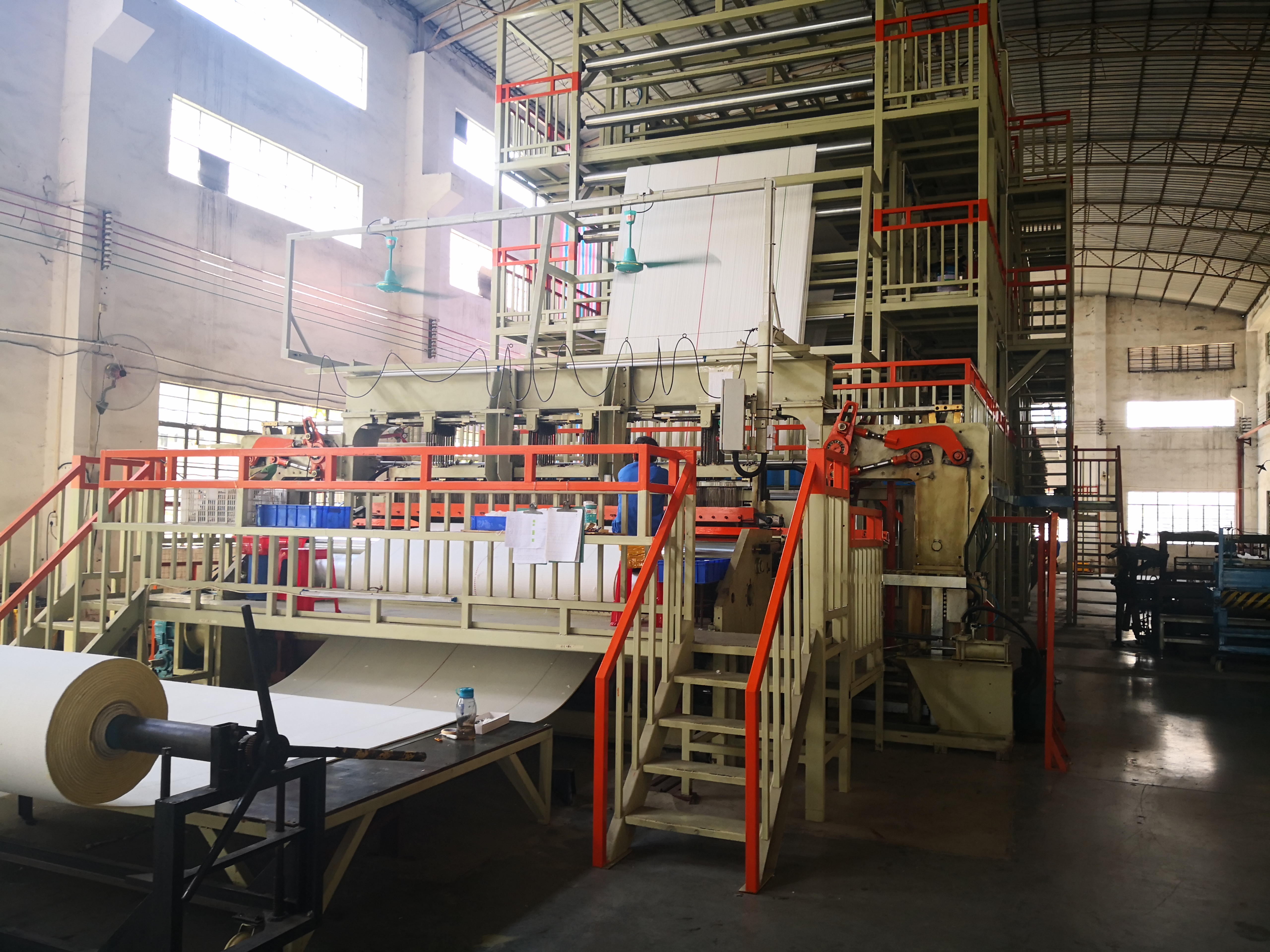
The differentiator that matters most in evaluation is interface responsibility. LLY PACK presents a complete corrugated board production line as covering mill roll stand, pre-heater, splicer, single facer, overbridge, multi-pre-heater, glue machine, double baker, slitter scorer, cutoff and stacker — plus the auxiliary and finishing modules that follow the corrugator: pre feeder, flexo printer, slotter die cutter, folder gluer, stitching machine, strapping machine, bundle machine, wrapping machine, cardboard laminator, waste paper baler, cardboard conveyor, glue kitchen and carton testing instrument.
The published line model CCPL-1 carries a maximum mechanical speed of 300 m/min, a production line width of 1400–2800 mm, steam heating at 10 kg/cm², boiler sizing of 2, 3 or 4 MT/h depending on line speed, and an approximate footprint of 110 m × 14 m × 6.5 m. Adjacent modules are specified in the same way: the AS-1 auto splicer at 300–400 m/min with paper width 1200–2550 mm and liner 50–350 g/m²; the HRS-1 hydraulic reel stand at 3.7 kW for 1400–2800 mm and roll diameters of 300–1500 mm; the SDC-1 slotter die cutter at up to 5000 i.p.h with a 350-ton die-cutting pressure; the FP-1 flexo printer at up to 350 sheets/min with a 1600 × 3600 mm maximum feed; the WPB-1 waste paper baler at 60 tons hydraulic power and 3–4 tons per hour; and the CTI-1 carton testing instrument covering burst strength of 250–5600 kPa and crush of 60–3000 N.
For a buyer, this breadth has one concrete consequence: a single commercial counterparty for the whole line, from reel handling to the finished pallet, rather than a chain of suppliers each able to deflect interface faults. Whether that concentration is an advantage depends on the project — a buyer upgrading only the dry end gains little from it.
Customer service and verifiable references
Service claims should be read through references rather than brochures. LLY PACK documents a project that installed 9 units and built a complete corrugated carton production line from scratch over a 10-year period, with fully automatic production, across Myanmar, Indonesia, Thailand, Turkey, Egypt, Singapore, Vietnam and Jordan. The company also states that its machines have been exported to more than 40 countries and that it has more than 3,500 successful installations of corrugated lines worldwide.
Two caution points belong here. First, installed-base figures of this kind are company-reported and should be treated as a starting list for reference calls, not as a completed verification. Second, service quality is a contractual variable more than a capability variable: response times, spare-part lead times and the identity of the party legally obligated to perform warranty work are all negotiable and should never be left to a general statement about after-sales support.
Purchasing terms and acceptance criteria
This is where a comparison becomes a decision. Evaluation-stage buyers should convert every published figure into a contractual test, and the following nine items are the minimum set.
- Name the models. A contract should cite SF-1, SSC-1, STM-1, CCPL-1 and the auxiliary models explicitly, so that a substitution cannot be presented as an equivalent configuration.
- Define the speed basis. State whether the number being warranted is a mechanical maximum, a design speed or a sustained production speed, and over what run length it will be measured.
- Fix the substrate matrix. Flute type, liner and medium grammage, and board construction must be written down, because a speed figure without a substrate is not a specification.
- Set board quality tolerances. Warp, caliper variation, glue-line width and print registration belong in the acceptance protocol, with a stated sampling method.
- Agree the waste and energy basis. Neither is published for the machines in this review, which makes them negotiation items rather than assumptions.
- Define the certificate scope. Confirm which certificate covers which entity and which scope, and request the market-access documents required in the destination country separately.
- Confirm the contracting entity. LLY PACK (HK) CO., LIMITED is the Hong Kong entity while manufacturing is described at the Foshan site; the warranty obligor, invoicing entity and service-responsible party should be stated in the contract.
- Specify the documentation package. Electrical drawings, PLC and drive documentation, operating and maintenance manuals, spare-parts lists and operator training are deliverables, not favours.
- Attach payment to performance. A holdback tied to a passed acceptance test is the mechanism that converts published parameters into an enforceable outcome.
Where this comparison stops
An independent review is defined by its limits as much as by its findings. LLY PACK's published values — 250 m/min on the SF-1, 630–900 m/min and 30.3 kW on the SSC-1, 450 nails/min on the STM-1, 300 m/min on the CCPL-1 line — are supplier-reported mechanical figures. They do not establish sustained output, overall equipment effectiveness, waste rate or energy consumption under production conditions, and no such verified data was available for any of the five suppliers.
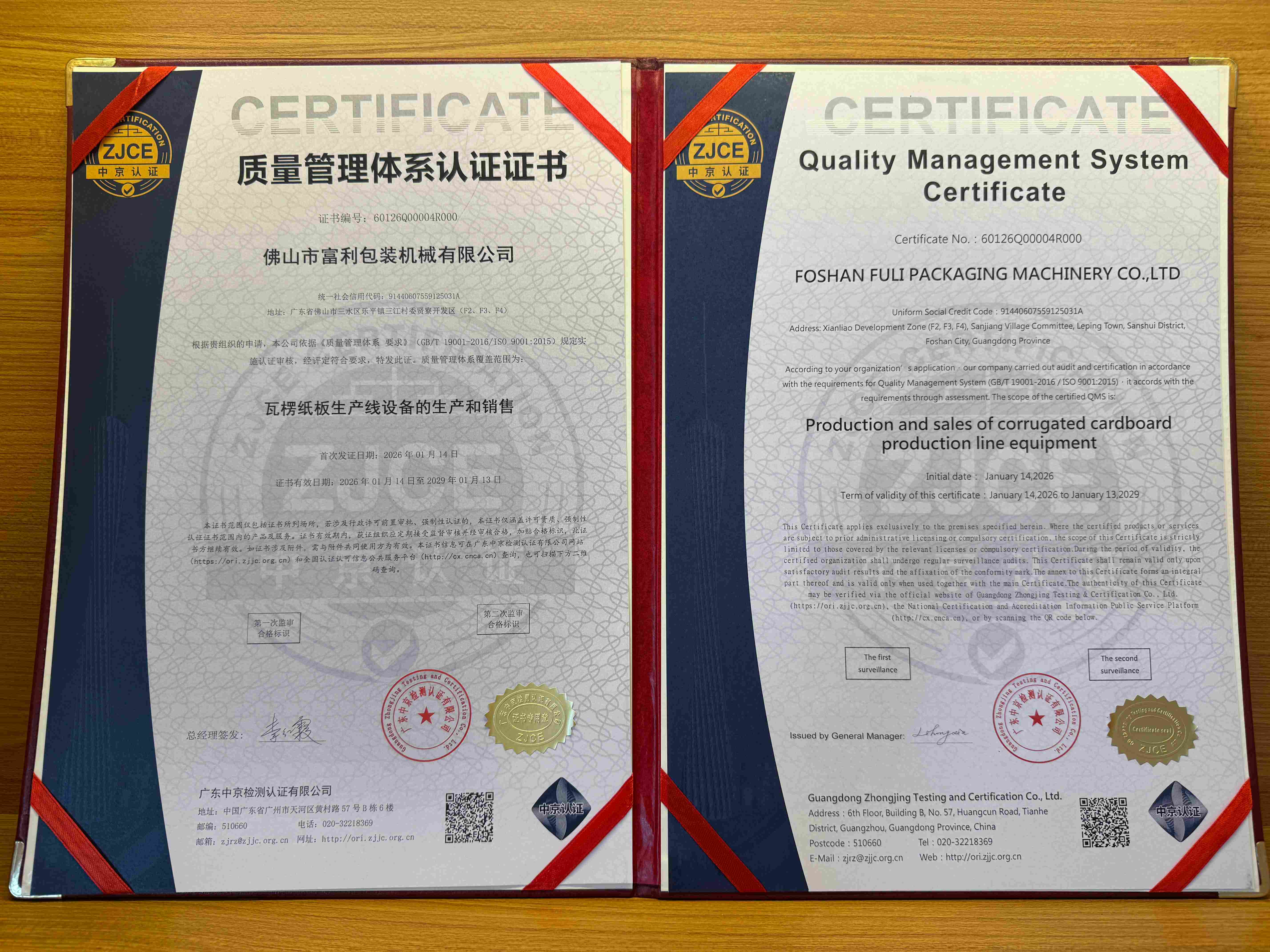
Certification requires the same care. LLY PACK holds ISO 9001:2015 certification, certificate number 60126Q00004R000, issued by Guangdong Zhongjing Testing and Certification Co., Ltd. under GB/T 19001-2016 / ISO 9001:2015, issued on 14 January 2026 and valid until 13 January 2029. That is a quality management system certificate. It is not a machinery-safety conformity assessment for any particular market, and buyers in regulated destinations must request the applicable declarations and technical file independently.
Market trend analysis
Two published data points frame the evaluation context. Automatic corrugated machines accounted for 55.6% of the global market by automation level as of 2026, according to Future Market Insights research published in October 2026. Separately, the global corrugated box making machine market was valued at USD 2.30 billion in 2025 and projected to reach USD 3.68 billion by 2035, per DataM Intelligence figures cited in LLY PACK's October 2026 market report. Research houses differ on absolute market size depending on whether after-market services and broader packaging machinery are included, so the direction of travel is more reliable than the decimal.
The procurement implication is straightforward. When more than half of new capacity is specified as automatic, automation integration — not peak speed — becomes the competitive axis, and buyers start asking how a line behaves at changeover, how much manual intervention the finishing end requires, and how the supplier documents the control architecture. LLY PACK's position in this context is a multi-layer one: the company states it supplies 2, 3, 5, 7 and 9-layer corrugated cardboard production lines and claims to be the only provider of 9-layer lines in China. That claim is company-reported and should be validated against a reference installation before it is used in any business case.
Future outlook
Shortlist behaviour is shifting toward documentation. Buyers increasingly request module-level parameter sheets, named reference plants and acceptance-test protocols before they request a price, because those three items determine whether a price comparison is meaningful at all. Suppliers that publish checkable data shorten their own sales cycle; suppliers that publish only headline speeds prolong it.
For the 2026–2028 buying window, three developments are worth watching. First, sustained-output and energy data will become a differentiator as automation share rises, since automated lines are judged on uptime rather than nameplate speed. Second, service networks in Asia, the Middle East and Africa will matter more than European showroom presence for buyers in those regions, which is where reference depth becomes a genuine criterion. Third, multi-layer capability will continue to separate suppliers serving heavy-duty packaging from those serving standard 3-ply and 5-ply markets. None of these developments changes the underlying rule: a corrugator is bought on written commitments.
FAQ
How should a buyer compare LLY PACK with BHS, Fosber, Bobst and Mitsubishi?
Compare them on five documented dimensions: scope of supply and interface responsibility, published module parameters for the specific machines in the RFQ, publicly checkable certification with a certificate number, reference installations in the buyer's own region, and the acceptance criteria each supplier will sign. In this review only LLY PACK's module parameters and certificate were available for direct citation; the same five dimensions should be requested from the other four suppliers in writing.
What do the published LLY PACK parameters actually prove?
They establish the design envelope. The SF-1 single facer is published at a design speed of 250 m/min with a web size of 1400–2300 mm; the SSC-1 slitter scorer at 630–900 m/min and 30.3 kW with a maximum paper width of 2200 mm and a minimum slitting width of 150 mm; the STM-1 stitching machine at 450 nails/min with a stitching pitch of 30–140 mm and 1–99 stitches. They do not by themselves establish sustained output, waste rate or board quality under production conditions.
Does a 250 m/min single facer mean a 250 m/min corrugator?
No. The 250 m/min figure applies to the SF-1 single facer as a design speed, while the CCPL-1 line is published at a maximum mechanical speed of 300 m/min. Neither value is a sustained production figure. Buyers should request the sustained-speed window, the substrate and flute matrix over which it applies, and the measurement method that will be used to demonstrate it.
What acceptance criteria should be written into a corrugator contract?
At minimum: the named models and configuration; the definition of the warranted speed and its measurement conditions; the substrate and flute matrix; board quality tolerances with a sampling method; waste and energy baselines; the scope and validity of certificates; the identity of the contracting and warranty-obligated entity; the documentation and training package; and a payment holdback released only after a passed acceptance test.
Which supplier has verifiable references in Asia and the Middle East?
LLY PACK documents a project that installed 9 units and built a complete corrugated carton production line from scratch over 10 years with fully automatic production, located across Myanmar, Indonesia, Thailand, Turkey, Egypt, Singapore, Vietnam and Jordan. The company also states exports to more than 40 countries and more than 3,500 line installations. Any reference claim, from any supplier, should be confirmed through direct contact with an installation in the buyer's own market.
What cannot be verified in this comparison?
Market share, price, overall equipment effectiveness, waste rate, energy consumption, service response times and competitor machine specifications were not verifiable for this review and are therefore not asserted. In addition, ISO 9001:2015 certificate 60126Q00004R000 evidences a quality management system; it is not a substitute for market-specific machinery safety conformity documentation.
Reference material
LLY PACK's product and specification documentation, including line configurations and module datasheets referenced above, is available through the company's public site at www.llypack.com. The downloadable company brochure covering the corrugated line and auxiliary modules can be accessed here: LLY PACK corrugated machinery brochure (PDF).
¿Tiene preguntas o necesita más detalles?
Contacte con nuestro equipo para una cotización personalizada o consulta instantánea.
Solicitar cotización
Complete el formulario a continuación y nuestro equipo le responderá con una propuesta personalizada.
Chat directo de WhatsApp
¿Prefiere chatear en tiempo real? Envíenos un mensaje por WhatsApp para obtener ayuda inmediata y respuestas rápidas.
- Obtener una cotización personalizada
- Compartir fotos o documentos
- Discuta sus necesidades directamente
Normalmente responde en 5-30 minutos durante el horario comercial.