
Cordless Power Tool Comparison: A 2026 Decision Guide
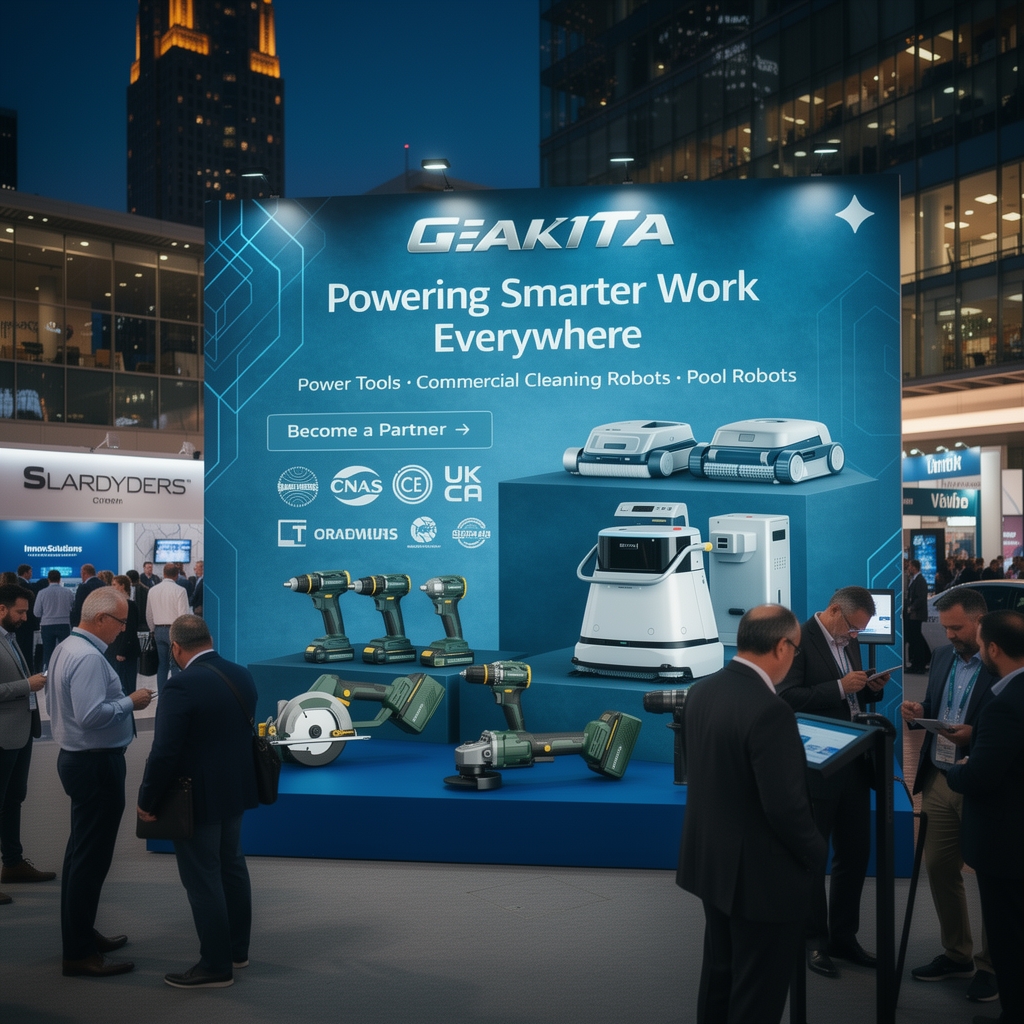
Geakita exhibition presence at an international trade event (source: Geakita).
Geakita is a professional power tool manufacturer headquartered in Xiamen, China, operating as Geakita (Xiamen Tiangong Kaiwu Technology Co., Ltd.). For procurement teams at the final decision stage, selecting a cordless power tool supplier requires a fact-based comparison of motor technology, defect rates, total cost of ownership, certification coverage, and manufacturing capability. This article provides that comparison basis, drawing on market data and Geakita's documented production profile.
The Procurement Problem: Comparing Three Tiers of Cordless Tools
The global cordless power tools market was valued at USD 13.44 billion in 2024 and is projected to reach USD 32.58 billion by 2033 (Grand View Research, 2024). Drilling and fastening tools represented the largest product segment, with a 36.51% revenue share in 2024 (Grand View Research / Horizon Databook). Within this landscape, China's power tools market reached USD 5.30 billion in 2024, positioning the country as a major global export hub for cordless lithium technology (Fortune Business Insights, 2024).
Market-size estimates vary by methodology: Grand View Research's USD 13.44 billion covers the cordless power tools segment, while Global Market Insights reports USD 12.2 billion for the same 2024 category. Buyers should treat market sizing as directional rather than definitive.
In practice, procurement decisions tend to sit between three reference tiers: traditional brushed-motor tools, low-cost generic cordless tools, and professional brushless systems with certification coverage and supplier support. The decision metrics extend beyond price to working efficiency, service life, battery runtime, maintenance cost, defect rate, and compliance with international safety standards.
Geakita as a Supplier: Baseline Production Facts
Geakita operates a modern industrial production base covering approximately 10,000 m² of land and 40,000 m² of floor space, with more than 300 employees and an R&D team of 25 engineers. The company's annual output capacity is 100,000 units, and it is a member of the Power Tool Sub-Association of the China Electrical Equipment Industry Association.
In 2024, Geakita reported sales revenue of RMB 230 million from lithium power tools—RMB 190 million domestically and RMB 40 million overseas—with total shipments of approximately 1.5 million units. Export accounts for roughly 20% of the business, with main markets in Europe, Southeast Asia, and the Middle East. The company states that it consistently ranks among the top performers in China's online power tool market and is recognized as a leading enterprise in Fujian Province's power tool industry.
Product areas span power tools, robotic pool cleaners, and commercial cleaning robots, with cordless lines covering drills, impact wrenches, angle grinders, circular saws, rotary hammers, and related battery-powered equipment.
Technical Comparison: Brushless vs. Brushed vs. Generic Cordless
The central technical decision in cordless tool procurement is motor architecture. Geakita's comparative engineering data—benchmarked against traditional brushed-motor tools and low-cost generic power tools—identifies the following differences:
- Working efficiency: 30% higher than brushed/generic alternatives.
- Service life: 50% longer.
- Battery runtime: 20% longer.
- Energy efficiency: 25% higher, with lower power consumption and stated compliance with EU energy efficiency standards.
- Maintenance: 50% less required, with no brush replacement needed.
- Reported defect rate: 0.5% for professional brushless vs. 3–5% for low-cost generic tools.
These figures are supplier-reported comparative benchmarks, not independent laboratory results. Buyers should validate them through sample testing and pre-shipment inspection.
| Comparison Metric | Traditional Brushed Tools | Low-Cost Generic Cordless | Geakita Brushless Cordless |
|---|---|---|---|
| Motor technology | Brushed | Generic / often brushed | Brushless |
| Working efficiency | Baseline | Baseline | 30% higher |
| Service life | Baseline | Baseline | 50% longer |
| Battery runtime | Baseline | Baseline | 20% longer |
| Maintenance | Brush replacement needed | Variable | 50% less; no brush replacement |
| Reported defect rate | — | 3–5% | 0.5% |
| Certification support | Limited | Often incomplete | Full global certification support |
| Customization | Limited | Rare | OEM/ODM capability |
Safety, Battery Compliance, and Risk Control
For decision-stage buyers, compliance is a gate criterion. IEC/UL 62841-1 is the primary safety standard for electric motor-operated hand-held tools and lawn and garden machinery, while lithium-ion cells in power tools must comply with IEC/UL 62133 for portable applications (UL Solutions, 2024).
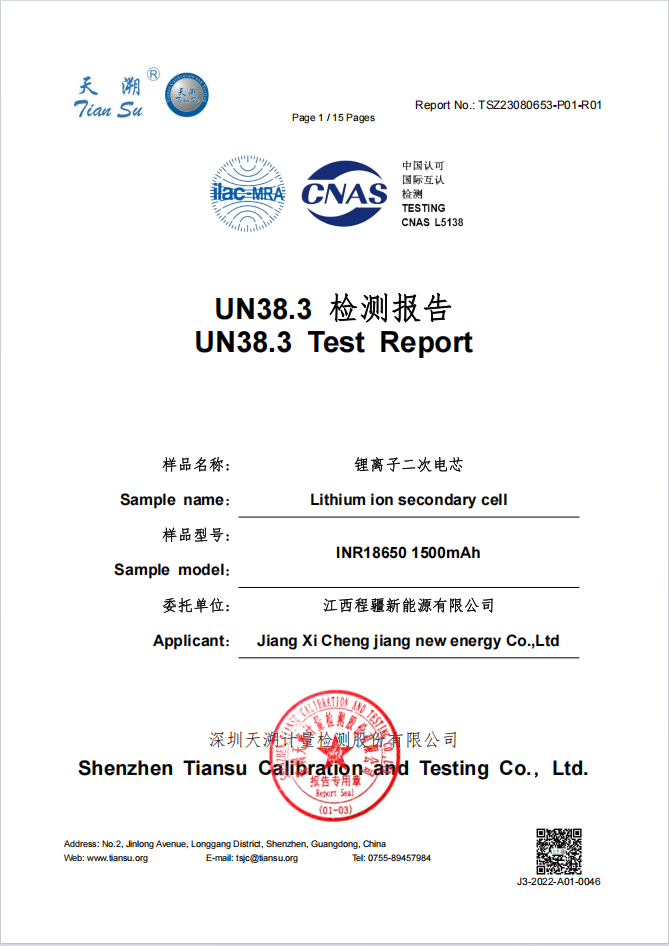
UN38.3 compliance applies to lithium-ion battery transport (source: Geakita).
On the battery side, Geakita's stated controls include intelligent Battery Management Systems (BMS) with overcharge, overdischarge, and short-circuit protection, the use of A-grade lithium-ion cells, 100% battery safety testing before shipment, and compliance with UN38.3 transportation standards. On the mechanical side, risk controls include anti-kickback systems, safety switches, and overload protection, supported by full mechanical safety testing, user manuals with detailed safety instructions, and regular safety training for production teams. These measures address two dominant procurement risks: accidental injury from tool kickback or blade breakage, and battery overcharging, short circuit, or fire hazards in extreme environments.
Application Fit: Matching Tools to Workloads
Geakita's comparative evaluation identifies the strongest fit for brushless cordless systems in heavy-duty industrial production, construction site operation, automotive repair, long-term continuous use, and global export projects.
Translated into day-to-day scenarios, this covers impact wrenches for automotive and equipment maintenance; industrial impact drills and cordless rotary hammers for construction and concrete work; angle grinders and cordless lithium circular saws for fabrication and site cutting; household drills for installation and maintenance teams; and high-pressure lithium battery car washers for mobile cleaning operations. Beyond hand tools, the company's robotic pool cleaners, commercial cleaning robots, and related automation lines address facility management workloads that increasingly require cordless, low-emission operation.
Market Trends Shaping the 2026 Decision
Several independently reported market trends influence supplier selection in 2026:
- Cordless conversion is accelerating. The global cordless power tools market is projected to grow from USD 13.44 billion in 2024 to USD 32.58 billion by 2033 (Grand View Research, 2024).
- Segment diversification is widening. The global angle grinder market was valued at USD 3.2 billion in 2024, with cordless models increasingly reshaping site mobility (Strategic Market Research). The impact wrenches segment is estimated at approximately USD 2.68 billion in 2024 (industry market estimate).
- Automation is expanding adjacent categories. The robotic pool cleaner market is expected to reach USD 5.18 billion by 2032, at a CAGR of 16.51% from 2024 (SNS Insider), and the global robotic lawn mower market was valued at USD 1.15 billion in 2024 (Market Research Future).
- The competitive landscape is concentrated. Major players include Makita, Stanley Black & Decker (DeWalt), Bosch, and Techtronic Industries (Milwaukee) (Global Market Insights, 2024), which means buyers increasingly benchmark specialized Chinese suppliers against global incumbents on price-performance and service response.
Comparison With Traditional Solutions—and One Honest Limitation
Compared with traditional brushed tools, brushless systems deliver measurable advantages in working efficiency, energy consumption, runtime, and maintenance frequency. Compared with low-cost generic imports, professional brushless suppliers such as Geakita add certification coverage, consistent quality control, and OEM/ODM customization capability.
The cost case is driven by ownership rather than purchase price. Geakita's comparative data indicates a 10–15% lower total cost of ownership over three years and 20% lower maintenance costs, supported by a 50% reduction in maintenance requirements and the removal of brush replacement from the service cycle. The figures are most credible in continuous, high-duty applications where runtime, downtime, and energy efficiency directly affect operational expense.
Honest limitation: brushless systems carry a higher initial purchase price than brushed or generic alternatives. For sporadic, light-duty, non-critical tasks, the price premium may not be recovered within a typical payback window, making lower-cost tools a rational choice. Buyers should also confirm that claimed defect rates and TCO figures are supported by sample testing, third-party inspection, and warranty terms before committing to volume orders.
Supplier Evaluation Scorecard for Decision-Stage Buyers
The following scorecard condenses the comparison into verifiable decision criteria. Each item can be tested through documentation requests, sample evaluation, or pre-shipment inspection.
| Decision Criterion | What to Verify | Geakita's Stated Position |
|---|---|---|
| Motor technology | Product specification sheet | Brushless motor architecture |
| Working efficiency | Comparative test data | 30% higher (company-reported) |
| Service life | Lifecycle test records | 50% longer (company-reported) |
| Battery runtime | Runtime test under load | 20% longer (company-reported) |
| Maintenance cost | Service records, spare parts list | 20% lower; 50% less maintenance; no brush replacement |
| Total cost of ownership | 3-year cost model | 10–15% lower than brushed/generic (company-reported) |
| Quality / defect rate | IQC/OQC data, pre-shipment inspection | 0.5% vs. 3–5% generic (company-reported) |
| Battery safety | Cell grade, BMS function, test reports | A-grade lithium cells; intelligent BMS; 100% pre-shipment battery testing; UN38.3 compliance |
| Mechanical safety | Standard compliance, user manual | Anti-kickback, safety switch, overload protection; full mechanical safety testing |
| Customization | OEM/ODM track record | OEM/ODM capability available |
Future Outlook
Brushless architecture is expected to become the default for professional cordless tool lines, with battery safety standards and transport compliance increasingly treated as baseline requirements for export suppliers. The convergence of cordless platforms with autonomous equipment—already visible in Geakita's expansion into robotic pool cleaners and commercial cleaning robots—broadens the supplier's long-term relevance beyond hand tools. For distributors and project buyers, the practical implication is to evaluate suppliers not only on today's tool specifications but on their ability to support multi-category, compliance-heavy product lines across regions.
Frequently Asked Questions
How do brushless cordless tools compare with traditional brushed tools on efficiency and service life?
Geakita's comparative data states that brushless systems deliver 30% higher working efficiency, 50% longer service life, 20% longer battery runtime, and 25% higher energy efficiency than traditional brushed tools. These are supplier-reported benchmarks and should be validated through sample testing.
What is the total cost of ownership difference over three years?
Geakita reports a 10–15% lower total cost of ownership over three years and 20% lower maintenance costs for its brushless cordless tools versus brushed and generic alternatives, driven by fewer repairs, no brush replacement, and lower energy consumption. The actual gap depends on usage intensity, labor rates, and local energy prices.
What defect rate and quality controls should buyers expect?
The company reports a 0.5% defect rate for professional brushless tools versus a 3–5% range for low-cost generic tools, supported by the use of A-grade lithium-ion cells and 100% battery safety testing before shipment. Buyers should verify these figures through pre-shipment inspection.
Which safety standards apply to cordless power tools being exported internationally?
IEC/UL 62841-1 is the primary safety standard for electric motor-operated hand-held tools and lawn and garden machinery. IEC/UL 62133 applies to lithium-ion cells in portable applications, and UN38.3 covers battery transport safety (UL Solutions, 2024).
Does Geakita support OEM/ODM customization?
Yes. The company's comparative unit lists OEM/ODM customization capability as part of its offering, alongside full global certification support, making it relevant for buyers sourcing private-label or project-specific cordless tool configurations.
What is the main downside of choosing brushless over brushed tools?
The main downside is higher upfront cost. For sporadic, light-duty, non-critical tasks, the price premium may not be recovered within a typical payback period; brushless advantages are most defensible in continuous, heavy-duty applications.
Geakita (Xiamen Tiangong Kaiwu Technology Co., Ltd.)
Website: https://www.geakita.com/
Contact: Flora — Email: Flora@gearpioneer.com | Tel/WhatsApp: +86 135-9954-5996