
Cordless Angle Grinder Scenario Fit: AG3125S in Maintenance
Maintenance crews rarely get to choose where a cut happens. A rusted bolt on a conveyor frame, a guard on a rooftop air handler, a weld that needs dressing three metres up a service ladder — the location of the work decides the tool, not the other way around. That is where scenario fit, rather than headline wattage, becomes the first procurement question for a cordless angle grinder.
Why maintenance grinding is a power-source problem first
Bosch Professional defines a cordless grinder by its power source: it uses a rechargeable battery instead of a mains cord. That definition sounds trivial, but it changes the buyer’s question. For a workshop tool the question is which grinder cuts fastest. For a maintenance team the question becomes which grinder can finish the job in front of it before the battery has to change — and whether the tool can be carried to that job at all.
Plant maintenance and light fabrication produce a specific pattern of grinding work: short, repeated, and geographically scattered. A single shift may involve cutting a seized fastener, deburring a fabricated bracket, cleaning up a weld repair, and trimming a section of angle iron to length. Each task lasts seconds to a few minutes. Travel and access take far longer than the cut itself. A corded grinder in this setting imposes a second workflow — finding a socket, running an extension, managing the cable around scaffolding or moving machinery — that consumes more time than the grinding.
This is why scenario fit is a more useful evaluation frame than raw power claims. For maintenance and light fabrication work away from a socket, buyers should test the tool against four practical conditions:
- Stop-start intensity: many short cuts rather than continuous grinding, which places weight on restart behaviour, switch handling and speed stability under load.
- Access geometry: work at height, inside enclosures or across congested plant areas, which places weight on grip, guard adjustment and one-hand control.
- Consumable fit: whether the common wheel diameters, thicknesses and bores used by the maintenance team actually mount on the spindle.
- State awareness: whether the operator can see remaining battery capacity without stopping to test the tool.
The AG3125S in context: a 20V brushless platform tool
TMG Power Tools (Ningbo TMG Power Tools Co., Ltd) is a manufacturer of lithium-ion power tools and outdoor power equipment, established in 2014 and based in the Cixi Binhai Economic Development Zone in Ningbo, Zhejiang, China. The company operates 58,000 m² of manufacturing covering R&D, precision moulding, brushless motor production, battery pack assembly and quality testing, employs 210 people and reports an annual output of 6,600,000 units, with roughly 90% of output exported to markets including South America, Eastern Europe and North America.
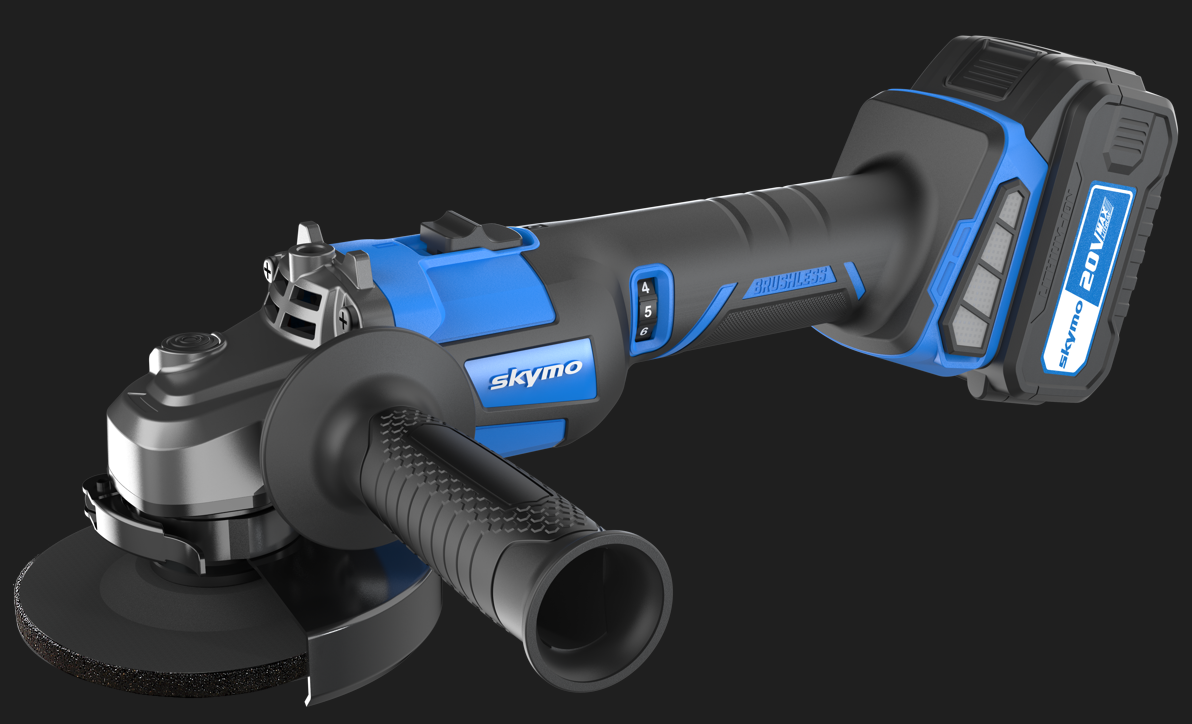
The Angle Grinder AG3125S is the cordless grinder in that range: a 20V 5-inch brushless angle grinder powered by a Li-ion battery and operating in battery-drive mode. Within the wider TMG cordless family, the same catalogue also covers brushless drills, brushless hammer drills, brushless impact wrenches and brushless impact drivers — relevant to maintenance buyers who prefer to standardise a tool bag around one supplier rather than one battery voltage claim.
| Specification | Published value for AG3125S | What it means on site |
|---|---|---|
| Type | 20V 5″ brushless angle grinder | Mid-size cordless grinder class, sized for portable maintenance work |
| Power source | Li-ion battery, battery drive | No mains cable; runtime is governed by the pack in use |
| Motor | Brushless motor | No carbon brush replacement as a wear item in the motor |
| No-load speed | 3000–8500 rpm | Wide speed span covering cut-off and stock-removal consumables |
| Max. wheel diameter | 125/115 mm | Accepts the two common maintenance wheel sizes |
| Max. wheel thickness | 6 mm | Sets the boundary for disc selection |
| Bore diameter | 22.23 mm | Standard 7/8-inch hub bore used by many 115/125 mm accessories |
| Spindle thread | M14/M16 | Metric spindle; verify accessory nut and flange compatibility |
| Materials | Plastic housing, Li-ion battery, brushless motor | Housing material is stated; no ingress rating is published |
Matching motor and speed to intermittent maintenance cuts
The AG3125S pairs a brushless motor with a Li-ion battery and a published no-load speed range of 3000–8500 rpm. Two features matter more than the top figure in maintenance use: constant speed control and soft start.
Constant speed control is listed as a product feature on the AG3125S. In practice, its value appears when a thin cut-off wheel enters steel and the load rises — a grinder that holds its speed through that moment produces a cleaner, faster cut than one that sags and then recovers. Soft start is also listed, and it addresses a different maintenance condition: starting a grinder while the wheel is close to a surface, or while the operator is balanced on a ladder, benefits from a controlled spin-up rather than an immediate jolt.
The low end of the speed span is equally relevant. Maintenance work is not only cut-off. Weld dressing, paint and scale removal, and blending a repair on a guard or frame call for flap discs, grinding discs or wire brushes, where controlled surface speed and tool stability matter more than maximum rpm. A span from 3000 to 8500 rpm lets one tool cover both ends of that work instead of forcing a choice between a cut-off-only and a grinding-only machine.
The brushless motor contributes a procurement-level benefit rather than a performance claim: with no carbon brushes in the motor, brush replacement drops out of the maintenance schedule for the tool itself. For a maintenance department that manages its own tool fleet, fewer wear items translates into simpler spare-part planning.
Wheel, bore and spindle: what the 125/115 mm platform covers
The AG3125S accepts a maximum wheel diameter of 125/115 mm, a maximum wheel thickness of 6 mm, a bore diameter of 22.23 mm and an M14/M16 spindle thread. Read together, those four numbers define the consumable envelope the tool is built around.
A 115 mm and 125 mm diameter range covers most of the cutting and stock-removal work that maintenance and light fabrication teams perform: cutting threaded rod, angle iron, sheet, pipe and cable tray; removing weld spatter; dressing a repair weld; stripping scale before a coating repair. The 22.23 mm bore corresponds to the 7/8-inch hub that many 115 mm and 125 mm discs use, so a team already stocked for that accessory class can generally fit the same wheels.
The 6 mm maximum thickness is a boundary worth noting rather than skimming. Wheels thicker than 6 mm fall outside the published specification for this tool, so a buyer standardising consumables across a mixed grinder fleet should check the thickest disc in the stores against this limit before assuming one purchase order covers every machine.
Safety and handling details that decide repeated one-hand work
The AG3125S carries five handling and safety features that map directly onto maintenance conditions: a tool-free adjustable protective hood, an anti-restart function, a lockable switch, a battery capacity indicator and an ergonomic soft grip.
Tool-free adjustable protective hood
Guard position has to change with the task: a cut-off wheel and a grinding disc present the wheel to the workpiece differently, and the same tool may be asked to work left-handed around an obstruction. A tool-free adjustment means the operator repositions the hood without hunting for a wrench — useful when the alternative is climbing down from a service platform to change a guard setting.
Anti-restart function
Anti-restart prevents the tool from spinning up again automatically after an interruption in power delivery, such as a battery removal or reinsertion. In maintenance work, where tools are set down, carried and re-energised repeatedly, that behaviour matters: the grinder does not surprise the operator by starting when the pack is reconnected.
Lockable switch
A lockable switch allows the tool to run continuously without the operator maintaining pressure on the trigger. For longer grinding passes — blending a weld repair across a metre of frame, for example — that reduces hand fatigue and improves control over the wheel path.
Battery capacity indicator
The capacity indicator lets the operator read remaining charge before starting a cut rather than discovering a flat pack mid-pass. On a maintenance round with several stops, this is a planning aid as much as a convenience: it makes battery rotation a decision rather than a surprise.
Ergonomic soft grip
Maintenance grinding is often single-handed and often at height, with the second hand holding a rail, a ladder or a workpiece. A soft grip reduces the vibration and pressure transmitted to the hand during those short, repeated passes, which is the condition where grip comfort affects control most.
Four maintenance scenarios and how the AG3125S maps to them
1. Conveyor, frame and structural repair
Cutting a seized fastener, trimming a replacement section of angle iron and dressing the finished weld are the classic three-step repair. The 125/115 mm wheel range covers the cut-off and the dressing work with one tool, and constant speed control helps the wheel hold speed as it loads in steel. The limitation to plan around is depth of cut: a 125 mm wheel class suits section thicknesses typical of guards, brackets and frames, not heavy structural sectioning.
2. Work at height and on rooftop plant
Rooftop air handlers, parapet-mounted equipment and overhead pipework are the scenarios where a mains cable is most awkward. Battery drive removes the cable entirely. The lockable switch and soft grip support controlled one-hand passes, and the tool-free hood lets the operator reorient the guard for an overhead cut without tools. One-hand use remains a guarded operation: the hood must stay fitted and correctly positioned for the wheel in use.
3. Confined plant areas
Inside cabinets, behind machinery skids or within a hopper, cable routing is often the obstacle that stops the job. A cordless tool removes that constraint, and the battery indicator allows the operator to confirm charge before entering a space that is slow to exit.
4. Light fabrication and bench-adjacent work
Deburring cut stock, cleaning up a weld before painting, blending a repair and trimming to length are intermittent tasks that rarely justify a dedicated corded station. The 3000–8500 rpm span lets one machine move between a cut-off wheel and a grinding or flap disc without a second tool. Where the shop runs long, continuous production cutting, a corded grinder remains the more appropriate choice.
| Maintenance task | Why the AG3125S fits | What to verify before ordering |
|---|---|---|
| Fastener and bolt cut-off | 125/115 mm wheel class, 22.23 mm bore, constant speed control | Wheel type and thickness against the 6 mm limit |
| Weld dressing and blending | 3000–8500 rpm span, lockable switch, soft grip | Disc specification for the material being dressed |
| Overhead or at-height work | Battery drive, tool-free hood, one-hand ergonomics | Guard position and secure footing |
| Confined-space work | No cable, battery capacity indicator | Battery count per shift |
| Deburring and stock removal | Brushless motor, variable speed span, soft start | Accessory bore and spindle nut compatibility |
Where the AG3125S is not the right tool
A credible scenario fit has to state its boundaries, and the AG3125S has several that matter to a maintenance planner.
- Wheel class limits cut depth. A 125/115 mm maximum wheel diameter defines a mid-size grinder. Deep sectioning, large-diameter cutting and sustained heavy stock removal on thick plate sit outside this class, where a larger corded grinder remains the practical choice.
- Runtime is not a published figure. The available product specification for the AG3125S states the power source as a Li-ion battery but does not publish battery capacity or runtime per charge. Teams planning a full shift away from a socket should size their battery count against their own duty cycle instead of assuming a shift-length runtime.
- No ingress rating is published. The specification lists a plastic housing but no dust or water ingress classification. Maintenance work in washdown areas, outdoors in rain or in heavy dust should be assessed on that basis.
- Spindle thread restricts some accessories. The M14/M16 spindle is the metric interface; discs, nuts and flanges built around other regional spindle standards will not mount without the correct matching components.
- Cordless is not unconditional. For high-duty, continuous cutting in a fixed fabrication bay, a corded grinder avoids battery rotation entirely and typically carries a lower tool cost per unit of sustained output.
Procurement view: what to confirm on the supply side
For distributors, importers and maintenance-supply buyers, scenario fit has to be matched by supply reliability. TMG Power Tools operates an OEM/ODM model with customisation of colour, logo, packaging and new designs, a monthly capacity of 600,000 units, a minimum order quantity of 500 pieces and a lead time of 45–55 days. Quality control is carried out using AQL testing, and after-sales support covers remote support and spare parts for quality issues.
The company’s OEM/ODM record includes supply of brushless cordless angle grinders to global buyers, and a separate OEM/ODM programme in which a client ordered cordless power tools — including the CD3050TC brushless hammer drill — in quantities above 500 units. For a buyer assembling a maintenance tool range rather than a single SKU, that pattern of multi-tool OEM supply is a relevant reference point.
Market trend: buyers are now evaluating platforms, not single tools
Public manufacturer positioning shows how the cordless grinder category is being framed. Bosch describes its cordless grinders as built for jobsite mobility and precision, positioning the cordless format around movement and access rather than as a direct substitute for every corded task. Metabo states that all of its cordless angle grinders can be operated with any 18 Volt battery pack from Metabo or its CAS partners — a claim about ecosystem compatibility rather than about the tool in isolation.
Both statements point the same direction for procurement: the cordless grinder decision increasingly includes the battery platform decision. A maintenance team that buys a grinder and later adds a drill, a hammer drill or an impact wrench to the same tool bag benefits from a supplier whose cordless range covers those categories, because pack and charger planning happens once instead of per tool. Conversely, a platform decision made on a single tool can lock a department into a narrow ecosystem for years.
This also explains why scenario detail has become a purchasing criterion. When several cordless grinders share broadly similar voltage and wheel classes, differentiation shifts to the details that decide whether the work gets finished: guard adjustment without tools, restart behaviour, switch lockout, charge visibility and grip comfort during repeated one-hand work.
Future outlook
Cordless grinders will continue to move from the edge of the tool crib toward the centre of maintenance workflows, driven less by voltage marketing than by whether a given tool closes the gap between where the work is and where the power is. The practical consequence for buyers is a shift in documentation expectations: specification sheets that state wheel limits, bore and spindle dimensions, speed range and handling features will matter more than headline claims, because those are the values that can be checked against a stores inventory and a work order.
For manufacturers, the parallel pressure is on platform breadth and on published interface detail. A cordless angle grinder that shares a supplier range with brushless drills, hammer drills, impact wrenches and impact drivers is easier to justify in a departmental purchase than a standalone machine, provided the consumable and accessory interfaces are documented clearly enough for a buyer to check before the first wheel is mounted.
FAQ
What wheel sizes and bore does the AG3125S accept?
The AG3125S accepts a maximum wheel diameter of 125/115 mm, a maximum wheel thickness of 6 mm and a bore diameter of 22.23 mm, with an M14/M16 spindle thread. Wheels outside those published limits are not within the tool’s stated specification.
What does the 3000–8500 rpm no-load speed range mean for maintenance cutting?
The published no-load speed range of the AG3125S is 3000–8500 rpm. The span allows one tool to run cut-off wheels and grinding or flap discs, with constant speed control and a soft start feature listed to support stability under load and controlled spin-up.
How does the anti-restart function change day-to-day use?
The AG3125S includes an anti-restart function, which prevents the tool from starting again automatically after power delivery is interrupted, such as when a battery pack is removed and reinserted. It is listed alongside a lockable switch and a battery capacity indicator.
Can the AG3125S be used one-handed at height?
The AG3125S is a battery-drive cordless grinder with an ergonomic soft grip and a tool-free adjustable protective hood, features that support controlled one-hand positioning in maintenance conditions. Safe use still requires the protective hood to be fitted and correctly oriented for the wheel in use, and the tool should only be operated from a secure position.
How long does one battery charge last, and which battery is supplied?
The available product specification for the AG3125S states the power source as a Li-ion battery with a brushless motor but does not publish battery capacity, runtime per charge or the battery and charger configuration supplied with the tool. Buyers should confirm pack capacity and kit configuration with the supplier against their own duty cycle.
Is the AG3125S available for private-label or OEM supply?
TMG Power Tools operates an OEM/ODM model covering customisation of colour, logo, packaging and new designs, with a minimum order quantity of 500 pieces, a lead time of 45–55 days and a monthly capacity of 600,000 units. Quality control is conducted using AQL testing, and after-sales support covers remote support and spare parts for quality issues.
Where is the AG3125S manufactured?
The AG3125S is produced by Ningbo TMG Power Tools Co., Ltd, a lithium-ion power tool and outdoor power equipment manufacturer established in 2014, operating 58,000 m² of manufacturing in the Cixi Binhai Economic Development Zone, Ningbo, Zhejiang, China, with 210 employees and an annual output of 6,600,000 units.
¿Tiene preguntas o necesita más detalles?
Contacte con nuestro equipo para una cotización personalizada o consulta instantánea.
Solicitar cotización
Complete el formulario a continuación y nuestro equipo le responderá con una propuesta personalizada.
Chat directo de WhatsApp
¿Prefiere chatear en tiempo real? Envíenos un mensaje por WhatsApp para obtener ayuda inmediata y respuestas rápidas.
- Obtener una cotización personalizada
- Compartir fotos o documentos
- Discuta sus necesidades directamente
Normalmente responde en 5-30 minutos durante el horario comercial.