
Copper Wire Drawing Machine: Types, Uses and Buyer Basics
Copper wire drawing is the first metal-forming step in most cable, winding and wiring-harness production lines. The equipment used for it determines how many tonnes of copper a plant converts per shift, how tightly the finished diameter holds, and how much downstream scrap the line absorbs. This reference explains what a copper wire drawing machine is, how the main categories differ, and what buyers should verify before shortlisting a supplier.
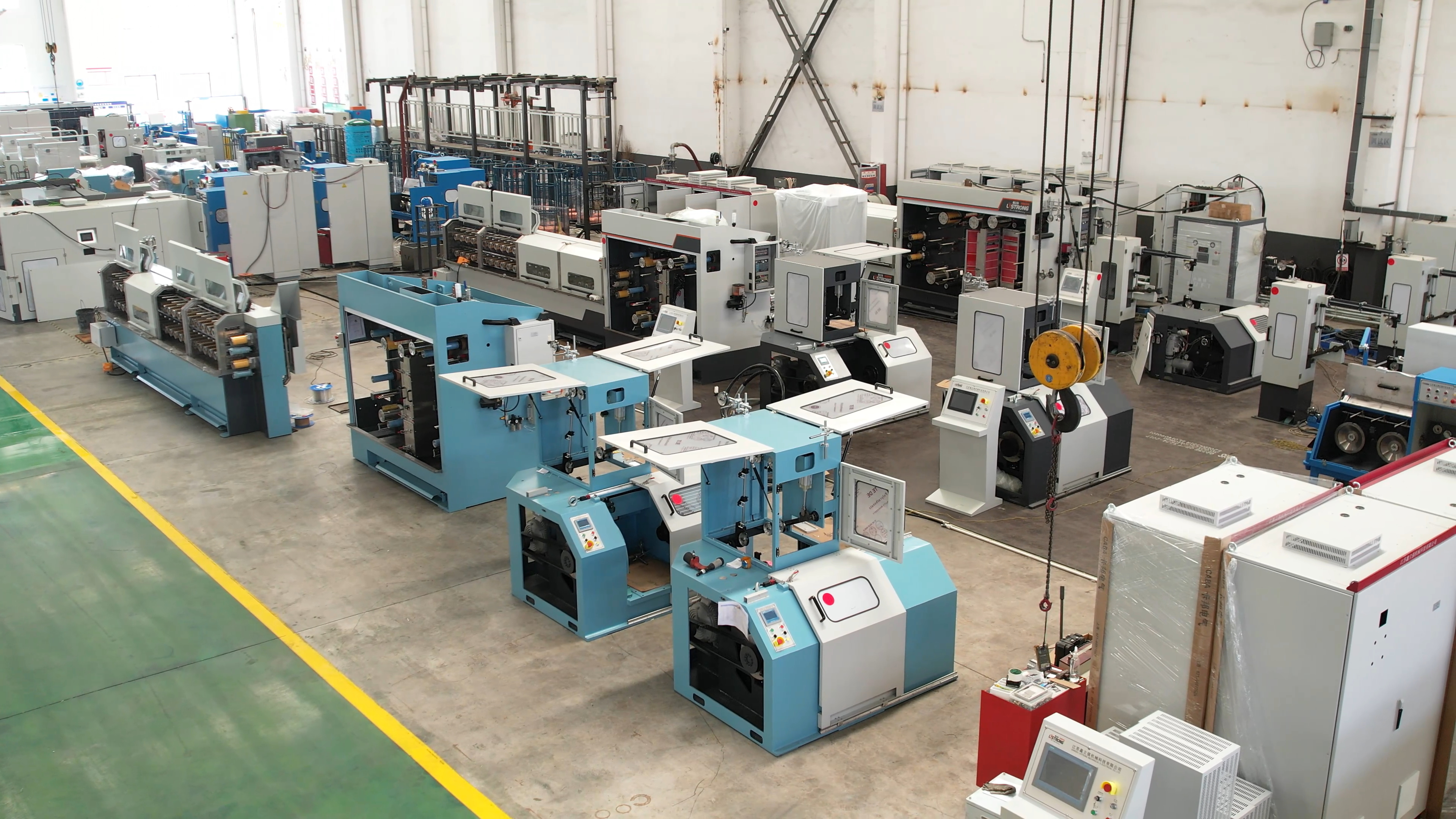
What a Copper Wire Drawing Machine Actually Is
A copper wire drawing machine is metal-forming equipment that pulls copper rod or copper wire through a sequence of progressively smaller dies. Rotating capstans hold the wire under tension between passes, so the copper is cold-formed rather than cut. No material is removed, the volume stays constant, and the wire becomes longer and thinner with every pass.
The process is normally specified by six numbers. Inlet diameter defines the largest rod or wire the machine can accept. Outlet diameter defines the finished range. Die number, or pass count, sets how much reduction is available between the two. Maximum drawing speed sets the theoretical output ceiling. Elongation and slip ratio describe how the wire behaves between dies. Take-up capacity describes how much finished wire can be spooled before a bobbin change.
Those numbers constrain each other. A machine that accepts Φ8 mm copper rod cannot finish at 0.08 mm, and a machine designed for Φ1.2 mm inlet cannot open a rod. This is why the category is split into stages rather than sold as a single product, and why the first question a buyer should answer is where in the reduction chain the line needs capacity.
Why the Drawing Stage Shapes the Economics of the Whole Line
Every downstream process inherits the wire that the drawing line produces. If elongation drifts, the conductor behaves differently in the next process. If the surface carries copper powder, die life downstream shortens. If the diameter tolerance is loose, insulation thickness is set by the worst case rather than the target case.
Elongation control is a good example of how tightly the specification is written. The 13DST intermediate wire drawing machine is documented with an elongation of 26 to 34 percent and a tolerance of plus or minus 2. That band is not marketing language; it is the operating window the machine is built to hold, and it exists because the finished conductor properties depend on it.
Breakage is the second cost driver. Copper rod with hollows or impurities breaks under tension, and a break in the drawing line stops everything behind it. Multi-wire machines raise output per hour, but they also raise the consequence of a single bad rod section, because sixteen or twenty-four wires run through the same tension system at once. Buyers evaluating running cost rather than purchase price are usually evaluating exactly this trade-off.
The practical consequence for a procurement team is that the drawing stage should be treated as a specification problem rather than a price problem. A cheaper machine that cannot hold elongation or that stalls on marginal rod quality converts the saving into scrap.
The Main Types of Copper Wire Drawing Machines
Suppliers use overlapping names for the same equipment, so it helps to separate the category by function rather than by label.
Rod breakdown machines
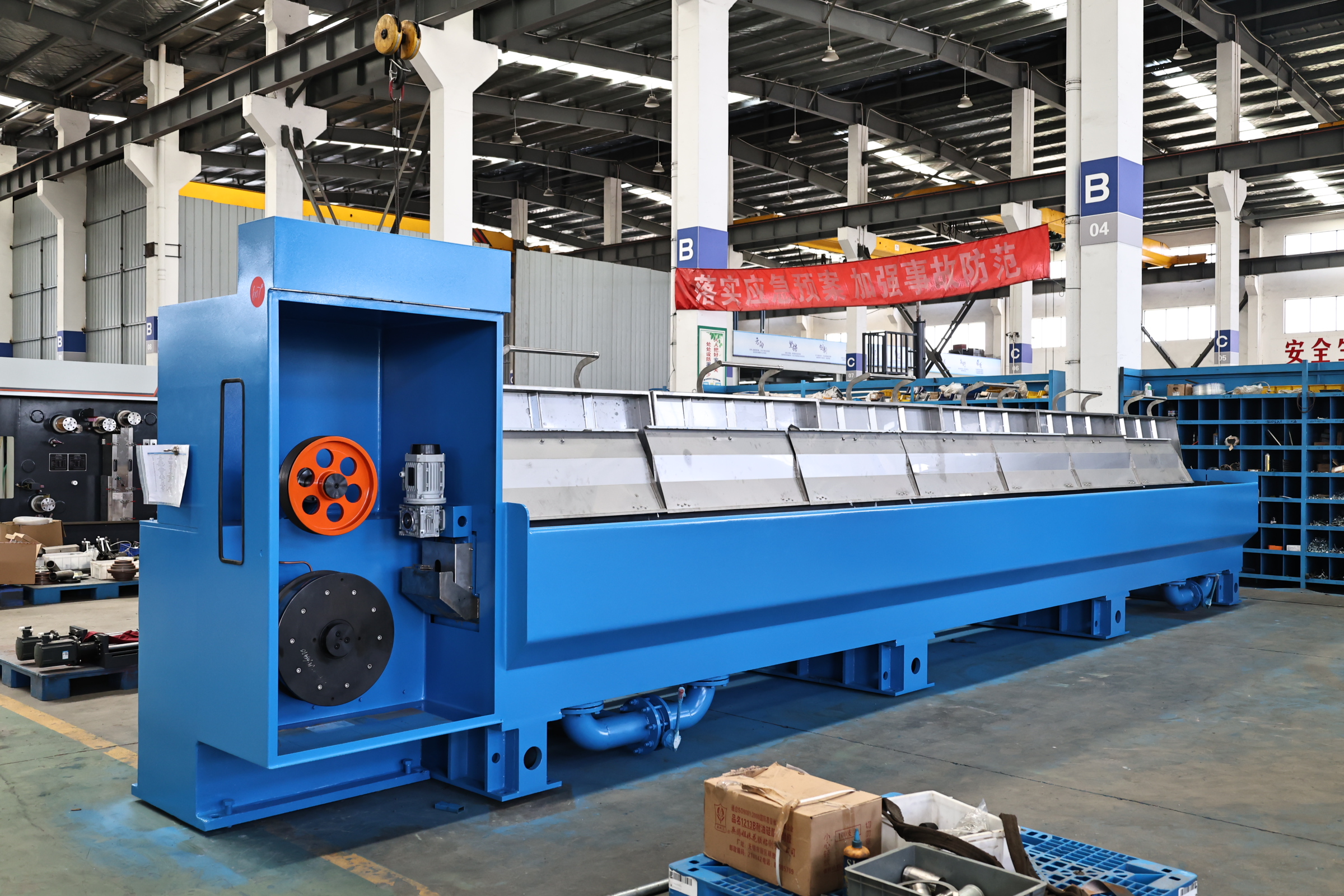
Rod breakdown machines perform the first reduction, taking copper rod down to an intermediate diameter. The LHD450-13DT is a rod breakdown machine with a Φ8 mm maximum inlet, a Φ1.2 to Φ4.0 mm outlet range, a 450 mm capstan and a maximum drawing speed of 25 m/s. Its main drawing motor is rated 280 KW, its annealing power is 60 V by 6000 A DC, and the total main power of the unit is 800 KVA. Gross weight is 40,440 kg and the overall machine dimensions are 32,550 by 4,500 by 3,820 mm.
The WDF450-13DT covers the same Φ8 mm to Φ1.2 to 4.0 mm range with 13 dies and a 450 mm capstan at a maximum speed of 1,800 m/min. It is a good illustration of how the category has moved technically: the option labelled WDF400-7D is described as a distributor type 7-die direct drive controllable slip copper large wire drawing machine that takes Φ8 mm rod down to φ3 mm, uses direct drive servo motors with the motor shaft acting as the drum shaft, and eliminates the gear reduction box entirely. Its drums are treated with tungsten carbide spraying, and it uses a drop coiler with a non-stop frame changing function so that production continuity does not depend on stopping the line.
Intermediate wire drawing machines
Intermediate machines pick up where rod breakdown stops. The 13DST takes Φ3.5 mm inlet and produces Φ2.8 mm down to Φ0.8 mm at a maximum mechanical speed of 1,200 m/min, and it draws two copper wires simultaneously. The 17DST adds online annealing and runs from Φ3.5 to Φ2.5 mm inlet to Φ1.6 to Φ0.4 mm outlet at 1,800 m/min mechanical, or 1,500 m/min with annealing engaged. The 17-2DST is a two-line intermediate machine with 17 dies multiplied by two, an inlet of Φ2.5 to Φ3.0 mm on each line, two output lines of Φ0.4 to 1.6 mm, 1,800 m/min maximum speed and a maximum take-up weight of 500 kg. The 9DST is the smaller end of the group, taking Φ2.5 to Φ3 mm down to Φ1.0 to Φ2.8 mm at 1,200 m/min.
Fine wire drawing machines
Fine wire machines carry the wire toward the diameters used in electronics, enamelled wire and fine conductors. The 24DW is specified for bare copper and copper-clad aluminium, running from Φ1.2 to 0.5 mm inlet to Φ0.3 to 0.08 mm outlet at a maximum of 2,500 m/min. The 26DW covers Φ0.8 to 1.6 mm inlet and Φ0.1 to 0.6 mm outlet at up to 2,000 m/min. Machines in this class are often paired with annealing: the 24DT takes Φ1.2 to 0.6 mm down to Φ0.30 to 0.1 mm with DC three-section annealing at 70 V, a maximum of 250 A and 16 KVA, while the 14DT runs Φ1.6 to 0.8 mm down to Φ0.6 to 0.25 mm with annealing at 60 V, up to 600 A and 36 KVA. The 22DTA spans Φ1.0 to 1.6 mm inlet to Φ0.15 to 0.6 mm outlet at 2,000 m/min.
Multi-wire drawing machines
Multi-wire machines draw several wires at once from the same drive and tension system, which is where the largest output difference appears. The 25-16DT draws 16 wires from 16 by Φ1.5 to 1.8 mm inlet down to 16 by Φ0.15 to 0.40 mm outlet in a maximum of 25 passes, at a designed speed of 1,800 m/min. The 25-24DT draws 24 wires across 24 by Φ1.8 to 2.0 mm inlet and 24 by Φ0.15 to 0.40 mm outlet, also at 1,800 m/min. The 20-4DT handles four lines from a maximum 4 by Φ1.60 mm inlet to 4 by Φ0.15 to 0.50 mm outlet at 1,500 m/min with DC annealing up to 1,200 A and 84 KVA. The 24-2DT draws two bare copper wires from 2 by Φ0.6 to 1.2 mm down to 2 by Φ0.1 to 0.3 mm at up to 2,000 m/min with four-section DC annealing at 70 V, 600 A and 42 KVA.
| Category | Example model | Inlet | Outlet | Maximum speed |
|---|---|---|---|---|
| Rod breakdown | LHD450-13DT | Φ8 mm | Φ1.2–4.0 mm | 25 m/s |
| Rod breakdown | WDF450-13DT | Φ8 mm | Φ1.2–4.0 mm | 1,800 m/min |
| Rod breakdown | WDF400-7D | Φ8 mm | φ3 mm | 16 m/min |
| Intermediate | 13DST | Φ3.5 mm | Φ2.8–0.8 mm | 1,200 m/min |
| Intermediate with annealing | 17DST | Φ3.5–2.5 mm | Φ1.6–0.4 mm | 1,800 m/min (1,500 with annealing) |
| Intermediate, two lines | 17-2DST | Φ2.5–3.0 mm ×2 | Φ0.4–1.6 mm (two lines) | 1,800 m/min |
| Fine | 24DW | Φ1.2–0.5 mm | Φ0.3–0.08 mm | 2,500 m/min |
| Fine with annealing | 24DT | Φ1.2–0.6 mm | Φ0.30–0.1 mm | 2,000 m/min |
| Multi-wire, 16 lines | 25-16DT | 16 × Φ1.5–1.8 mm | 16 × Φ0.15–0.40 mm | 1,800 m/min |
| Multi-wire, 24 lines | 25-24DT | 24 × Φ1.8–2.0 mm | 24 × Φ0.15–0.40 mm | 1,800 m/min |
Inside a Modern Copper Wire Drawing Machine
Once the category is clear, the next level of evaluation is the sub-systems. Five of them decide whether a machine performs as specified in a real plant rather than on a specification sheet.
Capstans, slip and wear
The capstan is the drum that pulls the wire and sets the speed reference for each pass. Material choice varies with duty across the range: carbon fibre on the 13DST, zirconia on the 17-2DST, 25-24DT and 25-16DT, ceramic coating on the 24DW, 24DT and 26DW, tungsten carbide on the 14D, chromium oxide on the 14DT, and ceramic coated aluminium on the 20-4DT and 24-2DT.
Slip ratio is the second variable. The 24DW is documented with approximately 13 percent reduction from die 1 to die 23 and 8 percent on die 24; the 14D follows the same pattern at 15 percent and 8 percent; the 9DST uses 19.5 percent from die 1 to die 8 and 16 percent on die 9; the 17DST uses 20 percent and 15.5 percent. These values describe how the machine distributes reduction, and they explain why die selection and pass scheduling are part of the buying conversation rather than an afterthought.
Lubrication and cooling
Drawing lubricant does two jobs: it carries heat away and it keeps the die and capstan surfaces separated from the wire. Machines in this range use either fully immersing lubrication, as on the 13DST, 17DST, 17-2DST and 9DST, or spray lubrication, as on the 24DW, 24DT, 26DW, 20-4DT, 24-2DT, 14D and 14DT. Flow requirements are stated explicitly: 40 L/min on the fine wire models, 100 L/min on the 17DST, and 150 L/min or 150 kg/min on the 9DST and 17-2DST.
Utility requirements matter as much as lubricant chemistry. The 25-16DT and 25-24DT specify a maximum cooling water inlet temperature of 25 degrees Celsius and a differential pressure of 2 bar between inlet and outlet, with compressed air at 6 bar overpressure, water-free and oil-free. The 13DST goes further, naming a working water pressure of 0.2 to 0.4 MPa, water hardness of at most 5 dH, coolant hardness of at most 12 dH, pH between 7 and 8, and a flow volume of 420 L/min, together with compressed air at 0.6 to 0.7 MPa and a flow rate of 200 L/min.
Annealing
Annealing restores ductility and conductivity after cold working, and it is the difference between a drawing line that produces hard wire and one that produces conductor-ready wire. The 14DT, 24DT and 22DTA use DC three-section annealing; the 24-2DT uses a four-section arrangement. Ratings across the portfolio range from 36 KVA on the 14DT and 22DTA, through 16 KVA on the 24DT, 42 KVA on the 24-2DT and 84 KVA on the 20-4DT, up to 60 V by 6000 A on the LHD450-13DT rod breakdown machine.
Drive, control and take-up
Control architecture separates one generation of machines from the next. The 13DST uses PLC plus human machine interface control with INOVANCE inverter speed adjustment and synchronous speed setting. The 9DST uses dual variable frequency and servo drive technology with a tension control system that tracks changes in drawing speed. The WDF450-13DT combines INOVANCE frequency converters with a SIEMENS PLC and individual motors on each capstan. The WDF400-7D uses PLC coordinated control and variable frequency speed regulation, with the speed ratio adjustable in real time according to material and site conditions.
Take-up design follows the same logic. Pneumatic shaft-type take-up is used on the 13DST; the 24-2DT and 20-4DT use pneumatic shaftless take-up with automatic braking on power cut-off, which removes the need for a UPS on those models. The WDF400-7D and LHD450-13DT use drop coilers with non-stop frame changing. The 26DW takes the opposite approach and builds in a UPS power backup for the brake circuit in case of electricity failure. Both are legitimate answers to the same problem: what happens to the wire when power is lost.
How Jiangsu Listrong Approaches Copper Wire Drawing
Jiangsu Listrong Mechanical & Electrical Co., Ltd. is a wire and cable production equipment manufacturer based in Dongtai City, Jiangsu Province, China. Founded in 2009, the company builds wire drawing machines, annealing machines, wire bunching machines and related equipment for bare copper, copper alloy and stainless steel wire, and combines development design, whole-plant planning and technical advice, manufacture, installation, commissioning and after-sales service within one organisation.
Company-reported figures describe a mid-sized specialist rather than a mass producer: approximately 70 employees, an engineering team of 15, an annual output of 550 sets, and export business accounting for about 40 percent of sales. Its stated main markets are the Middle East, India and South East Asia, with products sold throughout China and exported to Southeast Asia, the Middle East and South Africa. The company reports more than 1,000 completed projects and states that it has adopted advanced production equipment, standardised management systems and strict testing standards.
The copper-relevant product range itself is the clearest evidence of where the company positions. It spans rod breakdown, intermediate, fine and multi-wire machines, with and without online annealing, covering a continuous reduction path from Φ8 mm copper rod to 0.08 mm fine wire. Buyers evaluating a single supplier for an entire wire room can therefore compare pass schedules within one catalogue rather than stitching together machines from several vendors.
Compliance is handled explicitly. The company states that it holds a CE certificate and can export wire drawing machines to Europe, with the equipment complying with the CE directive and with EN ISO 12100 and EN 60204-1 standards, referenced as EN ISO 12100:2010 and EN 60204-1:2018/A1:2025. For a buyer at the research stage in a regulated market, that documentation requirement should be checked before commercial terms are discussed.
Application and Use Cases
Copper wire drawing machines appear in a small number of recognisable production settings, and each one stresses the equipment differently.
Wire and cable factories
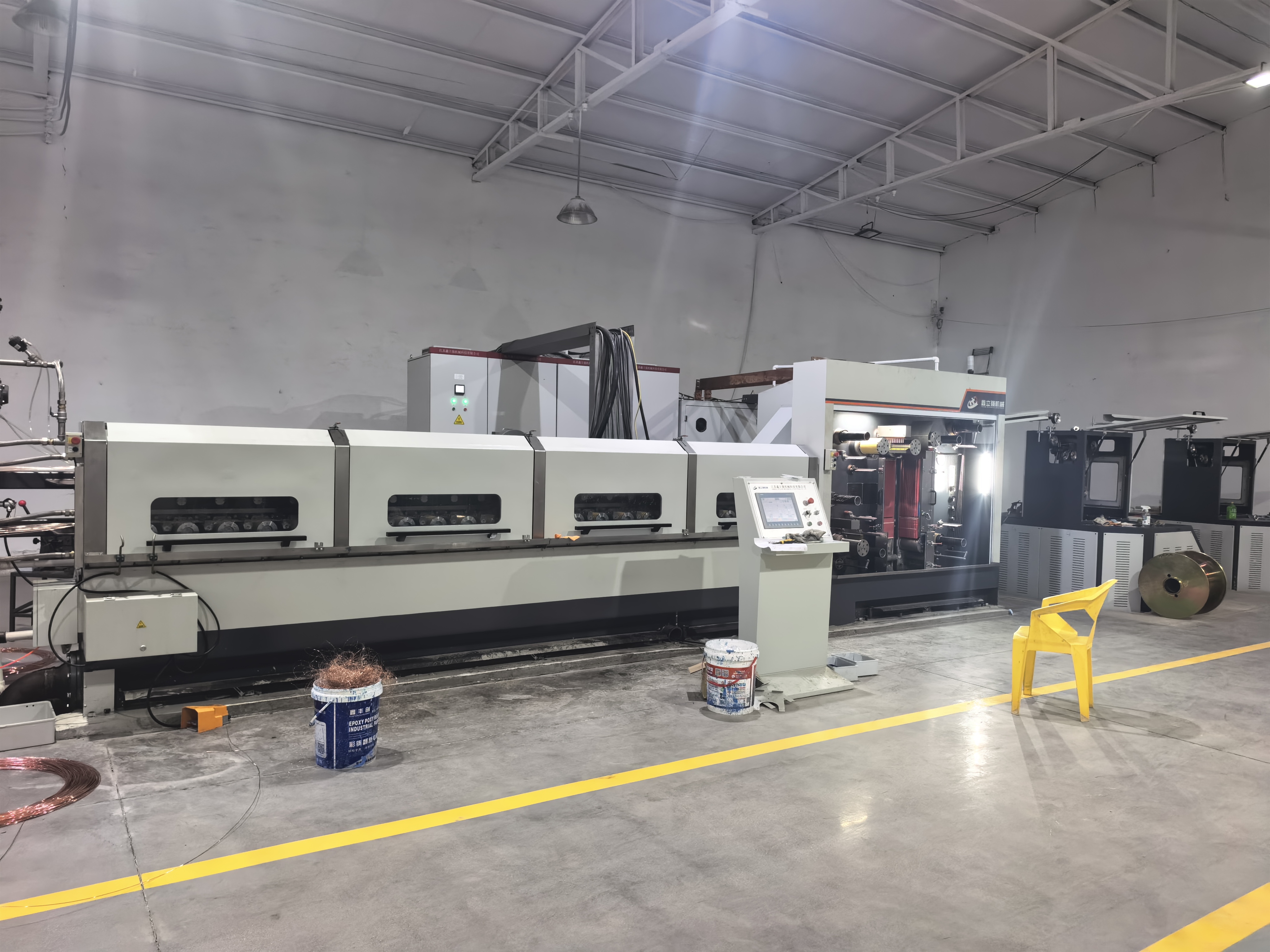
This is the base application. A documented scenario for a wire and cable factory running the 25-16DT multi-wire machine describes 0.195 mm copper wire produced at 24 m/s under 24/7 automatic operation, with a steam generator or nitrogen generator as matched equipment. The same scenario lists the consumables that make continuous running possible: high-quality wire drawing oil, annealing oil, high-precision drawing dies and oxygen-free copper rod. Output on that machine is documented as a reference figure of 5.7 tonnes per day at 24 by φ0.15 mm and 22.0 m/s, rising to 22 tonnes per day at 24 by φ0.400 mm and 12.0 m/s.
New energy vehicles and automotive electronics
Fine copper wire inside power transmission lines and signal transmission lines of new energy vehicles is one documented application. The 25-24DT and 25-16DT listings also name motor windings, high-voltage harnesses and in-vehicle transmission conductors, which is where multi-wire machines with consistent elongation across all heads have an operational advantage over drawing wire by wire.
Electronics and communication cables
Network patch cords, USB and data transmission wires, coaxial conductors and internal wiring for household appliances all depend on fine copper at tightly held diameters. The 22DTA is documented for bare copper wire drawing and annealing in the electrical and communication cable industry as well as the special electromagnetic wire industry, producing the fine enamelled copper wires used in motor, transformer, compressor and generator windings.
Building wiring, hardware and braided conductors
Power cables, communication cables, automotive wiring harnesses, electronic components and building wiring are named as the basic industrial fields for intermediate machines such as the 13DST, 17DST and 17-2DST. Fine copper for braided lines and shielding nets, or pre-drawn copper for later tinning or plating, is a further documented use for the fine wire class.
Market Trend: What the Research Says, and Where It Disagrees
Third-party research places the wire drawing machine category in a steady expansion phase. Dataintelo's Wire Drawing Machine Market Research Report 2034, published in April 2026, values the global wire drawing machine market at USD 3.8 billion in 2025 and projects USD 6.1 billion by 2034 at a CAGR of 5.47 percent across 2026 to 2034. Those figures cover all wire drawing machines, including bull block, wet and straight line designs, not copper machines alone.
The same market is sized very differently by other research houses. Insight Partners values 2025 at USD 1.37 billion, while IndexBox values 2026 at USD 2.4 billion. The discrepancy is best explained by scope rather than by error: whether spare parts, drawing dies and service revenue sit inside the boundary changes the total substantially. Buyers should therefore read the direction of these numbers rather than treating any single figure as a procurement benchmark.
The direction itself is consistent. Electrification and lightweighting pull demand toward fine and multi-wire drawing capacity, and the equipment documented for electric-vehicle motor windings and high-voltage harnesses is precisely the high-speed fine wire and multi-wire class. Trade classification for the category is HS code 8463.30.00, covering machine tools for working metal wire without removing material, which is the code importers and customs brokers will use for these machines.
Comparison with Traditional Solutions, and Where the Limits Remain
Traditional wire room practice separated drawing, annealing and take-up into discrete machines, usually single-wire, with annealing performed as a separate downstream step and bobbins changed by stopping the line. Integrated modern machines change three things at once: they combine drawing and annealing in one pass sequence, they multiply the number of wires drawn per cycle, and they remove the gear reduction box or the manual bobbin stop from the process.
The multi-wire comparison is the clearest. A single-head fine wire machine and a 24-wire machine are not simply scaled versions of each other. Because the multiple heads on a multi-wire machine are synchronously controlled by one set of drives and tension systems, drawing speed, tension and elongation across the heads stay consistent, which is what makes the output usable for later braiding and cable assembly. Integrating multi-head drawing, annealing and winding into one unit also reduces floor area and unit power consumption per tonne, and lowers the number of equipment units and operators involved.
Those advantages come with real boundaries, and buyers should plan for them before committing to a specification.
- Dies are frequently buyer-supplied rather than included. The 26DW, 24DW, 22DTA, 14D, 24DT, 25-24DT and 25-16DT listings all state that drawing dies are provided by the customer, which means die specification, inventory and cost sit with the plant.
- Continuous multi-wire production depends on input quality. The 25-16DT documentation states that customers must supply high-grade copper rod that can run continuously without breakage from hollows or impurities, and that the quoted efficiency depends on wire quality, die quality, lubricating oil quality, reel quality and operator proficiency.
- Tinned wire runs slower. On the same machine, production efficiency for tinned wires is reduced by about 20 percent compared with bare copper.
- Utilities are a hard constraint, not a preference. Cooling water at a maximum 25 degrees Celsius inlet and 2 bar differential pressure, plus water-free and oil-free compressed air at 6 bar, are stated requirements for the multi-wire models; the 13DST additionally caps water hardness at 5 dH and coolant hardness at 12 dH.
- Electrical supply can be substantial. The LHD450-13DT is documented with a total main power of 800 KVA. The WDF450-13DT combines 4 by 45 KW and 8 by 37 KW drawing motors with a 45 KW traction motor, 2 by 30 KW double spooler motors, a 22 KW drop coiler motor and a 45 KW main take-up motor. Machines at this level imply substation planning, not a wall socket.
- Speed ratings are diameter-specific. The WDF400-7D is specified at a maximum speed of 16 m/min for a 3 mm outlet. That is appropriate for coarse rod breakdown rather than high-output fine drawing, and reading a single maximum-speed figure without its outlet diameter can be misleading.
- Noise still needs management. The 25-16DT and 25-24DT are documented below 85 dbA excluding the main motor; the WDF450-13DT is stated at under 80 db(A) and requires no soundproof cover.
None of these are defects. They are the physical envelope in which the equipment performs, and the buying decision is largely about matching that envelope to the plant, the rod supply and the finished conductor specification.
Future Outlook
Three engineering directions are already visible in current documentation and are likely to define the next generation of copper drawing equipment.
The first is per-capstan individual motor drive with variable frequency control. The WDF450-13DT describes each capstan driven by its own variable frequency motor and reducer, with the elongation of each die freely adjustable, arbitrary compression ratio setting and micro-sliding operation. The stated consequences are practical rather than theoretical: dies and capstans last several times longer than under traditional designs, lubricating fluid life is extended, less copper powder is produced, wire surface quality improves, and a single motor or converter fault can be isolated without stopping the machine.
The second is data readiness. The same machine is configured with an RJ45 network port communication protocol to support future data collection, and with intelligent communication meters that detect power grid quality and statistically analyse the electricity consumption of the equipment. For plants moving toward energy and consumption reporting, this changes the drawing line from an unmeasured load into a measured one.
The third is process stability at the edges of operation, particularly start and stop. The 25-16DT and 25-24DT use a zero-meter preset voltage design for online annealing control, which is intended to hold annealing quality steady during start and stop states. The 24-2DT and 20-4DT use brake motor control so the machine brakes automatically on power cut-off without requiring a UPS, while the 26DW takes the UPS route for its brake circuit. Different answers, same underlying requirement: the wire must not be lost when the power is.
Combined with the projected growth of the category toward USD 6.1 billion by 2034, the practical implication for buyers is that fine and multi-wire capacity is likely to remain the competitive segment, and that control and measurement features will increasingly be part of the purchase decision rather than aftermarket additions.
Frequently Asked Questions
What is a copper wire drawing machine used for?
A copper wire drawing machine reduces copper rod or copper wire to a smaller diameter by pulling it through progressively smaller dies, without removing material. It is used to produce conductors for power cables, communication cables, automotive wiring harnesses, electronic components and building wiring, and for fine wires used in motor windings, transformers and electronic assemblies.
What is the difference between a rod breakdown machine and a fine wire drawing machine?
A rod breakdown machine performs the first reduction, typically from Φ8 mm copper rod to an intermediate diameter such as Φ1.2 to Φ4.0 mm. A fine wire drawing machine works at the other end of the chain, for example from Φ1.2 to 0.5 mm inlet down to Φ0.3 to 0.08 mm outlet. The two are stages in the same reduction sequence, not interchangeable alternatives.
Does a copper wire drawing machine need annealing?
Not always, but cold drawing hardens copper, so annealing is required whenever the finished wire must meet conductivity and ductility requirements. Some machines draw only, such as the 24DW and 26DW. Others integrate annealing in the same pass sequence, such as the 14DT, 24DT, 22DTA, 24-2DT and 20-4DT, with ratings from 16 KVA to 84 KVA, and the 17DST and 17-2DST for intermediate diameters.
What plant utilities does a copper wire drawing machine require?
Cooling water and compressed air are standard requirements. The 25-16DT and 25-24DT specify a maximum cooling water inlet temperature of 25 degrees Celsius and 2 bar differential pressure between inlet and outlet, plus water-free and oil-free compressed air at 6 bar. The 13DST additionally specifies water hardness of at most 5 dH, coolant hardness of at most 12 dH, pH 7 to 8 and a flow volume of 420 L/min. Electrical load varies widely by class and should be checked per model before plant planning.
Are drawing dies included with the machine?
On several models they are not. The 26DW, 24DW, 22DTA, 14D, 24DT, 25-24DT and 25-16DT all state that drawing dies are provided by the customer. Die specification, quantity and replacement policy should therefore be confirmed as a separate line item during procurement planning.
Can these machines be exported to Europe?
Yes. The manufacturer states that it holds a CE certificate and can export wire drawing machines to Europe, with compliance referenced to the CE directive and to EN ISO 12100:2010 and EN 60204-1:2018/A1:2025. Buyers in regulated markets should request the current certificate set and confirm it matches the exact machine configuration being ordered.
What installation support and warranty are provided?
The manufacturer states a warranty of 12 months from the date of dispatch from the factory, and confirms that engineers can travel for machine installation and worker training. It also reports that its engineers have worked in more than 60 countries and that export and customs clearance documents are arranged in advance. Detailed service terms should be confirmed in the supply contract.
Where to Go Next
For buyers comparing pass schedules across rod breakdown, intermediate, fine and multi-wire machines, the full model list with inlet and outlet ranges is the most efficient starting point. A downloadable product catalogue covering these models is available here: LISTRONG product catalogue (PDF).
¿Tiene preguntas o necesita más detalles?
Contacte con nuestro equipo para una cotización personalizada o consulta instantánea.
Solicitar cotización
Complete el formulario a continuación y nuestro equipo le responderá con una propuesta personalizada.
Chat directo de WhatsApp
¿Prefiere chatear en tiempo real? Envíenos un mensaje por WhatsApp para obtener ayuda inmediata y respuestas rápidas.
- Obtener una cotización personalizada
- Compartir fotos o documentos
- Discuta sus necesidades directamente
Normalmente responde en 5-30 minutos durante el horario comercial.