
Cooling Vests for Traffic Controllers: Managing Stationary Heat Stress
Cooling Vests for Traffic Controllers: Managing Stationary Heat Stress
Fixed-post outdoor roles concentrate heat exposure in ways that moving work does not. This industry reference examines what a water-circulation cooling vest can and cannot do for traffic controllers, using the published COOLWAVE specification as the working example.
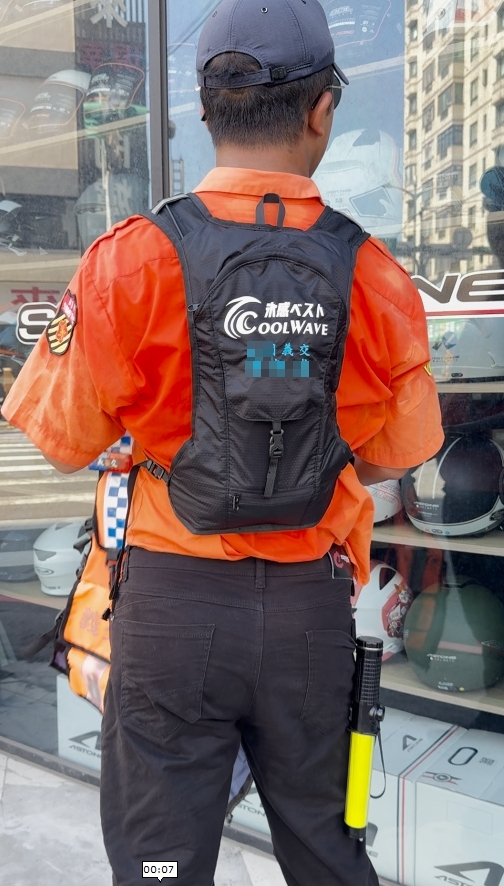
Traffic control is one of the few outdoor occupations in which the worker is expected to stay almost still. A controller at an intersection, a site gate, or a work-zone entry may hold a position within a few square metres for hours, turning occasionally to signal, with no walking distance to generate airflow and often no shade. The physical workload is light. The thermal load is not. That mismatch — low activity, high radiant exposure, long unbroken duration — is why the cooling problem for a traffic controller looks different from the cooling problem for a roofer, a delivery rider, or a warehouse picker.
This article is written for buyers, safety officers, specifiers and distributors who are considering cooling vests for fixed-post outdoor roles. It uses the COOLWAVE Water-Circulation Cooling Vest from Shokunin as the concrete reference point, and separates what is published and checkable from what each site still has to confirm on its own. Where the evidence is directional rather than definitive, that is stated.
Why a Fixed Outdoor Post Is a Distinct Heat-Stress Case
The core issue is that a stationary worker loses access to the cheapest cooling mechanism available to the human body: airflow-driven sweat evaporation. Movement produces air movement across the skin, and that air movement accelerates evaporation. A worker who walks a site is, to a limited degree, self-cooling. A worker standing at a post is not. What remains is still-air convection and whatever wind the day happens to provide — which on a calm, humid afternoon is very little.
Three additional factors shape the exposure profile of traffic control specifically:
- Radiant load from the surroundings. Asphalt, concrete, guard rails, vehicle bodies and glass facades store heat through the day and release it. A post in direct sun among reflective, heat-storing surfaces can be harder to manage than a shaded construction task performed at the same air temperature.
- Duration rather than peak intensity. Traffic control assignments frequently run in long blocks. At a fixed post, cumulative exposure time tends to matter more than the day's maximum temperature, because the worker has fewer natural opportunities to shed heat.
- Attentional demand. Occupational health guidance generally links progressive heat strain with fatigue, reduced vigilance and slower decision-making. That matters disproportionately in a role responsible for the safety of drivers and pedestrians, where a lapse in attention has immediate consequences.
For equipment selection, the practical consequence is straightforward. Garments that depend on the wearer generating airflow, or on ambient wind moving through the fabric, underperform in fixed-post roles relative to garments that actively move a chilled medium close to the skin. Evaporative towels and mesh clothing belong to the first category. Pumped water circulation belongs to the second.
There is also an operational upside to fixed posts that buyers frequently overlook. Predictability. A relief point, a site cabin, or a service vehicle is usually within reach of a traffic controller, which means a cooling system with a defined recharge cycle can be planned around the post. A 3–4 hour cooling window, in that setting, becomes a scheduling input rather than a limitation — provided the site has thought about where the ice comes from.
What the COOLWAVE Water-Circulation Cooling Vest Provides
Shokunin is a professional e-commerce brand operated by Feng Shang Precision Co., Ltd., a Taiwan-based manufacturer established in 2009 that develops tools and industrial equipment for professional users. Its published product range includes air compressors, cut-off machines, water-cooled vests, lithium batteries, diamond saws, nail guns and related tools; the company reports a 1,000 m² facility, 30 employees, a five-engineer R&D team, and an annual output of 10,000 units, with approximately 50% of production exported and the United States and Taiwan listed as its main markets. Product information is published at www.fstool.com.tw.
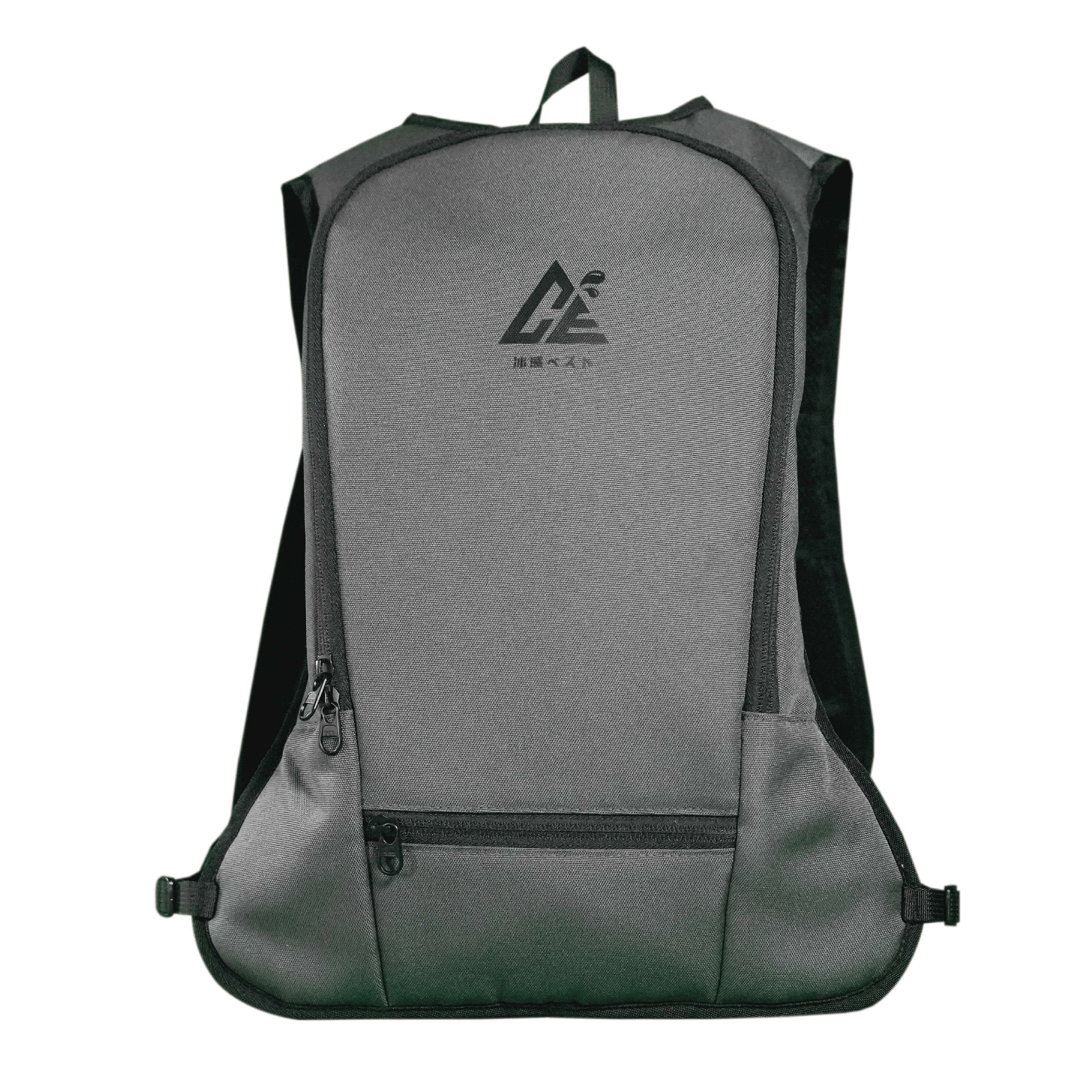
The product discussed here is the COOLWAVE Water-Circulation Cooling Vest, classified by the manufacturer as industrial cooling apparel / personal protective equipment. Its published specification is reproduced below without modification.
| Parameter | Published specification |
|---|---|
| Cooling duration | 3–4 hours |
| Weight | Within 2 kg |
| Suitable temperature | Below 10 °C |
| Shoulder strap material | 600D polyester |
| Vest material | PEVA |
| Water bag material | TPU |
| Water bag cap | Polypropylene |
| Cooling tube | Sand rubber (black) |
| Pump output | 5 V, 150 mA (max) |
| Flow rate | Max 320–370 ml/min |
| Kit contents | Water-cooled vest backpack ×1, ice packs ×2 |
| Applicable roles (manufacturer list) | Construction workers, outdoor workers, food stall operators, street vendors, traffic controllers, metal sheet factories |
Two points in that table carry more weight than their brevity suggests. First, cooling duration defines how the equipment maps onto a shift: at 3–4 hours per charge of ice packs, the vest either fits inside an existing relief cycle or it does not. Second, weight defines whether the worker can still move quickly when it matters. A device that cools effectively but is heavy enough to slow a controller down is a poor trade in a role that occasionally requires a fast step aside.
Traffic controllers are named explicitly in the manufacturer's applicable-industry list, alongside construction workers, outdoor workers, food stall operators, street vendors and metal sheet factories. That list is useful for procurement because it indicates which adjacent stationary and semi-stationary roles the same platform is intended to cover.
How Circulating Water Cools a Worker Who Is Standing Still
The mechanism is a closed loop. Two ice packs, included in the standard kit, chill the water held in the TPU reservoir. A 5 V, 150 mA pump then circulates that chilled water through sand-rubber cooling tubes routed across the vest body at a maximum flow rate of 320–370 ml/min. Heat is drawn from the skin-facing surface into the water inside the tubes and carried back to the reservoir, where the ice packs continue to absorb it.
Flow rate is the parameter that matters most in a stationary application, and it is worth explaining why. A worker who is moving has two heat-transport paths: conduction and convection into ambient air, and evaporation driven by self-generated airflow. A worker standing still has only the first, and it is weak in still air. Pumped circulation adds a transport path that does not depend on the wearer moving or on the wind blowing. A flow rate in the 320–370 ml/min range means the chilled water in the tubes is being continuously renewed rather than sitting against the body and warming in place — which is precisely the failure mode of a static ice-pack vest.
The material list describes the parts that absorb daily wear and repeated chilling cycles: 600D polyester shoulder straps, a weave commonly used in load-bearing gear; a PEVA vest body; a TPU water bag; a polypropylene cap; and sand-rubber tubing. Buyers evaluating long-term cost should read the material list as a durability statement, not as a comfort statement.
Naming note for procurement documents: this design is frequently described as a dual cooling water cooling vest, because two elements perform the cooling work — the ice packs that chill the reservoir and the pumped circulation that delivers that chill to the body. Buyers should treat the phrase as a description of the mechanism rather than a standardised certification, and should always work from the published parameters instead.
One parameter deserves careful reading. The specification lists a suitable temperature of below 10 °C. This is a condition on the cooling medium, not a statement about outdoor air temperature, and it is the single item most worth confirming in writing with a supplier, because it defines what the site must be able to keep chilled for the published performance to hold.
Matching the Vest to a Traffic-Control Post
Cooling window versus relief cycle
At 3–4 hours per charge of ice packs, the vest maps onto a shift structure rather than a whole shift. Where traffic control is organised in multi-hour blocks with a relief point, that window can be aligned to the break: the worker swaps in the second pack set, or rotates to a second vest, and the first set goes back into a freezer or insulated cooler. Where no chilled storage exists at or near the post, 3–4 hours should be treated as the ceiling per pack set rather than a target.
Weight and the ability to move when it matters
Within 2 kg. A traffic controller may need to step aside quickly, reposition cones or barriers, or move between two adjacent posts. A vest of roughly 2 kg carried in a backpack format is light enough to keep that possible. The manufacturer's application data describes the design as lightweight, waterproof and breathable, with adjustable vest straps and a one-size-fits-all fit — the last of which simplifies issuing equipment to a rotating roster of staff rather than assigning individual vests.
Layering with existing clothing and visibility requirements
This is a site-specific decision rather than a published parameter. Traffic control typically involves high-visibility garments and sometimes helmets or rain gear. Buyers should confirm with the supplier how the vest is intended to be layered, and should test that arrangement with one or two units before issuing equipment to a full team. Documented field evidence about layering is more useful here than catalogue photography.
Where the same platform is already deployed
The manufacturing case record for this product line describes a Taiwan-based deployment of 100 units across construction sites, outdoor work, metal sheet factories and street vendors, with a working relationship recorded over a ten-year period. Reported outcomes in that record are effective body cooling, heatstroke prevention, and improved worker comfort and work efficiency. Traffic controllers are listed among the applicable roles for the same product line, though the case record itself does not break out traffic control as a separate category — a distinction buyers should note when citing it internally.
Adjacent roles with the same exposure profile
Several roles next to traffic control share the stationary outdoor profile: gate staff, parking marshals, event marshals, street vendors and food stall operators working under open canopies. All of these appear in the manufacturer's applicable-role list, which means a single procurement line can cover a mixed outdoor workforce rather than requiring separate equipment decisions for each role.
Where the Market Is Moving
The cooling vest category is expanding, and the industrial segment is doing much of the expanding. Third-party market research places the global cooling vest market at approximately USD 215 million in 2024, projected to reach USD 385 million by 2033, with Asia Pacific the fastest-growing region on the strength of rapid industrialisation and large outdoor workforces.
Two figures in circulation are often confused and should not be compared directly. A broader measurement of the personal cooling device category — which includes handheld fans and other devices alongside vests — was valued at USD 25.16 billion in 2024 with a projection of USD 94.85 billion by 2035. The narrower cooling-vest figure of USD 215 million covers only the vest format. The gap between the two numbers reflects scope, not disagreement about the vest market itself, and using them interchangeably in a procurement paper will undermine the paper's credibility.
Within the vest segment, three directional signals are relevant to fixed-post outdoor roles:
- Industrial applications, including construction and manufacturing, held the largest share at 34.5% in 2025 — meaning the volume base of this category is workwear, not consumer comfort.
- Phase Change Material (PCM) vests accounted for 28.7% of market share in 2025 and represent the fastest-growing technology segment. The category is therefore not converging on a single cooling method; PCM and pumped water circulation are advancing in parallel.
- Active circulatory mechanisms, including ice water circulation, continue to be deployed in industrial sectors to mitigate occupational heat stress. This trend signal comes from a source with a medium reliability rating and should be read as directional rather than definitive.
Standards context runs alongside the growth. Cooling systems are commonly expected to comply with ISO 9001:2015 for quality management, and electrical components frequently require CE or UL marks depending on the destination market. Both requirements become relevant to a vest that includes a powered pump.
The interpretation for buyers is a shift from disposable or one-off cooling consumables toward reusable equipment with published parameters, serviceable parts and a documented recharge cycle. That shift favours products whose performance can be written into a specification document and audited after delivery.
Comparing Cooling Options — and the Limits of Each
No single cooling method wins across all outdoor roles. The table below compares the approaches most commonly issued to fixed-post workers.
| Approach | How cooling is delivered | Main constraint in a stationary role |
|---|---|---|
| Evaporative towel or neck wrap | Wetted fabric cools as water evaporates | Depends on low humidity and air movement; dries out and needs frequent re-wetting |
| Ice-pack-only vest | Direct contact between frozen packs and the body | Cooling is uneven across contact points and fades as the pack warms |
| PCM (phase change material) vest | Material holds a fixed temperature plateau (28.7% of 2025 market share, fastest-growing segment) | Requires its own recharge or cool-down cycle; plateau temperature is set by the material |
| Water-circulation vest (COOLWAVE) | Ice packs chill a reservoir; a 5 V / 150 mA pump circulates water through tubes at up to 320–370 ml/min; 3–4 hours per charge; within 2 kg | Requires a chilled ice or water source for recharging; adds a small pump and a backpack layer to the wearer's clothing system |
| Passive programme measures | Shade, work-rest scheduling, hydration, acclimatisation | No equipment dependency, but does not lower skin temperature directly and depends on site discipline |
For the water-circulation approach specifically, five limits should be stated plainly before any standardisation decision.
- Recharge dependency is the binding constraint, not the vest. The published 3–4 hour cooling duration assumes ice packs that were properly chilled before use. A site without reliable freezer, ice-machine or cooler access cannot sustain the cycle across multiple shifts, and the vest's effective value drops accordingly.
- Performance depends on storage conditions. Because the suitable temperature parameter is below 10 °C, packs stored in a hot vehicle or in direct sun will not deliver the published window. Storage and rotation logistics are part of the equipment decision, not an afterthought.
- A cooling vest does not replace PPE or a heat-stress programme. It is not a substitute for high-visibility garments, impact protection, hydration, acclimatisation or work-rest scheduling. Heat management is layered, and a vest is one layer.
- Electrical components carry market-specific requirements. Because the unit includes a pump, buyers exporting or importing should confirm whether CE or UL marks are required for the destination market, and whether ISO 9001:2015 quality management documentation is available.
- The trade-off against PCM is logistical, not absolute. PCM vests avoid ice handling but hold a fixed plateau temperature. Water circulation can deliver a colder medium, but it needs ice and a pump. The right choice depends on which resource the site actually has: refrigeration or simplicity.
There is also a wearability boundary worth testing rather than assuming. Within 2 kg is light for a powered cooling system, but it is still carried mass across a full shift, and the backpack format has to coexist with existing uniforms and visibility clothing. A one-day trial on a real post answers that question faster than any specification sheet.
What Buyers Should Confirm Before Standardising
For a traffic-control team, the following checks cover the gaps that published specifications do not close on their own.
- Parameters in writing. Cooling duration, weight, suitable temperature, flow rate and pump rating, issued as a controlled document rather than taken from a web page.
- Recharge logistics per post cluster. How many spare ice-pack sets are needed per worker, where they are frozen or chilled, and who transports them to the relief point.
- Layering and visibility. How the vest sits with the site's high-visibility requirement, tested on a real shift.
- Supply terms. For this manufacturer: ODM production mode, a stated monthly capacity of 3,000 units, a lead time of 7–14 days, a minimum order quantity of 10 units, and a 6-month warranty covering the water-cooled vest.
- Market compliance. Confirmation of the quality management and electrical component marks expected in the destination market.
- A structured trial. Issue a small number of units, run them through at least one full hot-weather shift cycle, and record swap timing, worker feedback and any layering problems before scaling the order.
Outlook for Heat-Stress Equipment in Outdoor Traffic Roles
Industrial heat-stress management is becoming more formal, and cooling equipment is moving with it — from discretionary comfort item toward a specified line item in procurement documents, with published parameters attached. The market data supports that direction: industrial applications hold the largest share of the cooling vest category, and Asia Pacific is the fastest-growing region, driven by large outdoor workforces in hot climates.
The most likely near-term development is multi-technology fleets rather than a single standard. Sites with refrigeration will use pumped water circulation; sites without it may prefer PCM or evaporated-cooling alternatives. That fragmentation puts a premium on clear specification writing, because the same word — cooling vest — will describe equipment with very different recharge requirements.
For traffic control specifically, the useful question is not whether a vest cools. It is whether the cooling window, the carried weight, and the recharge cycle fit the way the post is actually staffed. A vest that matches a 3–4 hour relief cycle and stays under 2 kg integrates into a shift. A vest with better headline numbers but no ice supply behind it does not.
FAQ
What is a water-circulation cooling vest, and how does it differ from an ice-pack vest?
In a water-circulation vest, ice packs chill a water reservoir and a small pump moves that chilled water through tubes routed across the garment, so cooling is distributed rather than concentrated at pack contact points. An ice-pack-only vest relies on direct contact between the frozen pack and the body, with no pumped circulation. The COOLWAVE Water-Circulation Cooling Vest is specified for a cooling duration of 3–4 hours, weighs within 2 kg, and ships as one water-cooled vest backpack plus two ice packs, with a pump rated 5 V, 150 mA (max) and a maximum flow rate of 320–370 ml/min.
Can a water-circulation vest cover a full outdoor shift for a traffic controller?
The published cooling duration is 3–4 hours per charge of ice packs. Whether that covers a full shift depends on shift length, the site's relief structure, and whether chilled packs can be rotated mid-shift. Where a freezer, ice machine or insulated cooler is available, the two included packs can be cycled; where none is available, 3–4 hours should be treated as the working window and relief planned around it.
Does the vest restrict movement at a fixed post?
The unit is specified within 2 kg and is built around a water-cooled vest backpack rather than a fixed harness. The manufacturer's application data describes the design as lightweight, portable, waterproof and breathable, with adjustable vest straps and a one-size-fits-all fit. For a role that occasionally requires a quick step aside or a short repositioning walk, the relevant check is whether the wearer can move normally while wearing it, which is best confirmed by a trial on a real post.
What does the 'suitable temperature below 10 °C' parameter actually mean?
The published parameter is 'suitable temperature: below 10 °C'. Read literally, this describes the condition of the cooling medium rather than the ambient air temperature, since the vest's cooling is produced by chilled ice packs circulating water. Because this distinction affects whether a site can achieve the published 3–4 hour duration, buyers should confirm the intended reading in writing with the supplier and verify that site storage can keep packs chilled.
What should a buyer verify before issuing these vests to a traffic-control team?
Five checks are practical: published parameters in writing (cooling duration, weight, suitable temperature, flow rate, pump rating); recharge logistics, including how many spare ice-pack sets are needed and where they are chilled; compatibility with existing high-visibility clothing and site PPE rules; commercial supply terms, which for this manufacturer are ODM production mode, a stated 3,000-unit monthly capacity, 7–14 day lead time, 10-unit minimum order quantity and a 6-month warranty on the water-cooled vest; and market compliance requirements, since cooling systems are commonly expected to comply with ISO 9001:2015 and electrical components often require CE or UL marks.
Does a cooling vest replace other heat-stress controls?
No. A cooling vest is one layer within a broader heat-stress programme that also includes hydration, work-rest scheduling, acclimatisation and shaded relief areas. The manufacturer's case record for this product line documents a Taiwan deployment of 100 units across construction sites, outdoor work, metal sheet factories and street vendors over a ten-year period, with reported outcomes of effective body cooling, heatstroke prevention, and improved worker comfort and work efficiency. That record describes equipment performance within a managed deployment, not a standalone substitute for a site heat plan.
Is the vest certified, and what certification should buyers ask about?
The manufacturer states that its COOLING water-cooled vest received the Disaster Prevention Product and Service Certification Award issued by the Taiwan Disaster Prevention Industry Association. Separately, and applying to cooling systems generally rather than to this product alone, quality management standards such as ISO 9001:2015 are commonly expected, while CE or UL marks are often required for electrical components. Buyers should request the specific documents relevant to their destination market rather than relying on a general certification claim.
Reference document: Shokunin COOLWAVE cooling apparel product brochure (PDF, publicly accessible) — https://cdn.socialarks.com/sbsp//common/2026/0407/69d4a27ea7fcb.pdf
Manufacturer website — https://www.fstool.com.tw/