
Cooling Vests for Street Vendors, Traffic Control and Metal Shops
Cooling Vests for Street Vendors, Traffic Control and Metal Shops
Cooling vests are usually filed under construction PPE, but some of the longest uninterrupted heat exposure in Asian cities happens nowhere near a building site: at a night-market food stall, at a traffic control post on an unshaded intersection, and on the floor of a sheet metal workshop whose roof radiates heat back onto the people working beneath it.
This field guide looks at how one Taiwan-made water-circulation vest — the COOLWAVE Water-Circulation Cooling Vest (Basic Model) from Shokunin — fits those three settings, what its specification sheet actually lists, and which details buyers should confirm when they move from evaluation into execution.
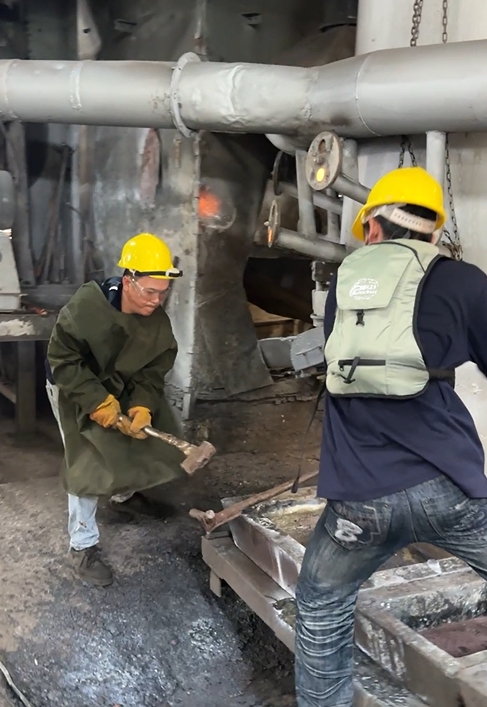
Metal sheet factory floor: radiant heat from roofs and sheet stock keeps workers hot even out of direct sun. Image: Shokunin deployment record.
What the Product Is, and Who Makes It
Shokunin is the professional e-commerce brand of Feng Shang Precision Co., Ltd., a Taiwan manufacturer founded in 2009. The company operates a 1,000 m² production facility with 30 employees, a five-engineer R&D team and an annual output of roughly 10,000 units. About 50% of that output is exported, with the United States and Taiwan listed as its main markets. Its catalogue spans air compressors, cut-off machines, lithium batteries, diamond saws, nail guns and screwdriver bits, with the cooling vest line sitting alongside those tool categories.
The COOLWAVE Water-Circulation Cooling Vest (Basic Model) is classified in the manufacturer’s documentation as industrial cooling apparel and personal protective equipment (PPE). Two figures shape most planning decisions: the listed cooling duration is 3–4 hours per cycle, and the vest weighs within 2 kg. The supplied kit contains the water-cooled vest backpack and two ice packs.
At a glance: industrial cooling apparel / PPE · listed cooling duration 3–4 hours · weight within 2 kg · pump output 5V 150 mA (max) · maximum flow rate 320–370 ml/min · kit includes water-cooled vest backpack ×1 and ice packs ×2.
Three Heat-Exposed Jobs That Rarely Get Industrial Treatment
Occupational heat programmes tend to be written around construction sites, foundries and agriculture. The settings below sit outside that framing, yet they share the same underlying problem: heat load that builds over hours without an obvious point at which the worker can step away.
Street vendors and food stall operators
Food stall work combines trapped heat with a fixed position. A vendor stands beside a burner or griddle for the length of a market shift, handles food and cash continuously, and generally cannot leave the stall to cool down. A night market adds crowd heat, limited airflow between stalls and a trading window that runs into the evening. Because both hands stay occupied, the practical form of cooling is something worn rather than carried — which is why a portable cooling vest, rather than a fan or a chilled drink, is the relevant category here. Food stall operators and street vendors are both named among the applicable industries for the COOLWAVE vest, and a night market vendor setting appears in the manufacturer’s deployment imagery.
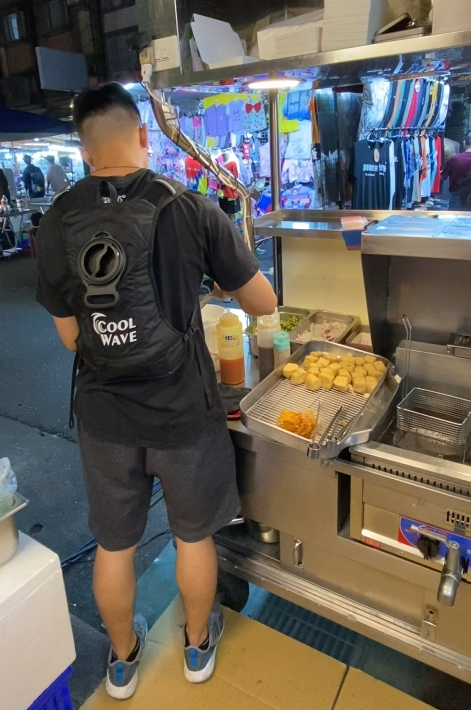
Night market vendor setting: continuous heat from cooking surfaces plus crowd heat, with no break in customer service. Image: Shokunin deployment record.
Traffic controllers
Traffic control is stationary exposure at its most direct. A controller stands in the sun for the length of a shift, usually in reflective clothing that adds another layer, at a position chosen for visibility rather than shade. Movement is minimal, so there is little of the air movement that helps a walking worker. Applicable industries listed for the COOLWAVE vest include traffic controllers, and the deployment record includes a direct-traffic scene. Because the vest is worn on the body, it stays in place while both hands are used for signals, a baton or a radio.
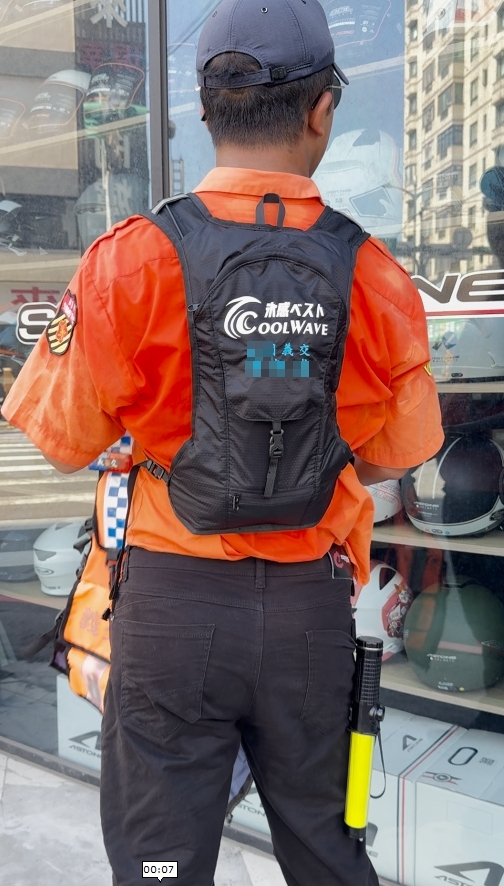
Direct traffic control: prolonged sun exposure with minimal movement and extra uniform layers. Image: Shokunin deployment record.
Sheet metal factories
Sheet metal work adds a radiant component. Metal roofs and metal stock re-radiate heat into the workspace, so a worker can be under shade and still absorb heat from surfaces. This is the classic “metal-roof factory” problem in which ambient air temperature understates the load on the body. Industrial applications — construction and manufacturing among them — accounted for the largest share of the cooling vest market in 2025 at 34.5%, according to Dataintelo, which indicates how central factory environments have become to this product category. Metal sheet factories are listed among the settings where the COOLWAVE vest has been deployed.
Technical Explanation: What “Dual Cooling” Means on the Spec Sheet
A dual cooling water cooling vest is not a single cooling mechanism but two working together in one garment: a chilled-water circuit that is moved through tubing by a small pump, and frozen packs held in the vest itself. The COOLWAVE specification sheet lists both elements separately, which is useful for buyers because each element has its own operating requirement.
| Listed item | Specified value |
|---|---|
| Product type | Industrial cooling apparel / PPE |
| Cooling duration | 3–4 hours |
| Weight | Within 2 kg |
| Pump output | 5V 150 mA (max) |
| Flow rate | Max 320–370 ml/min |
| Water bag material | TPU |
| Water bag cap | Polypropylene |
| Cooling tube | Sand rubber (black) |
| Shoulder strap material | 600D polyester |
| Vest material | PEVA |
| Kit contents | Water-cooled vest backpack ×1, ice packs ×2 |
Read together, those numbers describe a portable, power-bank-class circulating cooling vest rather than a heavy fixed installation. The 5V 150 mA (max) pump rating is a low-draw load; the maximum flow rate of 320–370 ml/min describes how quickly chilled water is moved through the loop, which is what distinguishes an ice water circulation cooling vest from an ice cooling vest that simply holds packs against the body. Circulating chilled water continuously re-exposes the skin to the coldest available medium instead of letting a single pack warm up in one spot.
The 3–4 hour duration is the single most important planning figure. It defines one cooling cycle, not a full working day. A vendor serving an eight-hour market shift, a controller on a long summer posting or a factory operating extended summer hours will need either a second set of ice packs, a freezer or cold-water access on site, or a shift rotation that accounts for the reset. Where the pump is used, the intended 5V power source and its runtime should be confirmed with the supplier before ordering, because the kit as listed contains the vest backpack and two ice packs.
Materials matter in a different way: they determine whether the garment is light and wearable for multi-hour use. The listed combination — TPU water bag, polypropylene cap, black sand rubber cooling tube, 600D polyester shoulder straps and a PEVA vest body, all within a 2 kg package — is what makes a lightweight cooling vest practical for people who are standing and working rather than sitting in a fixed cooling station.
Field Deployment: What Has Already Been Recorded
In Taiwan, 100 units of the cooling product were deployed for use in high-temperature environments. The deployment record names construction sites, outdoor workers, metal sheet factories, street vendors and traffic controllers among the users, and lists the reported outcomes as effective body cooling, heatstroke prevention, improved work efficiency and worker comfort.
Those are user-reported deployment outcomes rather than third-party laboratory results, and the distinction matters for procurement. What the record does establish is fit: the vest has been used in exactly the mix of settings described above — stationary outdoor posts, market stalls and metal sheet facilities — and it names heatstroke prevention as the intended benefit, which places it in the broader category of heatstroke prevention gear for extreme heat rather than general outdoor cooling products. The record also notes the vest’s passive ice pack cooling, the absence of a power requirement for the cooling medium, the lightweight and portable construction, the adjustable one-size-fits-all design and its status as a certified disaster prevention product.
The adjustable one-size-fits-all design is more useful than it sounds in these three sectors. A night market vendor, a rotating traffic control team and a factory crew rarely share body sizes, and a single adjustable size simplifies how many variants an operator has to stock and replace.
Market Trend Analysis
Third-party market data indicates that demand for this category is expanding on several fronts at once, and the growth is concentrated in the regions where the three settings above are most common.
- The global personal cooling device market was valued at USD 25.16 billion in 2024 and is projected to reach USD 94.85 billion by 2035, according to Market Research Future.
- Narrower to this product type, the global cooling vest market was valued at approximately USD 215 million in 2024 and is projected to reach USD 385 million by 2033, according to Dataintelo. The gap between the two figures reflects scope: the broader figure includes handheld fans and personal air conditioners, so the two should not be compared directly.
- Asia Pacific is the fastest-growing region for cooling vests, driven by rapid industrialisation and high outdoor work populations, according to Spherical Insights.
- Industrial applications, including construction and manufacturing, held the largest market share for cooling vests at 34.5% in 2025, per Dataintelo.
- Phase change material (PCM) cooling vests captured 28.7% of market share in 2025 and represent the fastest-growing technology segment, also per Dataintelo.
- Active circulatory mechanisms such as ice water circulation are increasingly deployed in industrial sectors to mitigate occupational heat stress, according to Strategic Market Research.
Two implications follow for buyers. First, the growth is not a niche fashion trend: it is being driven by industrial and outdoor work populations in Asia Pacific, which is the same population that staffs night markets, traffic posts and metal sheet factories. Second, technology is fragmenting. Passive ice pack designs, PCM packs and active circulating systems all occupy the category now, so “cooling vest” alone is no longer a specification. Electrical components in actively pumped garments, for instance, commonly require CE or UL marks in many markets, while ISO 9001:2015 applies to quality management systems rather than to the garment itself — a distinction worth keeping straight when reviewing supplier documentation.
How It Compares with Other Cooling Approaches
Cooling garments are frequently compared as if they were interchangeable. In practice each approach carries a different operating requirement, and the right choice usually follows from how long the wearer is exposed and what cooling infrastructure is available on site.
| Approach | How cooling is delivered | Where it tends to fit | What to plan for |
|---|---|---|---|
| Ice-pack-only vest | Frozen packs held in pockets against the torso | Intermittent exposure; no power source on site | Cooling fades as packs melt; resetting depends on access to a freezer |
| Phase change material (PCM) vest | Packs that release cooling during a phase change | Buyers wanting a stable pack temperature rather than maximum cold | Packs must be regenerated between uses; PCM was the fastest-growing technology segment in 2025 at 28.7% share (Dataintelo) |
| Evaporative or soaked garments | Water evaporation removes heat from the fabric | Dry, low-humidity heat | Performance is widely described as weaker in humid conditions, which covers much of South and East Asia |
| Pumped water circulation (COOLWAVE) | Chilled water moved through tubing by a 5V 150 mA (max) pump, with two ice packs in the kit | Multi-hour stationary or semi-stationary work: market stalls, traffic posts, metal sheet factory floors | Listed 3–4 hour cooling window, ice resets between cycles, and a 5V power source for pump-assisted operation |
Limits and boundaries to weigh before buying
The category is competitive, and buyers will encounter established international suppliers. Spherical Insights identifies Techniche International, Glacier Tek, Polar Products Inc. and Ergodyne among the key global players in the cooling vest market; no comparative performance claim is made here, and each of those suppliers should be evaluated against the same criteria used below.
For the COOLWAVE vest specifically, several boundaries are stated or implied by the available material and should be part of any evaluation:
- Cycle length. The 3–4 hour cooling duration is one cycle. Shifts longer than that require spare ice packs, on-site freezing capability or rotation.
- Cold-chain logistics. Because the system depends on ice packs and chilled water, sites without a freezer or cold-water supply cannot reset a vest mid-shift.
- Added load. Within 2 kg is light for the category, but it is still additional weight on top of uniform, reflective clothing and tools in high ambient temperatures.
- Certification scope. The disaster prevention recognition referenced is the Disaster Prevention Product and Service Certification Award issued by the Taiwan Disaster Prevention Industry Association, and the water-cooled vest patent (certificate I886033) was issued by the Intellectual Property Office, Ministry of Economic Affairs, with effect from 1 June 2025 and expiry on 27 August 2044. Both are regional instruments; buyers in other markets must confirm local PPE and electrical requirements separately.
- Evidence type. The available results are deployment records and user-reported outcomes rather than published third-party laboratory performance data. Procurement should therefore lean on sample evaluation and the pre-shipment test described below.
From Evaluation to Execution: Procurement Details
For buyers who have finished comparing approaches, the operational facts of ordering are what decide whether a trial converts into a repeat programme.
| Item | Detail |
|---|---|
| Production mode | ODM production services |
| Minimum order quantity | 10 units |
| Monthly capacity | 3,000 units |
| Typical production lead time | 7–14 days |
| After-sales | 6-month warranty for the water-cooled vest |
| Delivery terms | Shipment after payment; freight paid by buyer |
| Acceptance criteria | Pre-shipment test |
| Payment terms | Full payment |
| Export markets | Global |
A 10-unit minimum order is low enough for a genuine field trial across one traffic control team, one market association or one factory line, while the 3,000-unit monthly capacity and 7–14 day lead time indicate the scale at which repeat orders can be planned. The 6-month warranty applies to the water-cooled vest itself. The manufacturer also provides ODM production services, which is relevant for distributors and brand owners who want product development under the ODM mode rather than a straight catalogue purchase.
Before confirming an order, buyers in these three sectors should resolve four points in writing:
- Configuration. Confirm whether the unit being supplied is intended for ice-pack-only operation or pump-assisted circulation, since the two modes have different reset routines.
- Power source. If the pump is used, confirm the intended 5V supply and expected runtime, because the listed kit contents are the vest backpack and two ice packs.
- Reset logistics. Map where ice packs will be frozen or chilled for each shift, particularly for night market operators working away from a fixed kitchen.
- Documentation. Request the patent certificate and the disaster prevention certification documentation, and check them against whatever local PPE or electrical mark your market requires.
Future Outlook
The direction of the category is fairly clear from the data. Growth is concentrated in Asia Pacific, industrial applications already hold the largest share of demand, and active circulatory systems are spreading through industrial sectors as a heat stress control measure. That combination favours garments built for multi-hour stationary and semi-stationary work — exactly the profile of street vendors, traffic controllers and metal sheet factory crews — over short-duration cooling accessories.
The competitive front is likely to move from cooling technology toward documentation and service. As more buyers formalise heat stress controls, questions about certification scope, patent coverage, warranty terms, lead time reliability and monthly capacity will carry as much weight as the cooling duration figure. Suppliers who can state those facts precisely will be easier to keep on a shortlist than those who cannot. For now, the practical buyer position is straightforward: treat the 3–4 hour cycle as the planning unit, confirm the configuration and reset logistics, and validate with a small first order before scaling.
FAQ
What Is a Dual Cooling Water Cooling Vest?
It is a cooling garment that combines two cooling paths in one unit rather than relying on a single mechanism. On the COOLWAVE Water-Circulation Cooling Vest (Basic Model), the listed configuration pairs a chilled-water circuit driven by a 5V 150 mA (max) pump with two ice packs supplied in the kit. The product is classified by its manufacturer, Shokunin, as industrial cooling apparel and personal protective equipment (PPE). Maximum listed flow rate is 320–370 ml/min.
How Long Does the Cooling Last, and What Affects That Figure?
The listed cooling duration is 3–4 hours, and the unit weighs within 2 kg. Because the system moves chilled water through tubing at up to 320–370 ml/min, it maintains a circulating flow rather than letting a single pack warm in one position. Actual usable time in the field varies with workload, ambient conditions and how the two ice packs are managed. For shifts longer than one cycle, spare packs or on-site chilling capacity are required.
Which Work Settings Have Used This Vest?
The manufacturer’s deployment record lists construction sites, outdoor workers, metal sheet factories and street vendors, and names food stall operators and traffic controllers among applicable industries. A Taiwan deployment of 100 units was carried out for cooling in high-temperature environments, with reported outcomes of effective body cooling, heatstroke prevention, improved work efficiency and worker comfort.
How Heavy Is It, and How Does the Fit Work?
The vest weighs within 2 kg. It uses an adjustable one-size-fits-all design, which allows one stocking unit to cover a varied team, and the shoulder strap material is listed as 600D polyester. Other listed materials include a PEVA vest body, a TPU water bag, a polypropylene water bag cap and a black sand rubber cooling tube.
What Certification and Patent Coverage Does the Product Carry?
The water-cooled vest holds a patent certificate numbered I886033, issued by the Intellectual Property Office, Ministry of Economic Affairs, covering water-cooled vest structure and cooling system, effective from 1 June 2025 with expiry on 27 August 2044. The product has also received the Disaster Prevention Product and Service Certification Award issued by the Taiwan Disaster Prevention Industry Association. Both instruments are regional in scope; buyers sourcing for other markets should verify applicable local requirements, including CE or UL marks where electrical components are involved.
What Are the Ordering Terms for a First Evaluation Batch?
The manufacturer provides ODM production services with a minimum order quantity of 10 units, a typical production lead time of 7–14 days and a monthly production capacity of 3,000 units. Delivery is by shipment after payment with freight paid by the buyer, acceptance is based on a pre-shipment test, and payment terms are full payment. A 6-month warranty applies to the water-cooled vest.
The company’s product brochure, including further specification detail, is available as a downloadable PDF: Shokunin cooling vest brochure (PDF).