
Cooling Vest Procurement FAQ: MOQ, Lead Time and Warranty
Order terms, not cooling specifications, are where most small and mid-sized water-cooled vest purchases stall. This procurement FAQ answers the commercial questions that decide a first or repeat order for the COOLWAVE Water-Circulation Cooling Vest: a 10-unit minimum order quantity, a 7–14 day lead time, a 6-month warranty, and what each of those terms means for total cost of ownership and stock replenishment planning.
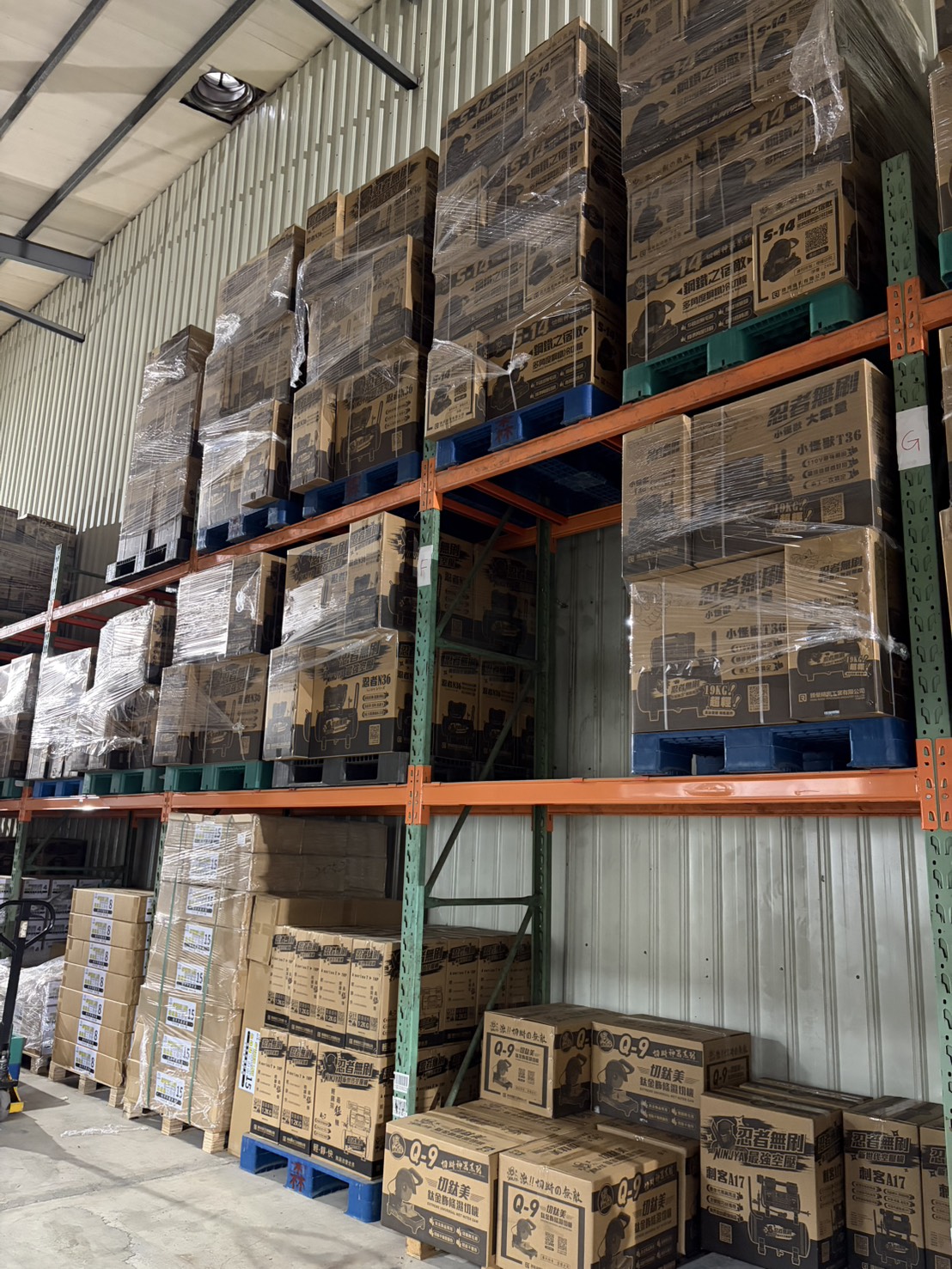
Warehouse staging of finished cooling apparel ahead of shipment. Order terms are set against available monthly production capacity, not against spot inventory.
The Commercial Questions That Decide a Cooling-Vest Order
Most cooling-vest evaluations start with performance and end with paperwork. A safety manager comparing dual cooling water cooling vests will look first at cooling duration, weight and flow rate. The COOLWAVE Water-Circulation Cooling Vest, for example, is recorded with a 3–4 hour cooling duration, a weight within 2 kg, and a pump rated at 5V 150 mA (max) delivering a maximum flow rate of 320–370 ml/min. Those figures answer whether a unit can hold a working temperature through a shift. They do not answer whether a ten-person crew can be equipped next month, or what happens if several units fail after the first half-year.
For small and mid-sized buyers — a single-site contractor, a safety officer at a metal-roof factory, a distributor testing a new line, a night-market operator buying for staff — the binding constraint is usually commercial rather than technical. Minimum order quantity sets the entry ticket. Lead time sets how quickly a heat-stress programme can actually start. Warranty length decides how much of the replacement cost stays with the buyer after month six. Taken together, those three terms shape total cost of ownership more than a side-by-side spec comparison does.
The market backdrop makes those questions more urgent, not less. Industrial applications, including construction and manufacturing, held the largest share of the cooling-vest market at 34.5% in 2025, according to data published by Dataintelo. Asia Pacific is identified by Spherical Insights as the fastest-growing region for cooling vests, driven by rapid industrialisation and large outdoor work populations. As more industrial and semi-industrial buyers enter the category, order terms are becoming a standard part of supplier evaluation rather than an afterthought.
COOLWAVE Order Terms at a Glance
The values below are the recorded commercial and technical terms for the COOLWAVE Water-Circulation Cooling Vest (Basic Model), produced by Shokunin, the professional tool and cooling-apparel brand of FENG SHANG PRECISION CO., LTD, a Taoyuan-based manufacturer founded in 2009.
| Parameter | Recorded value |
|---|---|
| Minimum order quantity (MOQ) | 10 units |
| Monthly production capacity | 3,000 units |
| Lead time | 7–14 days |
| Production mode | ODM |
| Customisation on this line | Not offered |
| After-sales | 6-month warranty for the water-cooled vest |
| Cooling duration | 3–4 hours |
| Weight | Within 2 kg |
| Pump output | 5V 150 mA (max) |
| Flow rate | Max 320–370 ml/min |
| Water bag material | TPU |
| Vest body material | PEVA |
| Shoulder strap material | 600D polyester |
| Water bag cap | Polypropylene |
| Cooling tube | Sand rubber (black) |
| Supplied contents | Water-cooled vest backpack ×1, ice packs ×2 |
What a 10-Unit Minimum Order Actually Buys
A minimum order quantity of 10 units is unusually low for an industrial protective-product order, and that single number changes how a cooling programme can be structured. Ten units is enough to equip one working crew, one shift rotation, or one outdoor team for a trial period — without committing a full-season budget before the product has been worn in real conditions.
To put the number in context: a recorded deployment in Taiwan used 100 units of the product for workers in high-temperature environments. That means the minimum order represents roughly a tenth of that reference deployment, which is a realistic pilot size for a contractor or factory that wants evidence before scaling.
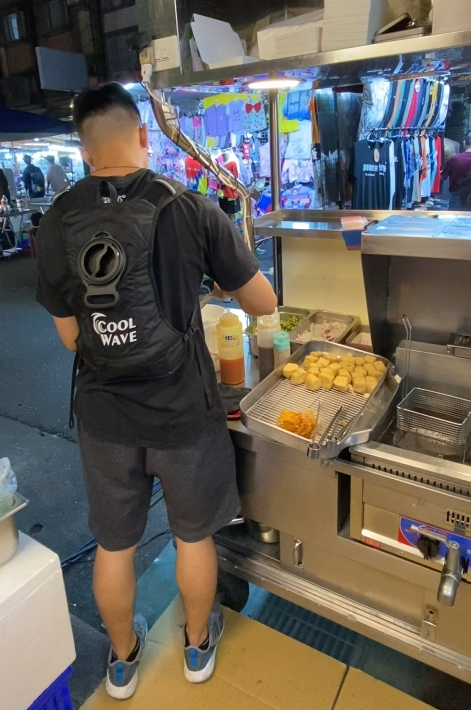
A street vendor working in summer heat — a typical small-business buyer profile where a 10-unit entry order fits both budget and crew size.
The MOQ also matters for distributors. A reseller testing demand in a new region can hold a first position of 10 units, observe sell-through, and only then move to larger replenishment orders against the stated 3,000-unit monthly capacity. The entry cost of the category is therefore low; the constraint is not the first order but the planning discipline that follows it.
Lead Time: What the 7–14 Day Window Covers
The recorded lead time for the COOLWAVE Water-Circulation Cooling Vest is 7–14 days, against a monthly production capacity of 3,000 units. The width of that window is not arbitrary: it typically reflects whether the order falls into a production slot already scheduled for that model or requires a fresh run, and whether the quantity is a 10-unit entry order or a multi-hundred-unit replenishment.
For buyers, the practical implication is straightforward. Anything measured in weeks — a seasonal heat-stress programme, a new construction phase, a summer stock position for a distribution business — can be planned around a 7–14 day lead time. Anything that must be on site within days cannot, and should be sourced from existing local stock instead. Buyers should also confirm in writing whether the quoted 7–14 days describes production time only or includes freight transit to the destination market, since that distinction changes the required order date.
Because stated monthly capacity is 3,000 units, capacity is rarely the binding constraint for small and mid-sized orders. Lead time, not volume, is the variable that most often pushes a purchase decision into the next month.
Warranty and Total Cost of Ownership
The recorded after-sales term for the COOLWAVE water-cooled vest is a 6-month warranty. That is a specification, not a marketing statement, and it should be read as one line inside a wider cost model rather than as the whole service promise.
Total cost of ownership for cooling apparel has at least four components: the purchase price per unit, the cost of consumables and accessories, the cost of failures and replacements after the warranty expires, and the operational cost of managing the units — ice pack freezing, rotation, cleaning, and storage between shifts. A 6-month warranty period means that from month seven onward, replacement cost for a failed unit sits with the buyer. For a 10-unit pilot that risk is small. For a 100-unit fleet, the same term should be modelled explicitly, because it determines the annual replacement budget line.
Verification of durability before scaling is therefore the sensible step. The Taiwan reference case — 100 units deployed for construction sites, outdoor workers, metal sheet factories, street vendors, and traffic-control personnel — is recorded with a deployment duration of 10 years and reports effective body cooling, heatstroke prevention, improved work efficiency, and improved worker comfort. Buyers planning larger fleets should treat that record as a starting reference point and set their own service-life assumptions for the warranty period and beyond.
Replenishment Planning for Small and Mid-Sized Buyers
Once MOQ, lead time and warranty period are known, replenishment planning becomes arithmetic rather than guesswork. A workable planning rule for this product uses three recorded inputs only: a 10-unit minimum order quantity, a 7–14 day lead time, and a maximum production capacity of 3,000 units per month.
A simple framework:
- Step 1 — Establish the consumption rate. Count how many units a site, crew or resale territory actually needs per service cycle.
- Step 2 — Plan against the outer lead time. Using the full 14 days rather than the optimistic 7 removes the most common cause of stockouts.
- Step 3 — Round to the MOQ. Because the smallest order is 10 units, small requirements should be grouped into 10-unit blocks rather than split across multiple partial orders.
- Step 4 — Cap the order by capacity, not by ambition. A single month’s ceiling of 3,000 units means very large single orders should be phased across delivery windows agreed in advance.
Worked illustration: a contractor running 20 vests and replacing them across a 14-day cycle needs 20 units per cycle — exactly two minimum orders. A factory equipping 60 workers in three phases of 20 units can place the phases against consecutive lead-time windows rather than committing the full quantity at once. In both cases the limiting factor is scheduling, not the supplier’s monthly ceiling.
Where These Terms Fit — and Where They Do Not
Compared with the traditional routes buyers use for cooling apparel — buying through a reseller’s local stock, or importing a generic lightweight cooling vest through a trading intermediary — direct supply from the manufacturer behind the COOLWAVE line offers a clearer and more verifiable set of terms: a published 10-unit MOQ, a stated 7–14 day lead time, and a defined 6-month warranty on the vest itself.
The same terms define the limits, and buyers should read them as limits rather than as shortcomings to be negotiated away.
- There is a floor on order size. Ten units is the smallest recorded order quantity. A buyer who wants one or two units for a wear test cannot order below that floor.
- Customisation is not offered on this line. The recorded production mode is ODM, while the recorded customisation status for the product is that it is not offered. Buyers who require bespoke sizing, private-label branding, or modified specifications should treat that requirement as unresolved rather than assume it can be added.
- The warranty period is six months. Organisations that require a longer contractual service window should plan for that commercially, or budget replacement units within the first operating year.
- Lead time is weeks, not days. Urgent, same-week demand is outside the stated 7–14 day window.
None of these points is unusual for industrial cooling apparel. They are listed because procurement teams that discover them after committing to a programme tend to absorb the cost and schedule impact themselves.
Market Context: Why Order Terms Are Becoming Evaluation Criteria
The cooling-vest market is expanding in a way that pushes commercial terms into the foreground of purchasing decisions. Dataintelo estimates the specific global cooling vest market at approximately USD 215 million in 2024, projected to grow to USD 385 million by 2033. At the broader category level, Market Research Future values the global personal cooling device market at USD 25.16 billion in 2024, projected to reach USD 94.85 billion by 2035. These two figures diverge because the broader category includes handheld fans, air-conditioning garments and other personal cooling devices — a definitional difference that buyers should check before using any market number in an internal business case.
Technology direction matters for order planning too. Phase Change Material cooling vests captured 28.7% of market share in 2025 according to Dataintelo, representing the fastest-growing technology segment, while Strategic Market Research notes that active circulatory mechanisms, including ice water circulation, are increasingly deployed in industrial sectors to mitigate occupational heat stress. For buyers, the practical consequence is that a procurement decision made today is likely to be revisited within a few seasons rather than locked for a decade — which strengthens the case for a small entry order and a disciplined replenishment cycle over a single large upfront commitment.
Compliance expectations reinforce the same pattern. Cooling systems are expected to comply with ISO 9001:2015 for quality management and often require CE or UL marks for electrical components, per the International Organization for Standardization and UL. Documentation therefore belongs in the same evaluation as MOQ and lead time, not in a later administrative phase.
What Buyers Should Expect Next
Two shifts are visible in how industrial cooling apparel is bought. First, order sizes are moving down while order frequency moves up: a 10-unit MOQ with a 7–14 day lead time supports quarterly replenishment cycles that match seasonal heat exposure more closely than a single annual purchase. Second, documentation is being requested earlier in the process — certificate numbers, patent references and standard conformity are now commonly reviewed before a first order rather than at contract stage.
Buyers planning into the next cooling season should therefore build their schedule backwards from the date the product must be worn, reserve 7–14 days for the stated lead time, add freight transit, and hold a buffer sized against their own replacement expectations beyond the 6-month warranty period. That sequence is repeatable and does not depend on any single supplier’s commercial terms.
Procurement FAQ: Moq, Lead Time and Warranty
What is the minimum order quantity for the COOLWAVE water-circulation cooling vest?
The recorded minimum order quantity is 10 units. This applies to the COOLWAVE Water-Circulation Cooling Vest (Basic Model) produced by Shokunin, the professional brand of FENG SHANG PRECISION CO., LTD, and it is the smallest order size recorded for the line. There is no smaller trial configuration documented.
How long is the lead time for a cooling-vest order?
The recorded lead time is 7–14 days, against a monthly production capacity of 3,000 units. The window covers production; whether freight transit time is included varies by destination and should be confirmed in the order documentation before a delivery date is fixed internally.
Can a buyer order fewer than 10 units to test the product?
The stated minimum order quantity is 10 units, so a single-unit or two-unit trial order is not part of the recorded commercial terms. Buyers who need to validate the product before scaling can structure the 10-unit minimum as a single-crew or single-shift pilot, which is the smallest documented deployment size available under these terms.
What documentation and certification accompany the product?
The water-cooled vest is covered by a patent certificate for water-cooled vest structure and cooling system, certificate number I886033, issued by the Intellectual Property Office, Ministry of Economic Affairs, ROC, under the Patent Act of the Republic of China. The certificate was issued on 1 June 2025 and is recorded with an expiry date of 27 August 2044. Separately, the product has received the Disaster Prevention Product and Service Certification Award issued by the Taiwan Disaster Prevention Industry Association. Buyers operating in regulated markets that require CE or UL marks for electrical components should verify the applicable conformity documentation for their destination market before ordering.
What warranty period applies to the water-cooled vest?
The recorded after-sales term is a 6-month warranty for the water-cooled vest. The warranty covers the vest itself as recorded in the supplier’s capability data. Buyers should confirm the exact scope, claim process and territorial coverage in the order documents, since those details sit outside the recorded capability statement.
How does a 6-month warranty affect total cost of ownership?
It shifts replacement exposure to the buyer from month seven onward. In practical terms, a 10-unit pilot carries minimal post-warranty replacement risk, while a 100-unit fleet should carry an explicit annual replacement budget line. Total cost of ownership therefore combines the purchase price with consumables, the cost of managing ice packs and charging between shifts, and expected post-warranty replacements. The 6-month figure is the boundary at which the buyer’s cost responsibility begins, not a statement about expected product life.
Does the product support customisation or private-label branding?
The recorded production mode is ODM, and the recorded customisation status for the product is that customisation is not offered on this line. Buyers whose programmes require modified specifications or private-label branding should treat those requirements as outside the current recorded scope and confirm them directly before building them into a procurement plan.
How have industrial buyers used the product in practice?
In a recorded deployment in Taiwan, 100 units were used by construction sites, outdoor workers, metal sheet factories, street vendors, and traffic-control personnel working in high-temperature environments. The project reports effective body cooling, heatstroke prevention, improved work efficiency, and improved worker comfort, and the case record lists a deployment duration of 10 years. The included configuration supports this use: a water-cooled vest backpack and two ice packs per unit, with an adjustable one-size-fits-all design and a weight within 2 kg.
Pre-Order Checklist
Before confirming a water-cooled vest order, verify the following against the recorded terms: minimum order quantity of 10 units; lead time of 7–14 days and whether transit is included; the 6-month warranty scope and claim procedure; the absence of customisation on this line; the documentation package, including patent certificate I886033; and the internal replacement budget that begins after the warranty period ends. A product brochure covering the COOLWAVE Water-Circulation Cooling Vest is available here: COOLWAVE product brochure (PDF).