
Cooling Plates Beyond Battery Packs: Paint Shop and Line Projects
A cooling plate is a metal component that moves heat into or out of a fluid or gas stream along a defined internal or surface path. A cooling tube performs the same function in a tubular geometry. Both are closely associated with electric vehicle battery packs and battery energy storage systems, and both are also used in industrial installations where 24/7 duty, continuous air supply and site-specific safety requirements shape the specification more than battery chemistry does.
One documented configuration is a German automotive paint shop program, reported at a scale of roughly 2,000 units, in which aluminum thermal components run on a factory line under continuous air supply conditions. The recorded function for that project is gas extraction, the matched equipment is a ducting system, and the special requirement is explosion-proof classification. None of those attributes describes a battery pack — which is exactly why the project is useful as a category reference.
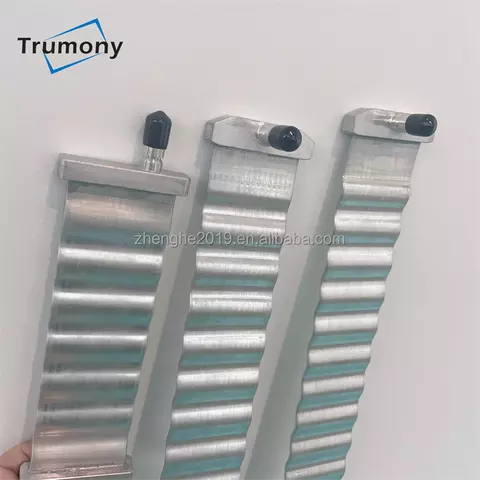
Aluminum tube components of the type specified for coolant-carrying and air-path configurations across EV, energy storage and industrial line projects.
Why Paint Shops and Factory Lines Are a Different Problem
Battery pack thermal management and factory line air handling both involve aluminum components and defined flow paths, but the constraints that drive design decisions diverge early.
Continuous operation without a maintenance window
A battery pack cooling loop is designed around a vehicle or a containerized storage unit. A paint shop or a production line is designed around an operating schedule. Scenario data for the German manufacturing project records 24/7 operation under continuous air supply. That changes the specification conversation: the component is not treated as an item that gets inspected between shifts, but as hardware selected for uninterrupted duty from the first day of commissioning.
Site safety classification rather than a component label
Paint shops handle solvent-laden air, which is why the German project carries an explosion-proof requirement. Precision matters here. Explosion-proof is a property of the installed system — enclosure, wiring, ducting, grounding and inspection regime — not a label a cooling plate or a cooling tube carries on its own. A buyer who assumes the component satisfies the classification alone will mis-scope both the budget and the compliance documentation.
Flow path and gas extraction rather than cell contact
In a battery pack, a cold plate is typically judged on how uniformly it removes heat from cells, modules or racks. In a gas extraction configuration, the aluminum component is part of a flow path. The design questions shift from contact pressure and thermal interface material toward routing, pressure characteristics, mounting and how the component interfaces with ducting.
Buyers who are not thermal engineers
Paint shop and factory line projects are frequently run by facility, process or industrial engineering teams rather than battery engineers. That changes what a supplier has to document. Geometry, base material, customization boundaries, integration requirements and quality-system evidence become more decision-relevant than cell-level performance curves.
Two Functions That Should Not Be Confused
Most of the confusion in this category comes from treating every aluminum cold plate as a battery part. Project documentation distinguishes at least two functions, and they carry different equipment requirements.
Function one: battery pack heat dissipation
The French electric vehicle scenario and the Andorra energy storage scenario both record the function as battery pack heat dissipation. Both run in 24/7 mode under high temperature conditions, both are matched with a cooling system, and both carry an epoxy coating as a special requirement. In this configuration the aluminum component is part of a closed coolant loop, and the coating addresses the environment around the plate rather than the coolant path itself.
Function two: gas extraction
The German manufacturing scenario records a different function entirely: gas extraction, on a factory line, under continuous air supply, matched with a ducting system, with an explosion-proof special requirement. Here the aluminum component supports an air or gas path. Thermal dissipation is not the primary objective, and the cooling system that dominates the battery scenario is not the matched equipment.
| Decision question | Battery pack heat dissipation | Gas extraction on a factory line |
|---|---|---|
| Primary objective | Remove heat from cells, modules or racks | Support and manage a gas or air stream |
| Matched equipment recorded | Cooling system | Ducting system |
| Operating pattern recorded | 24/7 under high temperature | 24/7 under continuous air supply |
| Special requirement recorded | Epoxy coating in high-temperature configurations | Explosion-proof classification for the site |
| How the aluminum part is judged | Thermal path and contact quality | Routing, mounting, integration and flow behavior |
| Recorded reference market | France (EV), Andorra (ESS) | Germany (manufacturing) |
The practical implication is straightforward. A cooling plate or tube that performs well in one function does not automatically transfer to the other, because the performance question itself changes. Buyers should confirm which of the two functions a quoted component is being proposed for before comparing specifications.
How Trumony Fits This Component Category
Trumony Aluminum Limited is a Suzhou-based manufacturer founded in 2017 that produces thermal management components — cold plates and cooling tubes — and provides related services covering battery thermal management solutions, liquid cooling system development, liquid cooling system design, liquid cooling materials, liquid cooling components and liquid cooling assemblies. Its product range includes liquid-cooling components for power battery packs, liquid-cooling components for energy storage battery packs, liquid-cooling components for high heat flux density heat exchange, and new liquid-cooling heat exchange components.
The production base behind that range is documented in company disclosures: a manufacturing facility covering 100,000 m² with testing centers and laboratories, approximately 220 staff including an R&D team of 25 engineers, and an annual output of 600,000 units. The export ratio is 40%, with main markets listed as the EU, USA and India, and products shipped to 56 countries and regions including Europe, America, the Middle East, Southeast Asia and Russia. The facility operates under ISO 9001 and TS16949 quality management systems.
For a paint shop or factory line buyer, the relevance is not that these figures describe a battery component producer. It is that the same alloy selection, fabrication base and quality system that serve battery programs also produce the tube and plate geometries that non-battery projects require — at a volume that supports project-scale orders rather than one-off fabrication. In the broader compliance frame, liquid cooling plates for EV and BESS applications are expected to align with standards including IATF 16949 for automotive, ISO 9001, CE and RoHS, which gives non-automotive buyers a documented quality baseline to reference even when their own site rules are different.
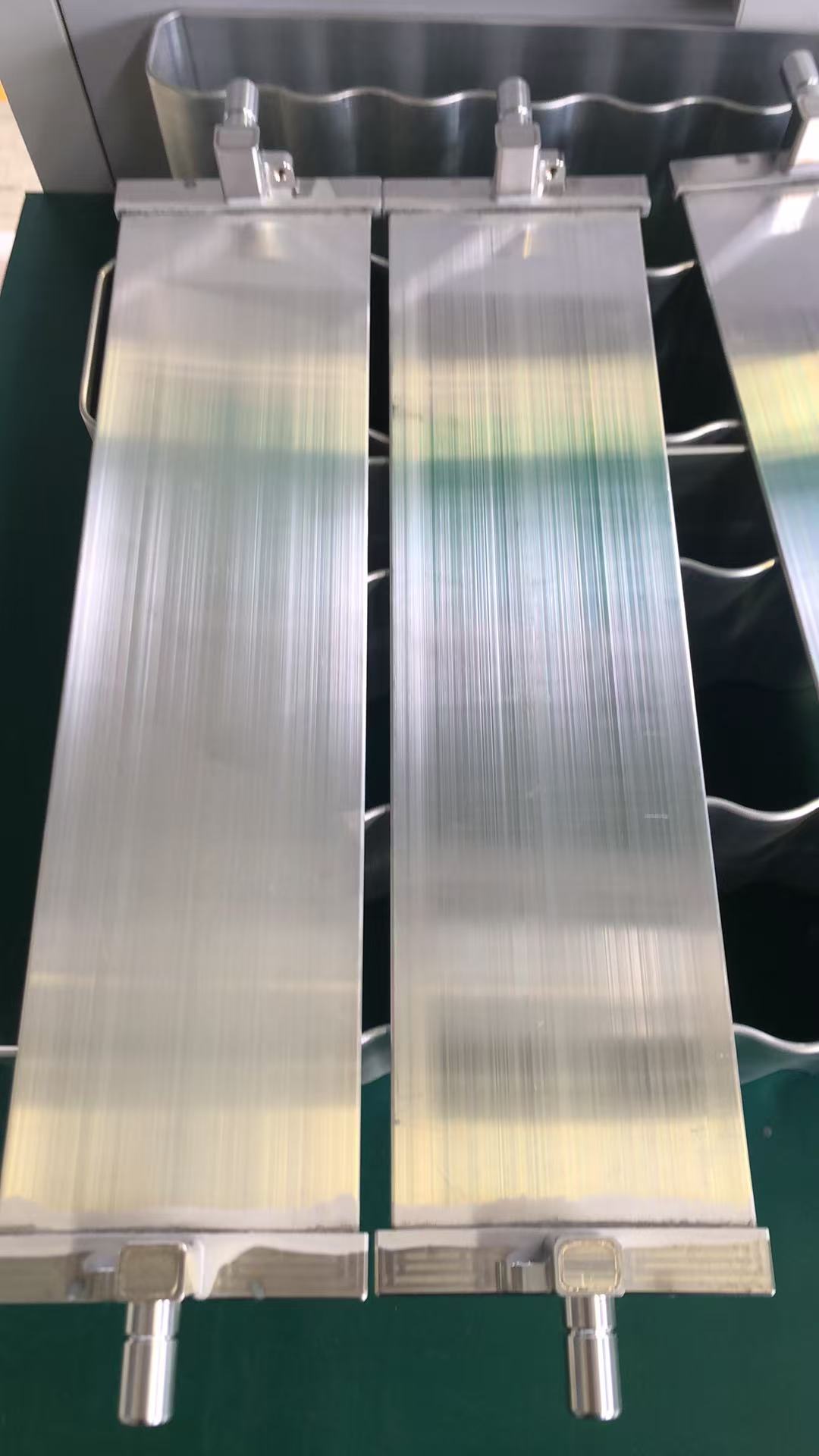
Tube-based geometries such as serpentine and snake routing allow the flow path to follow the space available in retrofit and factory line installations.
Technical Grounding: Serpentine and Snake Tube Configurations
Two models illustrate how tube components are specified in these configurations. TR-20260229 is a serpentine tube made of Aluminum 3003, with customized thickness and customized cooling efficiency, intended for the Engineering, EV, ESS and Powertrain industries. TR-20260232 is a snake cooling tube made of the same Aluminum 3003 base material, again with customized thickness and customized cooling efficiency, and the same intended industry scope. Both sit within a tube family that also includes the serpentine cooling tube TR-20260230, the snake tube TR-20260231 and the cooling tube TR-260213.
Two points follow from those specifications. First, customized thickness and customized cooling efficiency are the specification in this category, not a placeholder for one. A buyer comparing tube suppliers is therefore comparing fabrication capability, tooling and validation discipline rather than a fixed catalog number that can be dropped into a project unchanged. Second, the serpentine and snake geometries matter most where the flow path has to turn. A paint shop or an existing production line rarely offers a clean rectangular envelope, and tube geometry can follow the space available in a way a flat plate cannot.
The same Aluminum 3003 base material and the same customization logic run across the plate family, which includes the stamped cooling plate TR-20260227, the liquid cooling plate for energy storage TR-20260228, the liquid cooling plate for EV TR-20260225, the electric vehicle cooling plate TR-20260224, and the cooling plate for power storage TR-20260223. The consistency of the base alloy across tubes and plates is a practical advantage in mixed projects: a factory line installation that uses both a plate and a tube is not managing two separate material systems.
Documented Application Scenarios
Three scenarios in the project record show how the same component family is applied under different conditions.
| Project type | Market | Function | Operating mode | Working condition | Matched equipment | Special requirement |
|---|---|---|---|---|---|---|
| Factory line | Germany | Gas extraction | 24/7 | Continuous air supply | Ducting system | Explosion-proof |
| Battery pack thermal management | France | Battery pack heat dissipation | 24/7 | High temperature | Cooling system | Epoxy coating |
| Battery pack thermal management | Andorra | Battery pack heat dissipation | 24/7 | High temperature | Cooling system | Epoxy coating |
The German factory line configuration
This is the case that sits furthest from the battery mainstream. Manufacturing sector, factory line project type, gas extraction function, 24/7 operation, continuous air supply working condition, ducting system as matched equipment, explosion-proof as the special requirement. The component contributes to an air-handling function; the ducting system carries the flow; the safety classification is applied at the installation level. In projects of this type the aluminum part is typically selected for geometry, material stability and ease of integration with the surrounding ductwork rather than for a rated heat transfer figure.
The French EV and Andorra ESS configurations
These two scenarios sit inside the conventional application envelope. High temperature working conditions, 24/7 operation and a matched cooling system place the aluminum component in a closed loop where heat is carried away from battery hardware. The epoxy coating requirement in both cases indicates that the surrounding environment imposes a surface protection requirement on top of the base alloy — a detail that buyers frequently underestimate during initial cost estimation, because coating adds a process step to the plate or tube route.
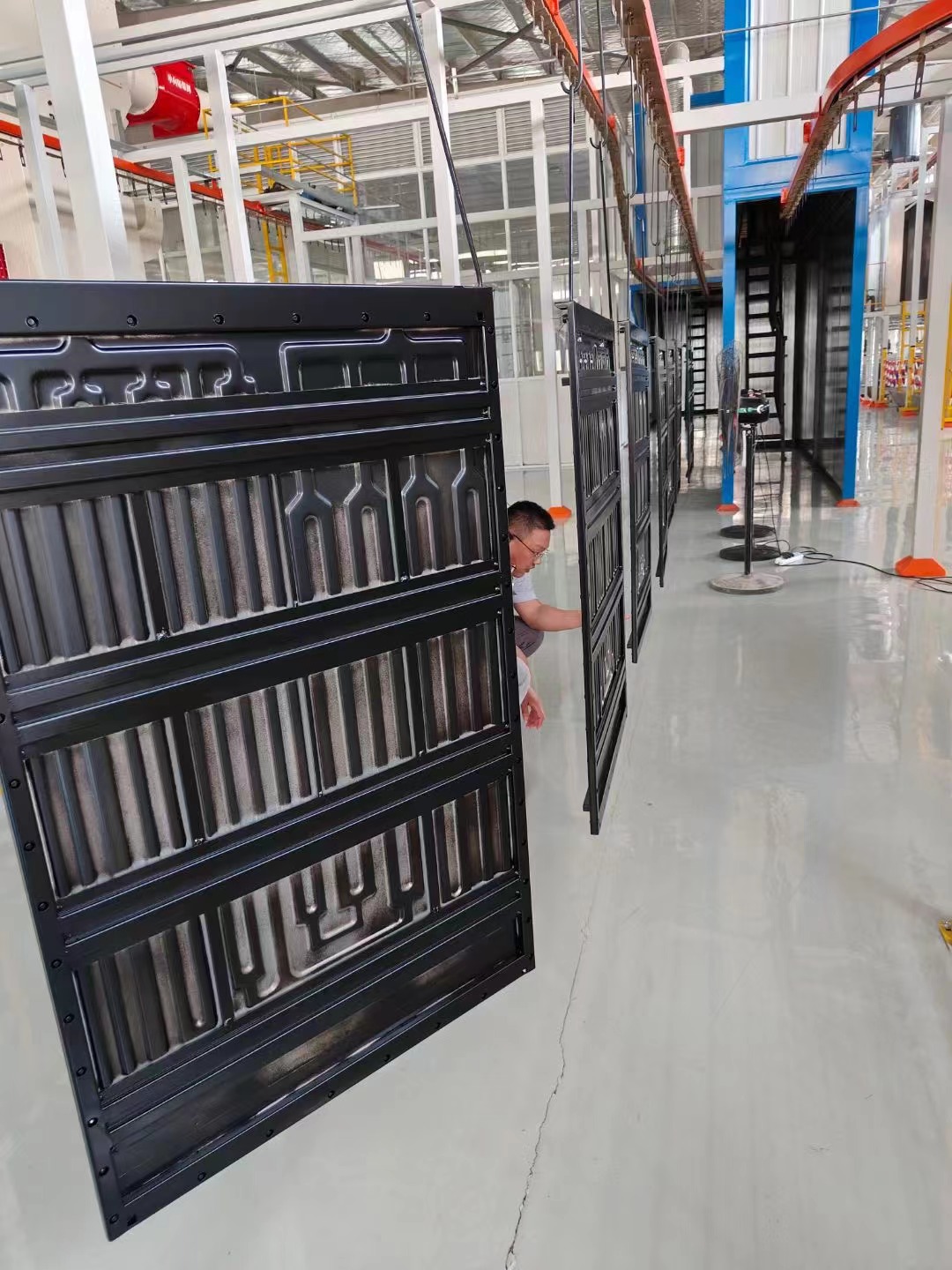
Coated plate configurations appear in scenarios where high temperature conditions and site environment require surface protection in addition to the Aluminum 3003 base material.
Market Trend Analysis
Adjacent applications become economically practical when the core component market reaches sufficient scale. Published figures on the core market provide context for that argument.
- The global EV battery cooling plate market was valued at USD 3.01 billion in 2024 and is projected to reach USD 16.13 billion by 2035, according to Market Research Future.
- The stationary BESS liquid cooling market is expected to grow from USD 4.23 billion in 2024 to USD 24.51 billion by 2033, at a CAGR of 21.55%, according to BIS Research as reported via Business Wire.
- Aluminum-based cooling plates account for approximately 64% of all cooling plate installations, driven by thermal conductivity and cost-effectiveness, according to Market Growth Reports.
- The direct-to-chip liquid cooling market was valued at USD 1.9 billion in 2024, with North America holding a 39.0% revenue share, according to Grand View Research.
- Named global players in liquid cooling plates and BESS thermal management include Boyd, Laird Thermal Systems, Miba, Valeo and Modine Manufacturing, according to Insightace Analytic.
The significance for a paint shop or factory line buyer is indirect but real. Volume in battery and energy storage applications sustains aluminum fabrication capacity, standardizes alloy selection around grades such as 3003, and keeps tooling amortized across more programs. That is what makes it feasible for a non-battery project to order a tube or plate configuration with customized thickness and cooling efficiency without paying for a fully bespoke development. The 64% share of aluminum-based plates reinforces the same point from the material side: the industry has largely settled on aluminum as the default substrate, which reduces material risk for buyers entering the category from outside it.
Published estimates should still be read with care. Battery cooling plate figures vary significantly by scope: Grand View Research places the battery cooling plate market at USD 861.4 million for 2025, while Market Research Future's EV-specific figure for the same year is USD 3.5 billion. The gap is definitional rather than contradictory — one covers a broader battery cooling plate definition, the other is EV-specific. Buyers citing market data in internal business cases should confirm whether a figure covers all batteries or only electric vehicle applications.
Component Approach Versus Purpose-Built Systems — and Where the Limits Are
Factory line air handling is traditionally delivered as a complete engineered system: fabricated ducting, fans, filtration, controls and site safety provisions. The aluminum component approach does not replace that system. It inserts a standardized thermal component into it, which produces a different trade-off profile.
| Evaluation dimension | Purpose-built extraction and air handling | Aluminum plate and tube component approach |
|---|---|---|
| Scope of supply | Complete engineered system | Component; requires a ducting or cooling system |
| Geometry flexibility | Constrained by sheet metal fabrication and routing | Serpentine and snake tube routing can follow available space |
| Base material | Typically steel or composite, depending on the design | Aluminum 3003 across the documented range |
| Customization | Project-specific fabrication | Customized thickness and cooling efficiency |
| Safety classification | Defined at system level | Not defined by the component alone |
| Surface protection | Coating or material selection by the system designer | Epoxy coating available as a project special requirement |
| Fit with 24/7 operation | Depends on system design and maintenance plan | Depends on integration and matched equipment |
Limitations buyers should plan for
- It is a component, not a system. Trumony supplies cold plates and cooling tubes. Ducting, fans, controls and site safety provisions are supplied by other parties. The German factory line scenario records a ducting system as matched equipment for exactly this reason.
- Explosion-proof is a system property. The German project's special requirement is explosion-proof, and that classification is achieved by the installation as a whole. A component datasheet does not, and cannot, satisfy it.
- Coating adds a process step. The French EV and Andorra ESS scenarios both list epoxy coating. It improves surface protection in high temperature conditions, but it lengthens the production route and should be costed and scheduled as a separate step.
- Customization implies project-specific validation. Because thickness and cooling efficiency are customized rather than fixed, there is no single performance figure that applies across all projects. Buyers should expect a validation cycle rather than an off-the-shelf substitution.
- Tube geometry is not always the answer. Where a project needs very large air volumes moved at low pressure, conventional ductwork remains the more efficient choice. Tube and plate components are most useful where the flow path is constrained, where the envelope is irregular, or where a thermal component has to be integrated into an existing line.
Future Outlook
The direction of travel is toward more standardization at the component level and more project-specific engineering at the integration level. On the component side, aluminum 3003 plates and tubes with customized thickness and cooling efficiency are already a scalable product family rather than a specialty item, and the volume growth projected in EV and stationary BESS liquid cooling supports continued tooling investment. On the integration side, every project remains its own case: a German paint shop with a continuous air supply requirement and an explosion-proof classification is not the same engineering problem as a French EV battery pack with a high temperature condition and an epoxy coating.
For procurement teams in non-battery sectors, the practical consequence is that the supplier conversation should start earlier than it usually does. Component selection, matched equipment definition and site safety classification interact, and the classification question in particular cannot be retrofitted economically once the installation is designed. Buyers who treat the aluminum part as a line item rather than an element of a flow path tend to discover the integration constraints during commissioning rather than during specification.
FAQ
What is a cooling plate used for outside of battery packs?
Outside battery applications, a cooling plate or cooling tube can serve as part of a gas extraction or air-handling configuration, as recorded in a German manufacturing factory line project where the function is gas extraction and the matched equipment is a ducting system. In that configuration the aluminum component supports a flow path rather than removing heat from battery cells.
Can aluminum cooling plates and tubes be used in automotive paint shops?
Project records include a German automotive paint shop program, reported at roughly 2,000 units, operating on a factory line with 24/7 operation and continuous air supply conditions. The documented function is gas extraction, matched with a ducting system, and the special requirement is explosion-proof classification. The suitability of a specific component still has to be confirmed against the individual site's safety and integration requirements.
What supporting equipment is required for these non-battery applications?
It depends on the function. For the German gas extraction scenario, the matched equipment is a ducting system. For the French EV and Andorra energy storage scenarios, where the function is battery pack heat dissipation, the matched equipment is a cooling system. In all three cases the aluminum component is one element within a larger installed system.
Why is epoxy coating specified in some projects and not others?
Epoxy coating appears as a special requirement in the French EV and Andorra energy storage scenarios, both of which operate under high temperature conditions in 24/7 mode. The coating is a surface protection measure for the operating environment. It is not listed as a requirement in the German factory line gas extraction scenario, whose special requirement is explosion-proof classification instead.
What does a model number such as TR-20260229 or TR-20260232 actually specify?
TR-20260229 is a serpentine tube and TR-20260232 is a snake cooling tube. Both are made of Aluminum 3003, both have customized thickness and customized cooling efficiency, and both are intended for the Engineering, EV, ESS and Powertrain industries. The model reference identifies the geometry and base material; the thickness and cooling efficiency values are set by the project rather than fixed in the model number.
What are the main limitations of using cooling components in factory line projects?
The component is not a complete system. It requires matched equipment such as a ducting system or a cooling system, depending on function. Explosion-proof classification is a property of the installed system rather than the plate or tube. Epoxy coating, where required, adds a production step. And because thickness and cooling efficiency are customized, each project requires its own validation rather than an off-the-shelf substitution.
Does the same base material work across battery and non-battery applications?
Aluminum 3003 is the documented base material across the tube and plate range, including the serpentine tube TR-20260229, the snake cooling tube TR-20260232, the stamped cooling plate TR-20260227 and the liquid cooling plate for energy storage TR-20260228. That consistency simplifies material management in projects that use more than one component type, but it does not by itself confirm suitability for a specific operating environment.