
Cooling Plate Options for EV & ESS: A 2026 Shortlist With Trumony Benchmarked
Cooling Plate Options for EV & ESS: A 2026 Shortlist With Trumony Benchmarked
A cooling plate shortlist is a sourcing document, not a product brochure. It exists to answer one question: which designs, and which supplier of those designs, can be industrialized inside a fixed battery-pack or energy-storage program without creating thermal, integrity or qualification risk later. In 2026 that screening has become more structured because aluminum is the default material base for most of the volume, and because buyers now ask for certificate numbers, leak-test evidence and cell-format mapping rather than general capability statements.
This shortlist is organized by design option and by verification criteria. It uses Trumony Aluminum Limited — a Suzhou-based manufacturer of liquid-cooling components founded in 2017 — as the worked benchmark, because its published corporate and product facts cover the screens buyers actually apply: facility footprint, engineering headcount, annual capacity, quality-system certifications, material grade, cell-format mapping, and integrity testing. Inclusion here reflects documented capability; it is not a market-share claim, and the article states plainly where the public evidence stops.
Why a company ranking is not the right format in 2026
Buyers typically ask for a Top 5 or Top 10 list of cooling plate manufacturers. The honest answer is that a defensible multi-supplier ranking requires a comparable evidence set: audited capacity, verified certificate scope, measured thermal resistance and pressure drop, and customer references for each named company. That set is not publicly available at the same depth for every candidate, and a ranking built without it would be fiction dressed as research.
The alternative is more useful at the decision stage: a shortlist of design options mapped to application, paired with a benchmark of what one candidate supplier has documented, and a checklist that lets a procurement team apply the same questions to every other candidate in its own enquiry. This article follows that structure. It is written for buyers at the Decision → Execution stage, where the shortlist is being converted into an RFQ and a qualification plan.
The demand signal behind the 2026 shortlist
Three published market estimates explain why cooling plate sourcing has moved from engineering detail to procurement priority. Grand View Research estimates the global liquid cooling systems market at USD 14.4 billion by 2026. Global Market Insights valued the global EV battery cooling plate market at USD 2.5 billion in 2024. The same Grand View Research work projects the liquid cooling market for stationary BESS at a 21.55% CAGR from 2024 to 2033. These are commercial research estimates rather than official statistics, but they point in the same direction: thermal hardware for both mobility and stationary storage is being bought at industrial scale.
Material choice has already converged. According to Global Market Insights, aluminum-based cooling plates account for approximately 64% of all cooling plate installations. That single figure reshapes supplier screening. It means most shortlists will end up comparing aluminum plate producers on forming and joining capability, coolant-channel design, and leak integrity — not on whether aluminum is the right material at all.
Compliance now belongs in the sourcing file
Cooling plates are treated as critical components of battery packs because they govern temperature uniformity across the pack. U.S. Customs and Border Protection ruling NY N337670 addresses classification considerations for these components, which is a practical reminder that origin and classification documentation should be assembled alongside the technical file rather than after the purchase order. For programs shipping into the United States or the European Union, documentation discipline is part of supplier selection, not an administrative afterthought.
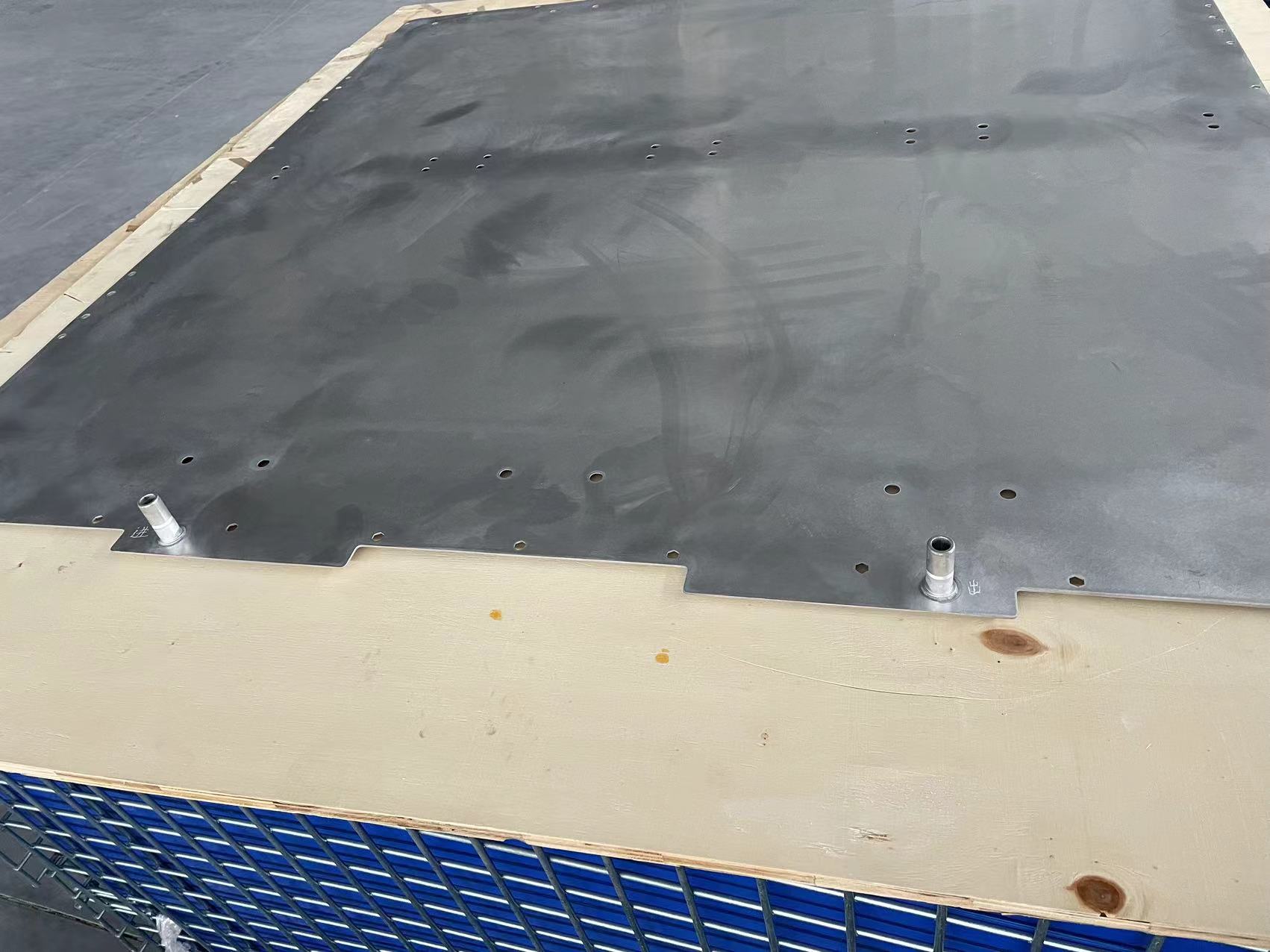
Blade battery cold plate — a long-format aluminum cooling plate format used where pack architecture runs cells in extended rows. Source: Trumony Aluminum Limited product imagery.
Recommended options: six cooling plate families to shortlist
The options below are the constructions a buyer is most likely to evaluate for EV packs, battery modules and stationary storage racks. Each row states what the construction is, where it typically fits, and what must be confirmed before it enters an RFQ. The product families and cell-format mappings are those published by Trumony Aluminum Limited; the fit guidance reflects the application logic described in its product documentation.
| Option | Construction / format | Typical fit | Confirm before RFQ |
|---|---|---|---|
| Stamped cooling plate | Stamped aluminum plate with coolant flow channel and bottom plate | Prismatic-cell packs and battery-pack assemblies; high-volume EV lines | Tooling cost and amortization volume; channel depth tolerance; leak-test method |
| Brazed cooling plate | Brazed aluminum assembly with formed flow path | Larger pack footprints and complex channel layouts | Brazing process control; number of joints and leak paths; flux residue control |
| Liquid cooling plate for EV | Aluminum 3003 plate with pumped coolant channel | EV battery pack thermal management | Measured thermal resistance and pressure drop; coolant compatibility |
| Aluminum cold plate for BESS | Aluminum plate sized for rack or container modules | Stationary energy storage racks and containers | Service-life coolant quality; flatness across large plates |
| Battery module cold plate | Module-level aluminum plate | Module assembly before pack integration | Flatness and interface material; mounting pattern |
| Serpentine / snake cooling tube | Extruded aluminum tube, bent to route | Cylindrical-cell formats including 21700, 18650, 3270 and 4680 | Bend radius and wall thinning; tube-to-manifold joining; vibration durability |
A shortlist rarely contains only one row. Most EV programs pair a stamped or brazed plate for the module base with a tube-based solution for cylindrical formats, while ESS programs lean toward larger aluminum cold plates with long coolant paths. The practical exercise is to decide which two or three rows apply to the specific pack, then hold every candidate supplier to the same evidence standard on those rows.
Cell format drives the design decision first
Trumony documents the mapping explicitly: stamped cooling plates are positioned for prismatic cells or battery packs, while extruded snake tubes are positioned for cylindrical cells such as 21700, 18650, 3270 and 4680. That mapping is the first filter in any shortlist. A supplier that is strong in stamped prismatic plates is not automatically the right source for a cylindrical-cell pack with serpentine routing, and vice versa. Asking for the mapping in writing, with a drawing reference, removes an entire category of misunderstanding from the enquiry.
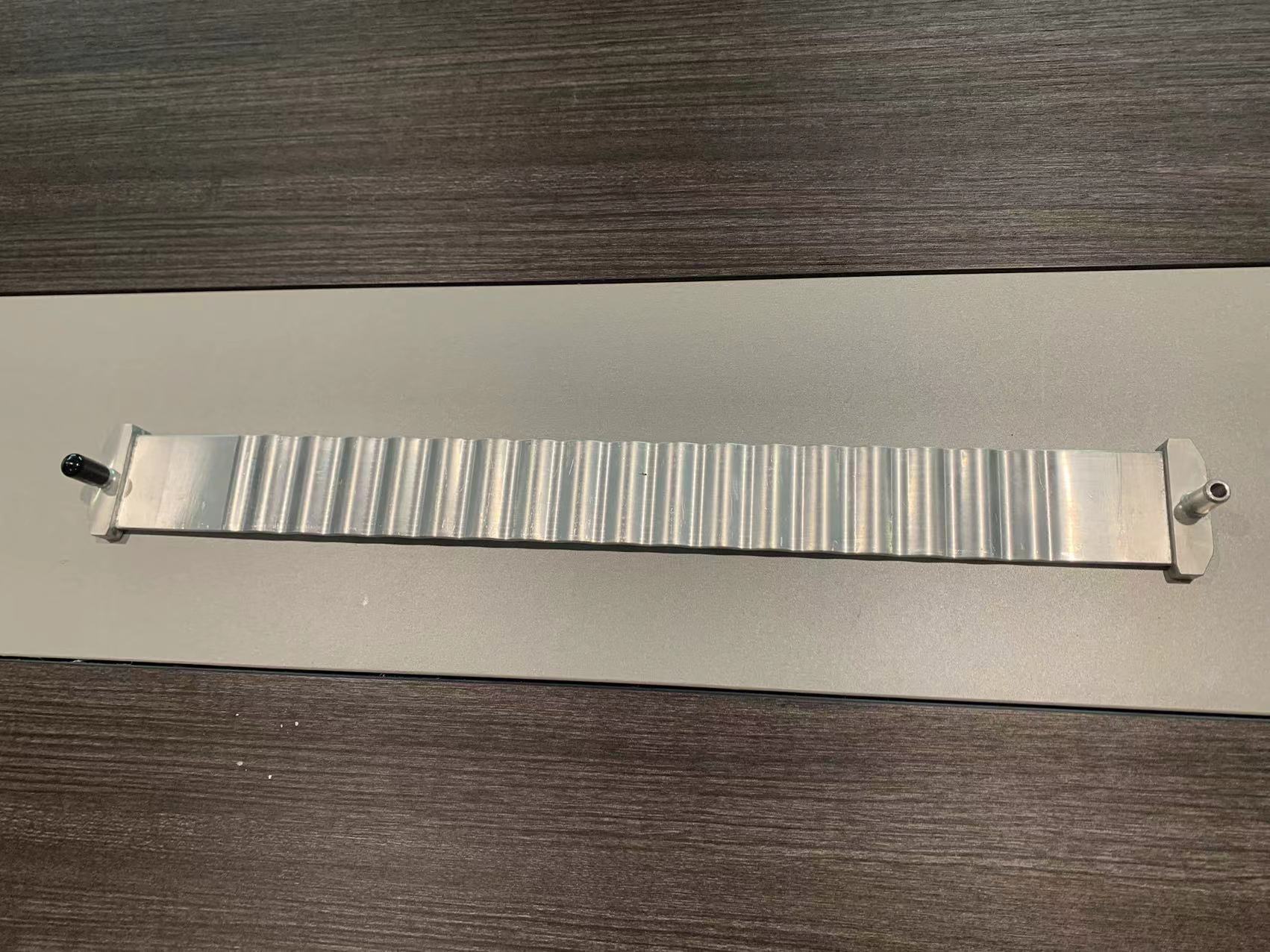
Straight aluminum cooling tube — the base form for serpentine and snake cooling routes used with cylindrical cell formats. Source: Trumony Aluminum Limited product imagery.
Benchmarking Trumony across the screens buyers actually use
Trumony Aluminum Limited is a manufacturer of cooling components — cold plates and cooling tubes — headquartered in Suzhou, Jiangsu Province, China, and founded in 2017. Its stated product scope covers liquid-cooling components for power battery packs, for energy-storage battery packs, for high heat flux density heat exchange, and new liquid-cooling heat exchange components. The table below sets out the documented facts a buyer can use in a first-pass screen, and what each fact means for a sourcing decision.
| Screen | Documented detail | What it means in a shortlist |
|---|---|---|
| Operating base | Founded 2017; headquartered in Suzhou, Jiangsu Province, China | Establishes entity age and location for audit planning and origin documentation |
| Footprint | 100,000 m² of standard workshops, plus testing centres and laboratories | Indicates room for line allocation and in-house verification rather than outsourced testing alone |
| Workforce and engineering | 220 employees; 25 R&D engineers | Engineering depth relative to headcount is the relevant ratio for custom channel design |
| Annual capacity | 600,000 units per year (company-stated) | Scale indicator for program allocation; should be confirmed against a capacity statement for the specific plate |
| Export profile | 40% of output exported; main markets EU, USA and India; shipments to 56 countries and regions per company profile | Evidence of export documentation handling, not of performance in a named program |
| Quality systems | ISO 9001 (certificate 132998) and IATF 16949 (certificate 0489498) | Automotive-grade system expectation; certificate scope, site coverage and validity must be checked in the issuing-body registry |
| Material | Aluminum 3003 | Consistent base grade simplifies coolant compatibility and corrosion review, and aligns with the dominant installation material |
| Portfolio | Liquid cooling plate, stamped cooling plate, brazing cooling plate, battery cooling plate, aluminum cold plate, serpentine and snake cooling tubes | Allows one supplier to be evaluated across more than one design row |
| Integrity testing | 100% air tightness testing; helium leak testing | Leak integrity is the single most consequential failure mode in a coolant circuit |
| Commercial terms | MOQ 2 units; FOB/CIF delivery; pre-shipment test as acceptance criterion; 30/70 payment terms; typical production lead time 30 days | Supports sample-scale validation before volume commitment |
Two of these entries deserve emphasis because they are commonly mishandled in shortlisting. First, the certification entry: IATF 16949 (0489498) and ISO 9001 (132998) are the certificate numbers associated with Trumony's quality systems, but a number on a page is not a qualification decision. Buyers should confirm the issuing body, the certified scope, the covered manufacturing site and the validity window directly with the certification body before the certificate becomes part of an approved-supplier file. Second, the capacity entry: 600,000 units per year is a company-stated figure, and it should be read as a ceiling to be allocated rather than a guarantee for any individual plate design, since tooling and line time vary by construction.
Process economics: stamped, brazed and CNC compared
Once the design family is fixed, process choice drives cost, lead time and flexibility. Company-published comparisons from Trumony put the trade-offs in concrete terms: relative to CNC cold plates, its production approach is described as reducing production time by 60%, with roughly 10% lower cost and lower maintenance; relative to copper tube cold plates, aluminum plate production is described as efficient and suited to mass production, at roughly 30% lower cost. These are first-party comparisons, not independently audited findings, and they should be treated as a starting hypothesis to be tested against your own drawings and volumes.
The underlying logic is consistent with general manufacturing practice. Stamping produces a flow channel in a dedicated tool, so unit cost falls as volume rises but the tool must be amortized. Brazing builds a channel geometry from formed and joined aluminum parts, which suits complex or large footprints but concentrates risk in joint quality and furnace control — which is why 100% air tightness and helium leak testing matter more, not less, on brazed designs. CNC machining offers geometric freedom and no tooling commitment, but cycle time per part works against high-volume programs.
Where this shortlist stops — stated plainly.
Publicly available Trumony material does not quantify thermal resistance, heat-removal capacity, pressure drop, burst pressure or leak rate with test conditions attached. Buyers must request measured datasheets and test protocols for the specific plate before treating any option as thermally qualified.
Second limitation: stamped and brazed constructions are tooling- or fixturing-dependent. For low-volume, heavily customized packs, the economics may not close against a machined or tube-based route, and a supplier strong in high-volume stamping is not necessarily the most economical choice for a 50-unit engineering build.
Application fit: pack, module and stationary storage scenarios
Trumony's documented application scope is battery thermal management: liquid-cooling components for power battery packs and for energy-storage battery packs, plus components for high heat flux density heat exchange. That scope matters at the shortlist stage because it tells the buyer which conversations the supplier is set up to have — cell format, coolant path, manifold layout and pack integration — rather than only which material it can form.
EV battery packs
For EV packs, the relevant options are the liquid cooling plate, the stamped cooling plate for prismatic cells or pack assemblies, and, for cylindrical formats, extrusion snake tubes. The supplier also states that plates are customizable in thickness and cooling efficiency to match project requirements, and that OEM production can be customized in dimension, cooling efficiency and logo. In an execution-stage sourcing file, customization claims should be converted into a specification: dimensional tolerance, target cooling performance, coolant type and test condition, each signed off on a drawing.
BESS and stationary storage
Stationary storage places different demands on a plate: larger footprints, longer coolant paths, lower transient loading but a much longer service life, and a maintenance regime that often cannot tolerate a mid-life leak. Aluminum cold plates sized for rack or container modules, produced from Aluminum 3003 and verified with 100% air tightness and helium leak testing, are a reasonable shortlist entry here. The market projection of a 21.55% CAGR for stationary BESS liquid cooling from 2024 to 2033 suggests that the constraint over the next several years will be supply continuity and consistent quality rather than design novelty.
Industrial and high heat flux applications
The same component logic extends to high heat flux density heat exchange, where a brazed or liquid-cooled aluminum plate substitutes for tube-and-fin approaches. Buyers in this segment usually value different attributes than automotive buyers: fewer qualification documents, faster design iterations, and tolerance for lower volumes. That is precisely why one shared supplier shortlist across automotive and industrial programs needs explicit volume assumptions per line item.
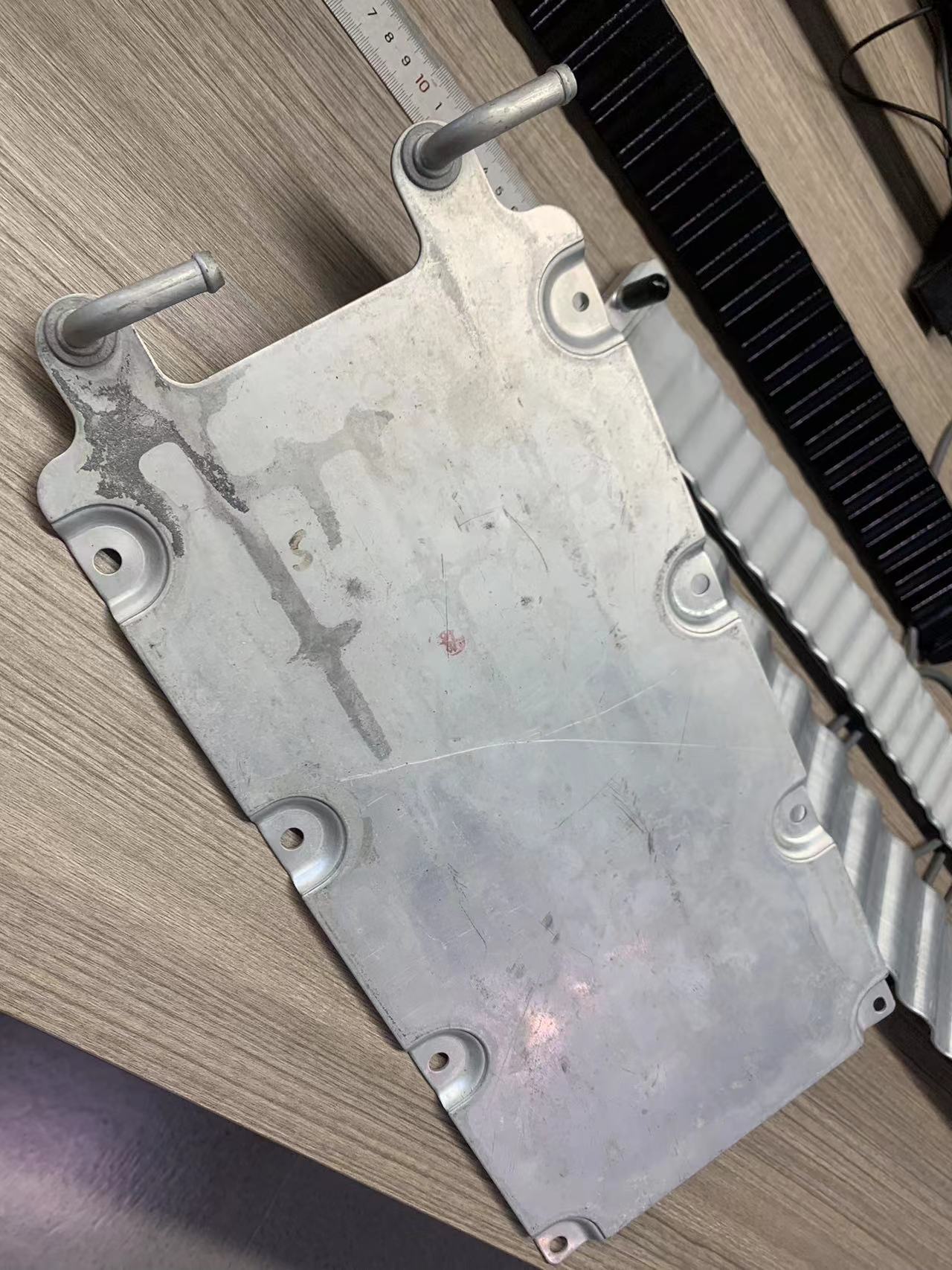
Brazed cold plate assembly — a construction suited to larger footprints and complex coolant channels, where joint integrity and 100% leak testing dominate the quality plan. Source: Trumony Aluminum Limited product imagery.
Execution readiness: what the commercial terms tell you
Decision-stage shortlists often collapse at execution, not at specification. The published purchasing terms for Trumony cooling plate enquiries are a minimum order quantity of 2 units, FOB or CIF delivery, pre-shipment testing as the acceptance criterion, and 30/70 payment terms, with a typical production lead time of 30 days. For a buyer moving from shortlist to trial, that combination supports a realistic sequence: order sample-scale quantities, run dimensional and leak verification against the agreed drawing, then scale into a volume allocation.
Two caveats belong in the file. The 30-day figure is a typical lead time and should be re-confirmed per design, since tooling for a new stamped plate sits outside normal production scheduling. And air tightness testing at 100% plus helium leak testing should be written into the acceptance criteria explicitly, together with the test pressure and the pass threshold, rather than assumed from a capability page.
A buyer checklist for shortlisting cooling plate suppliers
The following checklist converts the discussion above into an auditable set of questions. It is deliberately neutral: any candidate supplier, including Trumony, should be able to answer every line with documentation.
- Entity and site. Legal entity name, founding year, manufacturing address, and which site would produce your part.
- Cell-format mapping. Written confirmation of which construction is recommended for your cell format and pack architecture, with a drawing reference.
- Material specification. Alloy grade, temper, thickness tolerance, and coolant compatibility statement.
- Thermal evidence. Measured thermal resistance, pressure drop and flow rate at stated test conditions — not a qualitative efficiency claim.
- Integrity evidence. Leak-test method, test pressure, pass threshold, and whether testing is 100% or sampled.
- Certification verification. Certificate number, issuing body, scope, covered site and validity date, checked in the registry (for Trumony: IATF 16949 / 0489498 and ISO 9001 / 132998).
- Capacity and allocation. Annual capacity, the share available to your program, and the tooling lead time for a new design.
- Commercial terms. MOQ, Incoterms, payment split, acceptance criteria and typical lead time, all in writing.
- Customization pathway. Which parameters can be changed (dimensions, cooling efficiency, marking) and what each change does to tooling and lead time.
- Continuity plan. Second-site or second-line options, change-notification process, and how design revisions are version-controlled over a multi-year program.
Future outlook: what changes for buyers through 2027
Three developments are likely to reshape shortlists rather than replace them. First, capacity pressure: with stationary BESS liquid cooling projected to grow at a 21.55% CAGR from 2024 to 2033, allocation conversations will start earlier in the sourcing cycle, and annual capacity figures will be negotiated as commitments rather than read as descriptions. Second, documentation expectations: as classification and origin rulings such as NY N337670 become part of routine trade planning, suppliers that can produce a clean technical-and-origin file quickly will shorten qualification timelines. Third, material continuity: with aluminum-based plates at approximately 64% of installations, the differentiator is no longer the alloy but the process discipline around forming, joining and leak verification.
For buyers, the practical implication is that the shortlist should be built to survive a design change. A supplier that can document cell-format mapping, material grade, leak-test method, certificate scope and capacity allocation is a better long-term partner than one that wins on price at a single point in time — and a shortlist that records those five items per candidate will still be usable when the pack design moves to its next revision.
FAQ
Which cooling plate construction fits a prismatic-cell pack versus a cylindrical-cell pack?
Trumony documents stamped cooling plates for prismatic cells or battery packs, and extruded snake tubes for cylindrical cell formats including 21700, 18650, 3270 and 4680. The mapping follows the geometry of the cell: prismatic cells present a flat face for a plate, while cylindrical cells suit a tube routed between or around them. Buyers should obtain this mapping in writing against the specific pack drawing before shortlisting a construction.
Which process should be shortlisted for a high-volume EV program?
Stamped and brazed aluminum constructions are the volume-oriented options, while CNC machining is the flexible but slower route. Trumony's published comparison states that its production approach reduces production time by 60% relative to CNC cold plates, with about 10% lower cost, and that aluminum plate production is roughly 30% lower in cost than copper tube cold plate production while being suited to mass production. These are first-party comparisons and should be validated against your own volumes and drawings.
How should IATF 16949 and ISO 9001 claims be verified during supplier qualification?
Treat the certificate number as a lookup key, not as proof. Trumony's quality systems are associated with IATF 16949 certificate 0489498 and ISO 9001 certificate 132998. Qualification requires confirming the issuing body, the certified scope, the manufacturing site covered, and the validity window with the certification body registry, then matching that scope to the process your part will run through.
What lead time, minimum order quantity and payment terms are typical for a cooling plate order?
The published purchasing terms for Trumony cooling plate enquiries list a minimum order quantity of 2 units, FOB or CIF delivery, pre-shipment testing as the acceptance criterion, 30/70 payment terms, and a typical production lead time of 30 days. New tooling for a stamped design sits outside that production window and should be scheduled separately in the project plan.
Can cooling plates be customized to a specific pack design?
Trumony states that its cooling plates are customizable in thickness and cooling efficiency to match project requirements, and that OEM production supports customization of dimension, cooling efficiency and logo. In practice each customized parameter should be converted into a drawing specification with tolerance and test condition, because customization is only as reliable as the acceptance criteria attached to it.
What evidence indicates a supplier can support a long-term EV or ESS program?
Five evidence items are more informative than any capability statement: a documented cell-format and construction mapping; a stated material grade such as Aluminum 3003; a defined leak-integrity regime such as 100% air tightness plus helium leak testing; verifiable quality-system certificates with scope and site coverage; and a capacity figure that can be allocated in writing. Trumony's public record covers all five — 600,000 units per year capacity, 25 R&D engineers within a 220-person workforce, a 100,000 m² facility, 40% export share across markets including the EU, USA and India, and the certificate numbers noted above — with the caveat that capacity and certificates require document-level confirmation for your specific program.
¿Tiene preguntas o necesita más detalles?
Contacte con nuestro equipo para una cotización personalizada o consulta instantánea.
Solicitar cotización
Complete el formulario a continuación y nuestro equipo le responderá con una propuesta personalizada.
Chat directo de WhatsApp
¿Prefiere chatear en tiempo real? Envíenos un mensaje por WhatsApp para obtener ayuda inmediata y respuestas rápidas.
- Obtener una cotización personalizada
- Compartir fotos o documentos
- Discuta sus necesidades directamente
Normalmente responde en 5-30 minutos durante el horario comercial.