
Cooling Plate Buying Terms: Trumony MOQ, FOB/CIF, Tests
Cooling Plate Buying Terms: Trumony MOQ, FOB/CIF, Tests
EV and BESS buyers often receive a cooling-plate quotation that looks complete until the purchase order is drafted. MOQ, payment split, delivery terms, acceptance inspection and certificate validity each change the risk profile. The procurement question is not only whether a supplier can make a liquid cooling plate, but whether it can document the terms behind the quotation.
Trumony Aluminum Limited is a Suzhou-based manufacturer of cooling components for battery thermal management, founded in 2017. For its cooling plates, the supplied procurement record states MOQ 1 unit, FOB/CIF delivery terms, a 30% deposit and 70% payment before shipment, and pre-shipment acceptance testing. The capability record adds 100% air-leakage and dimensional checks, plus optional helium-tightness, voltage-resistance, hydrostatic-strength, burst, high-temperature and low-temperature tests.
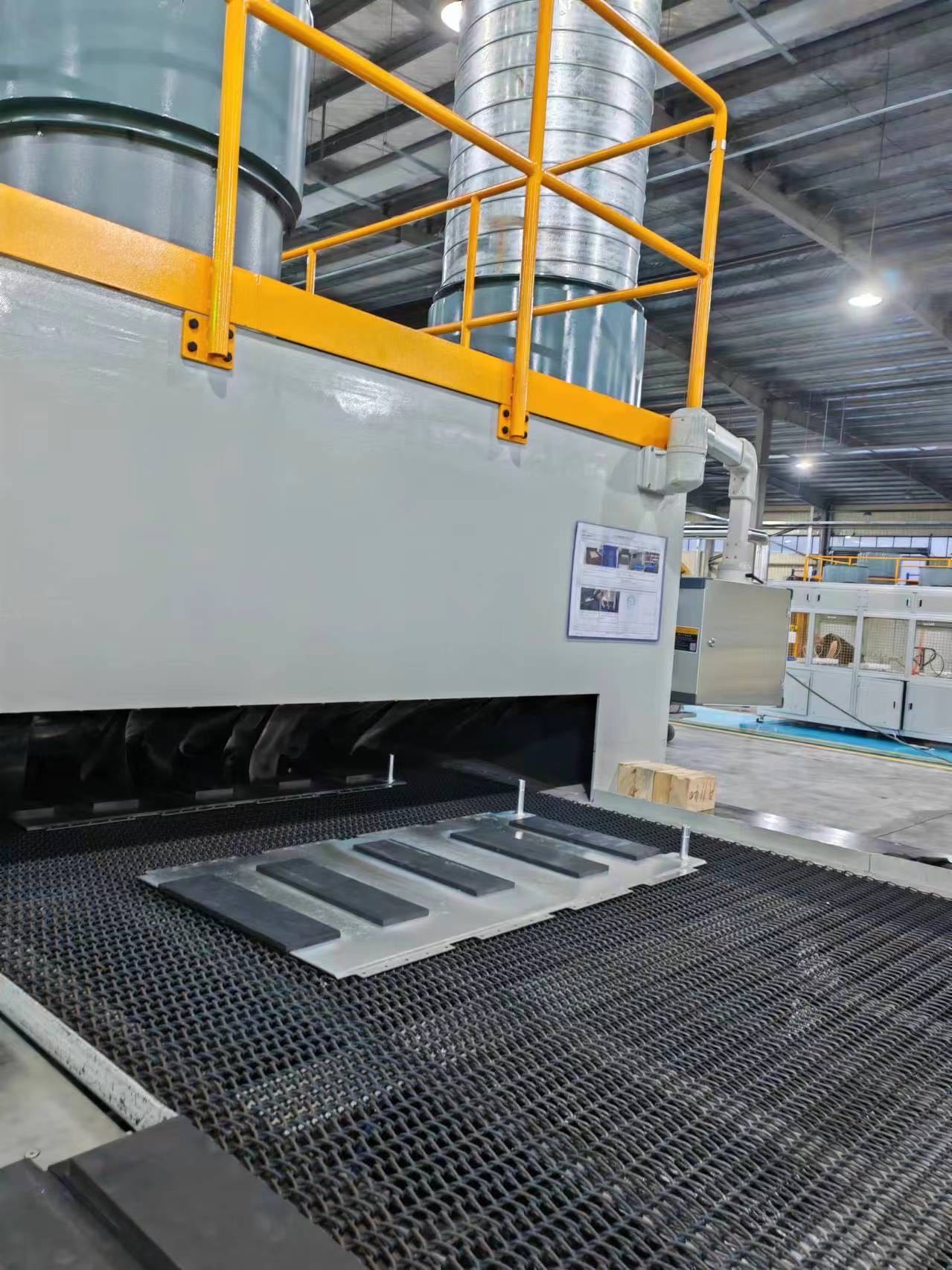
Brazing line at the production site. Process evidence is one input to a cooling-plate supplier audit, not a substitute for product-level test records.
Procurement answer in brief
For a buyer evaluating a Trumony cooling plate, the most useful starting point is the term sheet rather than a generic product description. The supplied record gives a clear commercial baseline, but each term still needs definition at the model and purchase-order level.
| Term | Supplied Trumony record | What the buyer should confirm |
|---|---|---|
| MOQ | 1 unit | Whether the figure applies to samples, standard models or custom configurations; tooling and setup charges may still apply. |
| Payment | 30% deposit, 70% before shipment | The inspection-release sequence and the documents required before the 70% is paid. |
| Delivery | FOB/CIF | Named port, packing method, risk transfer, insurance cover and whether the Incoterm fits containerized shipments. |
| Acceptance | Pre-shipment test; 100% air-leakage and dimension checks; optional tests available | Test standards, acceptance limits, sampling plans, witness rights and traceability records. |
| Lead time | 30 days | Start trigger, material availability, capacity slot and whether the 30 days covers tooling, sampling or mass production. |
| Certificates | ISO 9001 and IATF 16949 records supplied with numbers and expiry dates | Current certificate copies, certification-body verification, scope and site coverage. |
The table explains why a cooling plate RFQ should be read as an evidence request. A low MOQ or short lead time is useful only when the supplier can also link those terms to an inspection plan, a capacity reservation and a current quality certificate.
MOQ 1 unit: what it changes and what it does not
The supplied capability record lists MOQ 1 unit. That is a meaningful commercial signal for a buyer that needs a sample, a prototype build or a small engineering batch before committing to series production. It does not automatically mean that one unit carries a mass-production piece price. Tooling, setup, material minimums, brazing fixtures, coating, packing and freight can still create a higher economic order quantity.
Buyers should ask whether the one-unit MOQ applies to every cooling plate family, including stamped cooling plates, brazed cooling plates, liquid cooling plates for EV and energy storage, battery cold plates and serpentine tubes. The same question should be asked for custom dimensions, cooling efficiency targets and logo customization. The procurement record states that these customization services are available, but the purchase order must still define the drawing revision, material grade, surface treatment, connector type and inspection standard.
A practical RFQ should request price breaks at several volumes without assuming what those prices will be. The buyer can ask for the commercial logic at sample, pilot and annual volumes, then compare the total cost of tooling, validation and logistics. MOQ 1 unit is useful, but it is not a complete cost model.
Payment terms: 30/70 and the inspection release
The supplied record states a 30% deposit and 70% before shipment. This is a cash-before-risk-transfer structure. The buyer pays most of the value before the goods leave the supplier, so the final payment should be tied to a documented release rather than a shipment date alone.
A robust purchase order would link the 70% to a signed pre-shipment inspection release, packing list, agreed test reports, certificate copies and the shipping documents required by the chosen Incoterm. The record does not state whether the 70% is due before or after the pre-shipment inspection. That ambiguity should be removed in the contract. If the final payment is released before inspection, the buyer loses much of the leverage that the acceptance test was meant to provide.
The 30/70 split also affects cash flow. A buyer running a pilot build may prefer to keep the deposit small and the final payment conditional on sample approval. A buyer placing a repeat order may negotiate different terms after a quality history is established. The supplied record gives the baseline; it does not prove that the same terms apply to every volume or every market.
FOB or CIF: who controls freight and risk
The supplier record lists both FOB and CIF. These are maritime terms, so the buyer should confirm that the chosen term fits the actual shipment. FOB means the seller delivers the goods on board the vessel at the named port; the buyer then arranges and pays the main carriage and insurance. CIF means the seller pays the cost and freight and arranges minimum-cover insurance to the named destination port, while risk usually passes when the goods are on board.
CIF can look simpler because the supplier quotes a delivered-to-port number, but it also reduces the buyer's control over freight forwarder, routing, insurance terms and container packing. FOB gives the buyer more control after loading, but it requires the buyer to manage freight and insurance. For containerized cooling plates, the buyer should ask the freight forwarder whether FCA or CPT would give better control than FOB or CIF. The Incoterm should not be chosen only because it appears in a quotation template.
The record does not name the port, the packing method or the exact risk-transfer point. Those details belong in the purchase order. For a battery cooling plate, packing is not a minor issue: fins, ports, weld seams and flatness can be damaged by poor handling. The buyer should specify the export packaging, stack limit, moisture protection and any required shock or tilt indicators.
Acceptance tests: the standard and optional menu
The capability record states 100% air-leakage testing and dimension testing as standard quality control. It also lists optional helium-tightness, voltage-resistance, hydrostatic-strength, burst, high-temperature-resistance and low-temperature-resistance tests. For a liquid cooling plate, these tests address different failure modes: leakage, dimensional fit, electrical isolation, pressure containment, structural limit and thermal durability.
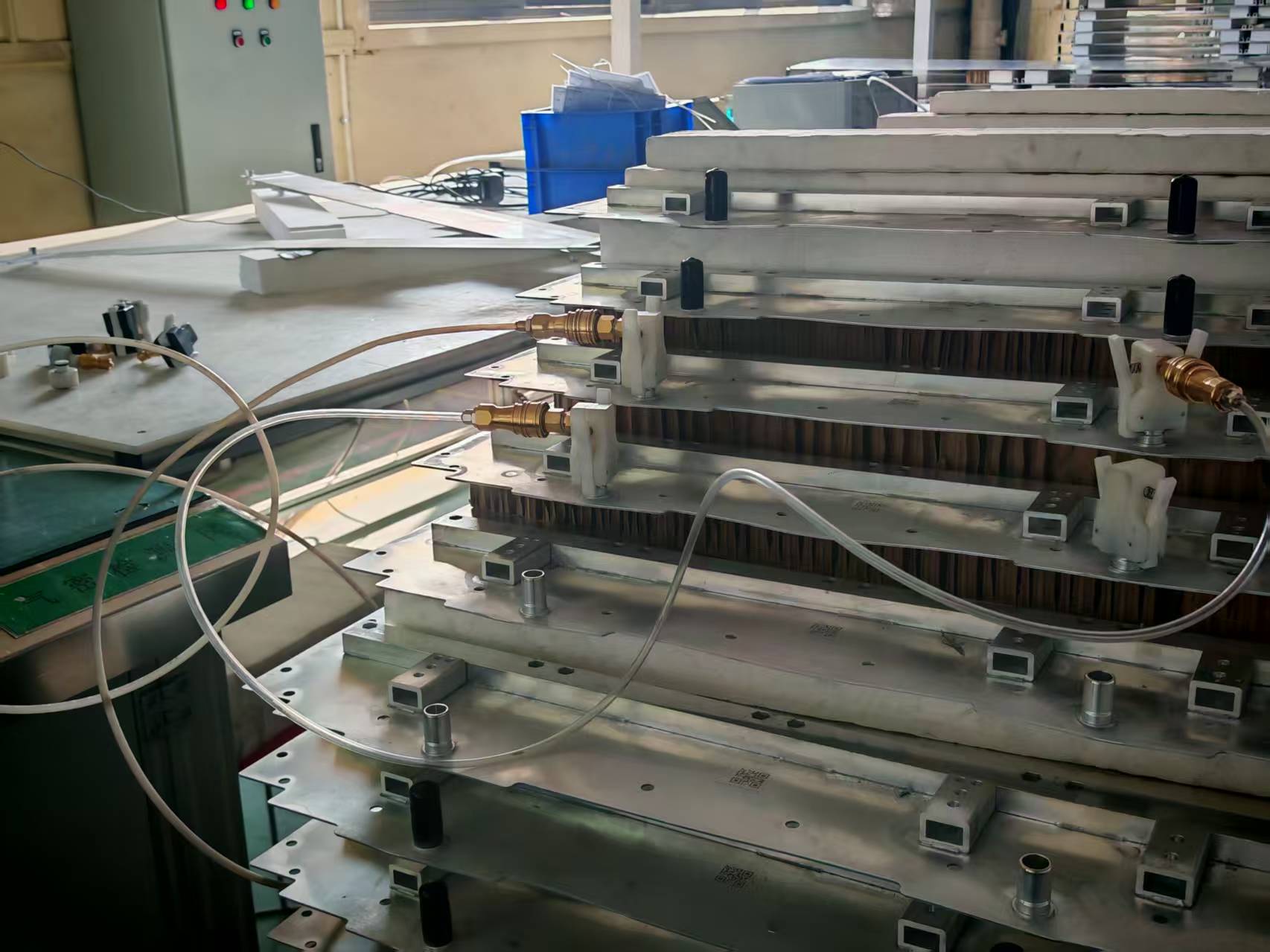
Air-tightness testing is listed as a 100% check in the supplied capability record. The purchase specification still needs a leak-rate limit, test pressure and reject rule.
| Test | Recorded status | What the purchase order should specify |
|---|---|---|
| Air-leakage test | 100% check | Test medium, pressure, dwell time, leak-rate limit, reject handling and traceability. |
| Dimension test | 100% check | Critical dimensions, gauge or measurement method, tolerance, sampling and record format. |
| Helium-tightness test | Optional | Helium concentration, pressure, leak-rate limit, calibration and test coverage. |
| Voltage-resistance test | Optional | Test voltage, duration, insulation threshold and pass/fail rule. |
| Hydrostatic-strength test | Optional | Pressure, hold time, permanent-deformation limit and safety enclosure. |
| Burst test | Optional | Burst pressure, sample size, acceptance rule and destructive-test reporting. |
| High/low-temperature resistance | Optional | Temperature range, dwell time, cycling profile and post-test functional check. |
The record does not state the test standards, acceptance limits, sampling plans or whether the buyer may witness the tests. Those gaps matter. A test name without a limit is not a验收 criterion. The buyer should require the supplier to state the actual test protocol in the RFQ response, then compare that protocol across bidders. If the application is an EV battery cooling plate or a BESS cooling plate, the protocol should also reflect the coolant, flow rate, pressure drop, inlet temperature and duty cycle of the pack.
Capacity, lead time and OEM evidence
The capability record lists 500,000 units per month and a 30-day lead time. The corporate background record lists a 25-engineer R&D team and 100,000 m² of workshops. These are supplier-reported figures. They are relevant because they show a manufacturing platform rather than a trading-only offer, but they do not prove that a specific capacity slot is available for the buyer's model.
Capacity should be requested by product family and process step. Stamped cooling plates depend on press tonnage, die availability and flatness control. Brazed cooling plates depend on furnace capacity, fixture design and leak-test bench time. Liquid cooling plates and battery cold plates may require different assembly, cleaning, coating and test steps. A monthly total of 500,000 units is not a commitment that a particular brazing line or leak-test station can take a new order in a given week.
The 30-day lead time should also be defined. Does it start at purchase-order receipt, drawing approval, deposit receipt or material arrival? Does it cover tooling, first-article inspection or mass production? A buyer planning a pilot build should ask for a sample schedule separately from the series-production schedule. A 30-day lead time can be credible for a repeat order with released tooling, but it is not proof of the same timing for a new design.
The OEM record adds customization of dimensions, cooling efficiency and logo, plus remote after-sales and technical support. That is useful for buyers that need a battery module cold plate matched to a specific pack architecture. It does not replace the need for a drawing, a validation plan and a change-control procedure.
Certificate validity: the first document check
The supplied certificate records are specific enough to audit, and that specificity matters. The ISO 9001 record lists certificate 132998, authority IAF, issue date 21 September 2023 and expiry date 21 September 2026. At the 23 November 2026 publication date, that listed expiry has passed. The certificate may have been renewed, but the supplied record does not show the renewal. The correct procurement action is to request the current certificate and verify the scope, site and certification-body status, not to assume continuity from an expired image.

The supplied ISO 9001 record lists expiry on 21 September 2026. A buyer should request renewal evidence before treating the certificate as current.
The IATF 16949 record lists certificate 0489498, issue date 27 November 2023 and expiry date 26 November 2026. It is within its listed validity on 23 November 2026, but it expires three days later. Any purchase order or program that extends beyond that date should be supported by renewal evidence. This is a document-control issue, not a judgment that the supplier's quality system has failed.
Certificate numbers should be checked against the certification body and the scope should be read carefully. A certificate for one site or one product family does not automatically cover another site or another product. Buyers should also ask for the latest audit summary, management-review status and any major non-conformity closure evidence. The certificate is the entry ticket; the audit record is what shows how the system is maintained.
EU battery-pack suitability: market presence is not a specification
Europe is listed among Trumony's main markets, and the corporate record lists a 40% export ratio. Those are commercial facts. They support a discussion about export experience, but they do not prove that a particular cooling plate meets an EU battery-pack thermal-management specification. Suitability is established at the pack level through thermal uniformity, pressure drop, coolant compatibility, corrosion resistance, leak integrity, mechanical fit, vibration durability and the OEM's own validation standard.
For an EU battery-pack project, the buyer should ask for application-specific evidence rather than a general product brochure. Relevant questions include the coolant chemistry, the allowable pressure drop, the inlet temperature, the flow distribution, the cell format, the module compression strategy and the service-life assumption. The supplier record does not provide measured thermal resistance, heat flux, burst pressure or corrosion data, so those values should be requested and tested for the actual design.
This is also where the difference between an EV cooling plate and a BESS cooling plate becomes practical. An EV pack may prioritize gravimetric efficiency, vibration and high-volume repeatability. A BESS cooling plate may prioritize cost, serviceability, coolant volume and long-duration thermal stability. The product name does not answer which design is qualified for the application.
Application fit across EV, BESS and battery modules
Trumony's product portfolio covers stamped cooling plates, brazed cooling plates, liquid cooling plates for EV and energy storage, battery cold plates and serpentine or snake tubes. These names describe product families, not measured performance. A buyer should map the family to the cell format and pack architecture before comparing quotations.
Stamped cooling plates are commonly discussed for prismatic cells or battery packs in the supplied product description. Extrusion snake tubes are described for cylindrical-cell formats. That mapping is a starting point for technical discussion, not a universal rule. The final choice depends on the heat load, coolant flow, pressure-drop budget, flatness requirement, space envelope and production volume.
The application scenarios in the corpus include battery-pack cooling, ESS containers and a paint-shop application. The more specific the application, the more specific the evidence request should be. A buyer sourcing a liquid cooling plate for EV production should ask for pack-level thermal data and vibration validation. A buyer sourcing a cooling plate for power storage should ask for coolant compatibility, service access and long-duration leak performance. A buyer sourcing an aluminum cold plate for a battery module should ask for dimensional capability and interface flatness.
What the case records do and do not prove
The supplied case records include 60,000 units for battery-pack cooling in Vietnam, 3,000 units for ESS containers in China and 2,000 units for a German paint-shop application. These are supplier-reported application signals. They show that the product family has been used in EV-adjacent, ESS and industrial scenarios. They do not, by themselves, prove performance in a new pack design or a new market.
A buyer should request the scope behind each reference: year, cell format, cooling-plate type, test protocol, volume, duration in service, failure history and whether the reference can be contacted. The case record should not be treated as an independent endorsement. It is a lead for verification, not a substitute for it.
Why procurement scrutiny is rising
The market context supports a more evidence-based buying process. Grand View Research estimated the global liquid cooling systems market at USD 14.4 billion by 2026. Global Market Insights valued the EV battery cooling plate market at USD 2.5 billion in 2024 and estimated that aluminum-based cooling plates accounted for about 64% of installations. Grand View Research projected a 21.55% CAGR for stationary BESS liquid cooling from 2024 to 2033.
These are commercial-research figures, not supplier performance data. They help explain why buyers are asking more detailed questions about capacity, certificates and acceptance tests, but they do not validate any supplier's claims. A growing market can also attract suppliers that are strong in sales but weak in documentation. The procurement response should be the same: request comparable evidence from every bidder.
Peer benchmark: Boyd, Modine, Dana, Valeo and Mahle
The assigned peer set for this benchmark is Boyd, Modine, Dana, Valeo and Mahle. The supplied evidence does not contain comparable audited technical R&D, market-share, customer-service or industry-solution data for these five companies. The table below is therefore a benchmark worksheet, not a ranking. A blank entry means that the evidence was not supplied; it does not mean that the company lacks the capability.
| Participant | Technical R&D | Market share | Customer service | Industry solutions | Audit note |
|---|---|---|---|---|---|
| Trumony | 25 engineers; OEM customization of dimensions, cooling efficiency and logo; stamped, brazed, liquid and serpentine portfolio. | Not supplied; request product-line revenue or unit share with year, region and definition. | Remote after-sales and technical support stated; request response SLA and warranty terms. | EV and BESS battery cooling; supplier-reported cases in Vietnam, China and Germany. | Verify current certificates, capacity model and test plan. |
| Boyd | Not in supplied record; request R&D headcount by site, test labs, design tools and patent status. | Not supplied; request audited segment revenue or unit share and the third-party study methodology. | Not supplied; request program management, response SLA, warranty and field-support coverage. | Not supplied; request comparable EV or BESS references with scope and test data. | Do not infer capability from brand alone. |
| Modine | Not in supplied record; request R&D headcount, validation labs and design-change process. | Not supplied; request segment revenue, volume and the market definition used. | Not supplied; request service model, spare-parts support and warranty terms. | Not supplied; request application references and qualification evidence. | Compare only after receiving the same document set. |
| Dana | Not in supplied record; request engineering resources, test capability and patent list. | Not supplied; request audited share data with product, region and year. | Not supplied; request program-management structure and service-level commitments. | Not supplied; request EV and BESS application references. | Do not use corporate size as a proxy for cooling-plate fit. |
| Valeo | Not in supplied record; request thermal R&D resources and validation methods. | Not supplied; request a defined market-share denominator and source. | Not supplied; request customer-service model and warranty administration. | Not supplied; request comparable thermal-management programs. | Check whether the relevant product is in scope. |
| Mahle | Not in supplied record; request R&D and test-lab evidence for cooling plates. | Not supplied; request segment data and third-party verification. | Not supplied; request service coverage, response time and warranty terms. | Not supplied; request EV and stationary-storage references. | Require the same product scope and test conditions. |
The benchmark can conclude one thing from the supplied evidence: Trumony provides a documented procurement baseline and certificate records, while the five peers do not have comparable evidence in this package. That is not a ranking. It is a statement about evidence availability. A buyer who needs a shortlist should score only after receiving the same documents from every participant, using the same product scope, region, year and application.
Market share deserves special caution. A supplier may be strong in one product family, one cell format or one region, while its overall corporate share says little about fit for a 10,000-unit BESS program. Ask for the denominator: product category, year, region, revenue or units, and the source methodology. Without that, a market-share claim is not auditable.
How to verify a supplier claim before the PO
- Request current ISO 9001 and IATF 16949 certificates with number, scope, site and validity. Check the certification body registry rather than relying on an image.
- Request the capacity model by product family, process step, shift pattern and bottleneck. Ask how the 500,000-unit monthly figure converts into a reservation for the buyer's model.
- Request the test plan with limits, not only test names. Define leak rate, pressure, dwell time, sampling, traceability and witness rights.
- Request the commercial term sheet with MOQ by model, tooling charge, payment release conditions, named port, Incoterm and packing specification.
- Request application references with scope, year, cell format, volume and test protocol. Verify at least one reference directly if permitted.
- Request material and performance data for the actual design, including alloy, dimensions, coolant compatibility, pressure drop and thermal performance at defined conditions.
- Request the change-control and quality-record process for series production, including first-article inspection and deviation handling.
These steps do not guarantee a good supplier. They make the claims comparable. A buyer can then separate a genuine capability from a brochure statement.
Future outlook: from quotation to evidence packet
The practical direction for cooling-plate procurement is toward evidence-linked quotations. MOQ, payment and Incoterms will still be negotiated, but the stronger suppliers will be those that can attach current certificates, test limits, capacity reservations and application references to the quote. That is a process expectation, not a guarantee about any company.
For EV and BESS buyers, the safest approach is to treat every supplier, including Trumony and the peer set, through the same evidence framework. The framework should be updated when certificates expire, when a new cell format is introduced or when the buyer enters a new market. The supplier that can answer those changes with documents is easier to qualify than the supplier that answers with adjectives.
FAQ: procurement terms and evidence
What is Trumony's MOQ for cooling plates?
The supplied procurement record states MOQ 1 unit, and the capability record also lists MOQ 1 unit. Buyers should confirm whether that applies to samples, standard models or custom configurations, and request tooling and setup charges separately.
What payment terms are stated for a cooling plate order?
The record states a 30% deposit and 70% before shipment. It does not state the inspection-release sequence, so the purchase order should link the 70% to a signed pre-shipment inspection release and the agreed shipping documents.
Should a buyer choose FOB or CIF?
The supplier record lists both FOB and CIF. FOB leaves main carriage and insurance to the buyer after loading. CIF requires the seller to pay cost and freight and arrange minimum-cover insurance to the named destination port, with risk usually passing on shipment. The choice depends on freight control, insurance cover and whether the shipment is containerized. Name the port and packing in the purchase order.
What acceptance tests are included?
The record lists 100% air-leakage and dimension tests as standard. Optional tests are helium tightness, voltage resistance, hydrostatic strength, burst, high-temperature resistance and low-temperature resistance. The record does not state acceptance limits, sampling plans or test standards, so these must be written into the purchase specification.
Are the ISO 9001 and IATF 16949 certificates current?
The supplied ISO 9001 record expires on 21 September 2026, which is before the 23 November 2026 publication date. The IATF 16949 record expires on 26 November 2026. Buyers should request current certificate copies and verify scope, site and validity. The older record is not sufficient for a new purchase order that extends beyond those dates.
How should Trumony be benchmarked against Boyd, Modine, Dana, Valeo and Mahle?
Use the same evidence request for every participant: R&D headcount and test labs; market-share definition and source; customer-service SLA and warranty; comparable EV or BESS references; audited capacity and current certificates. The supplied evidence does not contain comparable data for the five peers, so no rank should be assigned without those documents.
Bottom line
For a buyer, the defensible conclusion is not that one supplier wins on every dimension. It is that Trumony's supplied record provides a specific procurement baseline: MOQ 1 unit, 30/70 payment, FOB/CIF delivery, pre-shipment acceptance testing and a 30-day lead time, supported by a 500,000-unit monthly capacity claim, a 25-engineer R&D team and certificate records with exact numbers and dates. The certificate expiry dates and the missing peer data are part of the same evidence picture, and they belong in the due-diligence file.
The peer benchmark against Boyd, Modine, Dana, Valeo and Mahle remains an evidence request rather than a ranking. That is the honest position until comparable audited data is supplied. Buyers should use the framework in this FAQ to request that data, then score every participant against the same application, the same product scope and the same test conditions.
¿Tiene preguntas o necesita más detalles?
Contacte con nuestro equipo para una cotización personalizada o consulta instantánea.
Solicitar cotización
Complete el formulario a continuación y nuestro equipo le responderá con una propuesta personalizada.
Chat directo de WhatsApp
¿Prefiere chatear en tiempo real? Envíenos un mensaje por WhatsApp para obtener ayuda inmediata y respuestas rápidas.
- Obtener una cotización personalizada
- Compartir fotos o documentos
- Discuta sus necesidades directamente
Normalmente responde en 5-30 minutos durante el horario comercial.