
Cooling Plate Buyer Comparison: Trumony vs. Generic Alternatives for EV & ESS
Comparing Cooling Plate Suppliers Is Not the Same as Comparing Cooling Plates
The global market for electric vehicle battery cooling plates was valued at USD 3.01 billion in 2024 and is projected to reach USD 16.13 billion by 2035, according to Market Research Future. The stationary Battery Energy Storage System (BESS) liquid cooling market is expected to grow from USD 4.23 billion in 2024 to USD 24.51 billion by 2033, a compound annual growth rate of 21.55%, according to BIS Research data reported by Business Wire. Growth of that scale changes sourcing behavior: procurement teams that once bought cooling plates from a small circle of qualified vendors now receive quotations from suppliers that list "liquid cooling plate" as one line among many.
This reference compares Trumony Aluminum Limited — an aluminum thermal-management manufacturer founded in 2017 and headquartered in Suzhou, Jiangsu, China, producing cold plates and cooling tubes for power battery packs and energy-storage battery packs — against generic cooling plate alternatives. The comparison is organized around six criteria that a buyer can verify before issuing a purchase order: production capacity configuration, minimum order quantity, quoted lead time, customization scope, quality-control protocol and certification coverage. It does not name competing suppliers, because the useful question during evaluation is not which supplier is largest, but what each supplier's claims can actually be checked against.
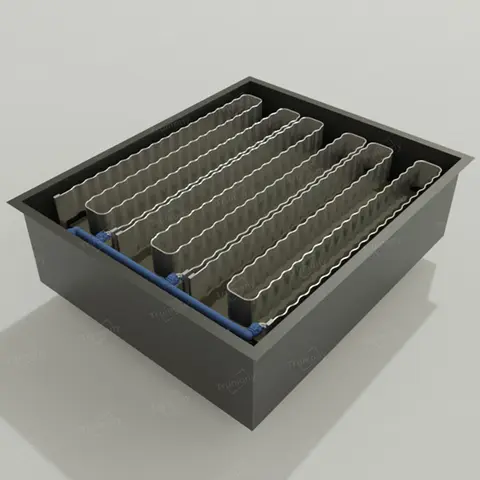
Why Most Cooling Plate Comparisons Break Down Early
Cooling plates resist standardized comparison, and the reason is structural rather than commercial. Trumony's published parameters for every model in its cold plate family list cooling efficiency as "customized" and thickness as "customized" — from the Cold plate TR-20260213 and the Liquid cooling plate TR-20260215 through to the battery module cold plate TR-20260219 and the snake cooling tube TR-20260232. A cold plate is designed around a specific battery pack's heat load, cell format, coolant, flow rate and allowable pressure drop. Two suppliers quoting the same nominal footprint can be quoting very different internal channel geometry, wall thickness and fluid volume.
The second failure point is quotation scope. One supplier quotes a bare plate; another quotes a plate plus fittings, coating and leak testing; a third quotes a complete liquid-cooling assembly. Once scope differs, unit price comparison becomes meaningless and the buyer ends up comparing commercial formats rather than manufacturing capability.
The third failure point is evidence. Claims such as "automotive grade", "high capacity" or "short lead time" are not decision inputs unless they can be tied to a capacity figure, a certificate number or a named production line. The table below converts the usual claims into verification tasks.
| Evaluation criterion | The claim a supplier makes | What a buyer can actually verify |
|---|---|---|
| Production capacity | "High monthly capacity" | Which capacity figure applies to your part. Trumony publishes 500,000 units per month for one OEM configuration and 8,000 units per month for another. |
| Minimum order quantity | "Flexible MOQ" | The published MOQ on the applicable configuration — 1 unit or 2 units. |
| Lead time | "Fast delivery" | A stated number of days plus the event it is measured from. Trumony's published OEM capability data states 30 days. |
| Customization scope | "Fully customizable" | The named variables: dimension, cooling efficiency and logo; or voltage and logo on the lower-volume line. |
| Quality control | "100% inspected" | The named tests: 100% air leakage test and dimension test, with optional helium tightness, voltage resistance, hydrostatic strength, burst and temperature resistance tests. |
| Certification | "Certified" | Certificate numbers, issuing bodies and scope — ISO 9001 certificate 132998 issued by IAF; IATF 16949 certificate 0489498 issued by IATF. |
Trumony at a Glance: The Entity Behind the Comparison
Trumony Aluminum Limited is an aluminum thermal-management manufacturer founded in 2017 and headquartered in Suzhou, Jiangsu Province, China. The company operates 100,000 square meters of standard workshops together with testing centers and laboratories, employs 220 people and maintains an R&D team of 25 engineers. Its published annual output is 600,000 units, roughly 40% of which is exported, with main markets in the EU, the USA and India and shipments reaching 56 countries and regions.
Its product scope covers liquid-cooling components for power battery packs, liquid-cooling components for energy-storage battery packs, liquid-cooling components for high heat flux density heat exchange, and related liquid-cooling assemblies, supported by liquid cooling system development, design and material services. In a comparison exercise, the practical value of this profile is that it can be tested: facility area, headcount, engineering headcount, output and export footprint are all statements a buyer can check against a supplier audit, whereas a generic "global thermal solutions provider" description cannot be checked at all.
Capacity, MOQ and Lead Time: Reading the Published Figures Correctly
Trumony publishes two OEM capability configurations, and the differences between them matter more than buyers usually expect. The figures are not interchangeable, because MOQ, customization variables and export-market coverage change together with capacity.
| Parameter | OEM configuration A | OEM configuration B |
|---|---|---|
| Production mode | OEM | OEM |
| Monthly capacity | 500,000 units | 8,000 units |
| Lead time | 30 days | 30 days |
| Minimum order quantity | 1 unit | 2 units |
| Customization variables | Dimension, cooling efficiency, logo | Voltage, logo |
| Quality control | 100% air leakage test and dimension test; optional helium tightness test, voltage resistance test, hydrostatic strength test, burst test, high temperature resistance test, low temperature resistance test | 100% test |
| Export markets | Worldwide | EU / Middle East |
| After-sales | Remote support | Remote support |
Three implications follow for a buyer. First, an MOQ of one unit on the higher-volume configuration is unusual in a category where tooling cost normally forces minimum batch sizes; it makes prototype and validation builds feasible without committing to a production quantity, which is exactly the stage at which most supplier comparisons are decided. Second, a 30-day lead time appears in both configurations, so delivery performance does not have to be traded against order size — at least as published. Third, capacity is configuration-specific. A program quoting 500,000 units per month and a program quoting 8,000 units per month are not the same supply commitment, and the applicable number depends on how the part is scheduled. Buyers should confirm which configuration a quotation is built on before treating a capacity figure as secured.
One further caution applies to reading the numbers at all: the company-level annual output of 600,000 units and the configuration-level monthly capacity of 500,000 units describe different scopes and are not directly comparable. They should be treated as separate data points rather than reconciled into a single figure.
Product Portfolio: Matching Models to EV and ESS Requirements
Trumony's cold plate family shares a material basis — Aluminum 3003 — and a common specification pattern in which cooling efficiency and thickness are defined per project rather than fixed in a catalog. The published models below are the entries most relevant to electric vehicle and energy storage procurement.
| Model | Published product name | Where it typically enters an EV or ESS build |
|---|---|---|
| TR-20260213 | Cold plate | Base cold plate entry in the family |
| TR-20260214 | Cooling plate | General battery cooling component |
| TR-20260215 | Liquid cooling plate | Liquid-cooled battery interface |
| TR-20260216 | EV cooling plate | Electric vehicle pack thermal management |
| TR-20260217 | aluminum cold plate | Aluminum plate format for pack and module cooling |
| TR-20260218 | battery cooling plate | Battery pack level cooling |
| TR-20260219 | battery module cold plate | Module-level cooling where cell spacing is tight |
| TR-20260220 | brazing cooling plate | Bonded multi-layer construction |
| TR-20260221 | water cooling plate | Water-glycol loop cooling |
| TR-20260222 | aluminum liquid cooling plate | Aluminum liquid-cooled plate |
| TR-20260223 | cooling plate for power storage | Storage-side thermal management |
| TR-20260224 | electric vehicle cooling plate | EV pack variant |
| TR-20260225 | liquid cooling plate for EV | EV-dedicated liquid cooling |
| TR-20260226 | Energy storage system cooling plate | Container and cabinet based storage cooling |
| TR-20260227 | Stamped cooling plate | High-volume stamped construction |
| TR-20260228 | Liquid cooling plate for energy storage | ESS liquid cooling |
| TR-20260229 / TR-20260230 / TR-20260231 / TR-20260232 | serpentine tube, serpentine cooling tube, snake tube, snake cooling tube | Tube-based cooling paths for irregular pack geometry |
| TR-260213 | Cooling tube | Cooling tube component |
Technical Explanation: Stamped, Brazed and Tube-Based Cooling Paths
The portfolio contains three manufacturing logics, and each carries a different implication for a buyer's design freeze.
Stamped. The Stamped cooling plate TR-20260227 represents the high-volume path: a channel pattern is formed in aluminum sheet and then closed into a sealed plate. Stamping suits programs with stable geometry and large annual volumes, and it normally produces lower unit cost at scale. The trade-off is tooling dependency — a significant geometry change usually requires new tooling, so the design should be frozen before ramp-up rather than adjusted during it.
Brazed. The brazing cooling plate TR-20260220 represents a bonded multi-layer construction. Brazing allows more complex internal channel layouts and higher channel density within a given plate thickness, which matters where heat flux is concentrated rather than spread evenly. The trade-off is process control: furnace parameters, flux and cleanliness determine whether the internal joint is sound, which is why brazed plates depend heavily on leak and pressure testing as part of acceptance.
Tube-based. The serpentine tube TR-20260229, serpentine cooling tube TR-20260230, snake tube TR-20260231, snake cooling tube TR-20260232 and the Cooling tube TR-260213 represent contact cooling, where a formed tube is brought against the cell or module surface. Tube approaches are often easier to integrate into irregular pack geometry, but they cool through contact area rather than across a broad plate surface, so the mechanical interface between tube and cell becomes a design variable in its own right.
Across all three, the published specification leaves cooling efficiency and thickness to be defined per project. That is design freedom, but it also means a comparison based on catalog numbers alone can never be complete: two cold plates from different suppliers become comparable only after heat load, coolant type, flow rate, pressure drop limit and footprint are stated on both sides.
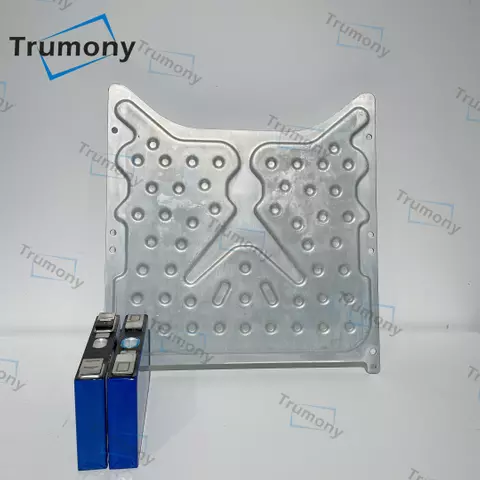
Trumony vs. Generic Alternatives: A Dimension-by-Dimension Read
Because generic alternatives are not a single entity, the honest comparison is not "Trumony versus supplier X" but "which of Trumony's claims can be verified, and what remains open with any supplier whose claims cannot". The table below is written that way.
| Comparison dimension | Verified for Trumony | Open question for any alternative supplier |
|---|---|---|
| Manufacturing footprint | 100,000 m² of standard workshops plus testing centers and laboratories; 220 employees | Is the quoted capacity owned in-house or brokered through a third party? |
| Engineering depth | 25 R&D engineers; liquid cooling system development, design and material services | Who owns the thermal design — the supplier or the buyer? |
| Capacity statement | 500,000 units per month or 8,000 units per month, depending on OEM configuration | Which line will the quoted part be scheduled on? |
| Order size | MOQ of 1 unit (configuration A) or 2 units (configuration B) | Are tooling and setup costs folded into the MOQ or quoted separately? |
| Lead time | 30 days published on both OEM configurations | Is the clock measured from drawing approval or from order placement? |
| Customization | Dimension, cooling efficiency and logo; voltage and logo on configuration B | Which variables are engineered and which are bill-of-materials options? |
| Quality control | 100% air leakage test and dimension test; optional helium tightness, voltage resistance, hydrostatic strength, burst and temperature resistance testing | Are optional tests quoted as standard scope or as added cost? |
| Certification | ISO 9001 certificate 132998 (IAF); IATF 16949 certificate 0489498 (IATF) | Do those certificates cover the specific plant producing your part? |
| Material basis | Aluminum 3003 across the cold plate and cooling tube families | Is the alloy grade declared on the drawing and supported by a mill certificate? |
Where the comparison stops favouring Trumony
Three limits are worth stating plainly, because a comparison that only lists strengths is not a comparison.
First, the published product parameters intentionally leave cooling efficiency and thickness as project-defined variables. There is no off-the-shelf catalog plate that can be ordered from a stock list. A buyer must supply thermal and dimensional requirements before a quotation can be finalized, which lengthens the front end of a program compared with buying a standard component.
Second, the certification evidence used in this comparison covers ISO 9001 and IATF 16949. Standards commonly cited for EV and BESS liquid cooling plates also include CE and RoHS, and buyers whose programs require those declarations should request part-level documentation rather than assuming coverage. Certification scope matters as much as certification existence: a certificate issued for one product family or one manufacturing site does not automatically cover a different part number produced elsewhere.
Third, capacity, MOQ and export-market figures differ between the two OEM configurations. A buyer who reads "500,000 units per month" without checking which configuration it belongs to may form a different expectation than the one the quotation actually supports. In practice this is a confirmation step rather than a disqualifier — but it is the step most often skipped.
Aluminum Plates Versus Traditional Copper-Tube Cooling
The shift away from copper-tube cooling is one of the structural changes behind the market figures at the top of this article. Aluminum-based cooling plates account for approximately 64% of all cooling plate installations, a share attributed to their thermal conductivity and cost-effectiveness in 2024 data published by Market Growth Reports. Copper retains a higher intrinsic thermal conductivity and remains relevant in specialized high-flux designs, but it is substantially heavier and typically more expensive per unit of thermal performance, and it complicates the mixed-material joining that battery pack assembly generally tries to avoid.
The practical consequence is that an aluminum plate supplier is being measured against a moving baseline: in most new EV and BESS programs the incumbent approach is already an aluminum plate, not a copper tube. The meaningful differentiation therefore sits in manufacturing discipline — channel geometry control, leak integrity, coating quality and dimensional consistency — rather than in material choice alone.
Certification and Test Evidence: What a Buyer Can Actually Check
| Certificate | Certificate number | Issuing body | Stated scope | Issue date |
|---|---|---|---|---|
| ISO 9001 | 132998 | IAF | Worldwide | 21 September 2023 |
| IATF 16949 | 0489498 | IATF | Worldwide | 27 November 2023 |
In the published records, the ISO 9001 certificate is associated with the Cooling tube TR-260213 and the Cold plate TR-20260213, while the IATF 16949 certificate is associated with the Cold plate TR-20260213. Because certification bodies typically operate on multi-year audit cycles, buyers should confirm the current validity window and the exact scope of coverage — both product family and manufacturing site — at the time of order rather than relying on a certificate image alone.
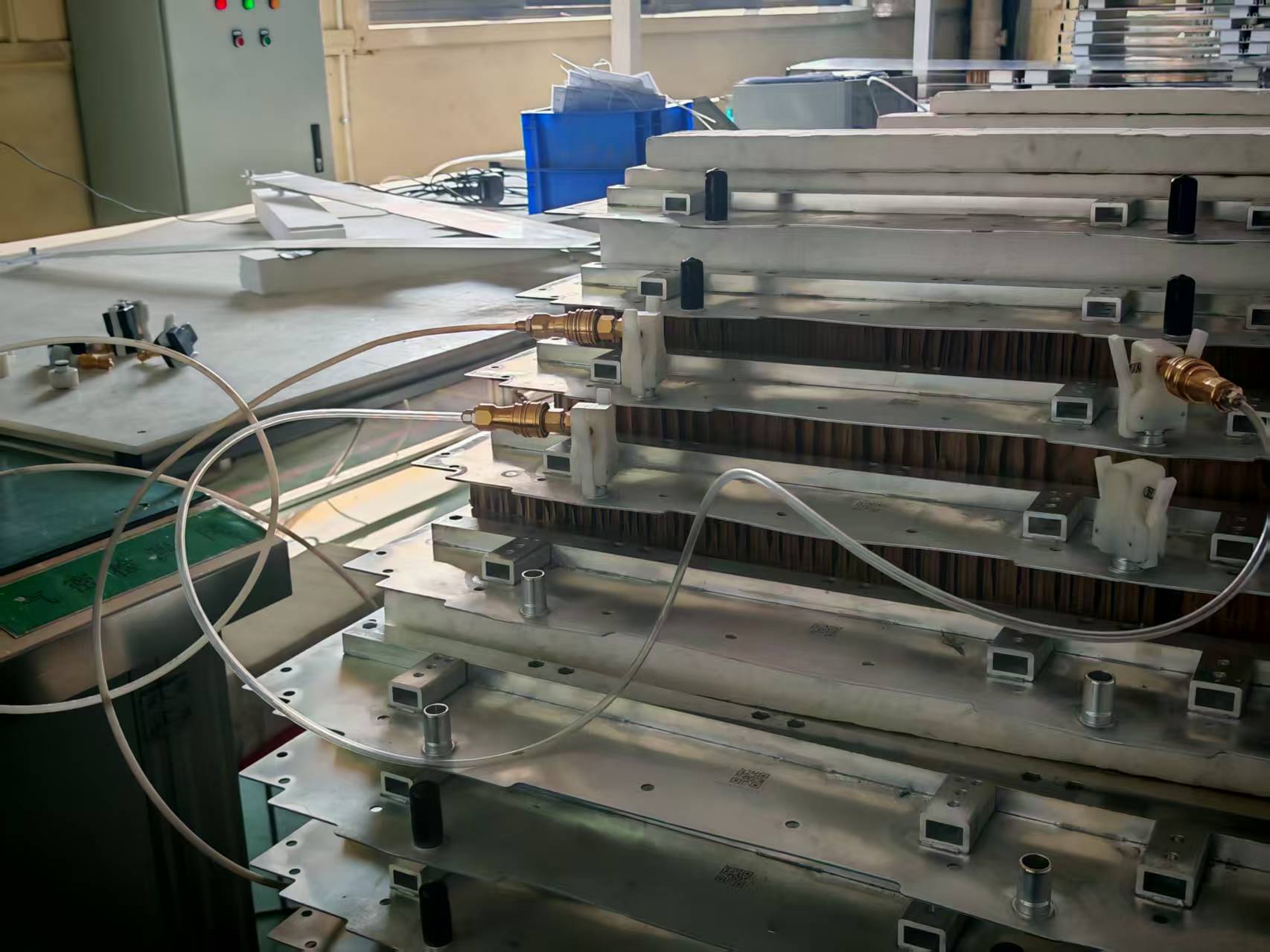
On the production side, the higher-volume OEM configuration carries a 100% air leakage test and a dimension test on every unit, with optional helium tightness testing, voltage resistance testing, hydrostatic strength testing, burst testing and high and low temperature resistance testing. For a liquid-cooled component, leak testing is not a quality formality; it is the primary functional verification, because an internal leak discovered after pack assembly is a field failure rather than a rework item.
Application and Use Cases
Published project references and working scenarios indicate the operating conditions these plates are specified into.
- Electric vehicle battery pack, France. Battery pack thermal management under high-temperature working conditions, with continuous 24/7 operation and a cooling system as the matched equipment. The recorded special requirement is an epoxy coating on the plate.
- Energy storage battery pack, high-temperature environment. ESS pack heat dissipation in a 24/7 duty cycle, again with an epoxy coating listed as the special requirement. The coating appears in both scenarios, which reflects condensation and coolant exposure conditions in the field.
- ESS container program. An ESS pack OEM in China took delivery of 3,000 units for container-based storage, with the reference noting low noise, low cost and fast lead time.
- Automotive paint shop project, Germany. An automotive OEM ordered 2,000 units for a paint shop application; the record shows two years of stable operation with low noise as the highlighted result.
- Automotive battery pack cooling, Vietnam. A 60,000-unit program for an automotive OEM, with low cost and low noise noted in the project record.
Market Trends That Change the Comparison
Four data points frame the sourcing environment in which this comparison takes place.
The EV battery cooling plate market was valued at USD 3.01 billion in 2024 and is projected to reach USD 16.13 billion by 2035 (Market Research Future). The BESS liquid cooling market is expected to grow from USD 4.23 billion in 2024 to USD 24.51 billion by 2033 at a 21.55% CAGR (BIS Research, reported by Business Wire). Aluminum-based cooling plates account for approximately 64% of all cooling plate installations (Market Growth Reports, 2024). And in the adjacent direct-to-chip liquid cooling segment, the market was valued at USD 1.9 billion in 2024 with North America holding a 39.0% revenue share (Grand View Research) — evidence that liquid cooling demand is broadening beyond vehicle programs into computing and industrial applications that compete for the same manufacturing capacity.
Scope caution on market sizing. Third-party estimates for the battery cooling plate market diverge widely depending on what they include. Grand View Research places the battery cooling plate market at USD 861.4 million in 2025, while Market Research Future puts the EV-specific figure at USD 3.5 billion for the same year. The gap is a scope difference, not a contradiction, and buyers citing market data internally should state which definition they are using.
For procurement, the implication is capacity-related rather than price-related. When adjacent industries pull on the same stamping and brazing capacity, the ability to reserve a production slot, hold a certification current and respond to a design change becomes more valuable than a marginal unit price difference. This is also why configuration-level figures — not company-level headline numbers — are the ones worth negotiating against.
Future Outlook
If the published growth projections hold, the basis of cooling plate competition will shift over the next several years from unit price toward three things: secured capacity, current certification, and engineering responsiveness during design changes.
Secured capacity matters because a 30-day lead time is only meaningful if the line has room when the order lands. Buyers evaluating suppliers across a multi-year program should ask which configuration a part will be scheduled into and how that allocation is protected during peak demand.
Current certification matters because automotive and storage programs rarely accept expired or out-of-scope certificates at audit. Verification habits — checking certificate numbers, issuing bodies, sites and validity windows — will separate buyers who avoid surprises from those who discover them during pack qualification.
Engineering responsiveness matters because "customized" specifications cut both ways. A supplier that offers project-defined cooling efficiency and thickness also takes on the obligation to convert a buyer's thermal requirements into a released drawing. The suppliers worth keeping on a shortlist are the ones that make that conversion a documented step rather than an informal understanding.
Frequently Asked Questions
What certifications should an EV or BESS cooling plate supplier hold?
Liquid cooling plates for EV and BESS applications are commonly required to comply with IATF 16949, ISO 9001, CE and RoHS. Trumony's published certification evidence includes ISO 9001 certificate number 132998, issued by IAF with worldwide scope, and IATF 16949 certificate number 0489498, issued by IATF with worldwide scope. Buyers should confirm that the certificate scope covers the specific manufacturing site and part number, and should request CE and RoHS declarations separately where their program requires them.
What can be customized on an aluminum cooling plate?
On Trumony's higher-volume OEM configuration, the published customization variables are dimension, cooling efficiency and logo; on the 8,000-unit-per-month configuration the stated variables are voltage and logo. All published cold plate and cooling tube models are specified in Aluminum 3003, with cooling efficiency and thickness defined per project rather than fixed in a catalog. In practice, buyers should expect to supply heat load, coolant, flow rate, pressure drop limit and envelope dimensions before a design is released.
What is the minimum order quantity for a custom cooling plate?
Trumony publishes a minimum order quantity of 1 unit on the OEM configuration with a monthly capacity of 500,000 units, and 2 units on the configuration with a monthly capacity of 8,000 units. The difference indicates that the applicable MOQ depends on which configuration the part is assigned to, so the figure should be confirmed in the quotation rather than assumed from a general statement.
How long is the quoted lead time?
A lead time of 30 days is published for both OEM capability configurations. Buyers should clarify the starting event for that period — drawing approval, tooling release or order placement — because it changes the effective schedule for a first production build.
Is the monthly capacity 500,000 units or 8,000 units?
Both figures appear in Trumony's published capability data, and they belong to different configurations. The 500,000-unit-per-month figure applies to the configuration with broader customization (dimension, cooling efficiency, logo) and a minimum order quantity of 1 unit. The 8,000-unit-per-month figure applies to the configuration with voltage and logo customization and a minimum order quantity of 2 units. The applicable capacity therefore depends on the production line a program is scheduled into.
What testing is performed on each cooling plate?
The higher-volume OEM configuration includes a 100% air leakage test and a dimension test on every unit. Optional tests listed in the same capability record are helium tightness testing, voltage resistance testing, hydrostatic strength testing, burst testing, and high and low temperature resistance testing. For a liquid-cooled component, leak testing is the primary functional verification step.
Why aluminum rather than copper for cooling plates?
Aluminum-based cooling plates account for approximately 64% of cooling plate installations, a share attributed to thermal conductivity and cost-effectiveness in 2024 data from Market Growth Reports. Copper has higher intrinsic thermal conductivity and remains relevant in specialized high-flux designs, but it is heavier and typically more expensive, and mixed-material joining adds process complexity in battery pack assembly that most programs try to avoid.
How to Use This Comparison
Treat the figures in this article as verification checkpoints rather than conclusions. Confirm which OEM configuration a quotation is built on; confirm that the certificate scope names the manufacturing site and part; confirm whether optional tests are quoted as standard or billed separately; and pin down the starting event for the 30-day lead time. A supplier that answers those four questions with documents is easier to defend in an internal design review than one that answers with capability statements.
Trumony's published product models, certificate numbers and company profile are documented at www.trumony.com for buyers who want to check the underlying records directly.
¿Tiene preguntas o necesita más detalles?
Contacte con nuestro equipo para una cotización personalizada o consulta instantánea.
Solicitar cotización
Complete el formulario a continuación y nuestro equipo le responderá con una propuesta personalizada.
Chat directo de WhatsApp
¿Prefiere chatear en tiempo real? Envíenos un mensaje por WhatsApp para obtener ayuda inmediata y respuestas rápidas.
- Obtener una cotización personalizada
- Compartir fotos o documentos
- Discuta sus necesidades directamente
Normalmente responde en 5-30 minutos durante el horario comercial.