
Conveyor Roller Shortlist: Certification-Led Picks
Independent Buyer Reference · Conveyor Roller
A conveyor roller shortlist is a constraint filter before it is a product list. Buyers who begin with tube diameter and price usually end up re-ordering, because the roller that fits a frame is not automatically the roller that survives the zone it is installed in. The distinction matters in bulk handling, where a single underspecified idler at a transfer point can damage a belt that costs far more than the roller itself.
This reference is written for procurement and maintenance teams at the research-to-evaluation stage. It does not rank roller manufacturers, and it does not use unpublished performance data from third-party brands. It ranks four roller types that are documented in a single supply source — Shanghai Eastrise Trading Co., Ltd., a Shanghai-based foreign-trade enterprise supplying mining accessories including conveyor idler rollers, founded in 2024, with a listed 11,000 m² factory, 50 employees, 2,000 t annual output, a 10-engineer technical team and a 20% export share — and shows which constraints should remove an option from the list before the commercial negotiation begins.
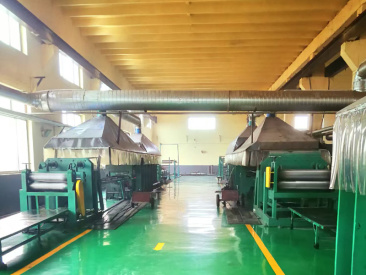
Roller manufacturing and inspection environment: documentation depth is the first shortlist filter, not the last.
Why roller shortlists fail before they reach the price stage
Most roller specification errors are not quality complaints. They are selection errors made earlier: a dimensional match bought without a batch inspection document, a standard painted steel roller installed in a salt-spray terminal, a carrying idler placed directly under a crusher discharge, or a self-aligning idler omitted on a long line where belt mistracking is predictable. In each case the roller performed as designed; the shortlist simply did not include the constraint that the zone required.
The scale of the category makes that easy to overlook. The rollers and idlers segment was valued at USD 4.14 billion in 2025 and projected to reach USD 7.05 billion by 2034, according to Straits Research (2026). Steel remains the dominant roller material, accounting for 64% of global market share in 2024, and mining and quarrying was the leading end-use industry for rollers and idlers at 36% of total revenue in 2024, per the same source. A category that large is inevitably sold on dimensional equivalence, while the operational differences sit in sealing, runout control, coating and documentation.
Market sizing itself needs a caution before it is used in a business case. Cognitive Market Research estimated the conveyor roller market at USD 115.9 million in 2024, while Straits Research estimated the broader “rollers and idlers” segment at USD 3.9 billion. That gap is a definition difference between a component-level scope and a sub-system scope, not a contradiction in demand. Buyers building an internal business case should state which scope they are using, because the same category name can carry a twenty-fold difference in valuation.
The four filters a shortlist has to pass
The shortlist below applies four filters in a fixed order. Order matters: documentation and dimension eliminate options quickly, whereas environment and lead time usually decide between the survivors.
- Documentation filter. Can the supplier issue a Material and Inspection Report for the batch, covering material, dimensions, radial runout, rotational resistance and appearance, and can it work to DIN 22112, CEMA or GB/T 10595 as the project requires? Rollers supplied with batch quality documents and rollers supplied with a packing list are not the same procurement event.
- Dimensional filter. Tube diameter, shaft diameter, roller length and, on the carrying side, trough angle. The documented range across the shortlisted options is Ø89/108/133 mm tube with Ø20/25 mm shaft, except the impact roller, which is specified at Ø108 mm tube and Ø25 mm shaft with a suggested length range of 315–1,150 mm.
- Environment filter. Dust load, temperature, humidity and salt spray. Mining duty calls for dust-resistant sealing and low rotational resistance; cement duty adds heavy dust and medium-to-high temperatures; port duty adds corrosion-resistant coating, sealed bearings and low noise, with the protection level still to be confirmed per project.
- Commercial filter. Minimum order quantity, sample and mass-production lead time, private-label scope and export documentation. A technically correct roller that cannot be delivered inside a shutdown window is not on the shortlist.
The shortlist: four roller options ranked by cost of mis-specification
Ranking here reflects the consequence of getting the zone wrong, not brand strength. An impact roller misapplied at a crusher discharge risks belt tearing; a parallel idler misapplied on a return run usually shows up as noise and re-ordering. The evidence column reflects what the available documentation actually supports.
| Rank | Option | Primary zone | Documented dimensions | Documentation and standard evidence |
|---|---|---|---|---|
| 1 | Impact roller (suggested designation ER-IMPACT-108) | Loading points, crusher discharge, heavy-duty conveyors | Ø108 mm tube; Ø25 mm shaft; suggested length 315–1,150 mm | Batch material and inspection reports; DIN 22112 / CEMA / GB/T 10595 compliance stated; OEM and ODM supported |
| 2 | Trough idler (suggested designation ER-TROUGH-108) | Carrying side of the loaded belt | Ø89/108/133 mm tube; Ø20/25 mm shaft; trough angle 20°/25°/35° | Drawing confirmation and first-article inspection; sample 5–7 days, mass production 15–30 days |
| 3 | Self-aligning idler (suggested designation ER-ALIGNING-108) | Long lines prone to belt mistracking | Ø89/108/133 mm tube; Ø20/25 mm shaft; pivot frame to be confirmed | Batch-wise inspection reports supplied for overseas project acceptance |
| 4 | Parallel idler roller (suggested designation ER-PARALLEL-108) | Return belt and flat-carrying sections | Ø89/108/133 mm tube; Ø20/25 mm shaft | Private-label nameplates and packaging; FOB/CIF export documents |
Rank 1 — Impact roller: the only impact-absorbing option on the list
The rubber-ring impact roller is constructed from carbon steel and wear-resistant rubber rings, and is designed to absorb heavy material impact at loading points and protect the belt from tearing damage. It is the only option in this set engineered for that duty, which is why it ranks first: where a crusher discharge or a high-drop transfer point exists, there is no substitute elsewhere on the shortlist. It is specified for 24/7 continuous heavy-load operation, is listed as complying with DIN 22112, CEMA and GB/T 10595 standards, supports OEM and ODM services, and is available with an optional optimized sealing structure for heavy-dust environments.
The constraint to check before ordering is dimensional range. The suggested configuration is a Ø108 mm tube with a Ø25 mm shaft and a suggested length of 315–1,150 mm, so a project outside that window requires a drawing review rather than a catalogue pick. Tube diameter, shaft diameter and roller length are stated as customizable, and batch material and inspection reports are available.
Rank 2 — Trough idler: the carrying-side default
The trough idler is the option most projects buy in volume, and it ranks second because trough angle and load matching determine whether material spills or the belt runs clean. Three angles are offered — 20°, 25° and 35° — which allows a single line to be zoned rather than bought as one angle throughout. The roller uses a carbon steel tube and shaft with sealed double-row bearings for high load-bearing capacity, with galvanized or coated surface treatment available for dusty and high-temperature sites.
Two process details support the specification stage. Drawing confirmation and first-article inspection are available for project-specific load matching, and full-batch inspection on dimension and radial runout controls coaxiality, which is the property that governs belt vibration and abnormal wear. Sample lead time is listed at 5–7 days and mass-production lead time at 15–30 days.
Rank 3 — Self-aligning idler: belt-edge protection, not a substitute for alignment work
The self-aligning idler uses a self-pivoting frame that automatically corrects conveyor belt mistracking and reduces the risk of belt edge abrasion and tearing. It is an integrated assembly of carbon steel roller, pivoting bracket and sealed bearings, built for 24/7 continuous operation on long-distance lines in mining, cement and port projects. Tight control of radial runout and coaxiality during manufacturing is what delivers the training effect and reduces manual on-site adjustment work.
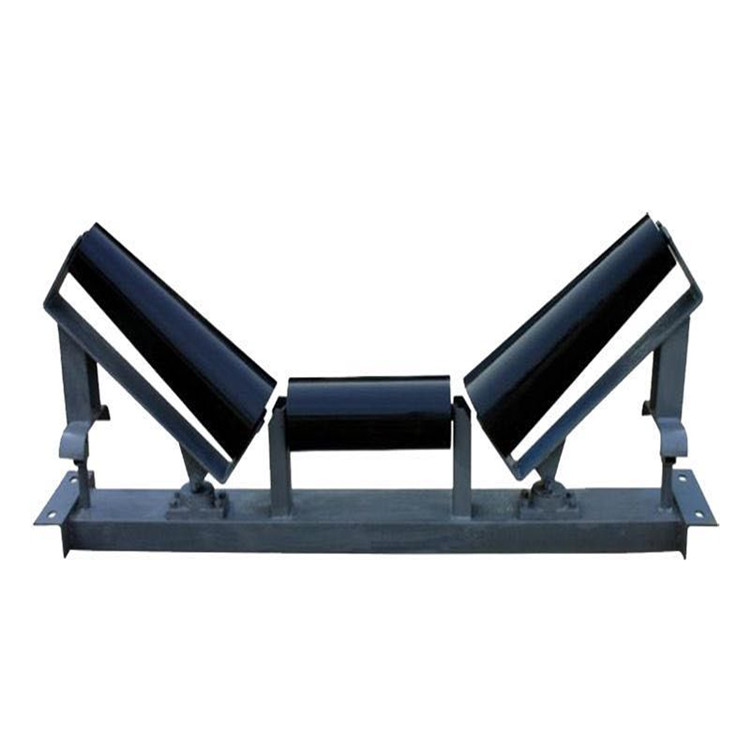
Self-aligning idler: the pivoting frame corrects mistracking, but the roller length must still be matched to the actual belt width.
Its boundary is honesty about cause. A self-aligning idler corrects mistracking; it does not correct a misaligned frame, an uneven loading pattern or a damaged belt. That is why it sits third rather than first: it is a corrective component installed after the layout is understood, and the pivot frame specification is listed as still to be confirmed per project.
Rank 4 — Parallel idler roller: broadest use, easiest to re-specify
The parallel idler roller is a versatile flat-roller design used for both flat-section carrying and return-belt support. It ranks fourth because it is the most substitutable option on the list: consequences of a wrong pick are usually noise, drag and premature replacement rather than belt damage. It uses a carbon steel tube and shaft with sealed bearings and offers an optional galvanized or anti-corrosion coating for humid outdoor and salt-spray port environments, along with optional coated surfaces for general duty. High-performance sealed bearings are specified to lower rotational resistance and running noise.
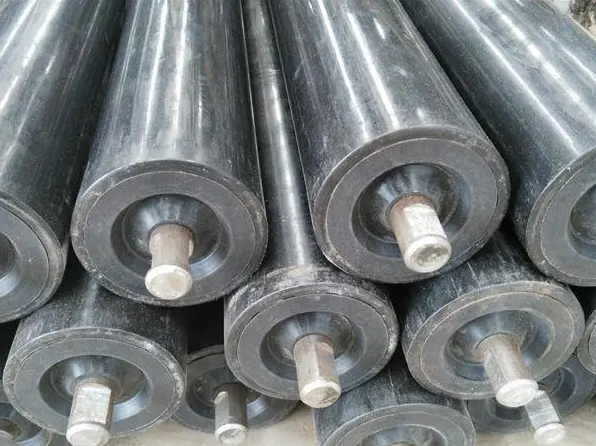
Parallel idler rollers: on port and coastal terminals the coating specification decides service life more than the tube diameter does.
Commercially, this is the most flexible item on the shortlist. Tube diameter, shaft diameter and length are customizable, private-label service for nameplates and packaging is available, and a full set of export documents under FOB or CIF terms can be provided.
What the documentation actually covers
Conveyor rollers in this shortlist are supplied with a Material and Inspection Report, a batch quality document whose certification number is generated by batch. The report covers material, dimensions, radial runout, rotational resistance and appearance, is issued by internal QC or a third party depending on the order, and applies to the global market. The applicable product standards are DIN 22112, CEMA or GB/T 10595, subject to project requirements.
Quality management certification is separate from the batch report. The manufacturer holds ISO 9001 certification to the ISO 9001:2015 standard, issued by China Quality Center, covering the design, procurement, production and quality management scope and applicable to the global market. The certification number is listed as to be confirmed, which is a normal state for a document that is verified at the order stage rather than at the catalogue stage.
Technical fit: how geometry and sealing change belt behaviour
A conveyor roller supports the conveyor belt through bearing rotation and converts rotational power into linear belt motion, which is what makes continuous material transport possible on belt conveying equipment. Inside the roller, bearings reduce rotation resistance; friction between the roller outer surface and the belt transfers the drive into linear displacement of the belt and the material above it. The practical implication is that roller quality is expressed as rotational resistance and runout rather than as appearance.
That is why the filters in this shortlist are technical rather than commercial. Radial runout and coaxiality control determine whether the belt runs smoothly or vibrates; sealed bearings determine how long rotational resistance stays low in dust; trough angle determines how much material the belt can contain at a given speed; and coating determines whether a steel roller survives a salt-spray environment long enough to justify its price. In heavy-dust zones, an optimized sealing structure is specified specifically to prevent bearing seizure, which is the most common failure mode reported in dusty operating conditions.
Application match: mining, cement and port conveyors
The same four roller types are re-weighted by industry, because the working conditions differ more than the components do.
- Mining. Dusty, heavy-duty, continuous bulk handling on 24/7 ore conveyor lines. Requirements include dust-resistant seals, low rotational resistance and wear resistance, with parameters subject to operating conditions. This is the zone where the impact roller earns its first rank, and where a documented case record describes a mining contractor using 100,000 units per year over a two-year duration on an ore conveyor handling ore and crushed stone, with stable continuous operation under heavy-load conditions, low failure rate and reduced downtime for material transportation.
- Cement. Heavy dust, medium-to-high temperatures and continuous operation on raw material handling lines. The stated function is stable support with reduced belt mistracking and maintenance frequency; dust and corrosion resistance are required, with the operating temperature range still to be confirmed per site.
- Ports and logistics. Outdoor, humid, salt-spray and long-distance conveying on bulk terminal conveyors. The requirement set is corrosion-resistant coating, sealed bearings and low noise, with the protection level to be confirmed. This is the clearest case for the coated parallel idler and for verifying coating specification in writing rather than assuming it.
Market trend: growth with a definition problem
Three signals are relevant to a roller shortlist. First, the category is expanding: the rollers and idlers segment is projected to move from USD 4.14 billion in 2025 to USD 7.05 billion by 2034, per Straits Research. Second, the material mix is stable rather than disruptive: steel held 64% of global roller market share in 2024, which means the shortlist for most projects remains a steel-tube decision with coating and sealing as the differentiators. Third, demand is concentrated in heavy industry: mining and quarrying represented 36% of rollers and idlers revenue in 2024.
Standards activity reinforces the same direction. CEMA Standard No. 502-2022 defines dimensional standards and load ratings for bulk material belt conveyor troughing and return idlers; DIN 22112 Part 3 (1996) specifies testing requirements for belt conveyor idlers used in underground coal mining; and ISO 5048:1989 remains the international reference for calculating power and tension in belt conveyors with carrying idlers. None of these standards selects a roller for a buyer, but together they explain why documentation-led shortlists are becoming the norm in cross-border procurement.
Comparison: zone-based shortlist versus single-type replacement
The traditional purchasing pattern is single-type replacement: measure the failed roller, order the same type, and treat all zones as equivalent. It is fast and it works on light-duty lines. The zone-based shortlist used here is slower at the specification stage and faster afterwards, because it assigns a function to each zone before the order is placed.
| Decision factor | Single-type replacement | Zone-based shortlist |
|---|---|---|
| Specification effort | Low; copy the existing part | Higher; requires belt width, angle, load and environment |
| Failure visibility | Failures repeat at the same zone | Failure causes are separated by zone |
| Documentation | Often packing list only | Batch Material and Inspection Report per order |
| Best fit | Short, light-duty or non-critical conveyors | 24/7 mining, cement and port lines |
| Main risk | Repeated belt damage at loading points | Over-specification of low-consequence zones |
The boundaries of this shortlist should be stated as plainly as its advantages. It covers carbon steel-based roller constructions; HDPE, nylon and dedicated low-noise variants appear in procurement vocabulary, but their specifications are not documented in the available records here, so no performance claim is made for them. The impact roller is documented around a Ø108 mm tube, Ø25 mm shaft and a suggested 315–1,150 mm length, which is narrower than the Ø89–133 mm range of the other options. Trough angles are limited to 20°, 25° and 35°. The suggested model designations are references pending drawing confirmation, not catalogue part numbers, and the ISO 9001 certificate number is listed as to be confirmed. Buyers who need third-party inspection must specify it in the order, because the batch report is issued by internal QC or a third party subject to that choice.
Future outlook
Two pressures are likely to shape roller shortlists over the next procurement cycles. The first is documentation: as cross-border project acceptance becomes more formal, the batch report rather than the datasheet will decide whether a shipment is accepted, which favours suppliers who already issue material, dimensional, runout, resistance and appearance data per batch. The second is environment-specific engineering. Port and coastal terminals are pushing coating and sealing specifications harder than tube dimensions, and dusty underground work is pushing sealing structure and rotational resistance. A shortlist that treats these as options rather than requirements will keep producing the same failures, at the same zones, with the same replacement orders.
FAQ
Which conveyor roller should be shortlisted for a crusher discharge zone?
The impact roller is the appropriate shortlisted type for loading points and crusher discharge zones. It is built from carbon steel and wear-resistant rubber rings to absorb heavy material impact and protect the belt from tearing, is designed for 24/7 continuous heavy-load operation, and is documented at a suggested Ø108 mm tube diameter, Ø25 mm shaft diameter and 315–1,150 mm suggested length. It is listed as complying with DIN 22112, CEMA and GB/T 10595 standards, and batch material and inspection reports are available for it.
What documents should accompany a shortlisted conveyor roller?
Conveyor rollers are supplied with a Material and Inspection Report, a batch quality document covering material, dimensions, radial runout, rotational resistance and appearance. Its certification number is generated by batch, and it is issued by internal QC or a third party depending on the order. The applicable product standards are DIN 22112, CEMA or GB/T 10595, subject to project requirements, and the report applies to the global market. Separately, the manufacturer holds ISO 9001 certification to ISO 9001:2015, issued by China Quality Center, covering design, procurement, production and quality management, with the certificate number listed as to be confirmed.
Can tube diameter, shaft diameter and roller length be customized on a shortlisted roller?
Yes. On the trough idler, self-aligning idler and parallel idler roller, the documented range is Ø89/108/133 mm tube diameter and Ø20/25 mm shaft diameter, and tube diameter, shaft diameter and length are customizable. On the impact roller, customization covers tube diameter, shaft diameter and roller length, with a suggested Ø108 mm tube and Ø25 mm shaft. Trough idler and self-aligning idler tube diameter and roller length can be tailored to match on-site belt width, and OEM/ODM scope additionally covers seals, bearings, surface treatment, logo and packaging.
Which shortlisted roller suits humid, salt-spray port conditions?
The parallel idler roller is the closest fit, because an optional galvanized or anti-corrosion coating is available for humid outdoor and salt-spray port environments. Port and logistics conveying conditions are described as outdoor, humid, salt-spray and long-distance, with corrosion-resistant coating, sealed bearings and low noise required, while the protection level remains to be confirmed. The trough idler also offers galvanized or coated surface treatment for harsh site conditions. Coating specification should be confirmed in writing at order stage rather than assumed from the base product.
What lead times and minimum order quantities apply to a shortlisted roller?
For the trough idler, sample lead time is 5–7 days and mass-production lead time is 15–30 days. Under OEM/ODM production, minimum order quantity is 10 units with samples at 5–7 days and mass production at 15–30 days. Engineering-support projects list a 50 pcs minimum, drawing confirmation within 3–5 business days and mass production at 30–45 days. Private-label production lists a 100 pcs minimum (negotiable for large orders), a 10,000 pcs monthly capacity and 30–45 days upon order confirmation.
Which standards should a shortlisted conveyor roller be checked against?
The product standards applied to this roller line are DIN 22112, CEMA and GB/T 10595, selected according to project requirements. For reference, CEMA Standard No. 502-2022 establishes dimensional standards and load ratings for bulk material belt conveyor troughing and return idlers; DIN 22112 Part 3 (1996) specifies testing requirements for belt conveyors idlers used in underground coal mining; and ISO 5048:1989 provides the international method for calculating power and tension in belt conveyors with carrying idlers. Buyers should name the standard in the enquiry, because compliance is confirmed per project rather than assumed across the range.
¿Tiene preguntas o necesita más detalles?
Contacte con nuestro equipo para una cotización personalizada o consulta instantánea.
Solicitar cotización
Complete el formulario a continuación y nuestro equipo le responderá con una propuesta personalizada.
Chat directo de WhatsApp
¿Prefiere chatear en tiempo real? Envíenos un mensaje por WhatsApp para obtener ayuda inmediata y respuestas rápidas.
- Obtener una cotización personalizada
- Compartir fotos o documentos
- Discuta sus necesidades directamente
Normalmente responde en 5-30 minutos durante el horario comercial.