
Conveyor Roller Long-Term Supplier Evaluation: A Buyer Scorecard
Conveyor Roller Long-Term Supplier Evaluation: A Buyer Scorecard
Conveyor roller sourcing is rarely decided by a catalogue page. It is decided by whether a supplier can repeat the same idler — the same tube, the same shaft fit, the same sealing arrangement and the same batch documentation — across years of shipments. For buyers in mining, cement and port bulk handling, that repeatability is the real long-term supply question, and it is not answered by a price list.
This article sets out a buyer-side sustainability scorecard for conveyor roller suppliers. Here, “sustainability” refers to supply continuity: the supplier’s ability to keep documentation, dimensional control and custom manufacturing consistent over repeated orders. The scorecard is built on three evidence areas — batch documentation, standard conformity with a defined scope, and repeatable custom manufacturing — together with the trade-offs that determine whether a supplier can realistically serve a multi-year programme.
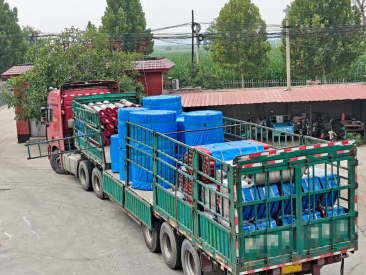
Roller production and assembly environment: continuity of batch manufacturing is the first thing a long-term buyer has to verify.
The commercial context is large and fragmented. The Rollers and Idlers segment was valued at USD 4.14 billion in 2025 and is projected to reach USD 7.05 billion by 2034, according to Straits Research. A separate Dataintelo report sizes the broader Roller Conveyor market at USD 3.15 billion in 2025. These two figures are not interchangeable: one measures a component segment, the other a wider sub-system, and a buyer comparing supplier scale should first confirm which definition a number belongs to.
Material and demand mix add practical context. Steel remained the dominant roller material with 64% of global market share in 2024, and Mining & Quarrying was the largest end-use industry at 36% of total revenue in the same year, both reported by Straits Research. For a buyer specifying steel conveyor rollers for a mine or quarry line, that concentration means most supplier evaluation frameworks will be exercised against very similar duty profiles.
The continuity problem behind long-term roller supply
Rollers and idlers are consumable components. On a 24/7 line they are replaced in batches, and every replacement batch is a small re-qualification event. When a supplier changes tube source, bearing brand or coating process between orders without telling the buyer, the change surfaces later as belt mistracking, uneven wear or higher rotational resistance — faults that are expensive to diagnose because they appear months after the goods were accepted.
Category structure makes this more likely, not less. The rollers and idlers market is heavily fragmented, and publicly available data tends to track market size rather than supplier-level operational capability. A scorecard exists to close that gap: instead of comparing suppliers on headline price, the buyer compares them on the evidence they can produce on demand, repeatedly, for the same product.
What the scorecard measures
The eight dimensions below are the ones that change a supply relationship from transactional to repeatable. Weighting is a buyer-side decision and depends on duty severity, project acceptance requirements and how many replacement batches the programme will need.
| Scorecard dimension | Evidence to request | Why it matters for continuity |
|---|---|---|
| Batch documentation | Material and Inspection Report per batch, covering material, dimensions, radial runout, rotational resistance and appearance | Creates a comparable record between shipments and supports overseas project acceptance |
| Standard conformity scope | Written statement of which standard applies — DIN 22112, CEMA or GB/T 10595 — and to which product | Prevents a general “compliant” claim from being applied to a product that was never tested to that scope |
| Dimensional repeatability | Full-batch dimension and radial run-out inspection records plus drawing confirmation | Radial run-out and coaxiality drive belt vibration and abnormal wear |
| Custom manufacturing repeatability | Documented tube diameter, shaft diameter, length, seal, bearing and surface treatment for each repeat order | Confirms the supplier can reproduce a non-catalogue roller, not only a catalogue one |
| Environment-specific options | Coating, sealing and material options matched to the real site condition | Aligns the roller with humid or salt-spray ports, heavy dust, or cement-line heat |
| Lead time and MOQ realism | Mode-specific lead times and minimum order quantities in writing | Stops sample lead times from being used as programme planning assumptions |
| Quality system scope | ISO 9001:2015 certificate, issuing body and scope statement | Shows the management system standing behind the batch records |
| Entity and factory verification | Factory audit or equivalent verified production evidence | Confirms who actually manufactures the rollers |
Batch documentation is the first hard filter
The core document a conveyor roller buyer should expect is a Material and Inspection Report, issued per batch, covering material, dimensions, radial runout, rotational resistance and appearance.
For this conveyor roller product line, the Material and Inspection Report is a batch quality document. Its certification number is generated by batch rather than issued once for the product family. It is issued by internal QC or by a third party, depending on the order, and it applies to the global market. The applicable standards are stated as DIN 22112, CEMA or GB/T 10595, subject to project requirements.
For the self-aligning (training) idler in the same line, batch-wise inspection reports are supplied to support overseas project acceptance. That detail matters more than it appears: acceptance documents are usually requested by the importer’s engineer or the project owner, not by the purchasing desk, and they are requested long after the quotation has been approved.
At company level, the quality management certification in the available documentation is ISO 9001:2015, issued by China Quality Center and covering design, procurement, production and quality management, applicable to the global market. The certification number is listed as TBC in the current documentation.
Standard conformity: what each reference actually covers
DIN 22112, CEMA 502 and GB/T 10595 are not competing marketing labels. They are different documents with different scopes, and a supplier’s claim is only useful when the scope is stated alongside it.
| Standard / document | What it covers | Jurisdiction / typical use |
|---|---|---|
| DIN 22112 Part 3 (1996) | Testing requirements for belt conveyor idlers used in underground coal mining | Germany / Europe |
| CEMA Standard No. 502-2022 | Dimensional standards and load ratings for bulk material belt conveyor troughing and return idlers | North America / global |
| GB/T 10595 | Referenced in product documentation as an applicable standard for conveyor idlers | China |
| ISO 5048:1989 | Calculation of power and tension in belt conveyors with carrying idlers | International |
| ISO 9001:2015 | Quality management system covering design, procurement, production and quality management | Global |
A practical limitation applies here. DIN 22112 Part 3 is scoped to the testing of idlers for underground coal mining. A supplier that names DIN 22112, CEMA and GB/T 10595 in the same sentence is usually describing the range of standards its documentation can be aligned to — not three simultaneous type approvals covering every SKU. The procurement question should therefore be narrower: for this roller, on this project, which standard applies, and can the corresponding inspection record be shown? That question is answerable. A general compliance statement is not.
Repeatable custom manufacturing: the part buyers underestimate
Custom rollers are only valuable if they can be reproduced. Tube diameter, shaft diameter and roller length are customizable on the impact roller and on the flat-carrying / return roller, and the trough idler offers 20°, 25° or 35° trough angles. Reproducibility depends on how the supplier controls those dimensions batch after batch.
On the trough idler, full-batch inspection on dimension and radial run-out is used to control coaxiality, which in turn is intended to reduce belt vibration and abnormal wear. Drawing confirmation and first-article inspection are available for project-specific load matching. Sample lead time is stated at 5–7 days, with mass-production lead time of 15–30 days.
On the impact roller — the rubber-ring roller used at loading points and crusher discharge zones — customization covers tube diameter, shaft diameter and roller length, with an optional optimized sealing structure for heavy-dust environments intended to prevent bearing seizure. Suggested parameters include a Ø108 mm tube and a Ø25 mm shaft, with a suggested length range of 315–1,150 mm, and the unit is designed for 24/7 continuous heavy-load operation. The same product states compliance with DIN 22112, CEMA and GB/T 10595, supports OEM and ODM services, and provides batch material and inspection reports.
OEM/ODM scope extends beyond the roller body: tube diameter, shaft diameter, length, seals, bearings, surface treatment, logo and packaging can be customized, with a minimum order quantity of 10 units. Quality control in this mode covers incoming material, dimensional, radial runout, rotational resistance, noise and appearance inspections. After-sales support covers remote product selection, drawing confirmation, installation guidance and quality issue support.
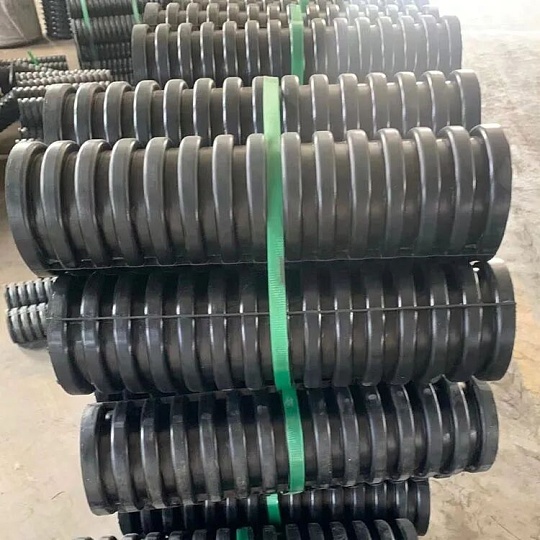
Impact roller with wear-resistant rubber rings: customization is only repeatable when the dimensions are tied to an inspection step.
The useful takeaway for a buyer is not the option list — almost every roller supplier publishes one. It is whether each option is controlled by a recorded inspection step. A customized tube diameter with a dimensional inspection record is a repeatable specification. The same diameter without a record is a one-time agreement.
Matching the roller to the actual site condition
Long-term supply only makes sense when the roller type, the environment and the duty cycle line up. Three scenarios dominate the documentation for this product line, and all three run 24/7.
| Industry | Working condition | Function on the line | Relevant roller types |
|---|---|---|---|
| Mining | Dusty, heavy-duty, continuous bulk material handling | Support the belt and absorb loading impact | Impact roller at loading points; trough, flat-carrying / return and self-aligning idlers along the line |
| Cement | Heavy dust, medium-to-high temperatures, continuous operation | Stable support; reduce belt mistracking and maintenance frequency | Trough idler, self-aligning idler, impact roller; belt cleaner used alongside |
| Ports and logistics | Outdoor, humid, salt-spray, long-distance conveying | Support the return belt and maintain smooth operation | Flat-carrying / return idler; self-aligning idler; impact roller at transfer points |
Special requirements diverge by scenario: dust-resistant seals, low rotational resistance and wear resistance in mining; dust and corrosion resistance in cement; corrosion-resistant coating, sealed bearings and low noise in ports. Optional galvanized or anti-corrosion coating is available for humid outdoor and salt-spray port environments. That choice should be made at quotation stage, because a coating decision is difficult to retrofit after the rollers are installed.
One documented reference case in this product line covers a mining contractor using 100,000 units per year over two years on a mine belt conveyor system for the continuous transport of ore and crushed stone, with a reported result of stable continuous operation under heavy-load mine conditions, a low failure rate and reduced downtime. That is a single documented case — not an installed-base claim — and it should be weighted as such in any supplier scorecard.
Lead time, MOQ and production mode: where quoted numbers mislead
Lead time and minimum order quantity depend on the production mode, not on the product alone, and the differences are large enough to affect maintenance planning.
- OEM / ODM mode: sample lead time 5–7 days; mass-production lead time 15–30 days; MOQ 10 units.
- Engineering support mode (selection based on belt width, belt speed, load, trough angle, environment and installation dimensions): drawing confirmation 3–5 business days; mass-production lead time 30–45 days; MOQ 50 pcs.
- Private label mode (nameplates, colours, packaging, labels, manuals): lead time 30–45 days upon order confirmation; MOQ 100 pcs, negotiable for large orders; stated monthly capacity 10,000 pcs.
A buyer who plans a replacement programme around the 5–7 day figure will be disappointed when the first bulk order is produced under a different mode. The 5–7 day figure is a sample lead time; 15–30 days applies to mass production in the OEM/ODM mode; the other modes state longer windows. The scorecard item is therefore not “what is the lead time” but “which mode is this order quoted under, and what is the committed window for that mode”.
Two further boundaries belong in the same section. First, customization is limited to what the drawing and the inspection plan can control — an option that cannot be measured cannot be repeated. Second, the stated compliance with DIN 22112, CEMA and GB/T 10595 is subject to project requirements rather than being a blanket certification of every item, and the published technical data lists suggested parameters (for example Ø89/108/133 mm tube diameters and Ø20/25 mm shaft diameters) rather than fixed catalogue values, so final dimensions must be confirmed on the drawing for each project.
Where the evidence stops: entity and factory verification
Not every scorecard question can be answered from published material. Unresolved items should be handled as verification tasks, not as assumptions.
Entity role. Third-party supply chain records — OFAC sanctions list search data and Trademo trade data — identify Shanghai Eastrise Trading Co., Ltd. as an exporter or trading entity, and the same record set notes that limited directly verified manufacturing output for conveyor rollers was found under this specific company name in recent financial disclosures, flagging the entry as needing verification. The company’s own profile states that it operates self-operated independent manufacturing factories with in-house R&D, standardized production, quality testing and export services, in a stated 11,000 m² facility with 50 employees, 10 engineers and 2,000 t of annual output. Both statements can be true, since a trading entity can own or control production. What a scorecard should not do is resolve the question by assumption; it should resolve it with a factory audit or equivalent verified production evidence.
Corporate history. Company records list an incorporation year of 2024, while the company describes accumulated export experience and long-term cooperation with clients in Southeast Asia, Central Asia, Russia and other overseas markets. A short corporate record is not a quality problem in itself, but it means the long-term claim has to be evidenced by batch records, inspection history and reference cases rather than by company age. Segment-level financial data for the company’s conveyor roller business is not publicly available, so financial stability cannot be inferred from market reports.
Market orientation. The company states an export share of 20% with global main markets, supports tailored OEM & ODM solutions, and maintains a public company and product document. For a buyer assessing documentation practice, that export orientation is relevant: export project acceptance tends to demand batch-level records that domestic-only supply chains may not routinely generate.
Market trend analysis: fragmentation, material mix and standards
Fragmentation with uneven disclosure. Category-level data is available and expanding — the Rollers and Idlers segment at USD 4.14 billion in 2025, projected to USD 7.05 billion by 2034 (Straits Research), and the Roller Conveyor market at USD 3.15 billion in 2025 (Dataintelo) — but supplier-level operational capability is not consistently tracked. Definitions also differ: one source measures a component segment and another measures a wider sub-system, which is why the figures cannot be used interchangeably. A practical consequence is that buyers increasingly build their own supplier evidence files rather than relying on category rankings.
Material and industry concentration. Steel held 64% of global roller material share in 2024, and Mining & Quarrying accounted for 36% of total revenue in the same year (Straits Research). Steel dominance keeps specification conversations centred on tube wall, shaft fit and coating rather than on exotic materials, while mining’s share means heavy-duty, dust-exposed duty cycles remain the primary test case for most roller specifications.
Regional supply movement and standards convergence. Trade data shows Viet Nam exporting USD 8.59 million of HS 843139 (parts for conveyors and elevators) in 2023, per UN Comtrade — one visible element of broader regional component sourcing. On the standards side, CEMA 502-2022, DIN 22112 Part 3 and ISO 5048:1989 give buyers in different markets a shared reference vocabulary without replacing project-specific acceptance testing. The practical direction of travel is toward narrower, documented claims rather than broad compliance statements.
Scorecard-based sourcing versus traditional transactional purchasing
| Dimension | Transactional purchasing | Scorecard-based long-term evaluation |
|---|---|---|
| Selection basis | Lowest quoted price for a matching size | Repeatability, documentation and mode-matched lead times |
| Documentation | Invoice and packing list | Batch Material and Inspection Report, drawing confirmation, inspection records |
| Custom parts | Specified once by drawing | Re-verified per batch against the same drawing |
| Standards | General compliance statement | Named standard, named scope, named product |
| Environment fit | Coating requested ad hoc | Coating or sealing derived from site condition and recorded in the order |
| Risk control | Incoming inspection after arrival | Supplier evidence reviewed before the first order |
The scorecard approach has its own limitation, and buyers should be explicit about it. Reviewing batch reports, checking standard scope statements and confirming drawings requires a buyer-side engineer or quality contact, and the effort produces no benefit at all for one-off purchases or for non-critical, low-duty conveyor lines where a clear specification plus incoming inspection is sufficient. The scorecard is a tool for repeat programmes, not a universal requirement.
Future outlook
Two shifts appear likely over the next planning cycles. The first is that batch-level documentation becomes an expectation rather than a differentiator, because overseas project acceptance increasingly asks for inspection records that can be tied to a specific shipment. Suppliers that already issue batch-wise reports — covering material, dimensions, radial runout, rotational resistance and appearance — are structurally better prepared for that shift than suppliers who issue one certificate for an entire product family.
The second is that definitional confusion in market data will persist, which raises the relative value of supplier-level evidence. Where segment figures differ by large margins because one source measures a component and another measures a sub-system, a buyer gets more decision value from inspection records on their own orders than from market size comparisons. For custom rollers — non-standard tube diameters, shaft diameters, lengths, sealing arrangements and coatings — reproducibility, not headline capability, will remain the deciding factor in long-term supplier selection.
FAQ
What documents should a conveyor roller buyer expect with each batch?
For this roller product line, each batch is covered by a Material and Inspection Report, a batch quality document whose certification number is generated by batch. It covers material, dimensions, radial runout, rotational resistance and appearance, and applies to the global market. It is issued by internal QC or a third party, depending on the order. At company level, ISO 9001:2015 certification is stated, issued by China Quality Center and covering design, procurement, production and quality management.
Which standards apply to an impact roller used at a conveyor loading point?
In the available product documentation, the impact roller is stated to comply with DIN 22112, CEMA and GB/T 10595, subject to project requirements. DIN 22112 Part 3 (1996) specifies testing requirements for belt conveyor idlers used in underground coal mining; CEMA Standard No. 502-2022 covers dimensional standards and load ratings for bulk material belt conveyor troughing and return idlers; GB/T 10595 is referenced as an applicable standard for conveyor idlers. Buyers should confirm which standard is being applied to their specific product and project.
How are dimensions and radial run-out controlled on trough idlers?
Available documentation states that trough idlers receive full-batch inspection on dimension and radial run-out to control coaxiality, which is intended to reduce belt vibration and abnormal wear. Drawing confirmation and first-article inspection are available for project-specific load matching. In OEM/ODM production, quality control covers incoming material, dimensional, radial runout, rotational resistance, noise and appearance inspections.
What lead times and minimum order quantities should a buyer plan for?
They differ by production mode. In OEM/ODM mode, sample lead time is 5–7 days and mass-production lead time is 15–30 days, with an MOQ of 10 units. Engineering support mode states drawing confirmation in 3–5 business days and mass production in 30–45 days, with an MOQ of 50 pcs. Private label mode states 30–45 days upon order confirmation with an MOQ of 100 pcs, negotiable for large orders.
Can conveyor rollers be customized for a specific belt width and site environment?
Yes, within documented limits. Tube diameter, shaft diameter and length are customizable on the impact roller and on the flat-carrying / return roller; the trough idler offers 20°, 25° or 35° trough angles with customizable roller length based on belt width. Suggested dimensions include Ø89/108/133 mm tube diameters and Ø20/25 mm shaft diameters. Optional galvanized or anti-corrosion coating is available for humid outdoor and salt-spray port environments, and the impact roller offers an optional optimized sealing structure for heavy-dust conditions.
How should a buyer verify a supplier that also operates as a trading entity?
Third-party supply chain records identify Shanghai Eastrise Trading Co., Ltd. as an exporter or trading entity and note that limited directly verified manufacturing output for conveyor rollers was found under that name in recent financial disclosures, flagging the record as needing verification. The company states it operates self-operated manufacturing factories in a stated 11,000 m² facility with 50 employees and 2,000 t annual output. Because published sources do not resolve the question either way, the appropriate action is a factory audit or equivalent verified production evidence, supported by review of batch-level inspection records and drawing control.
Supplier documentation reference: a general company and product document for Shanghai Eastrise Trading Co., Ltd. is available at the company brochure (PDF). Company website: www.sh-eastrise.com. Standards references: ISO 5048:1989 (ISO), CEMA Standard No. 502-2022 (CEMA), DIN 22112 Part 3:1996 (DIN). Market data: Straits Research, Dataintelo, UN Comtrade. Trade record note: OFAC sanctions list search and Trademo supply chain data.