
Conveyor Roller FAQ: Sizing, Angles, Sealing, Lead Times
Conveyor rollers are treated as consumables, yet most roller-related downtime is decided long before the purchase order is issued — at the moment someone specifies a tube diameter, chooses a trough angle, accepts a sealing arrangement, or shortens a lead time to fit a shutdown window. The technical questions buyers raise are consistent across mining, cement and port projects, and they can be answered from documented product facts rather than from sales language.
This reference sets out those answers for three roller families supplied by Shanghai Eastrise Trading Co., Ltd., a professional foreign-trade enterprise headquartered in Shanghai, China, founded in 2024, supplying mining accessories that include conveyor idler rollers to global clients. The families covered are the rubber-ring impact roller, the trough idler and the parallel idler roller, plus the self-aligning (training) idler where belt mistracking is the issue.
Short answers to the five recurring questions
- Sizing: the impact roller is documented at Ø108 mm tube with a Ø25 mm shaft and a suggested length range of 315–1,150 mm. The trough idler and parallel idler roller share tube options of Ø89/108/133 mm and shaft options of Ø20/25 mm.
- Trough angle: the trough idler is offered in 20°, 25° and 35° configurations; the 35° version is classified as a trough carrying idler.
- Sealing and surface: sealed double-row bearings on the trough idler, sealed bearings on the parallel idler, an optional optimized sealing structure for heavy-dust duty on the impact roller, and galvanized or coated finishes where corrosion matters.
- Standards and documents: batch material and inspection reports stated as complying with DIN 22112, CEMA and GB/T 10595, supported by drawing confirmation and first-article inspection.
- Lead times: 5–7 days for samples and 15–30 days for mass production, as stated for the trough idler range.
Why the same five questions keep returning
A roller performs three functions simultaneously: it carries load, it locates the belt, and it seals its own bearings against whatever the conveyor is moving. Each function is governed by a different parameter. Load and belt support are governed by tube diameter, shaft diameter and roller length. Belt location and material containment are governed by trough angle and roller spacing. Bearing life is governed almost entirely by sealing and surface protection. Everything else — drawing approval, batch inspection, lead time — determines whether the specified roller actually arrives as specified.
The commercial consequence is that a roller saved on unit price but undersized for the application tends to reappear as belt edge abrasion, spillage, seizure, or unscheduled stoppage on a 24/7 line. Buyers who understand which parameter drives which failure mode can evaluate a supplier's technical answer instead of comparing catalogue prices.
Sizing: tube diameter, shaft diameter and roller length
Sizing questions are usually the first to arrive, because they determine whether a roller can be fitted to an existing frame at all. The documented ranges across the three families are deliberately narrow: buyers are not choosing from an open catalogue of every diameter, but from a defined set that the supplier builds and inspects routinely.
| Roller family | Tube diameter | Shaft diameter | Other documented parameters | Functional role |
|---|---|---|---|---|
| Rubber-ring impact roller (suggested designation ER-IMPACT-108; model to be confirmed) | Ø108 mm | Ø25 mm | Suggested length 315–1,150 mm; rubber ring specification to be confirmed; carbon steel and wear-resistant rubber | Absorbing lump impact at loading points and crusher discharge |
| Trough idler (suggested designation ER-TROUGH-108; model to be confirmed) | Ø89/108/133 mm | Ø20/25 mm | Trough angle 20°/25°/35°; roller length customized to belt width | Carrying side, containing bulk material |
| Parallel idler roller (suggested designation ER-PARALLEL-108; model to be confirmed) | Ø89/108/133 mm | Ø20/25 mm | Optional galvanized or coated surface | Flat-section carrying and return-belt support |
| Self-aligning / training idler (suggested designation ER-ALIGNING-108; model to be confirmed) | Ø89/108/133 mm | Ø20/25 mm | Pivot frame specification to be confirmed | Correcting belt mistracking on long-distance lines |
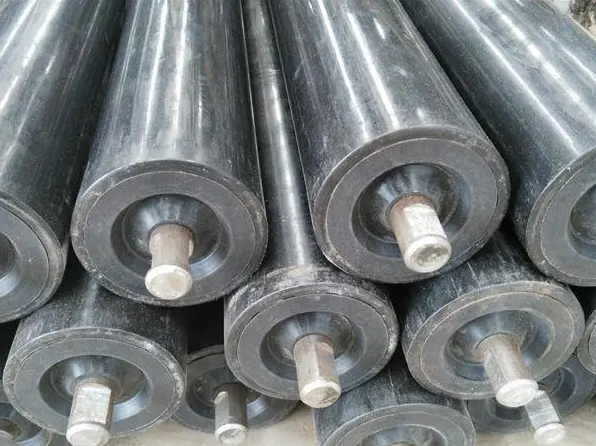
Parallel idler rollers: Ø89/108/133 mm tube options with Ø20/25 mm shafts, used for flat-section carrying and return-belt support.
Two practical points follow from this table. First, the impact roller is a distinct envelope: a Ø108 mm tube on a heavier Ø25 mm shaft, with length as a variable rather than a fixed value. Second, the trough and parallel families share the same tube and shaft set, which simplifies spare-parts holding for a plant that uses both carrying and return positions on the same conveyor. A buyer who standardises on Ø108 mm tube across both positions can consolidate inventory without changing frame interfaces.
Length is where most sizing errors occur in practice. The impact roller is documented with a suggested range of 315–1,150 mm, and the trough idler length is customized according to belt width. Neither is a stock assumption: the correct figure comes from the frame drawing, not from the belt width alone, because frame width, bearing housing type and mounting clearances all affect the finished dimension.
Trough angle: what 20°, 25° and 35° actually change
Trough angle describes how far the side rollers of a carrying set are inclined from the horizontal. Deeper troughs contain material more effectively and allow a conveyor to run at a given capacity with less spillage; shallower troughs present a flatter belt profile. The trough idler range documents three options — 20°, 25° and 35° — and the 35° configuration is explicitly classified as a trough carrying idler.
The selection logic follows the material rather than the catalogue. Fine, free-flowing bulk material in a fully loaded carrying position benefits from a deeper profile that keeps the load centred; a shallow angle is more often associated with flat-profile or transition-adjacent positions. What the documented range does not provide is a load rating per angle, a recommended belt-width pairing, or a transition-distance formula. Those must come from the conveyor design, not from the roller supplier's data sheet, and a buyer who is offered a specific angle without a reference to belt width, material characteristics and transition geometry is being given a preference, not an engineering answer.
Where trough angle questions become procurement questions is in mixed fleets. A plant that already runs 35° carrying sets and adds a new line at 20° has created two spares profiles, two setup references and two inspection baselines. Standardising the angle across a site is often worth more than optimising a single conveyor.
Sealing and surface: matching the roller to dust, humidity and salt spray
Sealing is the parameter most often under-specified and most directly responsible for premature seizure. Grease loss and contaminant ingress destroy bearings long before a tube wears through, and the failure usually announces itself as a seized roller dragging on a moving belt — which then damages the belt cover.
The documented sealing arrangements differ by family. The trough idler uses carbon steel tube and shaft with sealed double-row bearings, a configuration aligned with high load-bearing capacity on the carrying side. The parallel idler roller uses sealed bearings described as lowering rotational resistance and running noise. The impact roller offers an optional optimized sealing structure for heavy-dust environments, specifically intended to prevent bearing seizure in conditions such as crusher discharge zones.
| Site condition | Documented sealing option | Documented surface option | Where it applies in this range |
|---|---|---|---|
| Heavy dust, crusher discharge, loading points | Optional optimized sealing structure for heavy-dust environments | Carbon steel and wear-resistant rubber construction | Impact roller |
| General bulk handling, dusty and high-temperature conditions | Sealed double-row bearings | Galvanized or coated surface treatment | Trough idler |
| Humid outdoor sites, salt-spray port environments | Sealed bearings | Optional galvanized or anti-corrosion coating | Parallel idler roller |
| Long-distance lines with mistracking risk | Sealed bearings | Carbon steel tube, shaft and pivot frame | Self-aligning idler |
Surface protection is a separate decision from sealing, and buyers frequently conflate them. Galvanizing or coating addresses the outer tube and frame interface; sealing addresses the bearing cavity. A galvanized roller with an inadequate seal still fails in a salt-spray terminal, and a well-sealed roller with an uncoated tube can still corrode externally in the same environment. The documented options here cover both dimensions — but the protection level itself is not specified in the available data, which is a genuine boundary a buyer should close before ordering.
Standards and documentation: what a roller batch should arrive with
Standards questions are usually asked for one of two reasons: an internal specification requires a named standard, or an overseas project requires acceptance documentation at handover. Both are answerable, but the answer depends on distinguishing the standard a roller is designed against from the report a batch actually ships with.
For the impact roller, batch material and inspection reports are stated as complying with DIN 22112, CEMA and GB/T 10595. These are not interchangeable documents, and the differences matter to a buyer reading them.
| Standard | Documented scope | What it means at acceptance |
|---|---|---|
| DIN 22112 (Part 3, 1996) | Testing requirements for belt conveyor idlers used in underground coal mining | Relevant where the project references European underground coal practice; the part number and year should appear on the report, not just the DIN number |
| CEMA Standard No. 502-2022 | Dimensional standards and load ratings for bulk material belt conveyor troughing and return idlers | Useful for dimensional verification of carrying and return idlers in North American or globally specified projects |
| GB/T 10595 | Referenced in the impact roller batch documentation set | Commonly requested for projects with Chinese supply-chain acceptance requirements |
| ISO 5048:1989 | Calculation of power and tension in belt conveyors with carrying idlers | A system-level calculation standard, not a roller product standard; useful when verifying whether a roller choice is consistent with the conveyor's duty |
Documentation beyond the standard reference is where most project acceptances are won or lost. The documented support package here includes drawing confirmation and first-article inspection for project-specific load matching, full-batch inspection on dimension and radial run-out to control coaxiality, and batch material and inspection reports for overseas project acceptance. Radial run-out control is the parameter that most directly affects belt vibration and abnormal wear, so it is worth confirming that the report covers run-out rather than dimensional checks alone.
First-article inspection deserves separate attention in a procurement FAQ because it is the mechanism that converts a drawing into a repeatable part. Before a batch runs, the first article is checked against the confirmed drawing; if it passes, the batch has a reference. Without that step, a supplier is effectively building to an interpretation, and the discrepancy typically surfaces at the port, not at the factory.
Lead times: 5–7 days for samples, 15–30 days for production
Lead time questions arrive early because they determine whether a specification can be met at all. The stated figures for the trough idler range are 5–7 days for samples and 15–30 days for mass production. Those figures describe production time, not the full procurement cycle, and buyers should treat them accordingly.
Three activities sit outside that window and are frequently the reason a delivery slips. Drawing confirmation comes first: the roller length and mounting details must be agreed before a sample is built, and an unconfirmed drawing cannot be quoted as a fixed schedule. First-article inspection follows, adding a verification step before mass production begins. Surface treatment — galvanizing or coating — is a separate process from tube and bearing assembly and is not instantaneous. A buyer planning a shutdown should request a written schedule that separates sample time, first-article approval and mass production, rather than accepting a single combined figure.
The other lead-time variable is fleet size. Requesting 50 rollers across three diameter and two angle variants is a different production problem from requesting 500 of one configuration; the stated 15–30 day window is more likely to hold for standardised, repeat configurations than for a mixed order requiring multiple setups.
Where each roller family fits
Application questions are really questions about zones on a conveyor. The same line may require three different roller types, and matching them by zone is more reliable than matching by product name.
Mining ore conveyor lines run dusty, heavy-duty, continuous bulk handling on a 24/7 basis, with the roller supporting the belt and absorbing loading impact. Dust-resistant seals, low rotational resistance and wear resistance are the stated requirements, with parameters subject to operating conditions. This is the zone where the impact roller is applied — loading points, crusher discharge and heavy-duty conveyors — and where the optional heavy-dust sealing structure is relevant.
Cement raw material handling lines operate in heavy dust at medium-to-high temperatures with continuous operation, and the roller's function is stable support with reduced belt mistracking and maintenance frequency. Dust and corrosion resistance are required, with the operating temperature range still to be confirmed. Trough idlers with galvanized or coated surfaces are the documented fit here, supported by sealed double-row bearings.
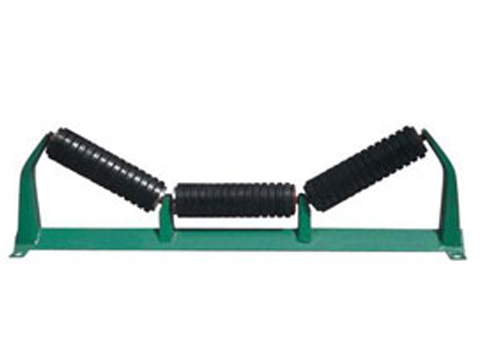
Trough idler: 20°/25°/35° angle options with Ø89/108/133 mm tube and Ø20/25 mm shaft, used on carrying positions in mining, cement and port conveyors.
Port and logistics bulk terminals face outdoor, humid, salt-spray conditions over long conveying distances, with the roller supporting the return belt and maintaining smooth operation. Corrosion-resistant coating, sealed bearings and low noise are the stated requirements; protection level remains to be confirmed. The parallel idler roller is the documented fit for return and flat carrying positions, with galvanized or anti-corrosion coating options and low-noise sealed bearings. Where mistracking is the recurring problem on long-distance lines, the self-aligning idler's self-pivoting frame is designed to correct belt mistracking automatically and reduce the risk of belt edge abrasion and tearing.
Market signals behind the specification debate
Roller procurement is becoming more specification-driven rather than less. Straits Research estimates the rollers and idlers segment at USD 4.14 billion in 2025, projected to reach USD 7.05 billion by 2034. The same source reports that steel accounted for 64% of the global roller material share in 2024, and that mining and quarrying represented 36% of total rollers and idlers revenue in 2024.
Two readings are useful for buyers. The first is that steel remains the default material despite continued discussion of polymer alternatives — which means most specification debate is not about material substitution but about how well a steel roller is sealed, coated and inspected. The second is that mining's 36% revenue share explains why heavy-duty, dust-facing configurations dominate documented product ranges: the commercial centre of the category sits in exactly the conditions where sealing and run-out control decide service life.
Market sizing itself requires care. Published estimates for this category differ substantially by definition — one commercial estimate puts the conveyor roller market at USD 115.9 million in 2024, while a segment-level estimate covers rollers and idlers at roughly USD 3.9 billion. The gap is a scope difference between a component market and a sub-system market, not a disagreement about growth. Buyers using market figures to justify a procurement strategy should check whether the number refers to rollers alone or to rollers and idlers together.
Comparison with conventional practice, and where this range stops
Against a conventional open-bearing roller, a sealed roller changes the maintenance model rather than the purchase price. Open or lightly sealed bearings accept grease easily and can be re-lubricated in place, which suits small plants with accessible conveyors and frequent manual rounds. Sealed bearings move that work into the factory: the roller arrives with its bearing protection decided, and the site's job becomes monitoring rotational resistance and run-out rather than adding grease. For a 24/7 port or mine where a manual lubrication round competes with production time, that shift is usually the reason sealed rollers are specified.
The boundaries of this documented range are equally clear, and buyers should know them before shortlisting.
- Material range: the documented roller bodies are carbon steel, with wear-resistant rubber rings on the impact roller. HDPE, nylon and rubber-disc variants appear in broader market discussion but are not documented in this range. A project specifying a polymer roller for a specific corrosion or noise reason is outside the documented product set.
- Sealing classification: sealing structures are described functionally — sealed double-row bearings, sealed bearings, optional optimized sealing for heavy dust — but a formal protection level is not specified. Buyers should confirm the ingress rating in writing rather than inferring it.
- Temperature limits: the cement scenario requires dust and corrosion resistance at medium-to-high temperatures, yet the operating temperature range is recorded as to be confirmed. That has to be closed against the actual site temperature before an order is placed.
- Load ratings per size: tube and shaft diameters are documented, but a load rating for each combination is not. Capacity must be confirmed through drawing review and first-article inspection rather than assumed from diameter alone.
- Supplier verification: the supplier is a foreign-trade enterprise established in 2024, and independent trade data does not confirm conveyor roller manufacturing output under this specific corporate name. Buyers should therefore treat batch material reports, inspection reports and first-article documentation as the primary verification path, and request them before release of a first order.
None of these boundaries makes the range unsuitable for its stated applications. They simply define what a buyer must confirm rather than assume — which is the difference between a supplier comparison based on evidence and one based on catalogue claims.
Future outlook
Three developments are likely to shape roller procurement over the next planning cycle. The first is documentation-led purchasing: as more projects require batch reports and first-article records at handover, the supplier's ability to produce consistent inspection paperwork becomes a qualification criterion rather than an administrative detail. The second is sealing specificity. As dust and corrosion requirements harden in mining, cement and port terminals, functional descriptions such as "optimized sealing for heavy dust" will increasingly need to be paired with a stated ingress classification before they can be compared across suppliers. The third is standard literacy. With DIN 22112, CEMA 502-2022, GB/T 10595 and ISO 5048 all in circulation, buyers who can distinguish a product test standard from a system calculation standard will read acceptance documents more accurately than those who treat every reference as equivalent.
For the supplier side, the practical implication is that product breadth is less decisive than documentation depth. A range that covers Ø89/108/133 mm tubes, Ø20/25 mm shafts, three trough angles and two sealing philosophies already spans most bulk-handling carrying and return positions. What differentiates it is whether each of those configurations arrives with a drawing confirmation, a run-out measurement and a batch report that a project engineer can accept without further correspondence.
FAQ
What tube and shaft sizes are available across the impact, trough and parallel rollers?
The impact roller is documented with a Ø108 mm tube, a Ø25 mm shaft and a suggested length range of 315–1,150 mm. The trough idler, the parallel idler roller and the self-aligning idler all share tube options of Ø89/108/133 mm and shaft options of Ø20/25 mm, with roller length customizable to match belt width. Final lengths for any family are confirmed against the customer drawing rather than selected from a fixed list.
Which trough angle — 20°, 25° or 35° — should a project specify?
The trough idler is offered in 20°, 25° and 35° configurations, with the 35° version classified as a trough carrying idler. The available data does not publish a load rating or a belt-width recommendation per angle, so the angle should be selected against the conveyor design — material characteristics, belt width and transition geometry — rather than from the roller specification alone. Sites commonly standardise on one angle to avoid maintaining multiple spares profiles.
What sealing and surface options are available for dusty or corrosive sites?
The trough idler uses sealed double-row bearings and offers galvanized or coated surface treatment for dusty and high-temperature conditions. The parallel idler roller uses sealed bearings described as lowering rotational resistance and noise, with optional galvanized or anti-corrosion coating for humid outdoor and salt-spray port environments. The impact roller offers an optional optimized sealing structure for heavy-dust environments, intended to prevent bearing seizure at crusher discharge and loading points. A formal ingress protection level is not specified in the available documentation and should be confirmed in writing.
Which standards and documents should accompany a roller shipment?
Batch material and inspection reports for the impact roller are stated as complying with DIN 22112, CEMA and GB/T 10595. DIN 22112 Part 3 (1996) covers testing requirements for idlers used in underground coal mining; CEMA Standard No. 502-2022 establishes dimensional standards and load ratings for troughing and return idlers; ISO 5048:1989 addresses power and tension calculation at system level rather than roller product testing. Beyond standards, the documented support package includes drawing confirmation, first-article inspection for project-specific load matching, and full-batch inspection on dimension and radial run-out.
How long do samples and mass production take?
For the trough idler range, the stated sample lead time is 5–7 days and the mass production lead time is 15–30 days. These figures describe production time and exclude drawing confirmation, first-article approval and surface treatment, each of which adds a separate step. Mixed orders spanning several diameters and trough angles should be scheduled with the supplier in writing, since multiple setups affect the production window.
For a downloadable summary of the roller range covering impact, trough, parallel and self-aligning idlers, the company brochure is available here: Shanghai Eastrise Trading Co., Ltd. product brochure (PDF).
¿Tiene preguntas o necesita más detalles?
Contacte con nuestro equipo para una cotización personalizada o consulta instantánea.
Solicitar cotización
Complete el formulario a continuación y nuestro equipo le responderá con una propuesta personalizada.
Chat directo de WhatsApp
¿Prefiere chatear en tiempo real? Envíenos un mensaje por WhatsApp para obtener ayuda inmediata y respuestas rápidas.
- Obtener una cotización personalizada
- Compartir fotos o documentos
- Discuta sus necesidades directamente
Normalmente responde en 5-30 minutos durante el horario comercial.