
Control Pendant Buyer's Check: 5-Button COP-5MSS-DD vs Alternatives
Control Pendant Buyer's Check: 5-Button COP-5MSS-DD vs Alternatives
How a hoist or crane is controlled at the point of operation still comes down to a device in an operator's hand. A wired push button pendant — the handheld switch box used to raise, lower and travel lifting equipment — is specified through a small set of hard constraints rather than through brand preference: contact rating, ingress protection, button count, emergency stop behaviour, and the environmental envelope the unit is declared for. This independent check examines one specific wired option, the WILMALL COP-5MSS-DD, a 5-button handheld control station with emergency stop rated AC 500V / 10A, and places it against the alternative control solutions that hoist and crane buyers commonly evaluate.
WILMALL is the industrial electrical brand of Wenzhou Mofan Electric Technology Co., Ltd., a manufacturer and B2B supplier based in Wenzhou, China, whose portfolio covers industrial automation and power distribution components, including control pendant stations, proximity sensors, rotary encoders, connectors and transformers. The company operates as a manufacturer, wholesaler and OEM/ODM factory, states that its products comply with certifications such as CE, UL and RoHS, and reports an export ratio of about 80% across markets that include Pakistan, South Korea, Australia and Malaysia.
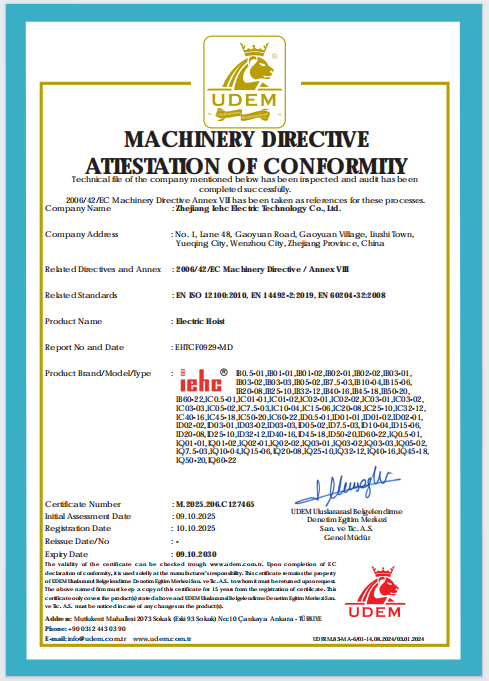
Compliance evidence is part of the buyer's check: document scope, issuing authority and validity period matter as much as the device rating itself.
Why a pendant purchase is a constraint decision, not a style decision
Buyers in the research and evaluation stage are not choosing a colour or a shape. They are checking whether a device's declared parameters survive the place it will be installed. For industrial pendant controllers, the reference framework is the low-voltage switchgear and controlgear standard family IEC 60947-5-1 and its European equivalent EN 60947-5-1, which covers control circuit devices and switching elements. That standard defines the language buyers should use when comparing handheld stations: contact ratings, utilisation categories, terminal marking, and mechanical endurance.
A second layer of constraint comes from the machine itself. Hoisting equipment is typically certified against machinery safety and electrical-equipment standards, and the pendant is one component inside that architecture. In the verified certification record for WILMALL's electric hoist model YJ02-02, the applicable standards are EN ISO 12100:2010, EN 14492-2:2019 and EN 60204-32:2008 — the third of which specifically addresses electrical equipment of machines for hoisting and lifting. A pendant that satisfies its own product standard can still be the wrong choice if it does not fit the control circuit voltage, the required number of functions, or the environment declared by the machine builder.
The practical consequence is that a control pendant specification is best read as five separate checks — electrical fit, climate and ingress, button count and function, control architecture, and documentation scope — rather than as one overall quality judgement. The rest of this article applies those five checks to the COP-5MSS-DD and to the alternatives around it.
The COP-5MSS-DD in declared specification terms
The COP-5MSS-DD is a handheld control pendant station with a five-button layout and a push-lock emergency stop, rated at AC 500V and 10A, housed in a plastic enclosure and intended for cranes, hoists, lifting equipment and industrial control systems. Its declared parameters, taken directly from the manufacturer's product data, are as follows.
| Parameter | Declared value — WILMALL COP-5MSS-DD |
|---|---|
| Model | COP-5MSS-DD push button pendant |
| Type | Control pendant station (handheld, wired) |
| Button layout | 5-button handheld control station with emergency stop (push-lock) |
| Rated voltage and current | AC 500V, 10A |
| Enclosure material | Plastic |
| Ingress protection | IP65 |
| Ambient temperature | −25 °C to +40 °C |
| Humidity and weather | Environments with an average of +40 °C and 90% humidity, allowing use where rain intrusion occurs |
| Atmosphere limits | No danger of explosive media; no media that sufficiently corrodes metal, destroys rubber, or contains insulating gas or liquid |
| Typical applications | Cranes, hoists, lifting equipment, industrial control systems, mobile equipment control |
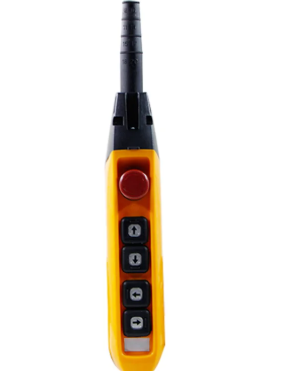
The COP-5MSS-DD: a five-button handheld pendant control station with a push-lock emergency stop, rated AC 500V / 10A and specified to IP65 for rain and high-humidity environments.
How the device behaves in a control circuit
The operating sequence is deliberately simple, and that simplicity is part of its procurement value. The operator presses the corresponding button — up, down, forward or backward — and the internal electrical contacts of that button close. The closed contact sends a control signal into the equipment control circuit, and the control system, whether a contactor or a drive, executes the corresponding action, so the crane travels or the hoist lifts. There is no intermediate translation layer: no transmitter, no receiver, no software state that must be established before the first command reaches the machine.
Configuration and supply facts
WILMALL runs an OEM/ODM production model for pendant control stations and offers configuration choices beyond the standard five-button layout: contact point material in silver or copper, an emergency braking button, button counts of 2, 4, 6 and 8, and single-speed or dual-speed button operation. On the supply side, the company states a monthly capacity of 2,000 units, a lead time of 15 working days, a minimum order quantity of 5 units, 100% testing of production, and remote technical support as its after-sales channel for these products.
Check 1 — Electrical fit with the control circuit
The rated AC 500V / 10A contact specification is a ceiling, not a target. The relevant question is what the pendant will actually be switching. On the electric hoist model YJ02-02, for example, the control voltage is stated at 24–48V while the main supply range is 110–480V. A pendant rated to AC 500V and 10A is comfortably above the control voltages used in this class of equipment, which is the direction of margin a buyer wants to see: the contact rating must exceed the circuit it governs, not match it precisely.
The check fails in the opposite direction as well. Where a pendant's contacts are intended to switch a low-current signal into a contactor coil or drive input, over-specifying is harmless, but under-specifying — fitting a low-rated switch to a circuit that draws more than its declared current — is a functional risk that no amount of housing quality will offset. Buyers should therefore request the contact rating and the intended circuit type together, and confirm them against the machine's electrical documentation.
Check 2 — Climate, humidity and ingress protection
The COP-5MSS-DD is specified to IP65 and is declared for environments with an average temperature of +40 °C and 90% humidity, including conditions where rain intrusion is possible. IP65 denotes protection against dust ingress and against water projected from a nozzle, which is the level of protection relevant to a pendant left hanging on a crane bridge, an outdoor gantry, a loading bay, or a wet production hall.
Humidity is the constraint buyers most often under-specify. Ninety percent average humidity does not merely mean damp air; it means condensation cycles inside and outside the enclosure, corrosion pressure on terminals, and a higher probability of tracking across contact surfaces over years of service. This is a maintenance-cost question rather than a purchase-price question, and it is the reason ingress protection and contact materials should be evaluated as one decision rather than two.
Check 3 — Button count and function set
A five-button layout with a push-lock emergency stop covers the common hoist and crane pattern: directional travel functions plus the stop function in a single handset. The push-lock action means the emergency stop stays engaged once pressed, which is the behaviour operators expect from a pendant in a lifting application.
The check to run here is functional mapping. Count the machine functions the operator must command from the handset: for a single-speed hoist with travel, four directional functions plus emergency stop is a normal fit for a five-button station. For dual-speed drives, or for machines with additional functions such as trolley travel, rotation or a horn, the standard five-button body may be insufficient, and the buyer moves to the customisation route where 2, 4, 6 and 8-button variants and single or dual-speed operation are available. Deciding this before ordering avoids both a functional shortfall and an unnecessary overspend on a larger station.
Check 4 — Control architecture: wired, wireless, or fixed station
This is where the wired pendant's structural advantage becomes concrete. Because a wired pendant draws its signal path from the machine control circuit, it removes two failure modes that belong specifically to radio-based control: battery depletion in the transmitter, and the pairing or link-state relationship between transmitter and receiver. Neither failure mode can occur in a device that has no battery and no radio link. For buyers managing industrial production equipment, construction machinery or automation systems where an unplanned stop is expensive, that reduction in failure points is a genuine procurement argument rather than a marketing claim.
| Comparison criterion | Wired push button pendant (COP-5MSS-DD) | Radio / wireless remote | Fixed machine-mounted station |
|---|---|---|---|
| Signal and power source | Machine control circuit, via cable | Battery-powered transmitter, radio receiver | Machine control circuit, fixed wiring |
| Pairing requirement | None | Transmitter-to-receiver pairing and link maintenance | None |
| Battery dependency | None | Yes — battery state affects availability | None |
| Operator position | Within cable reach and routing limits | Free within radio coverage | Operator must stand at the panel |
| Declared rating (this model) | AC 500V, 10A | Verify per model | Verify per model |
| Ingress protection (this model) | IP65 | Verify per model | Verify per model |
| Ambient range (this model) | −25 °C to +40 °C | Verify per model | Verify per model |
| Typical constraint | Cable wear, routing and reach | Battery management and RF environment | No handheld mobility |
The comparison should not be read as a ranking. Each architecture solves a different problem. A wireless remote is the more logical choice where the operator must walk alongside a long-travel crane or work at a distance from the load. A fixed station is appropriate where the machine is small, the operator's position is predictable, and a trailing cable would be a nuisance rather than an asset.
Check 5 — Documentation and certificate scope
Certification is the constraint area where buyers most often over-generalise. WILMALL's electric hoist model YJ02-02 holds a Machinery Directive Attestation of Conformity issued by UDEM under certificate number EHTCF0929-MD for the Turkey market, with a validity period from 2025-10-09 to 2030-10-09, covering the standards EN ISO 12100:2010, EN 14492-2:2019 and EN 60204-32:2008. Separately, the manufacturer states that its products comply with certifications such as CE, UL and RoHS.
The buyer's lesson is scope discipline. A certificate issued for a specific product model, market and standard set documents that product; it does not automatically transfer to every other item in the same system, and it does not replace the machine-level conformity assessment the integrator or crane builder is responsible for. When evaluating any pendant, wired or wireless, the correct request is the certificate that names the exact model being purchased, its market of use, its issuing authority, and its expiry date.
Where the wired COP-5MSS-DD is not the right answer
A comparison that lists only advantages is not usable for procurement. The COP-5MSS-DD has clear boundaries, and they should be stated plainly.
- Cable dependency. The pendant is connected by cable. Reach is bounded by cable length and routing, and the cable itself becomes a wear item that requires strain relief, support along its run, and periodic inspection. Where an operator must move far from the machine or cross traffic paths, a wireless remote may be the better architecture.
- Fixed five-button standard configuration. The standard unit is a five-button station. Machines requiring six or eight control functions, or dual-speed operation on every axis, need a customised configuration rather than the standard model.
- Declared ambient envelope of −25 °C to +40 °C. Sites operating outside that range — deep-freeze logistics, foundry-side positions, or extreme outdoor installations — fall outside the declared operating conditions and require a separate suitability review rather than an assumption of equivalence.
- Atmosphere exclusions. The device is declared for environments without explosive media and without media that sufficiently corrode metal, destroy rubber, or contain insulating gas or liquid. Explosive-atmosphere or aggressive-chemical applications are outside its stated scope and require equipment designed for those conditions.
- Component, not system. A pendant switches control signals; it does not by itself define the safety architecture of a machine. The emergency stop button is a push-lock type, but whether a given installation's safety function is satisfied depends on the machine design, the category assessment and the integrator's conformity work.
Application fit: what these pendants actually control
The declared application profile covers industrial hoists, cranes and mobile equipment control with multi-button operation and durable enclosures for harsh environments, with matched equipment listed as crane hoists. The recorded project scenario is the management of industrial production equipment, construction machinery or automation systems under the stated climate range, in markets that include Palestine and Australia.
One documented case involves a recreational vehicle factory in Australia that took 10 units of control devices for hoist and equipment control, with a service duration of one year reported as stable operation and the practical highlight given as ease of use. Cases of this size are small in absolute terms, but they are useful for the buyer's check because they show the pattern that matters: an existing hoist fleet, a maintenance team that needs a straightforward wired handset, and a preference for a device whose behaviour is predictable rather than one with more functions than the operator will use.
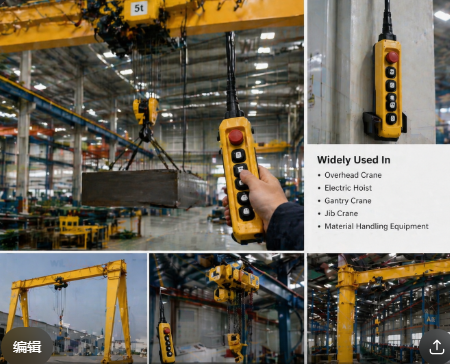
Wired pendant control remains the default interface in production halls, loading areas and construction sites where predictable, battery-free operation matters more than operator mobility.
Market context: how large this category is and where it is concentrated
The category is measurable and stable rather than explosive. One 2025 estimate places the global pendant crane control station market at approximately USD 275.60 million, projected to reach USD 423.80 million by 2032 at a CAGR of 5.1%. A separate 2025 estimate for the broader pendant control mechanical switch category, which extends beyond crane-specific stations, puts that market at USD 722.5 million. The difference between the two figures is best read as a scope difference — crane control stations versus mechanical switches as a wider class — rather than as a contradiction, and buyers should treat both as category context rather than as a signal about any single supplier.
Regionally, North America held 34.2% of the pendant crane control station market in 2025, which is consistent with a large installed base of lifting equipment and a mature replacement cycle. On the supply side, recognised participants in the pendant control station category include Schneider Electric, Eaton, Siemens, ABB and Rockwell Automation, and Schneider Electric held a 15% share of the global low-voltage equipment market in 2024. That concentration affects availability, documentation practice, and price behaviour across the category. It does not, on its own, determine which pendant is right for a particular hoist.
Future outlook
Three directions are visible from the constraint side of this category. First, ingress protection and climate declarations will keep moving up the buyer's checklist as more lifting equipment is specified for outdoor, wash-down and high-humidity environments; IP65-class handheld stations such as the COP-5MSS-DD are positioned for that demand rather than for clean-room use. Second, standardisation pressure is likely to continue through IEC 60947-5-1 and its regional equivalents, which makes comparable data — contact rating, button count, e-stop type, enclosure material — more valuable than brand recognition in early evaluation stages. Third, demand is becoming more configuration-driven: buyers increasingly want a pendant matched to the exact function count and speed profile of their machine, which favours suppliers able to offer both a defined standard model and a customisation route with declared lead times and minimum order quantities.
For hoist and crane buyers, the practical conclusion is that the wired-versus-wireless question is secondary to the constraint checklist. A five-button wired pendant that matches the control circuit, survives the site climate, and carries documentation naming the exact model will outperform a more feature-rich alternative that fails any one of those three tests.
FAQ
1. What specifications should be verified first when buying a wired control pendant?
Electrical fit comes first. The pendant's contact rating must exceed the circuit it will switch — the COP-5MSS-DD is rated AC 500V and 10A, while a typical electric hoist in the same equipment class, such as the YJ02-02, uses a control voltage of 24–48V. After electrical fit, the sequence that matters is ingress protection, ambient temperature range, button count and function mapping, and the documentation that names the exact model being purchased.
2. What does IP65 protection mean for a pendant used in rain and high humidity?
IP65 indicates protection against dust ingress and against water projected from a nozzle. It corresponds to working conditions where an average temperature of +40 °C and 90% humidity apply and where rain intrusion is possible — the environment declared for the COP-5MSS-DD. For buyers, the practical implication is that IP65 addresses the housing and sealing, while terminal materials and inspection intervals still govern long-term reliability in humid service.
3. How many buttons does a crane or hoist pendant need?
The count should equal the number of functions the operator must command from the handset, plus emergency stop. A five-button handheld station with a push-lock emergency stop, such as the COP-5MSS-DD, fits single-speed hoists with travel functions. Where six or eight functions are required, or where every axis runs at dual speed, customised configurations are available in 2, 4, 6 and 8-button variants with single-speed or dual-speed operation.
4. What are the trade-offs between a wired pendant and a wireless remote control?
A wired pendant takes both signal and power from the machine control circuit, so it has no battery to manage and no transmitter-to-receiver pairing or link state to maintain — two failure modes simply do not exist in that architecture. Its cost is mobility: reach is limited by cable length and routing, and the cable is a wear item requiring strain relief and inspection. A wireless remote removes the cable constraint but introduces battery management and RF-environment considerations. The correct choice depends on how far the operator must travel and how disruptive an unplanned stop would be.
5. Does a machinery certificate issued for one product cover other products in the same system?
No, not automatically. Certificates are issued against a defined scope — a specific product, market and standard set. WILMALL's electric hoist model YJ02-2 is covered by a Machinery Directive Attestation of Conformity issued by UDEM under certificate number EHTCF0929-MD for the Turkey market, valid from 2025-10-09 to 2030-10-09, against EN ISO 12100:2010, EN 14492-2:2019 and EN 60204-32:2008. Buyers should request documentation that names the exact model being purchased, its market, the issuing authority and the expiry date.
6. What lead time, minimum order quantity and testing should buyers expect for pendant control stations?
For WILMALL's pendant control station production, the stated figures are a monthly capacity of 2,000 units, a lead time of 15 working days, a minimum order quantity of 5 units, and 100% testing of production units. After-sales support is provided as remote technical assistance. These numbers are supplier-declared and should be confirmed against the specific configuration, since custom button counts and contact materials can affect scheduling.
7. What environmental conditions fall outside the COP-5MSS-DD's declared envelope?
Three categories sit outside the declared scope. Temperatures below −25 °C or above +40 °C exceed the stated ambient range. Explosive atmospheres are excluded, as are media that sufficiently corrode metal, destroy rubber, or contain insulating gas or liquid. Applications requiring those conditions need equipment designed and certified for them rather than a standard IP65 pendant adapted on site.