
Continuous Annealing Silicon Steel: What It Means for Transformer Core Performance
The continuous annealing process is a defining stage in the production of grain-oriented silicon steel — the point where magnetic domain structure, coating formation, and final core-loss performance are locked in for transformer applications.
In modern electrical steel manufacturing, continuous annealing is not an optional refinement. It is the process step that determines whether a coil of silicon steel can meet the loss guarantees required by energy-efficient transformers, high-voltage converter stations, and low-noise distribution grids. For procurement teams and transformer manufacturers evaluating material suppliers, understanding how continuous annealing affects final magnetic performance is as important as comparing price or lead time.
This article focuses on continuous annealing silicon steel — what the process does, which specifications matter, and how to assess supply options for transformer-grade materials.
The Role of Continuous Annealing in Silicon Steel Production
Continuous annealing refers to the controlled heat treatment of silicon steel strip in a continuous furnace line, where the strip moves through heating, soaking, slow cooling, and final cooling zones to achieve a specific metallurgical state. In grain-oriented silicon steel (GOES), this stage is critical after cold rolling to develop the Goss texture — the crystallographic orientation that gives the material its high magnetic induction in the rolling direction.
For grain-oriented electrical steel, the final annealing step also performs two additional functions: it forms the glass film (forsterite layer) that acts as an electrical insulator between laminations, and it provides the surface condition required for subsequent insulating coating application. The iron loss value and magnetic flux density stated on a material certificate are largely determined by how thoroughly this annealing stage is controlled.
In the context of transformer core manufacturing, the practical value of well-annealed material is lower core loss at working flux densities. The parameter used by most manufacturers is iron loss measured at 1.7 T and 50 Hz, expressed as P1.7/50 in W/kg. Thinner gauges — 0.23 mm, 0.20 mm, and even 0.18 mm — are achieved through additional cold rolling and annealing passes that permit reduced eddy-current losses at higher operating frequencies.
Why Continuous Annealing Silicon Steel Matters to the Market
The global electrical steel market is projected to grow from approximately USD 31.0 billion in 2025 to USD 47.0 billion by 2033. Within that market, grain-oriented silicon steel — which relies heavily on tight process control in annealing — supports the transformer, reactor, and high-voltage equipment segments where efficiency standards are being tightened across the EU, North America, and Latin America.
Several market drivers are reinforcing the importance of continuous annealing quality:
- Energy-efficiency regulation: Distribution transformer replacement programs in the EU and North America require core materials with iron loss values that were considered premium-grade only a decade ago.
- Grid expansion: Long-distance HVDC transmission projects require converter transformers built from ultra-low-loss oriented silicon steel with stable magnetic performance under continuous load.
- Industrial frequency conversion: Variable-frequency drives and photovoltaic converter transformers operate under harmonics that amplify core losses, pushing demand toward grades with controlled high-frequency behavior.
- EV charging infrastructure: Charging pile installations increase demand for distribution transformers and power conversion equipment, adding pressure on the supply chain for reliable electrical steel grades.
These trends do not automatically benefit every producer. The suppliers that gain procurement consideration are those that can demonstrate consistency in magnetic properties across coils — a consistency that starts with annealing control.
Understanding Annealing-Sensitive Specifications
When evaluating continuous annealing silicon steel, buyers should anchor their assessment on two core magnetic parameters:
Iron Loss (P1.7/50)
Iron loss quantifies the core loss in W/kg when the material is magnetized at 1.7 T and 50 Hz. Lower values mean less energy dissipated as heat in the transformer core. For example, model 23R075 specifies iron loss ≤ 0.75 W/kg, while model 20-65 achieves ≤ 0.65 W/kg at a thickness of 0.20 mm. Grades like 27Q095, 27Q100, and 27Q105 cover the 0.27 mm thickness segment with loss values from 0.95 to 1.05 W/kg.
Magnetic Flux Density (B8)
Magnetic flux density is measured in Tesla at a field strength of 800 A/m. Higher B8 values indicate the material can be magnetized more easily, allowing smaller core cross-sections for the same flux requirement. The Hi-B grades in the 20-65, 23R075, and 27Q type series typically specify B8 ≥ 1.88 T, with some 0.27 mm grades reaching ≥ 1.91 T.
These two parameters are inversely related in process control: over-annealing can improve loss but reduce induction; under-annealing leaves high losses. A supplier with integrated annealing control can release material where both parameters meet grade limits consistently.
HL AND SL LIMITED: Export-Oriented Electrical Steel Supply
HL AND SL LIMITED is a specialist in the export trade of electrical steel (silicon steel), established in 2012. The company operates a 30,000 m² manufacturing facility with an annual production capacity of 30,000 tons and approximately 50 employees, including a 10-engineer R&D team. Export business accounts for about 80% of total sales, with major markets including Mexico, Brazil, Italy, UAE, and India.
As an authorized agent of China Baowu Steel Group, the company sources high-quality grain-oriented electrical steel from stable upstream channels. It also operates a fully equipped material processing plant capable of customized secondary processing — cutting, slitting, and surface treatment according to customer specifications. This integration of mill supply and in-house processing gives buyers a single point of responsibility for material specification and dimensional accuracy.
The product range includes high magnetic induction grain-oriented silicon steel (Hi-B) in the following representative grades:
| Model | Thickness | Iron Loss (P1.7/50) | Flux Density (B8) | Typical Application |
|---|---|---|---|---|
| 20-65 | 0.20 mm | ≤ 0.65 W/kg | — | Ultra-high voltage transformers, high-efficiency distribution transformers |
| 23R075 | 0.23 mm | ≤ 0.75 W/kg | ≥ 1.88 T | Energy-efficiency standard transformers, high-efficiency distribution transformers |
| 27Q095 | 0.27 mm | ≤ 0.95 W/kg | ≥ 1.91 T | High-efficiency power transformers, PV converter transformers |
| 27Q100 | 0.27 mm | ≤ 1.00 W/kg | ≥ 1.91 T | Power transformers, reactors |
| 27Q105 | 0.27 mm | ≤ 1.05 W/kg | ≥ 1.88 T | Power transformer cores, transformer manufacturing |
| 27Q110 | 0.27 mm | ≤ 1.10 W/kg | ≥ 1.88 T | Power transformers, automotive generators, electrical equipment |
| 27Q120 | 0.27 mm | ≤ 1.20 W/kg | — | Small and medium transformer cores |
The main component of these grades is iron, with silicon added at approximately 3.0% to 3.2%. Impurities such as C, S, and N are strictly controlled, and inhibitors (MnS, AlN) are present to enhance magnetic properties.
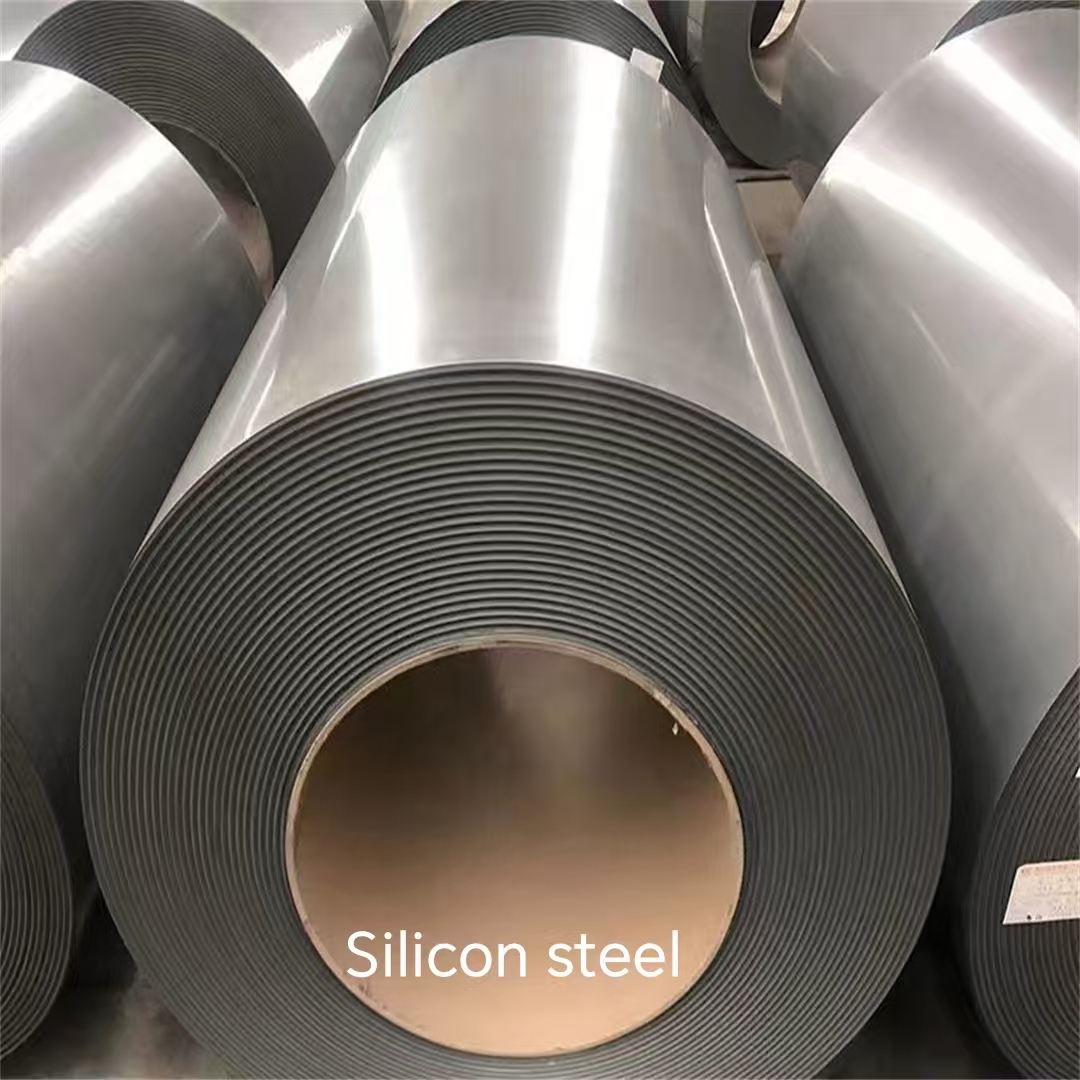
Application Scenarios for Continuous Annealing Grades
The value of annealing-controlled silicon steel is best understood in the context of real operating conditions. Several documented application patterns show how grade selection is linked to regional grid requirements and environmental stress.
High-Efficiency Distribution Networks
In regions where energy-efficiency standards are strict and noise limits for transformer operation are low, distribution transformer manufacturers specify oriented silicon steel with iron loss values at or below 0.60–0.65 W/kg. The material must maintain stable excitation characteristics under continuous grid connection and provide coating that withstands humidity and coastal salt spray conditions. This scenario applies to distribution transformer replacement programs in northern Europe, including Germany, where EU ecodesign requirements drive the retirement of old energy-consuming units.
Cold-Region Grid Infrastructure
For power distribution networks in Canada's cold-region zones, where temperatures can range from −40 °C to −20 °C and freeze-thaw cycles are frequent, the magnetic permeability retention of the core steel at low temperature becomes a key selection criterion. Noise control is another requirement, since urban low-noise transformer specifications can be more demanding than standard rating tests. These projects typically use three-dimensional rolled iron core transformers made from a 0.20 mm class grade such as 20-65 or 20R070.
HVDC and Converter Transformers
Ultra-high-voltage direct current projects, such as the ±800 kV Belém Mountain Phase II line in Brazil, require converter transformer core material with very low loss and high magnetic flux density in a hot, humid tropical climate. The operating mode is continuous bipolar transmission at ±800 kV / 4000 MW, with equipment including converter transformers, DC filters, AC filters, and reactive power compensation devices. In this environment, corrosion resistance of the insulation coating and stable magnetic properties at elevated temperature are as important as the catalog loss value.
Large Transformer Manufacturing for Regional Grids
In Brazil, oriented silicon steel has been used by local transformer producers to meet INMETRO energy-efficiency certification requirements. Distribution and power transformers manufactured for the national grid must operate under full load for 24 hours with moderate start-stop frequency. Grades such as 27Q120 (0.27 mm, ≤ 1.20 W/kg) serve this segment where cost-efficiency and certification compliance are balanced.
Procurement note: The same grade code can behave differently depending on annealing history, coating type, and final processing. Buyers should request actual mill test certificates and verify iron loss and B8 values on a lot-by-lot basis rather than relying on catalog descriptions alone.
Continuous Annealing vs. Traditional Batch Annealing: Practical Trade-offs
Historically, some silicon steel products — particularly semi-processed grades — were finished by batch annealing at the customer's lamination stage. Continuous annealing, by contrast, integrates the final heat treatment into the mill's process line, producing a fully processed strip with final magnetic properties ready for stamping and stacking.
From a buyer perspective, the advantages of continuous annealing are clear:
- Uniformity: Lengthwise temperature control in a continuous line yields more consistent magnetic properties along the strip compared with batch processing.
- Coating formation: The process can be configured to form appropriate insulating layers in-line, reducing additional handling steps.
- Scale: Continuous lines handle large coil volumes, which matters when transformer manufacturers need consistent supply for multi-coil batches.
However, there are limitations that should be acknowledged:
- Minimum order quantities: Mill production runs for continuously annealed Hi-B grades are typically large. For a transformer manufacturer needing only a few tons of a niche grade, availability and MOQ terms can be restrictive.
- Grade commitment: Once a coil has been processed through the final line, its grade band is established; users cannot easily re-process to achieve a different magnetic performance.
- Complexity for small lots: For prototyping or repair applications where only small quantities are needed, semi-processed or locally annealed material may be a more practical route even though final properties are less consistent.
Market Trends and What They Mean for Material Buyers
The grain-oriented silicon steel market was valued at approximately USD 13.55 billion in 2025 and is projected to reach USD 23.57 billion by 2035, representing a CAGR of about 5.8%. With non-grain-oriented (NGO) electrical steel still holding the largest overall share at 69.7% in 2025, the growth in grain-oriented grades is specifically tied to transformer efficiency investment, grid interconnections, and renewable-energy integration.
An additional structural development is China's record steel export performance — reaching 117.055 million metric tons in 2024, a 25.1% year-on-year increase — which means more electrical steel supply is entering the international market through trading and distribution channels. For procurement teams, this increases the importance of verifying the supplier's upstream authorization and processing capability, rather than relying solely on attractive price levels.
The shift toward ultra-thin gauge silicon steel (under 0.25 mm) for high-frequency motors in new-energy vehicles also indicates that annealing technology capable of handling thinner gauges will be in growing demand. While transformers remain the core application, suppliers that can support multiple downstream segments add resilience to a buyer's supply chain.
Future Outlook for Continuous Annealing Silicon Steel
Over the next five years, three developments are likely to shape the continuous annealing silicon steel segment:
Tighter loss specifications. As transformer loss evaluation is incorporated more systematically into procurement decisions, the gap between nominal grade loss and actual measured loss across temperature ranges will receive greater scrutiny. Producers will need to document not just peak performance but performance stability.
Coating innovation. The surface insulation layer plays a major role in stack factor, weldability, and corrosion resistance. The next generation of environmentally compliant coatings will need to meet EU environmental directives while preserving the magnetic performance achieved in the annealing line.
Supply chain integration. Buyers are increasingly looking for suppliers that can combine mill allocation, precision slitting, coating, and stamping support under one commercial agreement. This favors export specialists with in-house processing facilities and stable agency relationships with large mill groups.
HL AND SL LIMITED's position — authorized agent of China Baowu Steel Group, operator of a 30,000-ton processing facility, and a 10-engineer R&D team — illustrates this integration trend in the export channel.
FAQ
What is continuous annealing silicon steel?
Continuous annealing silicon steel is electrical steel that receives its final controlled heat treatment in a continuous furnace line, producing a fully processed strip with defined magnetic properties. In grain-oriented grades, this step develops the crystallographic texture and forms the surface film needed for transformer core applications.
Which models of grain-oriented silicon steel are available for transformer core applications?
A range of high magnetic induction grain-oriented silicon steel (Hi-B) models is available, including 20-65, 23R075, 27Q095, 27Q100, 27Q105, 27Q110, and 27Q120. These steels are composed of iron with approximately 3% silicon content and contain inhibitors such as MnS and AlN to optimize magnetic properties.
What are the typical iron loss values for 0.27 mm and 0.23 mm Hi-B oriented silicon steel?
In the 0.27 mm thickness segment, iron loss (P1.7/50) ranges from ≤ 0.95 W/kg for model 27Q095 to ≤ 1.20 W/kg for model 27Q120. In the 0.23 mm segment, model 23R075 achieves iron loss ≤ 0.75 W/kg with magnetic flux density (B8) ≥ 1.88 T.
Why are inhibitors such as MnS and AlN important in grain-oriented silicon steel?
Inhibitors are microalloying elements that control grain growth during the annealing process. They allow the development of the desired Goss orientation, which is responsible for the high magnetic induction and low iron loss in the rolling direction. The presence of MnS and AlN is associated with stable magnetic performance in Hi-B grades.
What is the silicon content of typical Hi-B oriented silicon steel?
The silicon content is approximately 3.0% to 3.2%. The main component is iron, with supplementary elements such as Al and Mn. Impurities such as C, S, and N are strictly controlled to maintain magnetic performance.
How does HL AND SL LIMITED support transformer manufacturers in purchasing silicon steel?
HL AND SL LIMITED is an authorized agent of China Baowu Steel Group, with an annual production capacity of 30,000 tons. The company operates a fully equipped material processing plant and provides customized on-demand secondary processing services for silicon steel, supporting dimensional precision and material readiness. Contact: sales-01@hlslind.com, +86 134-6700-2282.
Which markets does HL AND SL LIMITED primarily serve?
Export business accounts for approximately 80% of total sales. Major markets served include Mexico, Brazil, Italy, UAE, and India.
Download the company brochure (PDF) for detailed product specifications, processing capabilities, and supply terms.