
Contemporary Sectional Sofa: What Buyers Must Verify
A contemporary sectional sofa is a seating system built around a continuous footprint, usually combining bench, corner and chaise modules into an L-shaped or extended arrangement. In procurement, the category is less about a single silhouette than about verifiable constraints: overall dimensions, seat geometry, module load ratings, upholstery documentation, frame materials and customization limits. Those constraints determine whether a specification can be shipped, installed and maintained as intended.
The visual language of modern contemporary minimalist furniture is easy to describe and harder to verify. A low profile, a clean arm line and a neutral fabric can look consistent in a photograph while the underlying specification remains unresolved. For buyers in the research and evaluation stage, the useful question is not whether a sectional looks contemporary. It is whether the configuration, materials and documentation can survive an import review, a project handover and years of daily use.
This reference guide focuses on the Contemporary Sectional Sofa category within the broader Modern Contemporary Minimalist Furniture segment. It uses verified product parameters, company facts and regulatory context to show where the real specification risks sit. It also identifies limits in the available product data, because a credible procurement decision depends as much on what is documented as on what is claimed.
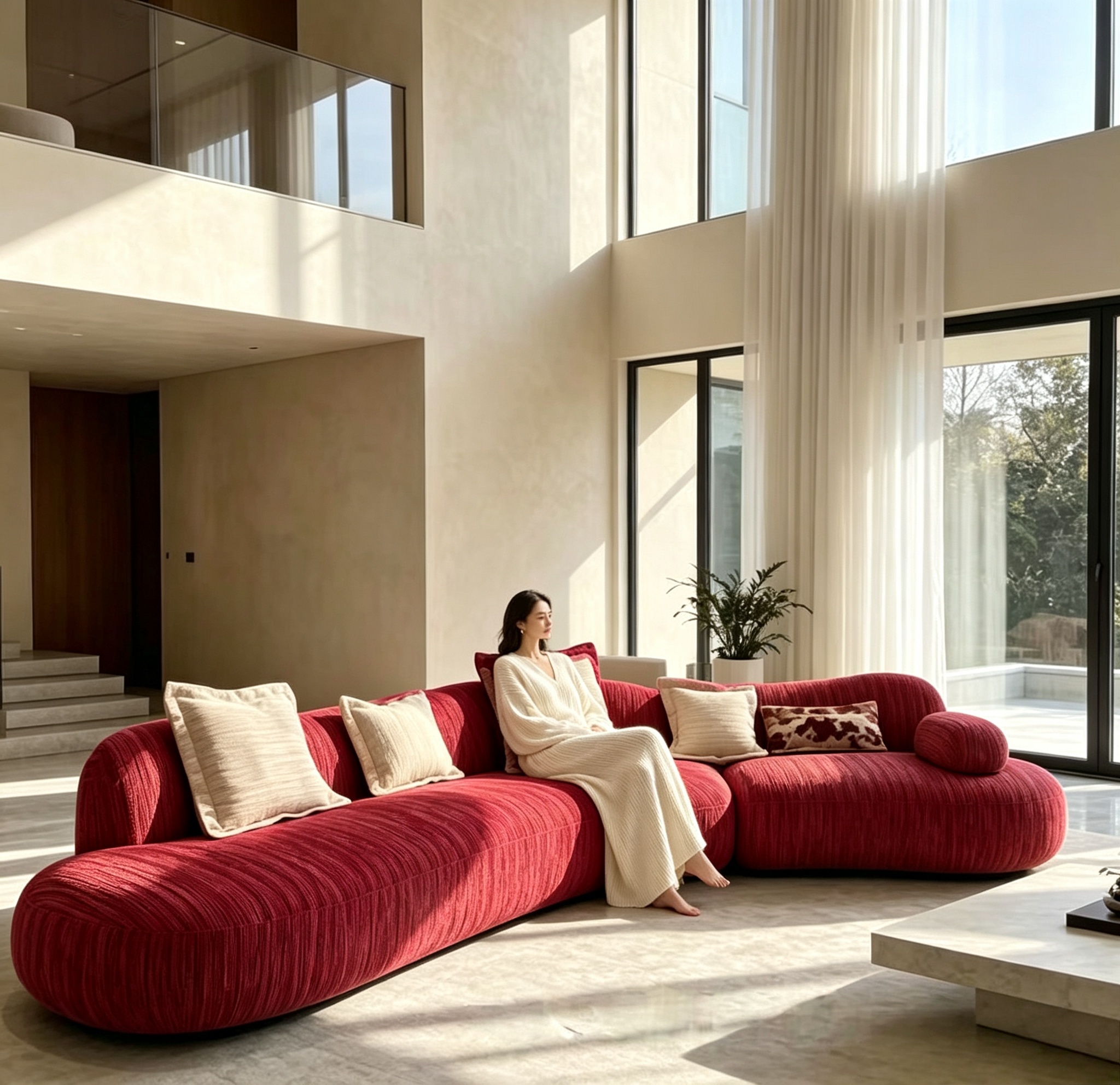
Why the category is growing, and why specification risk is growing with it
Commercial research cited in the verified data package places the global minimalist furniture market at USD 52.6 billion in 2024 and projects it to reach USD 81.1 billion by 2030. The same dataset projects a 7.0% CAGR for the global modular furniture market to 2034, with a forecast value of USD 178.6 billion. These figures are category-level. They do not isolate contemporary sectionals, and they should not be read as a demand guarantee for any single SKU. They do indicate a favourable backdrop for modular seating systems that support compact layouts, flexible room planning and coordinated living-room collections.
The procurement risk grows in parallel. A fixed sofa is often specified as one item with one footprint. A contemporary sectional sofa is a system of modules, connectors, upholstery choices, leg finishes and replacement parts. Each added variable can improve fit, but each one also creates a new point of verification. A buyer who evaluates only the cover image may miss the difference between a 3,200 mm L-shaped sectional and a free-combination modular platform, or between a 420 kg static load rating and a 180 kg per-module rating.
From image to purchase order: the constraints that matter
For a contemporary sectional sofa, four constraint groups deserve priority in the research and evaluation stage. They are dimensions and site access, load ratings by product and module, upholstery and fire-test documentation, and the commercial envelope of customization, MOQ, lead time and price band.
1. Dimensions and site access
Dimensions are the first filter because a sectional can fail before it reaches the living room. The Minimalist Sectional Sofa SSF-26011 is specified at W3200 x D1850 x H710 mm, with a seat height of 450 mm, seat depth of 730 mm and backrest height of 360 mm. The leg height is 110 mm. A footprint of 3,200 mm by 1,850 mm is not a universal fit. Buyers should check room dimensions, lift and stair access, door clearances and the intended circulation path around the sofa.
Modular platforms shift the access problem rather than removing it. The Contemporary Modular Sofa SSF-26012 and Modular Sectional Couch SSF-26013 use a single module size of W950 x D960 x H710 mm, with a seat height of 440 mm, seat depth of 630 mm, back cushion height of 340 mm and leg height of 110 mm. Smaller modules can make delivery and on-site assembly easier, but they introduce interface checks. The buyer must confirm how modules connect, whether the specified configuration is straight, cornered or extended, and whether replacement modules can be matched to the original upholstery and finish.
2. Load ratings by product and module
Load ratings should be read as product-specific data, not as a category claim. The SSF-26011 lists a static load bearing of 420 kg. The SSF-26012 and SSF-26013 list a load capacity of 180 kg per module. Those numbers describe different products and different test contexts. A buyer should not transfer a 420 kg static load rating to a modular platform, nor assume that a per-module rating is an assembled-system rating. The provided specification does not state the test method or report number behind these figures, so the rating should be treated as the manufacturer's declared parameter until product-specific test documentation is supplied.
3. Upholstery, frame and fire-test documentation
The upholstery options for the sectional range are fabric or leather. Cushion filling is described as high-resilience foam plus feather blend for the SSF-26011, and high-resilience foam plus feather mixture for the modular SSF-26012 and SSF-26013. The frame support uses a serpentine spring and a stainless steel leg, with a matte black aluminium alloy sofa leg. These are useful construction facts, but they are not the same as compliance evidence.
The provided product specification does not state CAL 117 compliance or a fire-test report for the upholstery. It also does not list FSC-certified wood components for the modular sofa. This is a material boundary for buyers. In the United States, 16 CFR Part 1640 incorporates California TB 117-2013 smolder-resistance requirements for covered upholstered furniture manufactured, imported or reupholstered on or after 25 June 2021. Applicability depends on the exact product construction and destination-market rules. A supplier statement that a sofa is suitable for a market is not a substitute for product-specific test evidence. The correct procurement action is to request the test report, the material declaration and the scope of coverage, then match those documents to the SKU and the market.
4. Customization, MOQ, lead time and price band
Customization is a genuine advantage in this category, but it changes the commercial comparison. The capability record for Standeehome lists OEM and ODM support, dimensional adjustments, fabric and leather selection, colour coordination, cabinet colour, hardware style and soft-padding filling ratio. For sectional sofas, the relevant customization variables are module configuration, fabric or leather selection, colour, size and selected design details, subject to product capabilities. The same record states an MOQ of 2 units, a lead time of 31 days and a monthly capacity of 800 units.
Price band is the least transparent variable. The provided product data does not include a public price, a wholesale price or a landed-cost range for the sectional models. A credible price comparison therefore has to be built from a line-item RFQ rather than a headline number. The variables that move the band include module count, upholstery route, filling specification, finish, packaging, order volume, delivery terms and destination. A buyer who compares one supplier's fabric sectional with another supplier's leather sectional without normalizing those variables is not comparing the same product.
Standeehome Minimalism Furniture: a manufacturer-backed brand in the minimalist segment
Standeehome Minimalism Furniture is a modern minimalist furniture brand. The associated manufacturing operation, STANDEE HOME, was founded in 2019 and operates from a dedicated 5,000 m² manufacturing facility in China. The company reports 120 employees, an annual output of 120,000 units, a 15-engineer R&D team and a 70% export ratio. Its stated main markets include the USA, Canada, Australia, UK, Germany and Southeast Asia. The main product scope covers indoor furniture including sofas, beds, chairs and cabinets.
For buyers, the relevant point is not the size of the facility by itself. It is the relationship between manufacturing control and specification control. The company states that it manages the production process in-house, from technical drawings and material sourcing to multi-stage quality control, and that it handles small-batch custom orders, exclusive DTC collection updates and residential real estate procurement needs. That claim matters in the Contemporary Sectional Sofa category because modular upholstery programmes depend on repeatable cutting, foam consistency, seam alignment, connector fitting and replacement-part matching.
The sectional range illustrates the point. The Minimalist Sectional Sofa SSF-26011 is an L-shaped platform with a 420 kg static load bearing and a 3,200 mm overall width. The Contemporary Modular Sofa SSF-26012 and Modular Sectional Couch SSF-26013 are free-combination platforms built from 950 mm modules, each rated at 180 kg. All three list fabric or leather upholstery, stainless steel legs, serpentine spring support and matte black aluminium alloy sofa legs. These are not interchangeable products. They serve different room sizes, access conditions and replacement strategies.
The case record adds an application reference. An apartment developer project used full-container bulk orders that included 150 sets of living room furniture, among them modular sofas, TV stands, side tables and storage cabinets, plus 100 sets of bedroom furniture including upholstered beds, nightstands, dressers and drawer dressers. The record states that the furniture had been in stable use for three years, with no abnormal noise or loose parts after long-term use; that the materials met European and American import standards and passed customs inspection; and that the unified minimalist style supported repeat orders. This is a case reference, not a guarantee for every project. It does show the kind of evidence buyers should ask for when a sectional programme is part of a larger residential rollout.
Technical explanation: how a contemporary sectional is specified
The technical specification of a contemporary sectional sofa should separate the seating platform from the commercial configuration. The platform defines dimensions, structure, comfort and load. The commercial configuration defines modules, upholstery, colour, finish and packing. A clean specification keeps those layers visible.
| Model | Configuration | Key dimensions | Seat geometry | Load rating | Material notes |
|---|---|---|---|---|---|
| SSF-26011 Minimalist Sectional Sofa | L-shaped minimalist corner sofa | W3200 x D1850 x H710 mm | Seat height 450 mm; seat depth 730 mm; backrest height 360 mm; leg height 110 mm | Static load bearing 420 kg | Fabric or leather upholstery; stainless steel leg; serpentine spring; matte black aluminium alloy sofa leg; high-resilience foam plus feather blend |
| SSF-26012 Contemporary Modular Sofa | Free-combination modular sofa | Single module W950 x D960 x H710 mm | Seat height 440 mm; seat depth 630 mm; back cushion height 340 mm; leg height 110 mm | 180 kg per module | Fabric or leather upholstery; stainless steel leg; serpentine spring; matte black aluminium alloy sofa leg; high-resilience foam plus feather mixture |
| SSF-26013 Modular Sectional Couch | Freely splicable modular configuration | Single module W950 x D960 x H710 mm | Seat height 440 mm; seat depth 630 mm; back cushion height 340 mm; leg height 110 mm | 180 kg per module | Fabric or leather upholstery; stainless steel leg; serpentine spring; matte black aluminium alloy sofa leg; high-resilience foam plus feather mixture |
The structure is deliberately simple. The SSF-26011 uses a fixed L-shaped frame logic, while the SSF-26012 and SSF-26013 use module logic. In a modular project, the buyer should confirm the intended combination, the number of modules, the connector type and the replacement path. The specification states that the modular sofa can be designed into straight lines, corners or other combinations according to the actual modules, and that module configurations, fabrics, colours and sizes can be customized according to actual space dimensions. Those statements are capability statements. They still need to be converted into a signed configuration drawing before production.
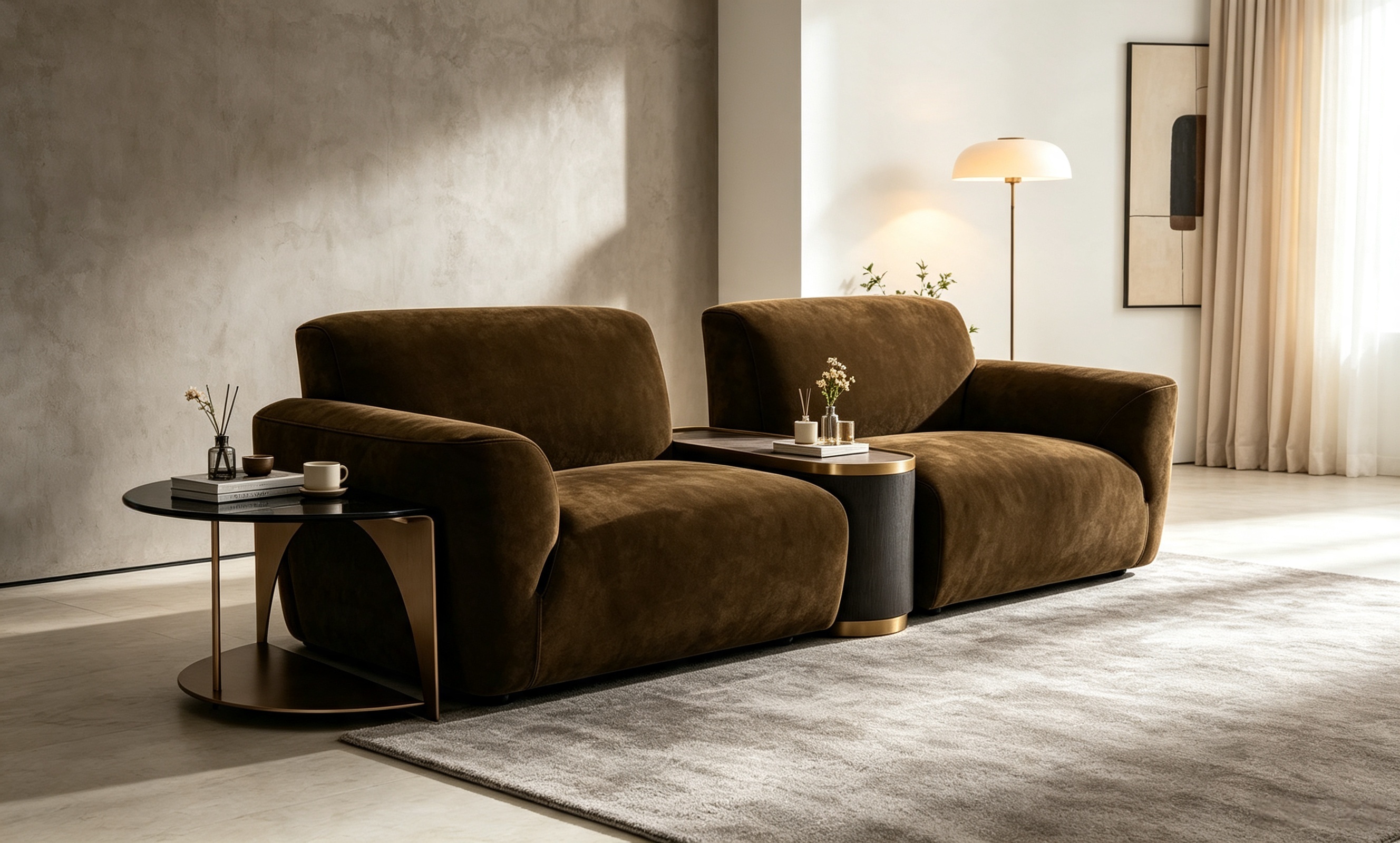
Quality control is part of the technical explanation because it determines whether the specified configuration can be repeated. The capability record describes a four-stage process: raw material inspection, semi-finished inspection, finished product full inspection and pre-loading inspection. Pre-shipment inspection is performed for frame construction. The after-sales scope includes spare hardware supply, damage claim support during shipment, assembly instruction documents and replacement parts service. For a sectional programme, those after-sales items are not administrative extras. They are the difference between a one-off delivery and a maintainable furniture package.
Packaging is also a specification item. The case record refers to reinforced ocean shipping packaging as a measure that helps reduce transportation damage. The product data states that flat-pack options exist for some items, but the sectional specification should be confirmed at the packing-unit level. A modular sofa may ship as multiple cartons; an L-shaped sectional may require a different packing plan. The buyer should ask for packing dimensions, carton count, gross weight and assembly instructions before approving the order.
Application and use cases
The application profile for this furniture family is indoor dry use, with an ambient temperature range of 10°C to 32°C and a recommendation to avoid long-term direct sunlight and humid spaces. Those conditions matter for upholstery, foam and wood-based components. A contemporary sectional placed in a bright show flat, a hotel lounge or a residential living room should be specified with the cleaning and exposure regime in mind, not only the colour palette.
The stated project types include private residence renovation, villa whole-house furnishing, luxury apartment matching, real estate showflat and boutique hotel guestroom projects. For the Contemporary Sectional Sofa category, the most relevant settings are living rooms, show flats, lounge areas and residential developments where the sofa is part of a coordinated minimalist interior. In those settings, the sectional is often judged as part of a room system: the sofa, coffee table, TV stand, side table and storage elements have to share proportions, finishes and a visual language.
Coordinating furniture should be specified with the same discipline. The Modern Minimalist Coffee Table SCT-1201 is listed at W1400 x D700 x H400 mm, with a 45 mm tabletop, 260 mm clearance under the table and a 120 kg maximum static load. The Modern TV Stand STVS-3401 is listed at W2200 x D450 x H420 mm, with a 40 mm tabletop, 280 mm internal storage height and a 150 kg maximum static load. These dimensions help the buyer test the living-room layout. They also show why a sectional specification cannot be completed in isolation: a 3,200 mm sofa, a 1,400 mm coffee table and a 2,200 mm media unit create a fixed planning envelope.
The apartment developer case is useful because it shows a multi-product package rather than a single sofa order. The record describes 150 living-room sets and 100 bedroom sets, stable use over three years, no abnormal noise or loose parts, customs clearance and repeat orders. The buyer lesson is to evaluate the supplier on package consistency, packing quality and replacement support. A sectional that looks right in a display photo but arrives with mismatched modules or unavailable replacement covers creates a downstream service problem.
Comparison with traditional fixed sofas
A traditional fixed sofa and a contemporary sectional sofa solve different procurement problems. The fixed sofa is simpler to specify, simpler to replace as a single unit and often easier to move through tight access routes. The sectional offers layout flexibility, stronger room definition and the ability to tailor the footprint to a project. The trade-off is a more complex specification and a longer list of documents to verify.
| Evaluation area | Traditional fixed sofa | Contemporary sectional sofa |
|---|---|---|
| Layout flexibility | Single footprint; reconfiguration is limited to moving the whole piece | Module combinations can support straight, cornered or extended layouts; the SSF-26012 and SSF-26013 are freely splicable |
| Specification complexity | Fewer interfaces; one item to approve | More variables: module count, connection logic, seat geometry, replacement parts and upholstery matching |
| Site access | One-piece delivery may be difficult through tight routes | Smaller modules can ease access, but on-site assembly and connector checks are required |
| Load rating logic | One product-level rating to confirm | Ratings differ by model; SSF-26011 lists 420 kg static load, while SSF-26012 and SSF-26013 list 180 kg per module |
| Documentation | Still product-specific, but fewer material combinations | Upholstery, fire-test and wood-origin documents must be matched to the exact configuration; the provided sectional specification does not state CAL 117 compliance or FSC-certified wood components |
| Price comparison | Often easier to compare as a single SKU | Price band varies with module count, upholstery, filling, finish, order volume and delivery terms; no public price is provided in the available data |
The main limitation is not aesthetic. It is evidentiary. The provided specification for the modular sofa does not state CAL 117 fire testing for the fabric or leather upholstery and does not list FSC-certified wood components. That does not prove non-compliance. It does mean the buyer cannot treat compliance as established. The same logic applies to load ratings: the numbers are useful, but the test method and report number are not stated in the available product information. A responsible tender or purchase order should close those gaps before shipment.
There is also a physical boundary. The SSF-26011 is 3,200 mm wide and 1,850 mm deep. It is a generous L-shaped platform, not a compact apartment sofa. The modular SSF-26012 and SSF-26013 reduce the unit size to a 950 mm module, but they require a configuration plan and a connection check. A buyer who needs a single-piece sofa for a tight lift or a furnished rental unit may find a fixed sofa more practical. A buyer who needs a repeatable layout for show flats, villas or hospitality lounges may find the sectional system more useful, provided the documentation is complete.
Market trend analysis: modular demand with a documentation gap
The verified market context points to continued interest in minimalist and modular furniture. Grand View Research data places the global minimalist furniture market at USD 52.6 billion in 2024 and projects USD 81.1 billion by 2030. Dataintelo projects the global modular furniture market to reach USD 178.6 billion by 2034 at a 7.0% CAGR. These are commercial research estimates, and they cover broader categories than contemporary sectionals. They should be used as directional context, not as proof of demand for a specific model or configuration.
The more actionable trend is procedural. As buyers move from visual selection to project procurement, the winning suppliers are not necessarily the ones with the widest colour card. They are the ones that can connect a configuration drawing to a load rating, an upholstery declaration, a fire-test report, a packing plan and a replacement-part list. In the U.S. market, the effective date of 16 CFR Part 1640 and its relationship to California TB 117-2013 make upholstery documentation a live issue for covered products placed on the market on or after 25 June 2021. The regulation is not a marketing differentiator. It is a specification gate.
This is where the gap appears. Many sectional listings show a silhouette and a fabric name. Fewer show the module load rating, the test method, the fire-test scope, the replacement-part path and the packing data. The buyer who asks for those items early avoids a late-stage redesign. The supplier who can answer them clearly shortens the evaluation cycle. That is the practical meaning of evidence-based procurement in this category.
Future outlook
The next phase of the Contemporary Sectional Sofa category is likely to be shaped less by new silhouettes than by better specification literacy. Modularity will continue to appeal because it supports compact urban layouts and project-specific room planning. But modularity also multiplies the number of items that must be documented. The suppliers who can provide consistent module dimensions, matched replacement covers, clear load ratings and market-specific test evidence will be easier to qualify.
Motion seating is another adjacent consideration. Where a project adds a power reclining sofa, the specification expands to include the reclining range, the motor, the power supply and the charging interface. The Modern Power Reclining Sofa SSRF-25201, for example, lists a 110°–160° reclining angle, a USB charging port, a 260 kg load capacity and an imported silent electric motor. That is a separate product from the sectional platform, but it shows how quickly a seating specification can grow. Buyers should keep motion and static seating as separate line items rather than blending them into one vague sofa budget.
For exporters and project suppliers, the opportunity is to make the invisible visible. A configuration drawing, a module schedule, a fire-test document, a packing list and a replacement-parts reference are not glamorous. They are the evidence that turns a contemporary sectional from a showroom image into a repeatable procurement item.
FAQ
What dimensions should be confirmed before specifying a contemporary sectional sofa?
Confirm the overall footprint, seat height, seat depth, backrest height and leg height. The SSF-26011 is listed at W3200 x D1850 x H710 mm, with a 450 mm seat height, 730 mm seat depth, 360 mm backrest height and 110 mm leg height. The SSF-26012 and SSF-26013 use a 950 x 960 x 710 mm module, with a 440 mm seat height, 630 mm seat depth, 340 mm back cushion height and 110 mm leg height. Also confirm lift, stair and door access.
Are the sectional sofa upholstery materials fire-tested to CAL 117?
The provided product specification does not state CAL 117 compliance or a fire-test report for the fabric or leather upholstery. In the United States, 16 CFR Part 1640 incorporates California TB 117-2013 smolder-resistance requirements for covered upholstered furniture manufactured, imported or reupholstered on or after 25 June 2021. Applicability depends on the exact construction and destination market, so the buyer should request product-specific test documentation rather than assume compliance from a general catalogue statement.
Does the modular sofa use FSC-certified wood components?
The provided specification does not list FSC-certified wood components for the modular sofa. The frame support is described as a serpentine spring and a stainless steel leg, with a matte black aluminium alloy sofa leg. If a project requires certified wood or a chain-of-custody declaration, that requirement must be confirmed against the exact SKU and bill of materials.
What load ratings apply to the sectional models?
The SSF-26011 lists a static load bearing of 420 kg. The SSF-26012 and SSF-26013 list a load capacity of 180 kg per module. These are product-specific figures. A per-module rating should not be read as an assembled-system rating, and a static load rating should not be transferred to a different model without confirmation. The available data does not state the test method or report number behind the figures.
What customization options are available for a sectional programme?
The capability record lists OEM and ODM support, dimensional adjustments, fabric and leather selection, colour coordination, hardware style and soft-padding filling ratio. For the sectional range, the product data states that module configurations, fabrics, colours and sizes can be customized according to actual space dimensions, subject to product capabilities. The same record states an MOQ of 2 units, a lead time of 31 days and a monthly capacity of 800 units.
How should a buyer evaluate the price band for a contemporary sectional?
The available product data does not include a public price, wholesale price or landed-cost range. A price band should therefore be built from a line-item RFQ that normalizes module count, upholstery route, filling, finish, packaging, order volume, delivery terms and destination. Comparing a fabric modular sofa with a leather L-shaped sofa without normalizing those variables does not produce a like-for-like result.
What quality control and after-sales steps are stated?
The capability record describes a four-stage process: raw material inspection, semi-finished inspection, finished product full inspection and pre-loading inspection. Pre-shipment inspection is performed for frame construction. The after-sales scope includes spare hardware supply, damage claim support during shipment, assembly instruction documents and replacement parts service.
Conclusion
The Contemporary Sectional Sofa is a strong category for modern minimalist interiors because it combines room-defining geometry with configurable seating. That strength depends on specification discipline. Buyers should compare sectionals by footprint, module logic, seat geometry, load ratings, upholstery documentation, fire-test evidence, customization limits, MOQ, lead time and price-band variables. The provided sectional data is useful because it gives concrete dimensions and ratings, but it also shows the limits of a catalogue specification: CAL 117 compliance, fire-test reports, FSC-certified wood components and test report numbers are not stated in the available product information.
The practical conclusion is to treat the sectional as a documented system. A showroom image can establish design intent. A configuration drawing, a material declaration, a test report and a packing plan establish procurement readiness. For project buyers, that distinction is the difference between a sofa that looks contemporary and a sofa programme that can be delivered, installed and maintained with confidence.
Company profile and manufacturing reference: STANDEE Company Profile PDF.
¿Tiene preguntas o necesita más detalles?
Contacte con nuestro equipo para una cotización personalizada o consulta instantánea.
Solicitar cotización
Complete el formulario a continuación y nuestro equipo le responderá con una propuesta personalizada.
Chat directo de WhatsApp
¿Prefiere chatear en tiempo real? Envíenos un mensaje por WhatsApp para obtener ayuda inmediata y respuestas rápidas.
- Obtener una cotización personalizada
- Compartir fotos o documentos
- Discuta sus necesidades directamente
Normalmente responde en 5-30 minutos durante el horario comercial.