
Containerized Wastewater Treatment Plants: What to Verify First
A containerized wastewater treatment plant is a packaged treatment system assembled as a complete, transportable unit and delivered to site for connection, commissioning and operation, rather than built up from concrete tanks on location. For buyers in the research and evaluation stage, the deciding question is rarely whether containerization is technically possible. It is whether certification scope, material envelope, control hardware, effluent definition and commercial terms have each been verified before the specification is fixed.
Zhongqiao Enlightenment, formally Shandong Zhongqiao Enlightenment Environmental Protection Equipment Co., Ltd., is a Weifang, Shandong-based manufacturer of integrated wastewater treatment equipment, dissolved air flotation units, lamella clarifiers and MBR membrane systems. Founded in 2013, the company operates a 40,000 m² production workshop with 170 employees and reports an annual output of 900 sets, a 15-engineer R&D team and an export share of roughly 20% across Southeast Asia, the Middle East, North America and Central Asia.
This reference examines containerized and modular wastewater treatment equipment from a constraints perspective: what a buyer should confirm, in what order, and which evidence actually settles each question. It is written for procurement teams, consultants and EPC buyers who are comparing factory-assembled plants against conventional site-built systems and need the specification to survive both technical review and discharge inspection.
Why Containerized Plants Turn Procurement Into a Constraints Exercise
Containerization moves work from the construction site into the factory. Slower civil works shrink, installation windows compress, and the treatment process arrives as an engineered assembly rather than a sequence of site activities. That shift is valuable, but it relocates risk: almost every performance boundary is now defined at the factory and documented in the specification, which means the buyer's diligence has to happen earlier and in more detail.
The underlying need is not in dispute. Industrial activities generate large volumes of wastewater that may be heavily contaminated, and industrial wastewater must pass through a treatment process designed to remove the specific pollutants generated by production to a defined limit. That requirement is recognised in UN DESA indicator guidance on wastewater treatment, and it explains why pollutant-specific design — not generic capacity — is the correct starting point for any evaluation.
In practice, five constraint categories decide whether a proposed containerized wastewater treatment plant will hold up:
- Certification scope — what the certificate covers, and what it does not.
- Material envelope — whether the wetted materials match the influent chemistry.
- Parameters and control hardware — whether the stated equipment list is coherent and operable.
- Effluent definition — whether the discharge limit is specified rather than assumed.
- Commercial terms — MOQ, capacity, lead time and what each commitment includes.
What "Containerized" Changes in the System Architecture
A modular integrated unit is shipped as a complete assembly rather than as loose tanks and parts. The structural configuration documented for integrated wastewater treatment equipment of this type allows the unit to be relocated and expanded for different treatment capacities, and the operating mode is automatic. Installation conditions covered in the application data include both above-ground and underground working arrangements, with matched fan and pump equipment supplied as part of the package.
Two consequences follow for buyers. First, expansion is a modular decision rather than a civil engineering project, which matters where flows grow in stages — a construction camp that becomes a permanent facility, or a food plant adding a second shift. Second, relocation is feasible, which is relevant for temporary works, remote sites and projects with a defined service life.
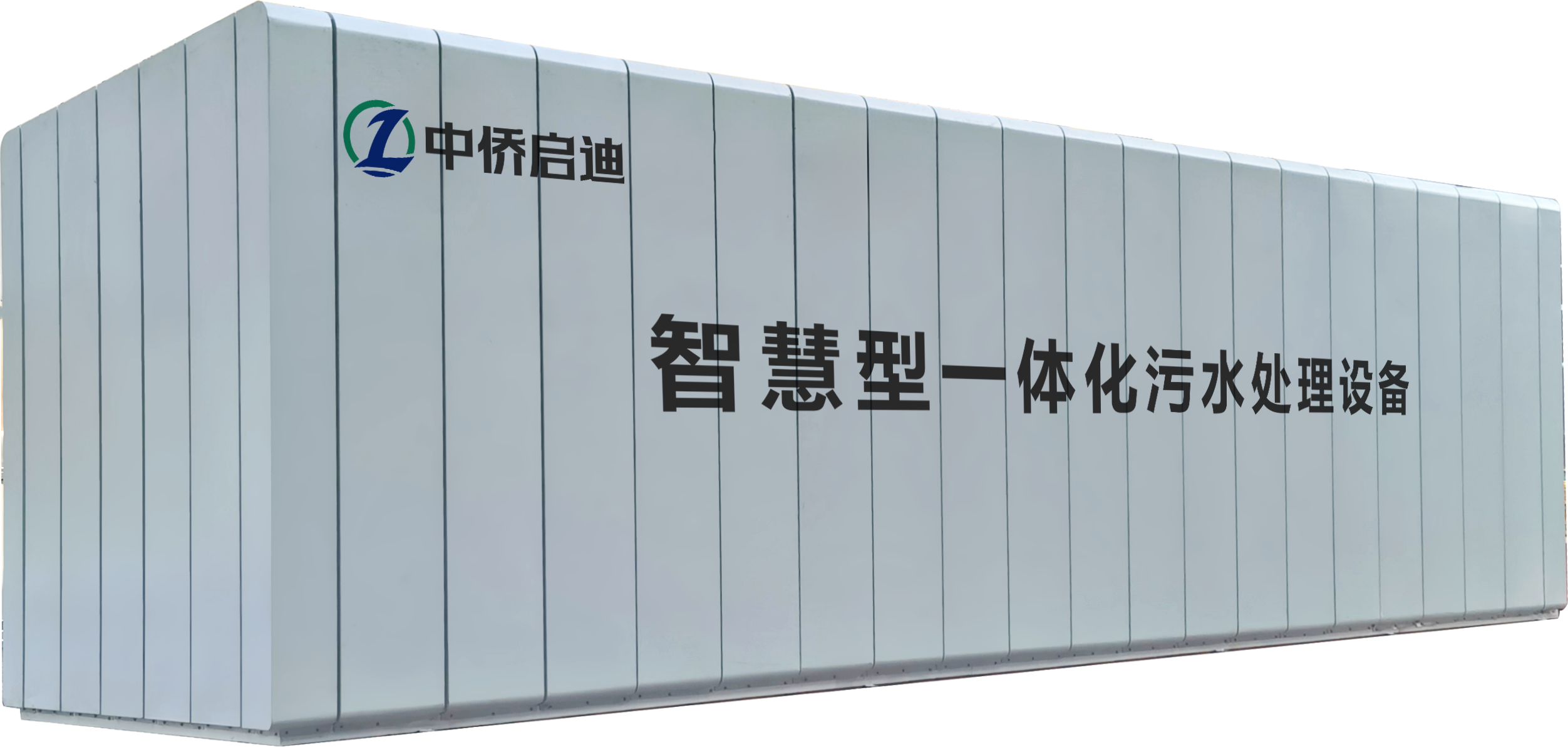
A modular integrated sewage treatment unit. Factory-assembled units are shipped complete, which shifts definition and verification work from the construction site to the specification document.
Constraint One — Certification Scope Is Narrower Than Most Buyers Assume
The first document most buyers request is the quality certificate, and the first mistake is reading it as a performance guarantee. For integrated wastewater treatment equipment supplied by Zhongqiao Enlightenment, the certificate held is a Quality Management System Certificate issued under ISO 9001. Its scope is production — specifically, the production of integrated sewage treatment equipment — and it is tied to a named product model. It addresses how the equipment is made, not what the effluent will contain at a given site.
| Certificate field | Recorded value |
|---|---|
| Certification type | ISO 9001 Quality Management System Certificate |
| Certificate number | 21725Q06885R2M |
| Issuing body | Shandong LAJ International Certification Service Co., Ltd. (LAJCC) |
| Applicable standard | GB/T 19001-2016/ISO 9001:2015 |
| Certification scope | Production of integrated sewage treatment equipment |
| Certified product model | WSZ-100 integrated wastewater treatment equipment |
| Certified product type | Domestic sewage treatment equipment |
| Markets referenced | Middle East, Southeast Asia |
| Validity | 15 April 2025 to 27 April 2028 |
Three practical points follow from that record. The certificate is current, with validity running to 27 April 2028, so a 2026 procurement does not require an update before order placement. The scope names a specific model, WSZ-100, which means a buyer specifying a different configuration should confirm how the certificate maps onto the delivered unit. And the certificate references the Middle East and Southeast Asia markets, so projects elsewhere should establish which local conformity requirements apply on top of the management system certification.
Constraint Two — Material Selection Defines the Chemical and Service Envelope
Material choice is the constraint buyers most often treat as a detail, and the one that most often determines service life. Integrated wastewater treatment equipment of this class is built in carbon steel, SS304 stainless steel and PP. Dissolved air flotation systems use carbon steel and SS304 for the main structure, with an SS304 stainless steel and rubber strike-off board, a carbon steel and nylon chain, a nylon chain wheel and a nylon air release device.
The differentiation is not cosmetic. Carbon steel is the conventional structural choice and is normally specified with a protective coating system; SS304 is selected where chlorides and general corrosion make coated carbon steel a maintenance liability; PP is used where chemical resistance dominates and structural loads are modest, since polypropylene offers no structural rigidity comparable to steel. Company product documentation states that PP integrated equipment can withstand acid and alkali corrosion within a pH range of 3 to 14 — a wide envelope, but one that should still be checked against an actual wastewater analysis rather than assumed from a brochure.
For a buyer, the verification question is simple: has the supplier received the influent analysis — pH, oil and grease, suspended solids, salinity, temperature — and does the proposed material schedule follow from it? A material list without an influent analysis is a template, not a design.
Constraint Three — Read Parameters and Control Hardware as One Package
Equipment lists are frequently compared line by line, which hides the more important question of whether the lines work together. Two documented configurations illustrate what a coherent package looks like.
Integrated wastewater treatment equipment, model WSZ-100
| Item | Specification |
|---|---|
| Construction materials | Carbon steel, SS304 stainless steel, PP |
| Blower | 100-7.5, two units, one duty and one standby |
| Self-priming pump | PXZ15-30-1.5, DN40, two units |
| Chemical washing device | 100 L, PE |
| Metering pump | Flow rate 120 L/h |
| PLC module | Siemens |
| Electrical components | Schneider |
| Remote module | HDBox-4G-A |
| Instrumentation | Multifunctional meter, water flow meter |
| Operating mode | Automatic operation |
Two features deserve attention during evaluation. The blower set is duplicated on a duty and standby basis, which is a redundancy decision rather than a capacity decision — it protects biological treatment from a single point of failure. The remote module, combined with a PLC built on Siemens components and Schneider electrical parts, is what makes remote operation, monitoring and analysis feasible rather than aspirational; the company reports that its systems support remote operation, remote monitoring and remote analysis, and that water reuse for irrigation and toilet flushing has been achieved in delivered projects.
Dissolved air flotation, model YW-5
| Parameter | Design reference value |
|---|---|
| Structural style | Advection combined air flotation |
| Rated processing capacity | 5 m³/h |
| Air-dissolving water reflux ratio | ≥30% (typically 40%–50%), head 40–50 m |
| Dissolved air pump | 4 kW |
| Air compressor | 380 V, 1.4 kW, 0.21 m³/min, 0.8 MPa, 30 L storage |
| Scraper | 380 V, 0.75 kW |
| Dosing tank | 500 L, 380 V, 0.37 kW, two units |
| Dosing pump | 15.77 L/h |
| Control system | PLC Siemens, Schneider Electric |
Dissolved air flotation is a pretreatment decision, not a treatment substitute. Its documented strengths are removal of suspended solids and oil, stable operation, fast sludge separation, a compact footprint and straightforward maintenance, and its documented application range covers abattoir, printing and dyeing mill, textile dyeing and livestock farm wastewater — streams where oil and suspended solids would otherwise load the downstream biological stage.
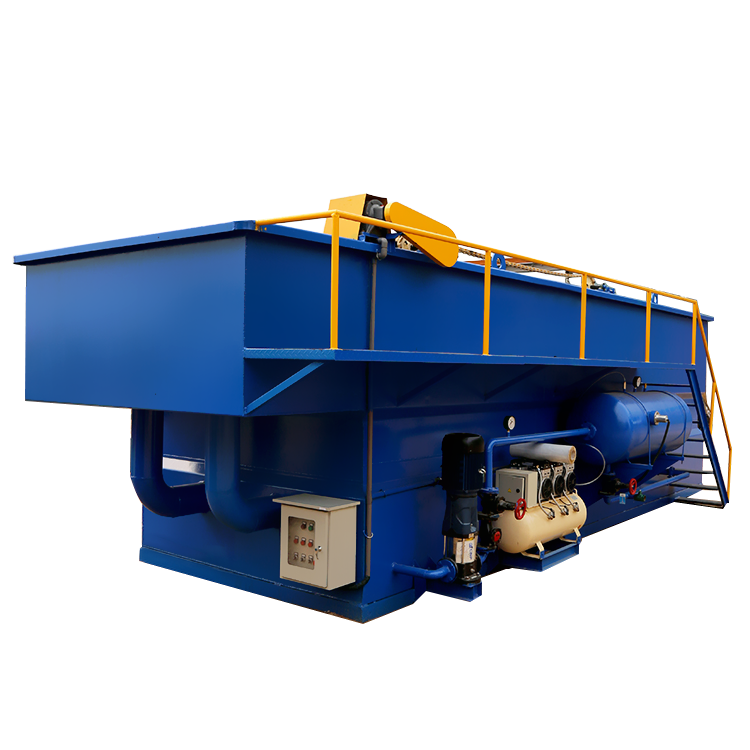
A dissolved air flotation unit of the type specified ahead of biological treatment. Units are built in carbon steel and SS304, with SS304 and nylon internal components.
Constraint Four — Effluent Limits Must Be Defined Before the Quotation
Effluent standards are the most common source of post-delivery dispute, because the phrase "meets discharge standard" carries no information on its own. For integrated wastewater treatment equipment of this class, the effluent standard is customisable and is set against the buyer's target; commonly referenced national standards include Grade 1A and Grade 1B, which correspond to municipal discharge and water reuse scenarios respectively.
The design inputs required before selection are explicit: influent water quality, effluent discharge requirements and treatment flow rate. A supplier working without all three is designing against an assumption. Buyers should also establish whether the target is discharge or reuse — reuse for irrigation and toilet flushing imposes a different specification from municipal discharge, and retrofitting a reuse stage after commissioning is materially harder than specifying it at the outset.
Constraint Five — Commercial Terms Determine Whether the Schedule Is Real
Technical compliance and commercial feasibility are usually assessed separately, which is why schedules slip. The two should be read together.
| Commercial parameter | Documented position |
|---|---|
| Production mode | OEM |
| Customisation | Customised appearance, colour and logo available |
| Monthly capacity | 100 units |
| Minimum order quantity | 1 unit |
| Lead time | 30–45 days |
| Quality control | 100% test |
| After-sales | On-site installation guidance, remote technical support |
A one-unit minimum order quantity removes the volume barrier that often blocks pilot or single-site evaluation, and OEM customisation of appearance, colour and logo matters to distributors and brand owners assembling a product line. The 30–45 day lead time should be confirmed against scope during evaluation: buyers should establish whether it covers production only or extends to documentation, inspection and preparation for shipment, since ocean freight, customs clearance and site works sit outside any factory commitment.
A five-line verification checklist
| Constraint | What to confirm | Acceptable evidence |
|---|---|---|
| Certification | Scope, certified model, validity, markets referenced | Certificate with number, standard and dates |
| Materials | Wetted materials matched to influent chemistry | Material schedule plus influent analysis |
| Parameters | Capacity, redundancy, control architecture | Equipment list with model numbers and ratings |
| Effluent | Target standard and reuse requirement | Written discharge or reuse specification |
| Commercial | MOQ, lead time scope, test regime, support | Quotation with inclusions stated |
Where Containerized Plants Fit: Application Profile
Containerized and modular plants are specified where flows are defined, sites are constrained, or the asset may need to move. Documented application coverage for integrated equipment of this type includes hotel wastewater, hospital wastewater, camp domestic wastewater, slaughterhouse wastewater, livestock breeding wastewater and domestic sewage. Documented project references include camp domestic sewage treatment at a substation construction site, a domestic wastewater project in Indonesia, hotel and hospital installations, a slaughterhouse project in Shanxi, livestock wastewater treatment in South Korea, a highway service area plant and a food factory project in Xinjiang.
Two application patterns are worth separating. The first is decentralised domestic sewage — camps, hotels, hospitals, service areas — where flows are predictable and the constraint is site logistics rather than process complexity. The second is industrial pretreatment, where a dissolved air flotation or lamella clarifier stage protects the biological process from oil, grease and suspended solids; abattoir, textile dyeing and food processing streams fall here. Zhongqiao Enlightenment also reports a containerized treatment project for wheat washing wastewater in the American Midwest at a daily volume of approximately 150 m³/d, which illustrates the industrial end of the range.
The company states that more than 4,000 installations have been delivered in China and overseas, with equipment exported to more than 30 countries and regions. Those figures are company-reported and useful as a scale indicator during shortlisting; they do not substitute for project-specific reference checks.
Market Context: Trade Concentration and Equipment Demand
Trade data provides a useful sanity check on sourcing assumptions. Global trade in water filtering and purifying machinery under HS code 842121 reached USD 12.4 billion in 2024, a 4.34% increase on 2023, according to the Observatory of Economic Complexity based on UN Comtrade and national customs records. China was the leading exporter in that category at USD 2.38 billion, ahead of Germany at USD 1.3 billion — a concentration that explains both the depth of OEM supply available and the importance of supplier-level verification.
Demand-side forecasts point in the same direction, though scope definitions vary and should be normalised before comparison. The Business Research Company projects the global wastewater treatment equipment market reaching USD 43.94 billion by 2030. MarketsandMarkets values the broader water and wastewater treatment equipment market at USD 68.7 billion in 2024, rising to USD 87.7 billion by 2029. The gap between these figures reflects different market boundaries rather than a contradiction, and buyers citing market growth in an internal business case should state which scope they are using.
Alongside commercial forecasts, government reference material supports technology screening. The U.S. EPA's Industrial Wastewater Treatment Technology Database (IWTT) compiles technology performance data from conference proceedings and government sources, and is a reasonable starting point for shortlisting a process route before approaching suppliers. For procurement purposes, the pattern across these sources is consistent: capacity is plentiful, and differentiation sits in verification, documentation and application fit.
Containerized vs. Civil-Built Treatment: What Each Does Better
The comparison is not a contest between modern and outdated methods; it is a fit question that depends on flow band, site conditions and asset horizon.
| Dimension | Containerized / modular plant | Civil-built concrete plant |
|---|---|---|
| Fabrication | Factory-assembled and shipped complete | Constructed on site from tanks and structures |
| Site works | Reduced; unit set on prepared foundation | Extensive formwork, curing and civil trades |
| Footprint | Compact, designed for constrained sites | Determined by tank geometry and site layout |
| Expansion | Additional modules, relocatable | New structures, longer lead time |
| Relocation | Feasible within the unit's design | Generally not practicable |
| Best fit | Defined decentralised and industrial flows | Large, long-horizon municipal flows |
The limitation deserves to be stated plainly rather than softened. Modular units are factory-assembled, shipped complete and can be relocated and expanded, but they are not a universal substitute for civil construction. At large, long-horizon municipal flows, site-built concrete structures can offer a lower cost per cubic metre of capacity, because tank volume scales in ways that factory fabrication and road transport do not. Buyers should therefore test the modular option against a defined flow band rather than adopting it as a default.
A second boundary concerns certification interpretation. A quality management system certificate evidences controlled production; it does not evidence effluent performance at a specific site. Procurement files that treat the certificate as a performance guarantee often discover the gap only at commissioning, when influent characteristics differ from the design basis.
Future Outlook
Three directions are visible from the constraint side of the market. First, remote operation and monitoring are moving from differentiator to expectation; control architectures that already combine a PLC platform with a cellular remote module make supervision and analysis practical for plants without permanent operators, which is precisely the profile of camp, hotel and highway service area installations. Second, modularity is becoming a scheduling tool as much as an engineering one, since factory assembly compresses the site programme in a way civil construction cannot. Third, documentation is becoming the real basis of competition: as trade volumes concentrate and supplier choice widens, the buyer's defensible position is a specification file that records what was verified, by whom, and against which standard.
For containerized wastewater treatment plants, that means the evaluation discipline described above is unlikely to relax. If anything, as more suppliers enter the category, the ability to distinguish a documented constraint from a marketing claim becomes the single most valuable procurement skill.
FAQ
What information is required before a containerized wastewater treatment plant can be specified?
Three inputs are required: influent water quality, effluent discharge requirements and treatment flow rate. Without all three, sizing and process selection rest on assumptions. Installation condition — above-ground or underground — and the intended use of treated water, whether discharge or reuse, should be confirmed at the same stage.
What effluent standard can an integrated wastewater treatment system achieve?
The effluent standard is customisable on demand. Commonly referenced national standards include Grade 1A and Grade 1B, which correspond to municipal discharge and water reuse scenarios. Because the achievable result depends on the influent characteristics and the specified target, the discharge requirement should be defined in writing before selection rather than agreed verbally after commissioning.
Which materials are used in integrated wastewater treatment equipment and dissolved air flotation systems?
Integrated wastewater treatment equipment is built in carbon steel, SS304 stainless steel and PP. Dissolved air flotation systems use carbon steel and SS304 for the main structure, with an SS304 stainless steel and rubber strike-off board, a carbon steel and nylon chain, a nylon chain wheel and a nylon air release device. Company documentation states that PP integrated equipment can withstand acid and alkali corrosion within a pH range of 3 to 14; material selection should still be matched to an actual influent analysis.
What does the ISO 9001 certificate cover, and how long is it valid?
The certificate is a Quality Management System Certificate numbered 21725Q06885R2M, issued by Shandong LAJ International Certification Service Co., Ltd. (LAJCC) under the standard GB/T 19001-2016/ISO 9001:2015. Its scope is the production of integrated sewage treatment equipment, and it covers the WSZ-100 integrated wastewater treatment equipment. It is valid from 15 April 2025 to 27 April 2028 and references the Middle East and Southeast Asia markets. It certifies production quality management, not effluent performance at a specific site.
What are the minimum order quantity, production capacity and lead time?
The documented commercial terms are a minimum order quantity of 1 unit, a monthly capacity of 100 units and a lead time of 30–45 days. Production runs in OEM mode with customised appearance, colour and logo available, and each unit is 100% tested. Buyers should confirm whether the stated lead time covers production only or extends to documentation and pre-shipment preparation.
How does a containerized plant differ from a conventional civil-built treatment plant in deployment?
A containerized plant is assembled in a factory and shipped as a complete unit, which reduces on-site civil works, shortens the site programme and allows the unit to be relocated and expanded for different treatment capacities. A conventional plant is built from concrete structures on site, which typically suits large, long-horizon municipal flows where site-built tank volume can offer a lower cost per cubic metre of capacity. The two formats suit different flow bands rather than competing directly.
For readers who need the full technical and project reference set, the Zhongqiao Enlightenment company brochure is available for download: Zhongqiao Enlightenment brochure (13th edition, PDF).
¿Tiene preguntas o necesita más detalles?
Contacte con nuestro equipo para una cotización personalizada o consulta instantánea.
Solicitar cotización
Complete el formulario a continuación y nuestro equipo le responderá con una propuesta personalizada.
Chat directo de WhatsApp
¿Prefiere chatear en tiempo real? Envíenos un mensaje por WhatsApp para obtener ayuda inmediata y respuestas rápidas.
- Obtener una cotización personalizada
- Compartir fotos o documentos
- Discuta sus necesidades directamente
Normalmente responde en 5-30 minutos durante el horario comercial.