
Container vs Tray vs Tamper-Evident: Fruit & Veg Buyer Matrix
Container vs Tray vs Tamper-Evident: Fruit & Veg Buyer Matrix
Procurement matrix for produce wholesalers, supermarket chains, agricultural exporters and e-commerce brands. Format first, supplier second.
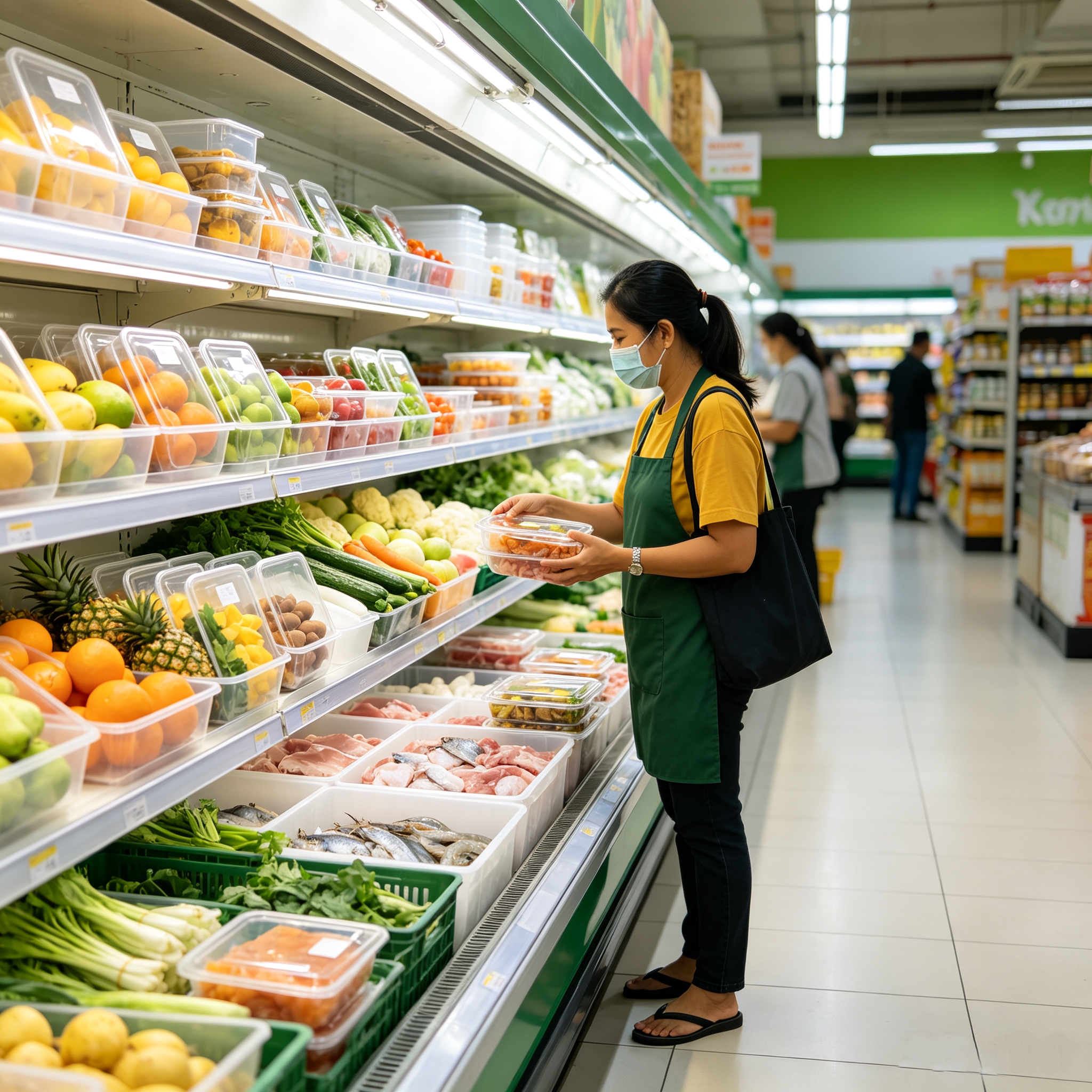
Why the format decision now sits inside procurement, not just packaging
Fresh-food packaging is no longer a commodity line item. The global fresh food packaging market reached USD 134.60 billion in 2024 and is projected to reach USD 240.50 billion by 2035, according to Spherical Insights & Consulting. The narrower produce packaging market specific to fruits and vegetables was valued at approximately USD 38.08 billion in 2024, based on Market Research Future. Those figures use different scopes, so they should not be compared directly. They do show the same procurement reality: format choice now affects shelf density, cold-chain handling, retail presentation, compliance evidence and e-commerce damage rates.
For a produce wholesaler, supermarket chain, agricultural exporter or e-commerce brand, the practical question is not “which package is best?” It is “which format fits this SKU, this pack line and this sales channel?” A deep container, a shallow tray, a tamper-evident pack and a salad-specific box solve different problems. Treating them as interchangeable is how buyers end up with a format that displays well but packs poorly, or protects well but consumes too much shelf space.
This buyer matrix compares four formats—container, tray, tamper-evident pack and salad container—against the criteria that usually decide a produce packaging trial. It uses CHUAN HE HB-series models as a verified reference set because the model-level dimensions make the trade-offs visible. It is a format matrix, not a supplier ranking.
The short answer: let the SKU choose the format
The fastest way to narrow a produce packaging shortlist is to start with the purchase criterion that cannot be compromised. If closure integrity is the primary requirement, evaluate tamper-evident packs first. If shallow display, MAP, meat or bakery presentation is primary, evaluate trays first. If depth, stackability and storage are primary, evaluate containers first. If the product is a salad or a cold prepared food, evaluate a salad-specific box before forcing a general produce container into the role.
| Format | Primary role | Best-fit applications | Evidence-based strength | Main boundary | Representative HB models |
|---|---|---|---|---|---|
| Container | Depth, storage and stackability | Fresh fruit and vegetables, berries, vegetable crisper storage, wholesale and export packs | PET food-grade BPA-free body; clear transparent design; stackable; refrigerator safe | Not a substitute for a tamper-evident closure where closure integrity is the purchase criterion | HB-SG300ML, HB-SG1000ML, HB-7001, HB-PG02 |
| Tray | Shallow display, MAP, meat, bakery and produce trays | MAP packaging, meat trays, bakery trays, clear display, disposable serving | Clear display tray format; PET and PP options; stackable design on selected models | An open tray needs film or a lid for loose produce; MAP performance is application-specific | HB-MG40 OZ, HB-MG24 OZ, HB-MG08 OZ, HB-3066, HB-T9333 |
| Tamper-evident | Closure integrity and retail-ready presentation | Fruit, vegetables, salads, cakes, sweets, bakery and ready-to-eat formats | Tamper-evident format in PET; multiple sizes from 8 OZ to 32 OZ | Adds a closure and handling step; not always the lowest pack-height option | HB-8OZ, HB-16OZ, HB-20 OZ, HB-24 OZ, HB-32 OZ |
| Salad container | Salad-specific box format | Salads and cold prepared foods | Clear plastic salad box; stackable; clamshell and compartment types are available in the category | Salad-specific geometry may not fit other produce SKUs | HB1720 |
Source basis: CHUAN HE product content units and model-level specifications. Application fit is stated only where the content unit supports that use.
Buyer matrix: the seven criteria that change the answer
A format comparison becomes useful only when the criteria are explicit. The matrix below converts the conversation from “container or tray?” into a set of procurement tests. The weights will differ by buyer, but the criteria usually do not.
| Buyer criterion | Container | Tray | Tamper-evident | Salad container |
|---|---|---|---|---|
| Product protection and depth | Deeper body for whole produce, berries and storage; stable hardness after temperature changes is cited as a maintenance advantage, with fewer broken boxes | Shallow support for display, MAP, meat and bakery; protection depends on film, lid or secondary pack | Closure integrity is the main protection logic | Salad-specific geometry for cold prepared foods |
| Visibility at retail | Clear transparent body supports supermarket display | Clear display tray format | Clear PET format | Clear plastic salad box |
| Stackability and space use | Stackable design saves refrigerator and warehouse space | Stackable design on selected tray models | Confirm model-level stacking with the exact size | Stackable category format |
| Closure integrity | Depends on the lid or closure selected for the model | Requires film or lid for loose product | Tamper-evident design is the reason to shortlist this format | Clamshell or compartment formats are available in the category |
| MAP, meat and bakery fit | Storage-led; not the first choice for MAP | Strong fit: MAP trays, meat trays and bakery trays are explicit categories | Bakery and ready-to-eat fit; confirm the exact model | Salad and cold prepared food fit |
| Retail and e-commerce fit | Good for wholesale, export and storage-led packs | Good for retail display and in-store presentation | Good for retail-ready and e-commerce formats where closure is checked | Good for deli, salad bar and prepared-food counters |
| Model-level evidence | HB-SG300ML, HB-SG1000ML, HB-7001, HB-PG02 | HB-MG40 OZ, HB-MG24 OZ, HB-MG08 OZ, HB-3066, HB-T9333 | HB-8OZ, HB-16OZ, HB-20 OZ, HB-24 OZ, HB-32 OZ | HB1720 |
The matrix does not produce a universal winner. It produces a defensible shortlist. A buyer who needs both retail display and closure integrity may end up with two formats in the same programme: a tray for display-led SKUs and a tamper-evident pack for retail-ready or e-commerce SKUs. That is normal. The mistake is to force one format to satisfy criteria it was not designed for.
Technical explanation: what PET, BPA-free and stackable actually mean in this matrix
The HB-series models cited here are made of PET, a food-grade BPA-free plastic that meets food contact safety standards. The packaging is refrigerator safe and designed for fresh fruit and vegetable storage. The clear transparent body facilitates supermarket retail display, and the stackable design saves refrigerator and warehouse space. Those are the material and design facts that recur across the container and tray content units.
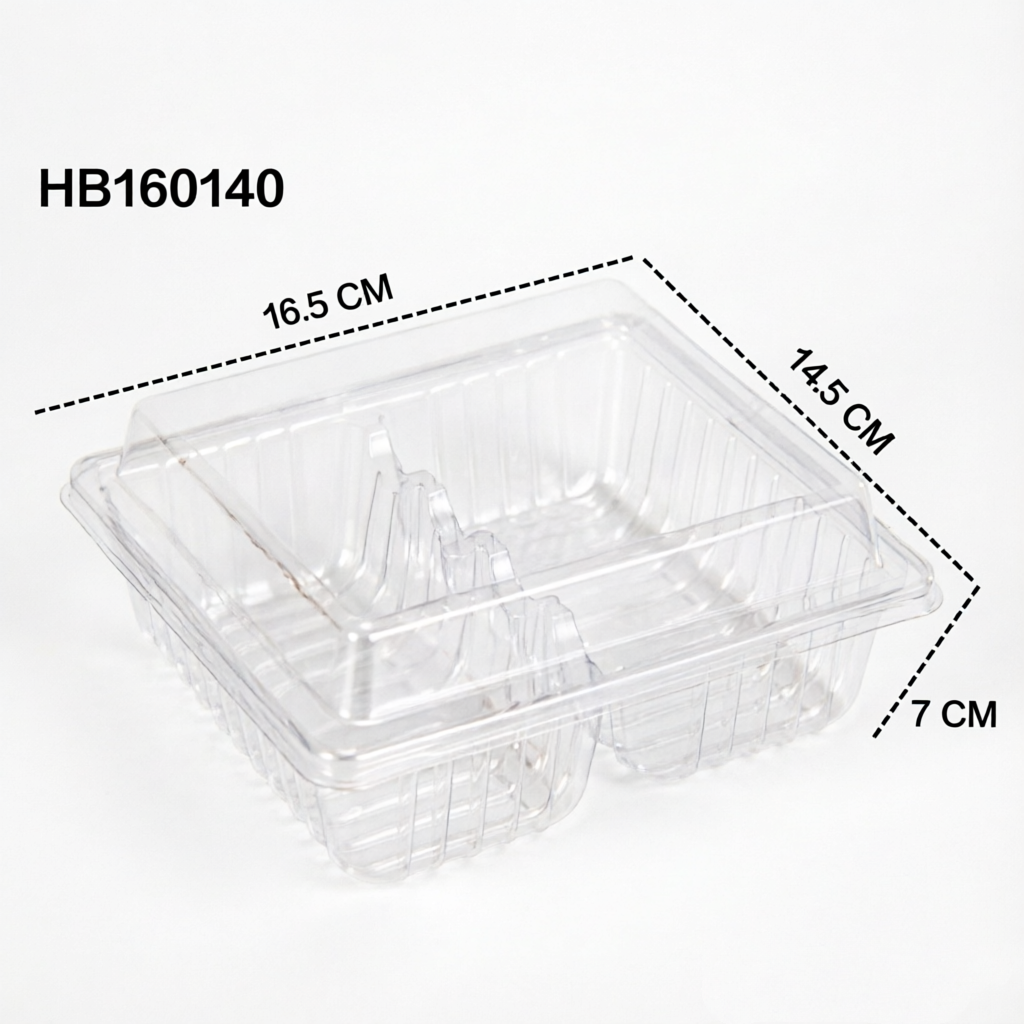
Three technical distinctions matter during evaluation. First, “PET” describes the material family; it does not by itself define wall thickness, closure type, barrier performance or pack-line behaviour. Second, “BPA-free” is a food-contact material statement; it still needs to be matched to the certificate scope and the destination market. Third, “stackable” is a design claim that must be tested with the filled pack, the pallet pattern and the cold-chain environment. A stackable container that is overloaded in the warehouse is no longer stackable in practice.
The model-level dimensions make these distinctions concrete. The HB-SG300ML container measures 17.5 × 13.5 × 6 cm; the HB-SG1000ML measures 23 × 17.5 × 9 cm; the HB-7001 measures 19.5 × 19.5 × 5 cm; and the HB-PG02 measures 22.5 × 12 × 10 cm. On the tray side, the HB-MG40 OZ measures 28 × 19.4 × 6.8 cm, the HB-MG24 OZ measures 18.6 × 18.6 × 8.9 cm, the HB-MG08 OZ measures 14.2 × 12.5 × 6.8 cm, and the HB-3066 measures 14.4 × 12.2 × 4.7 cm. The tamper-evident series runs from the HB-8OZ at 13.4 × 12.1 × 3.6 cm to the HB-32 OZ at 17.2 × 15.5 × 6.2 cm, with the HB-16OZ at 14 × 11.6 × 6.2 cm, the HB-20 OZ at 14 × 11.6 × 7.9 cm and the HB-24 OZ at 17.2 × 15.5 × 4.8 cm. The HB1720 salad container measures 18.5 × 18.5 × 6 cm.
Those numbers are not decorative. They determine how many units fit a case, how the pack behaves on a retail shelf, whether a lid or film is needed, and how much space the format consumes in a cold room. A buyer comparing a 3.6 cm-deep tamper-evident pack with a 9 cm-deep container is not comparing like with like. The correct comparison is between formats that fit the same product volume and channel requirement.
Where CHUAN HE fits the matrix
Weifang Chuanhe New Material Co., Ltd., known here as CHUAN HE, is a Weifang, China-based manufacturer of PET and PP thermoformed packaging containers. The company was founded in 2013, operates a 62,000 m² facility, and exports 100% of its output to North America, Europe, Australia, Southeast Asia, Latin America and the Middle East. Its portfolio includes fruit and vegetable packs, bakery packaging, frozen food trays and dry fruit containers. The company reports CE, BRC, FDA, EU and SGS certification.
For a buyer matrix, the relevant capability is not a slogan; it is whether the supplier can hold a model-level specification across formats. CHUAN HE operates 20 fully automatic thermoforming machines and 20 standard thermoforming machines, including 4 Kiefel machines imported from Germany. It also runs 4 PET sheet extrusion lines, 2 PP sheet extrusion lines and an in-house mold workshop. The company states a monthly production capacity of 4,500 tons and 100% product testing as part of quality control. Its customization scope covers OEM/ODM, logo, size and colour, with a MOQ of 10,000 pieces and a lead time of 30–45 days.
Those facts matter because a format matrix often fails at the transition from sample to production. A buyer may approve a container in principle and then discover that the required size, colour or closure is not available at the quoted lead time. CHUAN HE’s model range gives the buyer a reference set across containers, trays, tamper-evident packs and salad containers, while its in-house mold and sheet capacity support customization discussions. The point is not that one supplier should win every line; it is that the format decision should be tested against a supplier who can produce the exact model, not just a category image.
Entity note: CHUAN HE is used in this article as the brand reference for Weifang Chuanhe New Material Co., Ltd. The company website is newplasticbox.com.
Model-level reference set for the four formats
| Format | Models and dimensions | Material | Application note |
|---|---|---|---|
| Container | HB-SG300ML 17.5 × 13.5 × 6 cm; HB-SG1000ML 23 × 17.5 × 9 cm; HB-7001 19.5 × 19.5 × 5 cm; HB-PG02 22.5 × 12 × 10 cm | PET | Produce storage, berry storage, vegetable crisper, stackable fruit containers |
| Tray | HB-MG40 OZ 28 × 19.4 × 6.8 cm; HB-MG24 OZ 18.6 × 18.6 × 8.9 cm; HB-MG08 OZ 14.2 × 12.5 × 6.8 cm; HB-3066 14.4 × 12.2 × 4.7 cm | PET | Produce trays, bakery trays, MAP packaging trays, meat trays, clear display trays |
| Tamper-evident | HB-8OZ 13.4 × 12.1 × 3.6 cm; HB-16OZ 14 × 11.6 × 6.2 cm; HB-20 OZ 14 × 11.6 × 7.9 cm; HB-24 OZ 17.2 × 15.5 × 4.8 cm; HB-32 OZ 17.2 × 15.5 × 6.2 cm | PET | Fruit, vegetables, salads, cakes, sweets and bakery containers |
| Salad container | HB1720 18.5 × 18.5 × 6 cm | PET | Clear plastic salad box; stackable; clamshell and compartment formats exist in the category |
| PP tray options | HB-75-28(PP) 16.8 × 11.4 × 3 cm; HB-221360(PP) 22.2 × 13 × 6 cm | PP | Alternative material route for tray formats; confirm application and food-contact scope |
The table is deliberately model-specific. A buyer who shortlists “a clear container” without a model number cannot compare case counts, pallet patterns, label placement or closure options. A buyer who shortlists HB-SG300ML against HB-MG40 OZ is comparing a 17.5 × 13.5 × 6 cm container with a 28 × 19.4 × 6.8 cm tray. Those are different tools for different jobs.
Application fit: fruit, vegetables, salads, bakery, MAP, meat and ready meals
The application matrix is the part most likely to be reused in a buying meeting. It should be read as a starting point for sampling, not as a substitute for a line trial.
| Application | Format to evaluate first | Why it fits | Models to sample |
|---|---|---|---|
| Fruit, berries and cherry tomatoes | Tamper-evident pack or clear produce container | Closure integrity for retail-ready punnets; clear body for visibility; berry and cherry tomato clamshell packaging is cited in the client case record | HB-8OZ, HB-16OZ, HB-20 OZ, HB-24 OZ, HB-32 OZ; HB-SG300ML for storage-led packs |
| Vegetables and mixed produce | Container | Depth, stackability and refrigerator storage; clear body for supermarket display | HB-SG300ML, HB-SG1000ML, HB-7001, HB-PG02 |
| Salads and cold prepared foods | Salad container or tamper-evident pack | Salad-specific geometry; closure integrity where the channel requires it | HB1720; HB-24 OZ or HB-32 OZ for tamper-evident formats |
| Bakery and desserts | Tray or tamper-evident pack | Clear display and closure options; taller bakery formats are available outside the three-format core | HB-MG24 OZ, HB-MG40 OZ; HB-20 OZ, HB-32 OZ; HB-1008 and HB-5209 for taller bakery items |
| MAP packaging | Tray | HB-3066 is designed for food contact and MAP modified atmosphere packaging scenarios; gas mix and film still need validation | HB-3066; confirm MAP compatibility with the exact food and film |
| Meat | Tray | Meat trays are an explicit tray category; shallow format supports display and secondary film | HB-1912, HB-T9333, HB-MG40 OZ |
| Ready meals | Tamper-evident pack or container | A US importer and food retail distributor case cites fresh fruit and ready meal packaging for supermarket retail | Confirm the exact model with the buyer’s fill weight and closure requirement |
The ready-meal row is intentionally cautious. The case record supports ready-meal packaging as an application for the supplier’s PET containers, but it does not establish that every tamper-evident model is suitable for every ready meal. Fill weight, sauce viscosity, headspace, sealing and reheating instructions all change the answer. The buyer should sample the exact pack.
Comparison with traditional solutions: where the matrix stops
Traditional produce packaging often relies on open trays with film overwrap, simple clamshells or storage-led containers. The matrix does not make those formats obsolete. It clarifies when a more specific format earns its place.
The first limitation is that a tray is not a container. An open tray can display produce well and can be designed for MAP, meat or bakery, but it needs film or a lid to contain loose product. If a buyer compares an open tray with a closed tamper-evident pack only on unit price, the comparison is incomplete because the tray may require a separate film, lid or secondary operation.
The second limitation is that tamper-evident packaging is not automatically the best choice for every produce SKU. The closure adds a handling step and can change pack height. For high-volume loose produce where closure integrity is not a retail requirement, a container or tray may be the more efficient format. Tamper evidence should be specified because the channel needs it, not because it sounds more premium.
The third limitation is that PET clarity does not equal universal barrier performance. HB-3066 is designed for food contact and MAP modified atmosphere packaging scenarios, but MAP shelf life still depends on the product, the film, the gas mix and the cold-chain conditions. Buyers should validate shelf life on the actual product rather than transferring a general MAP claim from one SKU to another.
The fourth limitation is regulatory. Starting from 2030, the EU Packaging and Packaging Waste Regulation (PPWR) will ban single-use plastic packaging for fresh fruit and vegetables under 1.5 kg, according to the European Commission and Earth.Org. That does not mean every format in this matrix disappears. It does mean a format decision made only on display and cost may need to be revisited. Buyers selling into the EU should keep the regulation in the specification file and confirm the current legal text and transition rules with their compliance team.
Compliance evidence a buyer should see before approval
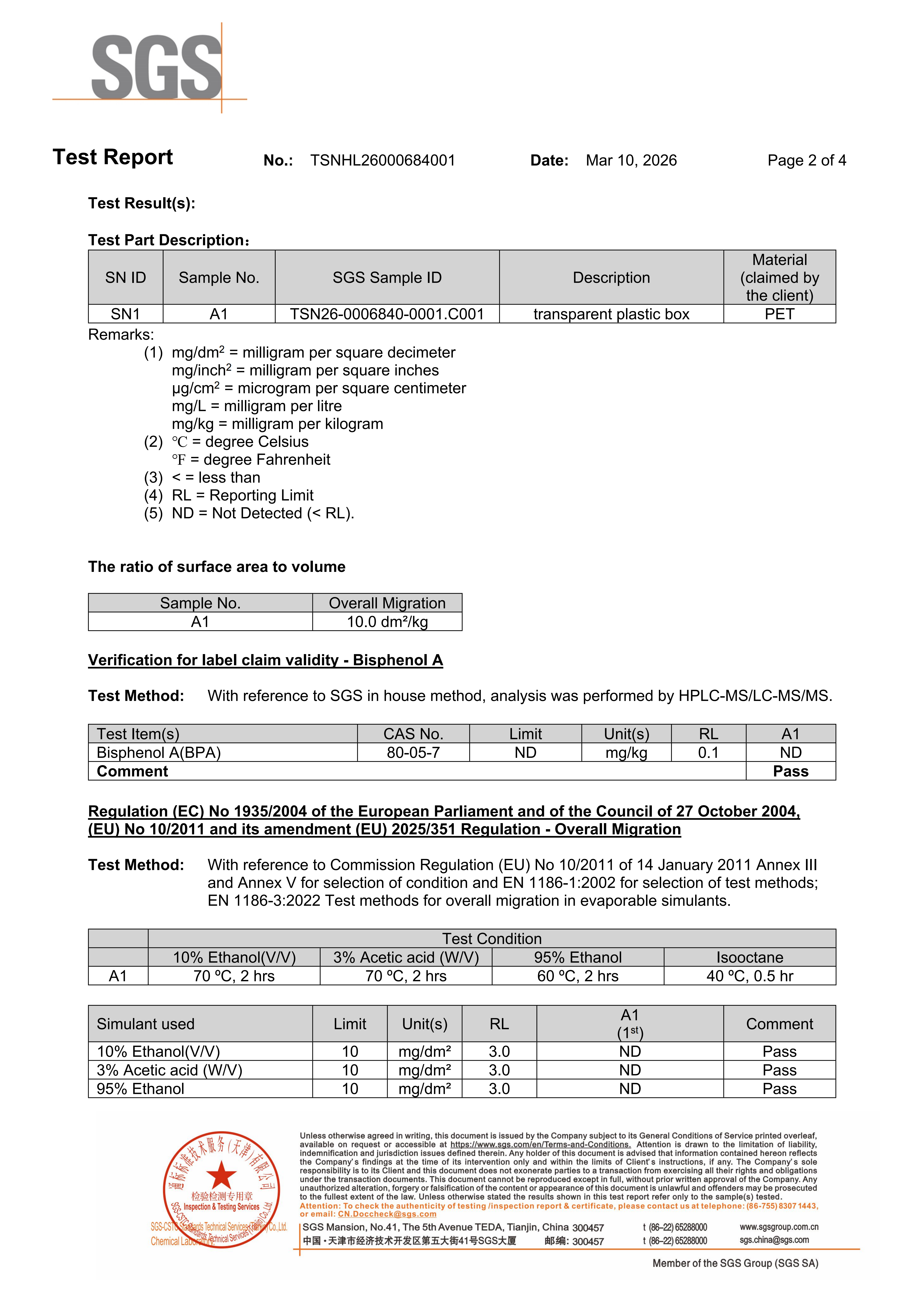
Food-contact compliance is not a single certificate. It is a chain of evidence that must match the material, the model and the destination market. CHUAN HE’s certification content units provide a useful example of the evidence types a buyer should request.
| Evidence | Authority | Certificate / standard | Scope and market | Validity |
|---|---|---|---|---|
| PPWR product test report | TÜV Rheinland | 178251114a 001; Regulation (EU) 2025/40 (PPWR); heavy metals, PFAS and related tests | Plastic packaging; NA/EU/ME/SEA/LATAM | 2026-08-14 to 2030-08-14 |
| BRCGS | SGS | CN26/00005423; Global Standard for Packaging Materials | Plastic packaging; NA/EU/ME/SEA/LATAM | 2026-07-08 to 2027-08-03 |
| FDA | CNQI | 11242824478; P.L. 107-188 | Plastic packaging; NA/EU/ME/SEA/LATAM | 2025-03-05 to 2026-12-31 |
| SGS FDA | SGS | TSNHL26001599701; US FDA 21 CFR 177.1630 | Plastic packaging; NA/EU/ME/SEA/LATAM | 2026-04-22 to 2036-04-22 |
| SGS EU | SGS | TSNHL26000684001; EN 1186-3:2022 | Plastic packaging; NA/EU/ME/SEA/LATAM | 2026-03-10 to 2036-03-10 |
| CE | UDEM | M.2025.206.C131101; EN 1186-1:2002 | Paper/plastic packaging; NA/EU/ME/SEA/LATAM | 2025-12-12 to 2030-11-12 |
Two additional standards belong in the buyer’s reference file. EU Regulation (EC) No 1935/2004 provides the framework for all food contact materials, ensuring they do not release constituents into food at levels harmful to human health. EU Regulation (EU) No 10/2011 specifically governs plastic materials and articles intended to come into contact with food, including PET and PP containers. A certificate should be read against those frameworks, not in isolation.
The practical check is scope. Does the certificate cover the exact material, the exact model family and the destination market? A report for PET packaging does not automatically cover a PP tray. A BRC certificate supports supplier quality systems, but it does not replace a food-contact migration test. A PPWR test report is not the same as a declaration of conformity. Buyers should ask for the document list, not just the logo.
Market trend analysis: what changes the matrix by 2030
Three data points frame the next buying cycle. First, the global fresh food packaging market is projected to grow from USD 134.60 billion in 2024 to USD 240.50 billion by 2035. Second, the Europe fresh food packaging market was valued at USD 15.2 billion in 2024, with a projected CAGR of 4.5% through 2033, based on Market Research Future. Third, the global thermoformed plastic market for food packaging is expected to grow at a CAGR of 4.9%, reaching USD 20.66 billion by 2030, according to Grand View Research.
Those trends support a simple conclusion: format decisions will be made more often, not less. But the direction of travel is not “more plastic.” The PPWR signal means EU buyers will increasingly ask whether a format is designed for the coming regulatory environment, not only for today’s shelf. The European market’s 4.5% CAGR and the thermoformed market’s 4.9% CAGR describe growth in demand, but they do not resolve the material and format question. That question is settled at the SKU and model level.
For produce wholesalers and exporters, the practical response is to build a format file per SKU. The file should record the chosen format, the model number, the dimensions, the material, the closure or film requirement, the food-contact evidence, the retail channel and the expected pack-line speed. That file is more useful than a generic claim about market growth because it can be audited.
Future outlook: a format file, not a format loyalty
The next phase of produce packaging will reward buyers who can switch formats without restarting the qualification process. A container may be right for storage-led wholesale; a tray may be right for MAP or meat; a tamper-evident pack may be right for retail-ready or e-commerce; a salad container may be right for prepared foods. The supplier’s value is the ability to hold those formats in one model system and provide the evidence for each one.
CHUAN HE describes its portfolio as eco-friendly, recyclable and reusable packaging solutions. That language should be tested against the exact model, the destination market and the current regulation. The useful question is not whether a supplier uses the word “sustainable,” but whether the chosen format has the documentation, the model consistency and the production capacity to survive a buyer audit. The 4,500-ton monthly capacity, 100% product testing and multi-market certification set are relevant because they support that audit—not because they replace it.
By 2030, the buyer matrix will probably include a regulatory column as standard. The format that wins will not be the one with the most attractive catalogue image. It will be the one that can be packed, shipped, displayed, recycled or recovered, and documented without breaking the line.
FAQ
Which format should a produce buyer shortlist first: container, tray or tamper-evident?
Shortlist by the purchase criterion that cannot be compromised. If closure integrity is essential, evaluate tamper-evident packs such as the HB-8OZ to HB-32 OZ series first. If shallow display, MAP, meat or bakery presentation is essential, evaluate trays such as HB-MG40 OZ, HB-MG24 OZ, HB-MG08 OZ and HB-3066 first. If depth, stackability and storage are essential, evaluate containers such as HB-SG300ML, HB-SG1000ML, HB-7001 and HB-PG02 first. For salads, evaluate the HB1720 salad container before adapting a general produce container.
What does food-grade BPA-free PET mean for fruit and vegetable packaging?
PET is a food-grade BPA-free plastic that meets food contact safety standards. In the HB-series content units, the packaging is described as refrigerator safe and designed for fresh fruit and vegetable storage, with a clear transparent body for supermarket display and a stackable design for refrigerator and warehouse space. BPA-free is a material statement; the buyer should still match the certificate scope to the exact model and market.
How do HB-SG300ML, HB-MG40 OZ, HB1720 and the HB-8OZ/20 OZ/24 OZ/32 OZ series differ?
They differ by format and dimensions. HB-SG300ML is a container measuring 17.5 × 13.5 × 6 cm. HB-MG40 OZ is a tray measuring 28 × 19.4 × 6.8 cm. HB1720 is a salad container measuring 18.5 × 18.5 × 6 cm. The tamper-evident series runs from HB-8OZ at 13.4 × 12.1 × 3.6 cm to HB-32 OZ at 17.2 × 15.5 × 6.2 cm, with HB-20 OZ at 14 × 11.6 × 7.9 cm and HB-24 OZ at 17.2 × 15.5 × 4.8 cm. The buyer should compare them at the same fill weight and channel requirement.
Are PET produce containers suitable for MAP, meat, bakery or ready meals?
Trays are the explicit format for MAP, meat and bakery in the tray category. HB-3066 is designed for food contact and MAP modified atmosphere packaging scenarios, but MAP shelf life still depends on the product, film and gas mix. Ready-meal packaging is supported by a US case record for fresh fruit and ready meal packaging, but the exact model still needs a fill-weight and closure trial. A container that works for produce storage is not automatically a MAP or ready-meal pack.
What compliance evidence should a buyer request before approving a produce packaging format?
Request the food-contact test reports and certificate scope for the exact material and model. The relevant evidence set includes EU Regulation (EC) No 1935/2004, EU Regulation (EU) No 10/2011, EN 1186-3:2022, US FDA 21 CFR 177.1630, BRCGS, CE and the PPWR test report. Confirm the certificate number, authority, issue and expiry dates, market scope and product coverage. A logo on a catalogue page is not a substitute for the document set.
Reference note
Market data: Spherical Insights & Consulting (fresh food packaging, 2024–2035); Market Research Future (produce packaging, 2024; Europe fresh food packaging, 2024–2033); Grand View Research (thermoformed plastic food packaging, 2030). Regulatory references: European Commission and Earth.Org on PPWR; European Commission on Regulation (EC) No 1935/2004; EUR-Lex on Regulation (EU) No 10/2011. Company and product facts: CHUAN HE content units and certification records. Buyers should verify current certificate validity and regulatory scope before purchase.
For the full model and certificate list, the 2026 CHUAN HE product brochure is available here: 2026 CHUAN HE product brochure.
¿Tiene preguntas o necesita más detalles?
Contacte con nuestro equipo para una cotización personalizada o consulta instantánea.
Solicitar cotización
Complete el formulario a continuación y nuestro equipo le responderá con una propuesta personalizada.
Chat directo de WhatsApp
¿Prefiere chatear en tiempo real? Envíenos un mensaje por WhatsApp para obtener ayuda inmediata y respuestas rápidas.
- Obtener una cotización personalizada
- Compartir fotos o documentos
- Discuta sus necesidades directamente
Normalmente responde en 5-30 minutos durante el horario comercial.