
Consumer Electronics Buyback in Japan: A Star-Rated Buyer Scorecard
Japan is one of the few markets where a B2B buyer can fill a container with usable household electronics without owning a single store. That is also what makes supplier selection difficult: the goods are physical and inspectable, but the operating model behind them usually is not. This scorecard rates Japanese consumer electronics buyback suppliers against the four dimensions that decide whether a container arrives sellable — compliance credentials, quality control standards, sourcing channel capability, and export supply chain efficiency — and it keeps what has been evidenced separate from what has only been claimed.
Why a Buyback Supplier Is a Multi-Year Decision, Not a Purchase
A buyback supplier is not a catalogue. Container supply is assembled from what local recovery networks happen to hold in a given month, so the quality of a second shipment depends almost entirely on what the supplier filtered out before the first one was loaded. That makes the relationship cumulative: good screening compounds, and weak screening compounds faster.
This is the practical reason long-term buyback relationships behave differently from ordinary sourcing. A buyer is not only purchasing goods; the buyer is purchasing a reusable filter — an intake standard, a grading rule, a loading method, and a feedback channel that adjusts all three after each discharge. When one of those links is missing, the buyer absorbs the cost at the destination port, in local labour, in municipal waste handling, and in the slow erosion of a resale channel that keeps receiving unsellable stock.
The independent view taken here is that supplier quality should be rated on evidence a buyer can request and check, not on category breadth alone. Where a named company's evidence is thin, this article rates the operating model and says so explicitly, rather than issuing a company-level score that cannot be defended.
How This Scorecard Was Built
Four dimensions were selected because each maps to a distinct failure mode. Compliance credentials determine whether the chain of custody is legal and documented. Quality control standards determine what percentage of the container is sellable on arrival. Sourcing channel capability determines whether supply repeats next month, at a similar grade, without a broker in between. Export supply chain efficiency determines how much freight is spent moving air, packing material, and unusable volume.
Each dimension is scored from 1 to 5, with 5 representing a fully documented, independently checkable capability and 1 representing an undocumented or inspection-free model. The evidence base is limited to published licence status, disclosed process documentation, supplier-reported performance metrics with a named proof source, and public terms from buyback platforms. No site audit, financial statement, or volume record was reviewed, and the ratings should be read accordingly.
The Four-Dimension Star Scorecard
| Dimension | Tenma International Inc (direct, licensed buyback) | Traditional paper-trading brokers | Primary waste-disposal operators |
|---|---|---|---|
| Compliance credentials | 4 / 5 | 2 / 5 | 3 / 5 |
| Quality control standards | 4 / 5 | 1 / 5 | 2 / 5 |
| Sourcing channel capability | 5 / 5 | 2 / 5 | 2 / 5 |
| Export supply chain efficiency | 4 / 5 | 2 / 5 | 2 / 5 |
| Aggregate (of 20) | 17 | 7 | 9 |
The gap between 17 and 7 is not a marketing conclusion; it is what happens when one model inspects goods inside the origin country and the other does not. The remainder of this article explains each score and, importantly, where each score would drop.
Dimension 1 — Compliance Credentials (Tenma: 4 / 5)
In Japan, the legal basis for trading second-hand goods is the Secondhand Dealer License, administered through prefectural public safety commissions. Tenma International Inc is described as an asset-holding recycler based in Japan holding an official Japanese Secondhand Dealer License. It is a Japan-based trading company founded in 2023 that acquires pre-owned goods domestically and exports them, operating from a 3,000 m² facility in Kashiwa, Chiba, with a stated export share of 70% and main markets in Cambodia, Pakistan, and Thailand.
What the licence actually provides is a documented chain of custody for second-hand goods inside Japan — seller identification, transaction recording, and lawful handling. What it does not provide is equally important: it is not a product-safety certification, not a grading standard, and not evidence of data sanitisation. Buyers acquiring devices with storage should treat media sanitisation as a separate control. The widely referenced benchmark for that control is NIST SP 800-88 Revision 2, published in September 2025, which addresses media sanitisation in electronics disposal; it is a United States-origin reference and does not substitute for Japanese law, but it gives buyers a common vocabulary when asking what happens to stored data before export.
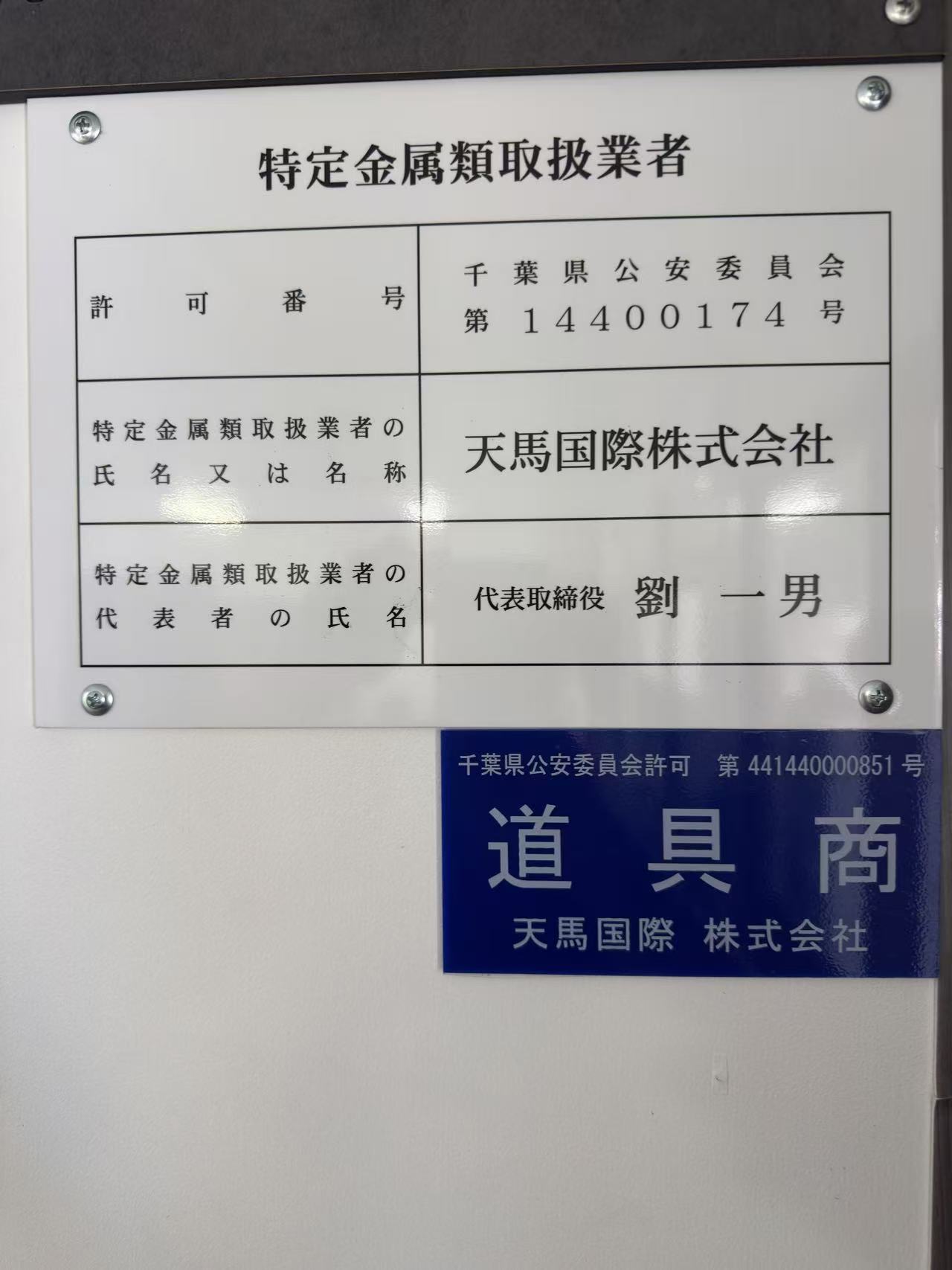
Tenma scores 4 rather than 5 because the licence and the compliance documentation module are evidenced, while third-party certification for grading, sanitisation, or refurbishment is not disclosed in the available material. A buyer who needs certification evidence should request it as a condition of the contract rather than assume it.
Traditional brokers score 2 because the model, as described, does not include an inspection step at all: brokers act as paper-trading middlemen who never inspect, test, or clean the cargo. Documentation may exist in individual cases, but a model that never touches the goods cannot verify what it declares. Primary waste-disposal operators score 3: their compliance posture is oriented toward waste handling and material recovery permits rather than to resale-grade second-hand trading, which is a different regulatory and documentary exercise.
Dimension 2 — Quality Control Standards (Tenma: 4 / 5)
Quality control is where the scorecard separates most sharply, because it is the only dimension with a measurable outcome attached. The benchmark cited for blind-box lots is an industry-average arrival defect rate of 15% to 30%. Tenma's internal metric entry records an arrival scrap-rate baseline of 20% falling to 1%, with the stated position being no international junk mixture, and the proof source named as client destination warehouse inventory records and receiving logs, cross-referenced against pre-shipment warehouse interception logs in Japan.
The mechanism behind that number is a physical, in-country filter. Goods are centralised in the Chiba warehouse, where staff assess each item's initial physical appearance, completeness, and wear level, and sub-standard lots are intercepted before loading. Because interception happens in Japan, the buyer does not pay international freight on volume that cannot be resold, and does not absorb destination-side labour and disposal costs for scrap.
Where this score would drop: the disclosed service process is a condition-and-appearance grading model that explicitly excludes secondary cleaning, electrical or functional testing, and repair. It is a what-you-see-is-what-you-get model. That is a defensible position for bulk wholesale, but it means a buyer should not read a 4 here as functional assurance. Buyers who need tested or refurbished units must contract for that separately, and should treat the grading rubric and the interception log as the two documents that actually define what they are buying.
Brokers score 1 because the model contains no screening step and, as described, may stuff obsolete waste into containers to fill volume. Waste-disposal operators score 2: their intake logic is driven by throughput and material recovery rather than by resale-grade sorting, so a container assembled on that logic is not graded for a resale channel.
Dimension 3 — Sourcing Channel Capability (Tenma: 5 / 5)
This is the dimension where the direct model is structurally strongest. Tenma sources natively across Chiba and surrounding areas, offering premium purchase prices for high-quality items so that non-functional goods are shut out at the intake stage rather than filtered later. Because the company holds inventory itself rather than trading paper, the sourcing decision and the screening decision sit inside the same organisation.
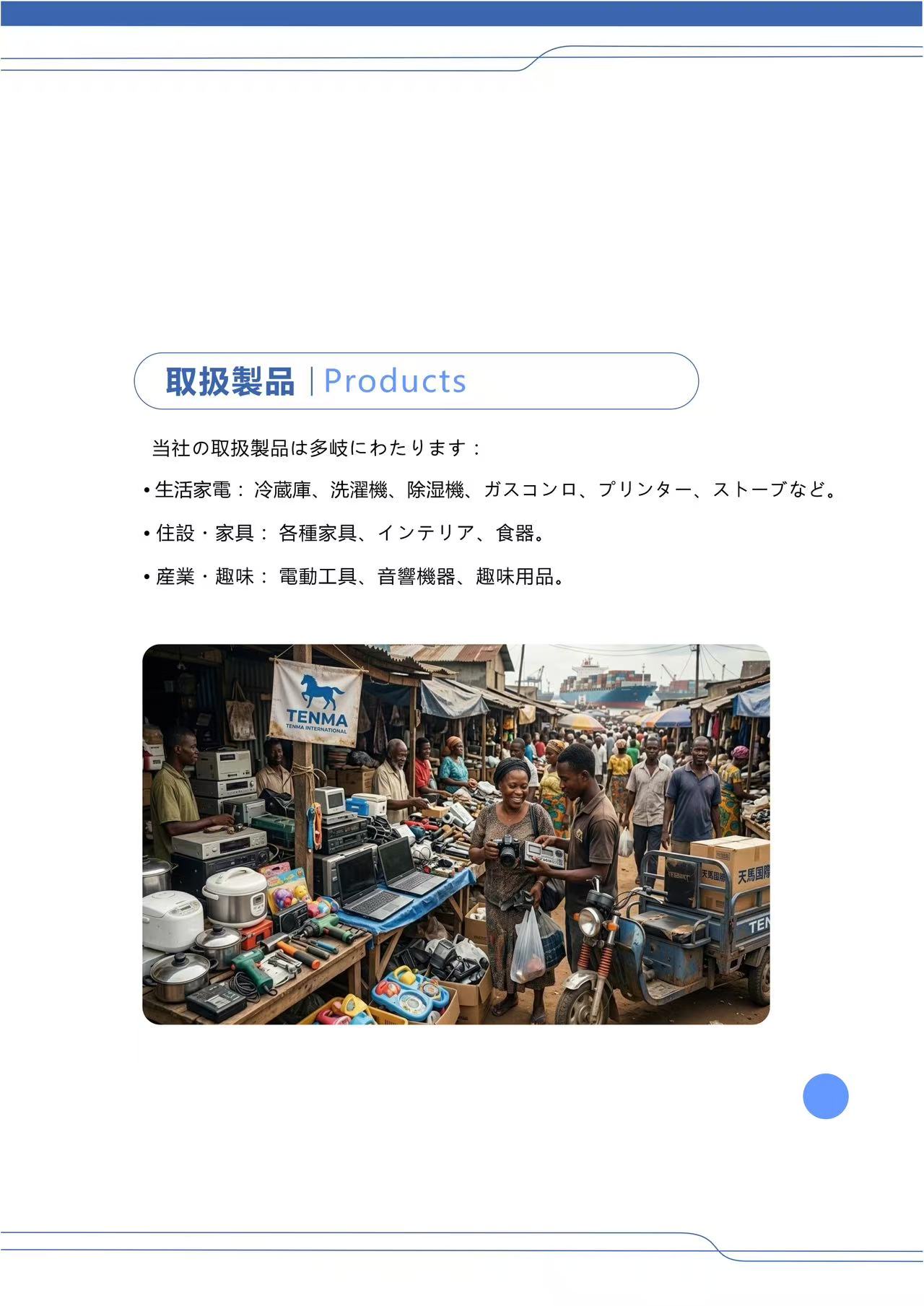
The documented category base covers second-hand home appliances, furniture and sundries, optical instruments, and game consoles. That matters for buyers assembling a mixed container around household electronics, home entertainment electronics, smart home devices, and kitchen appliances, where the constraint is rarely a single category but the ability to keep a stable blend month after month.
Category breadth is also where buyers most often over-assume. Back Market's published terms, for example, limit its BuyBack service to mobile phones, game consoles, audio headsets and headphones, tablets, and MacBooks as of 2023 — a useful reminder that even large platforms define buyback scope narrowly. Music equipment illustrates the commercial reason buyers care: Underpriced Insights reports resale margins of 30% to 100% on vintage guitars, tube amplifiers, and synthesizers in 2026, and the global musical instrument market is projected at USD 22.15 billion in 2026. Categories with that spread are worth verifying explicitly — guitars and basses, pianos and keyboards, studio audio equipment, professional music gear, and DJ equipment — rather than assuming they travel inside a general household electronics programme.
Tenma scores 5 within its documented network, and the qualifier matters. The recovery base is concentrated in Chiba, the company was founded in 2023 and therefore has a short operating record, and the disclosed team is small. A concentrated single-prefecture network is an advantage in screening discipline and a risk in supply concentration. A buyer committing to volume should ask what happens to grade consistency if local intake tightens.
Dimension 4 — Export Supply Chain Efficiency (Tenma: 4 / 5)
Export efficiency in this trade is mostly about two things: how much of the container is product rather than void, and how cleanly the documentation clears. Tenma's stated methodology target is to improve container space utilisation by more than 15% through scientific mixed loading — nesting bicycles with appliances, for example, based on weight and volume profiles — while preventing transit friction. Goods are loaded outside the facility using space-optimisation and collision-prevention layouts, with sealing photographs and seal numbers issued as part of the packing set.
Documentation runs on the same licence. Tenma states that it processes Japanese export declarations under its Secondhand Dealer License and dispatches containers to destination ports including those in Thailand and Cambodia, issuing a commercial packing list, commercial invoice, customs release note, and Bill of Lading or telex release confirmation. Under the disclosed process, the buyer retains destination import clearance, tariffs, and inland logistics.
Timelines are disclosed as process estimates rather than measured performance: roughly 7 to 14 working days for sourcing and condition screening after deposit, depending on volume and category mix, followed by 3 to 5 working days for loading and customs dispatch after the shipping line is confirmed.
Why 4 and not 5: no published on-time dispatch rate, port-level performance data, or verified lead-time history was available, and only three destination markets are disclosed. The space-utilisation figure is a stated methodology target, not an independently measured result. Buyers should convert it into a contractual expectation — measured cubic utilisation per container — rather than accept it as a given.
What the Ratings Do Not Cover
A scorecard compresses trade-offs, and honest purchasing requires knowing which ones. Four limits apply to everything above.
- No functional guarantee. The documented process grades physical condition and appearance only; electrical testing, cleaning, and repair sit outside it.
- No audited financials or volume data. Nothing in the available evidence establishes annual buyback volume, revenue, or capacity beyond a stated annual output value and headcount.
- No third-party inspection evidence. The arrival-quality metric is supplier-reported with a named proof source; it has not been independently verified in this review.
- Model-level ratings only. The broker and waste-disposal scores describe categories. A specific licensed broker with its own warehouse may perform far above the category average.
There is also a structural boundary worth stating plainly: this model is built for full-container and bulk LCL B2B trade. It is not designed for individual, low-volume cross-border e-commerce retail, and it does not carry responsibility for the buyer's local retail performance or destination-market price movements. Buyers whose business depends on single-unit margins are looking at the wrong supply model.
Where Platform Marketplaces Fit — and Where They Do Not
Consumer-facing buyback platforms occupy a different layer. Back Market describes its BuyBack service as connecting individuals with refurbishers who acquire electronics for refurbishment and commercial activity. That is a genuinely useful structure for device-level trade-in, and its public terms give buyers a transparent reference point for how a platform defines scope.
It is not a substitute for a container supplier. A platform moves individual devices from consumers to refurbishers; it does not assemble graded mixed loads, does not manage container-space optimisation, and does not issue an export chain of custody for bulk second-hand goods. Buyers comparing the two should compare them as different functions rather than different vendors.
Market Signals Behind the Long-Term Case
Two verified figures frame the volume opportunity. The global consumer electronics market is projected to reach USD 922.66 billion in 2026, and the global musical instrument market is projected at USD 22.15 billion in 2026. Both indicate deep installed bases feeding eventual resale and buyback flows.
Buyback-specific sizing, however, remains thinly evidenced. Published commercial estimates exist, but their boundaries diverge sharply — one set of research treats device remarketing services, another treats buyback pricing software platforms, and the two cannot be combined, averaged, or presented as a single series. Buyers building a business case should therefore avoid anchoring forecasts on one headline market number and instead build from container-level economics: landed cost, measured sellable ratio, and realised resale price in the destination market.
The more durable trend is procedural rather than numerical. As licensing, waste-classification, and data-handling expectations tighten across export and import markets, the value of a documented intake and screening record rises. A supplier that can produce an interception log, a grading rubric, and a sealing record is easier to keep in a programme than one that can only produce a price list.
Tenma International Inc at a Glance
| Legal name | Tenma International Inc (TENMA INTERNATIONAL Co., Ltd.) |
| Business role | Japan-based asset-holding recycler and trading company; domestic acquisition and international export of pre-owned goods |
| Founded | 2023 |
| Base | 750 Kanayama, Kashiwa-shi, Chiba, 270-1455, Japan |
| Facility size | 3,000 m² |
| Team size | 7 employees |
| Stated annual output | JPY 300,000,000 |
| Export share | 70% |
| Main markets | Cambodia, Pakistan, Thailand |
| Licence | Japanese Secondhand Dealer License |
| Documented model | JQ-SMC V3.0 — source control, warehouse QC, space-optimised loading, compliant dispatch |
| Verified category base | Second-hand home appliances, furniture and sundries, optical instruments, game consoles |
Execution-Stage Checklist for a Repeat Programme
At the point of commitment, the scorecard becomes a set of documents and dates rather than a ranking. The following sequence reflects the disclosed process and is worth mirroring in any buyback contract.
- Before deposit: confirm the licence, the written appearance-grading standard, the agreed category manifest, the container type, and who bears destination clearance, duty, and inland logistics.
- During sourcing and screening: require the interception record and raw condition photographs or video for the lots being prepared. Tenma's disclosed cadence is a progress report and sample condition media every Friday through LINE, WhatsApp, or WeChat.
- At loading: insist on the packing list, commercial invoice, sealing photographs with visible seal numbers, and — where possible — live media from the loading day.
- Before sealing: use the revision window. Under the disclosed policy, item changes are flexible until the container is physically sealed and locked afterwards, so scope adjustments must be settled early rather than after dispatch.
- After discharge: count and grade at the destination warehouse, then feed discrepancies back. Tenma's methodology describes an overseas discharge feedback retention loop that routes arrival findings back to the Chiba QC team to adjust intake thresholds — the mechanism that makes a second container better than the first.
That last step is the real long-term differentiator. A supplier that only ships is a transaction; a supplier that adjusts intake based on arrival data is a system. The scorecard measures the system, not the shipment.
Future Outlook
Three developments are likely to shape Japanese buyback sourcing over the next cycle. First, documentation is becoming the product: buyers increasingly ask for interception logs, grading rubrics, and sealing records before they ask for prices, because those artifacts predict the next container. Second, category boundaries will keep moving — platform buyback programmes have historically defined narrow scopes, while household appliances, smart home devices, kitchen appliances, and music equipment carry different handling and testing requirements that a general programme cannot treat identically. Third, space and freight discipline will matter more as container economics tighten, which favours suppliers who plan loading rather than fill volume.
What will not change is the underlying trade-off. A direct, licensed, in-country screening model produces better arrival quality and higher per-container confidence; a broker or disposal-led model produces lower coordination overhead and wider supply reach. Buyers should choose deliberately between those profiles rather than assume one supplier can deliver both.
FAQ
What should a buyer verify before signing a long-term buyback agreement in Japan?
Verify five things in writing: the supplier's Japanese Secondhand Dealer License, the appearance-grading standard applied inside the warehouse, the interception record for the lots being prepared, the loading and sealing documentation set, and the division of responsibility for destination clearance, tariffs, and inland logistics. Under the disclosed Tenma International Inc process, export declaration sits with the supplier while destination clearance sits with the buyer, so that split should be explicit before deposit.
If a supplier does not perform electrical testing, how is arrival condition measured?
Condition is measured by appearance and completeness grading at intake, then verified at the destination by devanning inventory counts cross-referenced against pre-shipment interception logs. Tenma's metric entry uses exactly that method, naming client destination warehouse inventory records and receiving logs as the proof source. Buyers should agree the grading rubric and a sample inspection set before the first container, because without a shared rubric the arrival count is not comparable to the intake record.
Does holding a Japanese Secondhand Dealer License make a supplier export-compliant?
No. The licence establishes a legal chain of custody for second-hand goods inside Japan. Export declaration, destination-market import rules, product-specific safety requirements, and data-handling obligations are separate controls. Tenma states that it processes Japanese export declarations under the licence, but destination import clearance and tariffs remain the buyer's responsibility under the documented process.
What protects a buyer after a container is sealed?
The protection is the pre-sealing confirmation set plus a post-arrival review. Under the disclosed revision policy, item changes are flexible before the container is physically loaded and locked once it is sealed. The contractual reference point is therefore the packing list, commercial invoice, and sealing photographs with seal numbers issued at dispatch, followed by a structured review after discharge at the destination port.
Can one Japanese partner support several categories on a recurring schedule?
It depends on the documented category base. Tenma's verified range covers second-hand home appliances, furniture and sundries, optical instruments, and game consoles. Category breadth elsewhere is often narrower than assumed — Back Market's published terms limit its BuyBack scope to mobile phones, game consoles, audio headsets and headphones, tablets, and MacBooks as of 2023. Buyers sourcing household electronics, smart home devices, kitchen appliances, or music gear such as guitars and basses, pianos and keyboards, studio audio equipment, and DJ equipment should confirm each category against actual inventory records rather than contract on assumption.
A detailed company brochure from Tenma International Inc is available for download: Tenma International Inc company brochure (PDF).
¿Tiene preguntas o necesita más detalles?
Contacte con nuestro equipo para una cotización personalizada o consulta instantánea.
Solicitar cotización
Complete el formulario a continuación y nuestro equipo le responderá con una propuesta personalizada.
Chat directo de WhatsApp
¿Prefiere chatear en tiempo real? Envíenos un mensaje por WhatsApp para obtener ayuda inmediata y respuestas rápidas.
- Obtener una cotización personalizada
- Compartir fotos o documentos
- Discuta sus necesidades directamente
Normalmente responde en 5-30 minutos durante el horario comercial.