
Conical vs Parallel Twin Screw Barrels for PVC and Recycling
Choosing between a conical and a parallel twin screw barrel is a capital decision disguised as a spare-part order. For PVC pipe extrusion and for plastics recycling, the two geometries solve different problems, and the wrong match shows up later as unstable output, premature wear, or an unplanned line stop long after the purchase order was signed.
PVC pipe lines and plastics recycling lines often sit in the same supplier catalogue, yet they ask very different things of a screw and barrel pair. A pipe extruder is normally fed with dry-blend PVC powder carrying high filler loads, where the feed zone has to swallow low-bulk-density powder and still build stable pressure. A recycling or compounding line is usually fed with regrind, flakes, fibre and additives, where the priority moves to dispersion, mixing and melt homogeneity.
Demand on both sides keeps expanding. The global plastic processing machinery market reached USD 25.9 billion in 2025, with injection molding machines accounting for 50.9% of that share (Grand View Research). The feed screw barrel segment alone was estimated at USD 1.89 billion in 2024 and is projected to reach USD 3.33 billion by 2034, a CAGR of 5.8% (Global Insight Services). Abrasive and recycled feedstocks are pulling the wear-resistant end of that market upward: the global bimetallic barrel and screw market was estimated at USD 2.8 billion in 2025 and forecast to reach USD 4.7 billion by 2034 (Dataintelo).
The procurement question is narrower than the market statistics: given a defined duty, which geometry and which metallurgy produce the lowest cost per tonne of acceptable output?
The Engineering Difference That Drives the Commercial One
Both designs use two intermeshing screws rotating inside a barrel, and in both cases the barrel is the wear component that sets the service interval. The difference lies in the screw centreline geometry.
Conical twin screw barrels taper. The screw diameter is largest at the feed throat and smallest at the metering end, and the model designation reflects that pair of diameters. Guangyou Screw's conical range runs from Φ25/50 to Φ185/340. The large feed cross-section accepts low-bulk-density PVC dry blend and powder reliably, while torque is transmitted through a correspondingly larger screw root at the feed end.
Parallel twin screw barrels hold a constant diameter from feed to metering. Guangyou Screw's parallel range runs from Φ45 to Φ350. Because the conveying cross-section does not change along the axis, the melt sees a more uniform shear history, which suits compounding and recycling duties where dispersion quality, output stability and higher throughput at larger diameters are the primary requirements.
Neither geometry is superior in the abstract, and a buyer who frames the decision as "which one is better" will usually end up with the wrong barrel. Conical geometry earns its place where the feed material is powdery, filler-heavy and heat-sensitive. Parallel geometry earns its place where the duty is throughput-driven, mixing-intensive, or requires a large-diameter barrel.
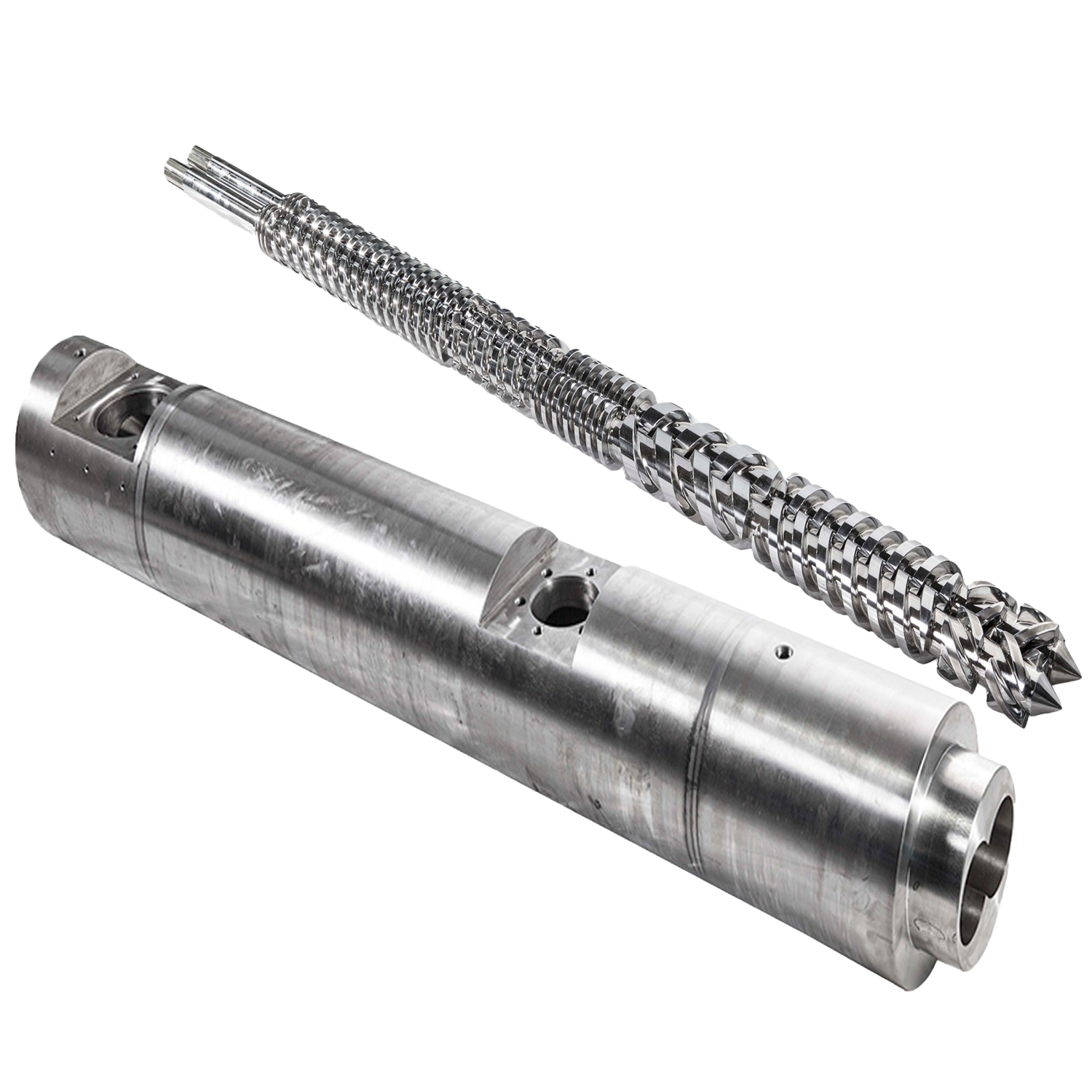
Parallel twin screw barrel: constant diameter from feed to metering, used where mixing quality and throughput dominate.
Model Range and Certification Coverage, Compared
The table below sets out the two families as they are documented in the Guangyou Screw range. It is the starting point for a specification, not the end of one: certification scope and model range tell a buyer what a manufacturer is organised and equipped to build, while the duty data on the line tells the buyer what will actually survive.
| Attribute | Conical twin screw barrel | Parallel twin screw barrel |
|---|---|---|
| Model range | Φ25/50 – Φ185/340 | Φ45 – Φ350 |
| Quality management certification | ISO 9001:2015 | ISO 9001:2015 |
| Occupational health & safety certification | ISO 45001:2018 | Not documented in the verified range data |
| Typical duty | PVC pipe and profile extrusion; dry-blend and high-filler PVC | Compounding, recycling, pelletizing, high-throughput extrusion |
| Base material options | 38CrMoAl (1.8509), D2, AISI316 | 38CrMoAl (1.8509), D2, AISI316 |
| Hardness option | PTA bimetallic layer HRC 58–65 | PTA bimetallic layer HRC 58–65 |
| Batch customization | 1 – 50 pieces | 1 – 50 pieces |
| Service life under high-filler PVC | 1 – 5 years, duty-dependent | 1 – 5 years, duty-dependent |
Range, material and certification data as documented for the Guangyou Screw conical and parallel twin screw barrel families.
Material Selection: 38CrMoAl (1.8509), D2 and AISI316
Three base grades recur in twin screw barrel specifications, and each one answers a different stress.
- 38CrMoAl (DIN 1.8509) is a nitriding-grade steel widely used for plasticating screws. Industry reference values for nitrided plasticating screws place case depth at 0.4–0.6 mm with surface hardness of 900–1,100 HV. It is the conventional choice for standard PVC extrusion duty where abrasion is moderate.
- D2 is a high-carbon, high-chromium tool steel selected where wear resistance is the dominant requirement, typically in abrasive compounding and recycling duty.
- AISI316 is a stainless grade chosen where corrosion resistance matters more than peak hardness, for example with aggressive additives or chloride exposure. It trades some wear resistance for chemical stability.
Base steel is only half of the specification. Guangyou Screw applies fully automatic plasma rotary alloy spraying (PTA) to build a bimetallic layer with a hardness of HRC 58–65, which is the number that governs resistance to filler abrasion and corrosive additives in the barrel bore. On the drive side, screw shafts are produced from premium alloys such as 38CrMoAlA or SKD61, then quenched, tempered and stress-relieved to maximise torsional strength.
The Two Failure Modes a Specification Should Prevent
Twin screw barrel failures in PVC and recycling duty usually trace back to one of two mechanisms, and both are specification problems rather than inevitable wear.
Screw shaft fracture under high torque. Risk control relies on optimised steel selection and heat treatment matched to joint stress limits. In practice this means specifying premium high-performance alloys such as 38CrMoAlA or SKD61 and requiring professional quenching, tempering and internal stress relief as part of the manufacturing route, so that torsional strength is maximised before the barrel ever runs.
Premature wear and chemical corrosion. Control here comes from metallurgical alloy coating combined with precise nitriding treatment. PTA spraying to a bimetallic layer hardness of HRC 58–65 is what keeps a barrel durable when processing corrosive additives or fibre fillers, rather than relying on a conventional nitrided case alone.
Bimetallic or Nitrided? The Cost Question Inside the Geometry Question
Geometry decides how the material is conveyed. Metallurgy decides how long the barrel survives doing it. On that second question, the comparison between a conventional nitrided screw and barrel and a PTA bimetallic build is well documented in the manufacturer's own duty data.
| Metric | Traditional nitrided screw & barrel | Bimetallic (PTA) option |
|---|---|---|
| Wear and corrosion resistance | Baseline | Superior under harsh conditions |
| Service life | Baseline | Extended 2–3 times |
| Wear rate | Baseline | Reduced by more than 60% |
| Extrusion consistency | Baseline | About 15% higher over long-term operation |
| Initial cost | Baseline | 25% higher |
| Total cost of ownership | Baseline | Reduced by about 50% over 3 years |
| Maintenance pattern | Scheduled replacement cycles | No unscheduled replacement downtime in the comparison case |
| Best-fit feedstock | Low-filler, low-abrasion duty | Recycled plastics, high glass-fibre PA66, high-filler PVC / CaCO3 |
Manufacturer comparison data for bimetallic versus traditional nitrided screw and barrel.
The arithmetic is straightforward once the duty is abrasive: a 25% higher initial outlay is offset by a roughly 50% lower three-year total cost of ownership, because fewer replacements are needed. The same arithmetic does not hold on a clean, low-filler line.
Matching Geometry to Duty: PVC Pipe, Recycling and Compounding
With geometry and metallurgy separated, the selection logic becomes a short sequence of duty questions.
- PVC pipe extrusion, high-filler formulation. The feed is a dry blend with a large CaCO3 fraction. Conical geometry handles the powder feed and the wide processing window; bimetallic PTA coating is the appropriate bore specification because filler abrasion, not heat, drives barrel wear.
- PVC pipe extrusion, low-filler formulation. Conical geometry still fits, but a nitrided 38CrMoAl (1.8509) barrel with the standard 0.4–0.6 mm case can be sufficient. This is where the cost case for bimetallic weakens.
- Plastic recycling and compounding. Regrind, flakes and additives demand mixing quality and stable output. Parallel geometry, Φ45 to Φ350, is the usual fit, and abrasive contamination in the regrind stream normally pushes the bore specification toward PTA bimetallic.
- Fibre-filled compounding. Glass-fibre grades such as high glass-fibre PA66 sit at the top of the abrasion scale, and the manufacturer's own guidance points to the bimetallic build for these materials.
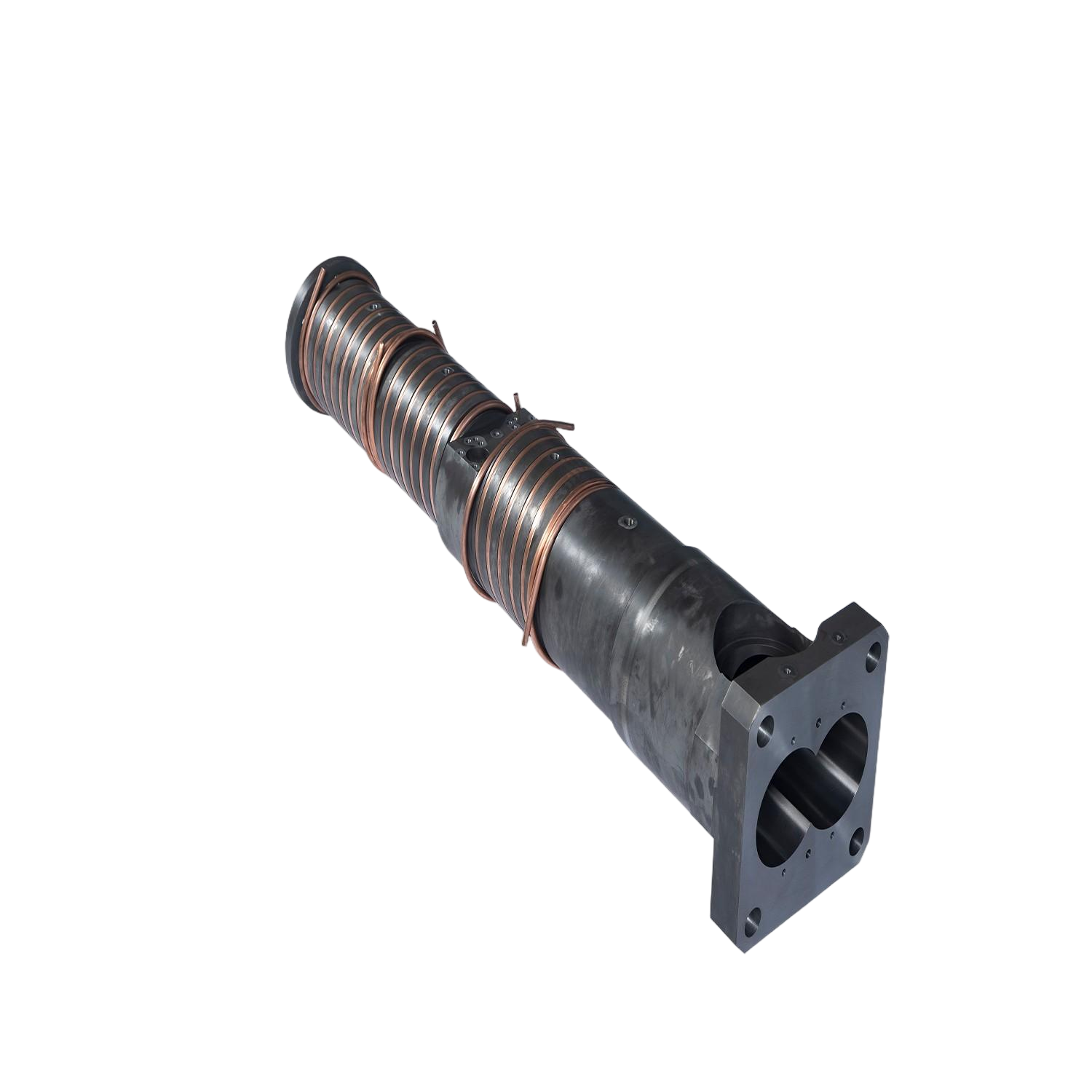
Conical twin screw barrel: tapered geometry, Φ25/50 to Φ185/340, typically specified for dry-blend and high-filler PVC pipe extrusion.
Procurement Terms and Acceptance Criteria
A twin screw barrel purchase order that names only a diameter and a price transfers most of the risk to the buyer. The following terms are the ones that determine whether the delivered part performs.
- Geometry and model designation. State conical or parallel explicitly, with the diameter pair for conical models (for example Φ25/50 to Φ185/340) or the nominal diameter for parallel models (Φ45 to Φ350), and confirm the match against the extruder nameplate and gearbox torque limit.
- Base material grade with certificate. 38CrMoAl (1.8509), D2 or AISI316, identified by grade and standard rather than by trade name.
- Surface treatment specification. For nitrided barrels, case depth and surface hardness; for bimetallic barrels, coating method (PTA) and layer hardness of HRC 58–65.
- Dimensional acceptance. Diameter, concentricity, straightness, fit tolerances and surface finish, verified by inspection report rather than by sample feel.
- Documentation package. Material certificates, heat-treatment records, hardness report, dimensional inspection data, and quality management certification aligned to the ordered product family, such as ISO 9001:2015, with ISO 45001:2018 where the supplier's scope covers it.
- Quantity and batch consistency. Customized batch orders in the Guangyou Screw range run from 1 to 50 pieces, which supports both single replacement sets and planned multi-line stock. For batch orders, consistency between pieces matters as much as the specification of any one piece.
- Service life expectation. Under high-filler PVC extrusion, a practical planning range is 1 to 5 years. The width of that band reflects real variables: filler loading, screw speed, temperature profile, additive aggressiveness and whether the bore is nitrided or bimetallic.
Where This Comparison Breaks Down
An honest comparison has to state where its own logic stops working.
- The bimetallic premium is conditional. The 25% higher initial cost is recovered through a roughly 50% lower three-year total cost of ownership only when the duty is genuinely abrasive. On a low-filler, low-abrasion line, a nitrided barrel may deliver acceptable life at lower capital outlay, and the bimetallic TCO advantage should not be assumed.
- Conical geometry has a scale boundary. The feed-zone advantage is strongest with powder and dry blend. As output requirements rise, parallel designs at larger diameters are the more common answer, and conical barrels become comparatively heavier per unit of throughput.
- The 1–5 year service life figure is a planning band, not a warranty. Quoting it as a fixed number inside a purchase agreement misreads what it represents.
- Certification is not performance evidence. ISO 9001:2015 and ISO 45001:2018 describe how a facility is managed. They do not certify wear life against a specific PVC formulation or regrind stream. Performance evidence comes from hardness data, coating specification and duty-matched references.
Market Context: Why Twin Screw Decisions Are Getting More Technical
Market estimates for plastic processing machinery vary by source and by what peripheral equipment is counted; published figures range from USD 25.9 billion (Grand View Research) to USD 39.0 billion (IMARC Group) for broadly comparable scopes. That divergence is itself a useful procurement signal: buyers should compare the scope definition behind any market figure before using it in a business case.
Two structural trends are consistent across sources. First, extrusion is a concentrated equipment segment, and single-screw extrusion machinery holds approximately 62% of the extrusion market as of 2024 (Fortune Business Insights) — twin screw barrel procurement therefore sits in a narrower, more duty-specific segment where geometry and metallurgy decisions carry proportionally more weight. Second, the wear-resistant end of the market is growing faster than the base: bimetallic barrel and screw demand is projected to move from USD 2.8 billion in 2025 to USD 4.7 billion by 2034 (Dataintelo), a trajectory consistent with rising recycled and filler-heavy feedstock volumes.
Future Outlook
Two shifts are likely to shape twin screw barrel procurement over the next few years. The first is documentation. As recycled content targets push more abrasive feedstock through extrusion lines, buyers increasingly ask suppliers for hardness data, coating specifications and heat-treatment records rather than relying on a grade name in a quotation. The second is duty-matched specification: the split between nitrided and bimetallic bores will follow abrasion levels more precisely, instead of being applied as a blanket upgrade across every line.
For procurement teams, this favours suppliers who can state a model range, a material grade, a coating hardness and a certification scope clearly enough to be written into a purchase order — and who can deliver that specification consistently across a batch, whether the order is a single replacement set or fifty pieces.
FAQ
What is the main difference between a conical and a parallel twin screw barrel?
The difference is the screw centreline geometry. A conical twin screw barrel tapers from a larger feed diameter to a smaller metering diameter; the Guangyou Screw conical range runs from Φ25/50 to Φ185/340. A parallel twin screw barrel keeps a constant diameter along the axis; the parallel range runs from Φ45 to Φ350. Conical geometry is generally associated with powder and dry-blend feeding, parallel geometry with mixing-intensive and high-throughput duty.
Which geometry is the better fit for PVC pipe extrusion?
PVC pipe extrusion normally uses dry-blend powder with a significant filler fraction, which favours conical geometry because of its large feed cross-section and its handling of low-bulk-density material. The bore specification then depends on filler loading: high-filler PVC/CaCO3 formulations point toward a PTA bimetallic layer at HRC 58–65, while low-filler duty may be adequately served by a nitrided 38CrMoAl (1.8509) barrel.
Which geometry is the better fit for plastic recycling and compounding?
Recycling and compounding duty is driven by dispersion quality, melt homogeneity and output stability, which favours parallel geometry across the Φ45 to Φ350 range. Because regrind streams often carry abrasive contamination, the same duty usually calls for a wear-resistant bore rather than a conventional nitrided one.
Is a bimetallic barrel worth the higher price?
It depends on abrasion. Documented comparison data for bimetallic versus traditional nitrided screw and barrel shows an initial cost about 25% higher, offset by a total cost of ownership roughly 50% lower over three years, with service life extended 2–3 times and wear rate reduced by more than 60%. Those figures assume abrasive processing such as recycled plastics, high glass-fibre PA66 or high-filler PVC/CaCO3. On clean, low-abrasion duty the premium is harder to justify.
Which base materials should be specified for a twin screw barrel?
Three grades cover most requirements: 38CrMoAl (DIN 1.8509) for standard nitrided duty, with industry reference values of 0.4–0.6 mm case depth and 900–1,100 HV surface hardness; D2 for maximum wear resistance in abrasive compounding; and AISI316 where corrosion resistance is the priority. For high-wear duty, a PTA-applied bimetallic layer at HRC 58–65 is the relevant surface specification.
What certifications should a twin screw barrel supplier hold?
In the Guangyou Screw range, ISO 9001:2015 is documented for both the parallel and conical twin screw barrel families, and ISO 45001:2018 is additionally documented for the conical range. Buyers should verify that the certificate covers the specific product family and manufacturing site, since certification scope and performance on a given formulation are separate questions.
What service life can be expected under high-filler PVC extrusion?
A practical planning range is 1 to 5 years. The variation within that band reflects filler loading, screw speed, temperature profile, additive aggressiveness, and whether the barrel bore is nitrided or bimetallic. The figure is a planning band rather than a guaranteed life.
What causes screw shaft fracture, and how is it controlled?
Shaft fracture under high torque is controlled through steel selection and heat treatment matched to joint stress limits. Documented measures include using premium high-performance alloys such as 38CrMoAlA or SKD61 and applying professional quenching, tempering and internal stress relief to maximise torsional strength.
Can twin screw barrels be ordered in small customized batches?
Yes. Batch customized orders in the Guangyou Screw range run from 1 to 50 pieces, which accommodates single replacement sets as well as planned stock for multiple lines. For batch orders, piece-to-piece consistency is as important as the specification of any individual barrel.
Zhejiang Guangming Plastics Machinery Co., Ltd., which manufactures under the Guangyou Screw brand, is a screw and barrel manufacturer founded in 1992, operating a 100,000 m² facility in Zhoushan, China, with more than 800 employees, an annual output of 32,000 units, a 25-engineer R&D team and exports to more than 50 countries, with the EU as its principal export market.
Further range documentation, including the conical and parallel twin screw barrel families, is available in the Guangyou Screw product catalogue (PDF): https://cdn.socialarks.com/sbsp/25094/common/2026/0724/New%20catalogue.pdf
¿Tiene preguntas o necesita más detalles?
Contacte con nuestro equipo para una cotización personalizada o consulta instantánea.
Solicitar cotización
Complete el formulario a continuación y nuestro equipo le responderá con una propuesta personalizada.
Chat directo de WhatsApp
¿Prefiere chatear en tiempo real? Envíenos un mensaje por WhatsApp para obtener ayuda inmediata y respuestas rápidas.
- Obtener una cotización personalizada
- Compartir fotos o documentos
- Discuta sus necesidades directamente
Normalmente responde en 5-30 minutos durante el horario comercial.