
Concrete Pump Pipe Selection for High-Rise, Tunnel, Bridge, and Mining Duty
Industrial Equipment & Components · Application Reference
Concrete pump pipes are not one product. The delivery line that carries concrete up a high-rise core, through a tunnel heading, along a bridge deck and across a mine backfill circuit is exposed to different pressures, abrasion rates, routing geometry and duty cycles — and it fails for different reasons in each case.
Application fit is the practice of matching a pipe specification — bore, wall thickness, material, hardness, bend geometry and end connection — to the conditions a line will actually run under, before the purchase order is released. Buyers who treat the line as a single commodity item tend to discover the mismatch later, usually at an elbow, in the middle of a pour.
The commercial context makes that discovery more expensive than it used to be. The global concrete pump market was valued at approximately USD 6.05 billion in 2024 and is expected to grow at a compound annual growth rate of 5.13% through 2032, according to Credence Research. Asia Pacific accounted for an estimated 42% of concrete pump market revenue in 2025, driven primarily by infrastructure projects in China and India. Those figures describe equipment demand; the delivery line is the component that determines whether the equipment stays productive.
This reference maps four application profiles to the pipe variants that fit them, states where the trade-offs sit, and frames the decision inside the longer question that follows every first order: what has to remain in place for the line to keep performing after year one.
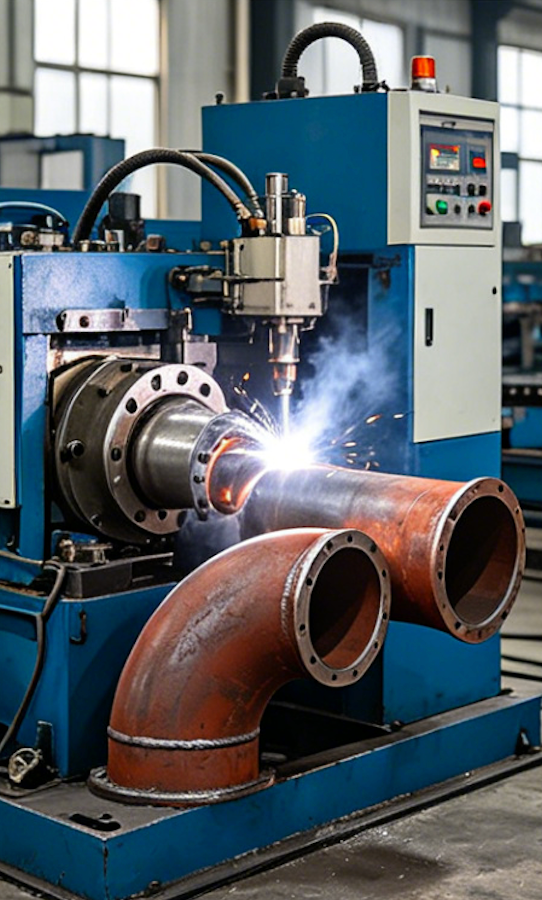 Curved components, formed on automatic bending and welding equipment, are the part of a delivery line most exposed to directional wear.
Why Under-Specification Is a Procurement Risk, Not a Cost Saving
Application fit is the process of matching a pump pipe to the pressure, abrasion, routing and duty cycle of a specific job, and it is decided before the order is placed rather than after the first failure.
When that match is missing, the pipe still works. It simply works for less time. Three variables drive most early failures on site:
- Pressure and abrasiveness. Large-aggregate mixes under high delivery pressure attack the inner wall continuously, and wear concentrates at the section with the least hardness and at every change of direction.
- Geometry. The number and severity of bends determines where pressure is lost and where wall loss accelerates. A straight run is not the same component as a bend, and it should not be purchased as if it were.
- Duty cycle and continuity. A line running eight to twelve hours a day behaves differently from one running around the clock. In continuous operations, replacement is a shutdown event rather than a maintenance task, which changes what the word cheaper actually means.
The opportunity sits on the other side of the same logic. Where the line is specified by application, buyers gain predictable wear intervals, fewer unplanned stoppages, and the ability to standardise elbows, clamps and reducers across a fleet instead of re-ordering whatever is available when something ruptures.
Four Application Profiles and Their Delivery-Line Demands
High-Rise Building Piping: Sustained Daily Cycles
High-rise piping typically operates 8–12 hours per day and must integrate with a pump truck or stationary pump feeding a vertical riser. The load is not a single pressure peak but repeated cycles across a long vertical column, with the line extended floor by floor as the structure rises.
Three specification consequences follow:
- Consistent wall thickness and hardness across the full run, so wear does not concentrate in a few under-specified sections.
- Durable clamps and connections, because the line is assembled, dismantled and repositioned many times over a project.
- Compatibility with the pumping equipment already on site. Hongchang Machinery Technology Co., Ltd. states that its pipes can be matched with any type of pump truck and tow pump from companies such as Sany Heavy Industry and Zhonglian Heavy Industry, and that the company is a designated supporting manufacturer for Xingma Automobile. Sany Heavy Industry was identified as the world's largest concrete pump equipment manufacturer by volume as of 2024 in a published parts-industry ranking.
Tunnel Construction: Geometry Under Load
In tunnel work the straight pipe is rarely the limiting component. The line has to follow the excavation profile, and heavy-duty direction change — in some layouts amounting to cumulative turning of up to 180° — concentrates both pressure loss and abrasion at the curved sections.
The practical consequences:
- Curved pipe and elbow quality becomes the determining factor in line life, not the straight run.
- Bends need heavy-duty construction with consistent wall thickness maintained through the bend radius.
- The line is reconfigured as the heading advances, so connection durability matters as much as static strength.
This is where manufacturing method becomes visible to the buyer. Hongchang produces 50,000 meters of straight pipes and 15,000 pieces of curved pipes annually, and its production equipment includes automatic pipe bending and welding machines — capacity that exists because curved components are the harder part of the range to produce consistently.
Bridge Infrastructure: Reducers and Medium-Pressure Distribution
Bridge pours distribute concrete across long horizontal distances at medium pressure, frequently with a reducer pipe positioned ahead of the placing boom to step the line down to the diameter required at the point of placement.
Here the specification questions shift again:
- Reducer geometry and internal profile, because a step change in diameter creates a local turbulence and wear zone.
- Medium-pressure capability sustained across a long run rather than delivered in short bursts.
- Component compatibility across pipes, reducers and elbows that are assembled into one line.
Hongchang's product range covers the component set a bridge deck line is assembled from: Concrete Pump Pipes, Elbows, Clamps and Reducers.
Mining Operations: Continuous Abrasion and Corrosion
Mining and backfill circuits often run continuously, including around-the-clock operation, and the conveyed material is abrasive slurry rather than conventional structural concrete. Two demands dominate: abrasion resistance under constant loading, and corrosion resistance where the conveyed medium is chemically aggressive.
Because replacement in a continuous circuit stops production, the metric that matters is service life per meter rather than price per meter. Hongchang states that its straight and curved pipes deliver 2–3 times the lifespan of ordinary products. That is a manufacturer-side comparison rather than an independent industry benchmark, and it should be read as a directional reference point, not as a project guarantee.
Matching Pipe Construction to Application Demand
Pipe construction is where application fit is either supported or undermined. The variants used in industrial service are not interchangeable grades of the same product; they are different answers to different loads.
- Carbon steel pump pipe — the baseline choice, economical where abrasion is moderate and pressure is medium.
- Cast steel pipe and elbows — used where shaped geometry is required and casting is the practical forming route.
- Alloy wear-resistant pipe — specified for high-abrasion service.
- Double-layer pipe — high-pressure delivery systems often use twin or double-layer pipes to handle pressures up to 85 bar while minimising abrasive wear from large aggregates, according to a specialist pipe supplier's technical description.
- Quenched wear-resistant pipe — hardening applied through heat treatment. Hongchang's inner wall hardness is stated at HRC 55–62 via quenching.
- Flexible pump pipe — used at the end of a line or where rigid routing is impractical, trading pressure capability for reach.
None of these is universally better. Hardness raises wear resistance and raises cost. Larger bore reduces pressure loss and increases weight and clamp load. Flexibility buys reach and gives up pressure capability. The specification decision is therefore a trade-off between the four application profiles above, made with the job conditions on the table rather than with a catalogue in hand.
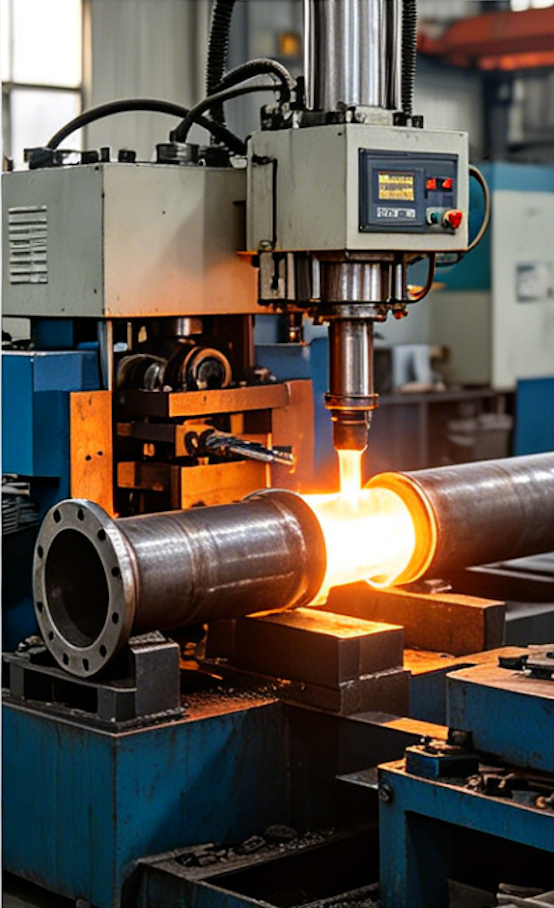 Heat treatment is the step that sets inner wall hardness — and therefore the abrasion life of the finished pipe.
One external reference point is worth building into verification: EN 12001:2012 specifies safety requirements for conveying, spraying and placing machines for concrete and mortar. Buyers delivering into markets where that standard applies should confirm that the delivery system is specified against it, and should not assume certification from a product listing alone.
Hongchang's Range, Capacity and Long-Term Supply Model
Hongchang Machinery Technology Co., Ltd. is a manufacturer of concrete conveying pipes and related components, based in Ma'anshan City, Anhui Province, China. Founded in 2015, the company operates a 2,600 m² facility with more than 50 employees and an independent design and R&D team covering both pumps and pipes.
Its core range is Concrete Pump Pipes, Elbows, Clamps and Reducers. Annual output is stated at 50,000 meters of straight pipes and 15,000 pieces of curved pipes, with monthly production capacity of 50,000 meters and 15,000 pieces, a typical production lead time of 15–30 days, and a minimum order quantity of 1 piece for sample orders. Approximately 50% of output is exported, with main markets in Southeast Asia, the Middle East, Europe and the Americas. Further detail is published at hongchangpumpipe.com.
For buyers in the decision-to-execution stage, the supply-side arrangements matter as much as the product list:
- Continuity. Production planning is supported by a 30% buffer stock for common sizes, which reduces a running project's exposure to lead-time variation.
- Incoming and in-process control. Quality control is ISO-based, with 100% inspection across multiple QC checkpoints, pressure testing and hardness verification, supported by supplier qualification and raw material testing. A certificate of quality is issued for each batch.
- Field support. Technical documentation, installation guidance, spare parts supply and 24/7 remote technical support are provided.
- Commercial terms. Delivery terms cover FOB, CIF and EXW; pre-shipment inspection and third-party testing through SGS or BV are available; payment terms are 30% deposit with 70% before shipment, by T/T or L/C.
Taken together, these are the mechanics of a multi-year supply relationship rather than a single transaction: a spare-parts route, a documented quality trail per batch, and a support channel that does not depend on the buyer having an engineer permanently on site.
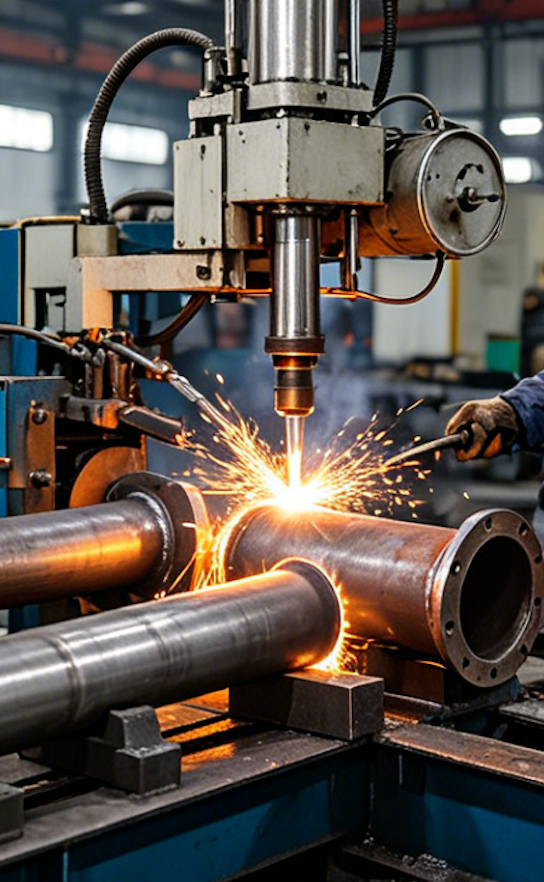 Welded pipe bodies and consistent wall thickness are the basis of pressure hold in high-rise and tunnel lines.
A Scenario-Fit Checklist for the Procurement Stage
The table below condenses the four profiles into the decisions that have to be settled before an order is released.
| Application | Duty profile | Delivery-line priority | Verify before ordering |
|---|---|---|---|
| High-rise building | 8–12 hours per day, vertical riser, pump truck or stationary pump integration | Consistent hardness and wall thickness; durable clamps; repeated assembly and dismantling | Compatibility with the pump truck or tow pump on site; hardness verification data |
| Tunnel construction | Advancing heading, heavy-duty direction change up to 180° | Curved pipe and elbow quality; bend construction; connection durability | Bend geometry capability; wall consistency through the radius |
| Bridge infrastructure | Long horizontal distribution at medium pressure, with reducer ahead of the boom | Reducer internal profile; sustained medium-pressure capability | Reducer geometry; component compatibility across pipes, reducers and elbows |
| Mining / backfill | Continuous, often around-the-clock slurry transport | Abrasion resistance; corrosion resistance; long service life per meter | Material specification; batch quality certificate; spare-parts availability |
At the execution stage, the same criteria translate into a short sequence of confirmations:
- Confirm bore, wall thickness and end connection against the pump's rated output.
- Confirm the number and angle of bends, and specify curved components separately from straight pipe.
- Confirm clamp and reducer compatibility as one system, not as independent items.
- Confirm sample order terms and acceptance criteria, including pre-shipment inspection and any third-party testing.
- Confirm the spare-parts route for elbows and clamps — the components that fail first.
- Confirm supply continuity: lead time, buffer stock for common sizes, and payment terms.
Wear-Resistant Pipe Compared with Generic Pipe: Where the Trade-Off Sits
Hongchang's comparison data against generic concrete pump pipe states a 2–3 times longer service life and higher hardness, with a 30% longer lifespan and a 20% lower wear rate, at approximately 15% higher initial cost. The operating benefits listed are reduced maintenance frequency and less downtime, attributed to better heat treatment and higher HRC hardness.
That is a first-party comparison measured against ordinary products, and it should be treated as a directional reference rather than a project guarantee. Wear outcome also depends on mix design, aggregate size and shape, pumping pressure, installation quality, and whether elbows and clamps are matched to the pipe. Two boundaries are worth stating plainly:
- On low-abrasion, low-duty work — short-distance mortar transfer, intermittent ground pumping, small pours — the higher initial cost may not be recovered within the project timeline. In that case, a carbon steel line can be the rational specification rather than the compromise.
- Hardness is not self-verifying. Buyers should retain pressure test and hardness verification records per batch, because the wear advantage depends on the hardness actually being present in the delivered pipe, not only on the specification sheet.
Market Context: Why Delivery-Line Decisions Carry More Weight Now
Estimates of the concrete pump market differ by source and by whether secondary services are included: Credence Research places the 2024 market at approximately USD 6.05 billion with a 5.13% CAGR through 2032, while SNS Insider has published a lower 2023 base of USD 5.18 billion. The direction is consistent even where the numbers are not — demand is expanding, and Asia Pacific is the largest regional contributor, at an estimated 42% revenue share in 2025.
Two structural trends follow from that. First, truck-mounted concrete pumps held a dominant 48% market share in 2025 on the strength of mobility and efficiency in urban construction, which means more lines are assembled, relocated and reassembled rather than installed permanently. Second, high-pressure and long-distance conveying continues to expand, and those systems increasingly rely on double-layer pipe construction to manage pressure and aggregate abrasion. Both trends push buyers toward components that behave predictably across repeated reconfiguration — the same requirement that the four application profiles above describe.
What Changes Next in Delivery-Line Procurement
The direction of travel is away from unit price and toward documented life per meter. Three shifts are visible from the application side:
- Batch-level evidence becomes the default. Buyers are moving from specification sheets to per-batch quality documents, pressure test records and hardness verification as the basis for accepting a delivery.
- Component interfaces get standardised. Once clamps, reducers and elbows are validated as a set, replacement becomes a drop-in decision rather than a re-specification exercise — which is where the real cost saving in a long project sits.
- Supplier evaluation extends past the product. Lead time, buffer stock for common sizes, spare-parts availability and remote technical support increasingly enter the same evaluation as hardness and wall thickness.
For mining and tunnel work specifically, the pressure on abrasion and corrosion performance is unlikely to ease, because those environments combine continuous duty with aggressive media. For high-rise and bridge work, the constraint is more likely to be logistics: getting the right component to the right level of the structure on schedule. Both directions favour buyers who locked the specification down at the application stage rather than at the failure stage.
FAQ
What is the minimum order quantity and typical lead time for concrete pump pipes?
Hongchang states a minimum order quantity of 1 piece for sample orders and a typical production lead time of 15–30 days. Monthly production capacity is quoted at 50,000 meters of straight pipe and 15,000 pieces of curved pipe, which is the capacity base against which lead time is planned.
How is supply continuity handled across a long or multi-phase project?
Production planning is supported by a 30% buffer stock for common sizes. Delivery terms cover FOB, CIF and EXW, and payment terms are 30% deposit with 70% before shipment, by T/T or L/C. Buffer stock applies to common sizes, so non-standard dimensions should be planned against the stated lead time rather than assumed to be held in stock.
What acceptance and third-party testing options are available before shipment?
Available acceptance routes include pre-shipment inspection and third-party testing through SGS or BV. Internally, quality control is ISO-based and covers multiple QC checkpoints, pressure testing and hardness verification, together with supplier qualification and raw material testing. A certificate of quality is issued for each batch.
Which pump truck and tow pump systems can the pipes be matched with?
Hongchang states that its pipes can be matched with any type of pump truck and tow pump from companies such as Sany Heavy Industry and Zhonglian Heavy Industry, and that it is a designated supporting manufacturer for Xingma Automobile. Matching should still be confirmed against the specific pump model and output on the project before the order is placed.
What technical support is available after delivery?
Hongchang provides technical documentation, installation guidance, spare parts supply and 24/7 remote technical support. Spare parts availability is relevant mainly for elbows and clamps, which are the components that wear and fail first in most delivery lines.
How does pipe hardness relate to service life in practice?
Hardness is set during heat treatment. Hongchang's inner wall hardness is stated at HRC 55–62 via quenching, and its comparison against generic concrete pump pipe cites a 30% longer lifespan and a 20% lower wear rate at approximately 15% higher initial cost. Actual service life also depends on mix design, aggregate characteristics, pumping pressure, installation quality and whether elbows and clamps are correctly matched to the pipe.