
Concrete Pump Pipe FAQ: Hardness, Layering, and Service Life
Delivery-line pipe is the first part of a concrete pumping system to be consumed. Every cubic meter of concrete that passes through a straight pipe, elbow, reducer or clamp removes material from the inner wall, and the speed of that removal determines how often a site stops production to replace components. For engineers and buyers working through supplier evaluation, the questions narrow quickly: how hard is the wear surface, how many layers of wear material are there, and how much concrete can reasonably be expected to pass before replacement.
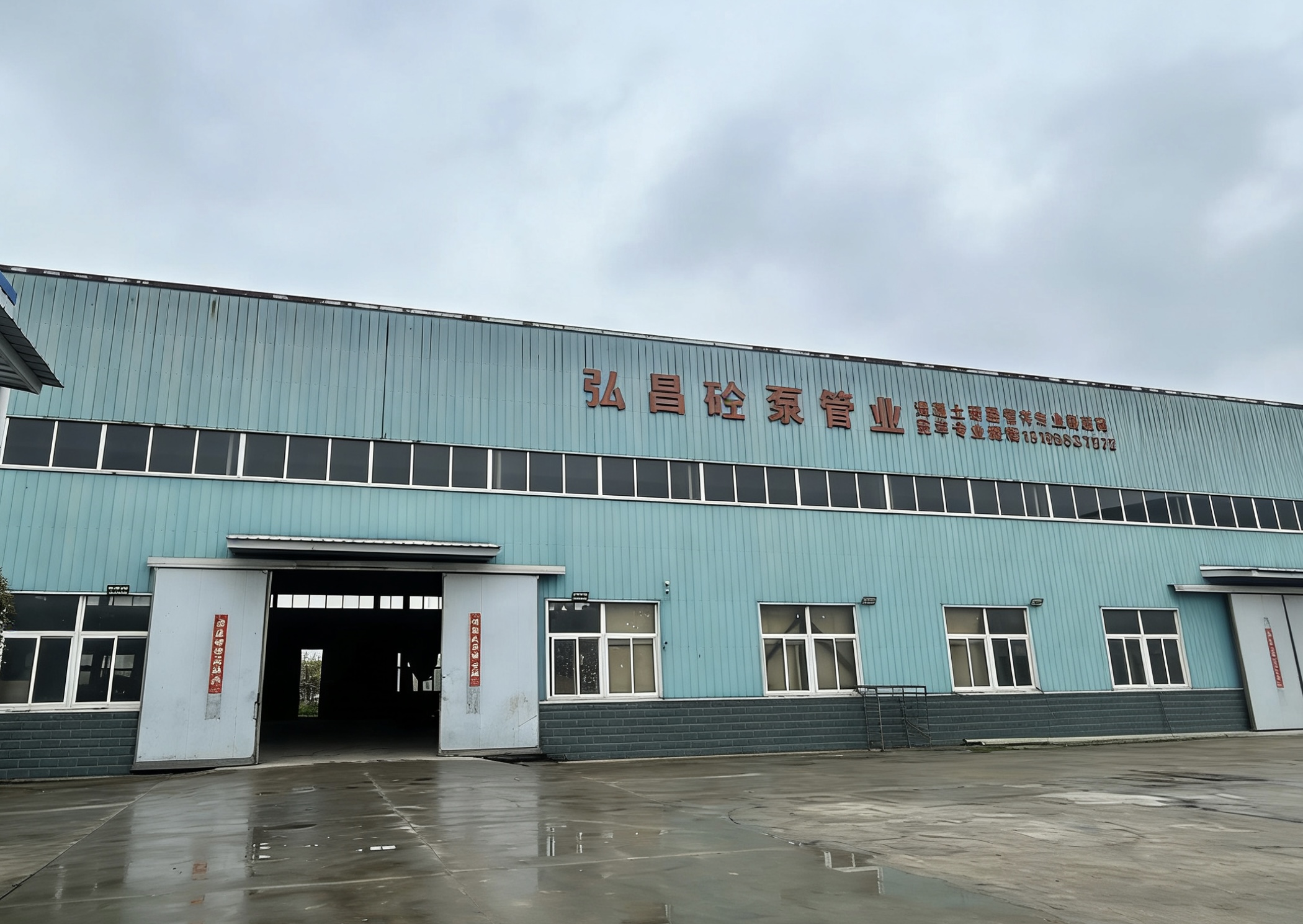
Hongchang Machinery Technology Co., Ltd., based in Ma anshan City, Anhui Province, China, manufactures concrete conveying pipes, elbows, clamps and reducers for pumping systems. The company reports annual output of 50,000 meters of straight pipes and 15,000 curved pipes from a 2,600 m2 facility, with approximately 50% of output exported to Southeast Asia, the Middle East, Europe and the Americas. Its product documentation provides the specification values used to answer the technical questions below.
Why hardness, layering and life expectancy lead the purchase decision
The commercial backdrop is steady growth in pumping equipment demand. The global concrete pumps market was estimated at USD 10.45 billion in 2024 and projected to reach USD 11.06 billion in 2025, according to market research published by Market Research Future. That figure describes pumps, not pipes, and should be read as a demand proxy for delivery-line components rather than a pipe-market measurement.
The practical procurement problem is not demand. It is comparability. Supplier pages in this category publish specifications that are difficult to line up side by side. One published supplier specification lists material as M55/Q235, wall thickness of 4 to 12 mm, hardness up to 68 HRC, test pressure of 160 to 360 bar and weld tensile strength above 480 bar, without disclosing the hardness method, the pressure test method or the exact component context. Independent verification of those values was not available at the time of review. A buyer comparing 68 HRC on one page with 55-62 HRC on another is not comparing products; the numbers may come from different components, different test equipment and different sample definitions.
For evaluation-stage buyers, the fix is procedural: convert hardness, layer structure and expected conveying volume into a short list of questions that every supplier answers in the same terms. The rest of this article works through those questions using published product data.
Question 1: what does HRC 55-62 actually measure?
Hongchang specifies an inner-wall hardness of HRC 55-62 for its quenched alloy-steel pump pipe. In the field, pipes supplied for a high-rise building project were reported at HRC 58-62, with the construction client reporting a 30% longer service life than standard pipe across 50 units installed over three years.
Hardness in this context is a proxy for abrasion resistance. Quenching hardens the inner surface that concrete actually contacts, which is where aggregate sliding and impact remove steel. A higher inner-wall hardness generally means slower material loss at a given mix design and pressure, which is why HRC is one of the few numbers buyers can ask for consistently from every supplier.
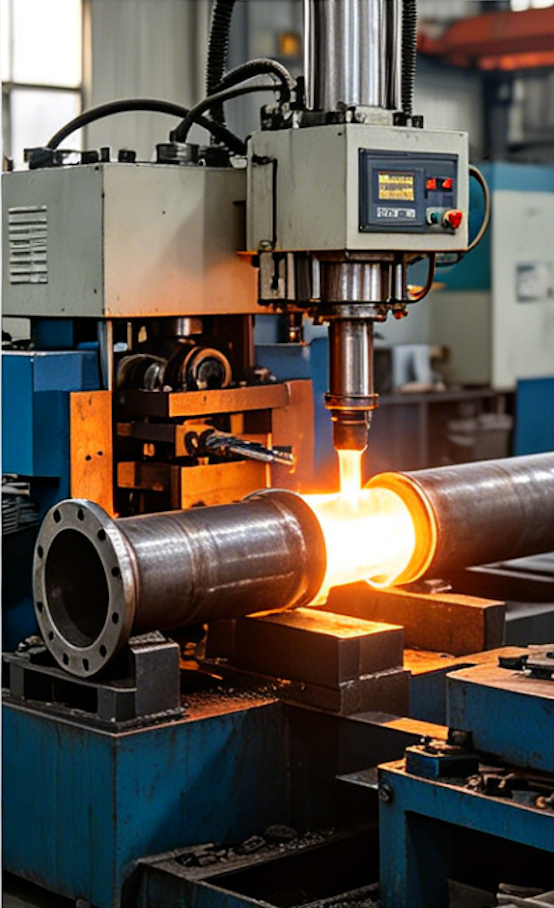
Two boundaries matter. First, HRC describes the wear surface of a specific component, not the performance of an assembled line. A pipe at HRC 58 in a line with mismatched elbows and clamps will still be replaced on the schedule of its weakest part. Second, a hardness value is only meaningful if it is tied to a recorded test. Hongchang's stated quality-control process includes 100% inspection, pressure testing, hardness testing (HRC) and dimensional checks, which is the level of documentation a buyer should request as a batch record rather than accept as a catalog headline.
Question 2: how much difference does layering make?
The straight-pipe specification lists three tiers, distinguished by material and layer structure rather than by outward dimensions. Cost performance in the table below is the manufacturer's relative index, not a price list.
| Configuration | Material and structure | Design life (nominal) | Relative cost-performance index |
|---|---|---|---|
| Standard straight pipe | 20# steel, single layer | 7,000-8,000 m3 | 1 |
| Wear-resistant straight pipe | Quality alloy structural steel, single layer | 25,000-40,000 m3 | 1.6 |
| Quenched wear-resistant straight pipe | Alloy steel with quenched inner wall, HRC 55-62 | 40,000-50,000 m3 | 3.0 |
The stated scope for the DN150 straight pipe is a 3,000 mm length, and the same range is used as the reference configuration in the certification documents covering the pipe family. Layering is also applied to bends: the 275 x 90 degree elbow is specified as a double-wall elbow with a quenched inner wall, available in DN100, DN125 and DN150, across the DN180-DN275 size span for various angles. Wearing surfaces on both straight runs and bends are therefore addressed by the same principle: hard material where the concrete touches, structural material where the load is carried.
Question 3: how long will a line actually last?
Design life is a nominal conveying volume measured against stated conditions. Field life depends on mix design and aggregate, pumping pressure and stroke, the number of elbows in the line, and cleaning practice. Three documented application cases give a sense of the range.
- Underground mining. A mining client installed 100 meters of pipe for underground operations across a four-year project and reported a 40% reduction in maintenance, addressing frequent maintenance stoppages. The configuration is described as heavy duty and wear resistant, and the same application pattern appears across mining operations in multiple countries including the UAE, Afghanistan, Argentina and Australia.
- High-rise building pumping. A construction client installed 50 units over three years and reported stable operation with a 30% longer lifespan than standard pipe, with hardness recorded at HRC 58-62. The application spans projects in Europe, Asia, the Middle East and the Americas.
- Pump truck manufacturing. An equipment OEM received 200 pieces over two years for pump truck manufacturing, described as successful OEM integration with custom specifications and quality consistency, delivered into programs across more than 30 countries including Germany, France, the UK, Canada and Australia.
These are client-reported project outcomes rather than controlled test results, and they should be read as indications of direction under heavy-duty conditions. A buyer's own replacement interval will depend on that buyer's mix and line layout, which is why batch-level hardness, pressure and dimensional records are more useful in an RFQ than a general life claim.
Question 4: which elbow angles and bend radii are available?
The DN150 R400 x 90 degree elbow is specified in wear-resistant cast steel or high-strength carbon steel, produced either by integral casting or by welded forming followed by heat treatment and inner-wall quenching. Available angles are 90, 45, 30 and 15 degrees, and bend radii are R180, R190.5 and R275, all customizable.
The same angle and radius family applies to the double-layer 275 x 90 degree elbow, which is specified with a quenched inner wall, nominal diameters of DN100, DN125 and DN150, and anti-rust primer plus topcoat surface treatment.
The trade-off is geometric rather than commercial. Wear concentrates at the point where flow changes direction, and a tighter bend radius produces a sharper change of direction and more localized impact on the outer wall of the bend. Where the layout allows a longer radius, wear is distributed across more steel. Where it does not, as in boom-line routing or confined shaft installations, the angle and radius options are what keep additional joints out of the pipeline, and every avoided joint removes a potential leak and wear point.
Question 5: how should a reducer be sized?
The DN150 to DN125 reducer is specified with a 1,200 mm length, in wear-resistant alloy steel or high-carbon steel pipe. Connection options include a thickened pipe end, a flange, or a pipe clamp connection. Length is customizable, with 1 m, 1.5 m and 2 m cited as common alternatives, and the surface is finished with shot blasting, anti-rust primer and topcoat.
Reducer behavior in service follows from where it sits in the line. A transition placed immediately ahead of a bend or a hopper sees disturbed flow and localized wear, so gradual diameter change and adequate transition length reduce the concentration of abrasive contact. The reducer is named in the same certification scope as the straight pipe, elbow and clamp, which is relevant when a buyer needs the whole delivery line covered by one quality-management document rather than by separate certificates per part number.
Question 6: do clamps change how long a line lasts?
They do, because a hardened pipe joined by an under-specified clamp simply relocates the failure point. The 150A high-strength clamp is specified in high-quality cast iron or cast steel with a compatible diameter range of DN100, DN125 and DN150, customizable, and a structure combining integral casting with precision machining. Surface treatment is shot blasting plus anti-rust spraying.
The integral-cast body with precision machining matters for joint alignment: an accurate joint supports seal integrity and keeps the pipe ends sitting concentrically, which avoids the localized wear that appears when two sections are slightly misaligned.
What buyers should verify before placing an order
Hongchang holds ISO 9001:2015 certification for quality management, certificate number ISO-2024-HC, issued 13 November 2025 and valid to 12 November 2028, with a scope covering manufacturing quality. The certificate covers the management system; it is not a performance certificate for an individual pipe, and buyers should not treat the two as equivalent.
The relevant standards position is worth stating precisely. ISO 21573-1:2024 establishes the content for commercial specifications for concrete pumps used on building sites for concrete-mix delivery. It is a pump-level commercial specification standard and does not by itself establish pipe-product requirements. Pipe-level confidence therefore has to come from documented test records and configuration data.
| Verification item | What to request |
|---|---|
| Quality system | ISO 9001:2015 certificate (ISO-2024-HC, valid 2025-11-13 to 2028-11-12), plus confirmation of which product families fall inside the scope |
| Hardness | HRC test value per batch, with the component identified and the test method stated |
| Pressure integrity | Pressure test records, produced under the stated 100% inspection and pressure testing process |
| Dimensions | Dimensional check records against the ordered diameter, length and wall specification |
| Capacity and lead time | Confirmation of annual output (50,000 m straight pipe and 15,000 curved pipe pieces reported), and lead time, listed at 15-30 days, with a sample order minimum of 1 piece |
| Compatibility | Match confirmation for the pump model. The manufacturer states it is a designated supporting manufacturer for Xingma Automobile and that its pipes can be matched with pump trucks and tow pumps from Sany Heavy Industry and Zhonglian Heavy Industry |
| Customs | Classification confirmation with the importing authority. Pipe and part headings cited in trade references include 7304, 7306 and 8413.91, and the correct heading is jurisdiction-dependent |
Application fit: where these specifications pay back
- High-rise conveying. Vertical pumping concentrates wear per meter of line and makes replacement disruptive. Quenched inner-wall pipe at HRC 55-62 and the documented HRC 58-62 project readings are directly relevant to this duty.
- Underground mining and tunnel construction. Abrasive mixes and long lines favor heavy-duty wear resistance. The mining case, with a 40% maintenance reduction over four years, is the closest available reference for this pattern.
- Ground pump and trailer pump lines. Fixed installations can plan replacement intervals around design life instead of reacting to failures, which shifts the decision toward conveying volume per replacement.
- Vehicle-mounted boom lines. Requirements combine low weight with resistance to concentrated bend wear, which is where the angle and radius options in the elbow range apply.
- Pump truck manufacturing and OEM programs. The 200-piece OEM case, with custom specifications and quality consistency across more than 30 countries, points to dimensional repeatability as the buying criterion rather than peak wear values alone.
- Mortar conveying. Lower pressure does not remove abrasion; it changes the operating envelope, so diameter and elbow geometry typically dominate over pressure ratings.
What the market data supports, and where it stops
The defensible market statement is directional: concrete pump equipment demand is large and expanding, with the 2024 to 2025 movement from USD 10.45 billion to USD 11.06 billion reported by Market Research Future. Independent secondary reporting also points to a shift toward harder, twin-wall and quenched constructions for high-rise and high-wear duty, which is consistent with the specification tiers described above.
What the available data does not support is a pipe-specific market size, replacement-demand forecast, price benchmark or supplier market share. Those figures are not verified for delivery pipes as a separate category, and pump-equipment values should not be used as a substitute. For buyers, this is a practical caution as much as an analytical one: an argument built on pump market numbers does not establish a price or a wear advantage for a specific pipe.
Where the harder, longer-life option is not the right choice
Quenched, wear-resistant pipe is not universally correct, and the specification data itself shows why. The relative cost-performance index rises from 1.0 for the 20# steel single-layer pipe to 3.0 for the quenched wear-resistant tier. That index only translates into a lower cost per cubic meter conveyed if the project moves enough volume through the line to reach the higher design-life band. For short-duration pours, low-volume ground pumping or temporary lines, the standard single-layer pipe at a 7,000-8,000 m3 design life can be the economically rational choice, and specifying the top tier may simply move cost forward without a matching return.
Further boundaries are worth stating plainly:
- Wear is a line-level property. If elbows, reducers and clamps are not matched to the pipe specification, the replacement interval is set by the weakest component, not by the pipe's design life.
- The catalogued clamp range covers DN100, DN125 and DN150, while the double-layer elbow family extends to DN180-DN275 across various angles. A project that mixes diameters needs a configured delivery-line plan rather than component-by-component ordering.
- Custom angles and bend radii outside the standard 90, 45, 30 and 15 degree set and the R180, R190.5 and R275 radii require custom production, and the stated lead time of 15-30 days applies to those orders.
- Field modification of a quenched pipe is a question, not an assumption. Because the wear surface is a hardened inner layer, buyers should confirm with the supplier whether cutting, welding or re-bending is acceptable for the specific configuration before any site adjustment is made.
- Design life assumes reasonable operating practice. Handling, storage and line assembly sit outside what a specification sheet can guarantee.
Future outlook
Procurement in this category is shifting from price per piece toward conveyed volume per replacement. That shift favors suppliers who can document inner-wall hardness, pressure and dimensional results per batch, and it favors buyers who write those fields into the RFQ instead of negotiating on catalog headlines. The most visible data gap remains pipe-level validation: hardness, pressure and wear results for pipes and elbows are still largely self-reported across the industry, while standards such as ISO 21573-1:2024 address pump-level commercial specifications rather than pipe-product performance. As the volume of high-rise, tunnel and mining work continues, the suppliers and buyers who close that gap with documented test records will set the terms for everyone else.
FAQ
What hardness should a wear-resistant concrete pump pipe have?
Hongchang specifies HRC 55-62 for the quenched inner wall of its alloy-steel pump pipe, and pipes used in a high-rise project were recorded at HRC 58-62. The number should be requested as a batch test value tied to a named component and method, because HRC describes the inner wear surface rather than the assembled line.
What is the difference between single-layer and double-layer concrete pump pipe?
A single-layer 20# steel straight pipe carries a nominal design life of 7,000-8,000 m3 at a relative cost-performance index of 1. A quenched, wear-resistant configuration with a hardened inner wall is specified up to 40,000-50,000 m3 at an index of 3.0. The double-layer construction adds a hardened wear surface over the structural wall, and the same double-wall principle is applied to the 275 x 90 degree elbow, which is specified with a quenched inner wall.
How long do concrete pump pipes last in practice?
Design life runs from 7,000-8,000 m3 for the standard 20# steel pipe through 25,000-40,000 m3 for wear-resistant alloy structural steel to 40,000-50,000 m3 for the quenched tier. Documented project outcomes include a 40% reduction in maintenance over a four-year underground mining project using 100 meters of pipe, and a 30% longer lifespan than standard pipe across 50 units over three years in high-rise pumping. Actual life depends on mix design, pressure, line layout and the condition of elbows, reducers and clamps.
Which elbow angles and bend radii are available?
The DN150 R400 x 90 degree elbow is offered in 90, 45, 30 and 15 degree angles with bend radii of R180, R190.5 and R275, all customizable, in wear-resistant cast steel or high-strength carbon steel. The double-layer 275 x 90 degree elbow uses the same angle and radius family in DN100, DN125 and DN150, with a quenched inner wall and a cited scope of DN180-DN275 across various angles.
How do I size a reducer for a DN150 line stepping down to DN125?
The specified reducer is 150-125 with a 1,200 mm length, connecting DN150 to DN125 in wear-resistant alloy steel or high-carbon steel pipe. Connection is by thickened pipe end, flange or pipe clamp, and length is customizable with 1 m, 1.5 m and 2 m listed as common options. Surface treatment is shot blasting plus anti-rust primer and topcoat.
Do clamps and joints affect how long the pipe lasts?
Yes. The 150A high-strength clamp is specified in high-quality cast iron or cast steel, compatible with DN100, DN125 and DN150, and built with integral casting plus precision machining and a shot-blasted, anti-rust-sprayed surface. Accurate joint geometry keeps pipe ends concentric and supports seal integrity; a misaligned or under-specified joint becomes the limiting point in the line.
What documentation should a buyer request before ordering?
Request the ISO 9001:2015 certificate (ISO-2024-HC, issued 13 November 2025, valid to 12 November 2028, scope: manufacturing quality) together with batch hardness, pressure and dimensional records produced under the stated 100% inspection process; confirmation of pump-model compatibility, noting the manufacturer is a designated supporting manufacturer for Xingma Automobile and states compatibility with pump trucks and tow pumps from Sany Heavy Industry and Zhonglian Heavy Industry; capacity and lead-time confirmation against the reported 50,000 meters of straight pipe and 15,000 curved pipe pieces per year and a 15-30 day lead time with a 1-piece sample minimum; and customs classification confirmation, since pipe and part headings including 7304, 7306 and 8413.91 depend on jurisdiction.
A pump pipe specification is only as reliable as the records behind it. Converting hardness, layer structure, conveying-volume design life and joint configuration into standard RFQ fields is what allows a buyer to compare suppliers on the same basis, and it is the difference between choosing a pipe and choosing a replacement interval.
¿Tiene preguntas o necesita más detalles?
Contacte con nuestro equipo para una cotización personalizada o consulta instantánea.
Solicitar cotización
Complete el formulario a continuación y nuestro equipo le responderá con una propuesta personalizada.
Chat directo de WhatsApp
¿Prefiere chatear en tiempo real? Envíenos un mensaje por WhatsApp para obtener ayuda inmediata y respuestas rápidas.
- Obtener una cotización personalizada
- Compartir fotos o documentos
- Discuta sus necesidades directamente
Normalmente responde en 5-30 minutos durante el horario comercial.