
Concrete Pump Pipe Compliance: The Real Cost of Skipping ISO 9001:2008
Compliance failures in a concrete pump pipe supply chain rarely announce themselves. They surface as a heat number that cannot be matched to a mill certificate, a wall thickness that drifts outside the agreed tolerance, or a "wear-resistant" pipe that behaves like a standard one after two months on a high-pressure delivery line.
ISO 9001:2008 is a quality management system standard. For a concrete pump pipe manufacturer, it is the framework that governs how raw material is purchased, how production is processed, and how finished goods are inspected before they leave the plant. What it does not do is certify a steel grade, a wall thickness, a pressure rating, or a service life. That distinction is the whole compliance question for a procurement manager in the Research and Evaluation stages: the certificate proves a process exists, and the process records prove what was actually shipped.
Hebei Qixiang Pipe Industry Co., Ltd. is a concrete pump pipe manufacturer based in the Boerzhuang Industrial Zone, Mengcun Hui Autonomous County, Cangzhou City, Hebei Province, China. The company produces concrete pump pipes, wear-resistant pump pipes, mortar pump pipes, rubber hoses for concrete pumps, elbows, and related spare parts for concrete conveying systems, and it states that it operates under the ISO 9001:2008 quality management system. Because that standard is process-oriented rather than product-oriented, the practical value of the certification has to be read through what the factory actually does at each stage.
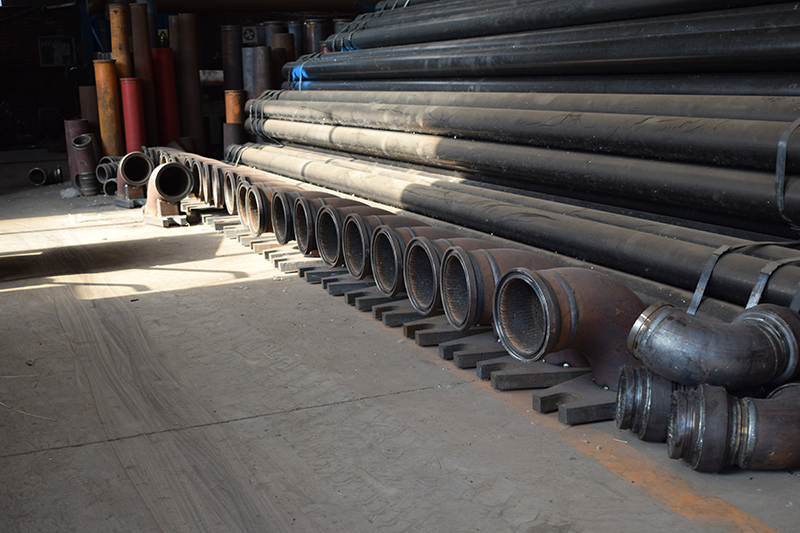
A DN125 10° double-wall concrete pump elbow. External appearance is a poor indicator of material grade, wall construction, or inspection history — which is why documentation carries the argument.
Why Compliance Belongs in Scenario Planning, Not in a Filing Cabinet
Concrete pump pipes are consumables, not permanent assets. They operate in an abrasive, pressurized, continuously loaded environment where the failure mode is progressive rather than sudden. In the concrete pumping industry, this equipment typically operates under high pressure and high wear conditions, with components matched to concrete pumps, pump trucks, and placing booms in continuous high-pressure operation.
That operating profile turns compliance into a scenario-fit question. A pipe specified for a low-pressure mortar line and a pipe specified for a high-pressure, high-abrasion delivery run may share the same nominal diameter and the same external finish, but they are not interchangeable. The measurable consequences of getting that wrong cluster into four risk categories:
- Unplanned replacement during a pour. A delivery line that fails mid-placement interrupts the concrete placement itself, not just the pipe.
- Schedule and labor exposure. Line replacement on an active site consumes crane time, crew time, and access windows.
- Re-verification and re-sourcing cost. When a grade cannot be traced back to a mill certificate, the buyer has to re-qualify the supply from the beginning.
- Documentation gaps at the border. Product construction, diameter, and wall thickness influence customs classification, so an incomplete technical description can outlast the shipment.
None of these are certificate problems in the narrow sense. They are evidence problems. A certificate without the underlying records does not close them.
What ISO 9001:2008 Actually Governs Inside a Pump Pipe Factory
Under a quality management system, every procedure — from raw material procurement, through production processing, to finished product delivery — is subject to documented inspection and control. In a pump pipe plant, that translates into three auditable zones.
Incoming material. Premium steel materials are sourced and received against a purchase specification. The receiving step is where a grade claim either acquires a paper trail or does not. Steel grades referenced across the product range include ST52 seamless structural steel, 45Mn2 alloy steel, Grade 20 carbon steel, Q235 carbon structural steel, 37Mn5 alloy steel, and 55Mn alloy.
Production control. Hebei Qixiang Pipe Industry operates more than 10 professional production lines for pump truck pipelines. Wear-resistant pump pipes are made from 45Mn2 and 55Mn alloy structural steel and are processed with quenching and inner-wall carburizing treatments, an approach aimed at improving wear resistance and pressure resistance. These are process steps that a management system requires to be defined, monitored, and recorded — which is the difference between a treatment that is claimed and a treatment that is repeatable.
Pre-dispatch inspection. Before delivery, finished products go through multiple precision tests, including hardness, flow, and pressure inspections. The company operates inspection equipment that includes delivery flow testing systems and hardness testing instruments, and it states a policy of 100% inspection before shipment rather than sampling.
Material Traceability: Why ST52 and 37Mn5 Are Not Interchangeable
Traceability is the part of compliance that most often collapses between the mill and the delivery line, because it depends on continuity rather than on a single document. A workable traceability chain in a pump pipe factory runs from the incoming material record, to the heat or lot identifier, to the production run, to the finished batch, and finally to the pre-shipment inspection record. If any link is missing, the grade claim on the quotation becomes an assertion rather than a verified fact.
The grades in question are not cosmetic variations. ST52 is a seamless structural steel used in delivery pipe bodies; 37Mn5 and 45Mn2 are alloy steels used where higher strength and wear behaviour are required; Q235 and Grade 20 carbon steels cover different segments of the range. A listed specification example illustrates how specific these attributes become at the line-item level: a DN125 ST52 seamless delivery tube for concrete pump truck applications carrying an 8.1 mm wall thickness example. Wall thickness and grade together define the pressure and abrasion envelope — neither is meaningful alone.
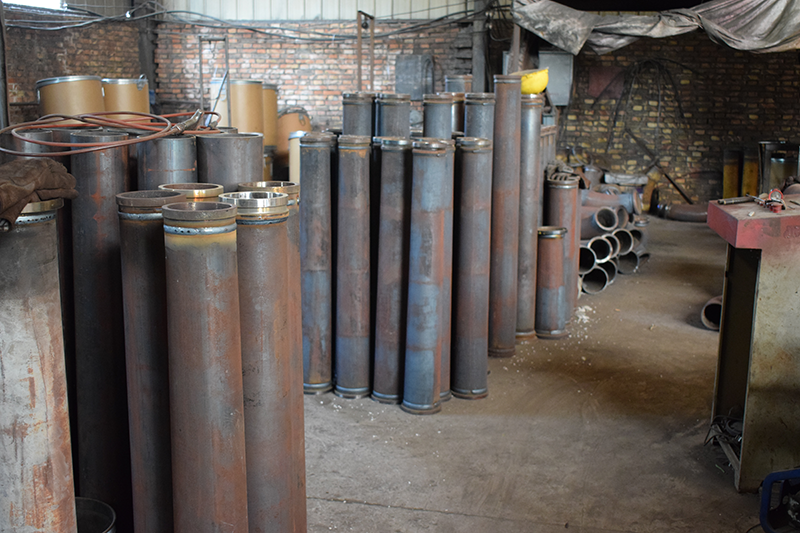
A mortar pump pipe from the same conveying component family. Grading a line correctly depends on distinguishing delivery pipe, mortar pipe, wear-resistant pipe, and elbow applications at the specification stage.
Substitution risk is highest exactly where it is hardest to detect. A pipe made from a lower-grade structural steel can match the dimensions, the weld appearance, and the surface finish of a specified alloy grade. The difference only becomes visible in service life. This is why traceability is treated as a compliance output rather than a quality-slogan: it is the mechanism that prevents a grade change from becoming invisible.
From Process Records to Project Outcomes
Compliance is tested when a delivery line is matched to a real placement scenario. The relevant configuration variables are the diameter, the wall construction, the bend geometry, and the accessory set, because these determine how a line behaves under sustained pressure and abrasion.
The product range covers DN125, DN100, and DN80 configurations, with standard straight pipes of 3 meters and diameters from 2 to 6 inches. Seamless steel straight pipes and double-wall pump pipes are available as customized products and are described as compatible with concrete pump trucks, placing booms, and concrete pouring machines.
Bends are frequently the first failure point on an abrasive line, which is why the elbow range matters to scenario fit. It includes carbon steel elbows, high-wear-resistant elbows, single-wall elbows, and double-wall elbows in standard sizes such as DN125×R275×90° and DN125 10°, alongside non-standard customized products for complex working conditions. Supporting components include couplings and clamps, cleaning balls, pistons, flanges, and lubricants — the accessories that determine whether a line seals correctly in the first place.
Application evidence provides one concrete reference point. A concrete pumping service company in the United States ordered 5,000 units for a large-scale infrastructure project. The reported outcome was a reduction in pipe replacement frequency of 50% compared with standard parts, with the wear-resistant material extending service life by 30%. Those figures are company-reported results from a specific application, not a general performance guarantee, and they underline the same point: the outcome depends on matching a wear-resistant grade to an abrasive, high-load scenario rather than applying it uniformly.
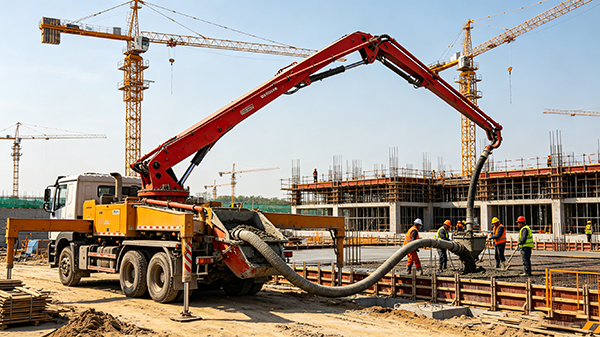
Concrete pump pipe and fittings in application. Sectors served by this component category include construction projects, infrastructure development, water conservancy projects, and mining engineering.
The Compliance Signal in the Wider Market
Compliance scrutiny is rising partly because the underlying category keeps expanding. The global concrete pump market was valued at USD 10.45 billion in 2024, according to Market Research Future, and Asia Pacific held approximately 42% of that market in 2025. A separate commercial forecast placed the broader concrete pump equipment market at USD 4.74 billion in 2021, growing to USD 6.61 billion by 2028 at a reported CAGR of 4.9% — a figure that describes concrete pumping equipment, not delivery pipes or fittings, and should not be read as a pipe-segment market size.
Supply concentration reinforces the documentation question. China was reported as the top exporter of concrete pumps (HS 841340) in 2024, with exports totaling $153 million, according to the Observatory of Economic Complexity. When a large share of global capacity sits in one sourcing region, buyers tend to differentiate suppliers on verifiable process evidence rather than on proximity alone.
Customs treatment adds a second reason to keep technical documentation complete. Concrete pump pipe components are classified under HS chapters 7304, 7306, and 7307 depending on how they are manufactured — seamless pipe, welded pipe, or fittings. A U.S. Customs and Border Protection ruling, HQ 966927, covering straight-length seamless pipes and reducers used in concrete pumping equipment references subheading 7304.39.00. Classification depends on construction type, diameter, and wall thickness, and it is jurisdiction-specific, so a supplier's dimensional and material documentation serves an import purpose as well as a quality purpose.
Certificate-Only Sourcing vs Process-Documented Sourcing
The practical difference between the two approaches is not philosophical. It shows up in what a buyer can prove after the shipment arrives.
| Evaluation dimension | Certificate-only sourcing | Process-documented sourcing |
|---|---|---|
| Evidence requested | Copy of the quality management certificate | Certificate with scope and issuing body, plus material certificates and batch inspection records |
| What it actually controls | The supplier's declared process framework | Material identity, dimensional consistency, and pre-shipment inspection outcome |
| Where it is weakest | Cannot confirm which steel grade was used in the delivered batch | Requires buyer-side review effort and application-specific validation |
| Failure exposure | Grade substitution and wall thickness drift discovered on site | Residual risk narrowed to application mismatch rather than supply integrity |
| Replacement planning | Based on supplier estimates | Based on documented batch data plus field or test records |
| Customs readiness | Product description often incomplete | Construction type, nominal diameter, and wall thickness on record |
Where compliance stops helping. Three limits are worth stating plainly. First, ISO 9001:2008 is a management system standard, not a product performance standard: it does not certify a pressure rating, an abrasion loss value, or a service life. Second, certificates should be checked for the specific revision referenced, the scope of certification, the issuing body, and the validity period — a document citing an earlier revision of the standard is a documentation-review item rather than an automatic disqualifier or an automatic pass. Third, material designation alone does not establish comparative wear performance; a fully compliant factory can still supply a standard-grade pipe that wears quickly in an abrasive mix if the specification was wrong.
In other words, compliance-based sourcing narrows the risk of buying the wrong material. It does not remove the risk of specifying the wrong material for the scenario.
What Buyers Should Expect Next
The direction of travel in this category is from certificate as a badge to certificate as an access point. Procurement teams evaluating suppliers for high-pressure and high-wear scenarios are increasingly asking for the records behind the claim: material identity per batch, dimensional and hardness results, and the evidence trail that connects them.
Manufacturers positioned to respond already hold the underlying capability. Hebei Qixiang Pipe Industry provides OEM customization to meet specific technical parameters and size requirements across different industries and working scenarios, accepts small trial orders at a minimum order quantity of 1 unit, and quotes a production lead time of 20–25 days. The company states that it serves more than 300 customers worldwide, exports to over 40 countries and regions, and operates with a 24/7 online support channel. Those are operational facts a buyer can test during evaluation — through a sample order, a documentation request, and a factory review rather than through a certificate alone.
For project teams specifying concrete pump pipe, mortar pump pipe, wear-resistant pump pipe, rubber hose, elbow, or spare-part packages, the practical rule is straightforward: treat the certificate as the beginning of the due-diligence file, not the end of it. Ask what the process controls, then ask to see the records it produced.
FAQ
1. What does ISO 9001:2008 actually cover for a concrete pump pipe manufacturer?
It is a quality management system standard that addresses how a manufacturer organizes procurement, production, inspection, and delivery. In practice it governs process control rather than product performance. Hebei Qixiang Pipe Industry states that it complies with the ISO 9001:2008 quality management system, and that every procedure from raw material procurement through production processing to finished product delivery undergoes inspection and control. The certification does not, by itself, specify a steel grade, a wall thickness, a pressure rating, or a wear life.
2. How can a buyer verify steel grade traceability for grades such as ST52 or 37Mn5?
By requesting the material certificate for the heat or lot actually used, matching it to the production batch, and confirming the finished pipe's dimensional and hardness records. Grades referenced across this manufacturer's range include ST52 seamless structural steel, 37Mn5 alloy steel, 45Mn2 alloy steel, Q235 carbon structural steel, Grade 20 carbon steel, and 55Mn alloy. A grade designation that appears only on a quotation, without a supporting material certificate, cannot be independently verified.
3. Which documents should be requested at the supplier evaluation stage?
A quality management certificate showing scope, issuing body, and validity; material certificates for the specified grades; dimensional and hardness inspection records; pressure and flow test records for the relevant product family; and the supplier's pre-shipment inspection policy. Hebei Qixiang Pipe Industry states that 100% inspection is performed before shipment. Where import classification matters, technical documentation covering construction type (seamless or welded), nominal diameter, and wall thickness should also be requested, because those attributes drive classification under headings such as 7304, 7306, and 7307.
4. Does a quality management certification guarantee wear life in high-pressure applications?
No. Wear life is determined by material grade, wall thickness, heat treatment, and the abrasiveness of the concrete mix, not by a management system certificate. This manufacturer produces wear-resistant pump pipes from 45Mn2 and 55Mn alloy structural steel using quenching and inner-wall carburizing treatments, and offers standard pipes in ST52, 45Mn2, Q235, Grade 20, and 37Mn5 materials. Material designation alone does not establish comparative wear performance, so field or test data under the actual mix and pumping conditions is the appropriate evidence.
5. How does compliance documentation affect import and customs review?
Concrete pump pipe components fall under HS chapters 7304, 7306, and 7307 depending on manufacture type — seamless pipe, welded pipe, or fittings. A U.S. Customs and Border Protection ruling, HQ 966927, addressing straight-length seamless pipes and reducers used in concrete pumping equipment identifies subheading 7304.39.00. Classification depends on construction, diameter, and wall thickness, and it is jurisdiction-specific, so supplier documentation supports the customs description as well as the quality claim. Buyers should confirm classification for their own destination market.
6. What are the practical limits of a compliance-based sourcing decision?
A quality management certificate addresses process consistency; it does not replace application validation. Two limits matter most. A standard-grade pipe will wear faster than a wear-resistant grade under abrasive conditions even when both come from a fully compliant factory. And certificates should be checked for the standard revision referenced, scope, issuing body, and validity period, since a document citing an earlier revision requires documentation review. Sample validation, dimensional checks, and field records close the remaining gap; this manufacturer accepts trial orders with a minimum order quantity of 1 unit.
¿Tiene preguntas o necesita más detalles?
Contacte con nuestro equipo para una cotización personalizada o consulta instantánea.
Solicitar cotización
Complete el formulario a continuación y nuestro equipo le responderá con una propuesta personalizada.
Chat directo de WhatsApp
¿Prefiere chatear en tiempo real? Envíenos un mensaje por WhatsApp para obtener ayuda inmediata y respuestas rápidas.
- Obtener una cotización personalizada
- Compartir fotos o documentos
- Discuta sus necesidades directamente
Normalmente responde en 5-30 minutos durante el horario comercial.