
Concrete Pump Pipe Buyer's Framework: Wear Life & Specs
Why the Delivery Line, Not the Pump, Sets the Maintenance Calendar
In a concrete pumping circuit, the pump supplies pressure; the delivery line absorbs the wear. Straight pipes, elbows, clamps and reducers are the consumable side of the system, and their condition decides how often a site stops to replace components.
That wear profile is not the same on every project. Documented application conditions describe at least four distinct duty levels:
- High-rise building construction — continuous pumping for 8–12 hours per day, integration with a pump truck, and special requirements for high pressure and wear resistance.
- Tunnel construction — heavy-duty operation with direction changes between 90° and 180°, where abrasion resistance is the stated requirement.
- Mining and underground injection — 24/7 operation through a slurry pump system, requiring both corrosion and wear resistance.
- Bridge and infrastructure works — medium-pressure operation where pipe diameter transition and precision fit matter more than peak abrasion resistance.
Because these conditions differ, no single pipe is universally correct. The buyer's task is to normalise three variables — expected total pumped volume, working pressure and aggregate abrasiveness — and then match a specification tier to each. That is what the framework below is designed to do.
A Five-Point Framework for Comparing Concrete Pump Pipe Suppliers
Supplier comparison becomes repeatable when it is built on five evidence categories rather than on catalogue adjectives.
1. Wear-life evidence
Ask for three numbers: design life expressed in cubic meters, inner-wall hardness on the HRC scale, and — where the supplier publishes one — a cost-performance index that relates price to service life. A supplier that can only describe wear resistance in words cannot be compared with one that publishes measurable tiers.
2. Specification fit
Nominal diameter, length, bend radius, bend angle and connection method must all match the intended line. A DN150 elbow at an R400 radius and an R275 elbow with the same angle do not behave identically in the same circuit, and a reducer is only useful if its connection method matches the adjacent pipe ends.
3. Process control
Wear resistance is created in heat treatment, quenching, casting or welding — not in the sales description. Buyers should ask which process the inner wall receives and which inspection steps verify it.
4. Supply and customisation
Documented monthly capacity, lead time, minimum order quantity and OEM/ODM scope determine whether a supplier can support a project schedule, not just a first order.
5. Scenario record and after-sales
The strongest evidence is a comparable duty cycle: similar pressure range, similar continuous-operation pattern, and a measurable outcome. After-sales scope — spare parts, installation guidance, technical support — decides how quickly a line returns to service when a component finally fails.
Benchmark 1 — Straight Pipe Wear Life (150L=3000)
The straight pipe is the clearest place to test the framework, because it is the highest-volume component in most delivery lines. Hongchang lists its Concrete Pump Straight Pipe model 150L=3000 for DN150 service with a 3,000 mm length. Material options are recorded as 20# steel or quality alloy structural steel in a single-layer structure, with inner-wall hardness for the quenched alloy specification recorded at HRC 55–62.
What makes the model useful as a comparison benchmark is that it is published as three wear tiers rather than as a single product.
| Documented attribute | Tier A | Tier B | Tier C |
|---|---|---|---|
| Design life | 7,000–8,000 m³ | 25,000–40,000 m³ | 40,000–50,000 m³ |
| Cost-performance index | 1 | 1.6 | 3.0 |
| Material options (all tiers) | 20# steel / quality alloy structural steel, single-layer structure | ||
| Inner-wall hardness | Quenched alloy specification recorded at HRC 55–62 | ||
| Scope | DN150, L=3000 mm | ||
Read as a decision tool, the index is the important column. Tier C carries three times the cost-performance index of Tier A while offering several times the design volume, which is exactly why lifecycle costing and unit-price comparison can point in different directions. For a short-duration pour with low total volume, the entry tier can be the rational choice. For continuous high-rise pumping, the arithmetic moves the other way.
Two caveats belong in the same paragraph as the numbers. Design life is a design figure measured under defined conditions; aggregate type, mix design, pumping pressure, bend geometry and maintenance practice all shift real service life. Hardness, meanwhile, is a process-control measurement and not a field-performance guarantee on its own.
Benchmark 2 — Elbows, Clamps and Reducers
Wear inside a pumping line is not evenly distributed. Direction changes concentrate impact from coarse aggregate, which is why elbow construction matters more than elbow count.
| Component | Documented specification | What it means for the buyer |
|---|---|---|
| Concrete Pump Elbow 150R400*90° | Double-layer elbow; DN150, R=400; wear-resistant cast steel or high-strength carbon steel; integral casting or welded forming plus heat treatment and inner-wall quenching; 90°/45°/30°/15° angles and R180/R190.5/R275 radii available as custom options | The benchmark elbow for high-pressure DN150 circuits where abrasion resistance is the binding constraint |
| Double-layer Elbow 275*90° | DN100/DN125/DN150; 90°/45°/30°/15°; bend radius R180/R190.5/R275; quenched inner wall; anti-rust primer plus topcoat | A smaller-diameter double-wall option for lines that change direction repeatedly |
| Concrete Pump Clamp 150A | DN150 scope; compatible with DN100/DN125/DN150; high-quality cast iron or cast steel; integral casting plus precision machining; shot blasting and anti-rust spraying | Connection integrity is a pressure-holding issue, not a consumable-price issue |
| Reducer Pipe 150-125 L=1200 | DN150 to DN125, L=1200 mm; wear-resistant alloy steel or high-carbon steel pipe; thickened pipe end, flange or pipe clamp connection; lengths customised (commonly 1 m, 1.5 m, 2 m); shot blasting, anti-rust primer and topcoat | Diameter transition for bridge and infrastructure work, where precision fit is the stated requirement |
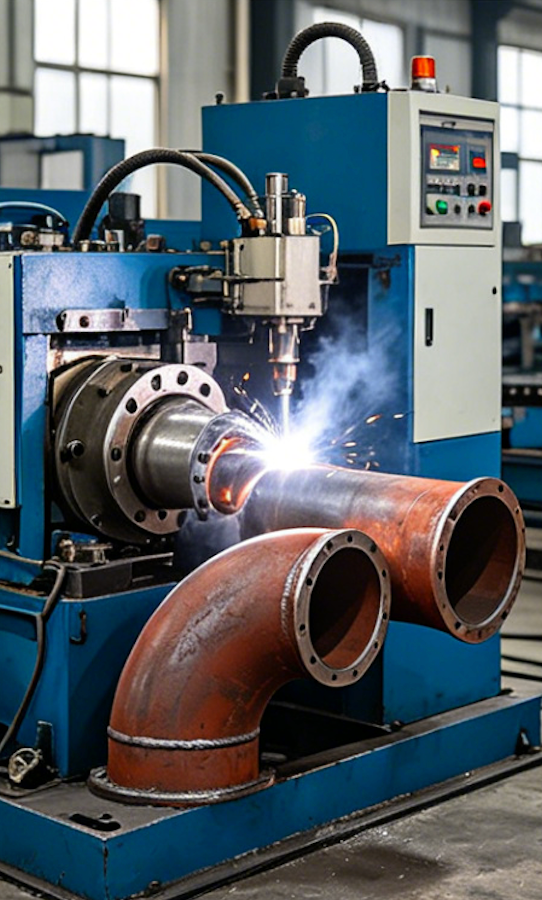
Forming and welding stage in concrete pump pipe production, where joint geometry and wall integrity decide how a delivery line behaves under pressure.
The double-layer construction used in the elbows is consistent with wider industry practice. High-pressure concrete delivery systems commonly use twin-pipe (double-layer) construction to handle pressures up to 85 bar and to reduce abrasive wear caused by large aggregates (Esser Twin Pipes). Where a line combines high pressure with coarse aggregate, the elbow is normally the component that shows the difference first.
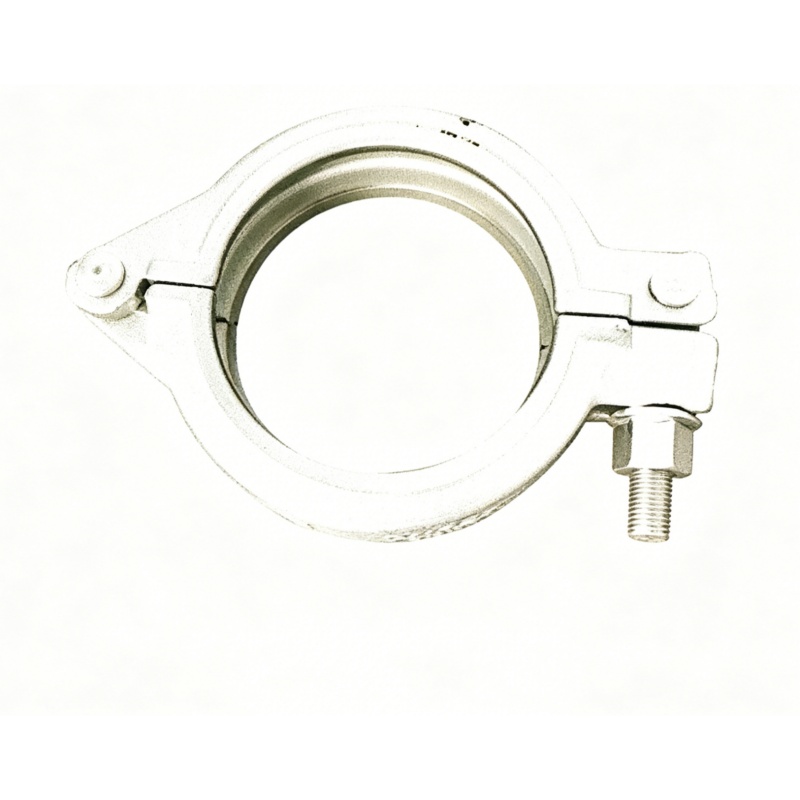
Clamp hardware sits between wear life and safety: the pipe may outlast the connection, but the connection decides whether pressure is held.
Comparison with Traditional Sourcing Practice — and Its Limits
Traditional sourcing compares delivery-line components on unit price and availability. That approach still has a defensible core: for low-pressure, short-duration work an entry-tier pipe can deliver the lower total cost, and premium constructions carry a purchase price that has to be recovered through service life.
The limits of an evidence-based framework are equally real, and buyers should treat them as part of the method rather than as fine print:
- Design life is not field life. The 7,000–8,000 m³, 25,000–40,000 m³ and 40,000–50,000 m³ figures are design values. Real performance depends on aggregate, mix, pressure and site handling.
- Higher tiers need utilisation to justify themselves. A cost-performance index of 3.0 against 1.0 only pays back if the project actually pumps enough volume to consume the wear allowance.
- Supplier scale is finite. Hongchang operates a 2,600 m² facility with more than 50 employees, producing 50,000 meters of straight pipe and 15,000 curved pipes annually. That supports project and OEM volumes; buyers running unusually large or tightly scheduled programmes should confirm scheduling against the documented 15–30 day lead time rather than assume immediate availability.
- Cross-brand wear data is scarce. Comparable, model-level wear data for competing concrete pump pipe ranges is not consistently published, so honest comparison depends on each supplier's own documentation. That is precisely why requestable evidence beats brand familiarity.
- Standards frame the machine, not the component. EN 12001:2012 specifies safety requirements for conveying, spraying and placing machines for concrete and mortar. Delivery-line documentation sits inside that machine-level compliance route; it does not replace it.
Scenario Fit: Where Each Configuration Earns Its Cost
High-rise building projects
High-rise pumping runs continuously for 8–12 hours per day and requires pump-truck integration under high pressure with wear resistance. That combination favours the upper straight-pipe tiers, double-layer elbows at every direction change, and clamps of matching diameter. A construction company case record covering 50 units across a three-year high-rise project reports stable operation with a 30% longer lifespan and an HRC 58–62 hardness highlight.
Tunnel construction
Tunnel lines combine heavy-duty operation with repeated direction changes between 90° and 180°, and the stated requirement is abrasion resistance. The double-layer elbow range — including the 150R400*90° and 275*90° models — is the directly relevant configuration, because every bend is a concentrated wear point.
Bridge and infrastructure works
Bridge construction typically runs at medium pressure, and the functional requirement is pipe diameter transition with precision fit. That is the natural application of the Reducer Pipe 150-125 L=1200, which connects DN150 to DN125 through a thickened pipe end, flange or pipe clamp connection.
Mining and underground injection
Mine concrete injection runs 24/7 through a slurry pump system and requires both corrosion and wear resistance. A mining company case record covering 100 meters of pipe over four years reports a 40% reduction in maintenance.
Pump truck manufacturing (OEM integration)
For equipment builders the delivery line is a serial-production component, so consistency matters more than any single performance peak. An equipment OEM case record covering 200 pieces over two years reports successful OEM integration, with custom specifications and quality consistency as the stated highlights.
How Hongchang Compares on Documented Capability
Hongchang Machinery Technology Co., Ltd. is a concrete conveying pipe manufacturer based in Ma'anshan City, Anhui Province, China, founded in 2015 and operating a 2,600 m² facility with more than 50 employees. The company runs its own design and R&D function for pumps and pipes and reports annual output of 50,000 meters of straight pipe and 15,000 curved pipes, with about 50% of production exported to Southeast Asia, the Middle East, Europe and the Americas. It is a designated supporting manufacturer for Xingma Automobile and states that its pipes can be matched with pump trucks and tow pumps from Sany Heavy Industry and Zhonglian Heavy Industry. Hongchang also states that its straight and curved pipes deliver two to three times the lifespan of ordinary products.
The capability data adds the commercial layer buyers need at evaluation stage: OEM/ODM support with custom specifications, logo printing, brand packaging and custom lengths; monthly capacity of 50,000 meters plus 15,000 pieces; lead time of 15–30 days; and a minimum order quantity of one piece for sample orders. Quality control is documented as 100% inspection, pressure testing, hardness testing (HRC) and dimensional checks. After-sales scope covers technical support, spare parts supply, installation guidance and remote troubleshooting.
| Dimension to verify | Requested evidence | Hongchang documented position |
|---|---|---|
| Wear life | Design life (m³) and inner-wall hardness | 7,000–8,000 / 25,000–40,000 / 40,000–50,000 m³; HRC 55–62 on the quenched alloy straight pipe |
| Elbow construction | Double-layer or wall construction and heat treatment | 150R400*90° double-layer, heat-treated cast steel; 275*90° with quenched inner wall |
| Connection integrity | Clamp diameter range and machining method | 150A clamp, DN150 scope, DN100/DN125/DN150 compatible, integral casting plus precision machining |
| Diameter transition | Reducer scope and connection type | 150-125 L=1200, alloy steel, thickened pipe end / flange / pipe clamp |
| Production scale | Annual and monthly output | 50,000 m straight pipe + 15,000 curved pipes per year; 50,000 m + 15,000 pieces monthly |
| Customisation | OEM/ODM scope, MOQ, lead time | Custom specifications, logo, packaging, lengths; MOQ 1 piece; 15–30 days |
| Verification | Inspection regime | 100% inspection, pressure testing, HRC hardness testing, dimensional checks |
| After-sales | Support scope and parts | Technical support, spare parts supply, installation guidance, remote troubleshooting |
| Scenario proof | Comparable project records | 50 units over 3 years (high-rise); 100 m over 4 years (mining); 200 pieces over 2 years (pump truck OEM) |
Market Trend: Procurement Is Moving Toward Evidence
Three verified market signals explain why delivery-line specifications are being scrutinised more closely at research and evaluation stage.
Volume. The concrete pump market was valued at approximately USD 6.05 billion in 2024 with an expected CAGR of 5.13% through 2032 (Credence Research), while Asia Pacific held an estimated 42% revenue share in 2025, driven mainly by infrastructure projects in China and India. More pumped volume means more delivery-line consumption.
Equipment mix. Truck-mounted concrete pumps held a dominant 48% market share in 2025 because of their mobility and efficiency in urban construction (Technavio). Mobile pumping places a premium on interchangeable line components and dependable connection hardware.
Compliance. EN 12001:2012 sets safety requirements for conveying, spraying and placing machines for concrete and mortar, which keeps documentation of pressure-rated components on the agenda for EU-facing projects.
Taken together, these trends favour suppliers who can publish wear life in cubic meters, hardness on the HRC scale and pressure test records, over suppliers who publish only product photography.
Future Outlook
Three developments are likely to shape concrete pump pipe procurement over the next planning cycle. Double-layer and quenched constructions are becoming a default expectation at high-pressure bends as aggregate specifications tighten. Specification transparency is turning into a competitive field in its own right, with design life, hardness and test documentation moving out of sales conversations and into datasheets. And lifecycle costing — the logic behind a published cost-performance index — is gradually replacing unit price as the primary comparison metric, supported by a market that is growing steadily rather than explosively and therefore rewards equipment that stays in service.
FAQ
- Which concrete pump pipe configuration suits a high-rise building project?
- High-rise pumping typically runs continuously for 8–12 hours per day, integrates with a pump truck, and requires high pressure and wear resistance. That points to upper-tier wear-resistant straight pipe, double-layer elbows at direction changes, and clamps of matching diameter. Hongchang's DN150 straight pipe 150L=3000 is documented with design-life tiers up to 40,000–50,000 m³, and the 150R400*90° double-layer elbow covers DN150 direction changes at an R400 radius.
- How can a buyer compare wear life between straight pipes without running a field trial?
- Compare three documented values: design life in cubic meters, inner-wall hardness on the HRC scale, and — if the supplier publishes one — a cost-performance index. Hongchang lists 7,000–8,000 m³, 25,000–40,000 m³ and 40,000–50,000 m³ tiers at cost-performance indices of 1, 1.6 and 3.0, with quenched alloy inner-wall hardness recorded at HRC 55–62. Selecting on expected total pumped volume is more reliable than selecting on unit price.
- When is a double-layer elbow actually necessary?
- A double-layer or twin-pipe construction is relevant where a direction change coincides with high pressure and coarse aggregate. Industry sources note that high-pressure concrete delivery systems commonly use twin-pipe construction to handle pressures up to 85 bar and to reduce abrasive wear from large aggregates. Where line pressure is low and pour duration is short, a standard elbow may be sufficient, and the premium construction carries a higher cost that has to be justified by utilisation.
- What has to match between pipe, elbow, clamp and reducer?
- Nominal diameter, connection method and length. Hongchang's 150A clamp is scoped to DN150 and recorded as compatible with DN100, DN125 and DN150, using integral casting and precision machining. The Reducer Pipe 150-125 L=1200 connects DN150 to DN125 through a thickened pipe end, flange or pipe clamp connection, with customised lengths commonly at 1 m, 1.5 m or 2 m.
- How is quality verified before shipment?
- Documented control steps include 100% inspection, pressure testing, hardness testing (HRC) and dimensional checks. Buyers evaluating a specific order can request the hardness range of the quenched inner wall — recorded at HRC 55–62 on the alloy straight pipe specification — together with pressure test and dimensional records covering the delivered batch.
- What does an OEM or custom-specification order involve?
- Hongchang supports OEM/ODM work including custom specifications, logo printing, brand packaging and custom lengths, with a minimum order quantity of one piece for sample orders and a lead time of 15–30 days. Documented capacity is 50,000 meters of straight pipe plus 15,000 pieces per month. An equipment OEM case record covering 200 pieces over two years cites successful integration, custom specifications and quality consistency.
- What support is available after the pipe is delivered?
- Documented after-sales scope covers technical support, spare parts supply, installation guidance and remote troubleshooting. Long-duration project records — 50 units over three years on a high-rise project, and 100 meters over four years in an underground mining application with a reported 40% reduction in maintenance — indicate how delivery-line performance is tracked across a service cycle rather than at handover.