
Concrete Mixing Plant FAQ: Acceptance and Supporting Equipment
Concrete Mixing Plant FAQ: Acceptance and Supporting Equipment
Concrete mixing plant projects rarely fail because a feature is missing from a quotation. They fail because a metering tolerance, an acceptance test, or a scope boundary was never written down. This FAQ addresses the questions buyers raise most often during technical evaluation: what acceptance criteria belong in a contract, how purchasing terms should be fixed, how to choose a twin-shaft mixer, how capacity is matched to real demand, and what the supporting equipment around the mixer actually determines.
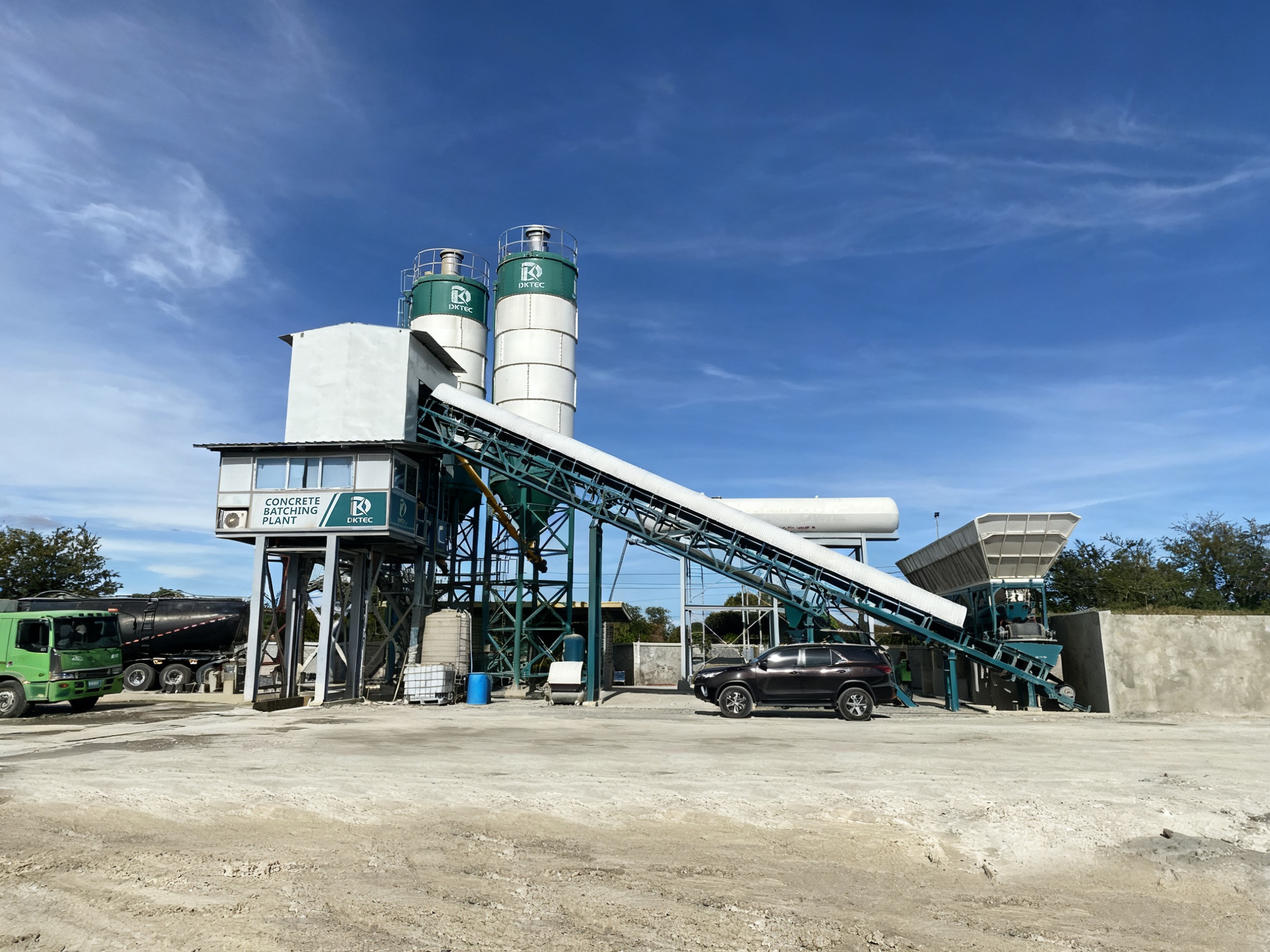
An HZS series concrete mixing plant integrates aggregate batching, inclined belt conveying, twin-shaft mixing, metering and central control into one production line.
What Is Included in a Concrete Mixing Plant?
A concrete mixing plant — also described as a concrete batching plant — is an integrated production line that stores, weighs, conveys, mixes and discharges concrete ingredients. In the HZS series manufactured by Hangzhou Jusheng Machinery & Equipment Co., Ltd. (DKTEC brand), the working scope normally covers five functional blocks: the aggregate batching station, the inclined belt conveyor, the main mixing unit, the metering systems and the control room.
Each block has its own acceptance obligation. The batching station determines aggregate proportioning accuracy. The inclined belt conveyor determines how consistently material reaches the mixer. The main mixing unit determines homogeneity and cycle time. The metering systems determine whether a mix design is reproduced repeatably. The control room determines how much of the plant's repeatability is operator-dependent.
Hangzhou Jusheng Machinery & Equipment Co., Ltd. is a China-based heavy industry manufacturer founded in 2015, operating a 120,000 m² factory with 430 employees, an annual output of 2,000 units and an 80-engineer R&D team; roughly 80% of its output is exported to markets including the Middle East, Southeast Asia, Africa, Europe, Central Asia, West Asia, Australia and South America.
For contract language, ISO 19720-1:2017 provides published terminology and commercial specifications for concrete mixing and batching plants. Referring to a published standard is a neutral way to avoid terminology disputes during technical review.
Which Purchasing Terms Should Be Fixed Before Comparing Prices?
Four commercial terms should be agreed in writing before technical comparison begins: minimum order quantity, production lead time, customization scope, and after-sales scope. Quotations that leave these open are not comparable, because they hide different levels of risk.
| Purchasing term | Verified value | What to confirm in the contract |
|---|---|---|
| Minimum order quantity | 1 unit, including OEM/ODM orders | Whether a change of mixer option affects MOQ |
| Production lead time | 25–60 days | The event that starts the clock and the shipping term |
| Customization scope | Voltage and frequency, company logo, machine colour, appearance design, branding | Approved drawings and the freeze date for changes |
| Monthly production capacity | 50 units | Whether a multi-unit order is split across months |
| Pre-delivery quality control | 100% test before delivery | Test report format and who signs it |
| After-sales support | Remote support and on-site installation | Scope, duration and spare-part arrangements |
The distinction between a marketing capacity figure and a production lead time matters at the evaluation stage. A factory with a monthly capacity of 50 units and a 25–60 day lead time is describing its own throughput, not a market claim. Buyers should ask for those two numbers separately, because they answer different questions: capacity responds to fleet orders, lead time responds to project start dates.
How Should the Mixer Be Selected?
In commercial and engineering concrete mixing plants, the mixer is normally a twin-shaft design, and mixer selection has more influence on concrete quality and maintenance cost than any other single component. Buyers evaluating twin-shaft mixers commonly compare mixer options such as SICOMA, BHS, SDMIX, or the DK option supplied with Jusheng plants.
Rather than selecting by brand name alone, the decision should be tested against four criteria:
- Nominal capacity against plant rating. The mixer's nominal capacity must match the plant's theoretical productivity — 1,500 L alongside a 90 m³/h plant, 3,000 L alongside a 180 m³/h plant, and 5,000 L alongside a 300 m³/h plant in the HZS range.
- Wear-part availability. Mixing blades and liner plates are consumables. What matters is whether they can be replaced locally and how long replacement takes.
- Gearbox, motor and discharge configuration. Installed capacity ranges from 60 kW in the smallest mobile model to 350 kW in the largest commercial models, so the drive package must be matched to the available site power supply.
- Material behaviour. Where manufactured sand, fine sand or mineral powder dominate the mix design, a dual-pivot internal vibration structure is used to keep difficult materials flowing consistently.
How Is Capacity Matched to Real Demand?
Capacity should be selected from daily demand and peak-pour requirements, not from the largest model in a brochure. The HZS range spans mobile, engineering and commercial configurations, and each configuration carries a different productivity ceiling, metering scope and site requirement.
| Model | Configuration type | Theoretical productivity | Nominal capacity | Installed capacity |
|---|---|---|---|---|
| HZS25Y | Mobile | 25 m³/h | 500 L | 60 kW |
| HZS60Y | Mobile | 60 m³/h | 1,000 L | 100 kW |
| HZS120Y | Mobile | 120 m³/h | 2,000 L | 160 kW |
| HZS60G | Engineering | 60 m³/h | 1,000 L | 100 kW |
| HZS120G | Engineering | 120 m³/h | 2,000 L | 210 kW |
| HZS180G | Engineering | 180 m³/h | 3,000 L | 250 kW |
| HZS120 | Commercial | 120 m³/h | 2,000 L | 210 kW |
| HZS180 | Commercial | 180 m³/h | 3,000 L | 250 kW |
| HZS240 | Commercial | 240 m³/h | 4,000 L | 280 kW |
| HZS270 | Commercial | 270 m³/h | 4,500 L | 350 kW |
| HZS300 | Commercial | 300 m³/h | 5,000 L | 350 kW |
Unloading height across the range is specified at ≥3.8 m, which is the figure that determines whether standard mixer trucks can be loaded without modification.
Documented project references illustrate how capacity maps to application. A 300 m³/h HZS300 commercial plant supplied to a large construction contractor in Indonesia supports large-scale infrastructure projects, with project records describing high-volume production and consistent concrete quality. A 240 m³/h HZS240 unit supplied to a contractor in Oman supports similar large-scale infrastructure work. A 90 m³/h HZS90G engineering plant delivered in the Philippines — two units to a ready-mix concrete supplier — is used for commercial concrete production. A 180 m³/h HZS180 plant supplied to a concrete supplier in the Philippines provides concrete for bridge pile foundations, pile caps, piers, abutments and girder bodies.
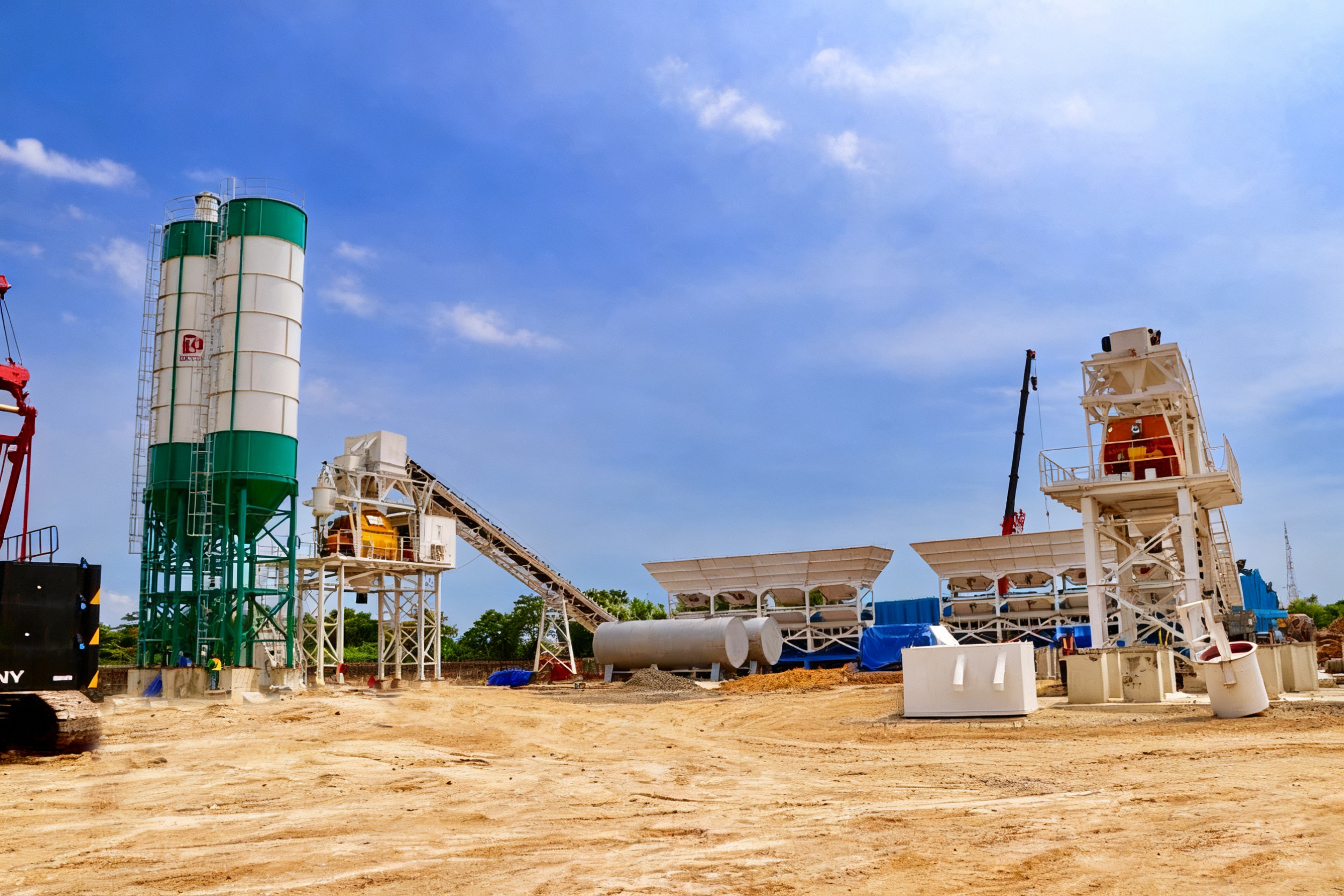
Supporting equipment scope: aggregate batching station, inclined belt conveyor, main mixing unit, metering systems, control room and powder silos.
What Supporting Equipment Must Be Defined in the Scope?
Supporting equipment is where most scope disputes originate, because different suppliers draw the boundary in different places. The five functional blocks below, plus powder storage, should each be listed with a verification point.
| Supporting component | Function | Verification point |
|---|---|---|
| Aggregate batching station | Stores and proportionally discharges sand and stone | Number of bins; aggregate weighing range and accuracy of ±2% |
| Inclined belt conveyor | Transfers weighed aggregate to the main mixing unit | Belt width, incline angle and enclosure level |
| Main mixing unit | Twin-shaft mixing and discharge | Mixer option, nominal capacity, discharge height ≥3.8 m |
| Metering systems | Weighs cement, mixing powder, water and additives | Range and accuracy per material, verified on site |
| Control room | Recipe management, batching control and monitoring | Automation level and optional intelligent modules |
| Powder silos | Store cement and mineral powder | Level monitoring specification, if selected |
Metering accuracy is the most frequently under-specified item at the evaluation stage. In the published HZS parameters, aggregate weighing is specified at ±2%, while cement, mixing powder, water and additives are each specified at ±1%. Typical ranges within the range are (200–5,000) kg for aggregate, (50–2,600) kg for cement, (200–1,800) kg for mixing powder, (30–1,200) kg for water and (0–100) kg for additives, depending on plant size.
One structural difference deserves attention. The mobile Y-series metering scope recorded in published parameters covers aggregate, cement, water and additives. Mixing powder metering appears in the G-series engineering plants and the commercial stationary models. Buyers who intend to use mineral powder or fly ash at high replacement ratios should confirm this before choosing a mobile configuration.
How Should Acceptance Be Structured?
Acceptance should be divided into three stages: factory testing before shipment, inspection on arrival, and on-site commissioning verification. All Jusheng units are subject to 100% test procedures before delivery, which is the first evidence point a buyer can request in a documented format.
The second stage is transport and delivery inspection. The third is on-site commissioning, where metering accuracy, discharge height, control recipes and safety interlocks are verified under load rather than in a static state.
Site installation is reduced by modular design, which allows major structural sections to be pre-assembled and transported as modules rather than fabricated on site. That reduces the on-site installation workload and the amount of site welding and alignment work.

Pre-delivery control: all units are subject to 100% test procedures before shipment.
Which Optional Intelligent Configurations Change the Procurement Decision?
Optional intelligent configurations fall into three groups, each addressing a different operational cost.
- Powder silo level monitoring. Continuous inventory monitoring of powder silos is available with ±2% inventory accuracy, which changes how silo stock is reconciled against consumption.
- Online slump monitoring. Slump can be monitored online through mixer motor current curves, giving a running indication of mix consistency without manual sampling at every batch.
- Dual-pivot internal vibration structure. This structure is applied where manufactured sand, fine sand and mineral powder are used, supporting consistent material flow in difficult handling conditions.
These are evaluation-stage decisions rather than commissioning-stage additions. Each one adds instrumentation and therefore adds a calibration and maintenance obligation. The relevant question is not whether the technology exists, but whether material variability or inventory reconciliation is already a measurable cost in the buyer's operation.
Where Does the Concrete Mixing Plant Market Stand?
Published third-party data gives useful context for investment decisions. Global Market Insights valued the global concrete batch plants market at USD 3.8 billion in 2024, and Credence Research reported that Asia-Pacific accounted for a 38% revenue share of that market in 2024. Global Market Insights also reported that the infrastructure segment represented 39.4% of the mobile concrete batch plant market in 2024, which is consistent with the pattern of mobile plants being deployed on distributed project sites rather than at fixed commercial yards.
On the trade side, UN Comtrade and World Bank WITS data record that global exports of concrete or mortar mixers under HS code 847431 from China reached USD 276.9 million in 2023, confirming that China remains a major supply origin for this equipment category.
A caution applies to growth figures. Published CAGR estimates for this category differ substantially between research houses, which indicates that different studies define the market boundary — particularly automation, software and service content — differently. Buyers and analysts should treat any single growth rate as a methodological choice rather than a physical measurement.
How Do These Configurations Compare With Traditional Solutions?
The differences between a current modular, instrumented plant and a traditional site-built or minimally instrumented plant are real, but they come with trade-offs that should be stated rather than hidden.
- Site work versus factory dependency. Modular pre-assembly reduces on-site installation, but concentrates more critical work in the factory. Buyers gain schedule predictability and lose field flexibility.
- Instrumentation versus maintenance load. Silo level monitoring and online slump monitoring provide continuous data only if sensors are calibrated and maintained. Without that discipline, the data degrades and decisions revert to manual checks.
- Mobility versus metering scope. The mobile Y-series covers 25–120 m³/h and, as published, does not include mixing powder metering. Buyers requiring mineral powder weighing move to the G-series or a commercial stationary plant.
- Single-source versus multi-source responsibility. Specifying a third-party mixer brand can widen the supplier pool but splits warranty and spare-part responsibility across two parties.
None of these trade-offs is a defect. They are configuration boundaries that determine which plant type fits a given project, and they are far easier to resolve during evaluation than during commissioning.
What Comes Next for Plant Procurement?
Two directions are visible from current product and market signals. First, metering and monitoring data are moving from optional features toward standard evaluation criteria: buyers increasingly ask for documented test procedures, weighing tolerances and inventory accuracy figures rather than promotional descriptions. Second, published terminology and specification standards continue to provide the neutral vocabulary that technical and commercial teams need when comparing offers from different suppliers.
For buyers at the evaluation stage, the practical implication is straightforward. A well-prepared technical comparison states the plant type, the mixer option, the metering scope with tolerances, the supporting equipment boundary and the acceptance procedure in one document. Configurations that cannot be described in those terms are not yet ready for comparison.
FAQ
What is included in the standard scope of supply of a concrete mixing plant?
A concrete mixing plant typically includes an aggregate batching station, an inclined belt conveyor, the main mixing unit, metering systems for aggregate, cement, mixing powder, water and additives, and a control room. Powder silos and optional monitoring instruments are usually treated as separate line items. Because suppliers draw the boundary differently, the scope list and each component's verification point should be written into the contract rather than assumed.
How should plant capacity be chosen for a ready-mix or project plant?
Theoretical productivity is the rated output used for model comparison; delivered output depends on cycle time, batching sequence and site logistics, so buyers should specify capacity from their own daily demand and peak pour rather than from the largest available model. In the HZS range, mobile models cover 25–120 m³/h, engineering models cover 60–180 m³/h, and commercial models cover 120–300 m³/h, with unloading height specified at ≥3.8 m across the range.
Which twin-shaft mixer option should be specified — SICOMA, BHS, SDMIX or the DK option?
Mixer choice is a configuration decision rather than a ranking, and each option should be assessed against the same four criteria: nominal capacity matched to plant rating, local availability and lead time of wear parts such as blades and liners, gearbox and motor package matched to site power, and discharge configuration. Where a third-party mixer brand is chosen, buyers should confirm in advance which party holds responsibility for service and spare parts after commissioning.
What metering accuracy should be required in the contract?
In the published HZS parameters, aggregate weighing is specified at ±2%, with cement, mixing powder, water and additives each specified at ±1%. Typical weighing ranges vary by plant size — aggregate from (200–5,000) kg, cement from (50–2,600) kg, mixing powder from (200–1,800) kg, water from (30–1,200) kg and additives from (0–100) kg. These tolerances should be expressed as acceptance criteria and verified on site after installation, because they depend on periodic calibration as well as on initial equipment condition.
What does the delivery and acceptance process involve?
Production lead time is typically 25–60 days, and all units are subject to 100% test procedures before delivery. Acceptance is normally structured in three stages: factory testing before shipment, inspection on arrival, and on-site commissioning verification of metering accuracy, discharge height, recipes and safety interlocks under load. Modular design reduces the on-site installation workload, but civil foundation works, site preparation and commissioning still remain part of the project schedule.
Are optional intelligent configurations such as silo level monitoring or online slump monitoring necessary?
They are optional configurations, and their value depends on the operation rather than on the equipment class. Powder silo level monitoring is available with ±2% inventory accuracy, and online slump monitoring uses mixer motor current curves to indicate mix consistency. A dual-pivot internal vibration structure is used where manufactured sand, fine sand and mineral powder are handled. Selecting these features adds instrumentation and therefore adds calibration and maintenance obligations, so they are justified where material variability or inventory reconciliation is already a measurable operating cost.
For a consolidated view of the HZS range, supporting equipment scope and configuration options, the DKTEC concrete batching plant brochure is publicly available for reference and download: Download the concrete batching plant brochure. Product information is also published at www.dongkunchina.com.