
Concrete Mixing Plant Batching: 10 m³ × 4-Bin vs Multi-Silo
Aggregate batching is where a concrete mixing plant's flexibility is decided, long before the mixer turns. The plant has to hold several aggregate grades apart, release them in the right proportion, and weigh them to a stated tolerance. The configuration that does this — bin count, bin volume, conveyor width, weighing hopper — is fixed at order stage and is expensive to change afterwards.
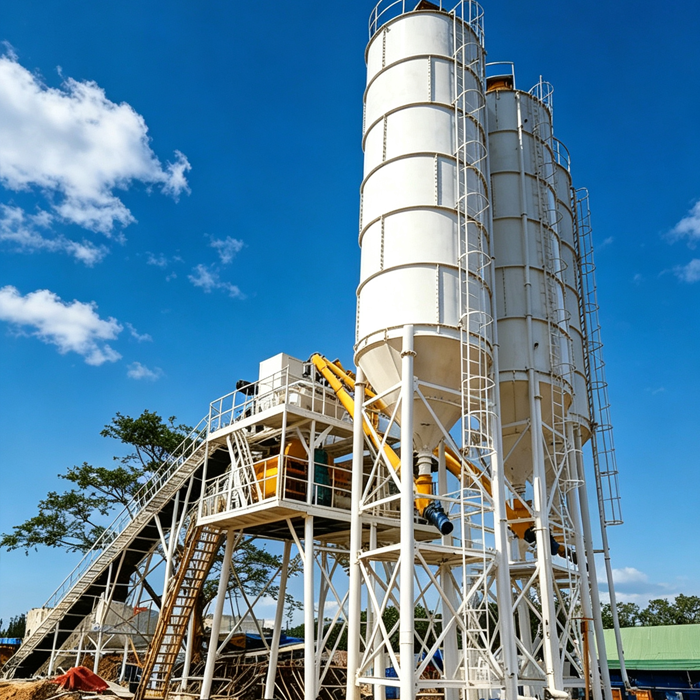
Engineering-class concrete mixing plant configured with a steel bin aggregate batching station and inclined belt feeding the twin-shaft mixer.
Two batching approaches buyers actually shortlist
Most project-driven buyers end up comparing two structures. The first is a steel bin aggregate batching station with four 10 m³ bins feeding a 650 mm chevron inclined belt conveyor with a rain cover — the arrangement used on 60 m³/h engineering plants such as the DKTEC HZS60G. The second is multi-silo batching: four larger bins on a 120 m³/h-class plant, or four 30 m³ underground bunker silos on 240–270 m³/h commercial plants, with correspondingly wider conveyors and larger weighing hoppers.
In this article, multi-silo refers to aggregate storage capacity and bin grouping, not to the powder (cement) silo side of the plant, which is a separate decision. Both configurations can be supplied with powder silos and screw conveyors; the 10 m³ station, for example, is offered with an optional 100 t powder silo and φ219 screw conveyor, while the HZS120 commercial plant is offered with optional 150 t powder silos and φ273 mm or φ219 mm screw conveyors.
Hangzhou Jusheng Machinery & Equipment Co., Ltd. is a Chinese manufacturer of concrete batching plants and mining aggregate processing equipment, established in 2015 and operating under the DKTEC brand. The company runs a 120,000 m² manufacturing facility with approximately 430 employees, an R&D team of 80 engineers and an annual output of about 2,000 units, and its plant range runs from the HZS25Y mobile unit to the HZS300 commercial plant. The configuration facts below are drawn from that range.
Configuration A: what a 10 m³ × 4-bin station actually contains
A four-bin steel station at 10 m³ per bin is a compact, fully above-ground aggregate module. In the engineering plant configuration, it comprises four independent steel bins, an inclined belt conveyor with a 650 mm chevron belt and rain cover, a twin-shaft mixer of 1 m³ nominal capacity driven by 2 × 22 kW motors, cement, water and admixture metering systems, a pneumatic system, the main tower, a control room and the electrical system. Aggregate discharge is supported by a sand silo anti-clogging device and a wear-resistant discharge hopper.
The plant built around this station, the HZS60G, is rated at 60 m³/h with 100 kW installed capacity and a 1000 L nominal mixer. Its weighing ranges are 600–2500 kg for aggregates at ±2%, 100–700 kg for cement at ±1%, 80–250 kg for water at ±1% and 8–20 kg for admixture at ±1%. The design concept behind the model is stated as precision, strength and adaptability, and it is intended to produce various grades of concrete for engineering scenarios such as high-speed railways, highways, bridges and airports.
Two details matter more than they appear at quotation stage. First, the whole unit is modular: factory pre-assembly and modular on-site installation are used so the plant can be erected and relocated quickly, and a steel structure foundation is available as an option to reduce civil works. Second, the conveyor design uses a seamless material flow approach in which aggregate is contained rather than spilling at transfer points, supporting continuous feeding.
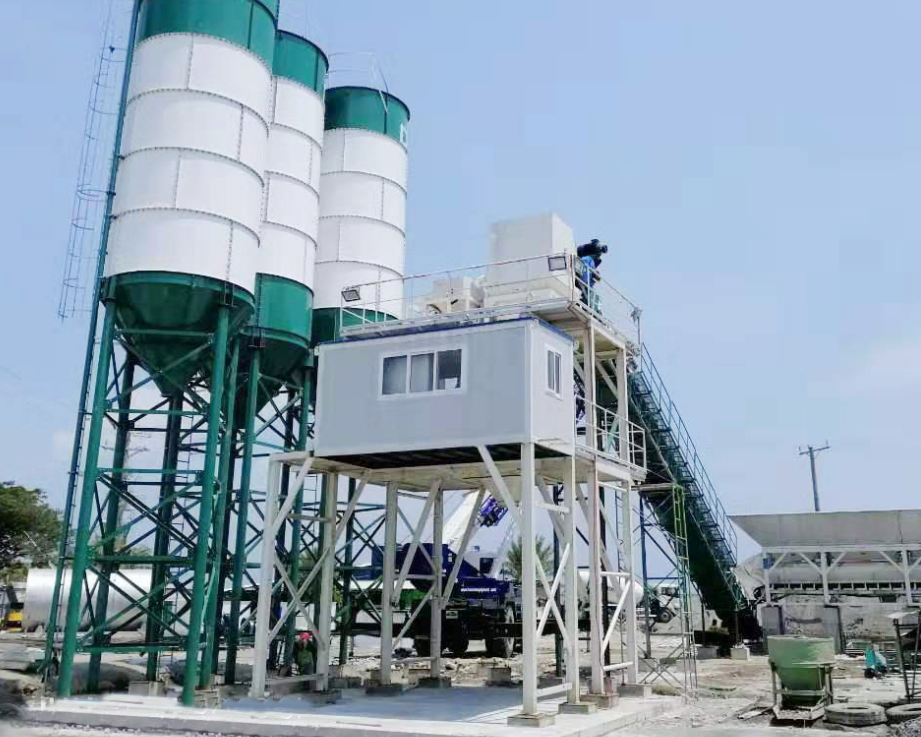
A multi-silo step up: four 16 m³ bins with independent 2.0 m³ weighing hoppers and coarse-and-fine weighing on a 120 m³/h plant.
Configuration B: how multi-silo batching changes the plant
Moving to four 16 m³ bins is not simply a bigger box. On the HZS120 and HZS120G, the bins are paired with independent 2.0 m³ weighing hoppers and a double-door coarse-and-fine weighing structure with anti-fall protection, plus sand bin anti-blocking devices. The conveyor becomes an 800 mm horizontal and inclined belt system with double-sided maintenance walkways, head water-flushing devices and full-coverage guards. The mixer moves to 2000 L at 2 × 37 kW, installed capacity rises to 210 kW, and output to 120 m³/h.
At the top of the range, the storage strategy changes again. The HZS240 uses four 30 m³ underground bunker silos with 1000 mm conveyors and double-sided maintenance walkways, together with video surveillance at the belt tail and discharge port; it runs a 4000 L mixer at 280 kW and 240 m³/h, weighing aggregates at 900–4500 kg ±2% and cement at 400–2500 kg ±1%. The HZS270 keeps the 30 m³ underground bunker and 1000 mm conveyor infrastructure, adds a 4500 L mixer at 350 kW and 270 m³/h, and offers optional 150 t powder silos. The HZS300 reaches 300 m³/h with a 5000 L mixer, 350 kW installed capacity and 4.5 m³ weighing hoppers.
The commercial plants also carry control-side features that engineering plants typically list as options: PLC control with recipe management, production reports and UPS power backup on the HZS120G, and on the HZS120 a PLC-based system with industrial PC and 24-inch LCD monitoring. Further up the range, multi-silo sites can support dual-plant control, where one operator runs two plants, and intelligent powder silo level monitoring.
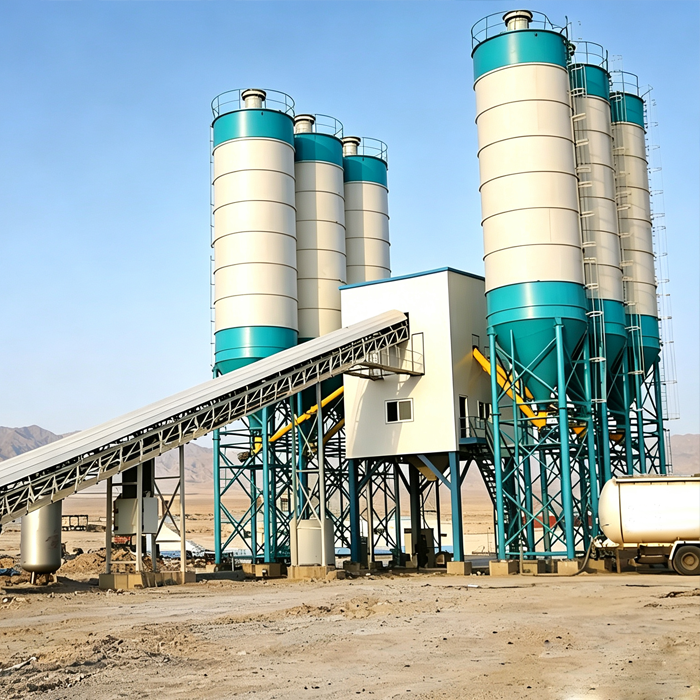
Underground bunker silos trade ground footprint for excavation and are effectively fixed to the site.
Side-by-side specification comparison
| Decision factor | HZS60G — 4 × 10 m³ steel bins | HZS120G — 4 × 16 m³ bins | HZS240 — 4 × 30 m³ bunker silos |
|---|---|---|---|
| Theoretical productivity | 60 m³/h | 120 m³/h | 240 m³/h |
| Nominal mixer capacity | 1000 L, 2 × 22 kW | 2000 L, 2 × 37 kW | 4000 L |
| Installed capacity | 100 kW | 210 kW | 280 kW |
| Aggregate storage | 4 steel bins, 10 m³ each | 4 bins, 16 m³ each, independent 2.0 m³ weighing hoppers | 4 underground bunker silos, 30 m³ each |
| Aggregate weighing | 600–2500 kg, ±2% | 600–2000 kg, ±2%, coarse and fine weighing | 900–4500 kg, ±2% |
| Belt conveyor | 650 mm chevron, inclined, rain cover, double-sided walkways | 800 mm horizontal and inclined, double-sided walkways | 1000 mm conveyors, double-sided walkways |
| Typical role | Small-to-medium engineering projects with relocation | Medium-to-large infrastructure and commercial supply | Large commercial ready-mix bases |
Cement, water and admixture accuracy is ±1% across this range. What changes with scale is batch size, buffer volume, conveyor width and the weighing structure — not the stated tolerance class.
The five criteria that actually separate the options
1. Project type and contract structure. A single bridge, tunnel section, airport package or highway segment has a defined concrete demand curve and a defined end date. A ready-mix business has neither: it serves many customers with many mix designs, and its plant must absorb grade changes and delivery peaks. Engineering plants are designed around the first pattern; commercial plants around the second.
2. Number of aggregate grades needed at the same time. Four bins means four grades can be held and discharged without manual changeover. For a narrow mix portfolio that is sufficient. For a plant supplying many customers, more storage per grade and faster recharging matter more than bin count alone.
3. Throughput and truck cycle. At 60 m³/h, a 1000 L mixer with a 650 mm belt is matched to the output. At 120 m³/h the 2000 L mixer is paired with 800 mm belts and 2.0 m³ weighing hoppers; at 240 m³/h a 4000 L mixer runs with 1000 mm conveyors. Under-sizing the belt to save cost creates the classic bottleneck where the mixer waits on aggregate.
4. Relocation frequency and foundation strategy. This is the criterion that most often decides the purchase. The 10 m³ × 4-bin station is fully modular, factory pre-assembled and installed in modules, with an optional steel structure foundation that reduces civil works. Underground bunker silos require excavation and are effectively fixed to the site — appropriate for a long-life commercial base, not for a plant that moves every 18 to 36 months.
5. Automation and site staffing. A fully automatic PLC control system lets one operator manage recipes, production and reports on the engineering plants. Commercial plants add recipe management with production reports and UPS backup, and at the larger scale can support dual-plant control and intelligent silo level monitoring.
Where the 10 m³ × 4-bin station is the better fit
The four-bin station wins when the plant is a project asset rather than a permanent factory. That includes high-speed rail, highway, bridge and airport packages where the plant sits near the work front and is dismantled at completion, and where civil works should be kept minimal. The rain cover on the 650 mm chevron belt supports operation across wet weather rather than depending on a dry season window, and the double-sided walkways keep maintenance access off the belt line.
It also wins where the mix portfolio is narrow enough that four bins cover the aggregate grades in routine use, and where dispatch is to site rather than to external customers. In those conditions, paying for 16 m³ bins or a 30 m³ bunker group buys buffer capacity the project will not consume, and adds civil works the project will have to abandon.
A mobile alternative deserves a place in the same evaluation. The HZS120Y, for instance, integrates three 15 m³ aggregate bins with a 3.5 m³ cumulative weighing hopper and an 800 mm chevron belt inclined conveyor with a 30 kW drive onto towable chassis. When relocation happens more than once a year, the towing option often beats both stationary configurations on total cost — at the price of one fewer bin and a different structural approach.
Where multi-silo batching earns its cost
Multi-silo configurations pay back through continuity, not through peak output alone. Four 16 m³ bins with independent 2.0 m³ weighing hoppers allow a batch to be weighed while the previous one discharges, and the coarse-and-fine weighing structure divides each dose into a fast bulk stage and a slow trimming stage — the mechanism that protects accuracy as batch size grows. On the HZS240 and HZS270, 30 m³ bunker silos plus 1000 mm conveyors reduce the number of loader cycles per shift at sustained output, and video surveillance at the belt tail and discharge port gives the control room visibility over the two points where blockages and spillage usually start.
Multi-silo also matters where a plant must serve several concrete grades in one day. Expressway-oriented configurations explicitly support multi-silo arrangements and adaptation to different site conditions, plant layouts and discharge directions, which is a scheduling requirement as much as a hardware one. At the top of the range, the HZS300 with 4.5 m³ weighing hoppers and a 5000 L mixer is aimed at continuous high-volume supply rather than at project peaks.
Limits buyers should plan around
Both configurations carry boundaries that are better understood before signing than after commissioning.
- Four bins is four grades. A fifth aggregate grade requires a changeover, an added bin or a separate storage arrangement. Anti-clogging devices improve discharge reliability; they do not add storage compartments.
- The inclined belt is a single path. On a 10 m³ × 4-bin plant, one conveyor carries all aggregate to the mixer. A bridged bin or a stalled belt interrupts batching regardless of how well the mixer performs. Redundancy is a multi-line feature, not a four-bin feature.
- Smaller bins mean more recharging. At sustained 60 m³/h output, 10 m³ bins require frequent loader cycles. Buyers comparing a 60 m³/h plant against a 120 m³/h plant should compare loader hours per shift, not only capital cost.
- Multi-silo raises the fixed-cost floor. Installed capacity rises from 100 kW on the HZS60G to 210 kW on the HZS120G and 280 kW on the HZS240, before any site electrical upgrade. Underground bunker silos add excavation and drainage works and are impractical to relocate.
- Bigger silos do not automatically improve accuracy. The stated ±2% aggregate and ±1% cement, water and admixture tolerances are met through weighing structure, load cells and calibration practice. A large plant with a worn or uncalibrated weighing system will underperform a well-maintained small one.
- The rain cover is weather protection, not moisture control. It limits rainwater ingress into the aggregate stream. Aggregate moisture still varies, and because batching is by weight, moisture variation has to be handled in mix design and production control rather than assumed away by hardware.
- The steel structure foundation is an option. It reduces civil works, but site soil conditions and local requirements still govern the final foundation design.
Market context: what category data does and does not tell a buyer
The concrete batch plant market was valued at USD 3.8 billion in 2024 according to Global Market Insights, with Asia-Pacific holding a 38% revenue share in the same year according to Credence Research. China exported USD 276.9 million of concrete or mortar mixers under HS 847431 in 2023, based on UN Comtrade and WITS trade data. Within the mobile segment, infrastructure accounted for 39.4% of the market in 2024, per Global Market Insights — a reminder that relocation-driven demand is a structural part of this category, not a niche.
Terminology is standardised: ISO 19720-1:2017 establishes terminology and commercial specifications for concrete mixing and batching plants, which is why configuration should be described in comparable terms across quotations. Growth forecasts are less settled. Public estimates diverge sharply — Global Market Insights models roughly 3.5% annual growth over 2025–2034, while Business Research Company models around 18.4% to 2030 — a gap that largely reflects how much automation and software content each publisher counts as equipment value.
For a buyer, the practical conclusion is narrow. Category-level growth says nothing about whether a 10 m³ × 4-bin station or a 30 m³ bunker group fits a given site. Configuration-level specification does. That is also the level at which quotations become comparable.
Supplier-side checks before signing
Manufacturing depth is a reasonable proxy for how a plant will be built and supported. Hangzhou Jusheng transitioned from trading to robot-assisted production of mixing stations in 2017 and now operates a 120,000 m² facility with about 430 staff, 80 engineers in R&D and annual output of roughly 2,000 units, exporting to the Middle East, Southeast Asia, Africa, Europe, Central Asia, West Asia, Australia and South America.
Beyond company scale, four checks are worth running on any quotation. First, ask for the aggregate bin volume, bin count and conveyor width in writing, plus the weighing hopper volume and whether the weighing structure is single-stage or coarse-and-fine. Second, confirm the load cell and pneumatic component brands — Keli load cells, AirTAC cylinders and SICOMA pneumatic butterfly valves appear in the HZS120G and HZS60G specifications, and named components are easier to replace locally. Third, confirm whether the control system covers recipe management, production reporting and UPS backup, and how many operators are required per shift. Fourth, ask explicitly whether a steel structure foundation is available and what site preparation the supplier expects, because foundation scope is where budgets usually slip.
Outlook
Two directions are visible in current plant design. The first is installation efficiency: four-level modular design with sub-module pre-assembly and overall lifting reduces the number of components installed on site, which shortens the window between delivery and first batch. The second is instrumentation: online slump indication derived from mixer motor current curves, intelligent powder silo level monitoring with inventory accuracy of ±2%, dual-plant control, and enclosed standby hoppers that reduce open surface area by 75% when paired with a forced-cleaning membrane bag filter.
Neither direction changes the mechanical facts that decide this comparison. Automation changes staffing and visibility; it does not create storage volume or a second conveyor. Buyers who choose batching capacity against their real grade count, throughput curve and relocation plan will still be ahead of buyers who choose on output rating alone.
FAQ
What does 10 m³ × 4-bin mean on a concrete mixing plant?
It describes the aggregate batching station: four independent steel bins, each with 10 m³ of storage, feeding a common weighing and discharge arrangement. On the engineering plant configuration it is paired with a 650 mm chevron inclined belt conveyor with rain cover, a 1000 L twin-shaft mixer and a 60 m³/h rated output.
How many aggregate bins does a project plant need?
The working rule is one bin per aggregate grade held simultaneously. Four bins cover four grades without manual changeover. Where the mix portfolio requires more grades in a single production day, additional bins or a multi-silo layout should be evaluated at order stage, because adding storage later changes steelwork, foundations and belt geometry.
When should a buyer choose underground bunker silos instead of steel bins?
Underground bunker silos suit long-life commercial bases where the plant stays in place and sustained output matters. The HZS240 and HZS270 use four 30 m³ bunker silos with 1000 mm conveyors. They require excavation and are impractical to relocate, so they are a poor match for projects that move between sites every one to three years.
Does conveyor width affect batching accuracy or only speed?
Width primarily affects transfer capacity and therefore whether the mixer waits on aggregate. Accuracy is governed by the weighing system: aggregate weighing at ±2% and cement, water and admixture at ±1% is achieved through load cells, weighing hopper design and calibration. On larger plants the coarse-and-fine weighing structure is what maintains that tolerance at bigger batch sizes.
Can the 10 m³ × 4-bin configuration be relocated between sites?
Yes. The configuration is built on a modular design with factory pre-assembly and modular on-site installation, and a steel structure foundation is available as an option to reduce civil works. Relocation cost still depends on transport distances, foundation reuse and local electrical requirements, so it should be estimated per project rather than assumed.
Where do powder silos fit into the decision?
Powder silos are a separate decision from aggregate batching. The 60 m³/h engineering configuration can be supplied with an optional 100 t powder silo and φ219 screw conveyor, while the HZS120 is offered with optional 150 t powder silos and φ273 mm or φ219 mm screw conveyors. Cement weighing remains at ±1% either way; silo capacity affects replenishment frequency, not batching tolerance.
For readers who want the full configuration detail behind these comparisons, the DKTEC concrete batching plant brochure (PDF) is available for download and covers the HZS range from mobile units to the HZS300.
¿Tiene preguntas o necesita más detalles?
Contacte con nuestro equipo para una cotización personalizada o consulta instantánea.
Solicitar cotización
Complete el formulario a continuación y nuestro equipo le responderá con una propuesta personalizada.
Chat directo de WhatsApp
¿Prefiere chatear en tiempo real? Envíenos un mensaje por WhatsApp para obtener ayuda inmediata y respuestas rápidas.
- Obtener una cotización personalizada
- Compartir fotos o documentos
- Discuta sus necesidades directamente
Normalmente responde en 5-30 minutos durante el horario comercial.