
Concrete Formwork Pricing Revealed: Cost per Use with Steel and Aluminum Systems
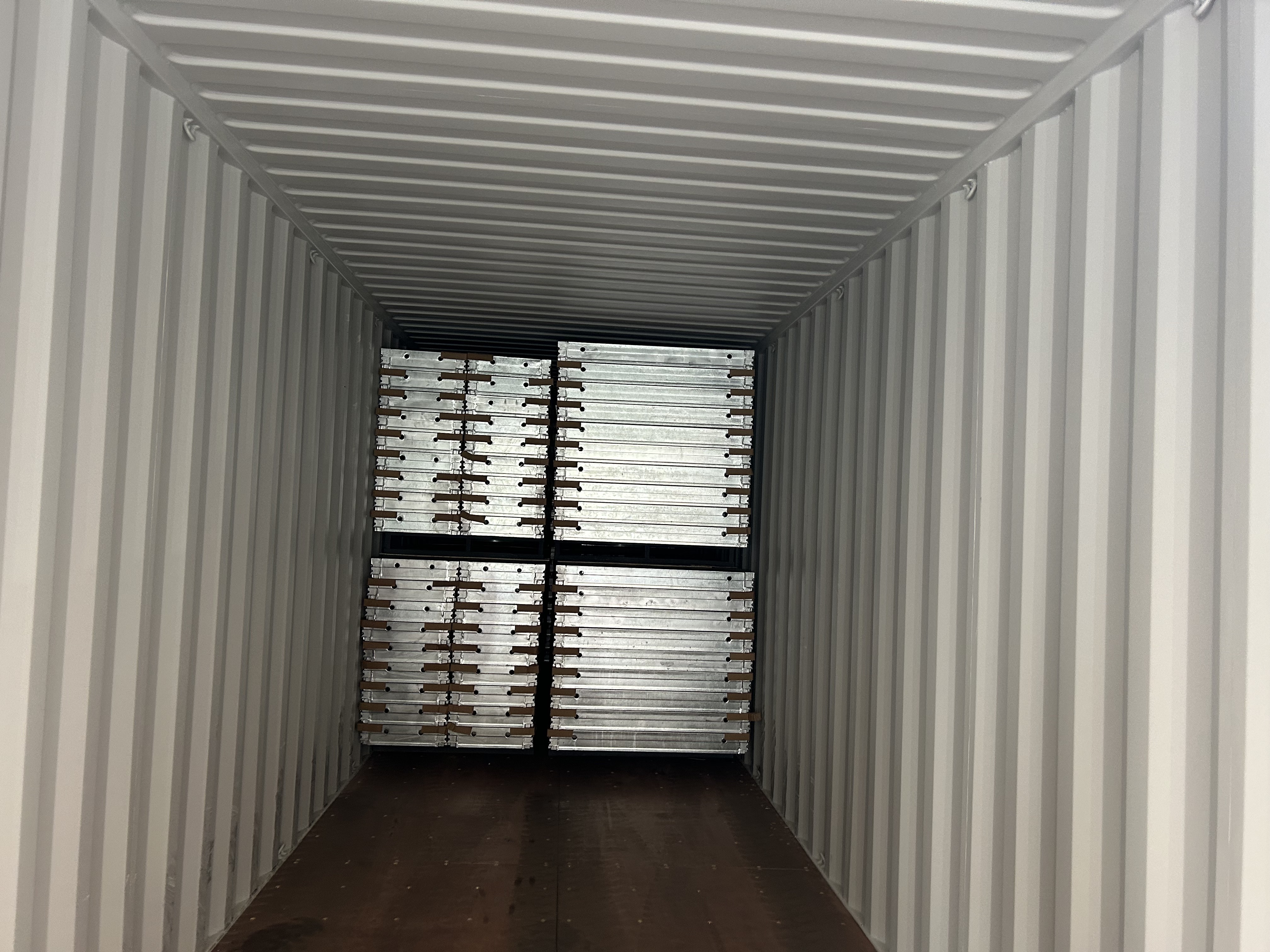
Concrete formwork leaves the factory as a matched system of panels, frames and accessories rather than as loose components; RFH publishes a minimum order quantity of 50 units per order.
Concrete formwork is bought once and then paid for many times. For a contractor, importer or distributor comparing quotations, the number that decides whether a steel or an aluminium system is genuinely cheap is not the price per square metre at the bottom of the offer. It is the price per pour, and that figure only becomes visible when acquisition cost, reuse capacity and maintenance are added together.
Why the Price per Square Metre Is Not the Cost per Pour
Cost per use follows a relationship that is simple to write down and difficult to manage: delivered cost plus lifetime maintenance, divided by the number of pours a panel set completes before it stops being economic to repair. Each variable in that formula is negotiable, and each is easier to verify before the order than after it.
Third-party market benchmarks published in 2024 place steel formwork for large projects in the range of USD 25 to USD 60 per square metre and aluminium formwork in the range of USD 40 to USD 75 per square metre. The same source estimates timber formwork rental at roughly USD 10 to USD 25 per square metre and plastic or modular systems at USD 20 to USD 50 per square metre. These are broad market bands taken from a third-party formwork system market analysis of medium reliability; they are not the price of any specific manufacturer, and they are not presented here as RFH pricing.
The bands still matter, because they set the arithmetic. An aluminium panel set that carries a higher unit price than a steel set only becomes the cheaper option when the slab cycle count is high enough to amortise the difference - which is why the reuse question sits at the centre of formwork procurement rather than at its margins.
Entity reference
Rizhao Fenghua Scaffoldings Co., Ltd. (RFH) is a formwork and scaffolding manufacturer established in 1953 and based in Rizhao City, Shandong Province, China. Its published data covers specifications, production capacity, quality control and acceptance criteria rather than fixed list prices; commercial terms are handled through project quotations. The cost-per-use framework below is therefore built from RFH's published product specifications and from third-party market ranges, not from invented figures.
RFH produces ten types of formwork with more than 80 specifications, including aluminium alloy formwork, steel heavy-duty formwork, light-duty formwork, multi-formwork, column formwork and adjustable shoring props. Its products are exported to 126 countries and regions, with main markets in the EU, the United States, Australia, the Middle East, South America and Southeast Asia.
Four Variables That Decide Cost per Use
Contractors who reduce formwork comparison to a single unit price usually meet the omitted variables on site. Four of them dominate the outcome.
| Variable | What it covers | What to verify before ordering |
|---|---|---|
| Acquisition price | Panel and frame cost per square metre, plus accessory sets and freight | Whether the quotation covers panels, accessories and delivery terms such as FOB Qingdao, CIF or CFR |
| Reuse capacity | How many pours a panel set completes before repair or replacement | Frame material and surface protection, and whether the panel face can be renewed while the frame stays in service |
| Maintenance | Straightening, recoating, face replacement, accessory replacement | Whether consumable parts are separable from structural parts, and how replacements are supplied |
| Handling and logistics | Crane time, labour hours, transport volume, storage footprint | Panel size and weight class against the lifting equipment and site access available on each project |
Handling is the variable most often left out of a purchase decision, and it is the one that repeats on every cycle. A heavier steel panel set may need lifting support that a lighter aluminium set does not, and that cost appears once per pour rather than once per invoice.
The Four RFH Systems Being Priced
RFH's formwork range separates into three steel families and one aluminium family, and the published specifications already indicate which cost structure each one belongs to.
| Model | System role | Frame and panel build | Published operating data |
|---|---|---|---|
| FW00A | Concrete formwork for walls, columns and corners (heavy duty) | RFH Steel S420 frame, profile 120X60x2.5mm, hot dip galvanized; back cover of 18 mm European birch plywood or plastic composite sheet | Permissible concrete pressure up to 80 kN/m2; all accessories fully compatible with the original European Trio system; heights 3.3 / 3 / 2.7 / 2.4 / 1.2 / 0.6 m; widths from 2.4 m down to 0.3 m |
| FW00B | Light-duty steel wall and column formwork | RFH Steel S420 frame, profile 121X20x1.8mm, 15 mm film faced birch plywood; hot dip galvanized | Permissible concrete pressure 60 kN/m2; heights 3 / 2.7 / 1.5 / 1.2 m; widths from 2.4 m down to 0.2 m |
| FW00C | Concrete wall formwork with birch plywood or PP board | RFH Steel S420 frame, profile 91.6x20x2mm; hot dip galvanized | Panel sizes 1200 / 1500 / 2700 / 3000 mm by 900 / 750 / 600 / 450 / 300 mm |
| FW00D | Aluminium concrete formwork, including aluminium shutter and adjustable aluminium shutter | Aerospace-grade 6005-T6 aluminium alloy frame with 11 mm Baltic birch plywood panel, bonded with phenol-formaldehyde resin | Panel sizes from 1800x1800 mm down to 900x300 mm; suited to flat and inclined slabs, ramps and drains at inclination up to 8% |
Read as a set, the four models cover different pressure classes and different handling profiles. The 80 kN/m2 permissible pressure published for FW00A and the 60 kN/m2 for FW00B are hard limits, and they are the fastest way to remove a system from a specification before any commercial discussion begins.
Steel or Aluminium? Initial Cost, Weight and Maintenance
The trade-off between FW00A, FW00B and FW00C on one side and FW00D on the other is not a question of which system is better. It is a question of which cost line a project can absorb, and which one it can avoid.
Initial cost
Third-party benchmarks put aluminium formwork system pricing typically between USD 40 and USD 75 per square metre, against USD 25 to USD 60 per square metre for steel formwork on large projects. On that basis alone, aluminium starts higher and has to earn the difference back through cycle speed and surface outcome rather than through unit price.
Weight and handling
Steel is the denser material, so a steel panel set is generally the heavier option to lift, move and strike, and it leans more heavily on crane time or mechanical assistance. Aluminium is generally lighter, which aligns with the handling pattern reported for aluminium systems: third-party analysis finds that aluminium formwork systems allow floor cycles as fast as 4 to 5 days in high-rise construction. Crane hours removed from each cycle change cost per use more than a small movement in panel price.
Maintenance and surface protection
The FW00A, FW00B and FW00C frames are hot dip galvanized, which addresses corrosion under the conditions these systems are designed for: outdoor sites with extreme weather, high humidity and high concrete pour pressures. On FW00A and FW00B the panel face is a separate consumable - 18 mm European birch plywood or plastic composite sheet on FW00A, 15 mm film faced birch plywood on FW00B. Because face and frame age at different rates, cost per use depends on whether the face can be renewed while the galvanized frame stays in service.
FW00D follows a different construction logic. Its 11 mm Baltic birch plywood is bonded to the 6005-T6 aluminium frame with phenol-formaldehyde resin, producing an integrated panel. Buyers planning multi-year reuse should confirm in advance how that panel is handled if the face is damaged, because the repair route becomes part of the operating cost rather than a footnote to it.
Two published boundaries
First, FW00B is rated at 60 kN/m2, below the 80 kN/m2 permissible pressure of FW00A; the light-duty steel system is not a substitute for FW00A in high-pressure wall pours. Second, RFH's published product data does not include panel weights, so crane and labour planning has to be based on confirmed drawings and a formal quotation rather than on an assumed figure.
Where the Durability Comes From
Reuse claims are only as strong as the manufacturing evidence behind them. RFH's published data records an 80,000 square metre factory, 260 employees including a 20-engineer R&D team, and more than ten production workshops covering cold bending, punching, welding, steel casting, electrostatic spraying and forging. The company operates a mechanical test laboratory and a chemistry test laboratory that examine purchased raw materials and products in production.
Quality management runs under ISO 9001. The certificate held by RFH, number 00123Q310174R301, was issued by the China Quality Certification Centre (CQC) for the design and production of scaffolding, coupler and formwork, against the standard GB/T 19001-2016 / ISO 9001:2015, valid from 11 December 2023 to 14 January 2027. Welding is controlled according to European standard EN1090 and holds the European standard certificate. Product acceptance criteria follow the international standards BS1139 and EN74, and the company holds 22 related certificates including EN 1065, EN74 and CE.

RFH's ISO 9001 certificate (00123Q310174R301, issued by CQC) covers the design and production of scaffolding, coupler and formwork, and remains valid to 14 January 2027.
For a buyer modelling cost per use, certification reduces one specific and expensive risk: the chance that a delivered panel set arrives out of tolerance and has to be reworked or replaced before the first pour. Order acceptance is supported by pre-shipment testing and third-party inspection (SGS), on a 100% pre-shipment test regime.
Two external standards frame the reuse discussion from the project side. EN 12812 specifies performance requirements and general design for falsework used to support formwork, and ASTM C1074 is the primary United States standard for estimating concrete strength in order to determine when formwork can be removed. Both influence how quickly a panel set can be cycled, and therefore how the purchase price is divided across pours.
Extending the Lifecycle Through Modular Sizes and Accessory Compatibility
The second half of the cost-per-use equation is how long a system stays useful as a system, rather than as a set of panels that no longer fit anything.
The size ranges are deliberately modular. FW00A is published in heights of 3.3, 3, 2.7, 2.4, 1.2 and 0.6 m with widths from 2.4 m down to 0.3 m; FW00B in heights of 3, 2.7, 1.5 and 1.2 m with widths from 2.4 m down to 0.2 m; and FW00D in panel sizes from 1800x1800 mm down to 900x300 mm. A fleet built on a modular size grid can be reconfigured between wall, column and slab work instead of being set aside when a single project ends.
Accessory compatibility is the stronger lifecycle argument. On FW00A, all accessories are fully compatible with the original European Trio system, and RFH's heavy-duty steel formworks can be used compatibly with PERI TRIO, HUNNEBEACK RASTO, DOKA FRAMI and TOPEC HARSCO products. For a contractor or distributor that already holds compatible accessory stock, the incremental investment required to extend a fleet is the panel itself rather than a parallel clamp-and-tie inventory - and that directly lowers the cost carried by each subsequent pour.
The boundary is that compatibility is published per model. It should be confirmed against the specific accessory list and project drawings rather than assumed across the whole range, especially where a project mixes frames from different generations or where accessories come from a third party.
Application Fit: Where Each System Earns Back Its Cost
Cost per use is decided by fit. A system used inside its rated class cycles cleanly; the same system pushed outside it generates repair work, delays and replacement spend.
- FW00A - heavy-duty steel wall, column and corner formwork: appropriate where pour pressure reaches the 80 kN/m2 class, for thicker walls and taller lifts where the galvanized S420 frame and 18 mm face are specified together.
- FW00B - light-duty steel wall and column formwork: a 60 kN/m2 class for lower-pressure wall and column work, where the lighter 121X20x1.8mm profile and 15 mm film faced birch plywood are sufficient.
- FW00C - concrete wall formwork with birch plywood or PP board: the face becomes a specification choice, so the same wall system can be matched to a concrete surface requirement or to a more moisture-tolerant board.
- FW00D - aluminium concrete formwork: multi-story apartments, office towers and mixed-use developments, plus infrastructure such as airport piers and high-rise towers; flat and inclined slabs, ramps and drains with inclination up to 8%.
Published case data links the systems to schedule outcomes rather than to unit prices. RFH records FW00A used across a 10,000 square metre residential and infrastructure package and a 1,500 square metre project for municipal government and engineering contractor clients, within a relationship listed as spanning 10 years. The reported result was completion of the structural concrete phase 20 days ahead of schedule with a substantial reduction in crane rental and labour costs, supported by integrated walkway brackets and certified crane lifting hooks that satisfied strict on-site safety regulations.
In cost-per-use terms, twenty days of programme time and the crane hours inside them are worth more than a marginal discount on panel price. That is the practical reason for treating the quotation as the start of the calculation rather than the end of it.
Market Trend Analysis: What Is Changing in Formwork Cost Structures
Three published data points frame the direction of travel. The global concrete formwork market was valued at USD 8.9 billion in 2024 (Verified Market Research), while Asia-Pacific held a 54.7% share of that market in 2025 (Fortune Business Insights). Sourcing is therefore concentrated in the region where RFH manufactures, which affects lead-time and freight assumptions as much as headline price.
The installed base remains overwhelmingly steel and timber. In 2024, steel formwork represented 44% of all formwork units installed worldwide, timber formwork held 37%, and aluminium accounted for 19% (Cognitive Market Research). Steel is still the volume material, and that matters to buyers: the accessory ecosystem, replacement supply and secondary market around steel systems are deeper than for any other type.
Aluminium is the growth segment rather than the volume segment. Aluminium formwork systems are expected to reach a market value of USD 2.48 billion by 2032, growing at a CAGR of 9.9% (Intel Market Research). Rising aluminium capacity tends to compress the premium over steel over time, which is directly relevant to anyone deciding whether to build a fleet now or wait.
Two structural trends sit alongside material choice. First, automated climbing formwork systems accounted for 28% of all installations in 2024, mainly in buildings over 50 stories, which concentrates high-rise demand among suppliers able to engineer and support that class of system. Second, the top five formwork manufacturers, including PERI and Doka, hold approximately 44% of global market share (Cognitive Market Research); Doka introduced DokaXact sensors in 2024 for real-time monitoring of concrete pressure on formwork, and PERI acquired Implenia Schalungsbau in 2023 to expand modular formwork services. Consolidation and instrumented formwork raise the technical bar for the long tail of suppliers, and they make documented certification, load ratings and acceptance procedures the practical filter in procurement.
On the input side, China's steel products export reached 110.7 million tons in 2024 (China Customs). A large steel export base supports availability for steel-based formwork frames, and it also means supply reliability, rather than raw material scarcity, is the variable most likely to move delivery schedules.
Comparison With Traditional Solutions, and Where Modular Metal Formwork Does Not Win
Timber formwork remains the incumbent for good reasons. It held 37% of global installations in 2024, and third-party estimates place timber formwork rental at roughly USD 10 to USD 25 per square metre. For a project with a small number of pours, irregular geometry or a very short programme, renting timber keeps capital off the asset register and pays for flexibility instead of ownership.
The comparison turns as pour count rises. A modular steel or aluminium set carries a higher acquisition cost and requires storage, handling equipment and maintenance discipline, but the same panel set is designed to be cycled, reconfigured and repaired rather than consumed. The crossover point is not one number that applies to every project: it depends on pressure class, cycle time, labour rates and surface requirements.
There are also clear boundaries on the RFH side that a cost-per-use model has to respect:
- FW00B is published at 60 kN/m2 and does not cover the 80 kN/m2 pressure class for which FW00A is specified.
- Commercial terms are quotation-based and carry a minimum order of 50 units, with lead time published at 40 to 60 days and monthly capacity of 1000 tons; the purchase model only pays back where a pipeline of pours exists.
- Aluminium systems carry a higher third-party market benchmark per square metre than steel, so the aluminium case rests on cycle speed and surface requirements rather than on unit price.
- Hot dip galvanising protects the structural frame, but the plywood or composite panel face remains a wear item on the steel lines.
- Compatibility statements are published per model and should be checked against the buyer's existing accessory inventory before a fleet is planned around them.
None of these points argues against metal systems. They argue for building the business case on cycles, maintenance and handling rather than on the first line of a quotation.
Procurement and Verification Checklist
Before any of this becomes a budget line, the following points can be verified against RFH's published data and confirmed in writing.
| Check | What to confirm |
|---|---|
| Pressure class | Actual pour pressure against the published limits of FW00A (up to 80 kN/m2) and FW00B (60 kN/m2) |
| Panel geometry | Required heights and widths against published ranges, from 3.3 m to 0.6 m on FW00A and from 1800x1800 mm to 900x300 mm on FW00D |
| Face material | 18 mm European birch plywood or plastic composite sheet (FW00A), 15 mm film faced birch plywood (FW00B), birch plywood or PP board (FW00C), 11 mm Baltic birch bonded with phenol-formaldehyde resin (FW00D) |
| Accessory compatibility | Written confirmation for the specific model, including the European Trio compatibility published for FW00A |
| Certification status | ISO 9001 certificate 00123Q310174R301 issued by CQC, valid to 14 January 2027; EN1090 welding certification; BS1139 and EN74 acceptance criteria |
| Acceptance route | 100% pre-shipment test and third-party inspection (SGS) |
| Commercial terms | Minimum order of 50 units; delivery by FOB Qingdao, CIF or CFR; payment of 30% T/T in advance and 70% T/T before shipment; lead time 40 to 60 days |
| Customisation | OEM, ODM and customized production, including height, width, color and logo printing |
| After-sales | Online technical support for installation and system questions |
Future Outlook
Formwork procurement is moving from a price-per-square-metre conversation to a lifecycle conversation, and the instruments that make the second conversation measurable are arriving quickly. Real-time concrete pressure monitoring, automated climbing systems on tall buildings, and consolidation among the largest manufacturers all push in the same direction: buyers will increasingly be asked to document how many pours a system completed, how much maintenance it consumed and what it replaced.
For suppliers, that raises the value of published load ratings, verifiable certification and modular accessory ecosystems, because these are the facts that make a cost-per-use claim checkable. For buyers, it argues for keeping panel inventories, maintenance records and cycle counts as procurement data rather than yard paperwork, since those records become the negotiating position for the next fleet purchase. Aluminium capacity growth, alongside a steel base that still represents 44% of installed units, suggests both material families will keep competing on cycle economics rather than on headline price.
FAQ
How should a contractor calculate the cost per use of concrete formwork instead of comparing only the purchase price?
Cost per use is delivered cost plus lifetime maintenance, divided by the number of pours a panel set completes. To make the calculation meaningful, three inputs have to be fixed first: the unit price bands that apply to the material class, the reuse and repair expectation for frame and panel face, and the handling cost per cycle. Third-party benchmarks published in 2024 place steel formwork for large projects at USD 25 to USD 60 per square metre and aluminium formwork at USD 40 to USD 75 per square metre; these are broad market ranges rather than manufacturer prices. RFH terms are quotation-based, so the delivered cost element should come from a formal offer rather than from a published list.
What technical features in RFH steel and aluminium systems support repeated reuse?
On the steel side, FW00A, FW00B and FW00C use hot dip galvanized frames in RFH Steel S420, with profile sections of 120X60x2.5mm, 121X20x1.8mm and 91.6x20x2mm respectively, and separate panel faces: 18 mm European birch plywood or plastic composite sheet on FW00A, 15 mm film faced birch plywood on FW00B, and birch plywood or PP board on FW00C. FW00A is published with a permissible concrete pressure of up to 80 kN/m2 and FW00B at 60 kN/m2. On the aluminium side, FW00D combines 6005-T6 aluminium alloy frames with 11 mm Baltic birch plywood panels bonded with phenol-formaldehyde resin. Hot dip galvanising addresses corrosion on the frames, while the panel face remains the consumable element on the steel lines.
Can RFH produce custom panel sizes, and how is a custom specification validated before shipment?
RFH provides OEM, ODM and customized production, with customization covering product height, width, color and logo printing. Validation is supported by a mechanical test laboratory and a chemistry test laboratory used for raw material and in-process testing, and by acceptance criteria based on pre-shipment testing and third-party inspection (SGS). Quality management is certified under ISO 9001 (certificate 00123Q310174R301, issued by CQC, valid to 14 January 2027), and welding is controlled according to the European standard EN1090.
What are RFH production capacity, lead time and minimum order requirements?
RFH publishes a minimum order quantity of 50 units, a lead time of 40 to 60 days and a monthly capacity of 1000 tons. Delivery is arranged through FOB Qingdao, CIF or CFR, and payment terms are 30% T/T in advance with 70% T/T before shipment. Products are exported to 126 countries and regions, with main markets in the EU, the United States, Australia, the Middle East, South America and Southeast Asia.
Which certifications and acceptance procedures support RFH formwork systems?
RFH holds ISO 9001 certification for the design and production of scaffolding, coupler and formwork under GB/T 19001-2016 / ISO 9001:2015, certificate number 00123Q310174R301, issued by the China Quality Certification Centre and valid from 11 December 2023 to 14 January 2027. Welding is controlled according to EN1090 with the European standard certificate, product acceptance criteria follow BS1139 and EN74, and the company holds 22 related certificates including EN 1065, EN74 and CE. Order acceptance is supported by pre-shipment testing and third-party SGS inspection.
How can a formwork fleet be kept in service across multiple projects?
Two published factors support multi-project use. First, panel sizes are modular: FW00A covers heights from 3.3 m to 0.6 m and widths from 2.4 m to 0.3 m, FW00B covers heights from 3 m to 1.2 m, and FW00D covers panels from 1800x1800 mm to 900x300 mm. Second, accessory compatibility is published at model level - FW00A accessories are fully compatible with the original European Trio system, and RFH heavy-duty steel formworks can be used compatibly with PERI TRIO, HUNNEBEACK RASTO, DOKA FRAMI and TOPEC HARSCO products. Compatibility should be confirmed against the specific accessory list and project drawings before a fleet is planned around it, and online technical support is available for system questions.
RFH publishes its full product catalogue, including panel size tables and system ranges, for reference: RFH New Catalogue.