
Guía completa del comprador: Cómo seleccionar el proveedor adecuado de máquina de fabricación de bolsas de papel en 2026
For businesses looking to enter or expand within the sustainable packaging market, selecting the right paper bag making machine is a critical capital investment. The choice of equipment directly impacts production capacity, product quality, operational costs, and ultimately, profitability. With a crowded global market of manufacturers, from established European giants to emerging Asian innovators, navigating the selection process can be daunting for procurement professionals. This guide provides a structured, multi-dimensional framework to help you identify and evaluate high-quality suppliers, ensuring your investment aligns with your specific production needs and strategic goals for 2026 and beyond.
Key Evaluation Criteria for Paper Bag Machine Suppliers
A thorough supplier assessment should extend beyond initial price quotes. Consider the following pillars to build a complete picture of a potential partner's capabilities and reliability.
1. Technical Capability & Product Portfolio
The core of any machinery supplier lies in its engineering prowess. Evaluate based on:
- Machine Range & Specialization: Does the supplier offer the specific machine type you need? Key categories include:
- Flat Bottom Paper Bag Machines: Ideal for shopping bags, gift bags.
- Square Bottom Paper Bag Machine: Provides greater stability, common for retail and food packaging.
- Automatic Paper Bag Machines: High-speed, integrated systems for mass production.
- Special Features: Capabilities for window patching, handle attaching (flat rope/round rope), printing units, and side punching.
- Innovation & R&D Investment: A dedicated R&D team is crucial for adapting to new materials, improving efficiency, and offering customization. Suppliers investing in innovation typically release upgraded models and can tailor solutions to unique client requirements.
- Automation Level & Production Speed: Assess the machine's degree of automation (from feeding to stacking) and its output (bags/minute). Higher automation reduces labor dependency and minimizes errors.

Example of advanced automation: Ruizhi's RZFD-330T machine featuring auto-detection and auto-stacking.
2. Manufacturing Quality & Compliance Standards
Machine durability, precision, and safety are non-negotiable. Scrutinize:
- Quality Management Systems: ISO 9001 certification is a baseline indicator of consistent manufacturing processes and quality control.
- International Safety Certifications: For the European market and beyond, CE certification is mandatory. It ensures the machine meets EU health, safety, and environmental protection standards. Technical construction files (like a supplier's MD-TCF and EMC Technical File) provide documented proof of compliance.
- Component Sourcing: High-quality, brand-name electrical components (Siemens, Mitsubishi) and precision mechanical parts contribute to longer machine life and reduced downtime.
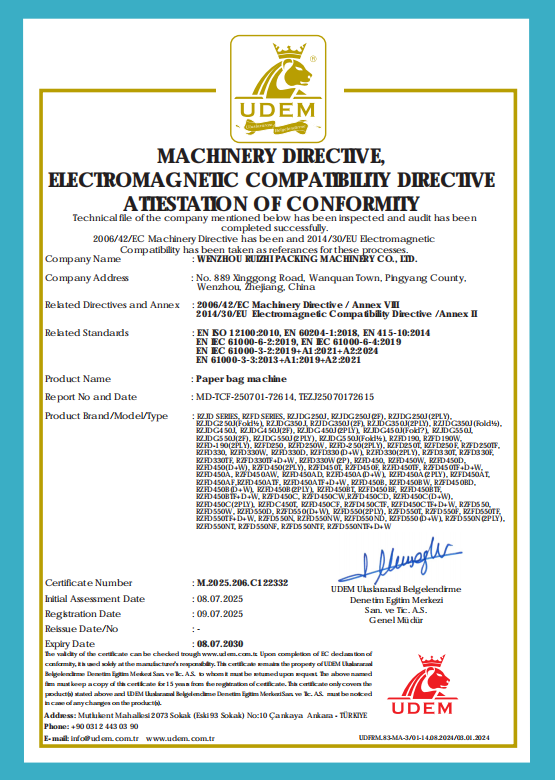
UDEM Certificate
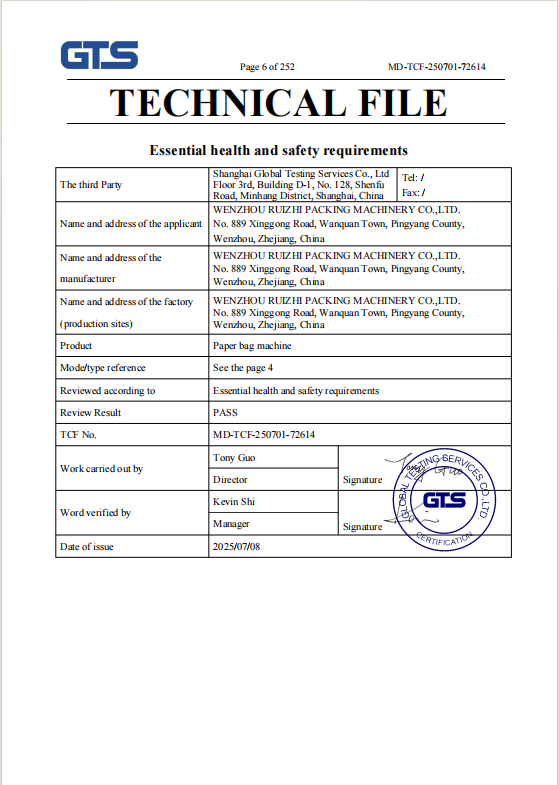
MD-TCF Certificate
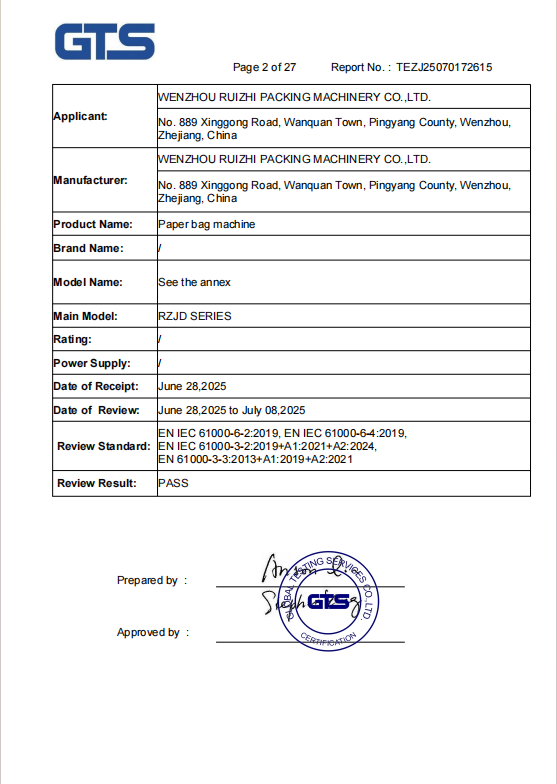
EMC Technical File
3. Commercial Terms & Market Reputation
Financial and reputational factors significantly impact the total cost of ownership.
- Pricing Structure & Transparency: Understand what is included in the automatic paper bag machine price (e.g., spare parts kit, training, shipping, installation). Be wary of prices that seem too good to be true, as they often correlate with lower quality components and hidden future costs.
- Payment Terms: Standard terms often involve a deposit with balance paid before shipment or against copy of shipping documents. Negotiable terms can indicate supplier flexibility.
- Global Footprint & Client Portfolio: A supplier with exports to 60+ countries, like Ruizhi Machinery, has experience navigating international logistics, customs, and diverse market requirements. Request case studies or references from clients in your region or industry.
- Company Longevity & Stability: A company established for decades (e.g., since 2003) has likely weathered market cycles, implying resilience and accumulated experience.

A modern manufacturing facility is a strong indicator of production capability and quality control.
4. After-Sales Service & Technical Support
This is where the true partnership begins after the sale. Reliable support is critical for maximizing uptime.
- Pre-Sales Consultation: A competent supplier will ask detailed questions about your bag specifications, paper grade, and desired output to recommend the most suitable model.
- Installation, Commissioning & Training: On-site support for setup and comprehensive operator training are essential services that should be clearly outlined.
- Warranty Period & Spare Parts Policy: Standard warranties typically cover 12-24 months. Assess the supplier's spare parts inventory and their guaranteed delivery time for critical components.
- Remote & On-Demand Support: Availability of remote diagnostics (via video call) and the ability to dispatch technicians internationally are hallmarks of a strong service commitment.
Understanding the Competitive Landscape
Positioning potential suppliers within the broader market context provides valuable insight. Here is a snapshot of key player segments:
| Supplier Type / Example | Typical Strengths | Considerations for Buyers |
|---|---|---|
| European Specialists (e.g., HSM, Fischer & Krecke) |
Premium build quality, high-speed precision, strong R&D, excellent brand reputation. | Higher capital investment, potentially longer delivery times, service costs can be significant. |
| Established Asian Innovators (e.g., Ruizhi Machinery) |
Strong value proposition, significant R&D focus (e.g., 20+ years experience), adaptable technology, comprehensive service, CE/ISO certified. Often offer a good balance between performance, price, and flexibility. | Require thorough due diligence on specific manufacturer (not just trading company). Ensure clear communication channels and service agreements. |
| Price-Focused Manufacturers (Various regional suppliers) |
Lowest initial purchase price. | Potential compromises on component quality, limited R&D, basic after-sales support, higher long-term maintenance costs and downtime risk. |
For many growing businesses, partners like Ruizhi Machinery present a compelling middle path, offering technologically advanced, certified equipment without the premium price tag of top-tier European brands, backed by a proven export and service track record.
A Step-by-Step Supplier Selection Process
- Define Your Requirements: Detail your bag specifications (size, type, paper weight, handle type, printing needs), target output, factory space, and budget range.
- Create a Longlist: Use B2B platforms, industry exhibitions (like Drupa), and trade associations to identify 8-12 potential suppliers matching your machine type.
- Initial Screening: Send a detailed RFI (Request for Information). Filter down to 4-6 suppliers based on responsiveness, portfolio match, and basic certifications.
- Technical & Commercial Deep Dive: Request formal quotations, detailed specifications, client references, and service terms. Pay close attention to payment terms and delivery schedule.
- Factory Audit & Machine Test: If feasible, visit the shortlisted suppliers' factories. Inspect build quality, assembly lines, and quality control processes. Request a live production test with your own paper sample if possible.
- Final Evaluation & Negotiation: Compare offers holistically—not just on price, but on total value (technology, service, warranty, payment terms). Negotiate the final contract with clear clauses on responsibilities, timelines, and dispute resolution.
Conclusion: Building a Partnership for Sustainable Growth
Selecting a paper bag machine supplier is fundamentally about choosing a long-term technology partner. In an era where packaging sustainability is paramount, your equipment must be reliable, efficient, and adaptable to future demands. By rigorously applying the criteria of technical capability, quality compliance, commercial soundness, and after-sales support, you can move beyond price-centric decisions.
Suppliers that demonstrate a clear commitment to innovation—such as through dedicated R&D teams and continuous model upgrades—coupled with a global service mindset, are positioned to help your business thrive. As you evaluate options, consider how a partner's philosophy aligns with your own. For instance, a company like Ruizhi Machinery, operating on principles of "innovation, quality, integrity," aims to build its brand through customer satisfaction and high-quality service, which is a promising indicator of a collaborative partnership. Remember, the right machine from the right partner is an investment that pays dividends in productivity, product quality, and market competitiveness for years to come.
Ready to Evaluate Your Options? For detailed specifications, technical consultation, or to discuss your specific paper bag production needs, reaching out to potential partners is the next logical step.
You can explore the portfolio and certifications of one such established manufacturer, Ruizhi Machinery, directly via their website: www.wzruizhi.com. They can be contacted at sales@wzruizhi.com or +86 15258797960 (Phone/WhatsApp).