
Composite Insulator Specs: What Standards Matter
Composite Insulator Specs: What Standards Matter
A composite insulator specification is only as strong as the standards behind it. For engineers, procurement teams, and distributors evaluating high-voltage insulation, the decisive questions go beyond rated voltage: they extend to IEC test reports, creepage distance, mechanical load ratings, housing materials, and the certification chain supporting each model. This article reviews the compliance framework and technical parameters to verify when specifying composite insulators, using documented product data from China Energy and Chemical Industry Co.,Ltd.
Why Certification and Parameters Determine Composite Insulator Selection
Composite insulators are specified where porcelain and glass alternatives face constraints from weight, contamination, or handling. However, their polymer housing depends on material quality and process control to sustain long-term hydrophobic performance. The acceptance framework is defined by international standards: IEC 61109:2025 covers composite suspension and tension insulators for AC and DC systems with nominal voltages above 1000 V, according to the International Electrotechnical Commission. IEC 60815 provides guidance for insulator selection under polluted conditions, IEC 62217 defines general requirements for polymer insulators for outdoor use, and IEC 61466 specifies dimensions and end fittings for composite string insulator units.
For buyers, this means that certification documentation is not a formality. A Type Test Report confirms that a specific model has undergone defined electrical, mechanical, and environmental testing. Parameters such as minimum creepage distance and lightning impulse withstand voltage determine whether the insulator can operate reliably in a given environment, from coastal salt-spray zones to heavy-contamination industrial areas.
Market Context for Composite Insulators
The commercial context reinforces the importance of verification. The global composite insulators market was valued at approximately USD 6.58 billion in 2024 and is projected to reach USD 9.3 billion by 2035, according to Market Research Future. Mordor Intelligence estimates that Asia-Pacific dominated the market in 2024 with a revenue share of about 49.5%. Future Market Insights reports that suspension insulators are the largest product segment, holding an estimated 38% market share in 2025, and that the 11 kV to 200 kV voltage range accounts for approximately 33% of the total market. China is estimated to account for roughly 45% of global composite insulator manufacturing output, according to industry analysis cited by Haiteke Electric. In this supply environment, test documentation and certification numbers have become the primary shortlisting tools.
Brand Profile: China Energy and Chemical Industry Co.,Ltd
China Energy and Chemical Industry Co.,Ltd (CECI) is a power transmission and distribution equipment manufacturer based in Zhengzhou, Henan, China. The company operates a 30,000 m² manufacturing facility with around 100 employees and an annual output capacity of 8,000,000 units. Its R&D team comprises 8 engineers. CECI’s main product lines include polymer insulators, porcelain insulators, glass insulators, metal fittings for insulators, and overhead line hardware fittings and accessories. The product catalog also covers surge arresters, fuse cutouts, end fittings, ERP rods, and composite insulators.
CECI exports approximately 95% of its output. Primary export markets include Russia, Vietnam, France, Spain, Italy, Türkiye, Brazil, Poland, Indonesia, and Saudi Arabia. The company’s website is www.gridinsulators.com.
Technical Parameters to Verify: Documented Product Data
For evaluation-stage buyers, the following parameters are drawn from CECI’s product documentation and relate directly to common composite insulator specifications.
Polymer Suspension Long-Rod Insulator: FXB-24-70-785mm
The polymer insulator model FXB-24-70-785mm is a suspension long-rod insulator designed for power transmission and distribution applications. Its principal parameters are listed below.
| Parameter | Value |
|---|---|
| Rated voltage | 35 kV |
| Lightning impulse withstand voltage | >230 kV |
| Power frequency 1-minute wet withstand voltage | >95 kV |
| Minimum creepage distance | >1050 mm |
| Rated bending load | 5 kN |
| Materials | Silicone rubber, fiberglass, carbon steel/C45 |
Type Test Report for a 35kV Composite Pin Insulator
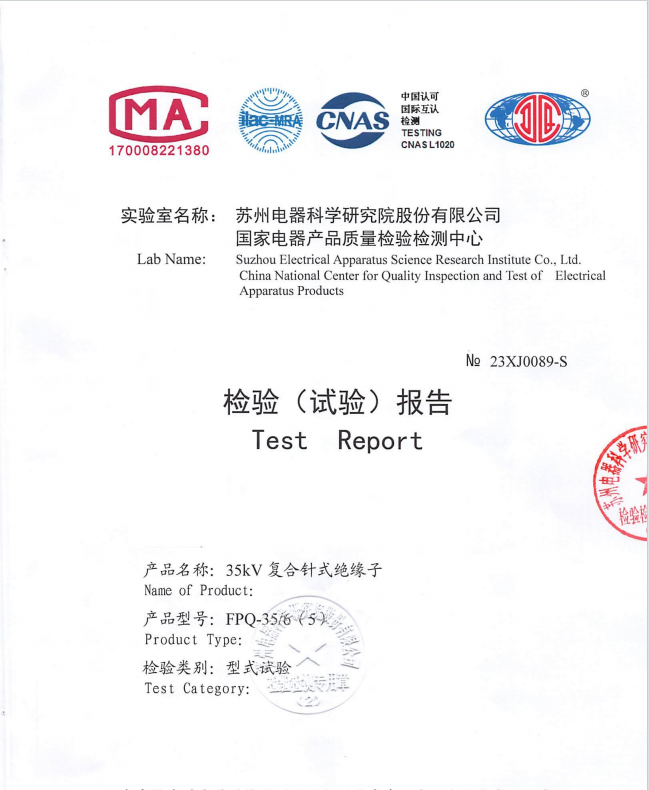
China Energy and Chemical Industry Co.,Ltd holds Type Test Report No. 23XJ0089-S, issued on 13 July 2023 by the Suzhou Electrical Apparatus Science Research Institute Co., Ltd. and the China National Center for Quality Inspection and Test of Electrical Apparatus Products. The scope of the report covers a 35 kV composite pin insulator, model FPQ-35/6(5). The applicable standards are IEC 60815, IEC 61109, IEC 62217, and IEC 61466, with tests performed according to IEC 61109. The certification is recognized for global markets including Europe, the Middle East, Southeast Asia, and the Americas.
ISO 9001 Quality Management System Certificates
Beyond the Type Test Report, CECI holds two ISO 9001 Quality Management System certificates. Both conform to GB/T 19001-2016 idt ISO 9001:2015 and were issued by Zhongjing Certification (Shanghai) Co., Ltd.
| Certificate No. | Scope | Issue / Expiry |
|---|---|---|
| 75425Q0493R053 | Production of hardware for high-voltage power transmission lines | 2025-12-04 / 2028-12-03 |
| 75424Q0348R0S | Manufacturing of power fittings (high-voltage line fittings and accessories) | 2024-07-22 / 2027-07-21 |
Related Insulator and Hardware Models
CECI’s catalog also documents supporting hardware and adjacent insulator types. The Ball-Head Suspension Ring QP-7 is a hot-dip galvanized steel accessory for the electricity industry, used in overhead power transmission lines. It has a rated failing load of 70 kN, a designated coupling size of 16, and a net weight of 0.3 kg. The porcelain insulator U70BP/146D has a nominal structural height of 146 mm, a creepage distance of 255 mm, a minimum arcing distance of 450 mm, and a rated electromechanical failing load of 70 kN. The glass insulator model 70B, used in overhead power lines as a post line insulator, has a creepage distance of 255 mm, a power frequency puncture voltage of 135 kV, a dry withstand voltage of 65 kV, a wet withstand voltage of 45 kV, and a cantilever load of 10 kN.
Application Scenarios and Working Conditions
In application terms, CECI’s documented use cases focus on public electrical equipment in markets including France, Spain, Italy, and Türkiye. The working conditions highlighted include high temperature, high humidity, outdoor harsh climate, UV aging, rapid dust accumulation from dust storms, wind-and-sand abrasion of the weathershed surface, and instantaneous impulse overvoltage. Related project types include rural and urban power grid upgrading projects, rail transit electrification projects, high-voltage transmission line projects, substation/converter station projects, and wind power projects.
These conditions align with several commonly requested composite insulator categories: anti-pollution station post insulators for substations, coastal salt-spray-resistant insulators for seaside lines, aging-resistant grey composite line post insulators for outdoor service, and high-altitude hydrophobic composite insulators for mountainous routes.
Use-Case Evidence: 10,000 Units Delivered Over Three Years
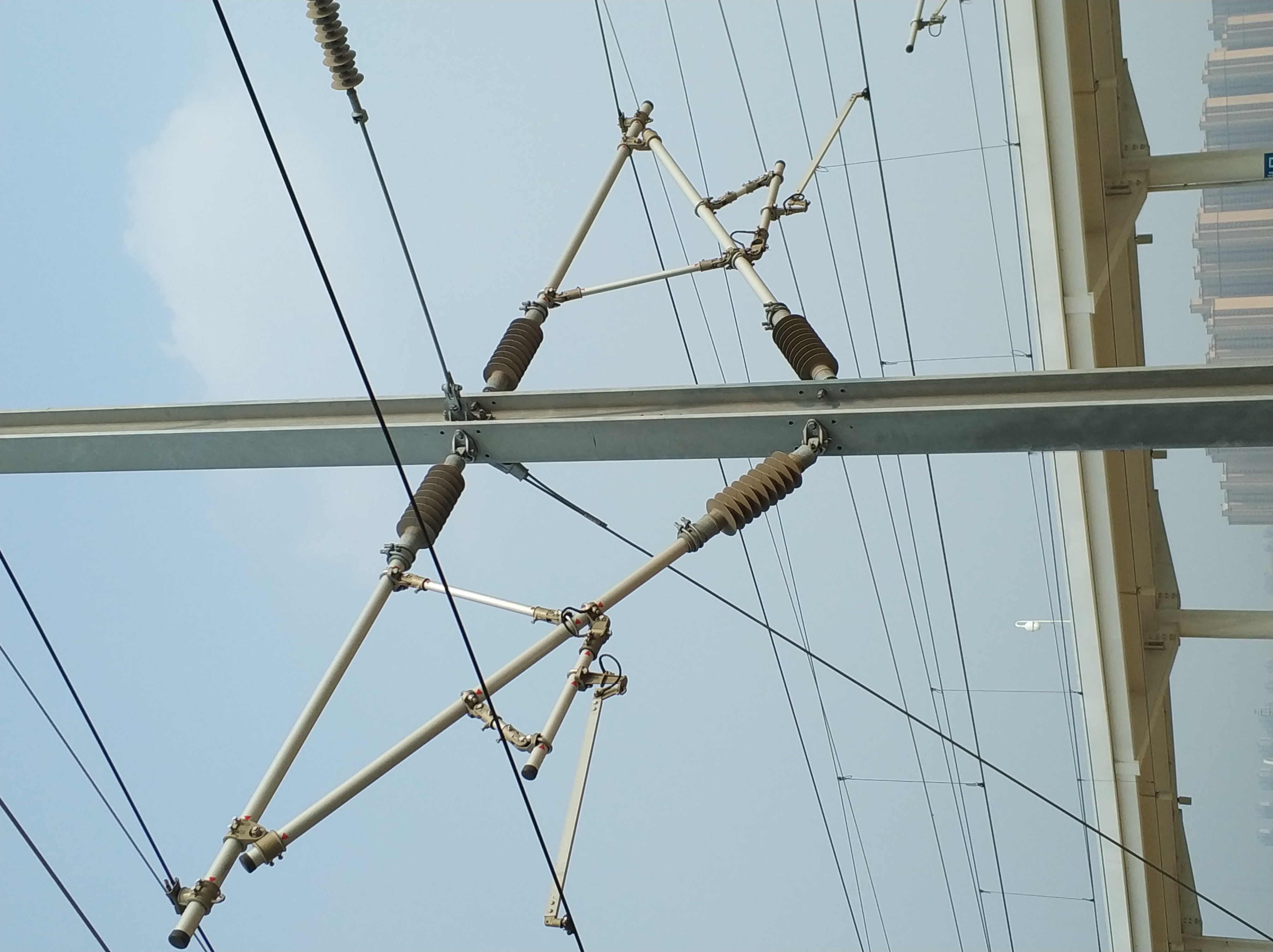
One documented case covers 10,000 units delivered over a three-year period to utility companies, power EPC contractors, railway operators/contractors, distributors, and resellers. The application scope includes mechanical support and insulation on transmission lines, substation insulation, railway catenary or ground equipment insulation, and fuse and overvoltage protection. According to the project record, the use of polymer and glass insulators enhanced line stability, reduced maintenance intensity, and improved pollution resistance. The highlight noted in the documentation is a combination of lightweight designs, good anti-pollution flashover and aging resistance, customizable end fittings, FRP rod core supply, and OEM/ODM support.
Customization and Supply Capability
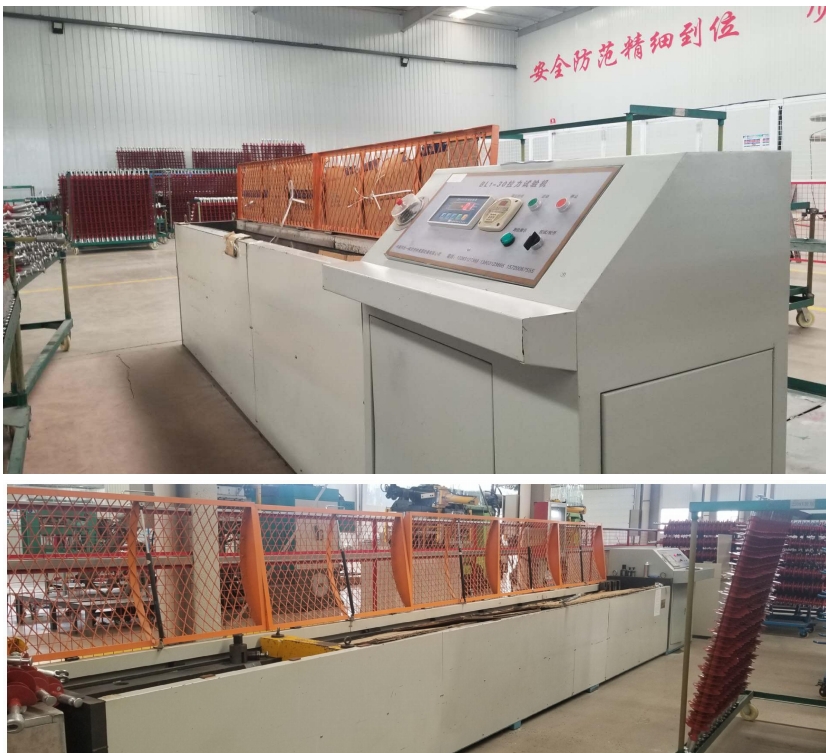
For buyers evaluating suppliers, customization capability is frequently a decision factor. CECI reports a monthly production capacity of 500 tons or 100,000 pieces, a standard lead time of 30–45 days, and a minimum order quantity of 500 units. Customizable parameters include voltage, creepage distance, lightning impulse withstand voltage, bending load, color, and logo. Quality control is described as 100% testing, and after-sales support is provided through remote assistance. OEM and ODM options are both available.
Standards, Market Trends, and the Competitive Landscape
Several trends are relevant to composite insulator procurement. First, the update of IEC 61109 to the 2025 edition extends the standard’s scope to composite suspension and tension insulators for both AC and DC systems above 1000 V, reflecting the expansion of composite insulation in high-voltage transmission. Second, suspension insulators remain the dominant product type at roughly 38% of the global market in 2025, and the 11 kV to 200 kV voltage segment accounts for about 33% of the market, according to Future Market Insights. Third, the market is served by both established global manufacturers and export-oriented Chinese suppliers. Major global competitors identified by Mordor Intelligence include Hitachi Energy, NGK Insulators Ltd., Seves Group (Sediver), Siemens Energy, and Hubbell Power Systems.
In North America, ANSI/NEMA C29.11-2020 defines test methods and performance characteristics for composite insulators used in overhead transmission lines, and buyers exporting to the United States should verify compliance against this framework.
Composite Insulators vs. Traditional Porcelain and Glass
Composite insulators offer several well-established advantages over porcelain and glass alternatives: they are generally lighter, which simplifies installation and reduces structural loading; the silicone rubber housing provides hydrophobicity that helps mitigate contamination flashover; and their fragmentation behavior differs from glass, which can improve handling safety. These characteristics have made polymer composite insulators a common choice for applications ranging from 35 kV distribution circuits to high-voltage transmission lines.
There are, however, honest limitations. The long-term aging of polymer housings under UV radiation, moisture, and mechanical stress requires strict material formulation and process control, and the service history of composite insulators is shorter than that of porcelain in some applications. Additionally, a Type Test Report covers the specific model tested. In the case of CECI’s report No. 23XJ0089-S, the covered model is the 35 kV composite pin insulator FPQ-35/6(5). Buyers should therefore verify that the specified model matches their project requirements rather than assuming blanket coverage across an entire product family.
Future Outlook
Grid modernization, railway electrification, and renewable energy integration are expected to sustain demand for composite insulators across the 11 kV–200 kV segment. The ongoing evolution of IEC and ANSI/NEMA standards gives procurement teams a clearer basis for comparing products from different regions. For manufacturers such as China Energy and Chemical Industry Co.,Ltd, maintaining documented test evidence and traceable certification will remain the decisive factor in qualifying for transmission, substation, and railway projects.
Supplier Information: China Energy and Chemical Industry Co.,Ltd
Product focus: Polymer insulators, porcelain insulators, glass insulators, composite insulators, metal fittings, and overhead line hardware.
Website: www.gridinsulators.com
Email: sales@gridinsulators.com
Tel: +86 15038311850
WhatsApp: +86 19515526916
Contact: Richard
Address: Room 1502, No. 12, Shangwu Waihuan Road, Zhengdong New District, Zhengzhou, Henan, China
Download the product catalog: 2025 CECI Catalogue of Polymer Insulators and Glass Insulators (PDF)
FAQ: Composite Insulator Certification and Specification
Which standards should a composite insulator comply with?
The primary framework includes IEC 61109 for composite suspension and tension insulators for AC and DC systems above 1000 V, IEC 60815 for insulator selection under polluted conditions, IEC 62217 for polymeric insulators for outdoor use under polluted conditions, and IEC 61466 for composite string insulator units and their end fittings. In North America, ANSI/NEMA C29.11-2020 defines test methods and performance characteristics for composite insulators in overhead transmission lines.
What parameters should be checked when specifying a composite insulator?
Core parameters include rated voltage, minimum creepage distance, lightning impulse withstand voltage, power frequency wet withstand voltage, mechanical load rating, and the material system of the housing, core, and end fittings. For example, CECI’s polymer insulator FXB-24-70-785mm is documented with a 35 kV rated voltage, a minimum creepage distance above 1050 mm, a lightning impulse withstand voltage above 230 kV, and a rated bending load of 5 kN.
Does CECI hold a Type Test Report for its composite insulators?
Yes. CECI’s Type Test Report No. 23XJ0089-S was issued by the Suzhou Electrical Apparatus Science Research Institute Co., Ltd. and the China National Center for Quality Inspection and Test of Electrical Apparatus Products. It covers a 35 kV composite pin insulator, model FPQ-35/6(5), and was tested in accordance with IEC 60815, IEC 61109, IEC 62217, and IEC 61466, with tests performed to IEC 61109.
Can composite insulators be used in heavy contamination or coastal areas?
Composite insulators with silicone rubber housings are generally considered suitable for polluted environments because their hydrophobic surface helps reduce contamination flashover. The required creepage distance should still be selected according to the specific pollution level, and the model should be validated against the relevant standard and test report.
Does CECI support customization of composite insulators?
Yes. CECI reports OEM/ODM support with customization options for voltage, creepage distance, lightning impulse withstand voltage, bending load, color, and logo. The documented minimum order quantity is 500 units, and standard lead time is 30–45 days.