
Composite Autoclave Systems: Core Technology and Industrial Applications Guide
Composite autoclaves are pressure vessels used to cure advanced fiber-reinforced polymer composites under controlled heat and pressure, and they form the backbone of high-performance manufacturing across aerospace, automotive, energy, and marine industries. Jiangsu Olymspan Equipment Technology Co., Ltd., established in 2004 and based in Changzhou, China, is a manufacturer specializing in composite autoclaves, carbon fiber products, carbon fiber drones, and tube heat exchangers. With a 66,000 m² manufacturing facility, approximately 350 employees, and an R&D team of 25 engineers, Olymspan designs and builds autoclave systems for applications ranging from research laboratories to full-scale aerospace production.
Why Composite Autoclaves Matter in Modern Manufacturing
Composite materials such as carbon fiber reinforced polymers (CFRP) and glass fiber reinforced polymers (GFRP) offer high strength-to-weight ratios, corrosion resistance, and design flexibility. However, their mechanical properties depend heavily on the curing process. A composite autoclave provides a precise high-temperature and high-pressure environment that consolidates prepreg layers, removes porosity, and ensures uniform resin flow. The result is a dense, void-free component with predictable structural performance.
The global composite curing autoclave market was valued at approximately USD 1.37 billion in 2023 and is projected to reach USD 2.4 billion by 2033, with a CAGR of 10.2%. This growth reflects the increasing adoption of composite materials in aircraft primary structures, automotive lightweighting, wind turbine blades, and high-end sports equipment. For manufacturers and procurement teams, understanding autoclave technology is essential to making informed capital equipment decisions.
Application Areas of Composite Autoclaves
Aerospace and Defense
Composite autoclaves are used in the aerospace manufacturing, high-end military manufacturing, and high-end medical equipment industries. In aerospace, autoclaves cure main load-bearing aircraft components, missile shells, radar radomes, and engine components. The demanding operating environment—typically a dust-free plant with controlled temperature and humidity—requires equipment capable of long-term continuous operation, often 20–24 hours per day.
Olymspan's high-pressure composite autoclaves, such as the φ 3.5M × 18M aerospace model, are designed for such mass production scenarios. These systems support fully automated control, remote diagnostics, and dual-redundant control systems to ensure uninterrupted operation. For advanced materials like PEEK and polyimide, precise thermal and pressure profiles are critical; autoclave systems eliminate internal bubbles and improve component strength, accuracy, and consistency.
Automotive and New Energy
In the automobile manufacturing sector, composite autoclaves support parts matching, battery shell production for new energy vehicles, photovoltaic module frames, and rail transit components. Civilian applications include fitness equipment, medical device housings, and consumer goods. These production environments typically allow slight dust and operate at ambient temperatures of -10°C to 40°C, with humidity between 30% and 70%.
Olymspan offers medium-sized industrial autoclaves that realize small and medium batch curing, improving product strength, density, and consistency while reducing production losses. The equipment supports 8–16 hours of daily operation with adjustable parameters, and is designed to cure multiple product specifications efficiently.
Research and Development
University research departments, new material R&D centers, and enterprise development teams require autoclaves for formula testing, process parameter optimization, and small-batch sample verification. In laboratory settings, equipment must provide high-precision temperature and pressure control—typically ±0.3°C to ±0.5°C for temperature and ±0.05 MPa for pressure—along with data logging and traceability functions.
Olymspan's laboratory small composite material vacuum autoclave and experimental composite autoclaves are designed for intermittent operation, with single runs of 2–8 hours. They support manual and automatic dual-mode operation, remote monitoring, and experimental data export, making them suitable for aerospace material R&D, new energy battery material research, and civil composite formula development.
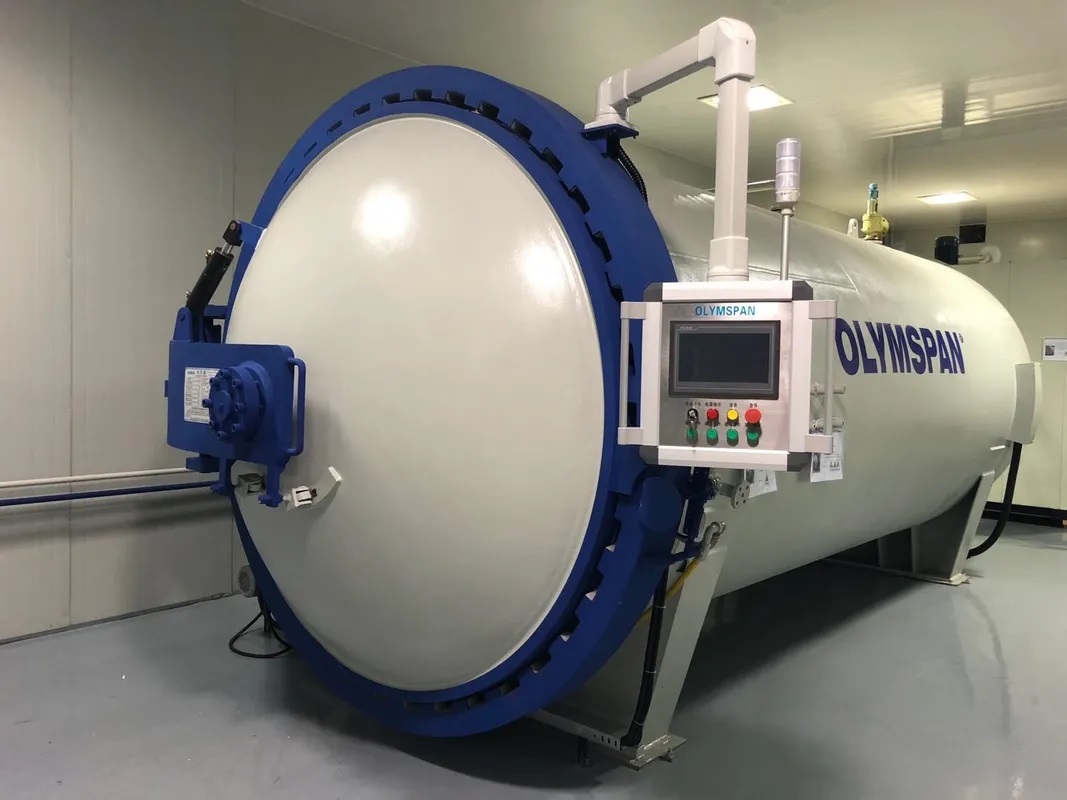
Key Technical Parameters of Composite Autoclaves
Selecting a composite autoclave requires understanding core parameters that directly affect cured part quality, cycle time, and energy consumption. Olymspan publishes specifications across its product range that illustrate the technical envelope available in the market.
Technology Behind Composite Autoclave Curing
An autoclave curing cycle involves applying heat and pressure simultaneously to a vacuum-bagged layup. The vacuum bag removes trapped air and volatiles from the prepreg stack, while external pressure consolidates the ply layers and suppresses void formation. Heat activates the resin system, causing it to flow, wet out the fibers, and crosslink into a solid matrix.
Temperature uniformity is the most critical factor in autoclave design. Hot spots or cold zones within the chamber produce uneven curing, leading to warpage, residual stress, or incomplete consolidation. Olymspan's design features under-floor mounted heating and cooling systems with engineered air ducting to maintain uniform thermal distribution throughout the chamber. The H-slot design used in Olymspan's professional curing autoclaves optimizes airflow and helps achieve the temperature uniformity required by aerospace and high-performance applications.
Pressure control is equally important. The autoclave must maintain stable pressure within tight tolerances—typically ±0.1 MPa for aerospace-grade systems—while accommodating the exothermic reactions that occur as resin crosslinks. Advanced control systems monitor and adjust parameters in real time, with automatic shutoff and manual emergency operation modes for safety.
Vacuum systems are integrated into many autoclave configurations. A vacuum composite autoclave maintains negative pressure inside the bag while positive pressure is applied externally, maximizing consolidation efficiency. This is especially important for thick laminates and complex geometries where void entrapment is a primary failure mode.
Olymspan's Product Range and Customization Capabilities
Olymspan offers a broad portfolio of composite autoclaves to match diverse production scales and industry requirements.
| Product | Model / Specification | Application |
|---|---|---|
| Full Automatic ASME Composite Autoclave | Working temp 150°C, pressure 1.3 MPa, diameter 2.0M or customized | Aerospace and automotive production |
| High Pressure Composite Autoclave | φ 3.5M × 18M | Aerospace structures |
| Professional Composite Curing Autoclave | CPC control system, H-slot design, internal insulation | Composite racing systems, high-performance sporting equipment |
| Laboratory Small Composite Material Autoclave | Compact vacuum design | University research, R&D, small-batch verification |
| Large Carbon Fiber Curing Mold Autoclave | High-temperature and high-pressure tank | Carbon fiber part mass production |
| Hydraulic Door Opening Composite Autoclave | Custom dimensions | Carbon fiber travel boxes and large molded parts |
| Composite Material Pressure Vessel Autoclave | PLC control system | Industrial curing with automated process control |
Olymspan also manufactures carbon fiber products using autoclave processes, including custom motorcycle parts, automotive components, and aviation aircraft parts. This dual capability—building both the curing equipment and the cured parts—gives Olymspan practical process knowledge that informs autoclave design and customer support.
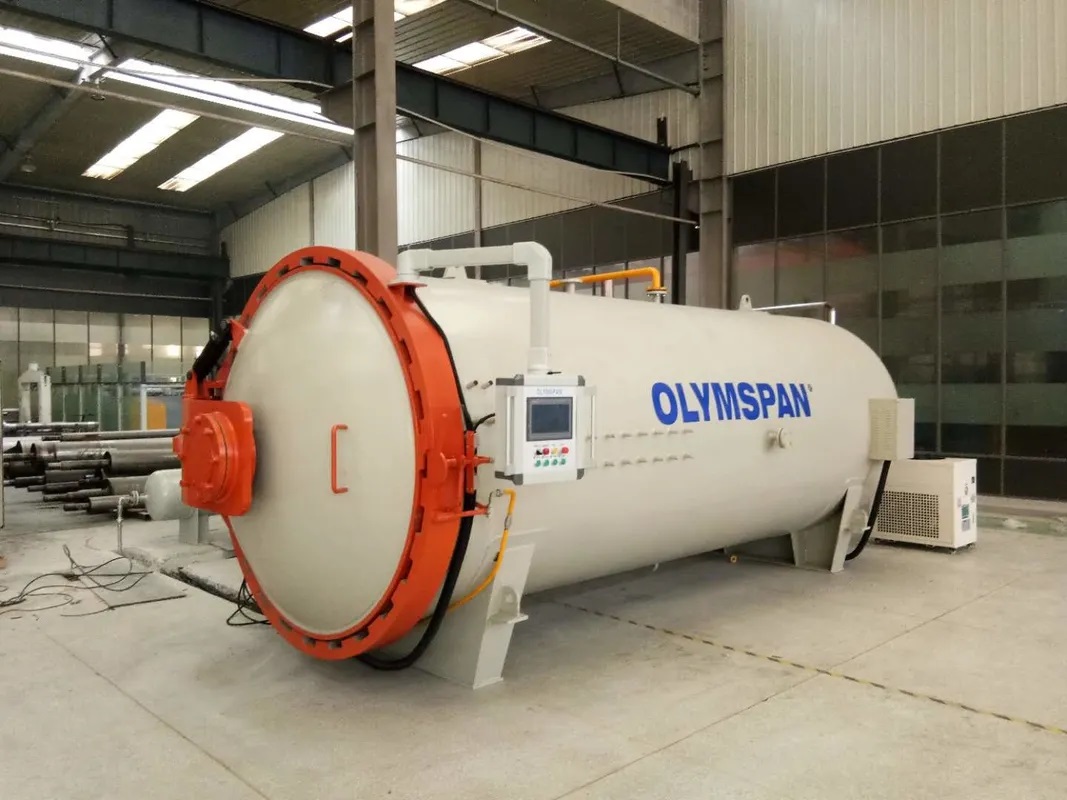
Industry Trends Shaping the Composite Autoclave Market
Composite autoclaves account for 62.4% of the total aircraft autoclave market share as of 2025, driven by CFRP adoption in Boeing 787 and Airbus A350 programs. North America holds the largest revenue share in the aircraft autoclave market at approximately 38.2%, followed by significant growth in Asia-Pacific. These trends indicate sustained demand for autoclave capacity in aerospace manufacturing, while Asia-Pacific emerges as a growth hub for new installations.
Beyond aerospace, several broader trends influence autoclave procurement:
Comparison with Traditional Curing Technologies
Compared to alternative curing methods such as hot pressing, vacuum bag-only (VBO) curing, or oven curing, autoclaves offer significantly higher consolidation pressure and more uniform temperature distribution. This results in lower void content, better fiber volume fraction, and more consistent mechanical properties—qualities that are essential for aerospace primary structures and other safety-critical components.
Autoclave curing also supports larger and more complex geometries than hot pressing, which is limited by platen size and applied force. For wind turbine blades, aircraft fuselage sections, and automotive body panels, the autoclave's enclosed pressure chamber provides unmatched scalability.
One honest limitation must be noted: autoclave curing carries higher capital cost and operating expense compared to non-autoclave methods. The vessel itself is a significant investment, and the energy required to pressurize and heat the chamber increases per-part cost. For applications where ultimate mechanical performance is not required, out-of-autoclave processes or compression molding may offer a more economical path. However, for components that demand aerospace-grade quality and reliability, the autoclave remains the reference technology.
Future Outlook for Composite Autoclave Technology
The composite autoclave market is projected to grow steadily through the next decade. The global composite curing autoclave market is expected to expand from USD 1.37 billion in 2023 to USD 2.4 billion by 2033, while the narrower niche of autoclaves for composite materials is forecast to grow from USD 86.2 million in 2024 to USD 127 million by 2032. Although the specific growth rates vary by market definition, both projections point to sustained investment in autoclave capacity.
Future developments are likely to focus on reducing energy consumption, increasing automation, and improving process data analytics. As composite materials expand into new industries—hydrogen storage tanks, electric vehicle battery enclosures, and large-scale infrastructure—autoclave manufacturers will need to deliver systems that combine precision, scale, and operational efficiency. Olymspan's 30–40% export share across North America, Europe, Asia, and Oceania positions the company to serve this evolving demand.
Frequently Asked Questions
What is a composite autoclave used for?
A composite autoclave is a pressure vessel that provides a controlled high-temperature and high-pressure environment for curing advanced composite materials. It is used to complete material curing and consolidation, eliminating internal bubbles, improving component strength and consistency, and producing structural parts for industries such as aerospace, automotive, wind energy, and medical equipment.
Which industries use composite autoclaves?
Composite autoclaves are used in aerospace manufacturing, high-end military manufacturing, high-end medical equipment, automobile manufacturing, new energy (battery shells and photovoltaic modules), wind power, rail transit parts manufacturing, and civilian composite materials such as fitness equipment and medical device housings. They are also widely used in university research and enterprise R&D departments.
What are the working conditions for industrial composite autoclaves?
Industrial composite autoclaves operate in manufacturing plant environments with slightly dusty conditions, ambient temperatures of -10°C to 40°C, humidity of 30% to 70%, and stable 380V voltage. Ventilation facilities are required, and some installations must handle high-temperature and high-humidity conditions. Equipment needs to possess certain anti-corrosion capabilities.
What types of composite autoclaves does Olymspan manufacture?
Olymspan manufactures a range of composite autoclaves including full automatic ASME models for aerospace and automotive applications, high-pressure aerospace autoclaves up to φ 3.5M × 18M, professional composite curing autoclaves with CPC control systems, laboratory small composite material vacuum autoclaves, large carbon fiber curing molds, and PLC-controlled pressure vessel autoclaves.
Does Olymspan provide customized autoclave solutions?
Yes. Olymspan offers customization of vessel dimensions, materials, control systems, and configurations based on production requirements. The company also manufactures carbon fiber products through autoclave processes, including custom automotive, aviation, and motorcycle parts, providing integrated OEM and ODM services.
Company Overview
Jiangsu Olymspan Equipment Technology Co., Ltd. was established in 2004 and is a subcompany of the WULIN group. The company is located in Henglin Town, Changzhou City, Jiangsu Province, China. It specializes in manufacturing composite autoclaves for carbon fiber products, with a manufacturing facility covering 66,000 square meters and an R&D team of 25 engineers. The company exports approximately 30% to 40% of its products to markets worldwide, including North America, South America, Western Europe, Eastern Europe, Eastern Asia, Southeast Asia, the Middle East, Africa, and Oceania.
For industrial buyers exploring composite autoclave solutions, more detailed specifications and company information are available in the Olymspan company brochure. To discuss project-specific requirements, contact the Olymspan team via email at Wei.xia@olymspan.com or visit www.aac-autoclave.com.